


 Скачать презентацию Integrating External Deduction Tools with ACL 2 Matt
c9317e05b0ed91dade14b984768a2da9.ppt
- Количество слайдов: 30
 Integrating External Deduction Tools with ACL 2 Matt Kaufmann, J Moore, Sandip Ray, Erik Reeber Department of Computer Sciences University of Texas at Austin, TX 78712 Presentation for IWIL 2006
 A Sincere Apology I am sorry I could not be in the conference to give this talk in person. My re-entry visa to the United States was unexpectedly refused pending security clearance and background checks and hence I cannot make international travels until the checks are over. I am disappointed at this unfortunate event, and sincerely apologize to the conference organizers and the audience for the inconvenience.
 Motivation We are interested in increasing the effectiveness of interactive theorem proving and its application to the formal verification of large-scale computing systems. There has been significant enhancement in the scalability of automated reasoning procedures in recent years. • • SAT and SMT solvers Model checkers Resolution theorem provers Decision procedures for theories like Presburger Arithmetic It is desirable for interactive theorem provers to exploit the automation provided by these procedures.
 Motivation But different reasoning tools implement different logics!! • Theorem provers: FOL or HOL, constructive type theory, etc. • Model checkers: Flavors of temporal logic, -calculus, etc. Different tools also have different formal syntax. To make an effective connection between a theorem prover and another reasoning tool, one must know how to interpret a formula proven by the tool as a theorem in the logic of theorem prover.
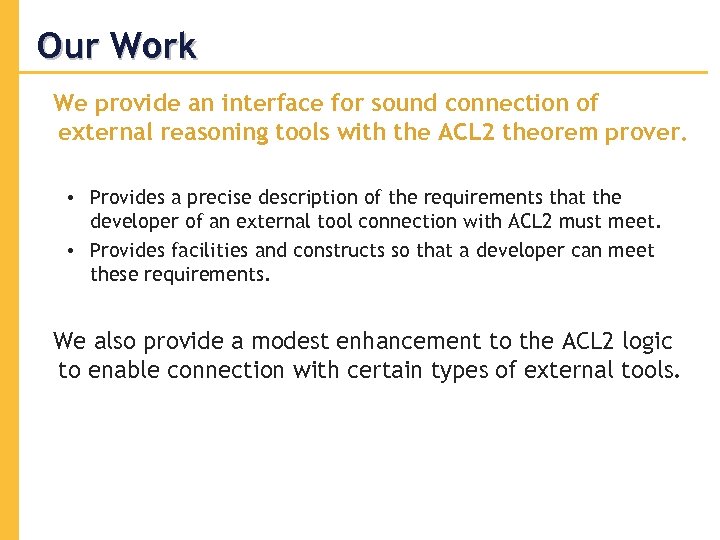 Our Work We provide an interface for sound connection of external reasoning tools with the ACL 2 theorem prover. • Provides a precise description of the requirements that the developer of an external tool connection with ACL 2 must meet. • Provides facilities and constructs so that a developer can meet these requirements. We also provide a modest enhancement to the ACL 2 logic to enable connection with certain types of external tools.
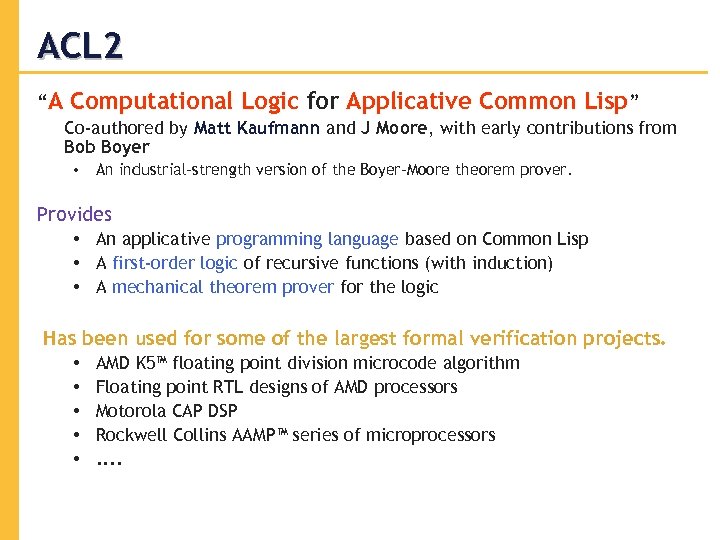 ACL 2 “A Computational Logic for Applicative Common Lisp” Co-authored by Matt Kaufmann and J Moore, with early contributions from Bob Boyer • An industrial-strength version of the Boyer-Moore theorem prover. Provides • An applicative programming language based on Common Lisp • A first-order logic of recursive functions (with induction) • A mechanical theorem prover for the logic Has been used for some of the largest formal verification projects. • • • AMD K 5™ floating point division microcode algorithm Floating point RTL designs of AMD processors Motorola CAP DSP Rockwell Collins AAMP™ series of microprocessors. .
 Our Immediate Motivation These projects involve several man-years of work!! Yet, many of the lemmas proven could have been stated in a decidable theory, and discharged by a decision procedure for theory. • Key example: Proving invariants for hardware models Other theorem provers (HOL, PVS, etc. ) provide interfaces to external tools or oracles.
 Non-Trivialities The ACL 2 logic is complicated by several constructs provided to structured proofs. • The complexity manifests itself in some aspects of the interface. This also makes developing a precise interface very important. • A tool developer without adequate understanding of complications might inadvertently produce an unsound connection.
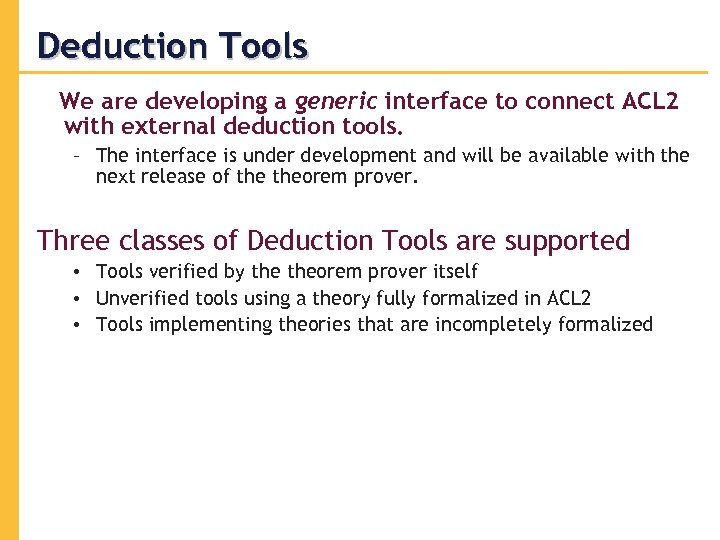 Deduction Tools We are developing a generic interface to connect ACL 2 with external deduction tools. – The interface is under development and will be available with the next release of theorem prover. Three classes of Deduction Tools are supported • Tools verified by theorem prover itself • Unverified tools using a theory fully formalized in ACL 2 • Tools implementing theories that are incompletely formalized
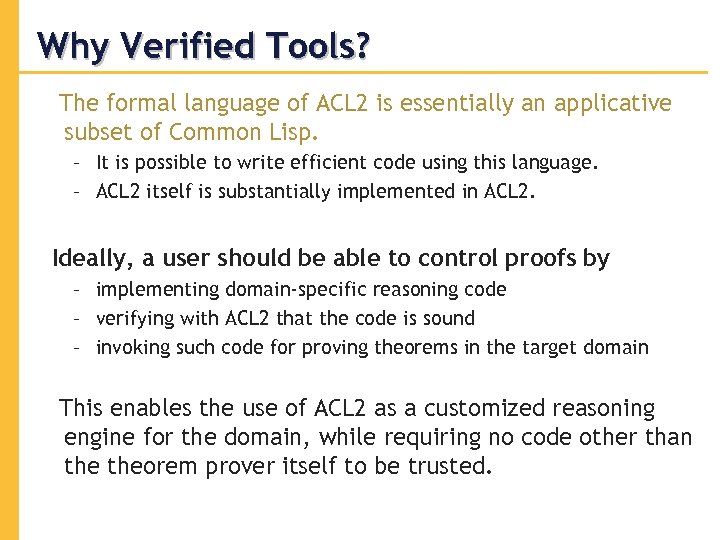 Why Verified Tools? The formal language of ACL 2 is essentially an applicative subset of Common Lisp. – It is possible to write efficient code using this language. – ACL 2 itself is substantially implemented in ACL 2. Ideally, a user should be able to control proofs by – implementing domain-specific reasoning code – verifying with ACL 2 that the code is sound – invoking such code for proving theorems in the target domain This enables the use of ACL 2 as a customized reasoning engine for the domain, while requiring no code other than theorem prover itself to be trusted.
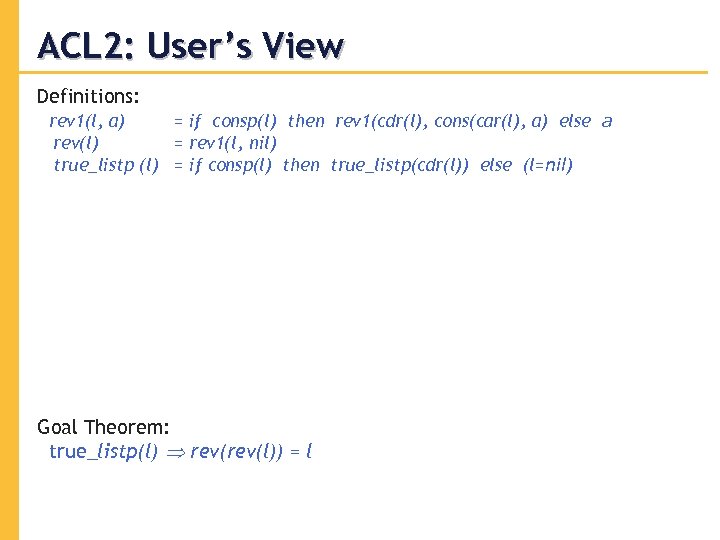 ACL 2: User’s View Definitions: rev 1(l, a) = if consp(l) then rev 1(cdr(l), cons(car(l), a) else a rev(l) = rev 1(l, nil) true_listp (l) = if consp(l) then true_listp(cdr(l)) else (l=nil) Goal Theorem: true_listp(l) rev(l)) = l
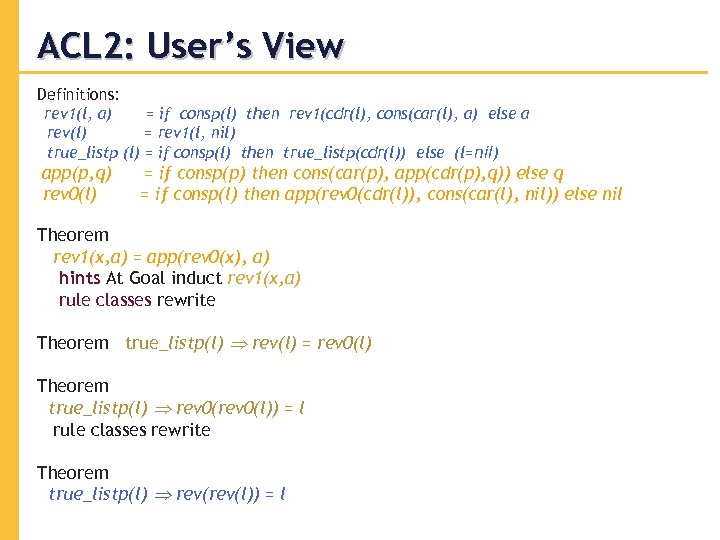 ACL 2: User’s View Definitions: rev 1(l, a) = if consp(l) then rev 1(cdr(l), cons(car(l), a) else a rev(l) = rev 1(l, nil) true_listp (l) = if consp(l) then true_listp(cdr(l)) else (l=nil) app(p, q) rev 0(l) = if consp(p) then cons(car(p), app(cdr(p), q)) else q = if consp(l) then app(rev 0(cdr(l)), cons(car(l), nil)) else nil Theorem rev 1(x, a) = app(rev 0(x), a) hints At Goal induct rev 1(x, a) rule classes rewrite Theorem true_listp(l) rev(l) = rev 0(l) Theorem true_listp(l) rev 0(l)) = l rule classes rewrite Theorem true_listp(l) rev(l)) = l
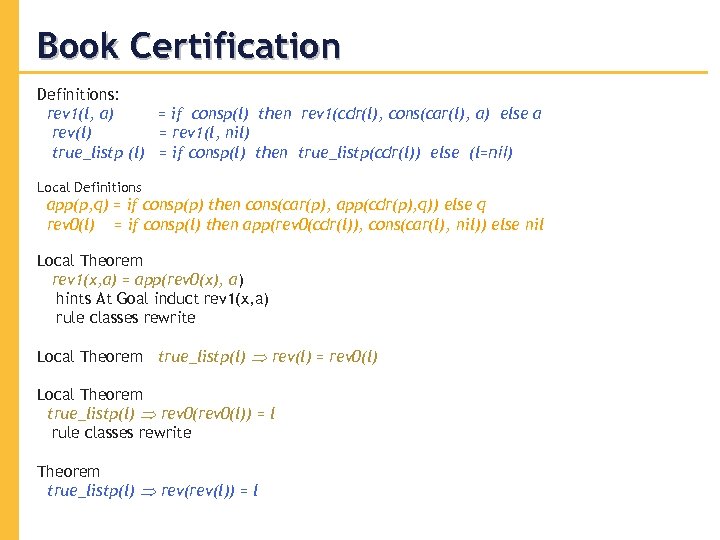 Book Certification Definitions: rev 1(l, a) = if consp(l) then rev 1(cdr(l), cons(car(l), a) else a rev(l) = rev 1(l, nil) true_listp (l) = if consp(l) then true_listp(cdr(l)) else (l=nil) Local Definitions app(p, q) = if consp(p) then cons(car(p), app(cdr(p), q)) else q rev 0(l) = if consp(l) then app(rev 0(cdr(l)), cons(car(l), nil)) else nil Local Theorem rev 1(x, a) = app(rev 0(x), a) hints At Goal induct rev 1(x, a) rule classes rewrite Local Theorem true_listp(l) rev(l) = rev 0(l) Local Theorem true_listp(l) rev 0(l)) = l rule classes rewrite Theorem true_listp(l) rev(l)) = l
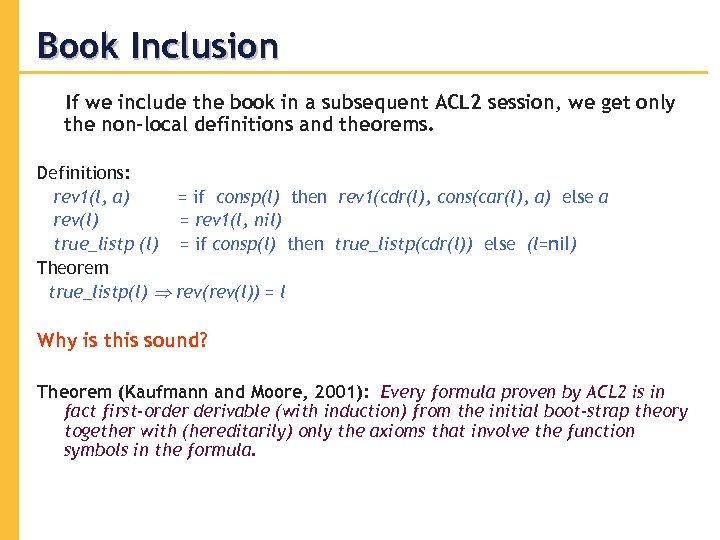 Book Inclusion If we include the book in a subsequent ACL 2 session, we get only the non-local definitions and theorems. Definitions: rev 1(l, a) rev(l) true_listp (l) Theorem true_listp(l) = if consp(l) then rev 1(cdr(l), cons(car(l), a) else a = rev 1(l, nil) = if consp(l) then true_listp(cdr(l)) else (l=nil) rev(l)) = l Why is this sound? Theorem (Kaufmann and Moore, 2001): Every formula proven by ACL 2 is in fact first-order derivable (with induction) from the initial boot-strap theory together with (hereditarily) only the axioms that involve the function symbols in the formula.
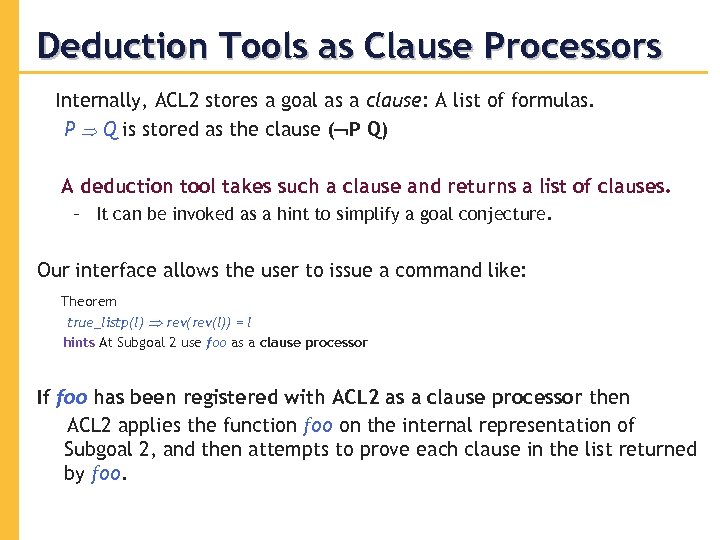 Deduction Tools as Clause Processors Internally, ACL 2 stores a goal as a clause: A list of formulas. P Q is stored as the clause ( P Q) A deduction tool takes such a clause and returns a list of clauses. – It can be invoked as a hint to simplify a goal conjecture. Our interface allows the user to issue a command like: Theorem true_listp(l) rev(l)) = l hints At Subgoal 2 use foo as a clause processor If foo has been registered with ACL 2 as a clause processor then ACL 2 applies the function foo on the internal representation of Subgoal 2, and then attempts to prove each clause in the list returned by foo.
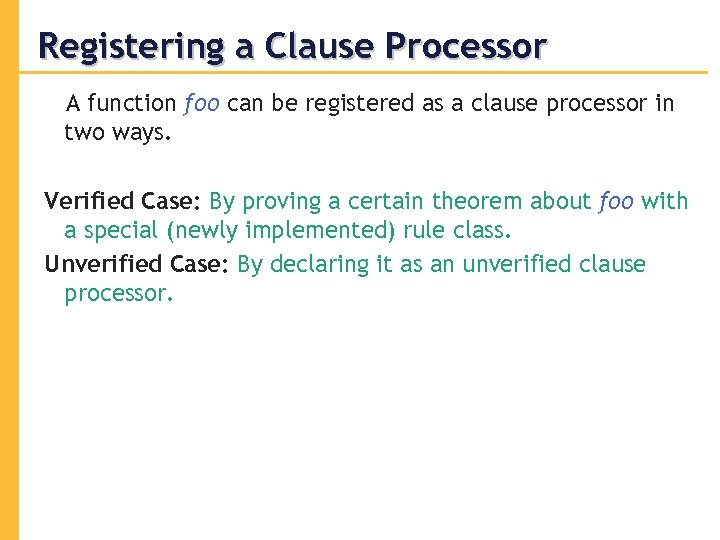 Registering a Clause Processor A function foo can be registered as a clause processor in two ways. Verified Case: By proving a certain theorem about foo with a special (newly implemented) rule class. Unverified Case: By declaring it as an unverified clause processor.
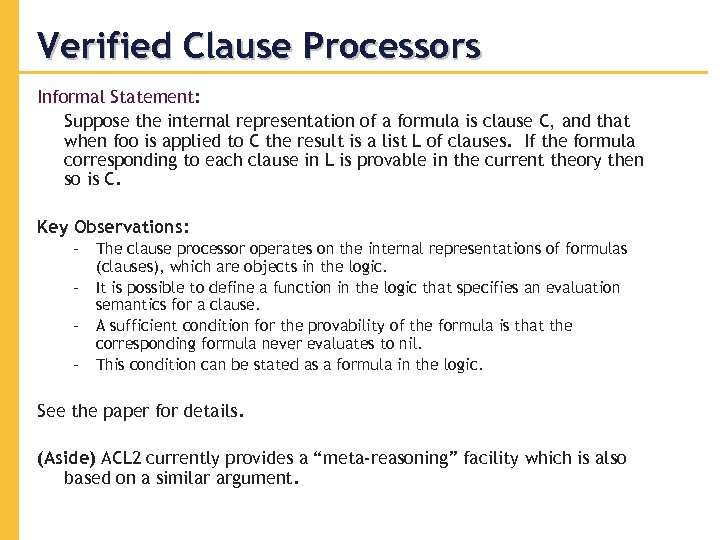 Verified Clause Processors Informal Statement: Suppose the internal representation of a formula is clause C, and that when foo is applied to C the result is a list L of clauses. If the formula corresponding to each clause in L is provable in the current theory then so is C. Key Observations: – The clause processor operates on the internal representations of formulas (clauses), which are objects in the logic. – It is possible to define a function in the logic that specifies an evaluation semantics for a clause. – A sufficient condition for the provability of the formula is that the corresponding formula never evaluates to nil. – This condition can be stated as a formula in the logic. See the paper for details. (Aside) ACL 2 currently provides a “meta-reasoning” facility which is also based on a similar argument.
 Unverified Tools We provide an interface in which a user can declare a function to be an unverified clause processor. – ACL 2 provides a logic-free programming facility (also an operating system interface for invoking arbitrary executables) which can be used for the implementation of an unverified clause processor. Expectation from the developer of an unverified tool: – The implementation satisfies the provability condition. Certification of a book with a declaration of an unverified clause processor requires an acknowledgement tag. – Any subsequent book that includes a tagged book (even locally) inherits the acknowledgement tag from that included book. (Aside) Currently a more general tagging mechanism is being developed with ACL 2 which will serve as a foundation for tagging of unverified clause processors.
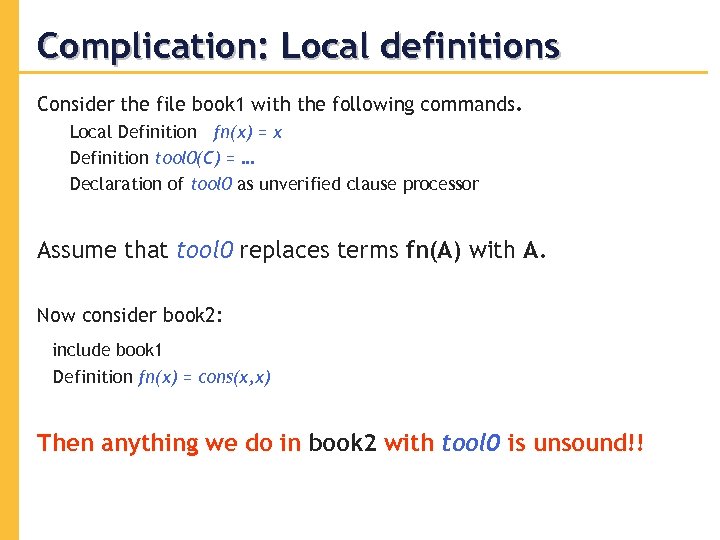 Complication: Local definitions Consider the file book 1 with the following commands. Local Definition fn(x) = x Definition tool 0(C) = … Declaration of tool 0 as unverified clause processor Assume that tool 0 replaces terms fn(A) with A. Now consider book 2: include book 1 Definition fn(x) = cons(x, x) Then anything we do in book 2 with tool 0 is unsound!!
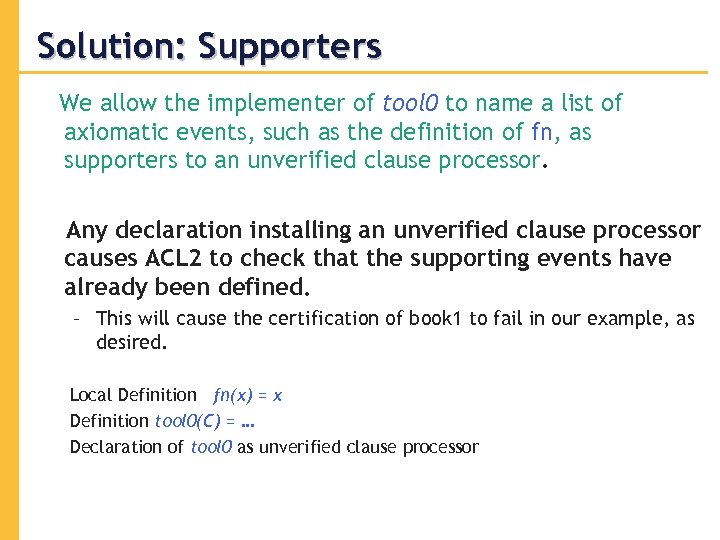 Solution: Supporters We allow the implementer of tool 0 to name a list of axiomatic events, such as the definition of fn, as supporters to an unverified clause processor. Any declaration installing an unverified clause processor causes ACL 2 to check that the supporting events have already been defined. – This will cause the certification of book 1 to fail in our example, as desired. Local Definition fn(x) = x Definition tool 0(C) = … Declaration of tool 0 as unverified clause processor
 “Advanced” Unverified Tools We will now consider tools that implement their own theory which is not formalized in ACL 2. “Why would you want to do that? ”
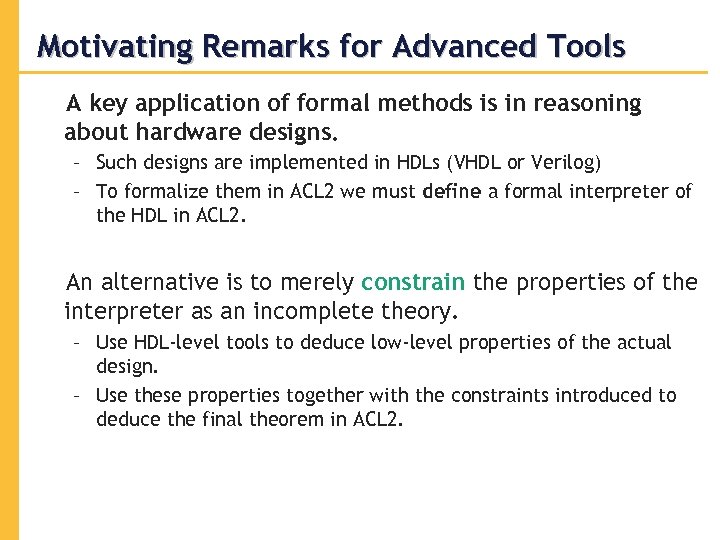 Motivating Remarks for Advanced Tools A key application of formal methods is in reasoning about hardware designs. – Such designs are implemented in HDLs (VHDL or Verilog) – To formalize them in ACL 2 we must define a formal interpreter of the HDL in ACL 2. An alternative is to merely constrain the properties of the interpreter as an incomplete theory. – Use HDL-level tools to deduce low-level properties of the actual design. – Use these properties together with the constraints introduced to deduce the final theorem in ACL 2.
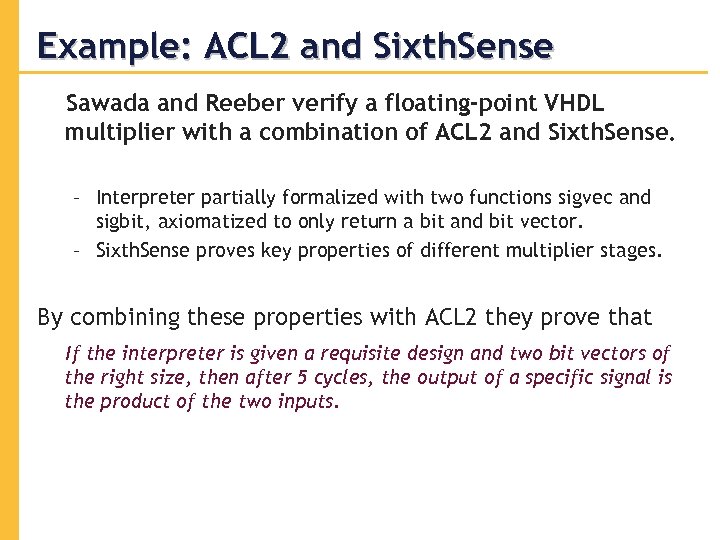 Example: ACL 2 and Sixth. Sense Sawada and Reeber verify a floating-point VHDL multiplier with a combination of ACL 2 and Sixth. Sense. – Interpreter partially formalized with two functions sigvec and sigbit, axiomatized to only return a bit and bit vector. – Sixth. Sense proves key properties of different multiplier stages. By combining these properties with ACL 2 they prove that If the interpreter is given a requisite design and two bit vectors of the right size, then after 5 cycles, the output of a specific signal is the product of the two inputs.
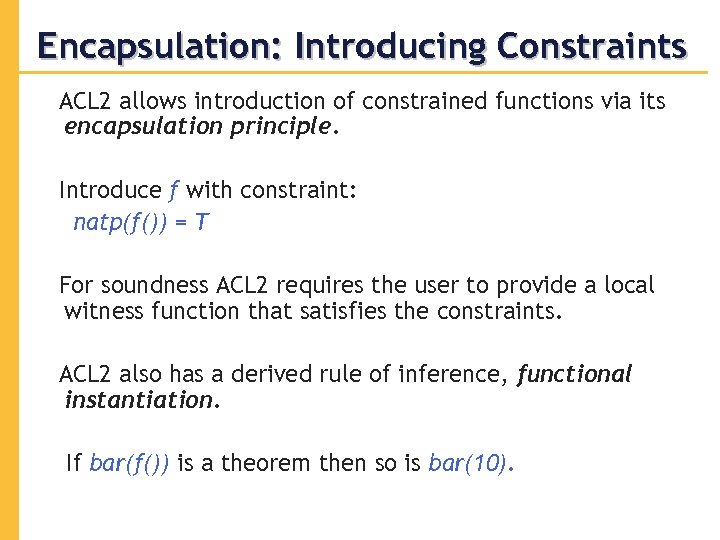 Encapsulation: Introducing Constraints ACL 2 allows introduction of constrained functions via its encapsulation principle. Introduce f with constraint: natp(f()) = T For soundness ACL 2 requires the user to provide a local witness function that satisfies the constraints. ACL 2 also has a derived rule of inference, functional instantiation. If bar(f()) is a theorem then so is bar(10).
 Incomplete Theories We cannot use encapsulation to introduce incomplete constraints. – If we introduced sigbit and sigvec as encapsulated functions and used Sixth. Sense to prove the correctness of the multiplier as a theorem, then functional instantiation would immediately produce inconsistency. Our solution – A new extension principle, templates. – Just like encapsulations, except that we acknowledge that the set of constraints explicitly specified might be incomplete. • Functional instantiation is not permitted to instantiate functions introduced as templates.
 Templates and Generalized Tools A clause processor can have a template function as a supporting event. The tool implementer must guarantee – The template could in principle be extended to an encapsulation which would have been permissible in place of the template. – Any theorem proven by the external tool is a theorem in theory in which the template were replaced by the promised encapsulation. • ACL 2 does not allow a template function to be a supporter of two different clause processors, to enable the tool implementer to provide such guarantee. More details in the paper.
 What Is ACL 2’s Logical Story? Transform each template in the ACL 2 session with an admissible encapsulation. (If some tool has it as a supporter we must transform the template to the encapsulate promised by the tool developer. ) Every alleged theorem in the session is then first-order derivable (with induction) from the axiomatic events of the session produced after this transformation.
 Related Work Theorem provers such as HOL, PVS, Isabelle, etc. , provide a notion of external oracles to connect theorem prover with other tools. For Isabelle and HOL, this is done by a concept of “theorem tagging” introduced by Elsa Gunter. • A tag is a function in the logic. • Each formula certified by the oracle is viewed as an implication with a tag for the oracle in the hypothesis. • This approach tracks unverified tools at theorem level. Our tagging mechanism tracks use of untrusted tools at the book level. • This is a design decision. • Our initial work attempting to introduce tag as theorem level revealed that the logical foundations were complicated in the presence of local events. We believe our approach will be effective for ACL 2 since users typically find it easy to move events between books.
 Random Concluding Remarks Does the builder of the connection need to be an ACL 2 expert? – She must understand the ACL 2 logic and the logic of the other tool. • Anyone interested in building sound connection between two formal tools must clearly understand the individual logics. – No knowledge of the internals of ACL 2 reasoning engine is necessary for soundness. We hope that the ACL 2 users will benefit from the interface. A Future Challenge: Can we create a logical foundation so that the user of the interface can make use of more expressive logics (say HOL) for discharging some ACL 2 obligation? – Note: There is already work in progress in the other direction (Gordon et al. , 2006) to use ACL 2 as an oracle for HOL 4.
 Questions? Please feel free to email us questions at: kaufmann@cs. utexas. edu moore@cs. utexas. edu sandip@cs. utexas. edu reeber@cs. utexas. edu Again, I apologize for not being able to give this talk in person.