


 Скачать презентацию Integrating ethics and policy into nanotechnology education Michael
fcdab9ff3dba2046fec0c1f34e3230d4.ppt
- Количество слайдов: 22
 Integrating ethics and policy into nanotechnology education Michael E. Gorman meg 3 c@virginia. edu Nathan Swami University of Virginia Discussed with NUE group at EEC meeting March 2012 1
 Why integrate societal dimensions into nanotechnology • Nano is already embedded in a socio-technical system—awareness of the system will make for both scientific and social progress • Taxpayer bet on an emerging technological frontier should show benefits over the longterm—policy-makers have made promises about jobs, health, energy and security
 Moral Imagination • We learn practical ethics from stories, which become mental models for virtuous behavior – Crichton’s Prey? • These mental models can become unquestioned assumptions--’realities’ • Moral imagination consists of seeing that these realities are like hypotheses about how to live, and that alternative hypotheses, e. g. , those of other stakeholders, are worth listening to Michael E. Gorman 3
 Moral Imagination & Nanotechnology • Envisioning the future of nanotechnology is an act of imagination that requires consideration of societal dimensions • Including how nanotechnology would be viewed from multiple perspectives. • This kind of reflection permits stakeholders to imagine alternate possibilities • And evaluate results of pursuing such possibilities Michael E. Gorman 4
 2011 NNI goal 4. 3. 2 Build collaborations among the relevant communities (e. g. , consumers, engineers, ethicists, manufacturers, nongovernmental organizations, regulators, and scientists— including social and behavioral scientists) to enable prompt consideration of the potential risks and benefits of research breakthroughs and to provide perspectives on new research directions.
 Four ways to integrate societal dimensions into nanotechnology education • • Guest lectures Case studies with discussion Simulations of ethical and policy issues Integrating humanists and/or social scientists into the course—students and teachers – This kind of integration also works in the laboratory
 Nanotechnology Undergraduate Education http: //www. nsf. gov/funding/pgm_summ. jsp? pi ms_id=13656 This solicitation aims at introducing nanoscale science, engineering, and technology through a variety of interdisciplinary approaches to undergraduate engineering education, especially devices and systems and/or societal, ethical, economic and/or environmental issues relevant to nanotechnology.
 Adding societal dimensions to an NUE • Can help fulfill NSF’s broader impact criteria • Current: http: //www. nsf. gov/pubs/gpg/broaderimpact s. pdf • Future: more focus on national goals http: //www. nsf. gov/nsb/publications/2011/0 6_mrtf. jsp
 Example: SES 0836648, Societal Dimensions of Nanotechnology: A Course Connecting Communities
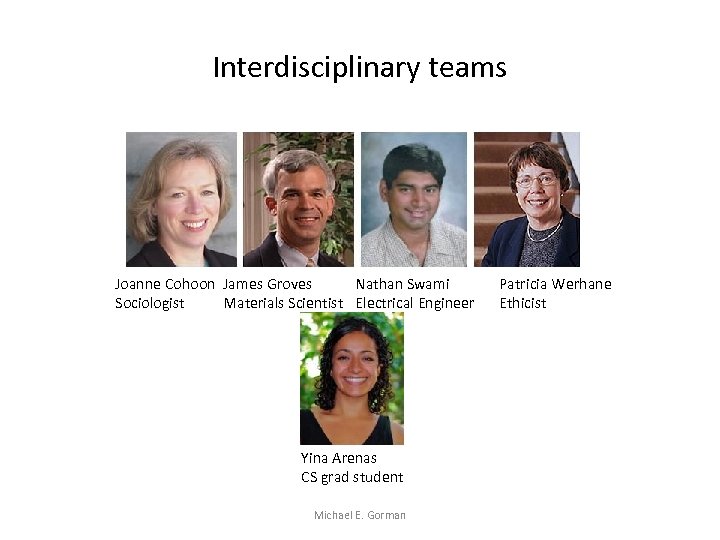 Interdisciplinary teams Joanne Cohoon James Groves Nathan Swami Sociologist Materials Scientist Electrical Engineer Yina Arenas CS grad student Michael E. Gorman Patricia Werhane Ethicist
 Guest lecturers doing NSF-funded work on social dimensions of nanotechnology • Cyrus Mody, Rice (affiliated with UCSB CNS)— history of nanotechnology • Erik Fisher, ASU (affiliated with ASU CNS)— integrating ethics and social sciences into the laboratory • Rosalyn Berne, UVA--Nanotalk
 Case studies • Provide background information, then ask students to make a decision • Use the Henrik Schon data falsification case to illustrate irresponsible conduct of science: http: //www. nap. edu/openbook. php? record_i d=4917
 Simulations That provide vicarious experience of policy and ethical dimensions of nanotechnology
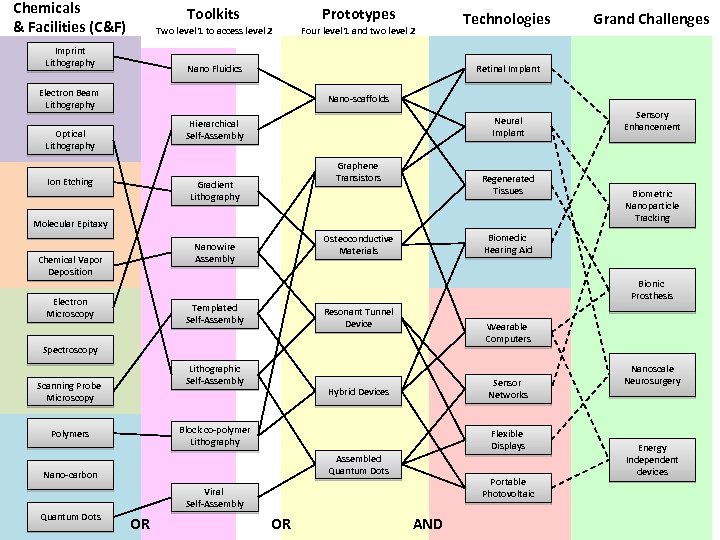
 Student role-playing exercise • Students design their own version of the NNI • Including a hypothetical technology tree • And play different roles in it
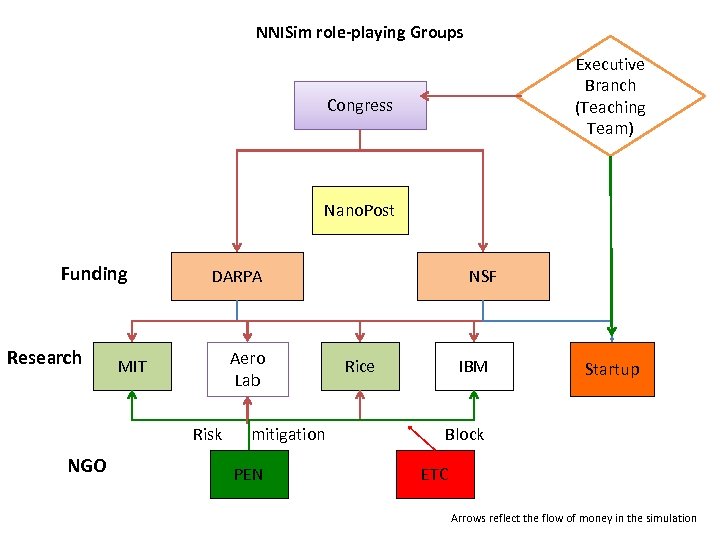 NNISim role-playing Groups Executive Branch (Teaching Team) Congress Nano. Post Funding Research DARPA Aero Lab MIT Risk NGO mitigation PEN NSF Rice IBM Startup Block ETC Arrows reflect the flow of money in the simulation
 NNI technology tree Set up based on student goals for their NNI
 Chemicals & Facilities (C&F) Toolkits Two level 1 to access level 2 Imprint Lithography Prototypes Four level 1 and two level 2 Nano Fluidics Technologies Retinal Implant Electron Beam Lithography Nano-scaffolds Neural Implant Hierarchical Self-Assembly Optical Lithography Ion Etching Graphene Transistors Gradient Lithography Regenerated Tissues Molecular Epitaxy Electron Microscopy Resonant Tunnel Device Wearable Computers Spectroscopy Lithographic Self-Assembly Sensor Networks Hybrid Devices Block co-polymer Lithography Polymers Flexible Displays Assembled Quantum Dots Nano-carbon Portable Photovoltaic Viral Self-Assembly OR Biometric Nanoparticle Tracking Bionic Prosthesis Templated Self-Assembly Scanning Probe Microscopy Sensory Enhancement Biomedic Hearing Aid Osteoconductive Materials Nanowire Assembly Chemical Vapor Deposition Quantum Dots Grand Challenges OR AND Nanoscale Neurosurgery Energy Independent devices
 Davis Baird in testimony before the Senate Committee on Commerce, Science and Transportation, May 1, 2003 Michael E. Gorman 19
 Embedding humanists and social scientists upstream • Gorman (social psychologist) and Groves (material science) shared a graduate student whose nanotechnology project began with a search for a worthwhile social goal—result was a patent application for a nano-scaffold that could be used in artheriosclerosis research (SES 0210452)
 Involve liberal arts and social science students in a nano class • In case study discussions • Or in a simulation like NNIsim
 The end result can be better science Both in terms of intellectual merit and broader impact
 ? Or comments contact Michael E. Gorman meg 3 c@virginia. edu