 Скачать презентацию Integrating best current evidence with clinical expertise and
a66cb78d908dfa47a8703f51ff004ba9.ppt
- Количество слайдов: 46





Integrating best current evidence with clinical expertise and patient/family preferences and values for delivery of optimal health care.
The key message of this module is: Safe, effective delivery of patient care requires the use of nursing practices consistent with the best available knowledge. This includes use of clinical expertise and patient preferences and values in addition to current best research evidence.




An example of the PICO is as follows: In hospitalized patients over 60 years of age, how effective is a falls-prevention program in comparison to the normal standard of care in decreasing falls and falls injury rates by 50%? The question guides the search for evidence so the more explicit the question the easier it is to develop the search strategies.
It is important to identify where the need for change has arisen. It may be related to new knowledge that needs to be examined for implementation into the clinical setting while there has not been any concern with current practice noted; or it may be related to a clinical problem which has been identified by clinicians and existing knowledge is being sought to provide solutions or improvements to the clinical problem.
The earlier that participants who will be instrumental in bringing about the change are identified and included in the process, the more likely the change is to be successful.
In this step, those who will be affected by the change are identified so the practice change can be tailored to fit the audience.
Knowing the individuals or groups who have a vested interest in the project and anticipating their acceptance, support, or resistance is critical to the success of the project.
6. Locate the Body of Knowledge, Synthesize and Extract the Clinical Meaning Searching for evidence in the healthcare literature is difficult and complex. Numerous templates are used for conducting systematic reviews. Detailed search strategies are necessary to locate and compile the studies to address the question, and appraisal methods need to be chosen to summarize the state of the knowledge. Information is gathered from several sources including locating systematic reviews, clinical practice guidelines, and searching journal publications for pertinent research articles.

6. Locate the Body of Knowledge, Synthesize and Extract the Clinical Meaning

6. Locate the Body of Knowledge, Synthesize and Extract the Clinical Meaning

6. Locate the Body of Knowledge, Synthesize and Extract the Clinical Meaning High quality systematic reviews provide the foundation for knowledge synthesis and they are indexed in both large, CINAHL and MEDLINE, and small databases such as the Cochrane and Campbell Collaborations.

6. Locate the Body of Knowledge, Synthesize and Extract the Clinical Meaning There are instances where quality summaries of evidence or EB guidelines or systematic reviews are not available and databases are used to locate individual journal articles for review and synthesis. Knowledge synthesis is the analysis and interpretation of the results of individual studies. A librarian is very helpful in assisting with the search for evidence. Once the studies are located they must be critically appraised to determine if the quality of the study is sufficiently sound to use the results and if the findings are applicable in a particular setting.

When grading strength of evidence in nursing what needs to be kept in mind is that different questions have different hierarchies and the RCT is not necessarily the gold standard to be applied across all of healthcare. For each type of question there is an appropriate research design.
The wiki Evidence-Based Medicine Librarian is a community of librarians involved in teaching and supporting EBP. On this site are listed numerous tutorials and resources for grading evidence for various clinical questions. Toolkits are available to guide clinicians in the critical appraisal of studies to determine if study results are valid, interpreting the results in the context of the patient population and determining if the results apply to the clinical setting.

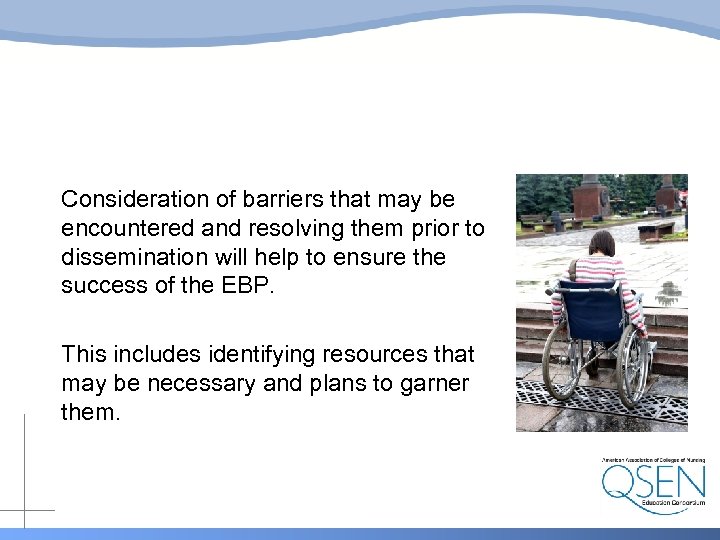
Consideration of barriers that may be encountered and resolving them prior to dissemination will help to ensure the success of the EBP. This includes identifying resources that may be necessary and plans to garner them.
A comprehensive and detailed plan including communication of the change to all those affected, training requirements, development of detailed protocols, and notifying other departments and individuals who may be affected by the change is included in the dissemination plan. Active interventions such as selfstudy, learning labs, reminders, and decision supports are more likely to induce change than passive education.

Identifying the predictors of success and developing a plan for collecting and analyzing data are components of the evaluation plan. This includes identifying who will be responsible for collecting, analyzing, and reporting the data and at what intervals.

Determine how the practice change is used. Audit and feedback demonstrates the gap between actual and desired results and address questions such as did the clinicians receive the information about a practice change and did they adhere to the practice change. How difficult or smooth was it to use the new way?
When the practice change has been modified sufficiently so that it is working as expected, it is ready to be implemented in other areas. A dissemination plan similar to the steps outlined above is needed to ensure a smooth implementation process. This includes planning for communication, training, and obtaining sufficient resources.
Quality of Care has assumed increasing importance. The public, government, and third-party payers want to know the outcomes of our interventions and the outcomes of care being delivered. Does it make a difference in the patient’s health, the provider components of care, and is it cost effective? Increasingly, nursing is being held accountable for the quality of nursing care delivered.
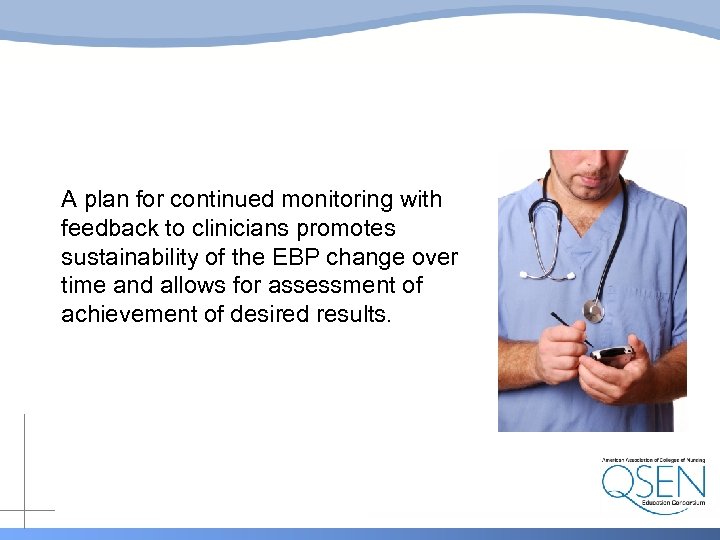
A plan for continued monitoring with feedback to clinicians promotes sustainability of the EBP change over time and allows for assessment of achievement of desired results.

Inform clinicians and all stakeholders of the results of the practice change including financial and clinical improvements.
EBP may be about an individual having a clinical question or discovering knowledge that may improve one’s own practice or it may be related to widespread implementation and organization system change. When tailoring the EBP to users and developing the implementation plan, Rogers identifies five steps that need to be considered.


Much has been written describing barriers to EBP and little has changed in nurses responses over the past 15 years, regarding why nurses do not use evidence in their practice.


EB clinical practice guidelines are systematically developed statements that help clinicians and patients make decisions about health care for specific clinical circumstances. They often are developed by a multidisciplinary group, followed by external review prior to publication. The National Guidelines Clearinghouse has guidelines developed in the US as well as internationally.
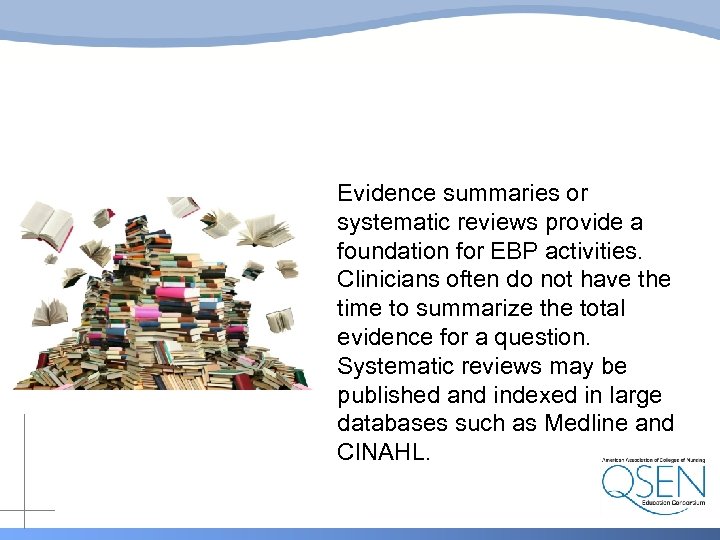
Evidence summaries or systematic reviews provide a foundation for EBP activities. Clinicians often do not have the time to summarize the total evidence for a question. Systematic reviews may be published and indexed in large databases such as Medline and CINAHL.

Little has been written regarding patient/family preferences and values related to EBP as well as the role of clinical expertise. Generally EBP has focused on the translation of research into practice. One of the complaints of EBP is that it is cookbook health care. However, research evidence alone is not sufficient to ensure sound clinical decisions necessary for effective health care.

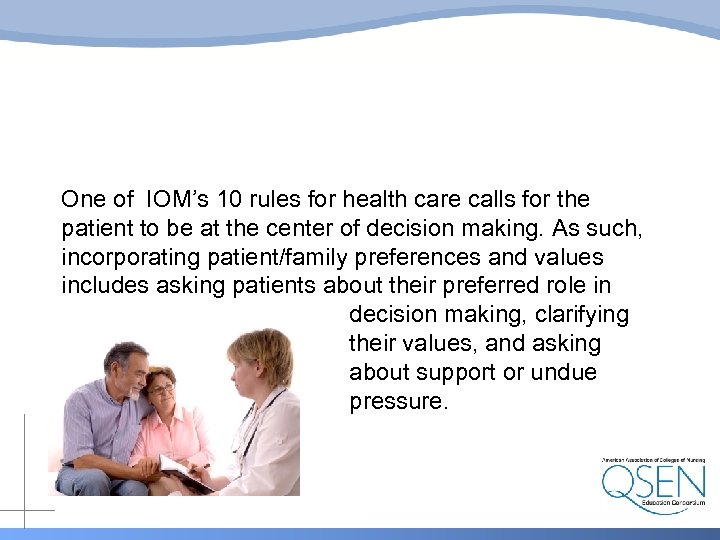
One of IOM’s 10 rules for health care calls for the patient to be at the center of decision making. As such, incorporating patient/family preferences and values includes asking patients about their preferred role in decision making, clarifying their values, and asking about support or undue pressure.
Question prompts for patients, and coaching to develop skills in questioning clinicians and deliberating about options improve patient/family member decision-making abilities. Kleinman’s questions for ascertaining patients’ beliefs and values may serve as a useful reference. Some make the case that patient-centered care may at times conflict with evidence-driven care and that patient preferences have priority over evidence-based recommendations.



 Скачать презентацию Integrating best current evidence with clinical expertise and
a66cb78d908dfa47a8703f51ff004ba9.ppt