


 Скачать презентацию Integrated Water Resource Planning Systems User Forum WRYM
838c169f2c4522791cfd258198fd866a.ppt
- Количество слайдов: 11
 Integrated Water Resource Planning Systems User Forum WRYM - New features 1 July 2004 1
 Layout – new features • Automated search for stochastic firm yield • Alternative method of modeling IFR - LHWP • Reconciliation scenario analysis using the historical sequence – F 16. DAT 2
 Automatic search for stochastic firm yield (1 of 2) – User defines the assurance level at which the yield needs to be determined (1: 50, 1: 20 return period) – Iterative analyses are undertaken to search for the firm yield using an upper and lower target drafts as starting point – User provides the initial upper and lower limits 3
 Automatic search for stochastic firm yield (2 of 2) – Activation variable: OPTFY=2, FO 1. DAT – Upper and lower target drafts defined through variable YIELD – New variable TARGRI defines the recurrence interval for which the yield is determined (“ 50” for 1: 50 or “ 20” for 1: 20), F 01. DAT 4
 Alternative method of simulating the IFR (1 of 4) – Application: Lesotho Highlands Water Project – Method approved by the Lesotho Highlands Development Authority – Use annual total flows as driver for IFRs – as apposed to normal method using monthly flow – Additional data provided in the F 14. DAT file 5
 Alternative method of simulating the IFR (2 of 4) – Two options are available: • 1 – Annual IFR is a constant percentage of the annual natural inflows as defined by a set of reference inflow nodes – smooth annual IFR duration curve • 2 - User defines finite set of IFR definitions and one definition is imposed exactly for a range of annual inflows as defined by a set of reference inflow nodes – IFR for a year is one out of the set of IFR values 6
 Alternative method of simulating the IFR (3 of 4) – Monthly disagregation: – Apply one of a set of user defined monthly values (12) for a simulation year which are selected based on a range of annual natural inflows that are referenced by a set of inflow nodes – Option 1 > Normalization of 12 monthly values are used – Option 2 > Exact specified 12 monthly values are used 7
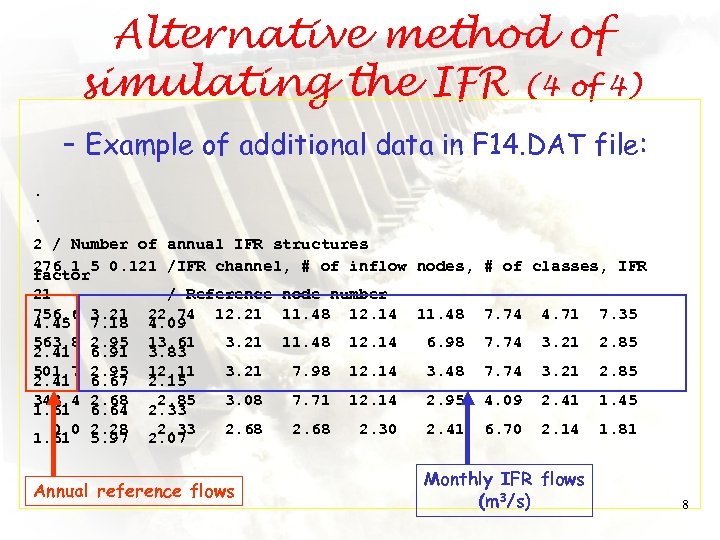 Alternative method of simulating the IFR (4 of 4) – Example of additional data in F 14. DAT file: . . 2 / Number of annual IFR structures 276 1 5 0. 121 /IFR channel, # of inflow nodes, # of classes, IFR factor 21 / Reference node number 756. 6 3. 21 22. 74 12. 21 11. 48 12. 14 11. 48 7. 74 4. 71 7. 35 4. 45 7. 18 4. 09 563. 8 2. 95 13. 61 3. 21 11. 48 12. 14 6. 98 7. 74 3. 21 2. 85 2. 41 6. 91 3. 83 501. 7 2. 95 12. 11 3. 21 7. 98 12. 14 3. 48 7. 74 3. 21 2. 85 2. 41 6. 67 2. 15 348. 4 2. 68 2. 85 3. 08 7. 71 12. 14 2. 95 4. 09 2. 41 1. 45 1. 61 6. 64 2. 33 0. 0 2. 28 2. 33 2. 68 2. 30 2. 41 6. 70 2. 14 1. 81 1. 61 5. 97 2. 07 Annual reference flows Monthly IFR flows (m 3/s) 8
 Reconciliation Scenario Analysis – A method to reconcile the water requirements with the available water by taking the interdependencies among users in a water resource system into account – Apply a water user type risk criteria that portions the demand into assurance categories – annual sequence only – Scenario defined by single multiplication factor for each abstraction channel in a system – input variables allow multiple scenario runs, maximum 10 – Factors applied to min-max and specified demand abstraction channel types – Simulation results assessed for compliance with risk criteria and summary of all channels presented as output 9
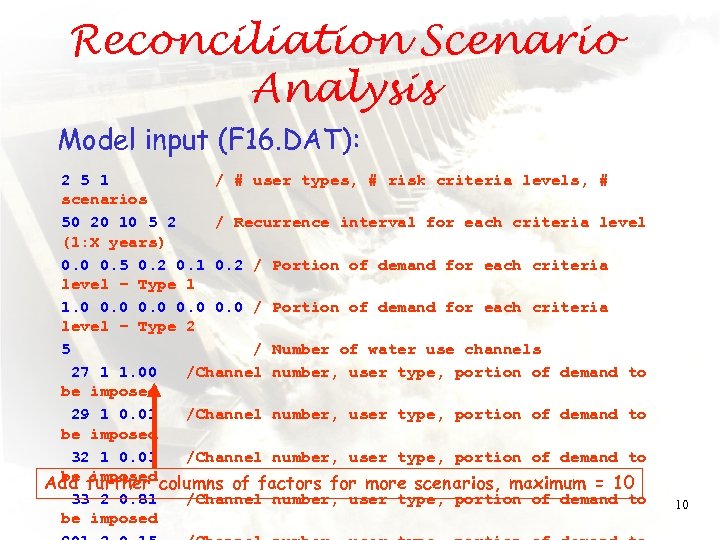 Reconciliation Scenario Analysis Model input (F 16. DAT): 2 5 1 / # user types, # risk criteria levels, # scenarios 50 20 10 5 2 / Recurrence interval for each criteria level (1: X years) 0. 0 0. 5 0. 2 0. 1 0. 2 / Portion of demand for each criteria level – Type 1 1. 0 0. 0 / Portion of demand for each criteria level – Type 2 5 / Number of water use channels 27 1 1. 00 /Channel number, user type, portion of demand to be imposed 29 1 0. 01 /Channel number, user type, portion of demand to be imposed 32 1 0. 03 /Channel number, user type, portion of demand to be imposed Add further columns of factors for more scenarios, maximum = 10 33 2 0. 81 /Channel number, user type, portion of demand to be imposed 10
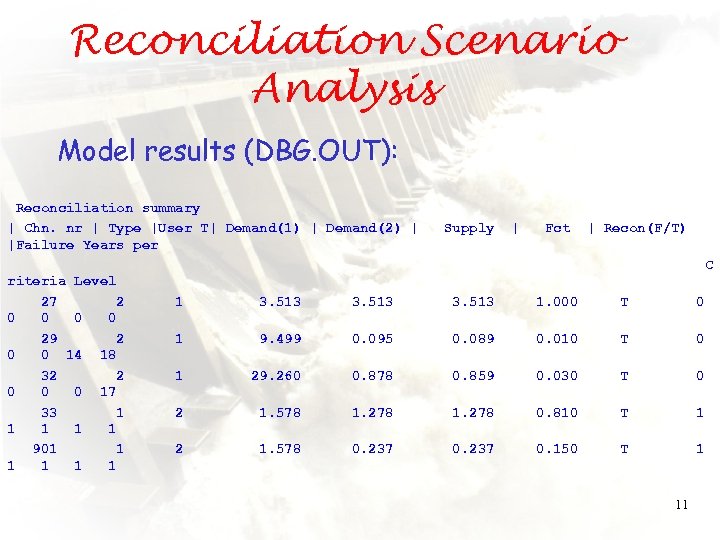 Reconciliation Scenario Analysis Model results (DBG. OUT): Reconciliation summary | Chn. nr | Type |User T| Demand(1) | Demand(2) | |Failure Years per Supply | Fct | Recon(F/T) C riteria Level 27 2 0 0 29 2 0 0 14 18 32 2 0 0 0 17 33 1 1 1 901 1 1 1 3. 513 1. 000 T 0 1 9. 499 0. 095 0. 089 0. 010 T 0 1 29. 260 0. 878 0. 859 0. 030 T 0 2 1. 578 1. 278 0. 810 T 1 2 1. 578 0. 237 0. 150 T 1 11