


 Скачать презентацию Integrated Strategic Plan 2013 -2018 and Annual Performance
96c9eb032f1b5016fc50c0d447915d17.ppt
- Количество слайдов: 23
 Integrated Strategic Plan (2013 -2018) and Annual Performance Plan (2013/14) THE INSTITUTE (Nemisa, ISSA, e. SI) e-Skilling South Africa for equitable prosperity and global competitiveness presentation to Portfolio Committee on Communications March 2013 1
 presentation outline strategic overview of the Institute: 1. vision 2. mission 3. situation analysis – performance environment – organisational environment 4. strategic objectives – programmes of the institute – strategic goals and targets 5. Identified risks 2
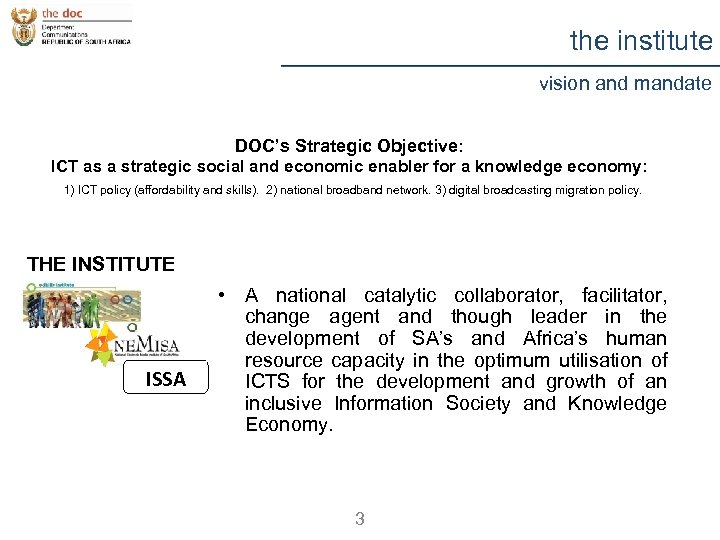 the institute vision and mandate DOC’s Strategic Objective: ICT as a strategic social and economic enabler for a knowledge economy: 1) ICT policy (affordability and skills). 2) national broadband network. 3) digital broadcasting migration policy. THE INSTITUTE ISSA • A national catalytic collaborator, facilitator, change agent and though leader in the development of SA’s and Africa’s human resource capacity in the optimum utilisation of ICTS for the development and growth of an inclusive Information Society and Knowledge Economy. 3
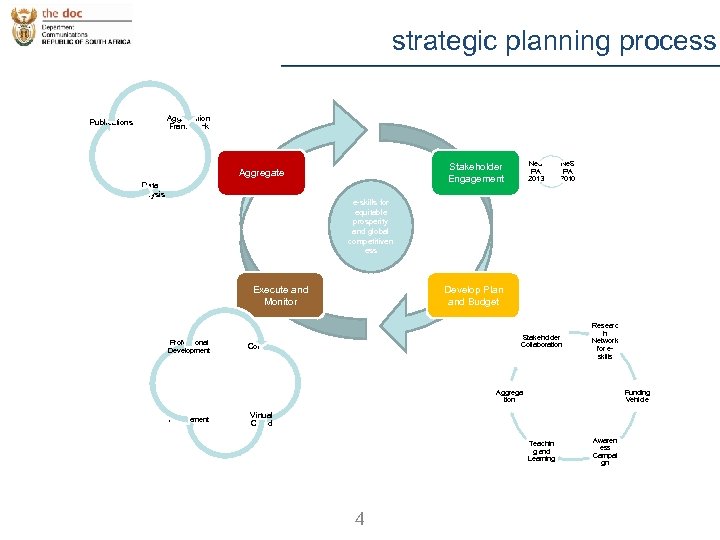 strategic planning process Aggregation Framework Publications Data Analysis Ne. S PA 2013 Stakeholder Engagement Aggregate Ne. S PA 2010 e-skills for equitable prosperity and global competitiven ess Execute and Monitor Professional Development Develop Plan and Budget Stakeholder Collaboration Content Researc h Network for eskills Aggrega tion Procurement Funding Vehicle Virtual Cloud Teachin g and Learning 4 Awaren ess Campai gn
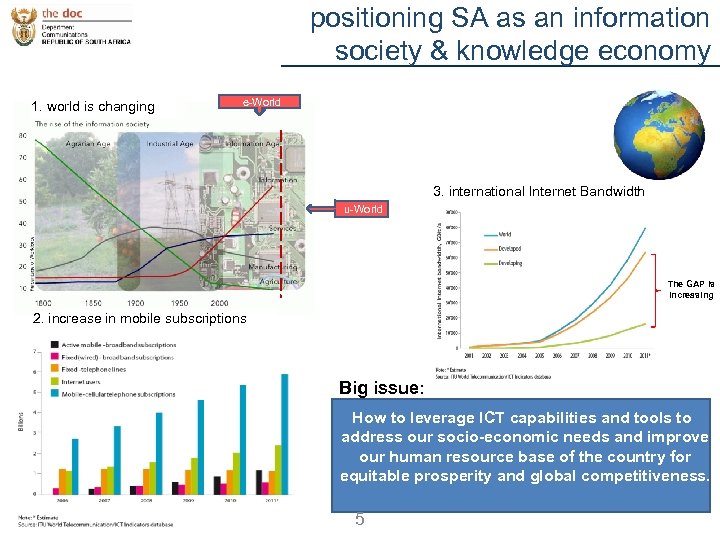 positioning SA as an information society & knowledge economy 1. world is changing e-World 3. international Internet Bandwidth International internet bandwidth u-World The GAP is increasing 2. increase in mobile subscriptions 6 billion mobile-cellular subscriptions Big issue: How to leverage ICT capabilities and tools to address our socio-economic needs and improve our human resource base of the country for equitable prosperity and global competitiveness. 5
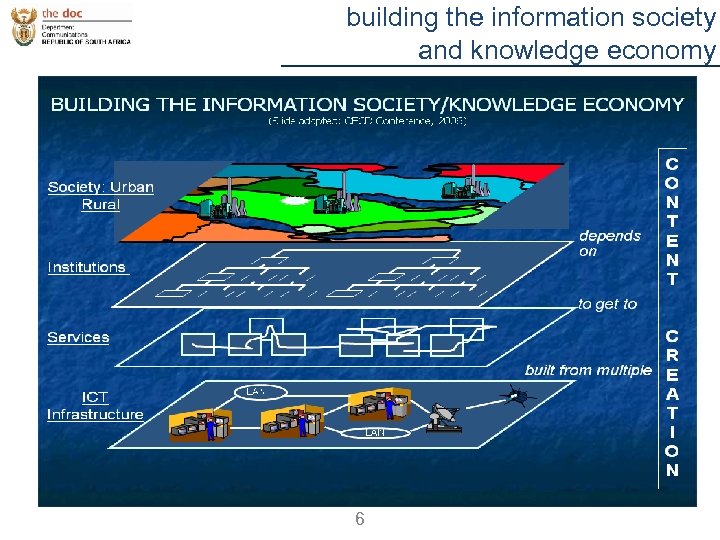 building the information society and knowledge economy 6
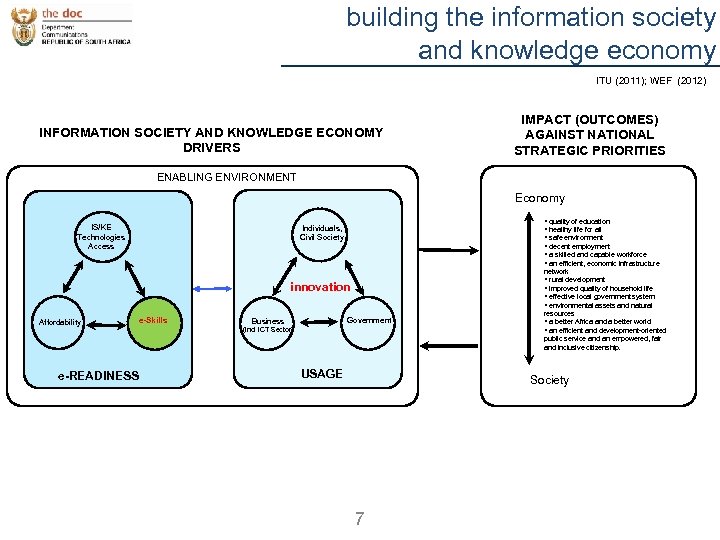 building the information society and knowledge economy ITU (2011); WEF (2012) INFORMATION SOCIETY AND KNOWLEDGE ECONOMY DRIVERS IMPACT (OUTCOMES) AGAINST NATIONAL STRATEGIC PRIORITIES ENABLING ENVIRONMENT Economy IS/KE Technologies Access § quality of education § healthy life for all § safe environment § decent employment § a skilled and capable workforce § an efficient, economic infrastructure Individuals, Civil Society USAGE innovation Affordability e-READINESS e-Skills Government Business (incl ICT Sector) USAGE network § rural development § improved quality of household life § effective local government system § environmental assets and natural resources § a better Africa and a better world § an efficient and development-oriented public service and an empowered, fair and inclusive citizenship. Society 7
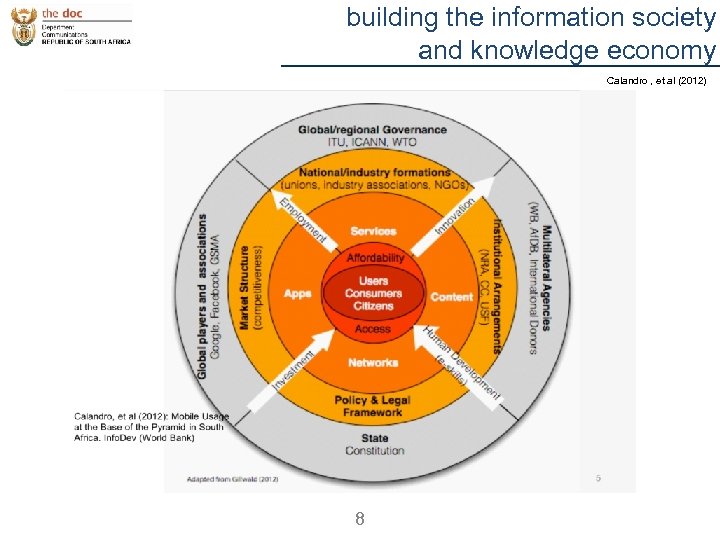 building the information society and knowledge economy Calandro , et al (2012) 8
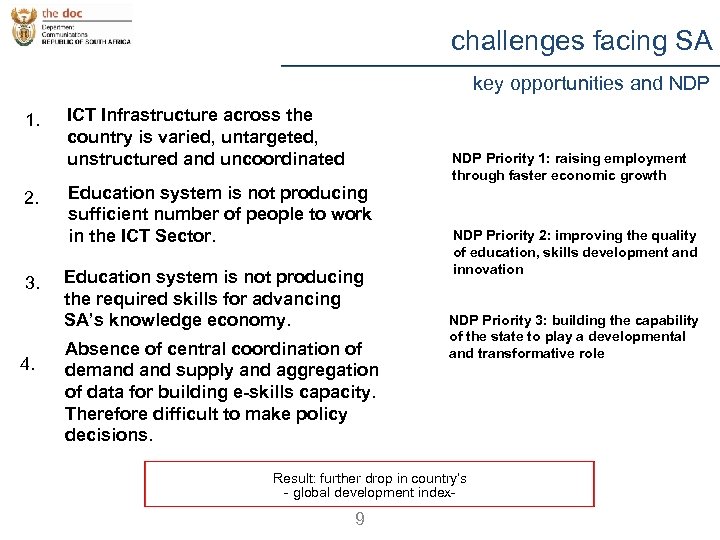 challenges facing SA key opportunities and NDP 1. 2. 3. 4. ICT Infrastructure across the country is varied, untargeted, unstructured and uncoordinated Education system is not producing sufficient number of people to work in the ICT Sector. Education system is not producing the required skills for advancing SA’s knowledge economy. Absence of central coordination of demand supply and aggregation of data for building e-skills capacity. Therefore difficult to make policy decisions. NDP Priority 1: raising employment through faster economic growth NDP Priority 2: improving the quality of education, skills development and innovation NDP Priority 3: building the capability of the state to play a developmental and transformative role Result: further drop in country’s - global development index- 9
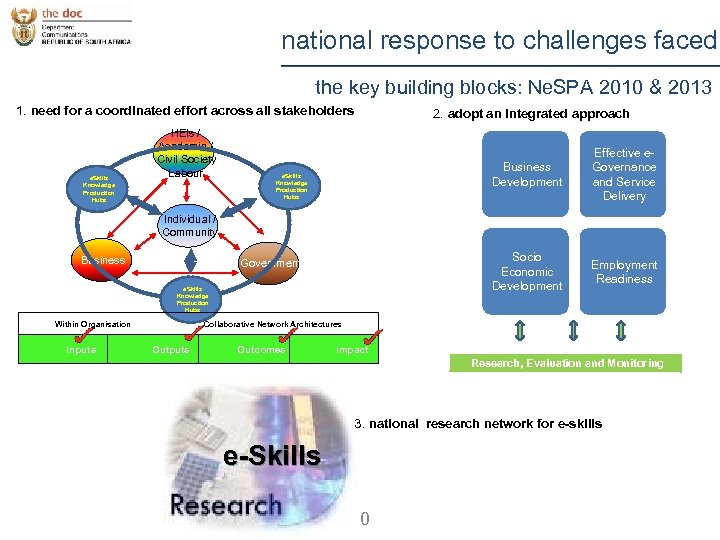 national response to challenges faced the key building blocks: Ne. SPA 2010 & 2013 1. need for a coordinated effort across all stakeholders e. Skills Knowledge Production Hubs HEIs / Academia / Civil Society Labour 2. adopt an integrated approach Business Development Socio Economic Development e. Skills Knowledge Production Hubs Effective e. Governance and Service Delivery Employment Readiness Individual / Community Business Government e. Skills Knowledge Production Hubs Within Organisation Inputs Collaborative Network Architectures Outputs Outcomes Impact Research, Evaluation and Monitoring 3. national research network for e-skills e-Skills 10
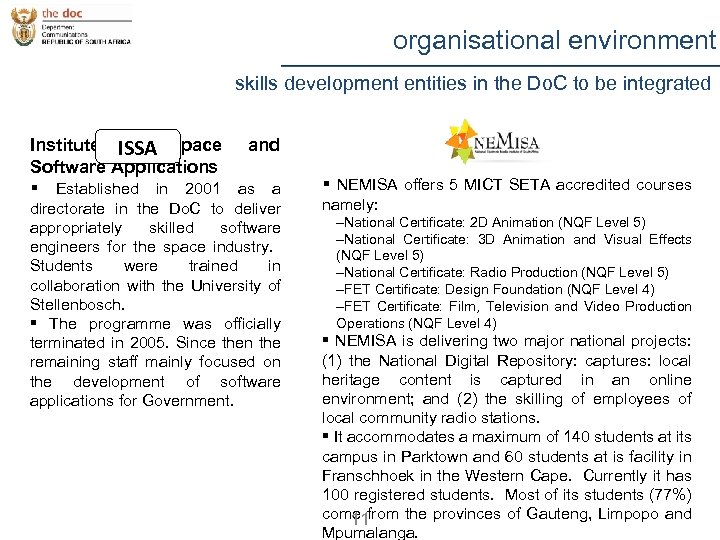 organisational environment skills development entities in the Do. C to be integrated Institute ISSA Space and of Software Applications § Established in 2001 as a directorate in the Do. C to deliver appropriately skilled software engineers for the space industry. Students were trained in collaboration with the University of Stellenbosch. § The programme was officially terminated in 2005. Since then the remaining staff mainly focused on the development of software applications for Government. § NEMISA offers 5 MICT SETA accredited courses namely: –National Certificate: 2 D Animation (NQF Level 5) –National Certificate: 3 D Animation and Visual Effects (NQF Level 5) –National Certificate: Radio Production (NQF Level 5) –FET Certificate: Design Foundation (NQF Level 4) –FET Certificate: Film, Television and Video Production Operations (NQF Level 4) § NEMISA is delivering two major national projects: (1) the National Digital Repository: captures: local heritage content is captured in an online environment; and (2) the skilling of employees of local community radio stations. § It accommodates a maximum of 140 students at its campus in Parktown and 60 students at is facility in Franschhoek in the Western Cape. Currently it has 100 registered students. Most of its students (77%) come from the provinces of Gauteng, Limpopo and 11 Mpumalanga.
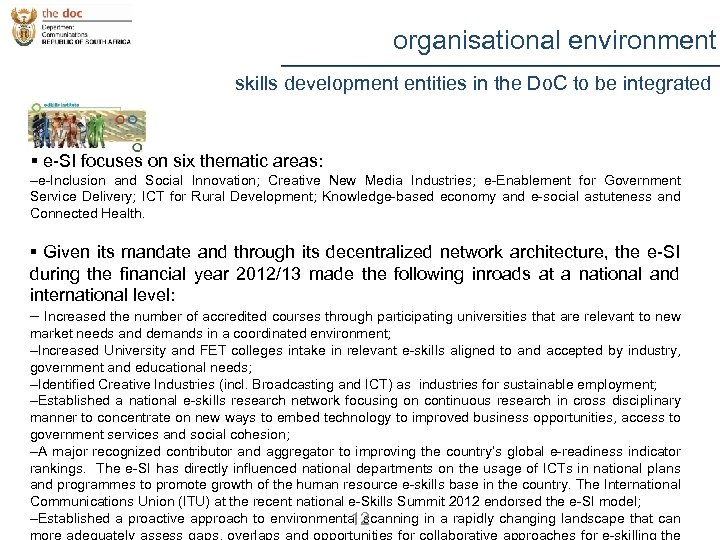 organisational environment skills development entities in the Do. C to be integrated § e-SI focuses on six thematic areas: –e-Inclusion and Social Innovation; Creative New Media Industries; e-Enablement for Government Service Delivery; ICT for Rural Development; Knowledge-based economy and e-social astuteness and Connected Health. § Given its mandate and through its decentralized network architecture, the e-SI during the financial year 2012/13 made the following inroads at a national and international level: – Increased the number of accredited courses through participating universities that are relevant to new market needs and demands in a coordinated environment; –Increased University and FET colleges intake in relevant e-skills aligned to and accepted by industry, government and educational needs; –Identified Creative Industries (incl. Broadcasting and ICT) as industries for sustainable employment; –Established a national e-skills research network focusing on continuous research in cross disciplinary manner to concentrate on new ways to embed technology to improved business opportunities, access to government services and social cohesion; –A major recognized contributor and aggregator to improving the country’s global e-readiness indicator rankings. The e-SI has directly influenced national departments on the usage of ICTs in national plans and programmes to promote growth of the human resource e-skills base in the country. The International Communications Union (ITU) at the recent national e-Skills Summit 2012 endorsed the e-SI model; –Established a proactive approach to environmental scanning in a rapidly changing landscape that can 12 more adequately assess gaps, overlaps and opportunities for collaborative approaches for e-skilling the
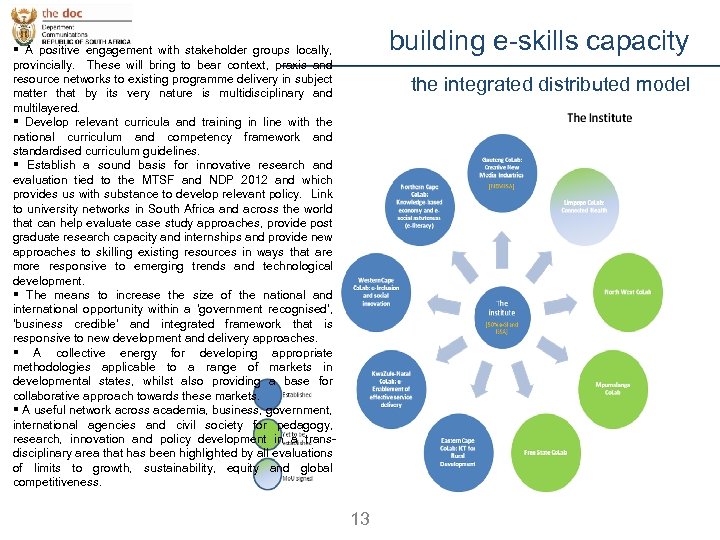 building e-skills capacity § A positive engagement with stakeholder groups locally, provincially. These will bring to bear context, praxis and resource networks to existing programme delivery in subject matter that by its very nature is multidisciplinary and multilayered. § Develop relevant curricula and training in line with the national curriculum and competency framework and standardised curriculum guidelines. § Establish a sound basis for innovative research and evaluation tied to the MTSF and NDP 2012 and which provides us with substance to develop relevant policy. Link to university networks in South Africa and across the world that can help evaluate case study approaches, provide post graduate research capacity and internships and provide new approaches to skilling existing resources in ways that are more responsive to emerging trends and technological development. § The means to increase the size of the national and international opportunity within a ‘government recognised’, ‘business credible’ and integrated framework that is responsive to new development and delivery approaches. § A collective energy for developing appropriate methodologies applicable to a range of markets in developmental states, whilst also providing a base for collaborative approach towards these markets. § A useful network across academia, business, government, international agencies and civil society for pedagogy, research, innovation and policy development in a transdisciplinary area that has been highlighted by all evaluations of limits to growth, sustainability, equity and global competitiveness. the integrated distributed model 13
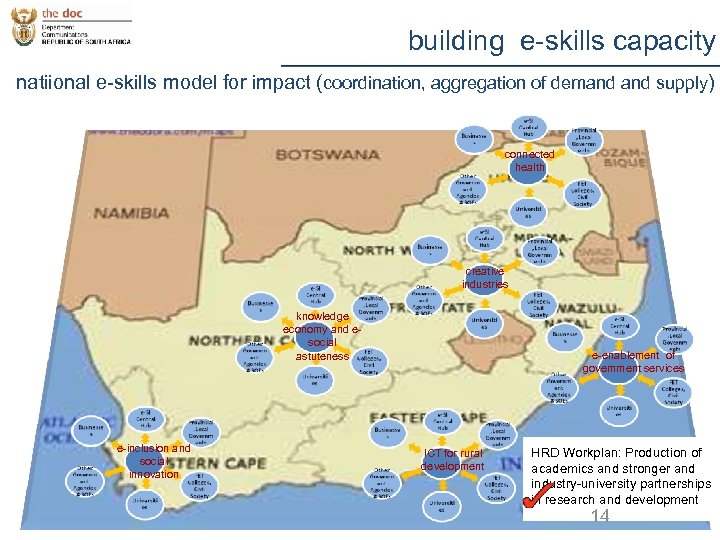 building e-skills capacity natiional e-skills model for impact (coordination, aggregation of demand supply) connected health creative industries knowledge economy and esocial astuteness e-inclusion and social innovation e-enablement of government services ICT for rural development HRD Workplan: Production of academics and stronger and industry-university partnerships in research and development 14
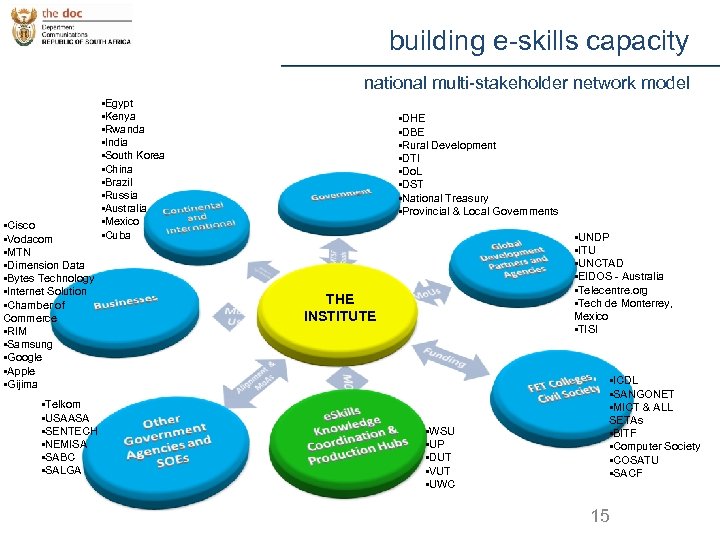 building e-skills capacity national multi-stakeholder network model • Cisco • Vodacom • MTN • Dimension Data • Bytes Technology • Internet Solution • Chamber of Commerce • RIM • Samsung • Google • Apple • Gijima • Telkom • USAASA • SENTECH • NEMISA • SABC • SALGA • Egypt • Kenya • Rwanda • India • South Korea • China • Brazil • Russia • Australia • Mexico • Cuba • DHE • DBE • Rural Development • DTI • Do. L • DST • National Treasury • Provincial & Local Governments • UNDP • ITU • UNCTAD • EIDOS - Australia • Telecentre. org • Tech de Monterrey, Mexico • TISI THE INSTITUTE • WSU • UP • DUT • VUT • UWC • ICDL • SANGONET • MICT & ALL SETAs • BITF • Computer Society • COSATU • SACF 15
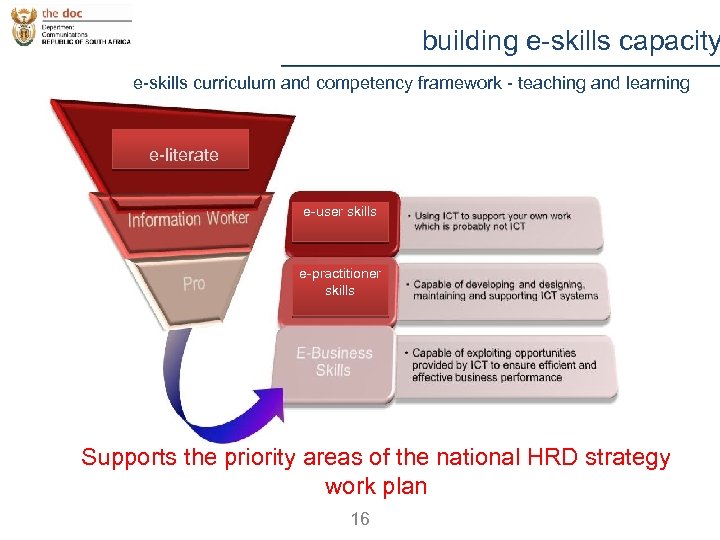 building e-skills capacity e-skills curriculum and competency framework - teaching and learning e-literate e-user skills e-practitioner skills Supports the priority areas of the national HRD strategy work plan 16
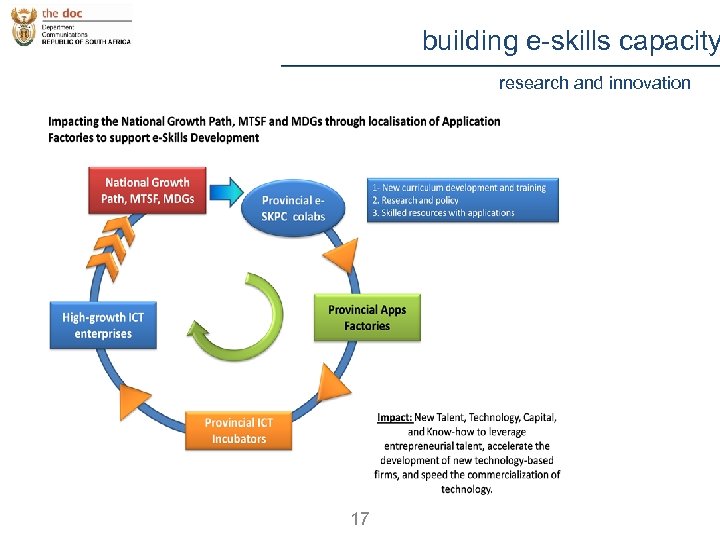 building e-skills capacity research and innovation 17
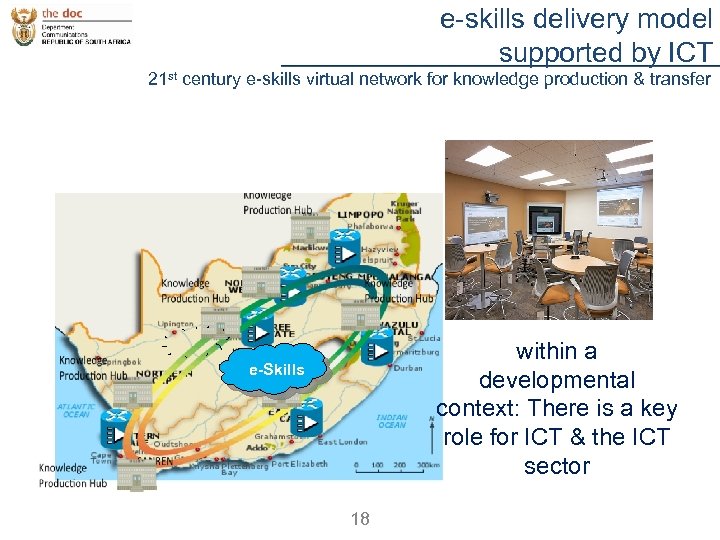 e-skills delivery model supported by ICT 21 st century e-skills virtual network for knowledge production & transfer within a developmental context: There is a key role for ICT & the ICT sector e-Skills 18
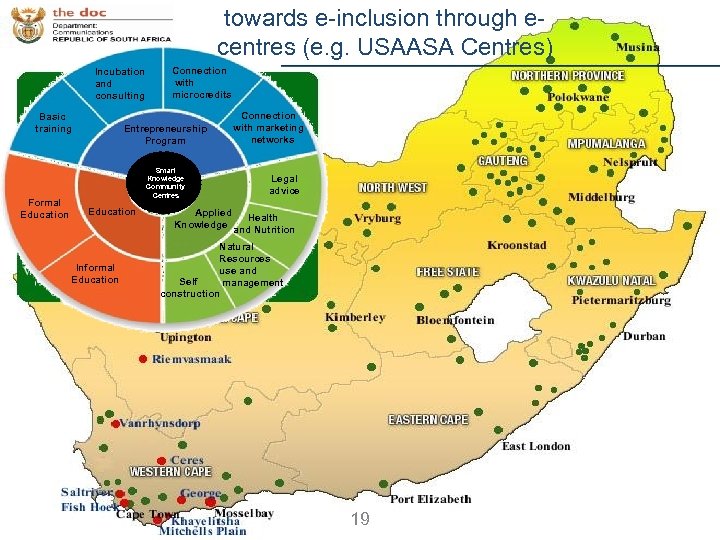 • 10 E-Centres Incubation and consulting Basic training Formal Education towards e-inclusion through ecentres (e. g. USAASA Centres) Connection with microcredits Entrepreneurship Program Smart Knowledge Community Centres Education Informal Education Applied Knowledge Connection with marketing networks Legal advice Health and Nutrition Natural Resources use and Self management construction 19
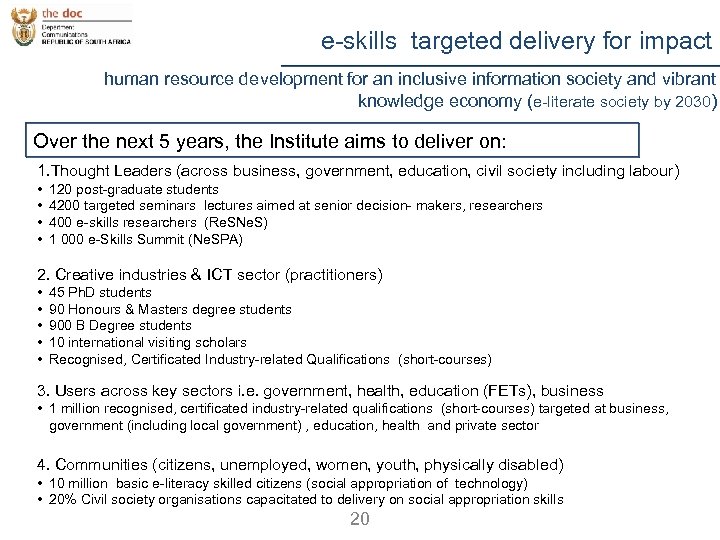 e-skills targeted delivery for impact human resource development for an inclusive information society and vibrant knowledge economy (e-literate society by 2030) Over the next 5 years, the Institute aims to deliver on: 1. Thought Leaders (across business, government, education, civil society including labour) • • 120 post-graduate students 4200 targeted seminars lectures aimed at senior decision- makers, researchers 400 e-skills researchers (Re. SNe. S) 1 000 e-Skills Summit (Ne. SPA) 2. Creative industries & ICT sector (practitioners) • • • 45 Ph. D students 90 Honours & Masters degree students 900 B Degree students 10 international visiting scholars Recognised, Certificated Industry-related Qualifications (short-courses) 3. Users across key sectors i. e. government, health, education (FETs), business • 1 million recognised, certificated industry-related qualifications (short-courses) targeted at business, government (including local government) , education, health and private sector 4. Communities (citizens, unemployed, women, youth, physically disabled) • 10 million basic e-literacy skilled citizens (social appropriation of technology) • 20% Civil society organisations capacitated to delivery on social appropriation skills 20
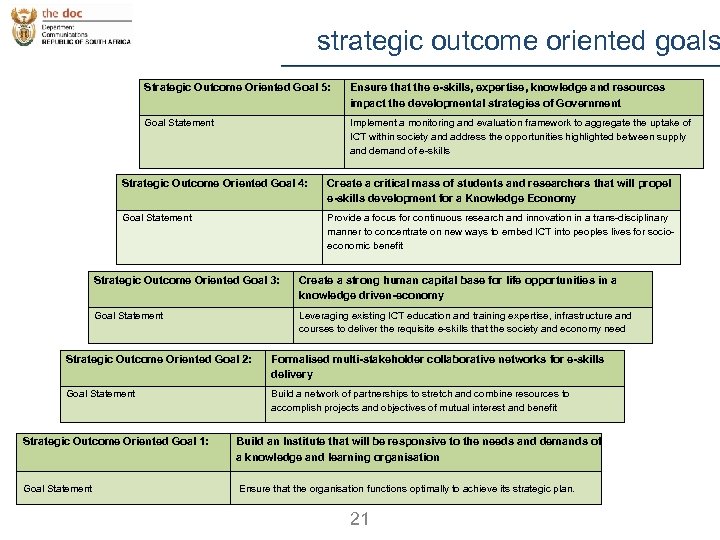 strategic outcome oriented goals Strategic Outcome Oriented Goal 5: Ensure that the e-skills, expertise, knowledge and resources impact the developmental strategies of Government Goal Statement Implement a monitoring and evaluation framework to aggregate the uptake of ICT within society and address the opportunities highlighted between supply and demand of e-skills Strategic Outcome Oriented Goal 4: Create a critical mass of students and researchers that will propel e-skills development for a Knowledge Economy Goal Statement Provide a focus for continuous research and innovation in a trans-disciplinary manner to concentrate on new ways to embed ICT into peoples lives for socioeconomic benefit Strategic Outcome Oriented Goal 3: Create a strong human capital base for life opportunities in a knowledge driven-economy Goal Statement Leveraging existing ICT education and training expertise, infrastructure and courses to deliver the requisite e-skills that the society and economy need Strategic Outcome Oriented Goal 2: Formalised multi-stakeholder collaborative networks for e-skills delivery Goal Statement Build a network of partnerships to stretch and combine resources to accomplish projects and objectives of mutual interest and benefit Strategic Outcome Oriented Goal 1: Build an Institute that will be responsive to the needs and demands of a knowledge and learning organisation Goal Statement Ensure that the organisation functions optimally to achieve its strategic plan. 21
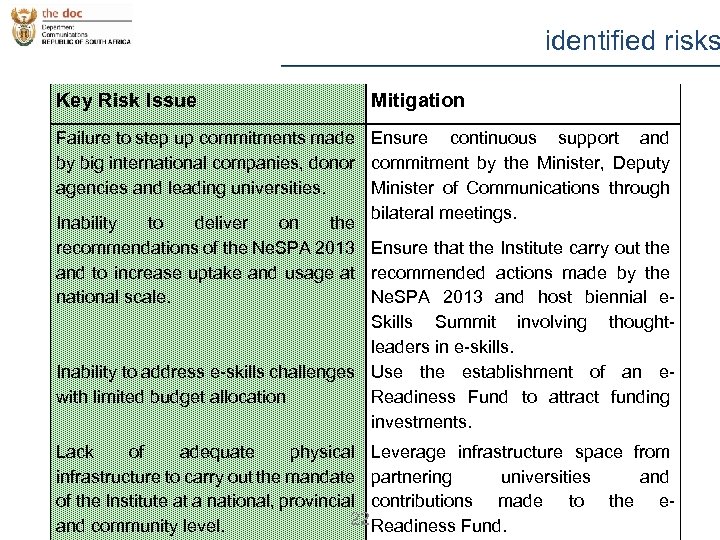 identified risks Key Risk Issue Mitigation Failure to step up commitments made Ensure continuous support and by big international companies, donor commitment by the Minister, Deputy agencies and leading universities. Minister of Communications through bilateral meetings. Inability to deliver on the recommendations of the Ne. SPA 2013 Ensure that the Institute carry out the and to increase uptake and usage at recommended actions made by the national scale. Ne. SPA 2013 and host biennial e. Skills Summit involving thoughtleaders in e-skills. Inability to address e-skills challenges Use the establishment of an ewith limited budget allocation Readiness Fund to attract funding investments. Lack of adequate physical Leverage infrastructure space from infrastructure to carry out the mandate partnering universities and of the Institute at a national, provincial contributions made to the e 22 Readiness Fund. and community level.
 THANK YOU 23