 Скачать презентацию Integrated Social Services in Armenia Case Study By
32152f355ff451fe713962b5d17a64f3.ppt
- Количество слайдов: 17



Integrated Social Services in Armenia Case Study By Lyudmila Harutyunyan Warsaw 2007
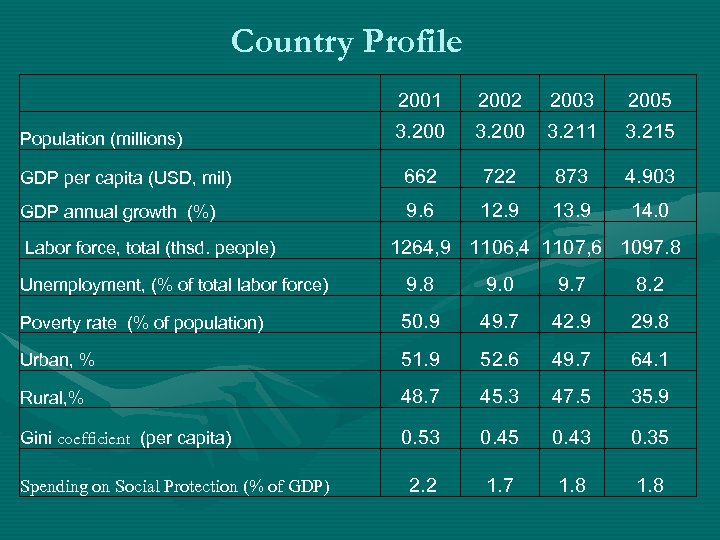
Country Profile 2001 2002 2003 2005 3. 200 3. 211 3. 215 GDP per capita (USD, mil) 662 722 873 4. 903 GDP annual growth (%) 9. 6 12. 9 13. 9 14. 0 Population (millions) Labor force, total (thsd. people) 1264, 9 1106, 4 1107, 6 1097. 8 9. 0 9. 7 8. 2 Poverty rate (% of population) 50. 9 49. 7 42. 9 29. 8 Urban, % 51. 9 52. 6 49. 7 64. 1 Rural, % 48. 7 45. 3 47. 5 35. 9 Gini coefficient (per capita) 0. 53 0. 45 0. 43 0. 35 2. 2 1. 7 1. 8 Unemployment, (% of total labor force) Spending on Social Protection (% of GDP)
Objectives of social policy • • • Social protection of the population Reduction of the poverty Povision of the means-tested programs to vulnerable families
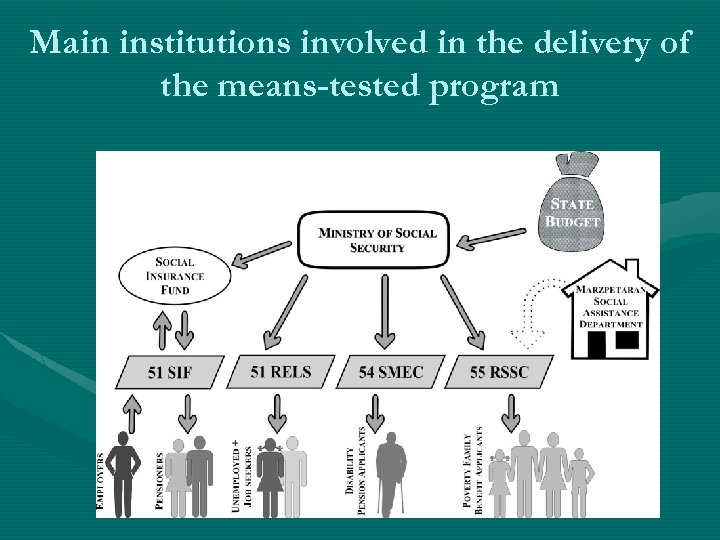
Main institutions involved in the delivery of the means-tested program
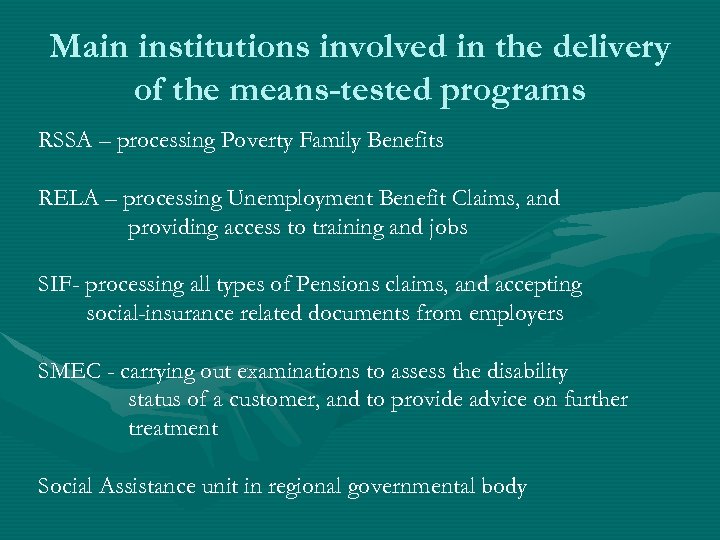
Main institutions involved in the delivery of the means-tested programs RSSA – processing Poverty Family Benefits RELA – processing Unemployment Benefit Claims, and providing access to training and jobs SIF- processing all types of Pensions claims, and accepting social-insurance related documents from employers SMEC - carrying out examinations to assess the disability status of a customer, and to provide advice on further treatment Social Assistance unit in regional governmental body
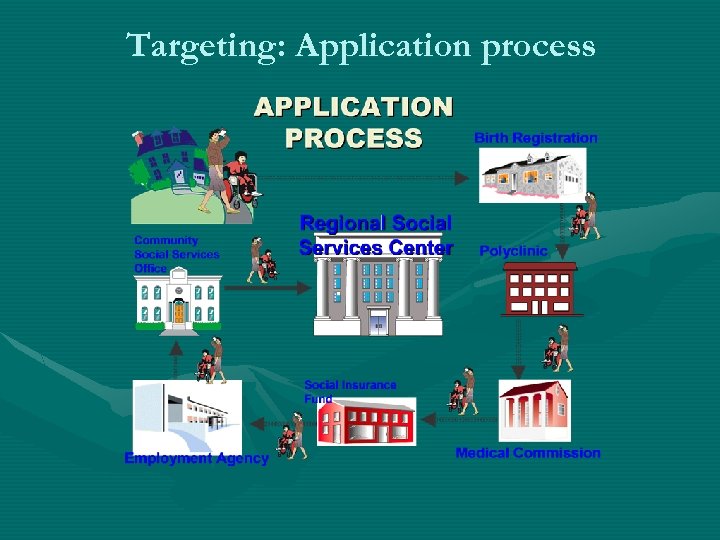
Targeting: Application process
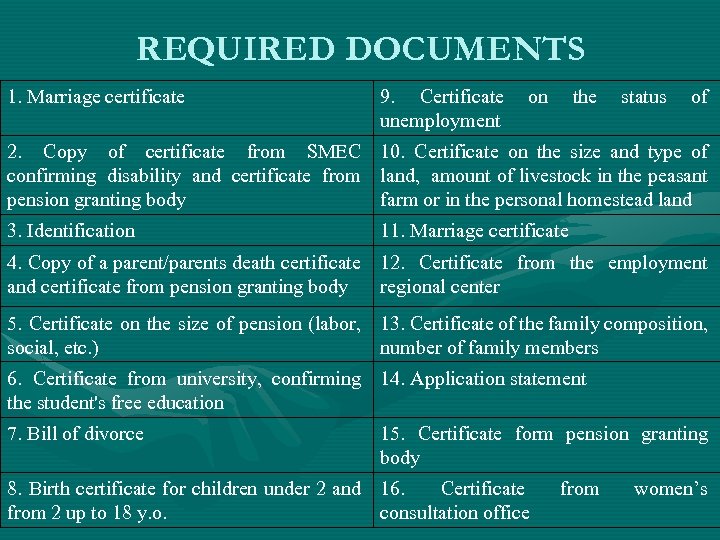
REQUIRED DOCUMENTS 1. Marriage certificate 9. Certificate unemployment on the status of 2. Copy of certificate from SMEC 10. Certificate on the size and type of confirming disability and certificate from land, amount of livestock in the peasant pension granting body farm or in the personal homestead land 3. Identification 11. Marriage certificate 4. Copy of a parent/parents death certificate 12. Certificate from the employment and certificate from pension granting body regional center 5. Certificate on the size of pension (labor, 13. Certificate of the family composition, social, etc. ) number of family members 6. Certificate from university, confirming 14. Application statement the student's free education 7. Bill of divorce 15. Certificate form pension granting body 8. Birth certificate for children under 2 and from 2 up to 18 y. o. 16. Certificate consultation office from women’s
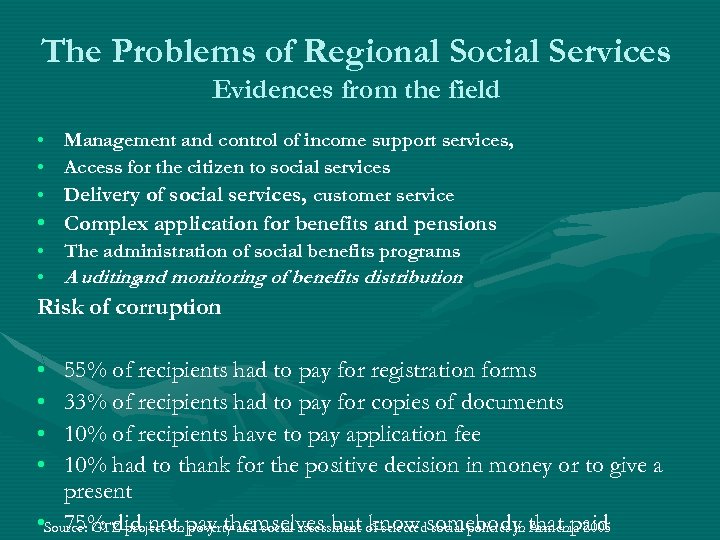
The Problems of Regional Social Services Evidences from the field • Management and control of income support services, • Access for the citizen to social services • Delivery of social services, customer service • Complex application for benefits and pensions • The administration of social benefits programs • A uditing monitoring of benefits distribution and Risk of corruption • • 55% of recipients had to pay for registration forms 33% of recipients had to pay for copies of documents 10% of recipients have to pay application fee 10% had to thank for the positive decision in money or to give a present • Source: GTZ project onpay themselves but of selectedsomebody that paid 75% did not poverty and social assessment know social policies in Armenia 2005
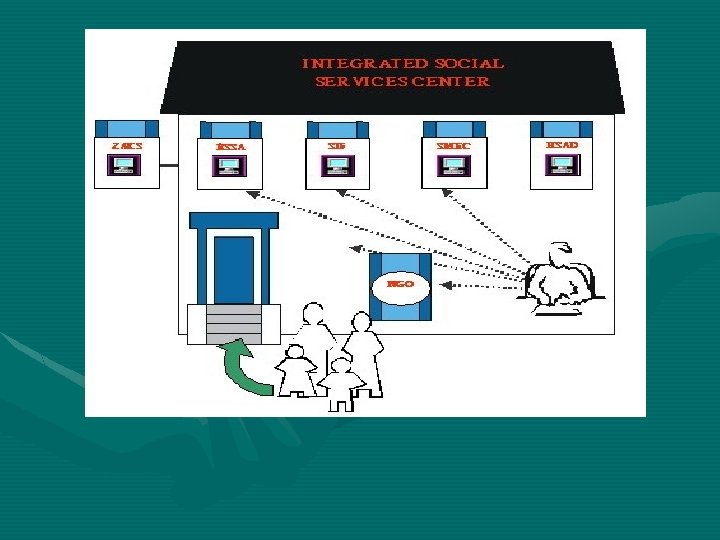
Integrated Social Service Center
• The first pilot site for testing the model of better social services delivery was established in Vanadzor, Lori Marz in March 2004. • A second pilot ISSC site was opened in Masis, Ararat Marz, in November 2004.
The objectives of ISSC • • to provide a more integrated approach to the administration, delivery, management and control of income support services, to improve access for the citizen to social services to improve delivery of social services, i. Improve Customer Service To make an application for benefits and pensions as simple as possible To speed up procedures and processing time needed for social service provision To improve the administration of social benefits programs To reduce the incidence of fraud and corruption, to have better auditing and monitoring of benefits distribution. To enable the NGOs, become more directly involved and interact with the other Services of ISSC
ISSC Components • Regional Social Service Agency (RSSA) – processing Poverty Family Benefits • Regional Employment and Labor Service Agency (RELA) – processing • Unemployment Benefit Claims, and providing access to training and jobs • State Social Insurance Fund (SIF)- processing all types of Pensions claims, and accepting social-insurance related documents from employers • Socio-Medical Examination Commission (SMEC) - carrying out examinations to assess the disability status of a customer, and to provide advice on further treatment • NGO representation – providing advice on additional help that may be available, training in non-work-related topics, and advocacy
Additional functions • • ISSC is extended its role as the social support hub of a locality: ISSC is a Center for NGO network ISSC has a community resource center, ISSC provides place for senior citizen’s clubs, playgroups for children • Social work training distance learning center is also situated in ISSC, to allow locally based social work trainees to participate in training provided by Yerevan State University • ISSC is further extending the services which operate around each component of the Center. Eg. RELA has it’s own training room, a job club assisting people with finding work, Youth training and employment center, NGOs are running Legal advice center, Social Support Center, Center for Psychological Support
The steps of ISSC creation • Needs assessments: Sociological Survey with customers, specialists, community leaders, NGO representatives • Concept design, preparation of documentation • co-locating all social services in one building • creating a more open and transparent appeals system • improving the administration of social benefits programs by – – – streamlining administrative procedures, designing systems for shared databases reducing the need for certificates to be written, providing more intensive and regular training of staff, making more efficient use of staff and technical resources among the colocated offices • improving the auditing system of social benefits. • enhancing and extending the range of social services available through close cooperation with NGOs working in the health and social sectors and with the municipality • Creating additional units to provide additional services
Outcomes of ISSC • families and individuals have a simpler access to social services which are available under one roof • • • Customer service is improved Administration of Social Services is improved A data exchange capacity through a local server is improved A fraud and corruption are reduced Staff is trained A community resource center which operates in ISSC provides access to local information and connects State and local social programs NGOs are providing assistance to citizens in addition to state benefits and other support referral systems of people to local NGOs providing social services and humanitarian assistance is operating
The remained issues • The problem of the administration of the programs • • The absence of outreach programs to improve the availability of information and access to services for vulnerable population groups The lack of financial, technical and human resources. There is a lack of mechanisms and tools for users participation in monitoring and evaluating of social services
Our gratitude for creation of ISSC • To Government of Armenia, Ministry of Labor and Social Issues • USAID and PADCO • Yerevan State University • Regional Government of Lori and Ararat regions • Communities of Vanadzor and Masis • International programs
Скачать презентацию Integrated Social Services in Armenia Case Study By
32152f355ff451fe713962b5d17a64f3.ppt