


 Скачать презентацию INTEGRATED SENSOR TECHNOLOGIES PREVENTING ACCIDENTS DUE TO DRIVER
0adf7cecf2b71dd04babdfb551f3ca7c.ppt
- Количество слайдов: 26
 INTEGRATED SENSOR TECHNOLOGIES PREVENTING ACCIDENTS DUE TO DRIVER FATIGUE By Carl Tenenbaum David Haynes Philip Pham Rachel Wakim
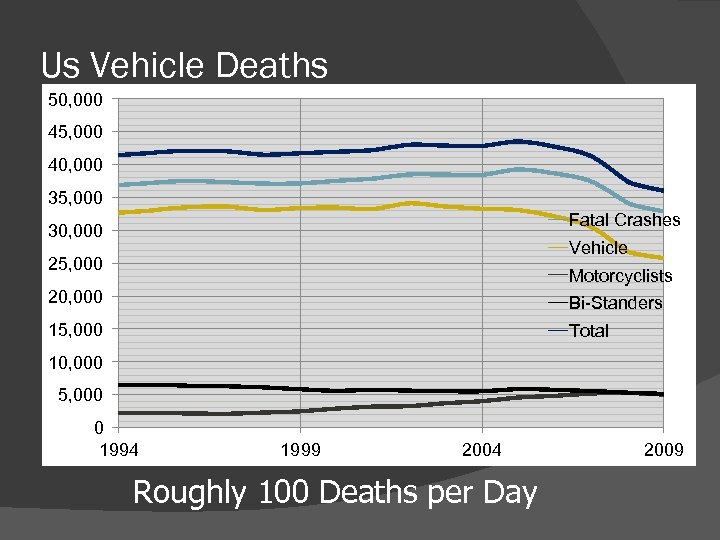 Us Vehicle Deaths 50, 000 45, 000 40, 000 35, 000 Fatal Crashes 30, 000 Vehicle 25, 000 Motorcyclists 20, 000 Bi-Standers 15, 000 Total 10, 000 5, 000 0 1994 1999 2004 Roughly 100 Deaths per Day 2009
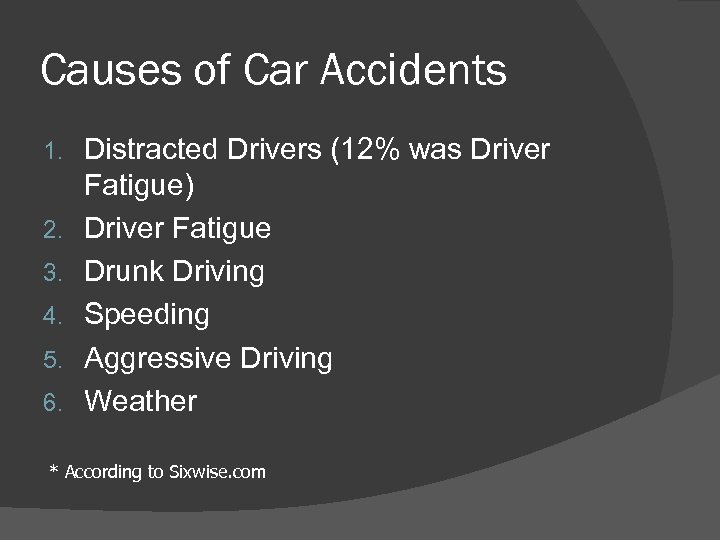 Causes of Car Accidents 1. 2. 3. 4. 5. 6. Distracted Drivers (12% was Driver Fatigue) Driver Fatigue Drunk Driving Speeding Aggressive Driving Weather * According to Sixwise. com
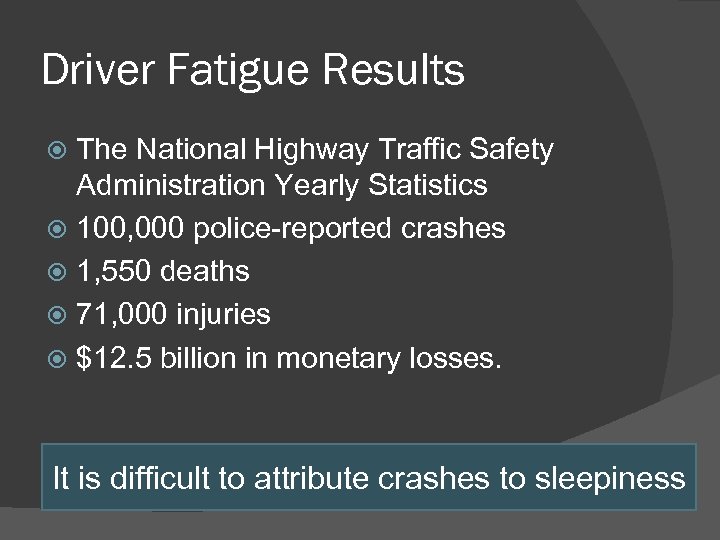 Driver Fatigue Results The National Highway Traffic Safety Administration Yearly Statistics 100, 000 police-reported crashes 1, 550 deaths 71, 000 injuries $12. 5 billion in monetary losses. It is difficult to attribute crashes to sleepiness
 David Haynes SENSE-SENSOR TECHNOLOGY
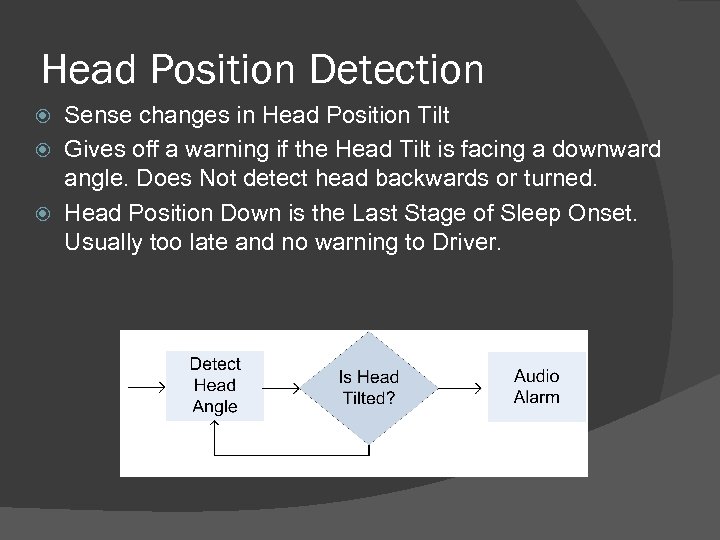 Head Position Detection Sense changes in Head Position Tilt Gives off a warning if the Head Tilt is facing a downward angle. Does Not detect head backwards or turned. Head Position Down is the Last Stage of Sleep Onset. Usually too late and no warning to Driver.
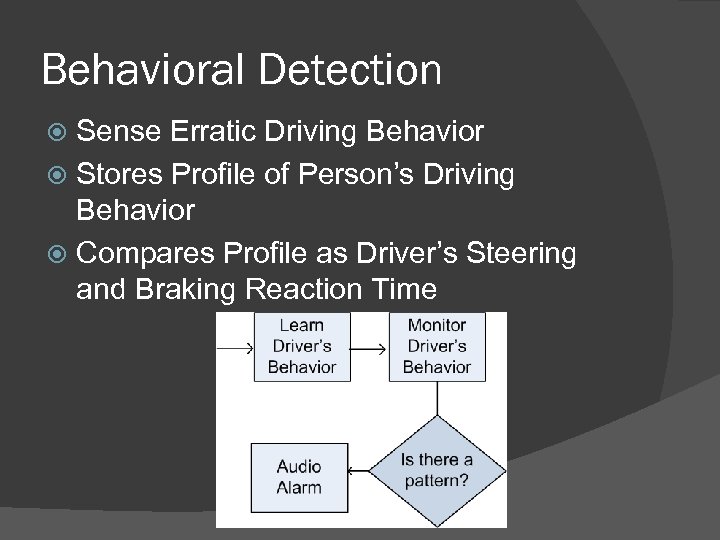 Behavioral Detection Sense Erratic Driving Behavior Stores Profile of Person’s Driving Behavior Compares Profile as Driver’s Steering and Braking Reaction Time
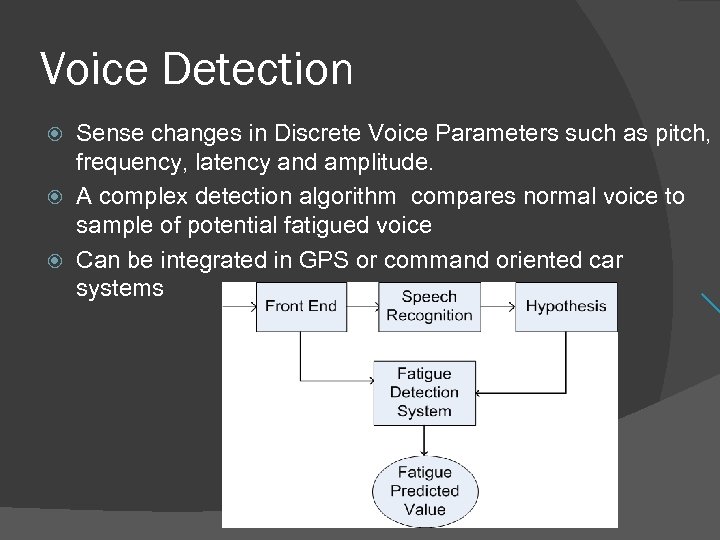 Voice Detection Sense changes in Discrete Voice Parameters such as pitch, frequency, latency and amplitude. A complex detection algorithm compares normal voice to sample of potential fatigued voice Can be integrated in GPS or command oriented car systems
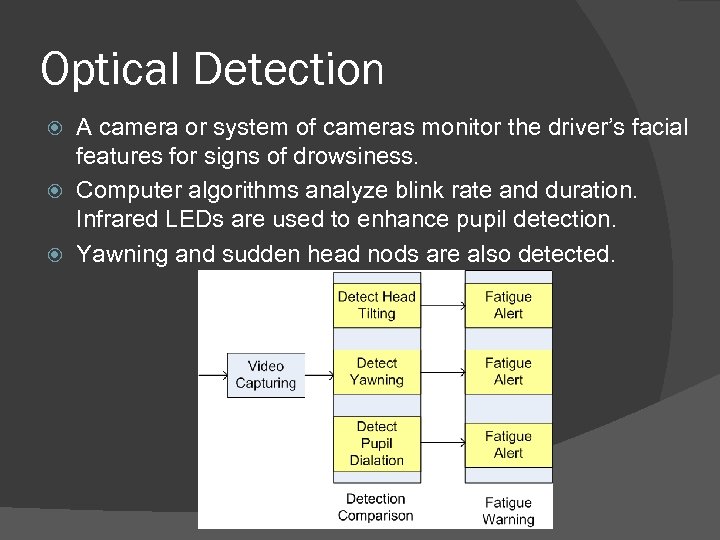 Optical Detection A camera or system of cameras monitor the driver’s facial features for signs of drowsiness. Computer algorithms analyze blink rate and duration. Infrared LEDs are used to enhance pupil detection. Yawning and sudden head nods are also detected.
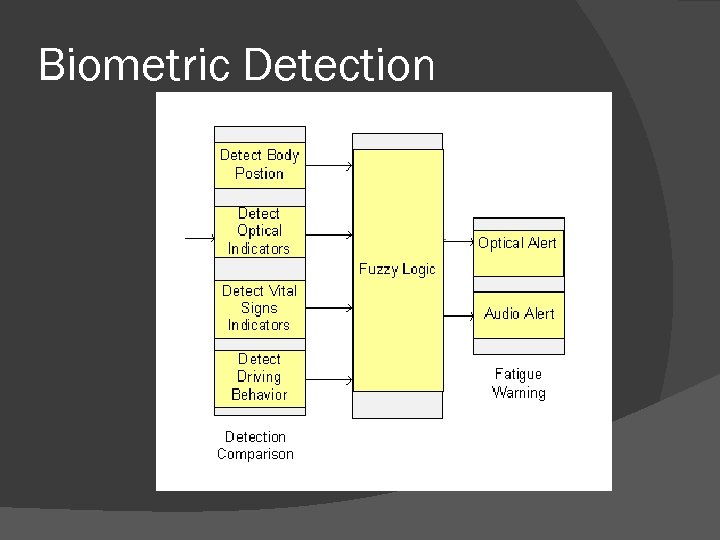
 Biometric Detection Capacitive Array on vehicle ceiling detects changes in driver’s body position. Sensors placed on steering wheel, seat, or wristwatch device monitor driver’s vital signs for analysis. Low power Doppler radar monitors vital signs and body position for analysis. Artificial neural network software analyzes steering wheel behavior for indicators of fatigue.
 Biometric Detection
 Rachel Wakim COMBINING SENSOR TECHNOLOGY AND REALWORLD APPLICATIONS
 To be attractive, a vehicle sensor system should be: Fairly inexpensive, Accurate, with a quick response time, Integrated with the car design, or at least “plug and play”, Noninvasive, Discreet, and non-distracting, Adaptable to different user conditions: i. e. , sunglasses, gloves.
 Head/eye Camera Measure head tilting/eye closing/yawning as signs of fatigue or drowsiness. Non-invasive, no need for user interface. Can be thwarted by sunglasses or hats. Driver movement may confuse the camera. 1/5 people do not show eye closure as a warning sign. [US Dept. of Transportation]
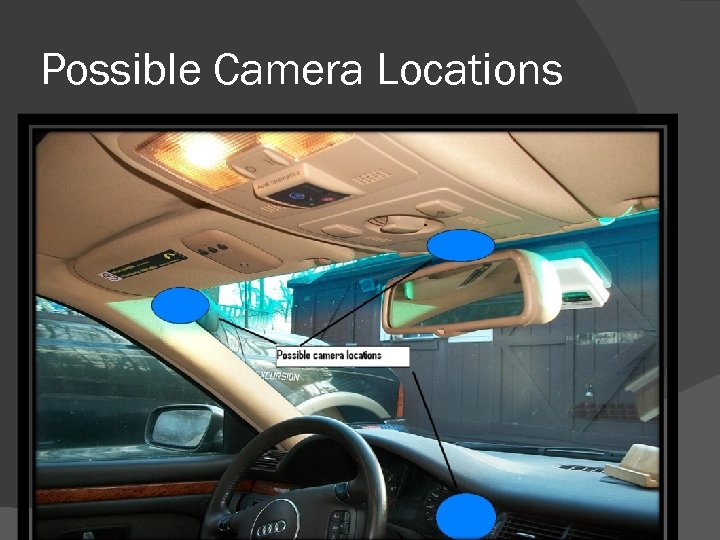 Possible Camera Locations
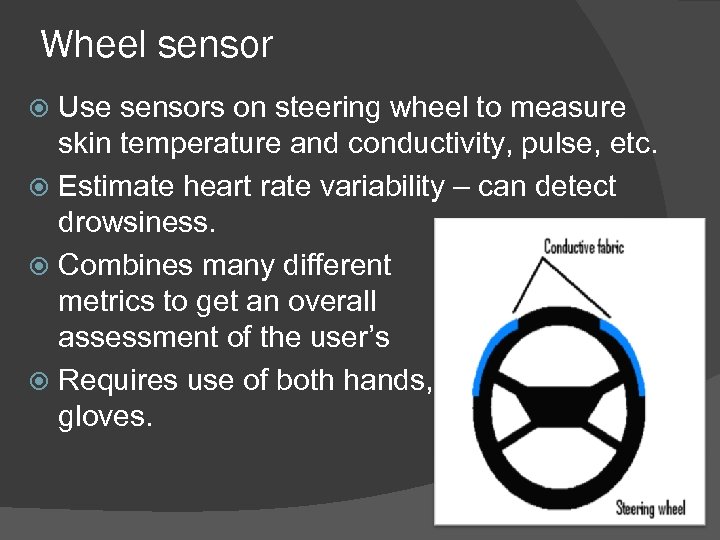 Wheel sensor Use sensors on steering wheel to measure skin temperature and conductivity, pulse, etc. Estimate heart rate variability – can detect drowsiness. Combines many different metrics to get an overall assessment of the user’s state. Requires use of both hands, without gloves.
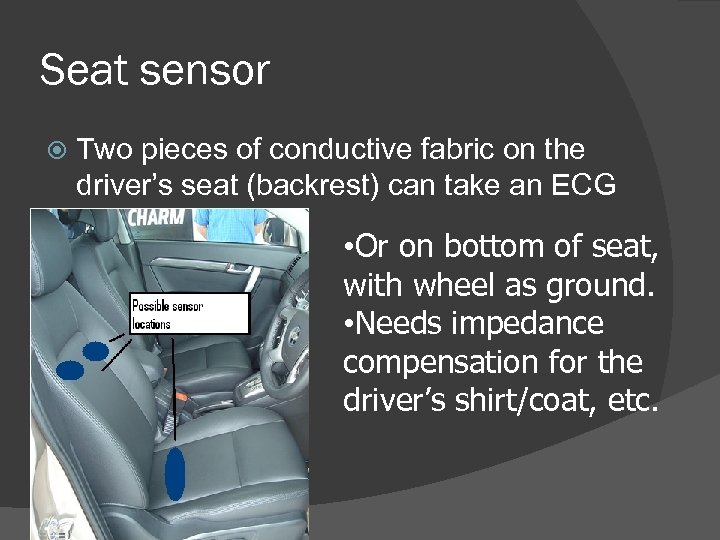 Seat sensor Two pieces of conductive fabric on the driver’s seat (backrest) can take an ECG - measurement. • Or on bottom of seat, with wheel as ground. • Needs impedance compensation for the driver’s shirt/coat, etc.
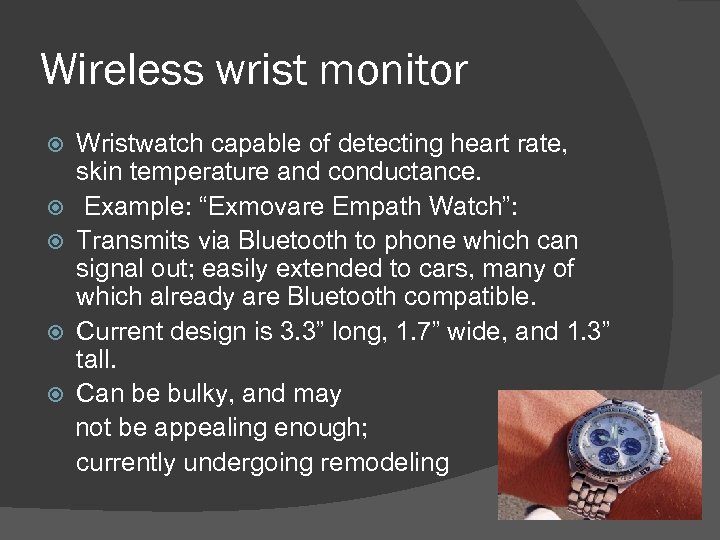 Wireless wrist monitor Wristwatch capable of detecting heart rate, skin temperature and conductance. Example: “Exmovare Empath Watch”: Transmits via Bluetooth to phone which can signal out; easily extended to cars, many of which already are Bluetooth compatible. Current design is 3. 3” long, 1. 7” wide, and 1. 3” tall. Can be bulky, and may not be appealing enough; currently undergoing remodeling
 Philip Pham ACT – DECISION MAKING
 Corrective and Prevention Actions Elevated Alarms a) Provide Visual Alarm (lights, signs, etc. ) b) Provide Audio Alarm (warning tone or voice) c) Recommend short nap (prevent car to start; studies show 15 -minute nap increases alertness to 4 -5 hours more) 2. Mechanical and Electronic Stimulations a) Counteract to the effects (steering wheel turn, lane drifting, speed change, etc. ) b) Apply brake to slow down to safety c) Dispatch for help if no response 1.
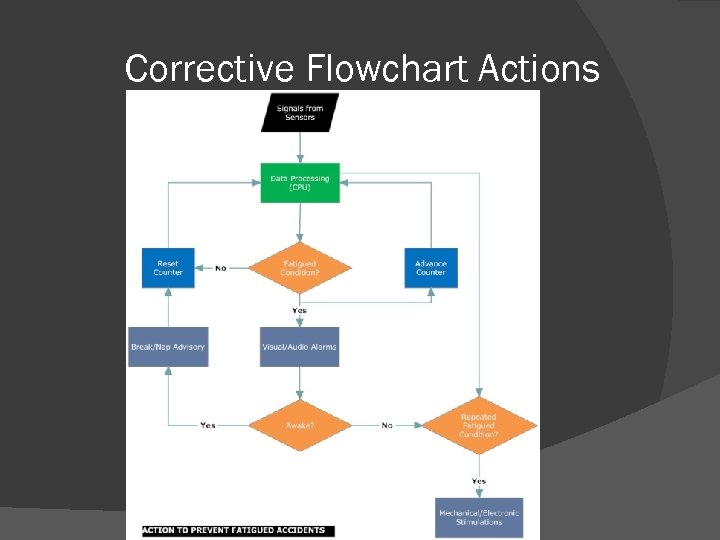 Corrective Flowchart Actions
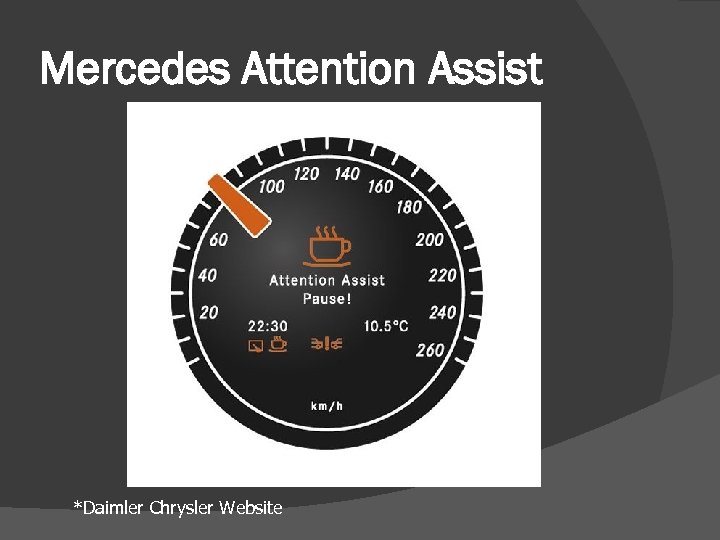 Mercedes Attention Assist *Daimler Chrysler Website
 Technology 1. Audio & Video Warning Circuits 2. Starter-Disabled Circuit 3. Auto-Pilot Control 4. Communication Protocol
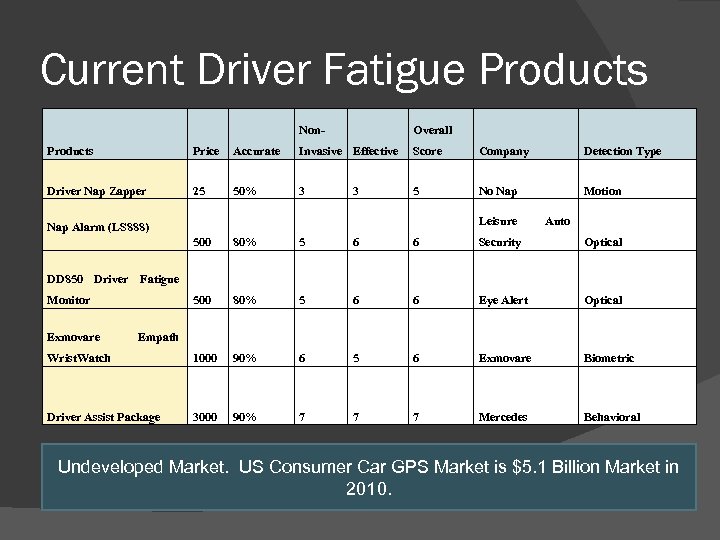 Current Driver Fatigue Products Non- Overall Products Price Accurate Invasive Effective Score Company Detection Type Driver Nap Zapper 25 50% 3 5 No Nap Motion 3 Leisure Nap Alarm (LS 888) Auto 500 80% 5 6 6 Security Optical 500 80% 5 6 6 Eye Alert Optical Wrist. Watch 1000 90% 6 5 6 Exmovare Biometric Driver Assist Package 3000 90% 7 7 7 Mercedes Behavioral DD 850 Driver Fatigue Monitor Exmovare Empath Undeveloped Market. US Consumer Car GPS Market is $5. 1 Billion Market in 2010.
 References Y. Lin, H. Leng, G. Yang, and H. Cai, “An intelligent noninvasive sensor for driver pulse wave measurement, ” IEEE Sensors J. , vol. 7, no. 5, pp. 790– 799, May 2007. X. Yu, “Real-time Nonintrusive Detection of Driver Drowsiness”, May 2009 US Department of Transportation, “An Evaluation of Emerging Driver Fatigue Detection Measures and Technologies”, June 2009 Y. Jie, Y. Da. Quan, W. Wei. Na, X. Xiao. Xia, and W. Hui, “Real-Time Detecting System of the Driver’s Fatigue”, 2006 Exmovere Holdings Inc, “The New Biotechnological Frontier: The Empath Watch”. Feb. 2011 http: //www. exmovere. com/pdf/Exmovere_Wearable_Sensor_Research. pdf S. Kar, M. Bhagat, and A. Routray, “EEG signal analysis for the assessment and quantification of driver’s fatigue”, June 2010 The 6 Most Common Causes of Automobile Crashes(2010). Retrieved February 9 th 2011, from http: //www. sixwise. com/newsletters/05/07/20/the_6_most_common_causes_of_automobile_crashes. h tm What causes Fatigue (2010), Retrieved February 21 st 2011, from http: //unsafetrucks. org/driver_fatigue. htm Kingman P. Strohl, M. D, Jesse Blatt, Ph. D, Forrest Council, Ph. D, Kate Georges, James Kiley, Ph. D, Roger Kurrus, Anne T. Mc. Cartt, Ph. D, Sharon L. Merritt, Ed. D. , R. N, Allan I. Pack, Ph. D. , M. D, Susan Rogus, R. N. , M. S. , Thomas Roth, Ph. D, Jane Stutts, Ph. D, Pat Waller, Ph. D. , David Willis, “Drowsy Driving and Automobile Crashes” (2010), Retrieved February 21 st 2011, from http: //www. nhtsa. gov/people/injury/drowsy_driving 1/drowsy. html#NCSDR/NHTSA
 References Continue Toshiyuki Matsuda, Masaaki Makikawa, “ ECG Monitoring of a Car Driver Using Capacitively-Coupled Electrodes” 30 th Annual International IEEE EMBS Conference , Vancouver, British Columbia, Canada, August 20 -24, 2008 Luis M. Bergasa, Jesús Nuevo, Miguel A. Sotelo, Rafael Barea, and María Elena Lopez “Real-Time System for Monitoring Driver Vigilance” IEEE Transactions on Intelligent Transportation Systems, vol. 7, no. 1, March, 2006 The John Hopkins university Applied Physics Laboratory “Technologies: Drowsy Driver Detection System” http: //www. jhuapl. edu/ott/technologies/featuredtech/DDDS/ George Washington University Center for Intelligent Systems Research “Driver Assistance: Drowsy/Fatigued Driver Detection” http: //www. cisr. gwu. edu/research/drowsy_details. html EURASIP Journal on Advances in Signal Processing Volume 2010 (2010), Article ID 438205 “Driver Drowsiness Warning System Using Visual Information for Both Diurnal and Nocturnal Illumination Conditions” http: //www. hindawi. com/journals/asp/2010/438205/ Jennifer F. May, Carryl L. Baldwin Transportation, “Driver fatigue: The importance of identifying causal factors of fatigue when considering detection and countermeasure technologies”, Research Part F 12 (2009) 218– 224 H. P. Greeley, E. Friets, , J. P. Wilson, S. Raghavan and J. Picone J. Berg, “Detecting Fatigue From Voice Using Speech Recognition”, 2006 IEEE International Symposium on Signal Processing and Information Technology