 Скачать презентацию Integrated Ocean Observing System IOOS Update Dave Zilkoski
1083d11342e88728320a15bd7ad1f302.ppt
- Количество слайдов: 17



Integrated Ocean Observing System (IOOS) Update Dave Zilkoski NOAA IOOS Project Manager National Oceanic and Atmospheric Administration (NOAA) October 17, 2006
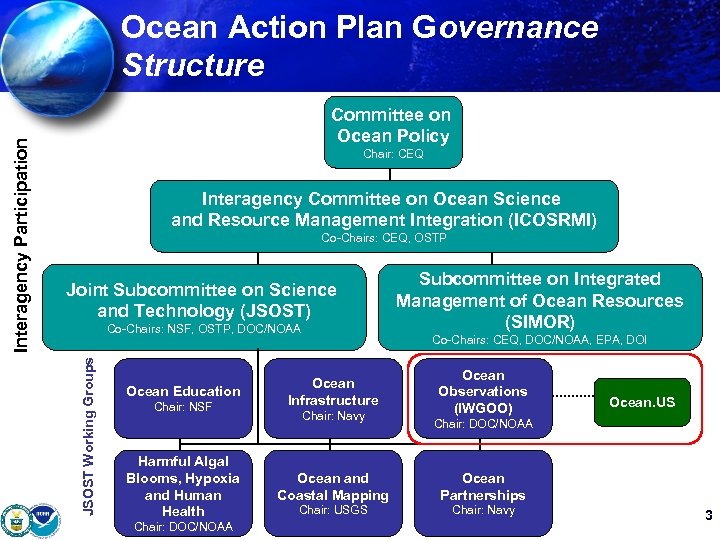
Committee on Ocean Policy Chair: CEQ Interagency Committee on Ocean Science and Resource Management Integration (ICOSRMI) Co-Chairs: CEQ, OSTP Joint Subcommittee on Science and Technology (JSOST) Co-Chairs: NSF, OSTP, DOC/NOAA JSOST Working Groups Interagency Participation Ocean Action Plan Governance Structure Ocean Education Chair: NSF Harmful Algal Blooms, Hypoxia and Human Health Chair: DOC/NOAA Subcommittee on Integrated Management of Ocean Resources (SIMOR) Co-Chairs: CEQ, DOC/NOAA, EPA, DOI Ocean Infrastructure Chair: Navy Ocean Observations (IWGOO) Ocean. US Chair: DOC/NOAA Ocean and Coastal Mapping Ocean Partnerships Chair: USGS Chair: Navy 3
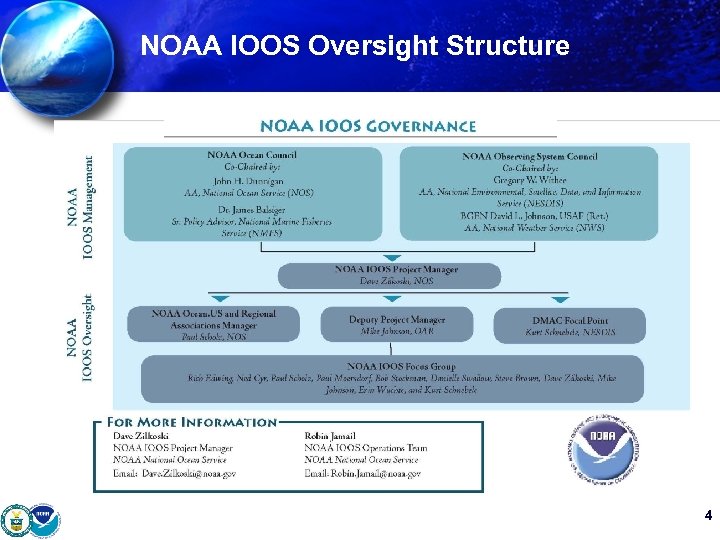
NOAA IOOS Oversight Structure 4
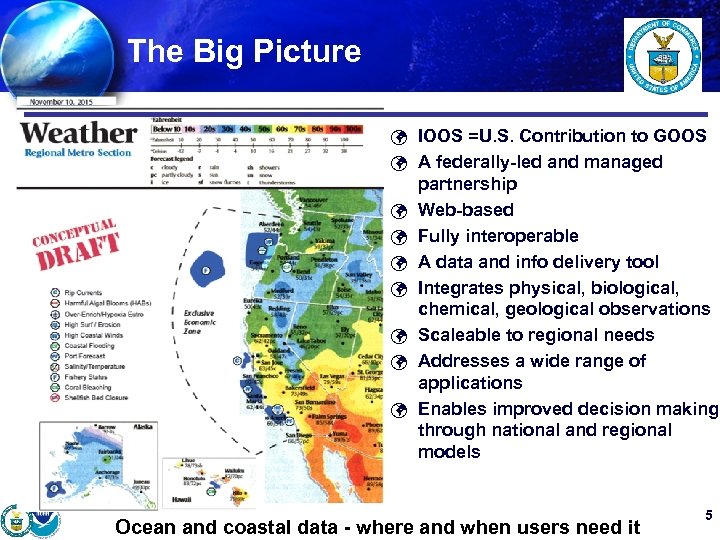
The Big Picture ü IOOS =U. S. Contribution to GOOS ü A federally-led and managed ü ü ü ü partnership Web-based Fully interoperable A data and info delivery tool Integrates physical, biological, chemical, geological observations Scaleable to regional needs Addresses a wide range of applications Enables improved decision making through national and regional models Ocean and coastal data - where and when users need it 5
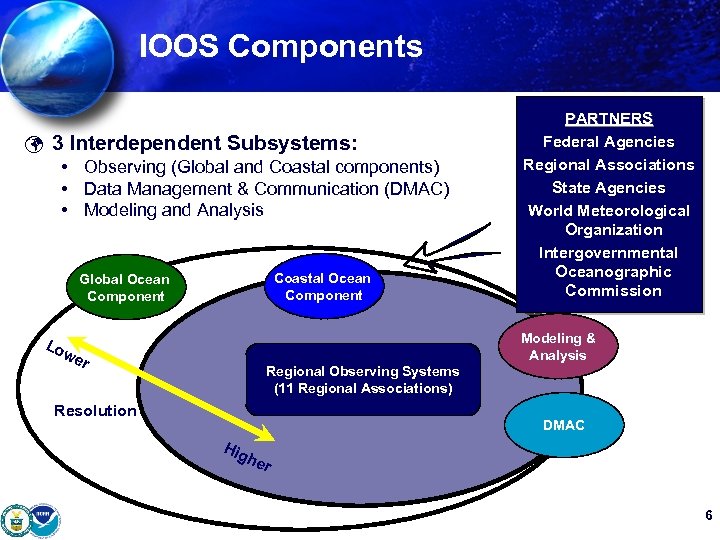
IOOS Components ü 3 Interdependent Subsystems: • Observing (Global and Coastal components) • Data Management & Communication (DMAC) • Modeling and Analysis Coastal Ocean Component Global Ocean Component PARTNERS Federal Agencies Regional Associations State Agencies World Meteorological Organization Intergovernmental Oceanographic Commission Modeling & Analysis Lo we r Regional Observing Systems (11 Regional Associations) Resolution DMAC Hig her 6
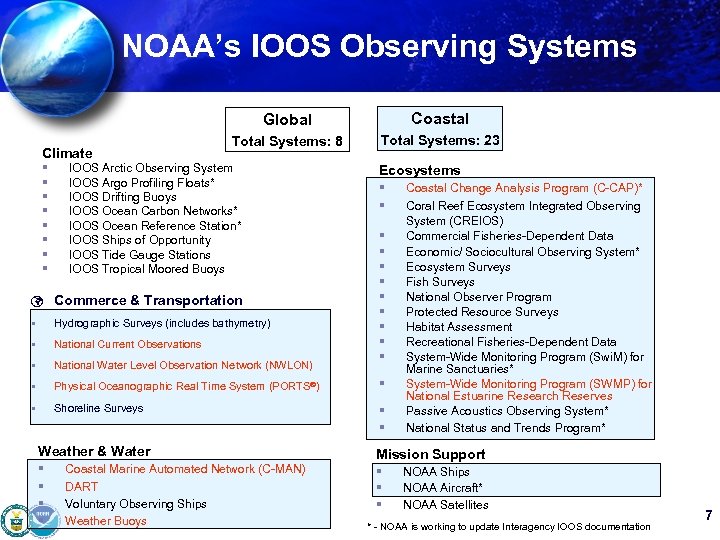
NOAA’s IOOS Observing Systems Global Climate § § § § Coastal Total Systems: 8 Total Systems: 23 IOOS Arctic Observing System IOOS Argo Profiling Floats* IOOS Drifting Buoys IOOS Ocean Carbon Networks* IOOS Ocean Reference Station* IOOS Ships of Opportunity IOOS Tide Gauge Stations IOOS Tropical Moored Buoys ü Commerce & Transportation Ecosystems § § § Hydrographic Surveys (includes bathymetry) § National Current Observations § National Water Level Observation Network (NWLON) § Physical Oceanographic Real Time System (PORTS®) § § Shoreline Surveys § § Coastal Change Analysis Program (C-CAP)* Coral Reef Ecosystem Integrated Observing System (CREIOS) Commercial Fisheries-Dependent Data Economic/ Sociocultural Observing System* Ecosystem Surveys Fish Surveys National Observer Program Protected Resource Surveys Habitat Assessment Recreational Fisheries-Dependent Data System-Wide Monitoring Program (Swi. M) for Marine Sanctuaries* System-Wide Monitoring Program (SWMP) for National Estuarine Research Reserves Passive Acoustics Observing System* National Status and Trends Program* Weather & Water Mission Support § § § § Coastal Marine Automated Network (C-MAN) DART Voluntary Observing Ships Weather Buoys NOAA Ships NOAA Aircraft* NOAA Satellites * - NOAA is working to update Interagency IOOS documentation 7
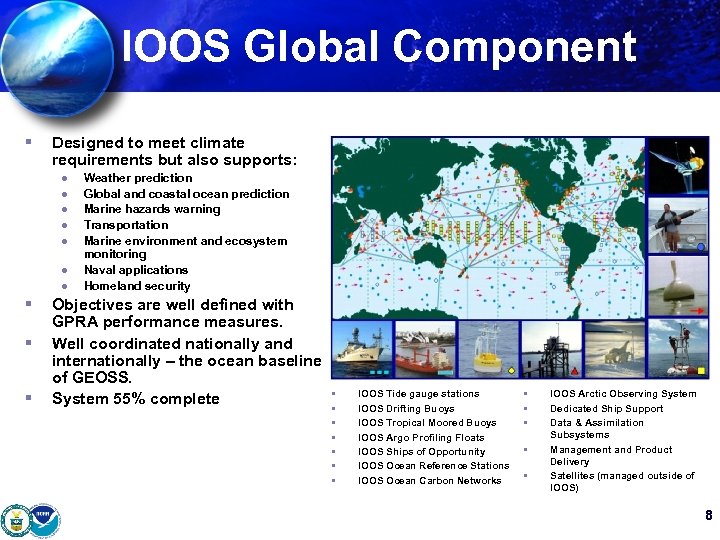
IOOS Global Component § Designed to meet climate requirements but also supports: l l l l § § § Weather prediction Global and coastal ocean prediction Marine hazards warning Transportation Marine environment and ecosystem monitoring Naval applications Homeland security Objectives are well defined with GPRA performance measures. Well coordinated nationally and internationally – the ocean baseline of GEOSS. System 55% complete § § § § IOOS Tide gauge stations IOOS Drifting Buoys IOOS Tropical Moored Buoys IOOS Argo Profiling Floats IOOS Ships of Opportunity IOOS Ocean Reference Stations IOOS Ocean Carbon Networks § § § IOOS Arctic Observing System Dedicated Ship Support Data & Assimilation Subsystems Management and Product Delivery Satellites (managed outside of IOOS) 8
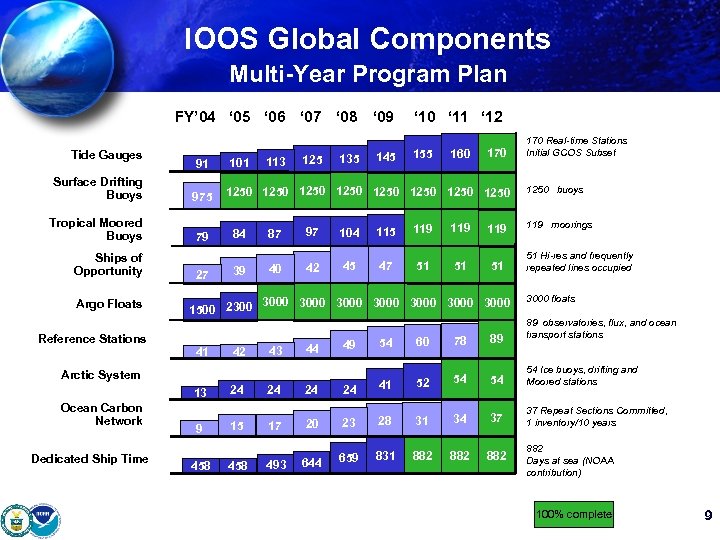
IOOS Global Components Multi-Year Program Plan FY’ 04 ‘ 05 ‘ 06 Tide Gauges Surface Drifting Buoys Tropical Moored Buoys Ships of Opportunity Argo Floats Reference Stations 113 ‘ 07 125 ‘ 08 135 145 155 160 170 101 975 1250 1250 79 27 84 39 87 40 97 104 115 119 119 42 45 47 51 51 51 3000 3000 1500 2300 41 13 Dedicated Ship Time ‘ 10 ‘ 11 ‘ 12 91 42 43 44 49 Arctic System Ocean Carbon Network ‘ 09 9 458 24 15 458 1250 buoys 119 moorings 51 Hi-res and frequently repeated lines occupied 3000 floats 54 60 78 89 89 observatories, flux, and ocean transport stations 54 54 54 Ice buoys, drifting and Moored stations 37 Repeat Sections Committed, 1 inventory/10 years 24 24 41 52 17 20 23 28 31 34 37 493 644 659 831 882 882 24 170 Real-time Stations Initial GCOS Subset 882 Days at sea (NOAA contribution) 100% complete 9
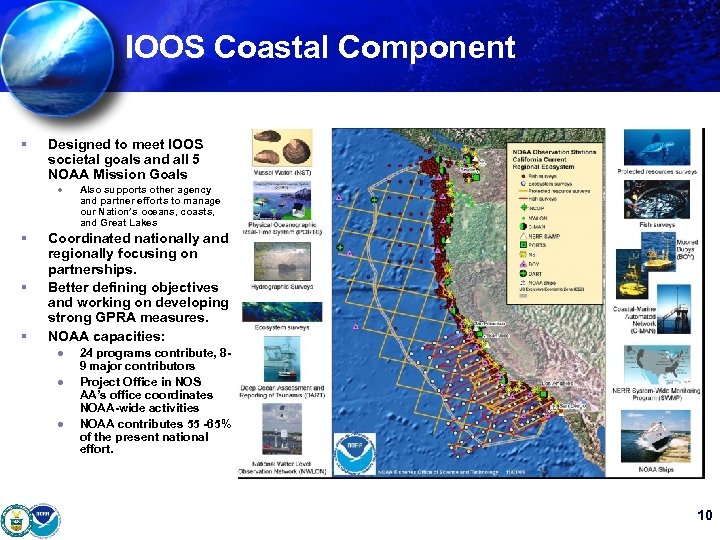
IOOS Coastal Component § Designed to meet IOOS societal goals and all 5 NOAA Mission Goals l § § § Also supports other agency and partner efforts to manage our Nation’s oceans, coasts, and Great Lakes Coordinated nationally and regionally focusing on partnerships. Better defining objectives and working on developing strong GPRA measures. NOAA capacities: l l l 24 programs contribute, 89 major contributors Project Office in NOS AA’s office coordinates NOAA-wide activities NOAA contributes 55 -65% of the present national effort. 10
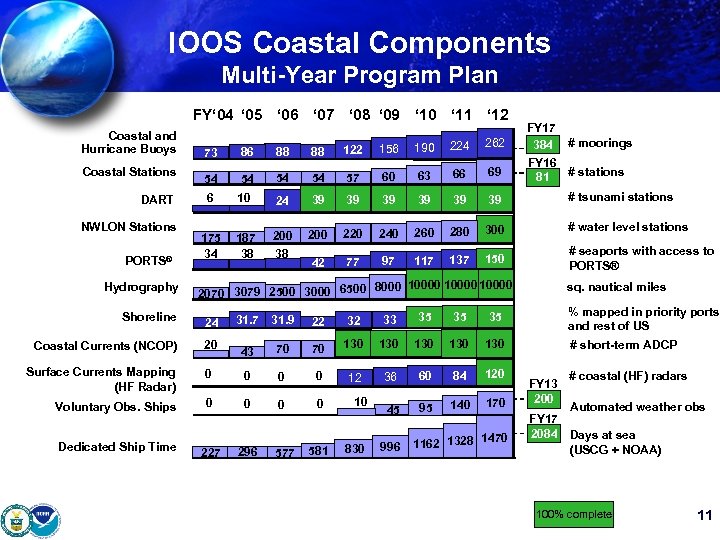
IOOS Coastal Components Multi-Year Program Plan FY‘ 04 ‘ 05 Coastal and Hurricane Buoys Coastal Stations DART NWLON Stations PORTS® Hydrography Shoreline Coastal Currents (NCOP) 73 86 ‘ 07 88 88 ‘ 10 ‘ 11 ‘ 12 156 190 224 262 FY 17 384 66 69 FY 16 # stations 81 122 # moorings 54 54 57 60 63 6 10 24 39 39 39 # tsunami stations 175 34 187 38 200 220 240 260 280 300 # water level stations 42 77 97 117 137 150 # seaports with access to PORTS® 8000 10000 2070 3079 2500 3000 6500 24 20 31. 7 31. 9 22 32 33 35 35 43 70 70 130 130 36 60 84 120 45 95 140 170 0 0 Voluntary Obs. Ships 0 0 577 581 227 % mapped in priority ports and rest of US 130 12 sq. nautical miles 35 Surface Currents Mapping (HF Radar) Dedicated Ship Time ‘ 08 ‘ 09 296 10 830 996 1470 1162 1328 # short-term ADCP FY 13 200 # coastal (HF) radars Automated weather obs FY 17 2084 Days at sea (USCG + NOAA) 100% complete 11
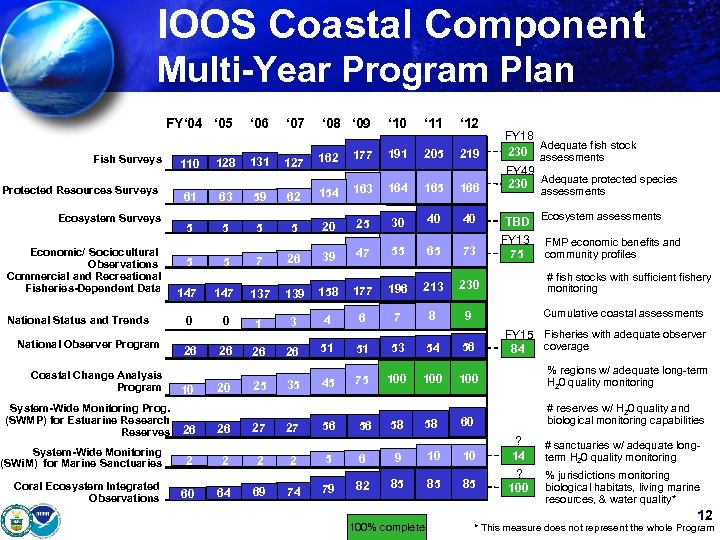
IOOS Coastal Component Multi-Year Program Plan FY‘ 04 ‘ 05 ‘ 06 ‘ 07 ‘ 08 ‘ 09 ‘ 10 ‘ 11 ‘ 12 110 128 131 127 162 177 191 205 219 FY 18 Adequate fish stock 230 assessments 61 63 59 62 154 163 164 165 166 FY 49 230 Adequate protected species 5 5 20 25 30 40 40 TBD Ecosystem assessments 26 39 47 55 65 73 177 196 213 230 6 7 8 9 56 Fish Surveys Protected Resources Surveys Ecosystem Surveys Economic/ Sociocultural Observations Commercial and Recreational Fisheries-Dependent Data National Status and Trends National Observer Program Coastal Change Analysis Program System-Wide Monitoring Prog. (SWMP) for Estuarine Research Reserves System-Wide Monitoring (SWi. M) for Marine Sanctuaries Coral Ecosystem Integrated Observations 5 5 7 147 139 158 0 0 1 3 4 26 10 26 2 60 26 2 64 26 25 27 2 69 assessments FY 13 75 FMP economic benefits and community profiles # fish stocks with sufficient fishery monitoring Cumulative coastal assessments FY 15 Fisheries with adequate observer coverage 84 26 51 51 53 54 35 45 75 100 100 % regions w/ adequate long-term H 20 quality monitoring 58 60 # reserves w/ H 20 quality and biological monitoring capabilities 56 2 5 6 9 10 10 79 82 85 85 85 74 56 58 27 100% complete ? 14 ? 100 # sanctuaries w/ adequate longterm H 20 quality monitoring % jurisdictions monitoring biological habitats, living marine resources, & water quality* 12 * This measure does not represent the whole Program
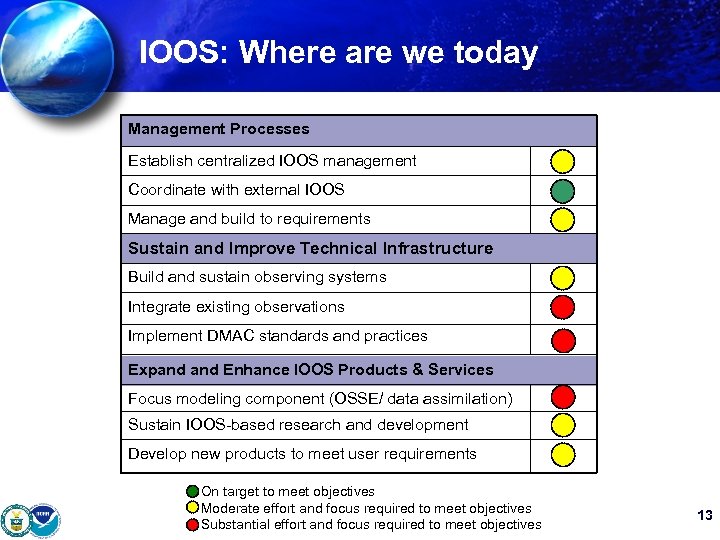
IOOS: Where are we today Management Processes Establish centralized IOOS management Coordinate with external IOOS Manage and build to requirements Sustain and Improve Technical Infrastructure Build and sustain observing systems Integrate existing observations Implement DMAC standards and practices Expand Enhance IOOS Products & Services Focus modeling component (OSSE/ data assimilation) Sustain IOOS-based research and development Develop new products to meet user requirements On target to meet objectives Moderate effort and focus required to meet objectives Substantial effort and focus required to meet objectives 13
NOAA FY 05 -06 Accomplishments ü Observations • Converted NOAA Weather Buoys to multi-purpose platforms • Leveraged existing platforms to fill observation gaps by adding 234 oceanographic sensors on 130 platforms by January 2007 • NERRS System Wide Monitoring Program Enhancements – Data Telemetry added for 27 weather stations and 35 water quality stations ü Data Management & Communications • Completed IOOS conceptual designs • Established interagency DMAC standards approval process - first set of standards have been submitted for approval • Established Data Assembly Center at NDBC which provides 38% more data on the NWS Telecommunications Gateway (NWSTG) for ingestion in NOAA models and forecasts ü Coastal Ocean Observing Technology Systems (COTS) • Regional platforms are augmenting NOAA observations • 5. 025 million observations/year • 25% from NOAA assets; 30% from other federal assets; and 45% from COTS recipients 14
NOAA FY 05 -06 Accomplishments ü Modeling and Analysis • Demonstrated community modeling approach - Created standardized inputs and outputs for next generation storm surge model ü Project Management • Sustained Ocean. US interagency planning office • Established interagency priorities ü Regional Association Development • RAs developed needs assessments and business plans • Regional governance structures established ü Research and Development • Applied research for a national High Frequency Radar Network • Sensor development of ecosystem observation technologies ü Education and Outreach • Developing NOAA Ocean Data Education (NODE) portal for data integration, visualization and interpretation for non-scientists 15
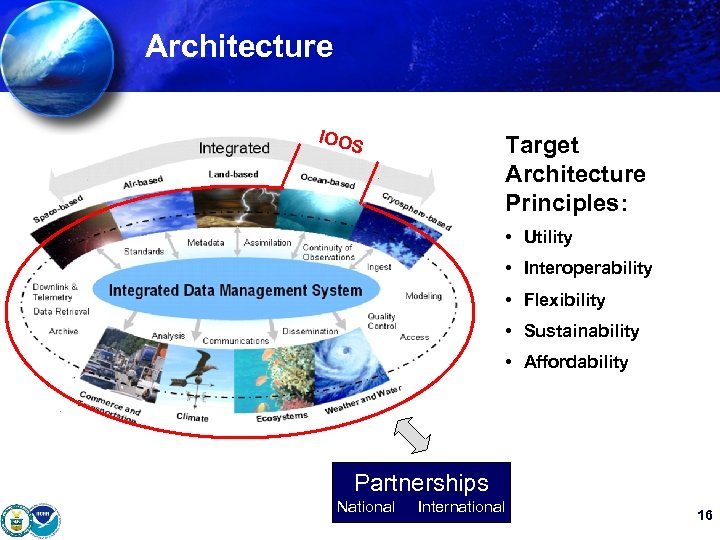
Architecture IOOS Target Architecture Principles: • Utility • Interoperability • Flexibility • Sustainability • Affordability Partnerships National International 16
Next Steps… ü Build IOOS community standards and protocols ü Establish formal interagency program structure ü Continue technology development ü Build partnerships ü Move forward on Conceptual Designs ü Comment on the Ocean Research Priorities Plan • Public comment period open until October 20 • http: //ocean. ceq. gov/about/sup_jsost_public_comment. html 17
Thank You
Скачать презентацию Integrated Ocean Observing System IOOS Update Dave Zilkoski
1083d11342e88728320a15bd7ad1f302.ppt