


 Скачать презентацию Integrated Marketplace Commission Staff Education March 26 2012
2f8aa1d9414bcac1a5694fae7e88a66c.ppt
- Количество слайдов: 194

 Integrated Marketplace Commission Staff Education March 26, 2012
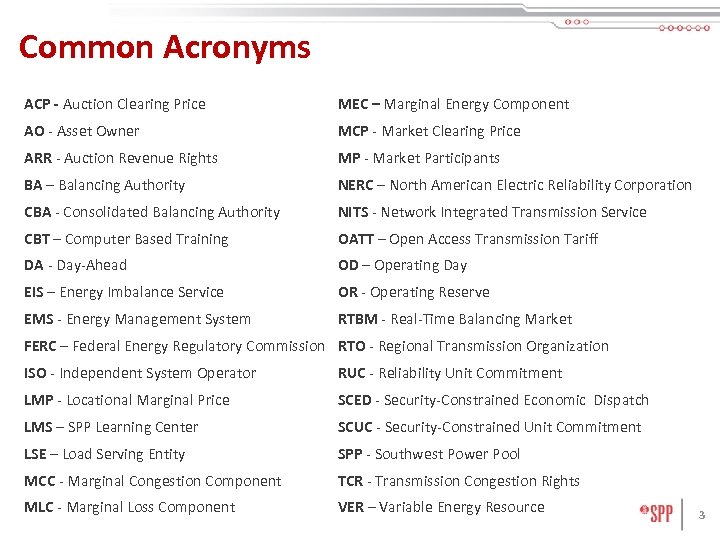 Common Acronyms ACP - Auction Clearing Price MEC – Marginal Energy Component AO - Asset Owner MCP - Market Clearing Price ARR - Auction Revenue Rights MP - Market Participants BA – Balancing Authority NERC – North American Electric Reliability Corporation CBA - Consolidated Balancing Authority NITS - Network Integrated Transmission Service CBT – Computer Based Training OATT – Open Access Transmission Tariff DA - Day-Ahead OD – Operating Day EIS – Energy Imbalance Service OR - Operating Reserve EMS - Energy Management System RTBM - Real-Time Balancing Market FERC – Federal Energy Regulatory Commission RTO - Regional Transmission Organization ISO - Independent System Operator RUC - Reliability Unit Commitment LMP - Locational Marginal Price SCED - Security-Constrained Economic Dispatch LMS – SPP Learning Center SCUC - Security-Constrained Unit Commitment LSE – Load Serving Entity SPP - Southwest Power Pool MCC - Marginal Congestion Component TCR - Transmission Congestion Rights MLC - Marginal Loss Component VER – Variable Energy Resource 3
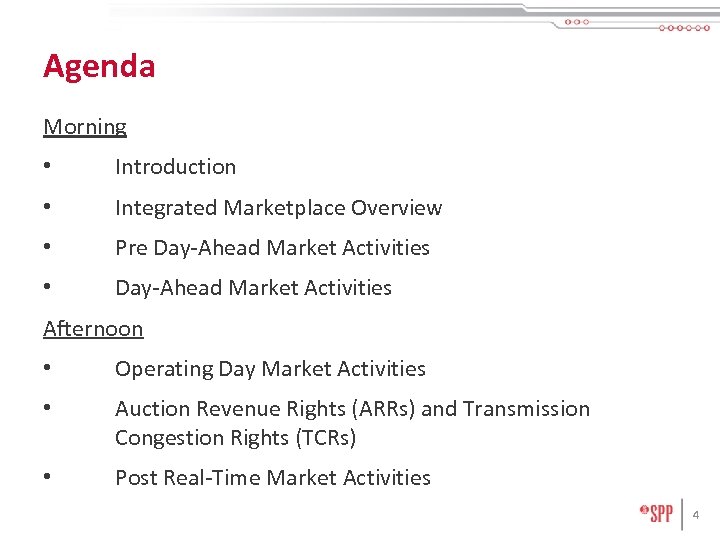 Agenda Morning • Introduction • Integrated Marketplace Overview • Pre Day-Ahead Market Activities • Day-Ahead Market Activities Afternoon • Operating Day Market Activities • Auction Revenue Rights (ARRs) and Transmission Congestion Rights (TCRs) • Post Real-Time Market Activities 4
 Section 1 INTRODUCTION 5
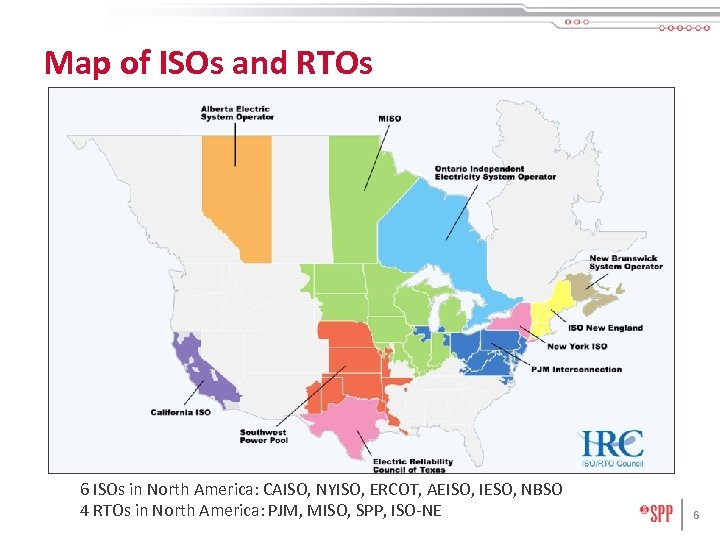 Map of ISOs and RTOs 6 ISOs in North America: CAISO, NYISO, ERCOT, AEISO, IESO, NBSO 4 RTOs in North America: PJM, MISO, SPP, ISO-NE 6
 Integrated Marketplace Net Benefits • Projected savings around $45 -$100 Million/Year • Reduce total energy costs through centralized unit commitment while maintaining reliable operations • Day-Ahead Market allows additional price assurance capability prior to real-time • Includes new markets for Operating Reserve to support implementation of Consolidated Balancing Authority (CBA) and facilitate reserve sharing 7
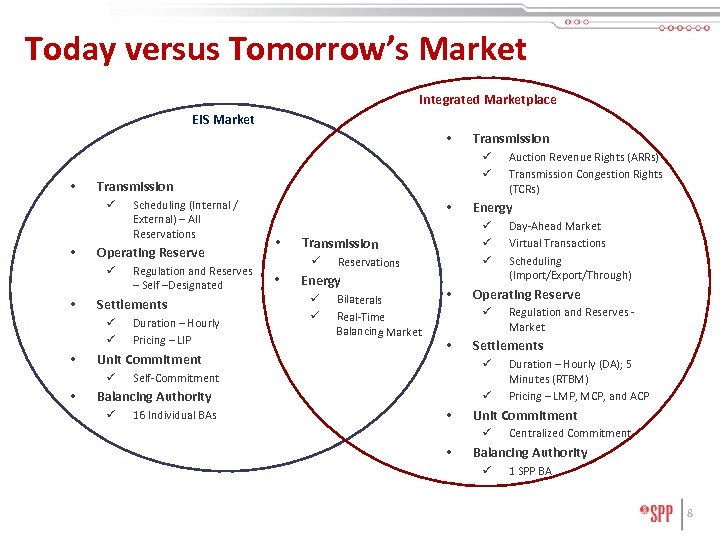 Today versus Tomorrow’s Market Integrated Marketplace EIS Market • • • Duration – Hourly Pricing – LIP Unit Commitment ü • Regulation and Reserves – Self –Designated Settlements ü ü • Scheduling (Internal / External) – All Reservations Operating Reserve ü • ü ü Transmission ü • • Transmission ü • Reservations Energy ü ü Bilaterals Real-Time Balancing Market • 16 Individual BAs ü • Duration – Hourly (DA); 5 Minutes (RTBM) Pricing – LMP, MCP, and ACP Unit Commitment ü • Regulation and Reserves Market Settlements ü Self-Commitment Day-Ahead Market Virtual Transactions Scheduling (Import/Export/Through) Operating Reserve ü • Auction Revenue Rights (ARRs) Transmission Congestion Rights (TCRs) Energy ü ü ü Balancing Authority ü Transmission Centralized Commitment Balancing Authority ü 1 SPP BA 8
 Section 2 INTEGRATED MARKETPLACE OVERVIEW 9
 Topics Covered • SPP Roles and Responsibilities • Market Participant Roles and Responsibilities • System Models Configuration • Roles and responsibilities of Market Monitoring • Integrated Marketplace Processes and Products • Market Pricing 10
 INTEGRATED MARKETPLACE OVERVIEW: EVOLUTION OF SPP AND THE INTEGRATED MARKETPLACE 11
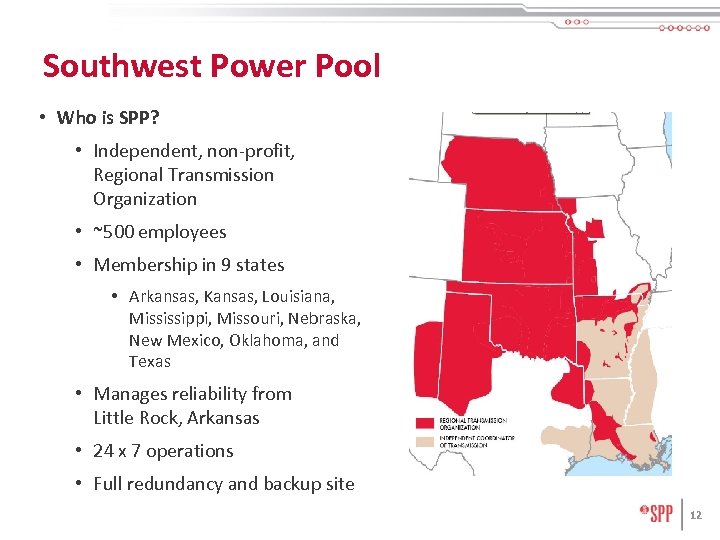 Southwest Power Pool • Who is SPP? • Independent, non-profit, Regional Transmission Organization • ~500 employees • Membership in 9 states • Arkansas, Kansas, Louisiana, Mississippi, Missouri, Nebraska, New Mexico, Oklahoma, and Texas • Manages reliability from Little Rock, Arkansas • 24 x 7 operations • Full redundancy and backup site 12
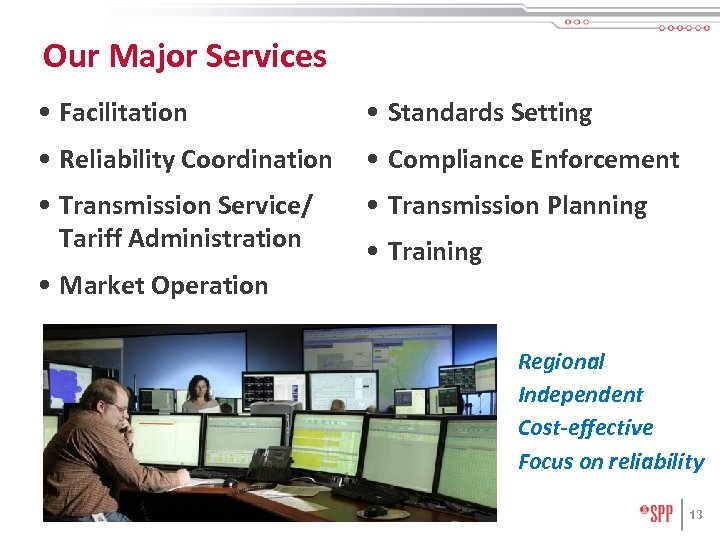 Our Major Services • Facilitation • Standards Setting • Reliability Coordination • Compliance Enforcement • Transmission Service/ Tariff Administration • Transmission Planning • Market Operation • Training Regional Independent Cost-effective Focus on reliability 13
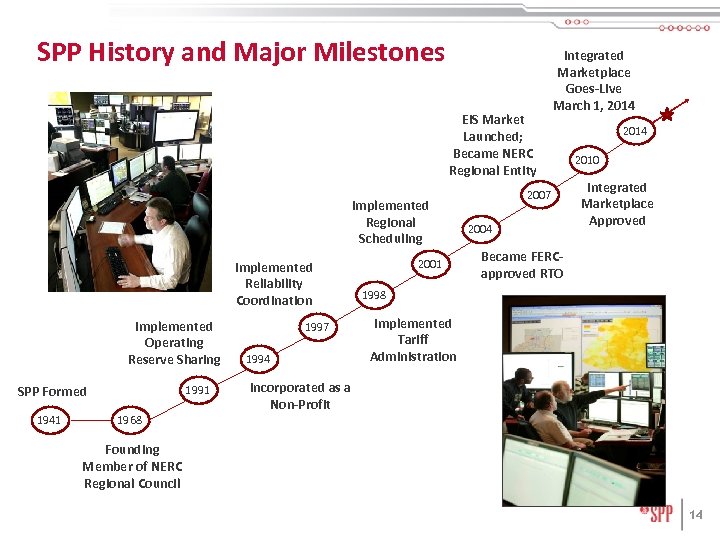 SPP History and Major Milestones EIS Market Launched; Became NERC Regional Entity Implemented Regional Scheduling Implemented Reliability Coordination Implemented Operating Reserve Sharing SPP Formed 1941 1991 1968 1997 1994 2001 Integrated Marketplace Goes-Live March 1, 2014 2007 2004 2010 Integrated Marketplace Approved Became FERCapproved RTO 1998 Implemented Tariff Administration Incorporated as a Non-Profit Founding Member of NERC Regional Council 14
 SPP Roles and Responsibilities • Post implementation of the Integrated Marketplace, SPP is responsible for: • Providing all market services for Energy, Operating Reserve, and Transmission Service in accordance with the Open Access Transmission Tariff (OATT) and Market Protocols • Managing and administering the Tariff • Acting as the centralized SPP Balancing Authority • Providing reliable operation of the transmission system • Administering the Day-Ahead, Real-Time, Operating Reserve, and Transmission Congestion Rights Markets 15
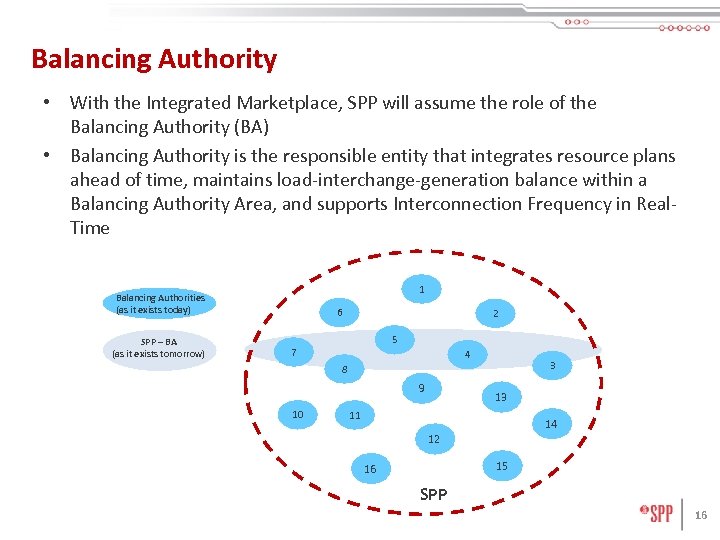 Balancing Authority • With the Integrated Marketplace, SPP will assume the role of the Balancing Authority (BA) • Balancing Authority is the responsible entity that integrates resource plans ahead of time, maintains load-interchange-generation balance within a Balancing Authority Area, and supports Interconnection Frequency in Real. Time 1 Balancing Authorities (as it exists today) SPP – BA (as it exists tomorrow) 6 2 5 7 4 3 8 9 10 13 11 14 12 15 16 SPP 16
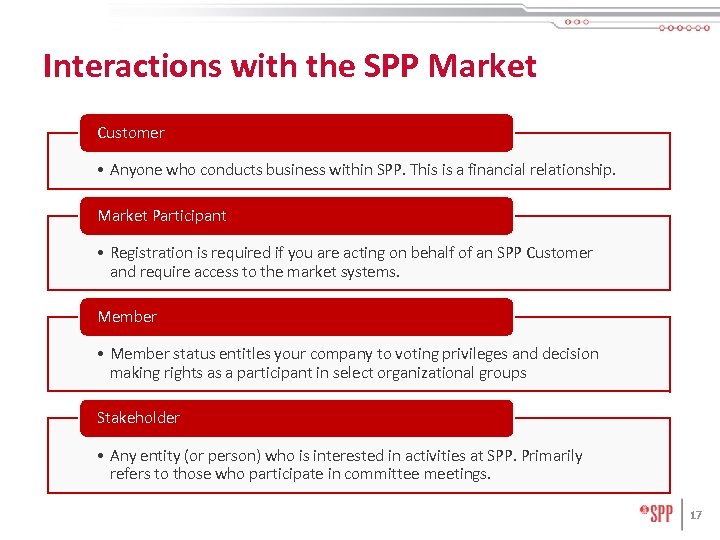 Interactions with the SPP Market Customer • Anyone who conducts business within SPP. This is a financial relationship. Market Participant • Registration is required if you are acting on behalf of an SPP Customer and require access to the market systems. Member • Member status entitles your company to voting privileges and decision making rights as a participant in select organizational groups Stakeholder • Any entity (or person) who is interested in activities at SPP. Primarily refers to those who participate in committee meetings. 17
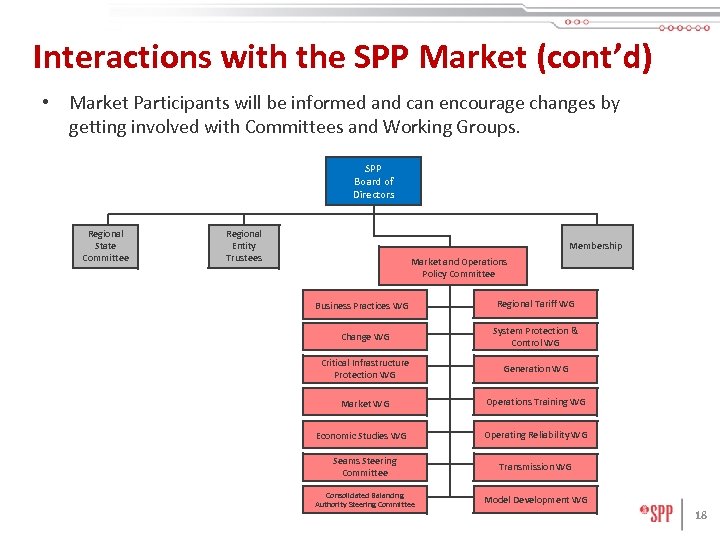 Interactions with the SPP Market (cont’d) • Market Participants will be informed and can encourage changes by getting involved with Committees and Working Groups. SPP Board of Directors Regional State Committee Regional Entity Trustees Membership Market and Operations Policy Committee Business Practices WG Regional Tariff WG Change WG System Protection & Control WG Critical Infrastructure Protection WG Generation WG Market WG Operations Training WG Economic Studies WG Operating Reliability WG Seams Steering Committee Transmission WG Consolidated Balancing Authority Steering Committee Model Development WG 18
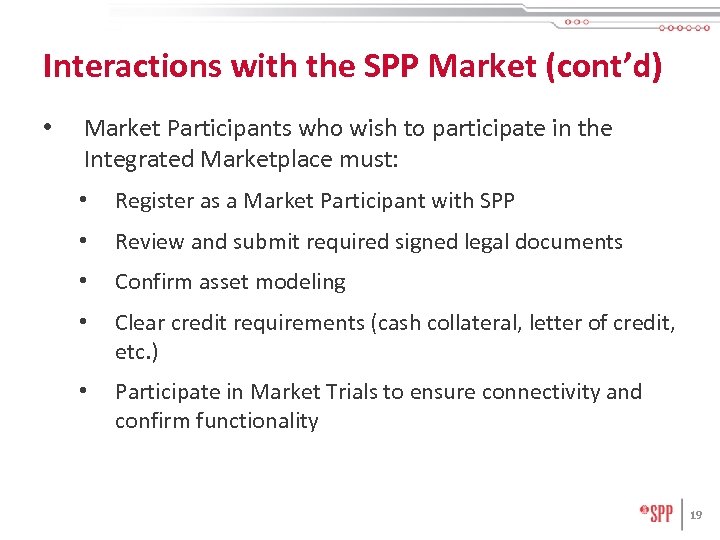 Interactions with the SPP Market (cont’d) • Market Participants who wish to participate in the Integrated Marketplace must: • Register as a Market Participant with SPP • Review and submit required signed legal documents • Confirm asset modeling • Clear credit requirements (cash collateral, letter of credit, etc. ) • Participate in Market Trials to ensure connectivity and confirm functionality 19
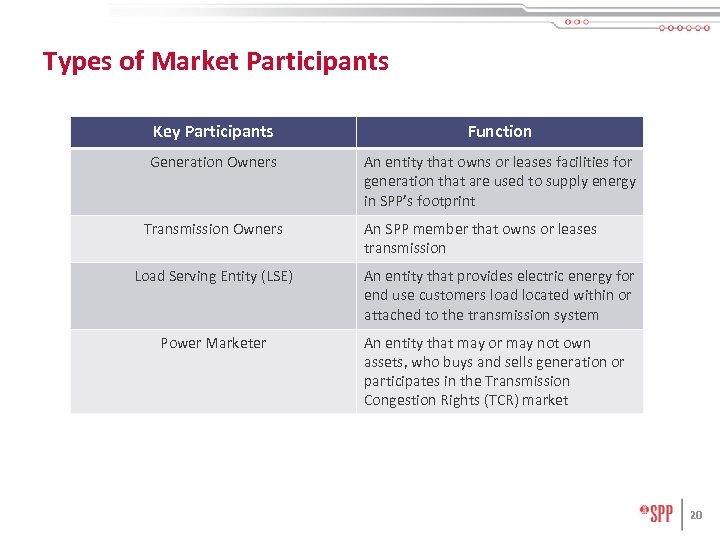 Types of Market Participants Key Participants Function Generation Owners An entity that owns or leases facilities for generation that are used to supply energy in SPP’s footprint Transmission Owners Load Serving Entity (LSE) Power Marketer An SPP member that owns or leases transmission An entity that provides electric energy for end use customers load located within or attached to the transmission system An entity that may or may not own assets, who buys and sells generation or participates in the Transmission Congestion Rights (TCR) market 20
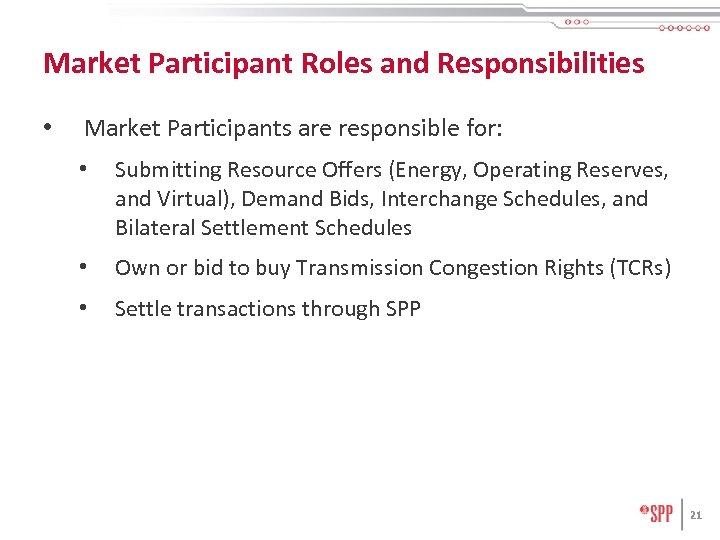 Market Participant Roles and Responsibilities • Market Participants are responsible for: • Submitting Resource Offers (Energy, Operating Reserves, and Virtual), Demand Bids, Interchange Schedules, and Bilateral Settlement Schedules • Own or bid to buy Transmission Congestion Rights (TCRs) • Settle transactions through SPP 21
 INTEGRATED MARKETPLACE OVERVIEW: MARKET MONITORING 22
 Market Monitoring Objective - Ensure the integrity of the SPP markets Two Primary Responsibilities 1. Monitoring and prevention abusive practices by Market Participants • Market power abuse • Market manipulation and gaming 2. Monitoring and improving market efficiency • Identify market design flaws and recommend changes • Monitor system operators to identify and correct inefficient processes or procedures 23
 Monitoring Reports • Annual / Monthly reports – Required under SPP Tariff – Provides overview of market activities and highlights any major developments • Special Studies – Demand Response Assessment – External Generation Access Assessment • FERC weekly pricing updates – Pricing changes – Congestion updates 24
 INTEGRATED MARKETPLACE OVERVIEW: SYSTEM MODELS 25
 Network Model • Physical representation of the Transmission System Network Model where electrical equipment components (e. g. generators, loads, transmission lines, and transformers) connect 26
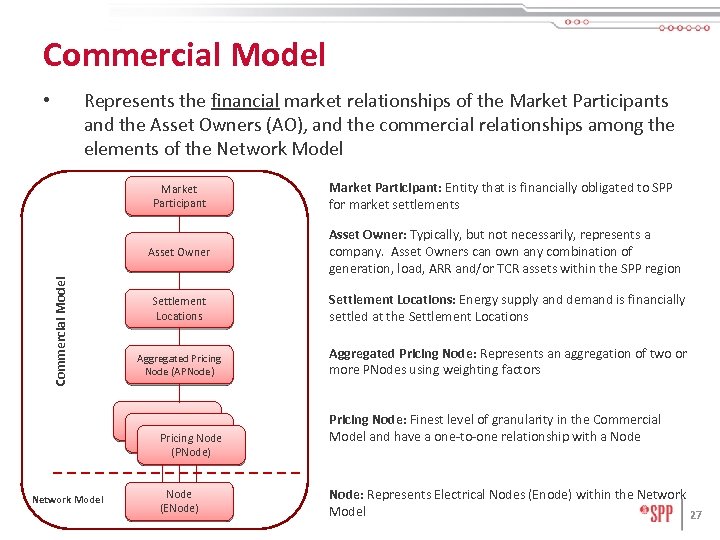 Commercial Model Represents the financial market relationships of the Market Participants and the Asset Owners (AO), and the commercial relationships among the elements of the Network Model • Market Participant: Entity that is financially obligated to SPP for market settlements Commercial Model Asset Owner: Typically, but not necessarily, represents a company. Asset Owners can own any combination of generation, load, ARR and/or TCR assets within the SPP region Settlement Locations: Energy supply and demand is financially settled at the Settlement Locations Aggregated Pricing Node (APNode) Aggregated Pricing Node: Represents an aggregation of two or more PNodes using weighting factors Pricing Node (PNode) Network Model Node (ENode) Pricing Node: Finest level of granularity in the Commercial Model and have a one-to-one relationship with a Node: Represents Electrical Nodes (Enode) within the Network Model 27
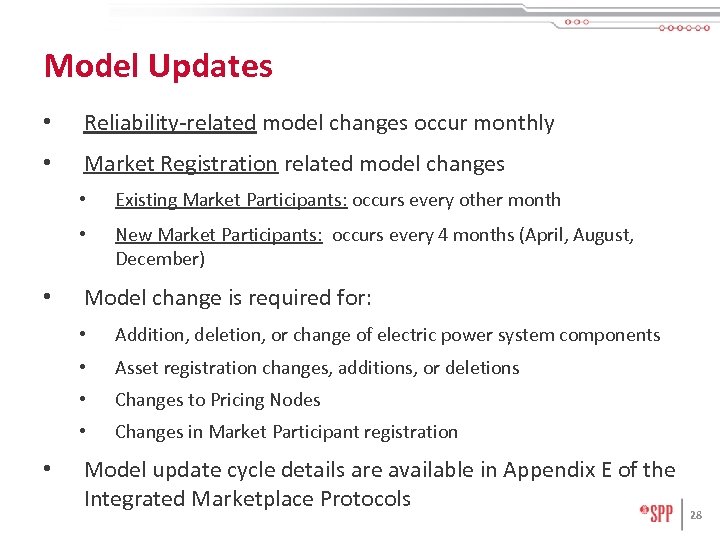 Model Updates • Reliability-related model changes occur monthly • Market Registration related model changes • • • Existing Market Participants: occurs every other month New Market Participants: occurs every 4 months (April, August, December) Model change is required for: • • Asset registration changes, additions, or deletions • Changes to Pricing Nodes • • Addition, deletion, or change of electric power system components Changes in Market Participant registration Model update cycle details are available in Appendix E of the Integrated Marketplace Protocols 28
 INTEGRATED MARKETPLACE OVERVIEW: MARKETPLACE PROCESSES, PRODUCTS AND TIMELINE 29
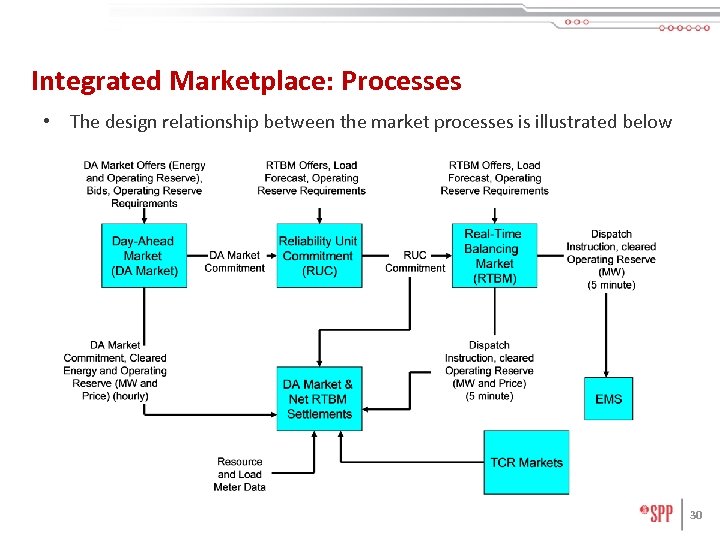 Integrated Marketplace: Processes • The design relationship between the market processes is illustrated below 30
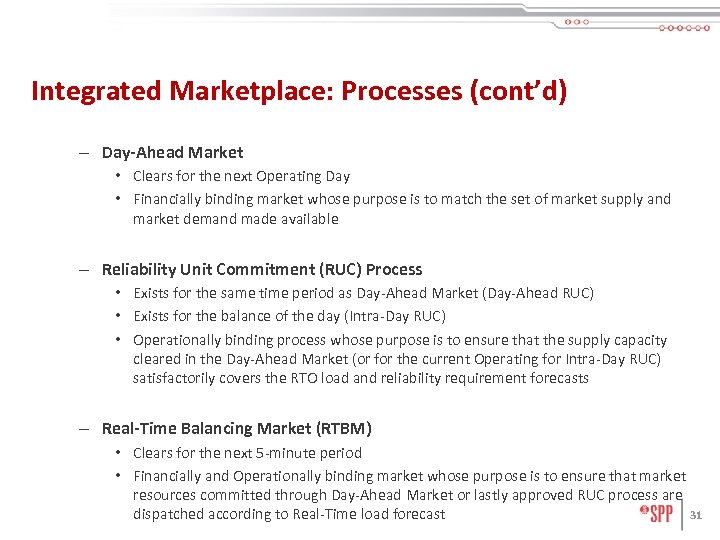 Integrated Marketplace: Processes (cont’d) – Day-Ahead Market • Clears for the next Operating Day • Financially binding market whose purpose is to match the set of market supply and market demand made available – Reliability Unit Commitment (RUC) Process • Exists for the same time period as Day-Ahead Market (Day-Ahead RUC) • Exists for the balance of the day (Intra-Day RUC) • Operationally binding process whose purpose is to ensure that the supply capacity cleared in the Day-Ahead Market (or for the current Operating for Intra-Day RUC) satisfactorily covers the RTO load and reliability requirement forecasts – Real-Time Balancing Market (RTBM) • Clears for the next 5 -minute period • Financially and Operationally binding market whose purpose is to ensure that market resources committed through Day-Ahead Market or lastly approved RUC process are 31 dispatched according to Real-Time load forecast
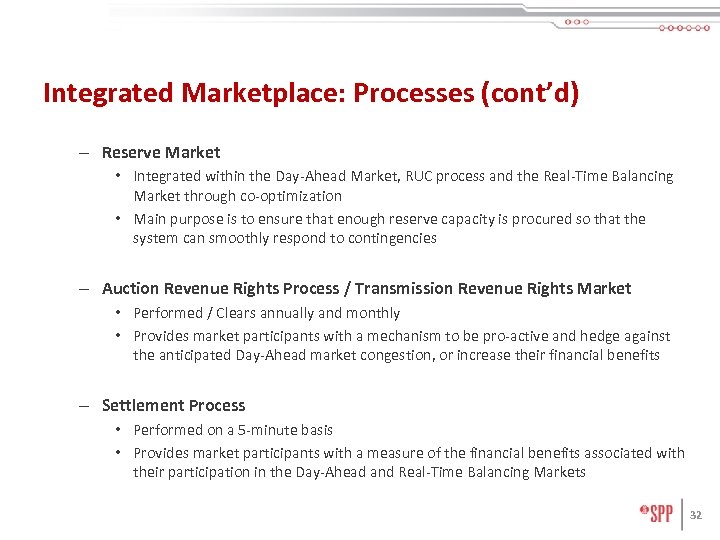 Integrated Marketplace: Processes (cont’d) – Reserve Market • Integrated within the Day-Ahead Market, RUC process and the Real-Time Balancing Market through co-optimization • Main purpose is to ensure that enough reserve capacity is procured so that the system can smoothly respond to contingencies – Auction Revenue Rights Process / Transmission Revenue Rights Market • Performed / Clears annually and monthly • Provides market participants with a mechanism to be pro-active and hedge against the anticipated Day-Ahead market congestion, or increase their financial benefits – Settlement Process • Performed on a 5 -minute basis • Provides market participants with a measure of the financial benefits associated with their participation in the Day-Ahead and Real-Time Balancing Markets 32
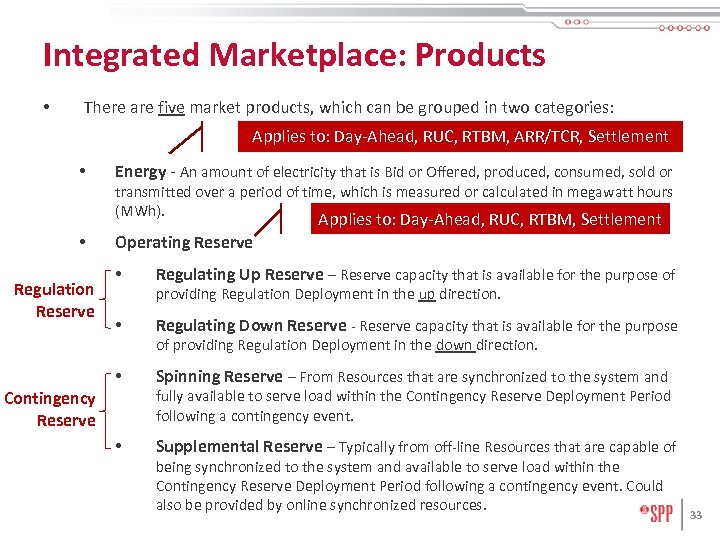 Integrated Marketplace: Products • There are five market products, which can be grouped in two categories: Applies to: Day-Ahead, RUC, RTBM, ARR/TCR, Settlement • Energy - An amount of electricity that is Bid or Offered, produced, consumed, sold or transmitted over a period of time, which is measured or calculated in megawatt hours (MWh). Applies to: Day-Ahead, RUC, RTBM, Settlement • Regulation Reserve Operating Reserve • Regulating Up Reserve – Reserve capacity that is available for the purpose of providing Regulation Deployment in the up direction. • Regulating Down Reserve - Reserve capacity that is available for the purpose of providing Regulation Deployment in the down direction. • Spinning Reserve – From Resources that are synchronized to the system and fully available to serve load within the Contingency Reserve Deployment Period following a contingency event. Contingency Reserve • Supplemental Reserve – Typically from off-line Resources that are capable of being synchronized to the system and available to serve load within the Contingency Reserve Deployment Period following a contingency event. Could also be provided by online synchronized resources. 33
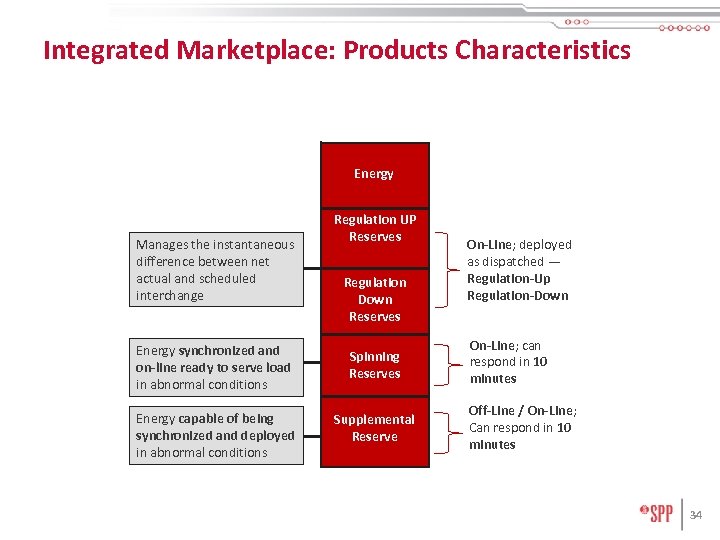 Integrated Marketplace: Products Characteristics Energy Manages the instantaneous difference between net actual and scheduled interchange Regulation UP Reserves Regulation Down Reserves Energy synchronized and on-line ready to serve load in abnormal conditions Spinning Reserves Energy capable of being synchronized and deployed in abnormal conditions Supplemental Reserve On-Line; deployed as dispatched — Regulation-Up Regulation-Down On-Line; can respond in 10 minutes Off-Line / On-Line; Can respond in 10 minutes 34
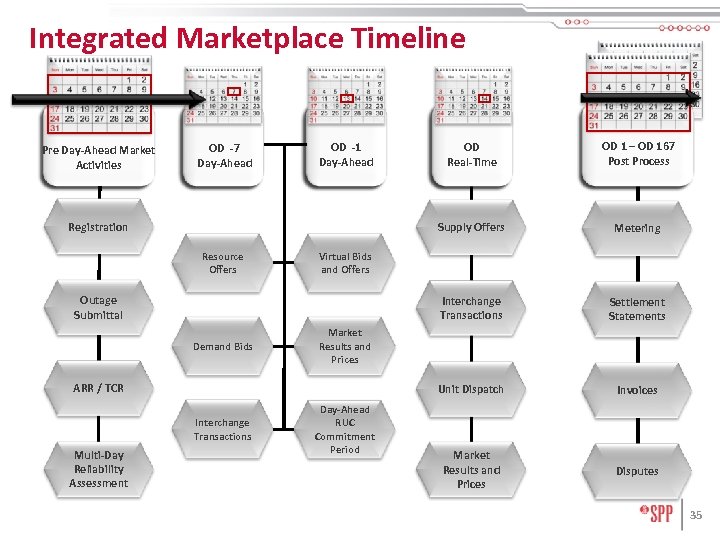 Integrated Marketplace Timeline Pre Day-Ahead Market Activities Resource Offers Multi-Day Reliability Assessment Invoices Market Results and Prices Disputes Market Results and Prices ARR / TCR Interchange Transactions Settlement Statements Virtual Bids and Offers Outage Submittal Demand Bids Metering Unit Dispatch Registration OD 1 – OD 167 Post Process Interchange Transactions OD -1 Day-Ahead OD Real-Time Supply Offers OD -7 Day-Ahead RUC Commitment Period 35
 INTEGRATED MARKETPLACE OVERVIEW: MARKET PRICING 36
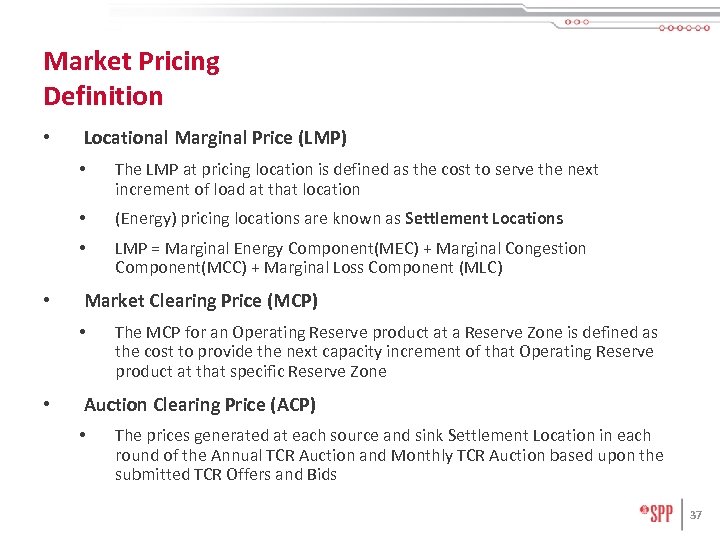 Market Pricing Definition • Locational Marginal Price (LMP) • • (Energy) pricing locations are known as Settlement Locations • • The LMP at pricing location is defined as the cost to serve the next increment of load at that location LMP = Marginal Energy Component(MEC) + Marginal Congestion Component(MCC) + Marginal Loss Component (MLC) Market Clearing Price (MCP) • • The MCP for an Operating Reserve product at a Reserve Zone is defined as the cost to provide the next capacity increment of that Operating Reserve product at that specific Reserve Zone Auction Clearing Price (ACP) • The prices generated at each source and sink Settlement Location in each round of the Annual TCR Auction and Monthly TCR Auction based upon the submitted TCR Offers and Bids 37
 Market Pricing LMP – Key Concepts • Locational Marginal Price (LMP) • Applies to Energy product only • Can be impacted by both Energy and Operating Reserve offers • Hourly LMPs are posted for the Day-Ahead Market • 5 -Minute LMPs are posted for each Settlement Location for the Real-Time Balancing Market • Congestion and Loss factors cause price separation 38
 Market Pricing MCP – Key Concepts • Market Clearing Price (MCP) • Applies to Operating Reserve product only • Can be impacted by both Energy and Operating Reserve offers • Hourly MCPs posted for the Day-Ahead Market • 5 -Minute MCPs posted for the Real-Time Balancing Market • One MCP per Operating Reserve by Reserve Zone 39
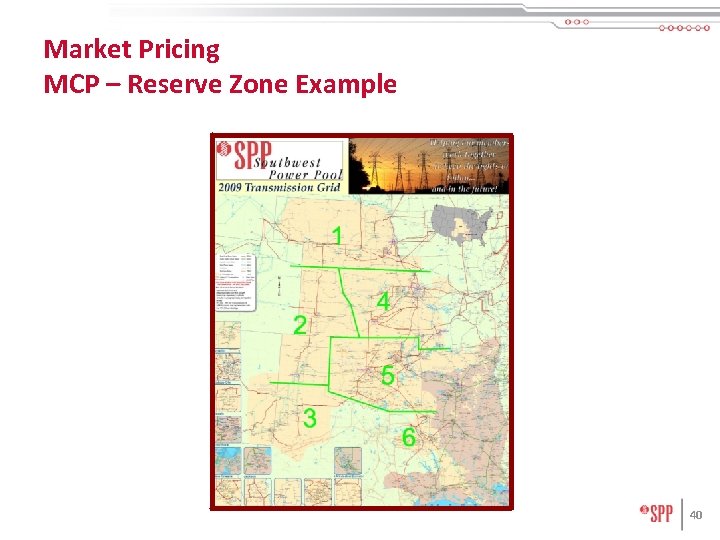 Market Pricing MCP – Reserve Zone Example 40
 Market Pricing ACP – Key Concepts • Auction Clearing Price (ACP) • Prices generated at each source and sink Settlement Location in each round of the Annual TCR Auction and Monthly TCR Auction based upon the TCR Offers and Bids submitted • The key principle of Auction Clearing algorithm is to maximize the total auction value while holding the flows on the constrained transmission lines to their limit • Bids are awarded from highest to lowest and Offers are awarded from lowest to highest until the TCR availability is consumed • The auction value is calculated for each TCR based on its clearing price on the path 41
 Section 3 PRE DAY-AHEAD MARKET ACTIVITIES 42
 Topics Covered • Market registration • Outage Notification • ARRs/TCRs Purposes • Multi-Day Reliability Assessment 43
 PRE DAY-AHEAD MARKET ACTIVITIES: MARKET REGISTRATION 44
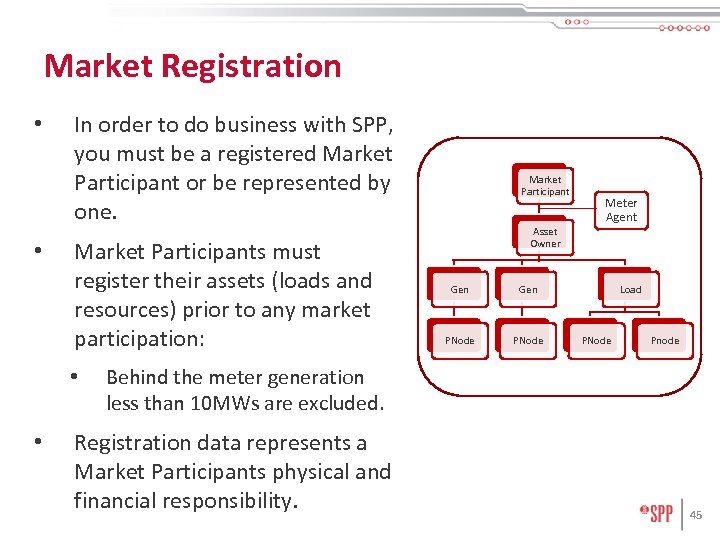 Market Registration • • In order to do business with SPP, you must be a registered Market Participant or be represented by one. Market Participants must register their assets (loads and resources) prior to any market participation: • • Market Participant Meter Agent Asset Owner Gen PNode Load PNode Pnode Behind the meter generation less than 10 MWs are excluded. Registration data represents a Market Participants physical and financial responsibility. 45
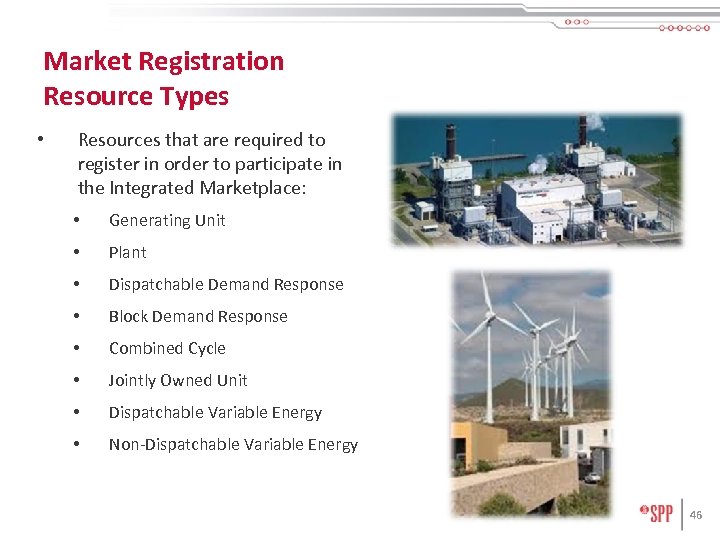 Market Registration Resource Types • Resources that are required to register in order to participate in the Integrated Marketplace: • Generating Unit • Plant • Dispatchable Demand Response • Block Demand Response • Combined Cycle • Jointly Owned Unit • Dispatchable Variable Energy • Non-Dispatchable Variable Energy 46
 Market Registration Characteristics • Resource characteristics required for asset registration: • Location of Physical Resource • Legal Owner • Resource Type • Non-Price Related Operating Parameters • Settlement Location ID • Resource Settlement Area ID • Real-Time Settlement Meter Data 47
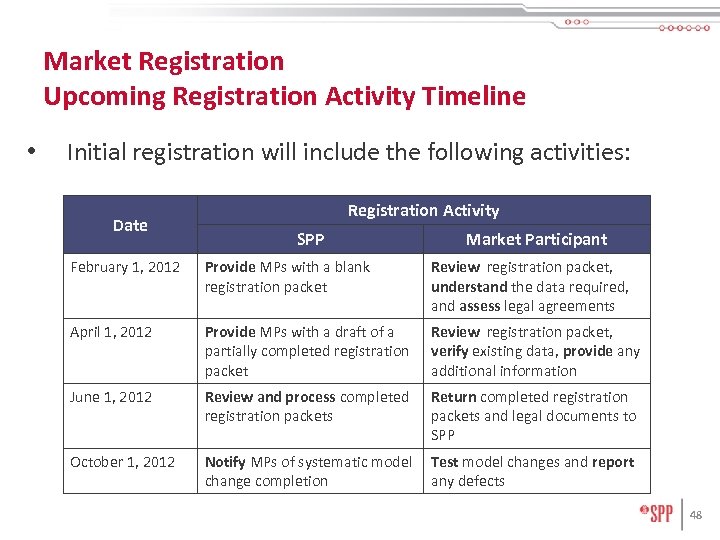 Market Registration Upcoming Registration Activity Timeline • Initial registration will include the following activities: Date Registration Activity SPP Market Participant February 1, 2012 Provide MPs with a blank registration packet Review registration packet, understand the data required, and assess legal agreements April 1, 2012 Provide MPs with a draft of a partially completed registration packet Review registration packet, verify existing data, provide any additional information June 1, 2012 Review and process completed registration packets Return completed registration packets and legal documents to SPP October 1, 2012 Notify MPs of systematic model change completion Test model changes and report any defects 48
 PRE DAY-AHEAD MARKET ACTIVITIES: OUTAGE NOTIFICATION 49
 Outage Notification • Market Participants will need to notify SPP when a generation and/or transmission asset needs to deviate from its normal operations • Notifications are in the form of an outage submittal through the Outage Scheduler • Types of outages include: • Unplanned (Deration, Emergency, Forced) • Planned (Maintenance, Construction) 50
 PRE DAY-AHEAD MARKET ACTIVITIES: AUCTION REVENUE RIGHTS / TRANSMISSION CONGESTION RIGHTS (ARR / TCR) 51
 Pre Day-Ahead Market Activities ARRs / TCRs • ARRs and TCRs are Congestion Hedging instruments Market Participants use to manage the anticipated Day-Ahead congestion. • The allocation of ARRs occurs annually and incrementally (i. e. not systematic every month) , shortly before the TCR auction for the same planning period. • The auction of TCRs occurs annually and monthly, in advance of the target Operating Day. • Further discussion in the ARRs/TCRs section 52
 PRE DAY-AHEAD MARKET ACTIVITIES: MULTI-DAY RELIABILITY ASSESSMENT 53
 Pre Day-Ahead Market Activities Multi-Day Reliability Assessment • Process that is performed prior to the Operating Day to assess capacity adequacy for the Operating Day (at least three days prior to the Operating Day) • Resources with long lead times (“Long-Lead-Time Resource”) that cannot be considered as part of the Day-Ahead Market or Day-Ahead RUC will be considered • SPP will issue a commitment order to affected Market Participants • Resources committed during the Multi-Day Reliability Assessment process are subject to Day-Ahead Make-Whole Payment given that they meet the eligibility criteria 54
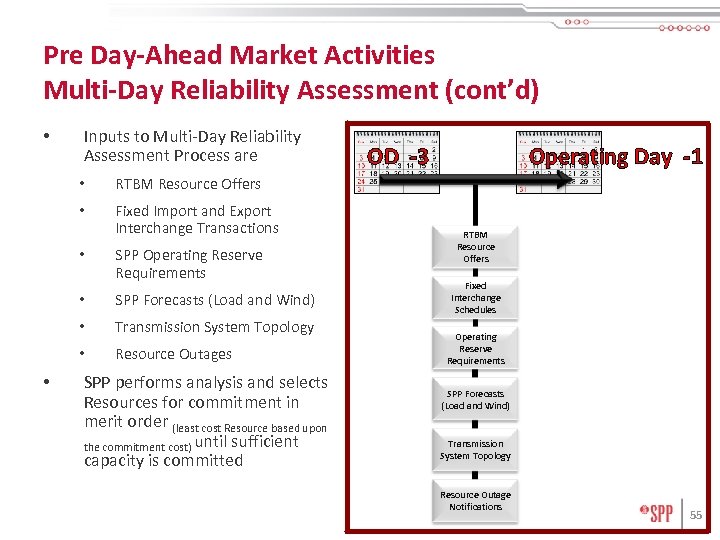 Pre Day-Ahead Market Activities Multi-Day Reliability Assessment (cont’d) • Inputs to Multi-Day Reliability Assessment Process are • Fixed Import and Export Interchange Transactions • SPP Operating Reserve Requirements • SPP Forecasts (Load and Wind) • Transmission System Topology • • Operating Day -1 RTBM Resource Offers • OD -3 Resource Outages SPP performs analysis and selects Resources for commitment in merit order (least cost Resource based upon the commitment cost) until sufficient capacity is committed RTBM Resource Offers Fixed Interchange Schedules Operating Reserve Requirements SPP Forecasts (Load and Wind) Transmission System Topology Resource Outage Notifications 55
 Section 4 DAY-AHEAD MARKET ACTIVITIES 56
 Topics Covered • Day-Ahead Market: Definition and Objective, Resources Offers • Day-Ahead Market Clearing • Day-Ahead Make-Whole Payment • Day-Ahead Market Timeline • Day-Ahead RUC: Definition and Objective • Day-Ahead RUC Execution • Day-Ahead RUC Timeline 57
 Day-Ahead Market What is the Day-Ahead Market? • Forward Market that provides Market Participants with the ability to submit: • offers to sell Energy and Operating Reserve • bids to purchase Energy • Simultaneously co-optimizes Energy and Operating Reserve using SCUC and SCED algorithms • Ensures that resources are scheduled to be online to meet bid-in load demands and operating reserve obligations for the next Operating Day • Financially binding market. Based on clearing market prices: • Injection or supply transactions receive credit • Withdrawal or demand transactions receive charge 58
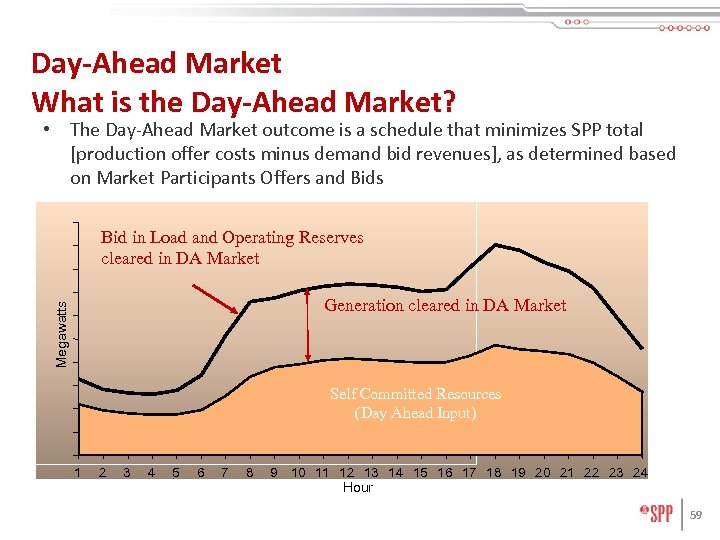 Day-Ahead Market What is the Day-Ahead Market? • The Day-Ahead Market outcome is a schedule that minimizes SPP total [production offer costs minus demand bid revenues], as determined based on Market Participants Offers and Bids Bid in Load and Operating Reserves cleared in DA Market Megawatts Generation cleared in DA Market Self Committed Resources (Day Ahead Input) 1 2 3 4 5 6 7 8 9 10 11 12 13 14 15 16 17 18 19 20 21 22 23 24 Hour 59
 Day-Ahead Market Resource Offers • A Resource Offer is a comprehensive set of information that will allow a Market Participant to sell generation into the SPP Integrated Marketplace • A Resource Offer consists of the following: • • Resource Parameters (start-up, no-load) • • Resource Limits Resource Offer curves Market Participant’s Day-Ahead Resource Offers must offer enough capacity to cover their bid-in loads and Operating Reserve requirements 60
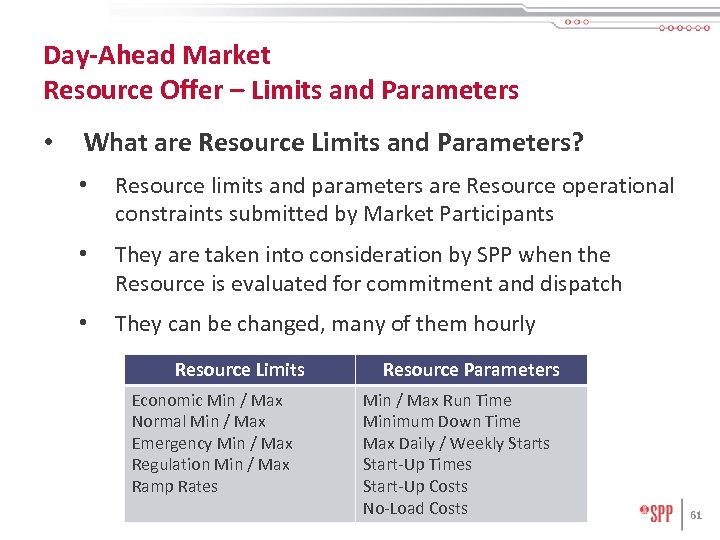 Day-Ahead Market Resource Offer – Limits and Parameters • What are Resource Limits and Parameters? • Resource limits and parameters are Resource operational constraints submitted by Market Participants • They are taken into consideration by SPP when the Resource is evaluated for commitment and dispatch • They can be changed, many of them hourly Resource Limits Economic Min / Max Normal Min / Max Emergency Min / Max Regulation Min / Max Ramp Rates Resource Parameters Min / Max Run Time Minimum Down Time Max Daily / Weekly Starts Start-Up Times Start-Up Costs No-Load Costs 61
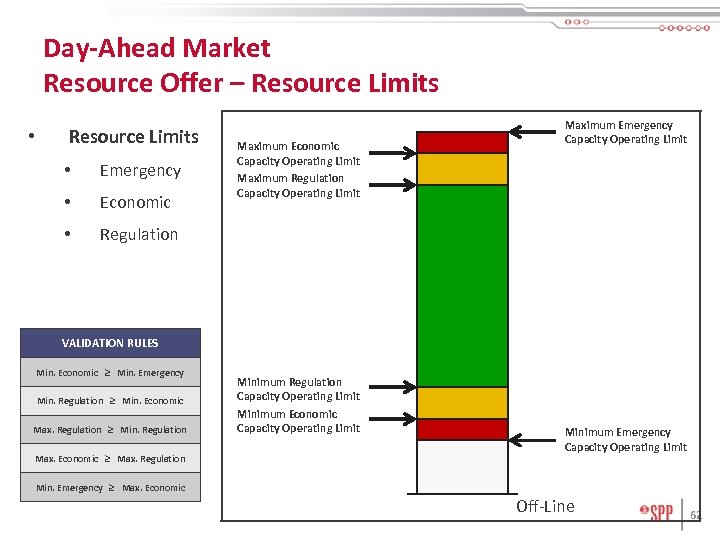 Day-Ahead Market Resource Offer – Resource Limits • Emergency • Economic • Maximum Economic Capacity Operating Limit Maximum Regulation Capacity Operating Limit Maximum Emergency Capacity Operating Limit Regulation VALIDATION RULES Min. Economic ≥ Min. Emergency Min. Regulation ≥ Min. Economic Max. Regulation ≥ Min. Regulation Max. Economic ≥ Max. Regulation Minimum Regulation Capacity Operating Limit Minimum Economic Capacity Operating Limit Minimum Emergency Capacity Operating Limit Min. Emergency ≥ Max. Economic Off-Line 62
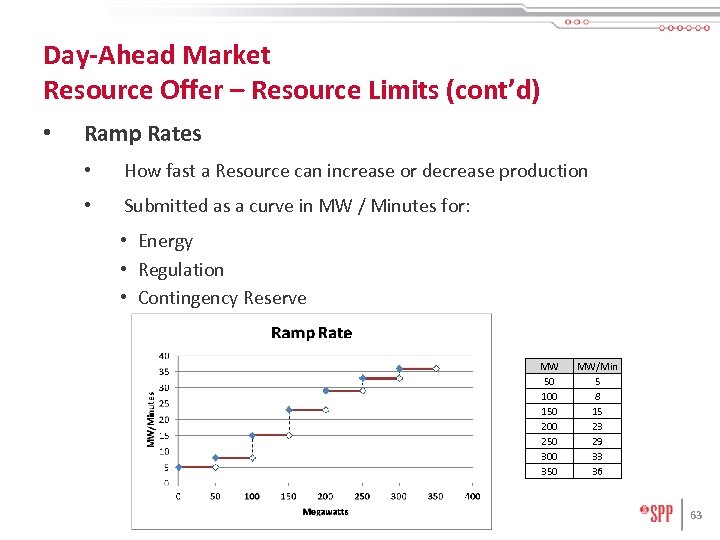 Day-Ahead Market Resource Offer – Resource Limits (cont’d) • Ramp Rates • How fast a Resource can increase or decrease production • Submitted as a curve in MW / Minutes for: • Energy • Regulation • Contingency Reserve MW 50 100 150 200 250 300 350 MW/Min 5 8 15 23 29 33 36 63
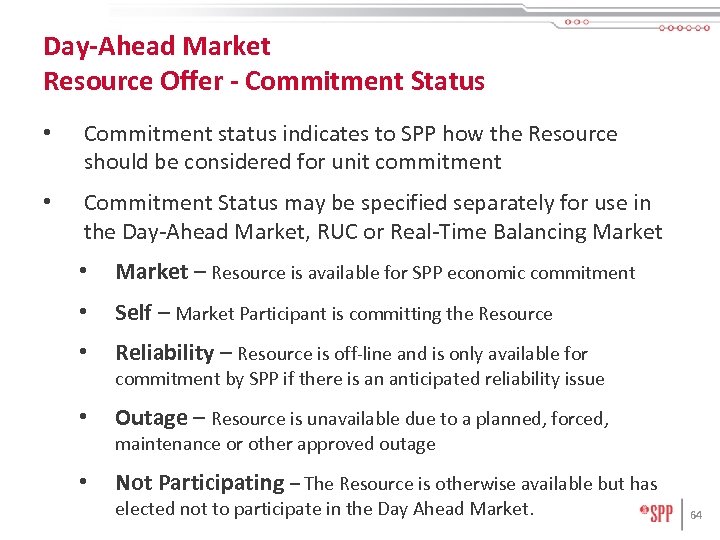 Day-Ahead Market Resource Offer - Commitment Status • Commitment status indicates to SPP how the Resource should be considered for unit commitment • Commitment Status may be specified separately for use in the Day-Ahead Market, RUC or Real-Time Balancing Market • Market – Resource is available for SPP economic commitment • Self – Market Participant is committing the Resource • Reliability – Resource is off-line and is only available for commitment by SPP if there is an anticipated reliability issue • Outage – Resource is unavailable due to a planned, forced, maintenance or other approved outage • Not Participating – The Resource is otherwise available but has elected not to participate in the Day Ahead Market. 64
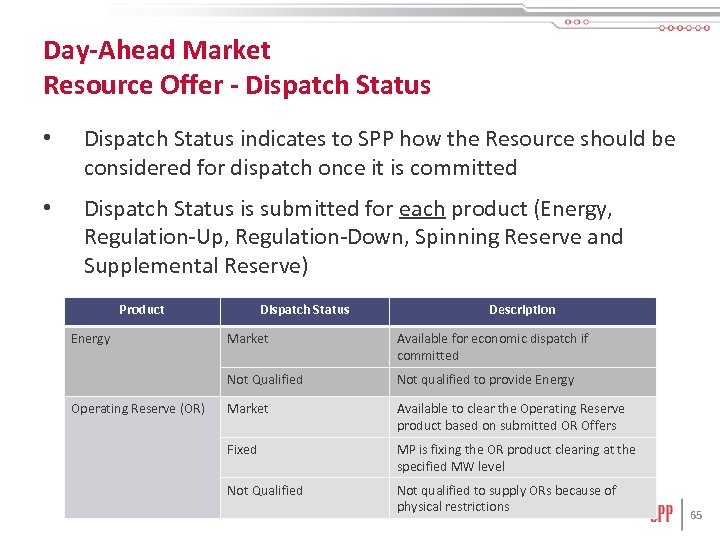 Day-Ahead Market Resource Offer - Dispatch Status • Dispatch Status indicates to SPP how the Resource should be considered for dispatch once it is committed • Dispatch Status is submitted for each product (Energy, Regulation-Up, Regulation-Down, Spinning Reserve and Supplemental Reserve) Product Energy Dispatch Status Description Available for economic dispatch if committed Not Qualified Operating Reserve (OR) Market Not qualified to provide Energy Market Available to clear the Operating Reserve product based on submitted OR Offers Fixed MP is fixing the OR product clearing at the specified MW level Not Qualified Not qualified to supply ORs because of physical restrictions 65
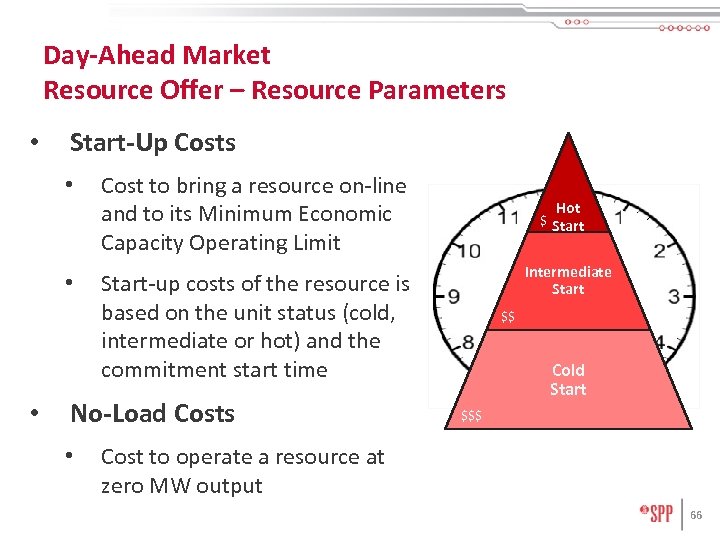 Day-Ahead Market Resource Offer – Resource Parameters • Start-Up Costs • • • Cost to bring a resource on-line and to its Minimum Economic Capacity Operating Limit Intermediate Start-up costs of the resource is based on the unit status (cold, intermediate or hot) and the commitment start time No-Load Costs • Hot $ Start $$ Cold Start $$$ Cost to operate a resource at zero MW output 66
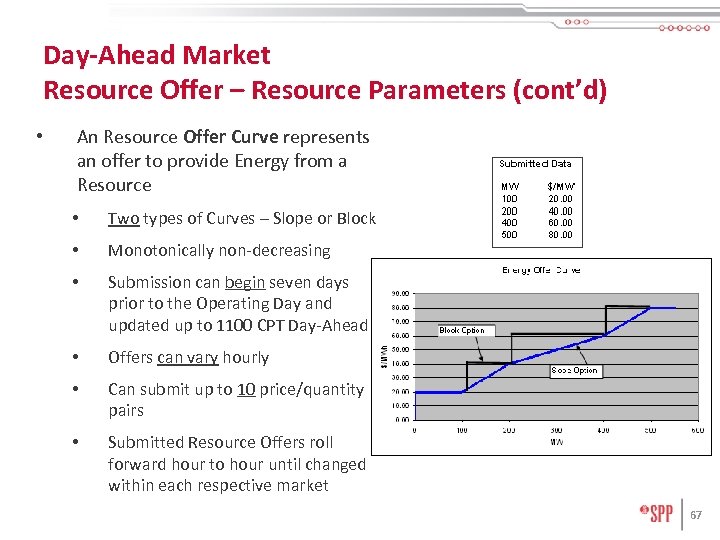 Day-Ahead Market Resource Offer – Resource Parameters (cont’d) • An Resource Offer Curve represents an offer to provide Energy from a Resource • Two types of Curves – Slope or Block • Monotonically non-decreasing • Submission can begin seven days prior to the Operating Day and updated up to 1100 CPT Day-Ahead • Offers can vary hourly • Can submit up to 10 price/quantity pairs • Submitted Resource Offers roll forward hour to hour until changed within each respective market 67
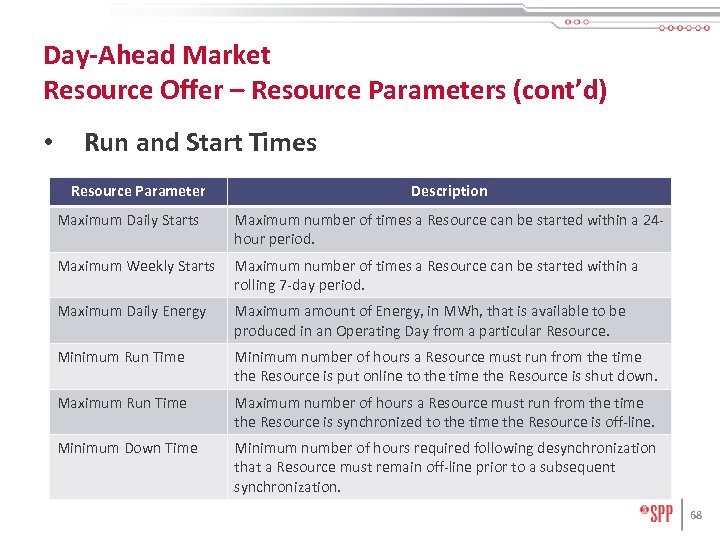 Day-Ahead Market Resource Offer – Resource Parameters (cont’d) • Run and Start Times Resource Parameter Description Maximum Daily Starts Maximum number of times a Resource can be started within a 24 hour period. Maximum Weekly Starts Maximum number of times a Resource can be started within a rolling 7 -day period. Maximum Daily Energy Maximum amount of Energy, in MWh, that is available to be produced in an Operating Day from a particular Resource. Minimum Run Time Minimum number of hours a Resource must run from the time the Resource is put online to the time the Resource is shut down. Maximum Run Time Maximum number of hours a Resource must run from the time the Resource is synchronized to the time the Resource is off-line. Minimum Down Time Minimum number of hours required following desynchronization that a Resource must remain off-line prior to a subsequent synchronization. 68
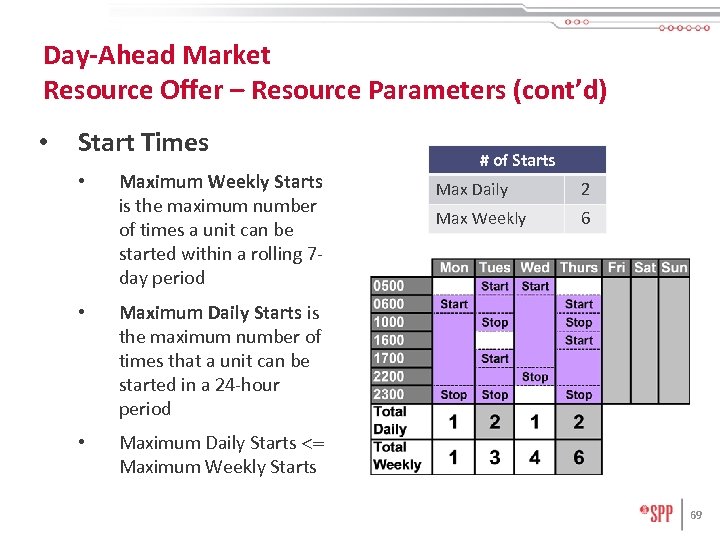 Day-Ahead Market Resource Offer – Resource Parameters (cont’d) • Start Times • Maximum Weekly Starts is the maximum number of times a unit can be started within a rolling 7 day period • Max Daily 2 Max Weekly 6 Maximum Daily Starts is the maximum number of times that a unit can be started in a 24 -hour period • # of Starts Maximum Daily Starts <= Maximum Weekly Starts 69
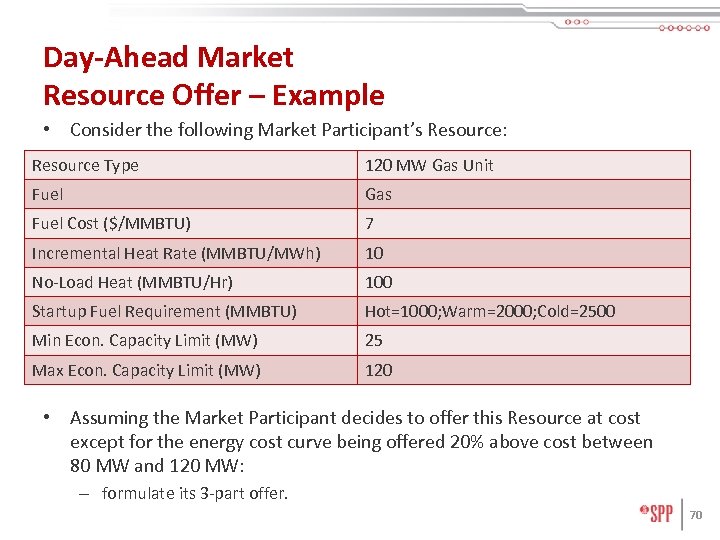 Day-Ahead Market Resource Offer – Example • Consider the following Market Participant’s Resource: Resource Type 120 MW Gas Unit Fuel Gas Fuel Cost ($/MMBTU) 7 Incremental Heat Rate (MMBTU/MWh) 10 No-Load Heat (MMBTU/Hr) 100 Startup Fuel Requirement (MMBTU) Hot=1000; Warm=2000; Cold=2500 Min Econ. Capacity Limit (MW) 25 Max Econ. Capacity Limit (MW) 120 • Assuming the Market Participant decides to offer this Resource at cost except for the energy cost curve being offered 20% above cost between 80 MW and 120 MW: – formulate its 3 -part offer. 70
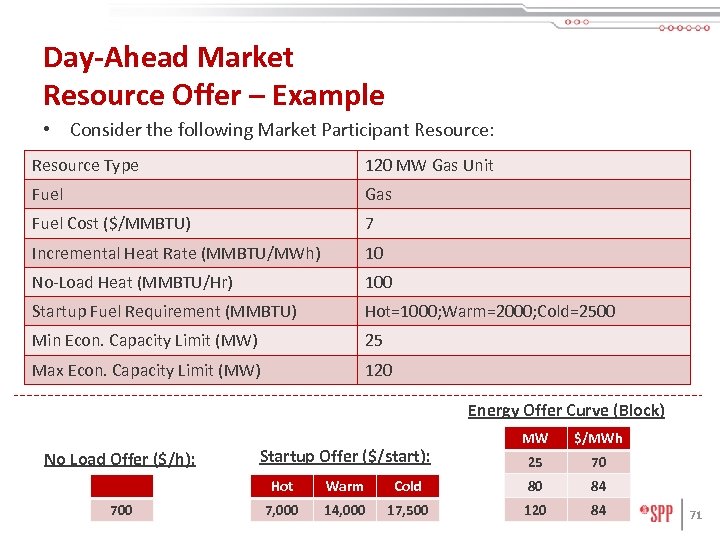 Day-Ahead Market Resource Offer – Example • Consider the following Market Participant Resource: Resource Type 120 MW Gas Unit Fuel Gas Fuel Cost ($/MMBTU) 7 Incremental Heat Rate (MMBTU/MWh) 10 No-Load Heat (MMBTU/Hr) 100 Startup Fuel Requirement (MMBTU) Hot=1000; Warm=2000; Cold=2500 Min Econ. Capacity Limit (MW) 25 Max Econ. Capacity Limit (MW) 120 Energy Offer Curve (Block) No Load Offer ($/h): Startup Offer ($/start): MW $/MWh 25 70 Hot 700 Warm Cold 80 84 7, 000 14, 000 17, 500 120 84 71
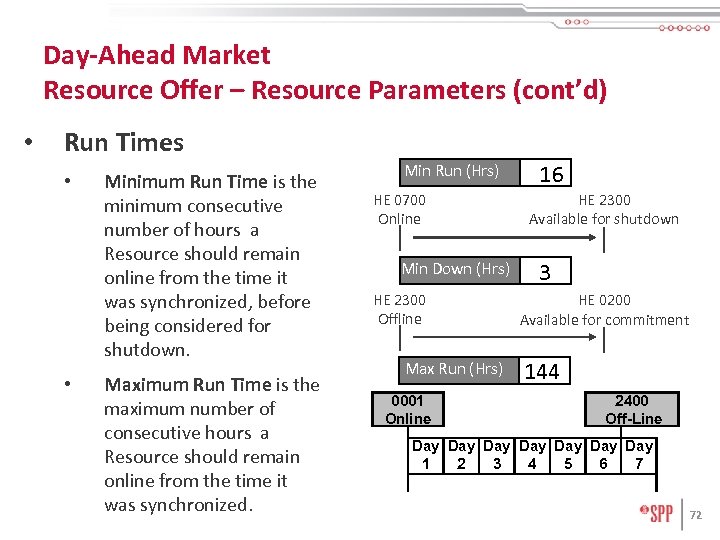 Day-Ahead Market Resource Offer – Resource Parameters (cont’d) • Run Times • • Minimum Run Time is the minimum consecutive number of hours a Resource should remain online from the time it was synchronized, before being considered for shutdown. Maximum Run Time is the maximum number of consecutive hours a Resource should remain online from the time it was synchronized. Min Run (Hrs) HE 0700 Online Min Down (Hrs) HE 2300 Offline Max Run (Hrs) 0001 Online 16 HE 2300 Available for shutdown 3 HE 0200 Available for commitment 144 2400 Off-Line Day Day 1 2 3 4 5 6 7 72
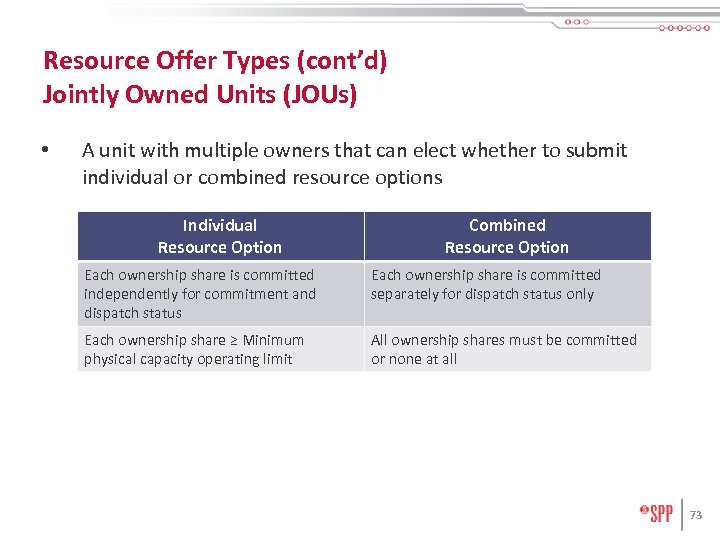 Resource Offer Types (cont’d) Jointly Owned Units (JOUs) • A unit with multiple owners that can elect whether to submit individual or combined resource options Individual Resource Option Combined Resource Option Each ownership share is committed independently for commitment and dispatch status Each ownership share is committed separately for dispatch status only Each ownership share ≥ Minimum physical capacity operating limit All ownership shares must be committed or none at all 73
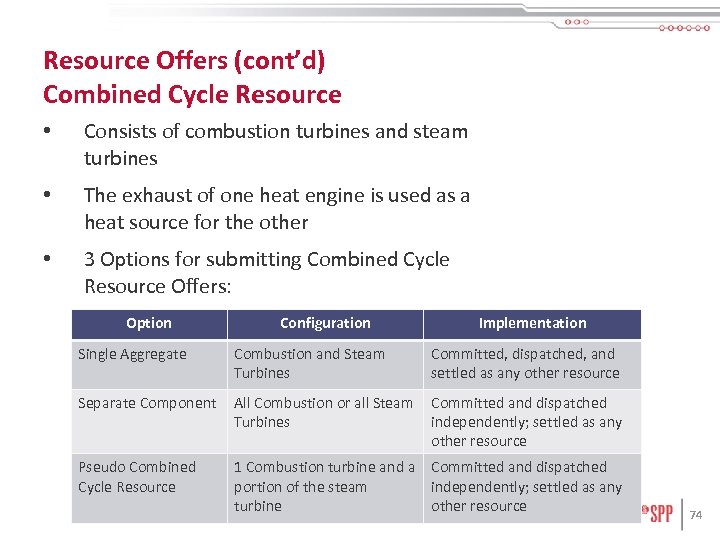 Resource Offers (cont’d) Combined Cycle Resource • Consists of combustion turbines and steam turbines • The exhaust of one heat engine is used as a heat source for the other • 3 Options for submitting Combined Cycle Resource Offers: Option Configuration Implementation Single Aggregate Combustion and Steam Turbines Committed, dispatched, and settled as any other resource Separate Component All Combustion or all Steam Turbines Committed and dispatched independently; settled as any other resource Pseudo Combined Cycle Resource 1 Combustion turbine and a Committed and dispatched portion of the steam independently; settled as any turbine other resource 74
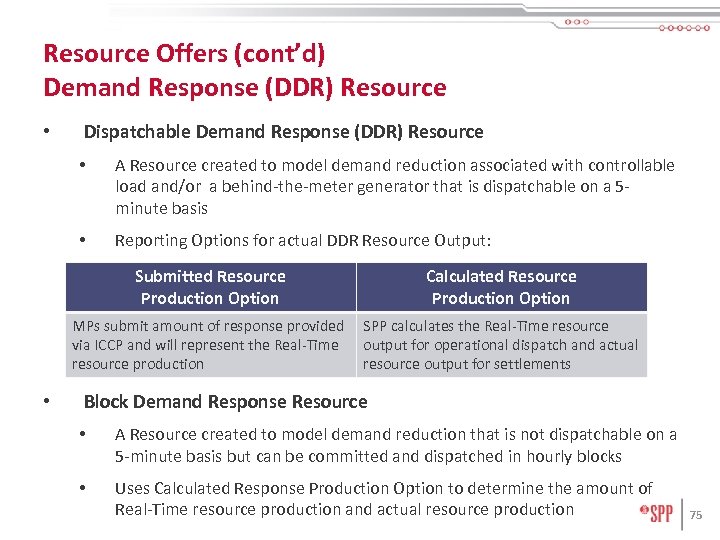 Resource Offers (cont’d) Demand Response (DDR) Resource • Dispatchable Demand Response (DDR) Resource • A Resource created to model demand reduction associated with controllable load and/or a behind-the-meter generator that is dispatchable on a 5 minute basis • Reporting Options for actual DDR Resource Output: Submitted Resource Production Option MPs submit amount of response provided via ICCP and will represent the Real-Time resource production • Calculated Resource Production Option SPP calculates the Real-Time resource output for operational dispatch and actual resource output for settlements Block Demand Response Resource • A Resource created to model demand reduction that is not dispatchable on a 5 -minute basis but can be committed and dispatched in hourly blocks • Uses Calculated Response Production Option to determine the amount of Real-Time resource production and actual resource production 75
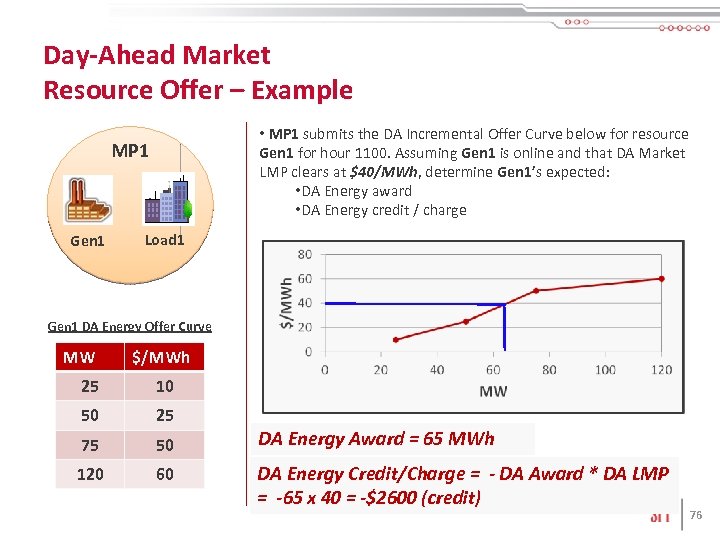 Day-Ahead Market Resource Offer – Example • MP 1 submits the DA Incremental Offer Curve below for resource Gen 1 for hour 1100. Assuming Gen 1 is online and that DA Market LMP clears at $40/MWh, determine Gen 1’s expected: • DA Energy award • DA Energy credit / charge MP 1 Gen 1 Load 1 Gen 1 DA Energy Offer Curve MW $/MWh 25 10 50 25 75 50 DA Energy Award = 65 MWh 120 60 DA Energy Credit/Charge = - DA Award * DA LMP = -65 x 40 = -$2600 (credit) 76
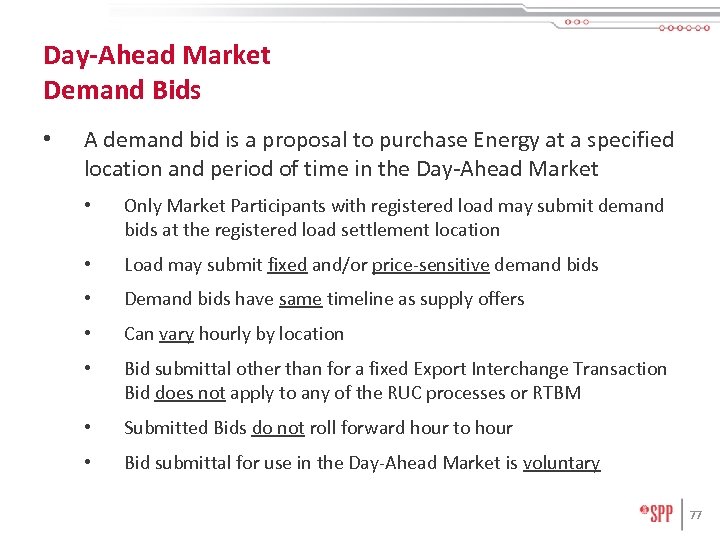 Day-Ahead Market Demand Bids • A demand bid is a proposal to purchase Energy at a specified location and period of time in the Day-Ahead Market • Only Market Participants with registered load may submit demand bids at the registered load settlement location • Load may submit fixed and/or price-sensitive demand bids • Demand bids have same timeline as supply offers • Can vary hourly by location • Bid submittal other than for a fixed Export Interchange Transaction Bid does not apply to any of the RUC processes or RTBM • Submitted Bids do not roll forward hour to hour • Bid submittal for use in the Day-Ahead Market is voluntary 77
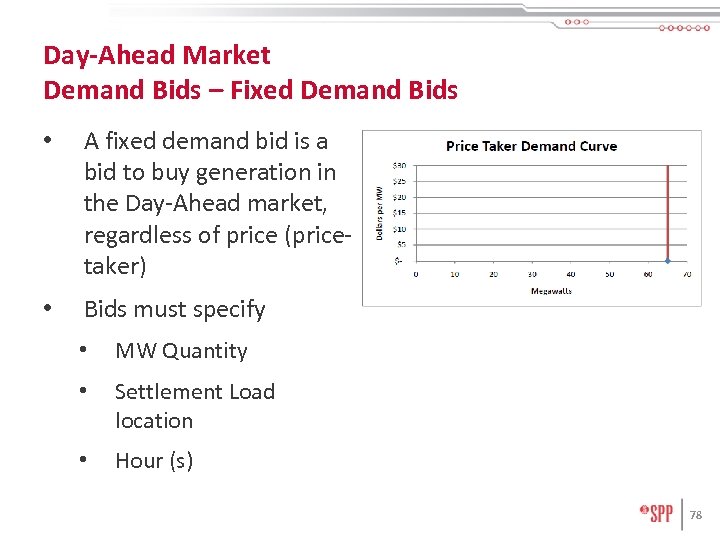 Day-Ahead Market Demand Bids – Fixed Demand Bids • A fixed demand bid is a bid to buy generation in the Day-Ahead market, regardless of price (pricetaker) • Bids must specify • MW Quantity • Settlement Load location • Hour (s) 78
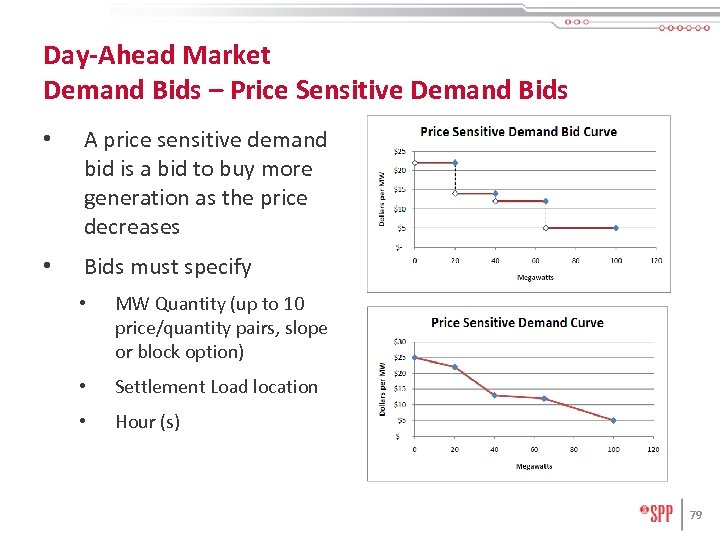 Day-Ahead Market Demand Bids – Price Sensitive Demand Bids • A price sensitive demand bid is a bid to buy more generation as the price decreases • Bids must specify • MW Quantity (up to 10 price/quantity pairs, slope or block option) • Settlement Load location • Hour (s) 79
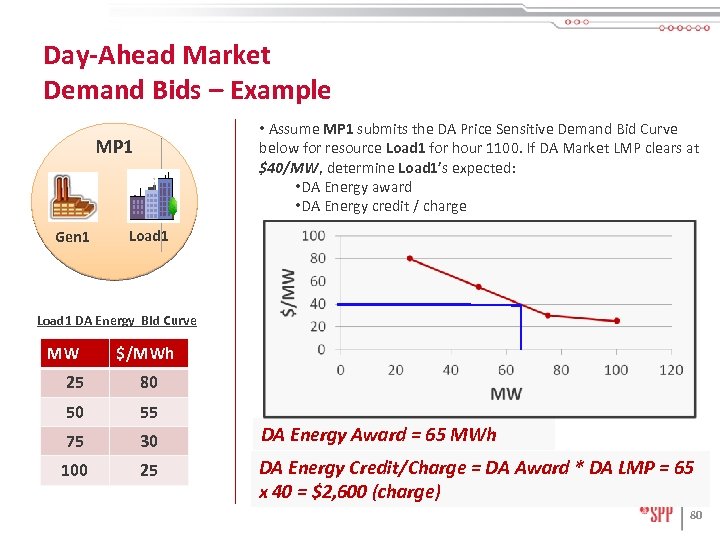 Day-Ahead Market Demand Bids – Example • Assume MP 1 submits the DA Price Sensitive Demand Bid Curve below for resource Load 1 for hour 1100. If DA Market LMP clears at $40/MW, determine Load 1’s expected: • DA Energy award • DA Energy credit / charge MP 1 Gen 1 Load 1 DA Energy Bid Curve MW $/MWh 25 80 50 55 75 30 DA Energy Award = 65 MWh 100 25 DA Energy Credit/Charge = DA Award * DA LMP = 65 x 40 = $2, 600 (charge) 80
 Day-Ahead Market Interchange Schedules • Contract for transfer of Energy between seller and buyer • Interchange Schedules (Physical) • Transactions that crosses the boundary of the SPP Balancing Authority Area and transfers physical energy • Classified as Import, Export, or Through transactions 81
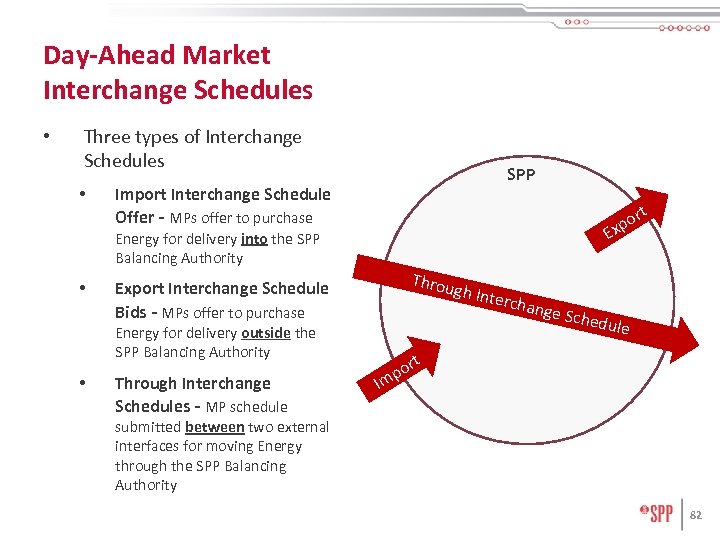 Day-Ahead Market Interchange Schedules • Three types of Interchange Schedules • SPP Import Interchange Schedule Offer - MPs offer to purchase rt o Exp Energy for delivery into the SPP Balancing Authority • Throu Export Interchange Schedule Bids - MPs offer to purchase gh Int Energy for delivery outside the SPP Balancing Authority • Through Interchange Schedules - MP schedule ercha nge Sc hedul e rt I o mp submitted between two external interfaces for moving Energy through the SPP Balancing Authority 82
 Day-Ahead Market Virtual Transactions • Virtual Transactions are Day-Ahead Energy market instruments • A Virtual Transaction can either be: • • • Virtual Energy Offer: a proposal by a Market Participant to sell Energy at a specified price, Settlement Location and period of time in the Day-Ahead Market that is not associated with a physical Resource. Virtual Energy Bid: a proposal by a Market Participant to purchase Energy at a specified price, Settlement Location and period of time in the Day-Ahead Market that is not associated with a physical Load. When cleared by the Day-Ahead Market, a Virtual transaction will be settled at the price difference between the Day-Ahead LMP and the Real-Time LMP 83
 Day-Ahead Market Virtual Transactions • In general, the net effect of Virtual Transactions is to cause the Day-Ahead LMPs and RTBM LMPs to converge: – If a Settlement Location is expected to be priced higher in day-ahead than in real-time, market participants may be incented to submit Virtual offers until, overtime, the two markets equalize in price • Mechanics of a Virtual Offer – Offer Quantity/Price into DA Market – If DA LMP >= Offer Price, then transaction clears DA Market – If cleared, market participant must buy Energy back at realtime LMP: • Profit if DA LMP >= RTBM LMP, • Loss otherwise • Mechanics of a Virtual Bid – Bid Quantity/Price into DA Market – If DA LMP <= Bid Price, then transaction clears DA Market – If cleared, market participant must sell Energy back at realtime LMP: • Profit if DA LMP <= RTBM LMP, • Loss otherwise 84
 Day-Ahead Market Virtual Transaction - Rules • Virtual Energy Offers and Bids are subject to a transaction fee • Virtual Energy Offers and Bids can be submitted by a Market Participant at any Settlement Location, subject to meeting credit requirements • A Market Participant may submit a single Virtual Energy Bid and a single Virtual Energy Offer for each Asset Owners at any Settlement Location for a particular Hour • Each Virtual Energy Offer and Bid must specify a start and stop Hour within the applicable Operating Day 85
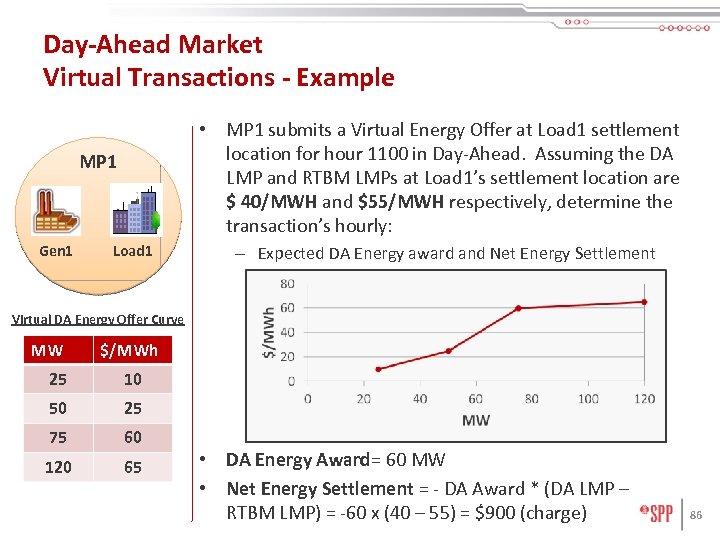 Day-Ahead Market Virtual Transactions - Example • MP 1 submits a Virtual Energy Offer at Load 1 settlement location for hour 1100 in Day-Ahead. Assuming the DA LMP and RTBM LMPs at Load 1’s settlement location are $ 40/MWH and $55/MWH respectively, determine the transaction’s hourly: MP 1 Gen 1 Load 1 – Expected DA Energy award and Net Energy Settlement Virtual DA Energy Offer Curve MW $/MWh 25 10 50 25 75 60 120 65 • DA Energy Award= 60 MW • Net Energy Settlement = - DA Award * (DA LMP – RTBM LMP) = -60 x (40 – 55) = $900 (charge) 86
 Day-Ahead Market Bilateral Settlement Schedules • Bilateral Settlement Schedules (Financial) • Transactions that transfer financial responsibility for market product between 2 participating entities within SPP Confirmation by both parties is required. • Can be defined for: • • Energy: Day-Ahead or Real-Time Balancing Market • Transaction must specify: buyer, seller, MW amount and Settlement Location • Operating Reserve: Day-Ahead Market only • Transaction must specify: buyer, seller, obligation percentage and Reserve Zone for settlement pricing Purely a settlement activity: does NOT impact market clearing 87
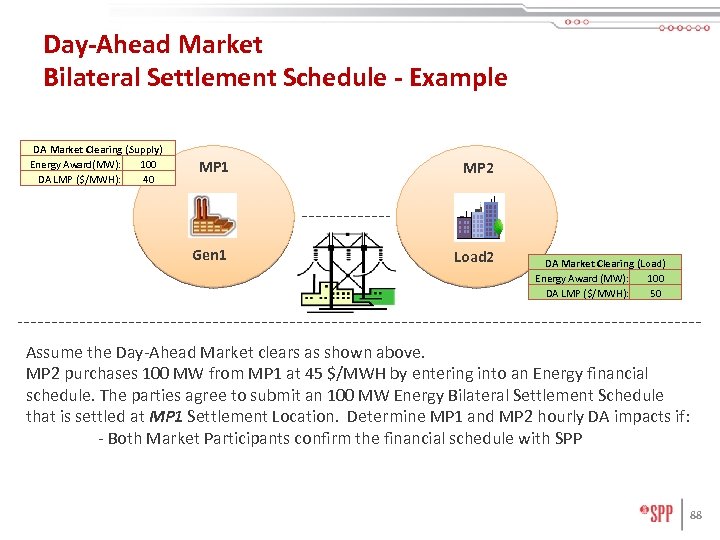 Day-Ahead Market Bilateral Settlement Schedule - Example DA Market Clearing (Supply) Energy Award(MW): 100 DA LMP ($/MWH): 40 MP 1 MP 2 Gen 1 Load 2 DA Market Clearing (Load) Energy Award (MW): 100 DA LMP ($/MWH): 50 Assume the Day-Ahead Market clears as shown above. MP 2 purchases 100 MW from MP 1 at 45 $/MWH by entering into an Energy financial schedule. The parties agree to submit an 100 MW Energy Bilateral Settlement Schedule that is settled at MP 1 Settlement Location. Determine MP 1 and MP 2 hourly DA impacts if: - Both Market Participants confirm the financial schedule with SPP 88
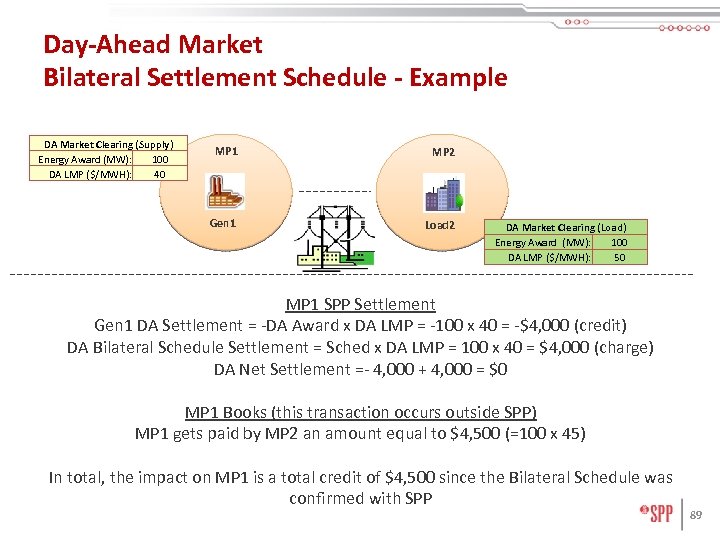 Day-Ahead Market Bilateral Settlement Schedule - Example DA Market Clearing (Supply) Energy Award (MW): 100 DA LMP ($/MWH): 40 MP 1 MP 2 Gen 1 Load 2 DA Market Clearing (Load) Energy Award (MW): 100 DA LMP ($/MWH): 50 MP 1 SPP Settlement Gen 1 DA Settlement = -DA Award x DA LMP = -100 x 40 = -$4, 000 (credit) DA Bilateral Schedule Settlement = Sched x DA LMP = 100 x 40 = $4, 000 (charge) DA Net Settlement =- 4, 000 + 4, 000 = $0 MP 1 Books (this transaction occurs outside SPP) MP 1 gets paid by MP 2 an amount equal to $4, 500 (=100 x 45) In total, the impact on MP 1 is a total credit of $4, 500 since the Bilateral Schedule was confirmed with SPP 89
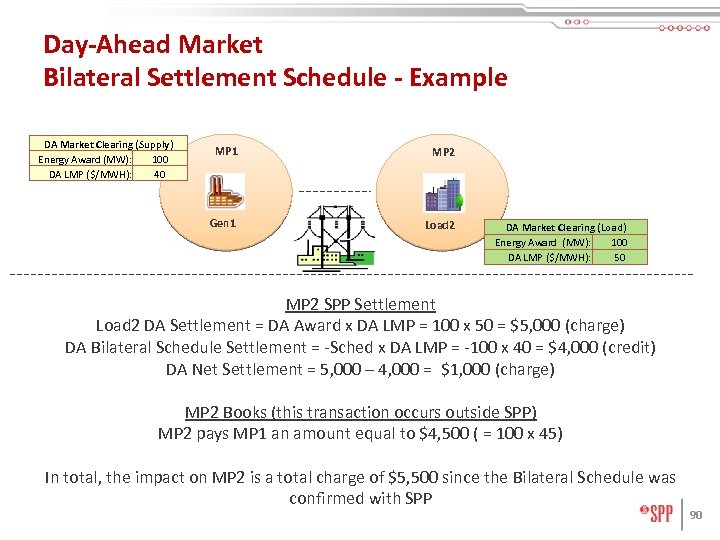 Day-Ahead Market Bilateral Settlement Schedule - Example DA Market Clearing (Supply) Energy Award (MW): 100 DA LMP ($/MWH): 40 MP 1 MP 2 Gen 1 Load 2 DA Market Clearing (Load) Energy Award (MW): 100 DA LMP ($/MWH): 50 MP 2 SPP Settlement Load 2 DA Settlement = DA Award x DA LMP = 100 x 50 = $5, 000 (charge) DA Bilateral Schedule Settlement = -Sched x DA LMP = -100 x 40 = $4, 000 (credit) DA Net Settlement = 5, 000 – 4, 000 = $1, 000 (charge) MP 2 Books (this transaction occurs outside SPP) MP 2 pays MP 1 an amount equal to $4, 500 ( = 100 x 45) In total, the impact on MP 2 is a total charge of $5, 500 since the Bilateral Schedule was confirmed with SPP 90
 DAY-AHEAD MARKET ACTIVITIES: DAY-AHEAD MARKET CLEARING 91
 Day-Ahead Market Activities Day-Ahead Market Clearing and Results • SPP clears the Day-Ahead Market between 1100 and 1600 Day-Ahead for the entire next Operating Day • Day-Ahead Market Clearing requires the following algorithms: • • Security-Constrained Economic Dispatch (SCED) • • Security-Constrained Unit Commitment (SCUC) Simultaneous Feasibility Test (SFT) Results of the Day-Ahead Market include hourly: • Market product awards for each market instrument • LMP for each Settlement Location • MCP for each Operating Reserve product per Reserve Zone 92
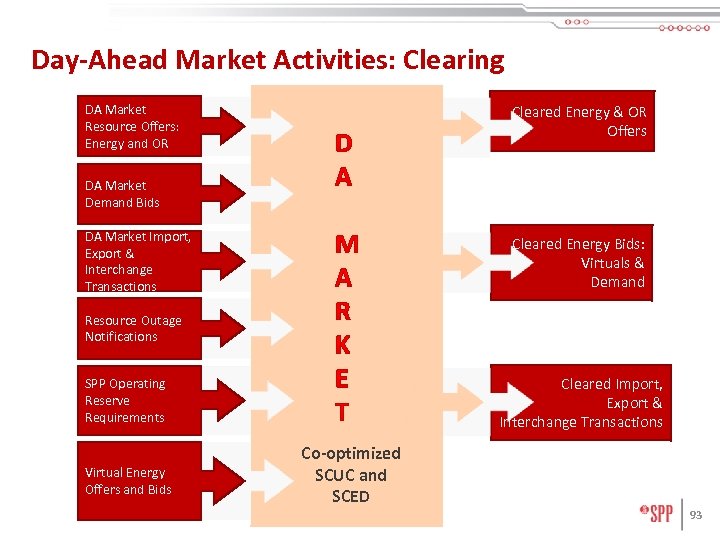 Day-Ahead Market Activities: Clearing DA Market Resource Offers: Energy and OR Cleared Energy & OR Offers DA Market Demand Bids DA Market Import, Export & Interchange Transactions Cleared Energy Bids: Virtuals & Demand Resource Outage Notifications Cleared Import, Export & Interchange Transactions SPP Operating Reserve Requirements Virtual Energy Offers and Bids Co-optimized SCUC and SCED 93
 Day-Ahead Market Activities Timeline • By 7: 00 AM: SPP publishes load and wind Forecast, provides Market Participants with their Operating Reserve Requirement • By 11: 00 AM: Market Participants submit their Day-Ahead Demand bids, Resource Offers and outage notification, Virtual, Bilateral and Physical Transactions information to SPP • Between 11: 00 AM and 4: 00 PM: SPP clears Day-Ahead Market • By 4: 00 PM: SPP publishes the results of Day-Ahead Market 94
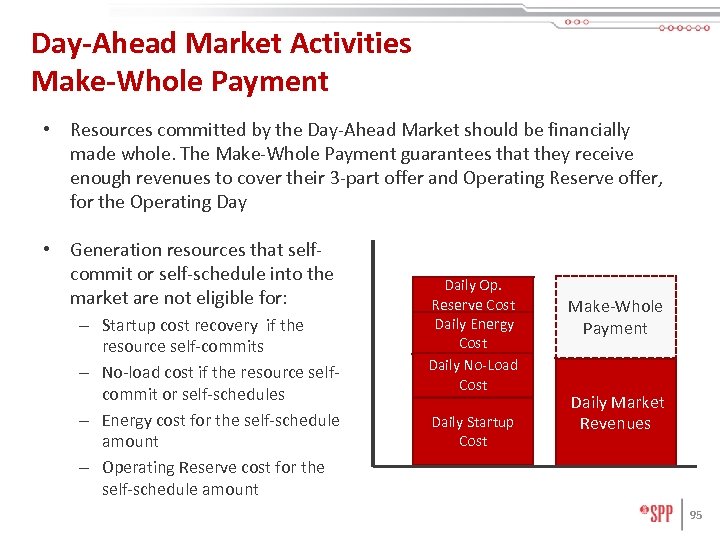 Day-Ahead Market Activities Make-Whole Payment • Resources committed by the Day-Ahead Market should be financially made whole. The Make-Whole Payment guarantees that they receive enough revenues to cover their 3 -part offer and Operating Reserve offer, for the Operating Day • Generation resources that selfcommit or self-schedule into the market are not eligible for: – Startup cost recovery if the resource self-commits – No-load cost if the resource selfcommit or self-schedules – Energy cost for the self-schedule amount – Operating Reserve cost for the self-schedule amount Daily Op. Reserve Cost Daily Energy Cost Daily No-Load Cost Daily Startup Cost Make-Whole Payment Daily Market Revenues 95
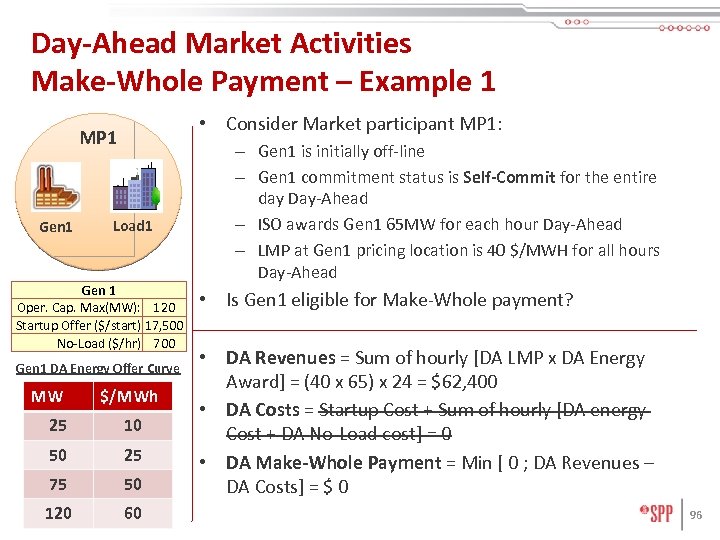 Day-Ahead Market Activities Make-Whole Payment – Example 1 • Consider Market participant MP 1: MP 1 Gen 1 Load 1 Gen 1 Oper. Cap. Max(MW): 120 Startup Offer ($/start) 17, 500 No-Load ($/hr) 700 Gen 1 DA Energy Offer Curve MW $/MWh 25 10 50 25 75 50 120 60 – Gen 1 is initially off-line – Gen 1 commitment status is Self-Commit for the entire day Day-Ahead – ISO awards Gen 1 65 MW for each hour Day-Ahead – LMP at Gen 1 pricing location is 40 $/MWH for all hours Day-Ahead • Is Gen 1 eligible for Make-Whole payment? • DA Revenues = Sum of hourly [DA LMP x DA Energy Award] = (40 x 65) x 24 = $62, 400 • DA Costs = Startup Cost + Sum of hourly [DA energy Cost + DA No-Load cost] = 0 • DA Make-Whole Payment = Min [ 0 ; DA Revenues – DA Costs] = $ 0 96
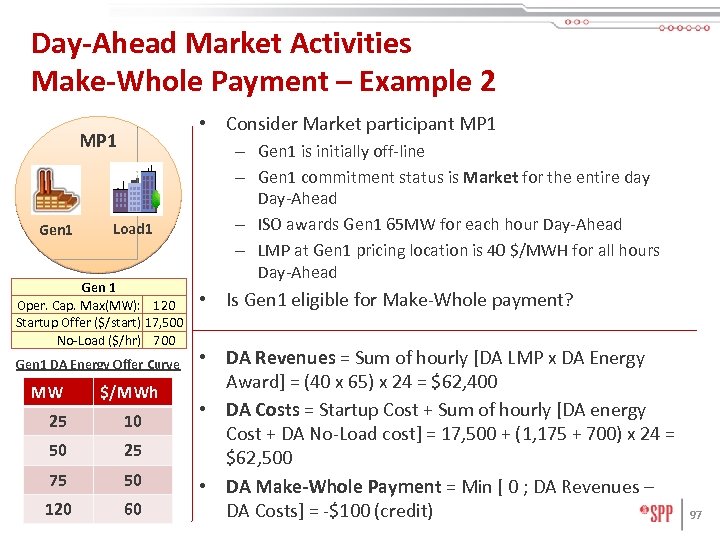 Day-Ahead Market Activities Make-Whole Payment – Example 2 • Consider Market participant MP 1 Gen 1 Load 1 Gen 1 Oper. Cap. Max(MW): 120 Startup Offer ($/start) 17, 500 No-Load ($/hr) 700 Gen 1 DA Energy Offer Curve MW $/MWh 25 10 50 25 75 50 120 60 – Gen 1 is initially off-line – Gen 1 commitment status is Market for the entire day Day-Ahead – ISO awards Gen 1 65 MW for each hour Day-Ahead – LMP at Gen 1 pricing location is 40 $/MWH for all hours Day-Ahead • Is Gen 1 eligible for Make-Whole payment? • DA Revenues = Sum of hourly [DA LMP x DA Energy Award] = (40 x 65) x 24 = $62, 400 • DA Costs = Startup Cost + Sum of hourly [DA energy Cost + DA No-Load cost] = 17, 500 + (1, 175 + 700) x 24 = $62, 500 • DA Make-Whole Payment = Min [ 0 ; DA Revenues – DA Costs] = -$100 (credit) 97
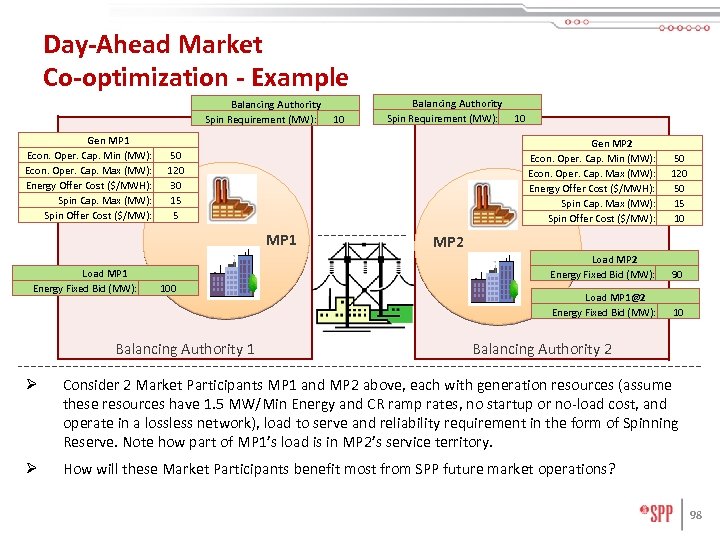 Day-Ahead Market Co-optimization - Example Balancing Authority Spin Requirement (MW): Gen MP 1 Econ. Oper. Cap. Min (MW): Econ. Oper. Cap. Max (MW): Energy Offer Cost ($/MWH): Spin Cap. Max (MW): Spin Offer Cost ($/MW): 10 Gen MP 2 Econ. Oper. Cap. Min (MW): Econ. Oper. Cap. Max (MW): Energy Offer Cost ($/MWH): Spin Cap. Max (MW): Spin Offer Cost ($/MW): 50 120 30 15 5 MP 1 Load MP 1 Energy Fixed Bid (MW): 10 Balancing Authority Spin Requirement (MW): 50 120 50 15 10 MP 2 Load MP 2 Energy Fixed Bid (MW): 100 Balancing Authority 1 90 Load MP 1@2 Energy Fixed Bid (MW): 10 Balancing Authority 2 Ø Consider 2 Market Participants MP 1 and MP 2 above, each with generation resources (assume these resources have 1. 5 MW/Min Energy and CR ramp rates, no startup or no-load cost, and operate in a lossless network), load to serve and reliability requirement in the form of Spinning Reserve. Note how part of MP 1’s load is in MP 2’s service territory. Ø How will these Market Participants benefit most from SPP future market operations? 98
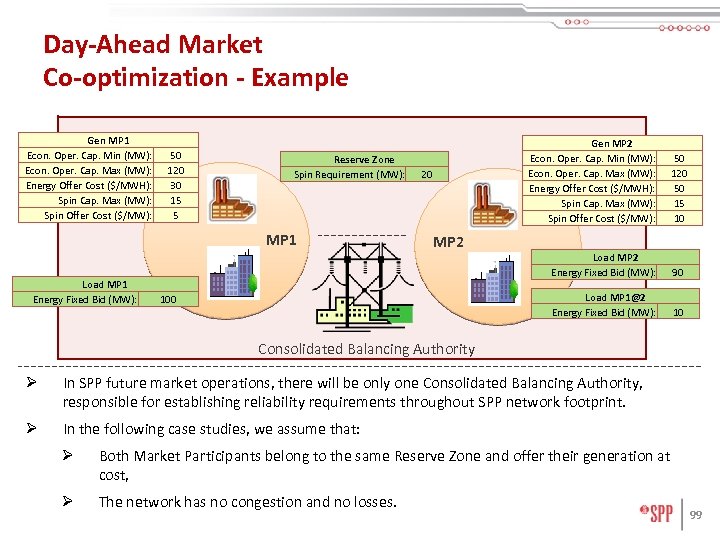 Day-Ahead Market Co-optimization - Example Gen MP 1 Econ. Oper. Cap. Min (MW): Econ. Oper. Cap. Max (MW): Energy Offer Cost ($/MWH): Spin Cap. Max (MW): Spin Offer Cost ($/MW): 50 120 30 15 5 Reserve Zone Spin Requirement (MW): MP 1 Load MP 1 Energy Fixed Bid (MW): Gen MP 2 Econ. Oper. Cap. Min (MW): Econ. Oper. Cap. Max (MW): Energy Offer Cost ($/MWH): Spin Cap. Max (MW): Spin Offer Cost ($/MW): 20 MP 2 50 120 50 15 10 90 Load MP 1@2 Energy Fixed Bid (MW): 100 Load MP 2 Energy Fixed Bid (MW): 10 Consolidated Balancing Authority Ø In SPP future market operations, there will be only one Consolidated Balancing Authority, responsible for establishing reliability requirements throughout SPP network footprint. Ø In the following case studies, we assume that: Ø Both Market Participants belong to the same Reserve Zone and offer their generation at cost, Ø The network has no congestion and no losses. 99
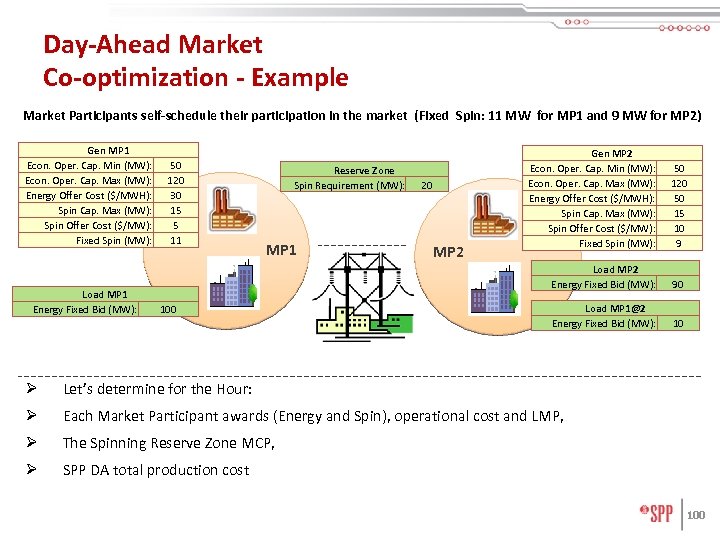 Day-Ahead Market Co-optimization - Example Market Participants self-schedule their participation in the market (Fixed Spin: 11 MW for MP 1 and 9 MW for MP 2) Gen MP 1 Econ. Oper. Cap. Min (MW): Econ. Oper. Cap. Max (MW): Energy Offer Cost ($/MWH): Spin Cap. Max (MW): Spin Offer Cost ($/MW): Fixed Spin (MW): Load MP 1 Energy Fixed Bid (MW): 50 120 30 15 5 11 Reserve Zone Spin Requirement (MW): MP 1 20 MP 2 Gen MP 2 Econ. Oper. Cap. Min (MW): Econ. Oper. Cap. Max (MW): Energy Offer Cost ($/MWH): Spin Cap. Max (MW): Spin Offer Cost ($/MW): Fixed Spin (MW): 50 120 50 15 10 9 Load MP 2 Energy Fixed Bid (MW): 100 90 Load MP 1@2 Energy Fixed Bid (MW): 10 Ø Let’s determine for the Hour: Ø Each Market Participant awards (Energy and Spin), operational cost and LMP, Ø The Spinning Reserve Zone MCP, Ø SPP DA total production cost 100
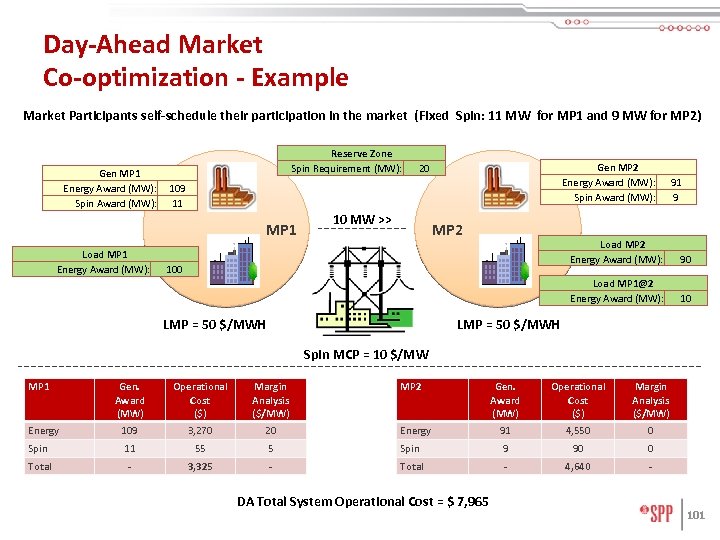 Day-Ahead Market Co-optimization - Example Market Participants self-schedule their participation in the market (Fixed Spin: 11 MW for MP 1 and 9 MW for MP 2) Gen MP 1 Energy Award (MW): Spin Award (MW): Reserve Zone Spin Requirement (MW): Gen MP 2 Energy Award (MW): Spin Award (MW): 20 109 11 MP 1 10 MW >> MP 2 91 9 Load MP 2 Energy Award (MW): 100 LMP = 50 $/MWH 90 Load MP 1@2 Energy Award (MW): Load MP 1 Energy Award (MW): 10 LMP = 50 $/MWH Spin MCP = 10 $/MW MP 1 Gen. Award (MW) Operational Cost ($) Margin Analysis ($/MW) Energy 109 3, 270 20 Spin 11 55 Total - 3, 325 MP 2 Gen. Award (MW) Operational Cost ($) Margin Analysis ($/MW) Energy 91 4, 550 0 5 Spin 9 90 0 - Total - 4, 640 - DA Total System Operational Cost = $ 7, 965 101
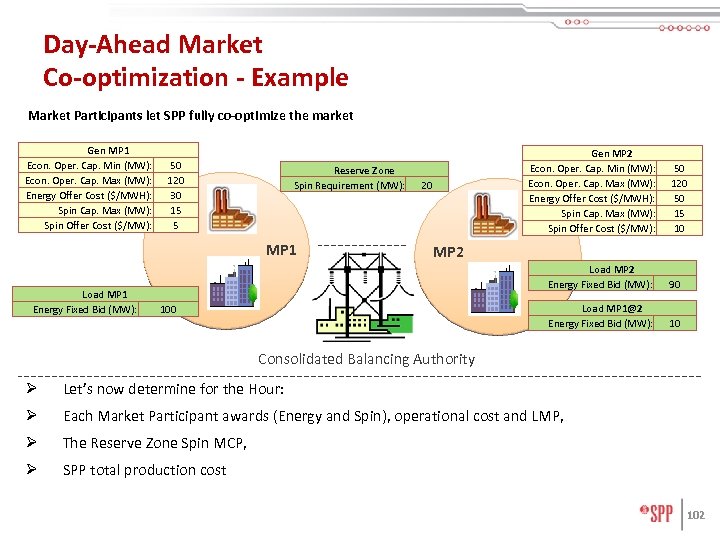 Day-Ahead Market Co-optimization - Example Market Participants let SPP fully co-optimize the market Gen MP 1 Econ. Oper. Cap. Min (MW): Econ. Oper. Cap. Max (MW): Energy Offer Cost ($/MWH): Spin Cap. Max (MW): Spin Offer Cost ($/MW): 50 120 30 15 5 Reserve Zone Spin Requirement (MW): MP 1 Load MP 1 Energy Fixed Bid (MW): Gen MP 2 Econ. Oper. Cap. Min (MW): Econ. Oper. Cap. Max (MW): Energy Offer Cost ($/MWH): Spin Cap. Max (MW): Spin Offer Cost ($/MW): 20 50 15 10 MP 2 Load MP 2 Energy Fixed Bid (MW): Load MP 1@2 Energy Fixed Bid (MW): 100 90 10 Consolidated Balancing Authority Ø Let’s now determine for the Hour: Ø Each Market Participant awards (Energy and Spin), operational cost and LMP, Ø The Reserve Zone Spin MCP, Ø SPP total production cost 102
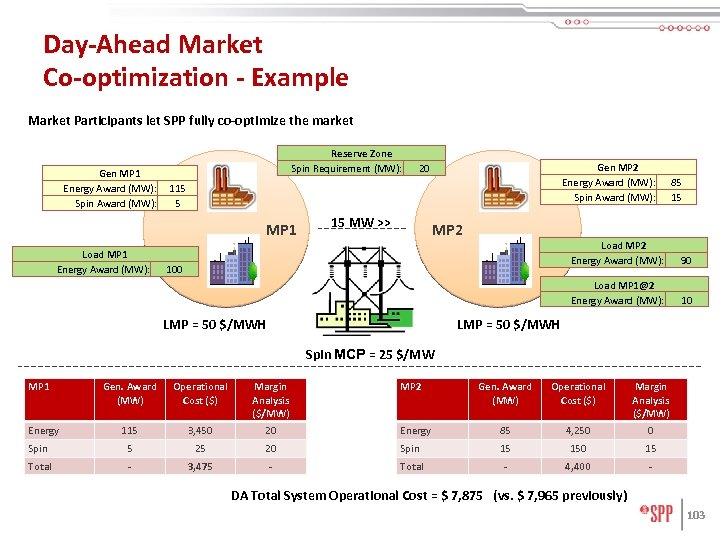 Day-Ahead Market Co-optimization - Example Market Participants let SPP fully co-optimize the market Gen MP 1 Energy Award (MW): Spin Award (MW): Reserve Zone Spin Requirement (MW): Gen MP 2 Energy Award (MW): Spin Award (MW): 20 115 5 MP 1 15 MW >> 85 15 MP 2 Load MP 2 Energy Award (MW): 100 LMP = 50 $/MWH 90 Load MP 1@2 Energy Award (MW): Load MP 1 Energy Award (MW): 10 LMP = 50 $/MWH Spin MCP = 25 $/MW MP 1 Gen. Award (MW) Operational Cost ($) Margin Analysis ($/MW) 115 3, 450 20 Spin 5 25 Total - 3, 475 Energy MP 2 Gen. Award (MW) Operational Cost ($) Margin Analysis ($/MW) Energy 85 4, 250 0 20 Spin 15 150 15 - Total - 4, 400 - DA Total System Operational Cost = $ 7, 875 (vs. $ 7, 965 previously) 103
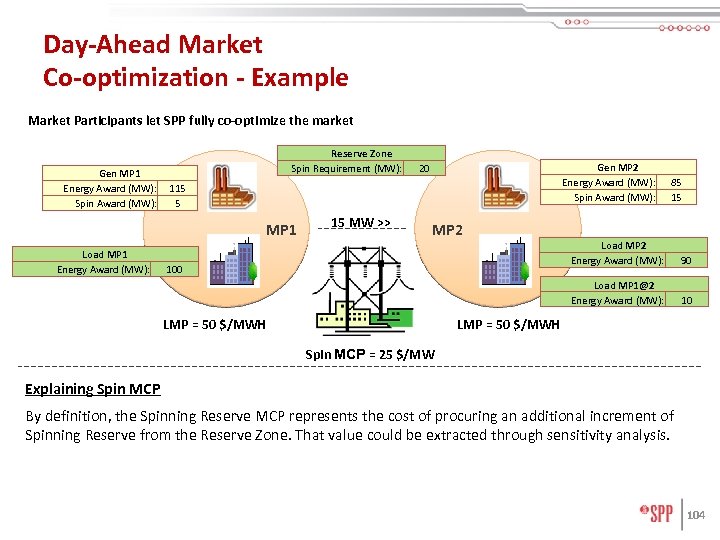 Day-Ahead Market Co-optimization - Example Market Participants let SPP fully co-optimize the market Gen MP 1 Energy Award (MW): Spin Award (MW): Reserve Zone Spin Requirement (MW): Gen MP 2 Energy Award (MW): Spin Award (MW): 20 115 5 MP 1 15 MW >> 85 15 MP 2 Load MP 2 Energy Award (MW): 100 LMP = 50 $/MWH 90 Load MP 1@2 Energy Award (MW): Load MP 1 Energy Award (MW): 10 LMP = 50 $/MWH Spin MCP = 25 $/MW Explaining Spin MCP By definition, the Spinning Reserve MCP represents the cost of procuring an additional increment of Spinning Reserve from the Reserve Zone. That value could be extracted through sensitivity analysis. 104
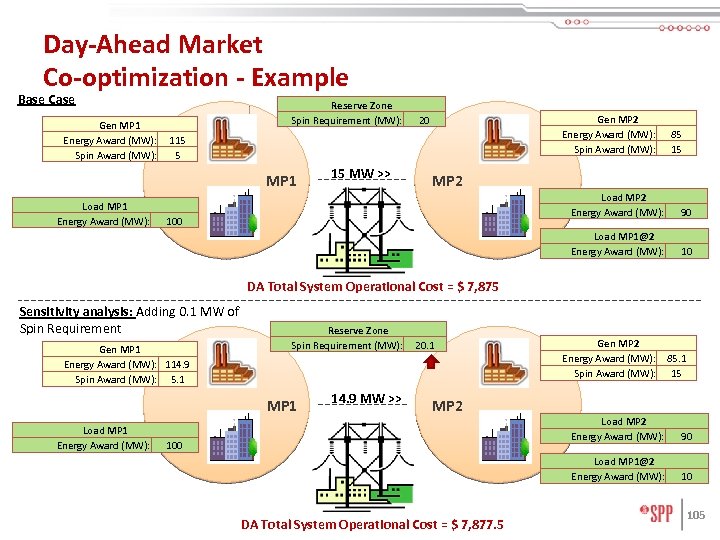 Day-Ahead Market Co-optimization - Example Base Case Gen MP 1 Energy Award (MW): Spin Award (MW): Reserve Zone Spin Requirement (MW): Gen MP 2 Energy Award (MW): Spin Award (MW): 20 115 5 MP 1 15 MW >> 85 15 MP 2 Load MP 2 Energy Award (MW): 100 90 Load MP 1@2 Energy Award (MW): Load MP 1 Energy Award (MW): 10 DA Total System Operational Cost = $ 7, 875 Sensitivity analysis: Adding 0. 1 MW of Spin Requirement Gen MP 1 Energy Award (MW): 114. 9 Spin Award (MW): 5. 1 Reserve Zone Spin Requirement (MW): MP 1 Load MP 1 Energy Award (MW): 14. 9 MW >> 20. 1 Gen MP 2 Energy Award (MW): 85. 1 Spin Award (MW): 15 MP 2 Load MP 2 Energy Award (MW): DA Total System Operational Cost = $ 7, 877. 5 90 Load MP 1@2 Energy Award (MW): 100 10 105
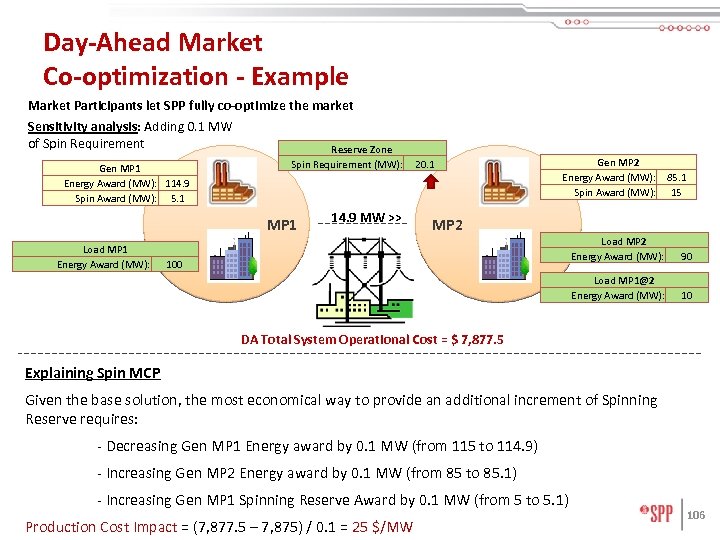 Day-Ahead Market Co-optimization - Example Market Participants let SPP fully co-optimize the market Sensitivity analysis: Adding 0. 1 MW of Spin Requirement Gen MP 1 Energy Award (MW): 114. 9 Spin Award (MW): 5. 1 Reserve Zone Spin Requirement (MW): MP 1 14. 9 MW >> 20. 1 Gen MP 2 Energy Award (MW): 85. 1 Spin Award (MW): 15 MP 2 Load MP 2 Energy Award (MW): 100 90 Load MP 1@2 Energy Award (MW): Load MP 1 Energy Award (MW): 10 DA Total System Operational Cost = $ 7, 877. 5 Explaining Spin MCP Given the base solution, the most economical way to provide an additional increment of Spinning Reserve requires: - Decreasing Gen MP 1 Energy award by 0. 1 MW (from 115 to 114. 9) - Increasing Gen MP 2 Energy award by 0. 1 MW (from 85 to 85. 1) - Increasing Gen MP 1 Spinning Reserve Award by 0. 1 MW (from 5 to 5. 1) Production Cost Impact = (7, 877. 5 – 7, 875) / 0. 1 = 25 $/MW 106
 DAY-AHEAD ACTIVITIES: RUC COMMITMENT PERIOD 107
 Day-Ahead Activities Reliability Unit Commitment (RUC) • The Reliability Unit Commitment (RUC) process is a market mechanism that ensures there is enough capacity committed in order to cover the system load and Operating Reserve requirement forecasts, as determined by the RTO. • Purpose of running a Day-Ahead RUC process is to ensure a reliable operating plan for the next Operating Day. • The Day-Ahead RUC is executed shortly after the Day-Ahead Market completes. • The clearing in the RUC process is performed via a Security-Constrained Unit Commitment (SCUC) algorithm. 108
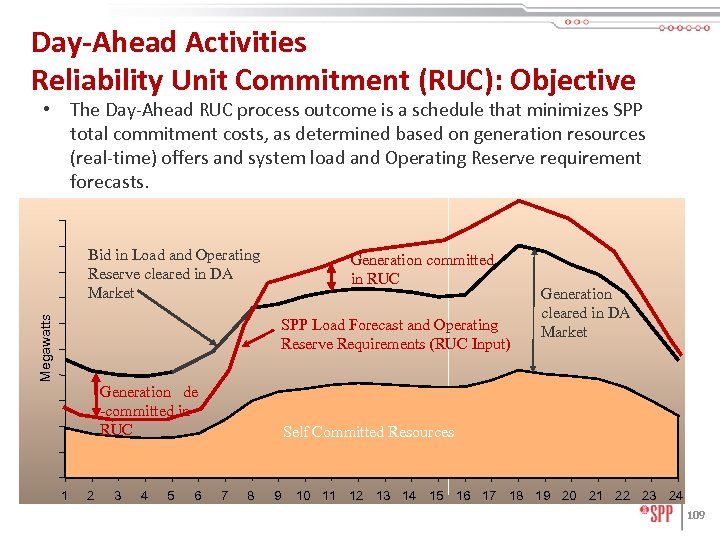 Day-Ahead Activities Reliability Unit Commitment (RUC): Objective • The Day-Ahead RUC process outcome is a schedule that minimizes SPP total commitment costs, as determined based on generation resources (real-time) offers and system load and Operating Reserve requirement forecasts. Bid in Load and Operating Reserve cleared in DA Market Megawatts Generation committed in RUC SPP Load Forecast and Operating Reserve Requirements (RUC Input) Generation de -committed in RUC 1 2 3 4 5 6 Generation cleared in DA Market Self Committed Resources 7 8 9 10 11 12 13 14 15 16 17 18 19 20 21 22 23 24 109
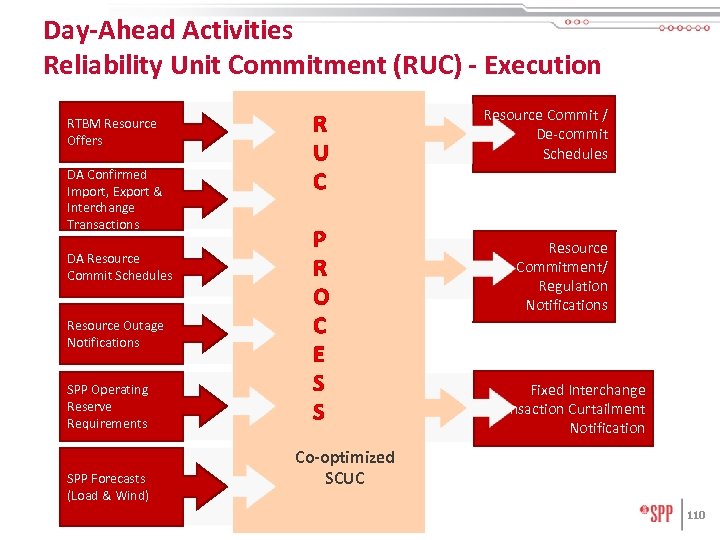 Day-Ahead Activities Reliability Unit Commitment (RUC) - Execution Resource Commit / De-commit Schedules RTBM Resource Offers DA Confirmed Import, Export & Interchange Transactions Resource Commitment/ Regulation Notifications DA Resource Commit Schedules Resource Outage Notifications Fixed Interchange Transaction Curtailment Notification SPP Operating Reserve Requirements SPP Forecasts (Load & Wind) Co-optimized SCUC 110
 Day-Ahead Activities Reliability Unit Commitment (RUC) (cont’d) • All Market Participants need to submit (Real-Time) offers for all their registered resources that are not on planned, forced or otherwise approved outage • The RUC process will take into consideration the cleared resource commitment schedules from the Day-Ahead Market and updated Current Operating Plan (which could have been modified as a result of a previously cleared RUC process) • Resources committed by any RUC (Day-Ahead or Intra-Day) or Reliability Assessment processes are subject to Make-Whole Payment given that they meet the eligibility criterion 111
 Day-Ahead Market vs. Day-Ahead RUC Differences • Day-Ahead Market: • Uses Day-Ahead Offer data • MPs must offer enough capacity to cover load • Clears by matching Resource Offers to Load Bids • Accepts Virtual Bids and Offers • Day-Ahead RUC: • Uses Real-Time Offer data • MPs must submit offers for ALL resources not on outage • Uses SPP Load Forecast to make commitment decisions • Does NOT evaluate Virtual Bids and Offers 112
 Day-Ahead Activities Reliability Unit Commitment (RUC) - Timeline • Between 4: 00 PM and 5: 00 PM: Market Participants can update RTBM Resources Offers and outage notification, including Resources that were not selected by Day-Ahead Market • Between 5: 00 PM and 8: 00 PM: SPP execute Day-Ahead RUC • By 8: 00 PM: SPP notifies Market Participants affected by Day-Ahead RUC results 113
 Section 5 OPERATING DAY MARKET ACTIVITIES: INTRA-DAY RELIABILITY UNIT COMMITMENT (INTRA-DAY RUC) 114
 Topics Covered • Intra-Day RUC: Definition and Timeline • RTBM: Definition and Objective, Resource Offers • RTBM Clearing 115
 Operating Day Market Activities Intra-Day Reliability Unit Commitment (Intra-Day RUC) • Purpose of running the Intra-Day RUC process is to ensure Resource and Operating Reserve adequacy for the Operating Day • Process performed by SPP at least every four hours throughout the Operating Day, for the balance of the day • All Market Participants need to submit (Real-Time) offers for all their registered resources that are not on planned, forced or otherwise approved outage • Affected Market Participants are notified by SPP • Resources committed by RUC or Reliability Assessment processes are subject to Make-Whole Payment given that they meet the eligibility criteria. 116
 OPERATING DAY MARKET ACTIVITIES: REAL-TIME BALANCING MARKET (RTBM) 117
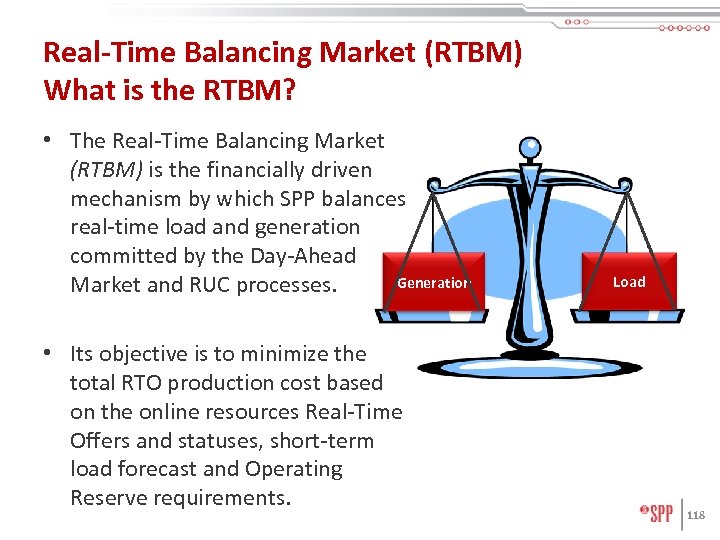 Real-Time Balancing Market (RTBM) What is the RTBM? • The Real-Time Balancing Market (RTBM) is the financially driven mechanism by which SPP balances real-time load and generation committed by the Day-Ahead Generation Market and RUC processes. • Its objective is to minimize the total RTO production cost based on the online resources Real-Time Offers and statuses, short-term load forecast and Operating Reserve requirements. Load 118
 Operating Day Activities Real-Time Balancing Market (RTBM) • The RTBM is executed every 5 -minutes for the next Dispatch Interval • Resources receive dispatch amount for Energy and Operating Reserve every 5 -minutes • Setpoint Instructions are issued every 4 -seconds to represent the sum of Energy and Operating Reserve deployment for a Resource • Deviations from Setpoint Instructions result in additional charges 119
 Operating Day Activities Real-Time Balancing Market (RTBM) • SPP may issue a reliability directive in the form of a Manual Dispatch to resolve emergency condition (Referred to as OOME, Out-of-Merit Energy) • The clearing of Energy and Operating Reserves is co-optimized using a SCED algorithm • The difference in Day-Ahead cleared and RTBM dispatch amounts are settled based on RTBM prices • Prices are posted every 5 -minutes 120
 Real-Time Balancing Market (RTBM) Resource Offers • A Resource Offer is a comprehensive set of information that will allow a Market Participant to sell generation into the SPP Integrated Marketplace • All Market Participants must submit RTBM offers for all their registered Resources that are not on planned, forced or otherwise approved outage • Market Participants are required to keep their Resource Offer operating parameters up-to-date during the Operating Day 121
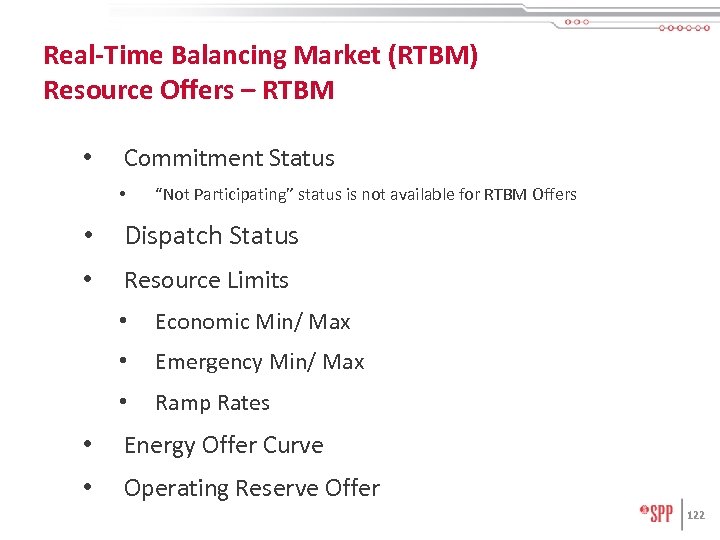 Real-Time Balancing Market (RTBM) Resource Offers – RTBM • Commitment Status • “Not Participating” status is not available for RTBM Offers • Dispatch Status • Resource Limits • Economic Min/ Max • Emergency Min/ Max • Ramp Rates • Energy Offer Curve • Operating Reserve Offer 122
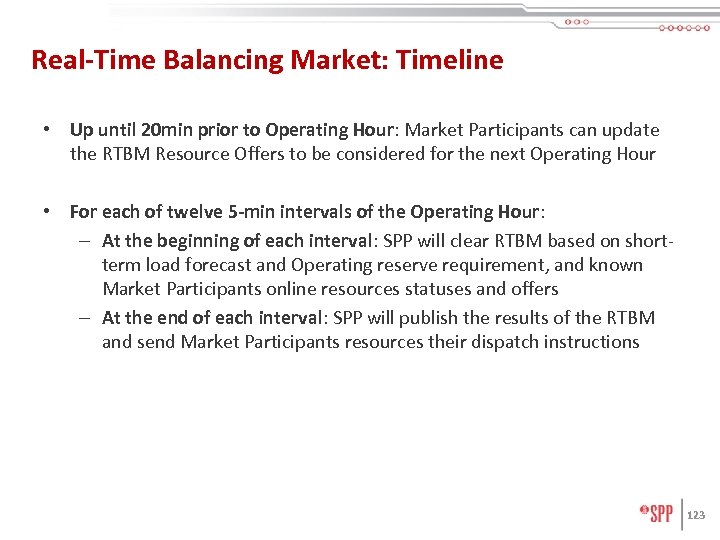 Real-Time Balancing Market: Timeline • Up until 20 min prior to Operating Hour: Market Participants can update the RTBM Resource Offers to be considered for the next Operating Hour • For each of twelve 5 -min intervals of the Operating Hour: – At the beginning of each interval: SPP will clear RTBM based on shortterm load forecast and Operating reserve requirement, and known Market Participants online resources statuses and offers – At the end of each interval: SPP will publish the results of the RTBM and send Market Participants resources their dispatch instructions 123
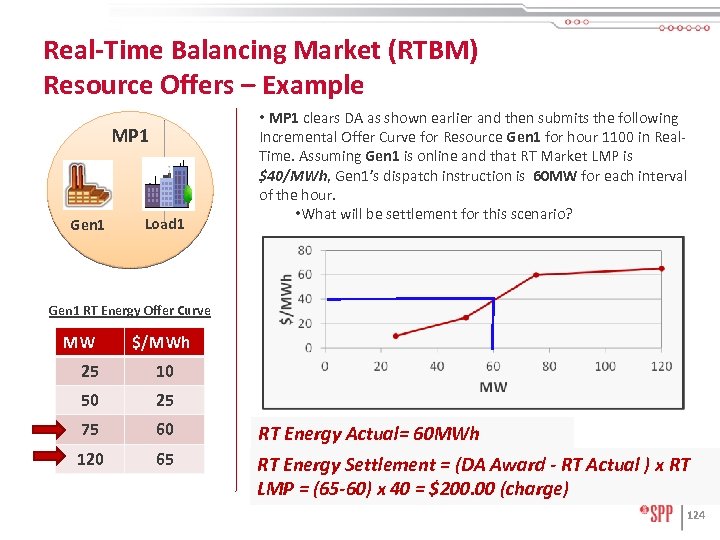 Real-Time Balancing Market (RTBM) Resource Offers – Example MP 1 Gen 1 Load 1 • MP 1 clears DA as shown earlier and then submits the following Incremental Offer Curve for Resource Gen 1 for hour 1100 in Real. Time. Assuming Gen 1 is online and that RT Market LMP is $40/MWh, Gen 1’s dispatch instruction is 60 MW for each interval of the hour. • What will be settlement for this scenario? Gen 1 RT Energy Offer Curve MW $/MWh 25 10 50 25 75 60 RT Energy Actual= 60 MWh 120 65 RT Energy Settlement = (DA Award - RT Actual ) x RT LMP = (65 -60) x 40 = $200. 00 (charge) 124
 Section 6 AUCTION REVENUE RIGHTS (ARRS) AND TRANSMISSION CONGESTION RIGHTS (TCRS) 125
 Topics Covered • Understanding Congestion • ARRs/TCRs Processes Interaction: Overview and Timeline • ARRs: Definition and Allocation Objective • ARR Allocation: Process • TCRs: Definition and Auction Objective • TCR Auction: Process • TCRs Secondary Market • ARRs and TCRs Settlement Valuation 126
 Understanding Congestion About Congestion • Congestion occurs when the desired amount of electricity is unable to flow due to limitations on the transmission grid • The transmission grid limitations could be intrinsic to the grid itself or further exacerbated by planned (e. g. transmission line maintenance) or unforeseen events (e. g. transmission line damage caused by extreme weather) • However, one can hedge to manage the uncertainty of congestion – Electricity Congestion – ARRs/TCRs 127
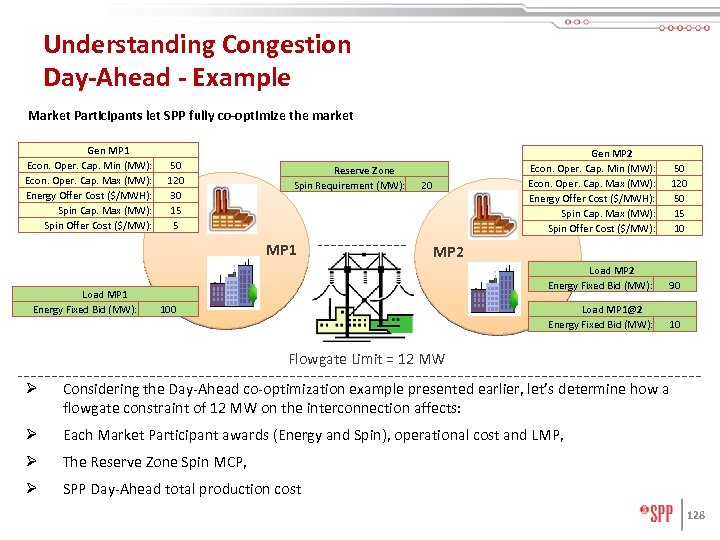 Understanding Congestion Day-Ahead - Example Market Participants let SPP fully co-optimize the market Gen MP 1 Econ. Oper. Cap. Min (MW): Econ. Oper. Cap. Max (MW): Energy Offer Cost ($/MWH): Spin Cap. Max (MW): Spin Offer Cost ($/MW): 50 120 30 15 5 Reserve Zone Spin Requirement (MW): MP 1 Load MP 1 Energy Fixed Bid (MW): Gen MP 2 Econ. Oper. Cap. Min (MW): Econ. Oper. Cap. Max (MW): Energy Offer Cost ($/MWH): Spin Cap. Max (MW): Spin Offer Cost ($/MW): 20 50 15 10 MP 2 Load MP 2 Energy Fixed Bid (MW): Load MP 1@2 Energy Fixed Bid (MW): 100 90 10 Flowgate Limit = 12 MW Ø Considering the Day-Ahead co-optimization example presented earlier, let’s determine how a flowgate constraint of 12 MW on the interconnection affects: Ø Each Market Participant awards (Energy and Spin), operational cost and LMP, Ø The Reserve Zone Spin MCP, Ø SPP Day-Ahead total production cost 128
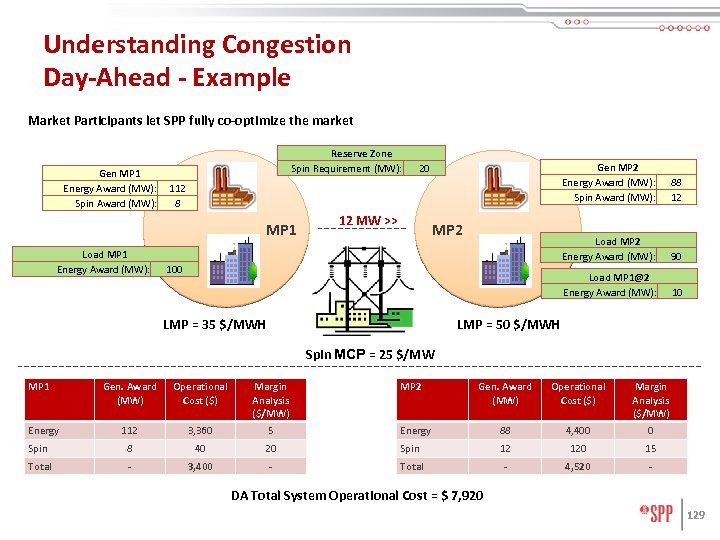 Understanding Congestion Day-Ahead - Example Market Participants let SPP fully co-optimize the market Gen MP 1 Energy Award (MW): Spin Award (MW): Reserve Zone Spin Requirement (MW): MP 2 100 LMP = 35 $/MWH 90 Load MP 1@2 Energy Award (MW): 12 MW >> 88 12 Load MP 2 Energy Award (MW): 112 8 MP 1 Load MP 1 Energy Award (MW): Gen MP 2 Energy Award (MW): Spin Award (MW): 20 10 LMP = 50 $/MWH Spin MCP = 25 $/MW MP 1 Gen. Award (MW) Operational Cost ($) Margin Analysis ($/MW) 112 3, 360 5 Spin 8 40 Total - 3, 400 Energy MP 2 Gen. Award (MW) Operational Cost ($) Margin Analysis ($/MW) Energy 88 4, 400 0 20 Spin 12 120 15 - Total - 4, 520 - DA Total System Operational Cost = $ 7, 920 129
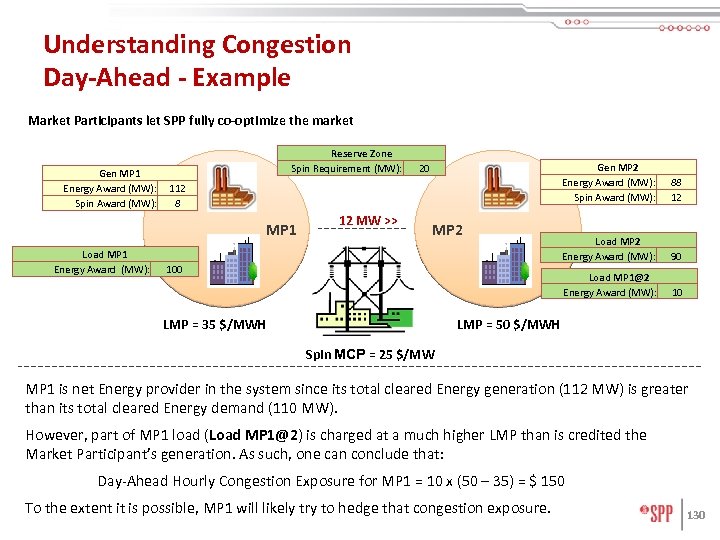 Understanding Congestion Day-Ahead - Example Market Participants let SPP fully co-optimize the market Gen MP 1 Energy Award (MW): Spin Award (MW): Reserve Zone Spin Requirement (MW): 12 MW >> MP 2 100 LMP = 35 $/MWH 88 12 Load MP 2 Energy Award (MW): 90 Load MP 1@2 Energy Award (MW): 112 8 MP 1 Load MP 1 Energy Award (MW): Gen MP 2 Energy Award (MW): Spin Award (MW): 20 10 LMP = 50 $/MWH Spin MCP = 25 $/MW MP 1 is net Energy provider in the system since its total cleared Energy generation (112 MW) is greater than its total cleared Energy demand (110 MW). However, part of MP 1 load (Load MP 1@2) is charged at a much higher LMP than is credited the Market Participant’s generation. As such, one can conclude that: Day-Ahead Hourly Congestion Exposure for MP 1 = 10 x (50 – 35) = $ 150 To the extent it is possible, MP 1 will likely try to hedge that congestion exposure. 130
 Understanding Congestion Differences from SPP’s current EIS Market • TCRs replace the use of Energy Schedules and Native Load Schedules as congestion hedges. • Pre-DA activity – Congestion hedging process occurs prior to Real-Time and Day-Ahead operations. • Financial Players – External participants and those without assets in market footprint can participate. 131
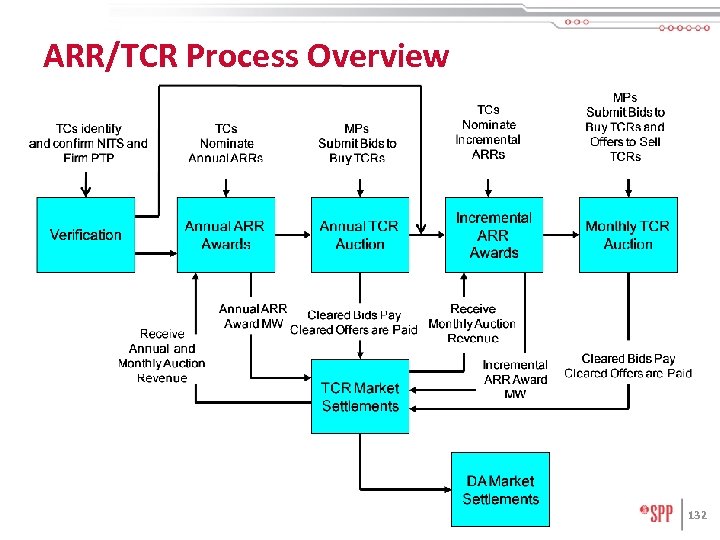 ARR/TCR Process Overview 132
 ARR/TCR PROCESS: TIMELINE: ANNUAL AND MONTHLY 133
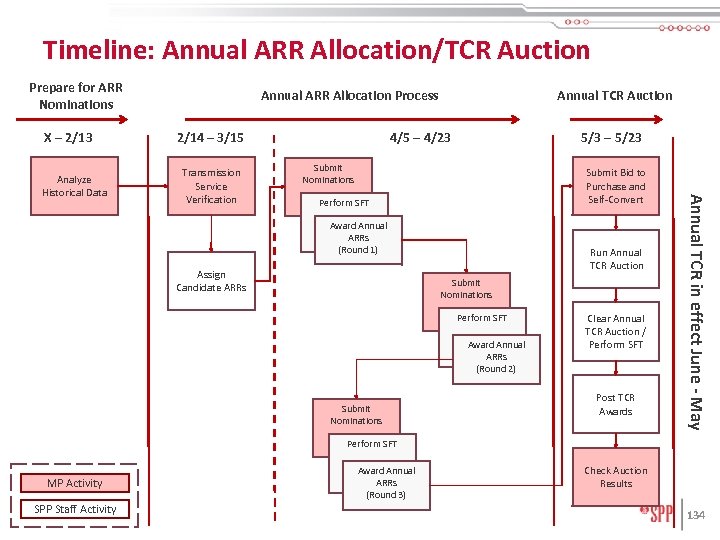 Timeline: Annual ARR Allocation/TCR Auction Prepare for ARR Nominations X – 2/13 2/14 – 3/15 Transmission Service Verification Annual TCR Auction 4/5 – 4/23 5/3 – 5/23 Submit Nominations Submit Bid to Purchase and Self-Convert Perform SFT Award Annual ARRs (Round 1) Assign Candidate ARRs Run Annual TCR Auction Submit Nominations Perform SFT Award Annual ARRs (Round 2) Submit Nominations Clear Annual TCR Auction / Perform SFT Post TCR Awards Annual TCR in effect June - May Analyze Historical Data Annual ARR Allocation Process Perform SFT MP Activity SPP Staff Activity Award Annual ARRs (Round 3) Check Auction Results 134
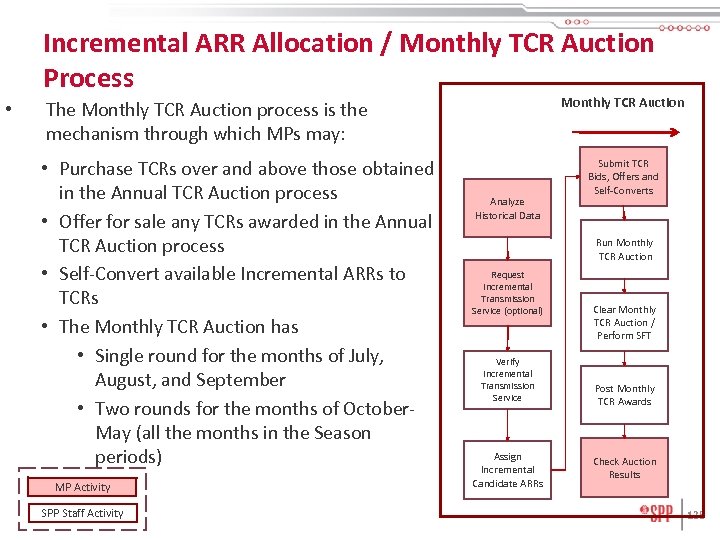 Incremental ARR Allocation / Monthly TCR Auction Process • Monthly TCR Auction The Monthly TCR Auction process is the mechanism through which MPs may: • Purchase TCRs over and above those obtained in the Annual TCR Auction process • Offer for sale any TCRs awarded in the Annual TCR Auction process • Self-Convert available Incremental ARRs to TCRs • The Monthly TCR Auction has • Single round for the months of July, August, and September • Two rounds for the months of October. May (all the months in the Season periods) MP Activity SPP Staff Activity Analyze Historical Data Submit TCR Bids, Offers and Self-Converts Run Monthly TCR Auction Request Incremental Transmission Service (optional) Verify Incremental Transmission Service Assign Incremental Candidate ARRs Clear Monthly TCR Auction / Perform SFT Post Monthly TCR Awards Check Auction Results 135
 ARR/TCR PROCESS: AUCTION REVENUE RIGHTS (ARRS) OVERVIEW 136
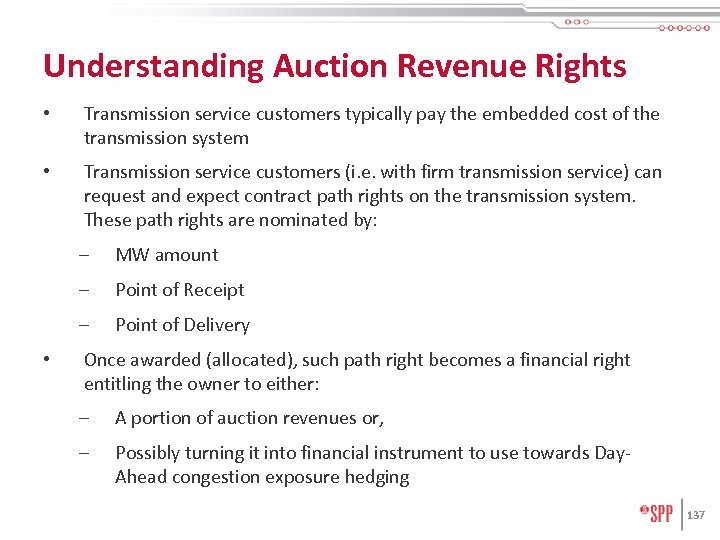 Understanding Auction Revenue Rights • Transmission service customers typically pay the embedded cost of the transmission system • Transmission service customers (i. e. with firm transmission service) can request and expect contract path rights on the transmission system. These path rights are nominated by: – – Point of Receipt – • MW amount Point of Delivery Once awarded (allocated), such path right becomes a financial right entitling the owner to either: – A portion of auction revenues or, – Possibly turning it into financial instrument to use towards Day. Ahead congestion exposure hedging 137
 ARRs: Definition • In Integrated Marketplace, such path right is known as Auction Revenue Right (ARR) and defined as: A financial right, awarded during the annual/incremental ARR allocation process, that entitles the holder to a share of the auction revenues generated in the applicable TCR auction(s) and/or entitles the holder to self-convert the ARRs into TCRs – Nomination Parameters: § § Source Settlement Location § Sink Settlement Location § Could be Network Type or PTP type § – MW Amount Time of Use (Period, On/Off-Peak) Candidate nominated ARRs are subject to a cap, which is a function of: § – Historical peak load or, Incremental candidate ARR allocation Financial Obligation § Will be either a credit or a liability to Market Participant in TCR auction settlement § Valuation based on the full MW allocation 138
 ARRs: Definition • In Integrated Marketplace, candidate ARRs do not have to be necessarily submitted in the ARR Allocation process • Possible use of candidate ARR: – Do nothing or, – Nominate for ARR Allocation Process and: § § • Self-convert Allocated ARR to TCR Bid, or Retain Allocated ARR for settlement based on the TCR Auction The ARR allocation process is conducted: – Annually – Incrementally (i. e. monthly if there is new transmission service reservation for that month or existing reservation that could not be accounted for in the annual process) 139
 ARR Allocation: Objective • The objective of the ARR Allocation Process is to grant as much ARR MWs as possible (or minimize the total curtailment amount, if needed) , while ensuring that the transmission network security is maintained: that allocation algorithm is referred to as ARR Simultaneous Feasibility Test (ARR SFT) • The results of the ARR Allocation Process will include: – The awarded (allocated) MW amount for each nominated candidate ARR – The total system awarded ARR MW amount 140
 Auction Revenue Rights How are Candidate ARRs allocated? • Based on following Confirmed Firm Transmission Rights – Network Integrated Transmission Service Agreement – Point to Point Firm Transmission Service Request – Grandfathered Agreements • Nominate Candidate ARRs to become ARRs • Allocated Annually - Period and Class – – Fall, Winter, Spring (On/Off Peak) – • June, July, August, September (On/Off Peak) Allocated in three rounds Allocated Monthly - Class – Monthly single round (On/Off Peak) – as needed basis 141
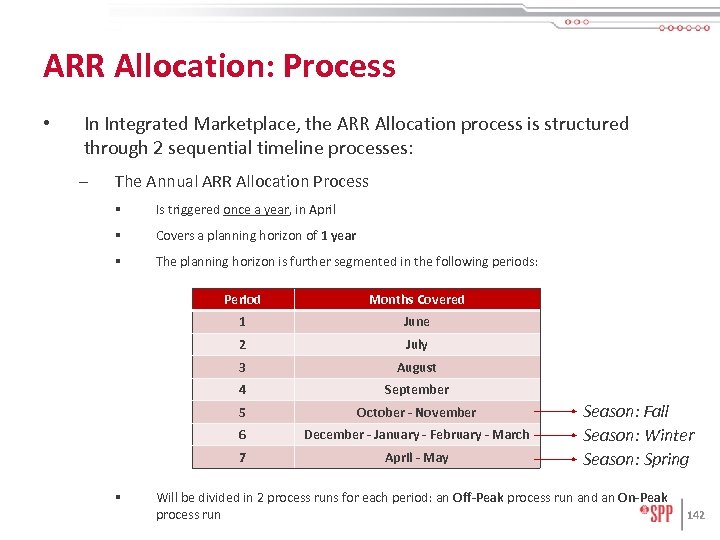 ARR Allocation: Process • In Integrated Marketplace, the ARR Allocation process is structured through 2 sequential timeline processes: – The Annual ARR Allocation Process § Is triggered once a year, in April § Covers a planning horizon of 1 year § The planning horizon is further segmented in the following periods: Period 1 June 2 July 3 August 4 September 5 October - November 6 December - January - February - March 7 § Months Covered April - May Season: Fall Season: Winter Season: Spring Will be divided in 2 process runs for each period: an Off-Peak process run and an On-Peak process run 142
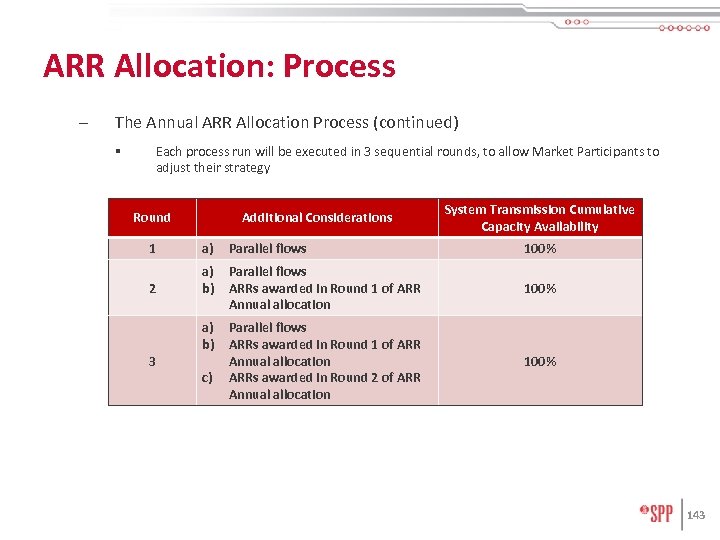 ARR Allocation: Process – The Annual ARR Allocation Process (continued) Each process run will be executed in 3 sequential rounds, to allow Market Participants to adjust their strategy § Round Additional Considerations System Transmission Cumulative Capacity Availability 1 a) Parallel flows 100% 2 a) b) Parallel flows ARRs awarded in Round 1 of ARR Annual allocation 100% a) b) Parallel flows ARRs awarded in Round 1 of ARR Annual allocation ARRs awarded in Round 2 of ARR Annual allocation 100% 3 c) 143
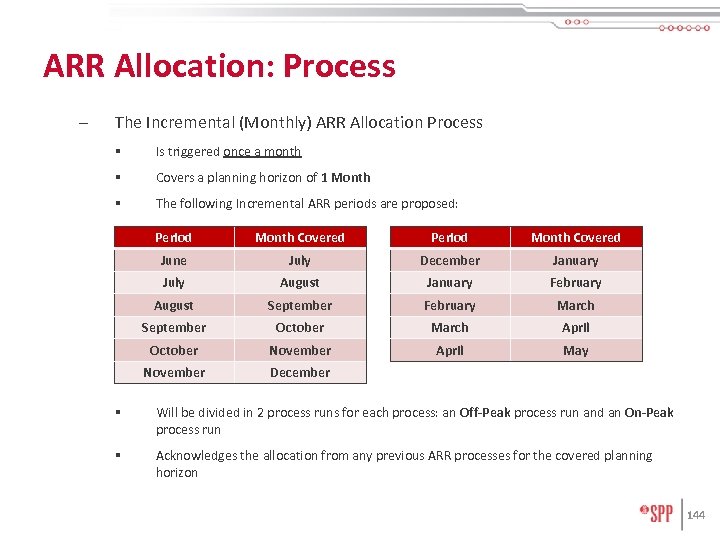 ARR Allocation: Process – The Incremental (Monthly) ARR Allocation Process § Is triggered once a month § Covers a planning horizon of 1 Month § The following Incremental ARR periods are proposed: Period Month Covered June July December January July August January February August September February March September October March April October November April May November December § Will be divided in 2 process runs for each process: an Off-Peak process run and an On-Peak process run § Acknowledges the allocation from any previous ARR processes for the covered planning horizon 144
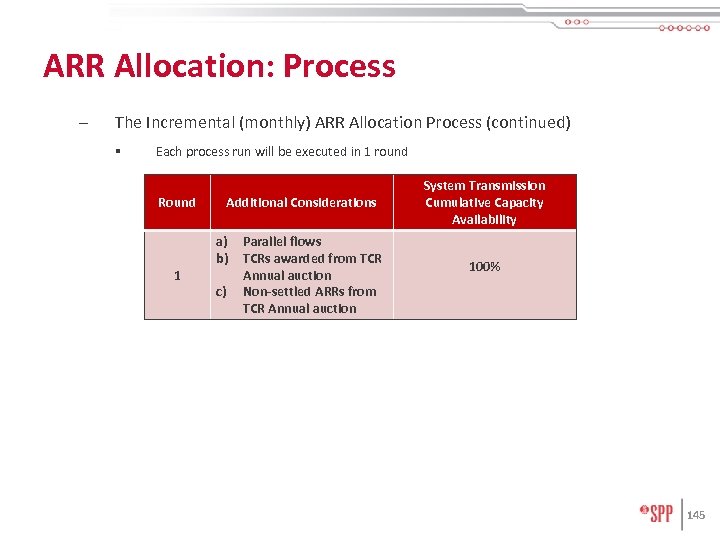 ARR Allocation: Process – The Incremental (monthly) ARR Allocation Process (continued) § Each process run will be executed in 1 round Round 1 Additional Considerations a) b) c) Parallel flows TCRs awarded from TCR Annual auction Non-settled ARRs from TCR Annual auction System Transmission Cumulative Capacity Availability 100% 145
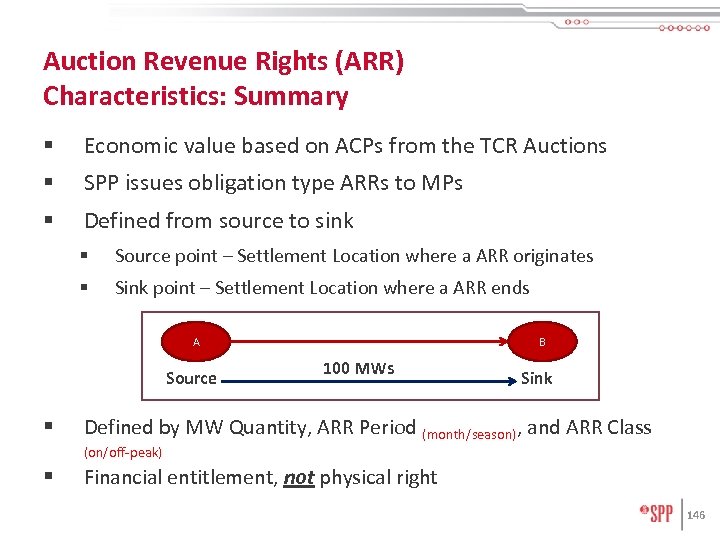 Auction Revenue Rights (ARR) Characteristics: Summary § Economic value based on ACPs from the TCR Auctions § SPP issues obligation type ARRs to MPs § Defined from source to sink § Source point – Settlement Location where a ARR originates § Sink point – Settlement Location where a ARR ends A Source § B 100 MWs Sink Defined by MW Quantity, ARR Period (month/season), and ARR Class (on/off-peak) § Financial entitlement, not physical right 146
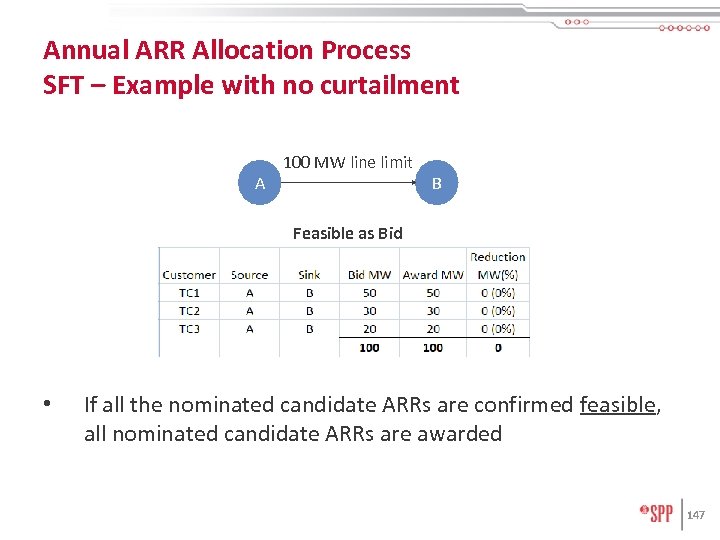 Annual ARR Allocation Process SFT – Example with no curtailment A 100 MW line limit B Feasible as Bid • If all the nominated candidate ARRs are confirmed feasible, all nominated candidate ARRs are awarded 147
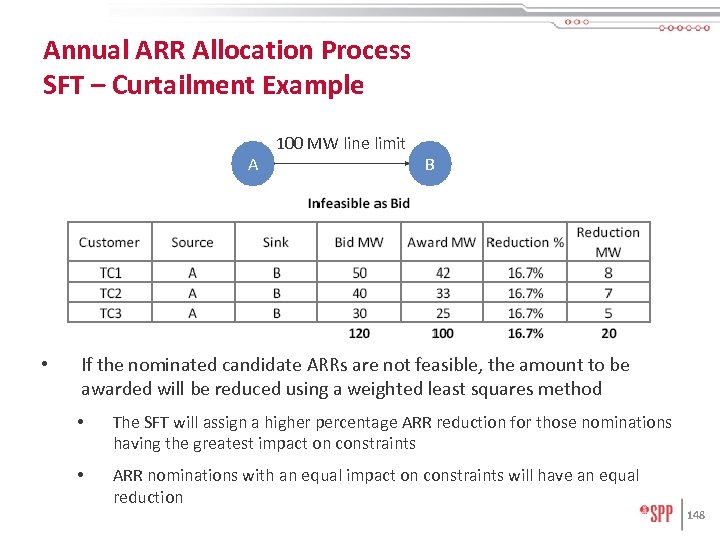 Annual ARR Allocation Process SFT – Curtailment Example A • 100 MW line limit B If the nominated candidate ARRs are not feasible, the amount to be awarded will be reduced using a weighted least squares method • The SFT will assign a higher percentage ARR reduction for those nominations having the greatest impact on constraints • ARR nominations with an equal impact on constraints will have an equal reduction 148
 ARR/TCR PROCESS: TRANSMISSION CONGESTION RIGHTS (TCRS) OVERVIEW 149
 Understanding Transmission Congestion Rights • In addition to providing ARRs for Market Participants who are entitled to, there is also the possibility of purchasing or selling (financial) transmission rights. Once granted, these rights are then used to mitigate the Market Participant congestion exposure to the Day-Ahead Market • The MW amount of purchase or sale in these transmission rights is determined through an centralized auction process whose objective is to maximize the auction value • These financial rights are submitted with the following characteristics: – MW amount – Point of Receipt – Point of Delivery – Incremental Offer/Bid Price 150
 TCRs: Definition • In Integrated Marketplace, such financial right is known as Transmission Congestion Right (TCR) and defined as: A financial right that entitles the holder to a share of the congestion revenue collected in the Day-Ahead Market – Submittal Parameters: § § Incremental Offer/Bid Price § Source Settlement Location § Sink Settlement Location § – Max MW Amount Time of Use (Period, On/Off-Peak) Credit Check: § – MP TCR Bids/Offers can be limited or cancelled in case of inadequate MP Market Credit Financial Obligation: § Will be either a credit or a liability in DA Settlement valuation § Valuation based on the full MW award 151
 TCR Auction: Objective • The objective of the TCR Auction Process is to maximize the auction value based on the TCR bids and offers, while ensuring that the transmission network security is maintained: that auction algorithm is known to as TCR Simultaneous Feasibility Test (TCR SFT) • The results of the TCR Auction Process will include: – The awarded MW amount for each submitted TCR Bid/Offer – The Auction Clearing Price (ACP) at each system Pricing Location – The total auction value 152
 TCRs: How can one obtain TCRs from SPP? • Annual TCR auction – – Multi-Class (On Peak/Off Peak) – • Multi-period (months/seasons) Based on reduced system capability Monthly TCR auction – – Multi-Class (On Peak/Off Peak) – • Single or two rounds Based on residual capability that was not purchased TCR secondary market – Bilateral trading 153
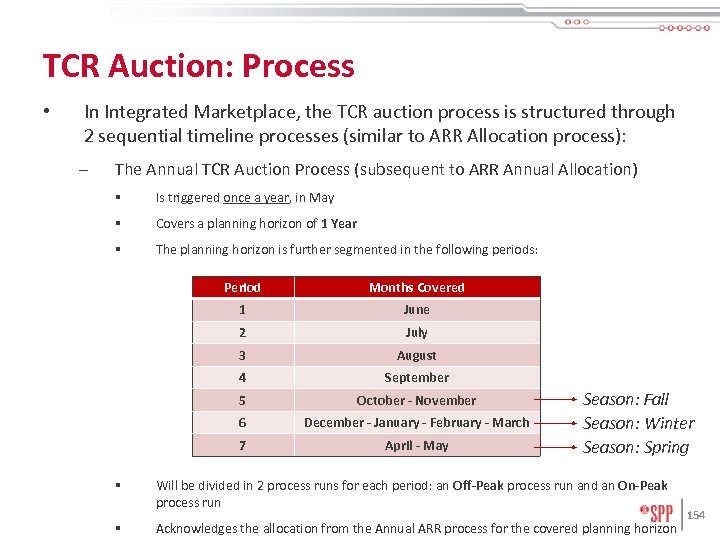 TCR Auction: Process • In Integrated Marketplace, the TCR auction process is structured through 2 sequential timeline processes (similar to ARR Allocation process): – The Annual TCR Auction Process (subsequent to ARR Annual Allocation) § Is triggered once a year, in May § Covers a planning horizon of 1 Year § The planning horizon is further segmented in the following periods: Period 1 July 3 August 4 September 5 October - November 6 December - January - February - March 7 § June 2 § Months Covered April - May Season: Fall Season: Winter Season: Spring Will be divided in 2 process runs for each period: an Off-Peak process run and an On-Peak process run Acknowledges the allocation from the Annual ARR process for the covered planning horizon 154
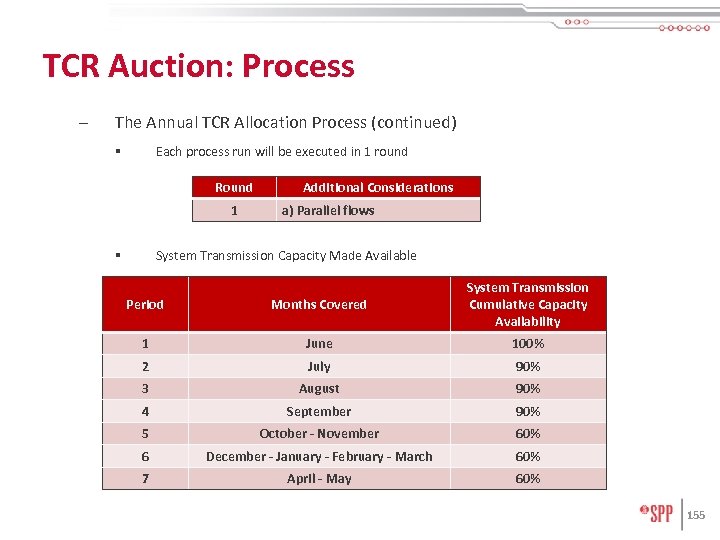 TCR Auction: Process – The Annual TCR Allocation Process (continued) Each process run will be executed in 1 round § Round 1 Additional Considerations a) Parallel flows System Transmission Capacity Made Available § Period Months Covered System Transmission Cumulative Capacity Availability 1 June 100% 2 July 90% 3 August 90% 4 September 90% 5 October - November 60% 6 December - January - February - March 60% 7 April - May 60% 155
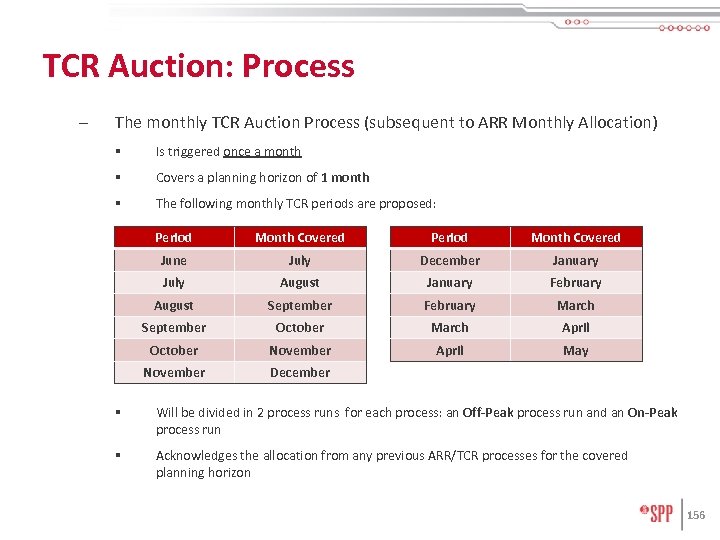 TCR Auction: Process – The monthly TCR Auction Process (subsequent to ARR Monthly Allocation) § Is triggered once a month § Covers a planning horizon of 1 month § The following monthly TCR periods are proposed: Period Month Covered June July December January July August January February August September February March September October March April October November April May November December § Will be divided in 2 process runs for each process: an Off-Peak process run and an On-Peak process run § Acknowledges the allocation from any previous ARR/TCR processes for the covered planning horizon 156
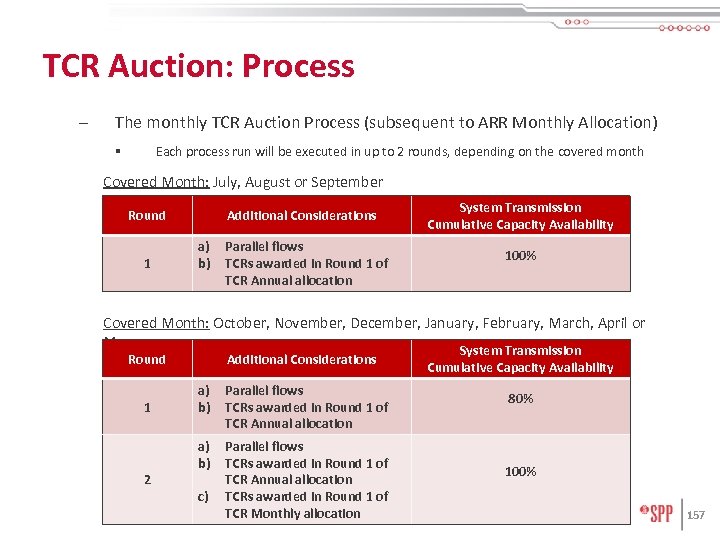 TCR Auction: Process – The monthly TCR Auction Process (subsequent to ARR Monthly Allocation) Each process run will be executed in up to 2 rounds, depending on the covered month § Covered Month: July, August or September Round 1 Additional Considerations a) b) Parallel flows TCRs awarded in Round 1 of TCR Annual allocation System Transmission Cumulative Capacity Availability 100% Covered Month: October, November, December, January, February, March, April or May Round 1 2 Additional Considerations a) b) Parallel flows TCRs awarded in Round 1 of TCR Annual allocation TCRs awarded in Round 1 of TCR Monthly allocation c) System Transmission Cumulative Capacity Availability 80% 100% 157
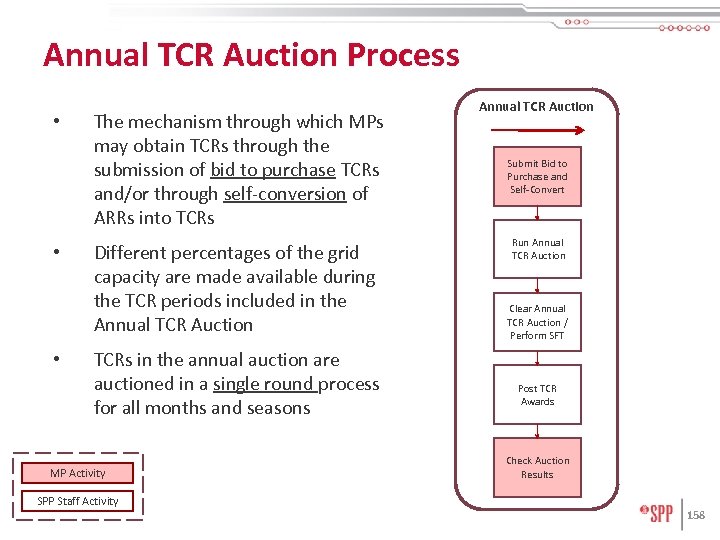 Annual TCR Auction Process • • • The mechanism through which MPs may obtain TCRs through the submission of bid to purchase TCRs and/or through self-conversion of ARRs into TCRs Different percentages of the grid capacity are made available during the TCR periods included in the Annual TCR Auction TCRs in the annual auction are auctioned in a single round process for all months and seasons MP Activity SPP Staff Activity Annual TCR Auction Submit Bid to Purchase and Self-Convert Run Annual TCR Auction Clear Annual TCR Auction / Perform SFT Post TCR Awards Check Auction Results 158
 Annual TCR Auction Process Auction Bidding – Self-Convert • If an MP elects to purchase the TCR corresponding to an ARR he holds, he will submit the ARR as a “self-convert” bid type during the Annual TCR Auction • Only MPs holding ARRs may submit a Self-Convert TCR bid • The Self-Convert bid must contain the same source and sink as the associated ARR • The Self-Convert MW must be less than or equal to the associated ARR MW • The MP will technically pay for the TCR, but as holder of the corresponding Auction Revenue Rights they will in effect be funding their own portion of the ARR fund, typically resulting in a net $0 transaction during ARR Settlements 159
 Annual TCR Auction Process Auction Bidding – Bid to Purchase § Bid to purchase § § § An MP may elect to submit bids to purchase TCRs instead of or in addition to self-converting ARR MWs Sources and Sinks for TCR bids may be any valid Settlement Location The number of TCR MW an MP may bid to purchase is limited by the amount of credit they have established in the TCR System 160
 Monthly TCR Auction Process Monthly Auction Bidding § § The TCR offer and bid submittal process allows for the following submittal types: § Self-Convert: When a Market Participant elects to purchase the TCR corresponding to an ARR that it holds § Bids to Purchase: Sources and Sinks for bids to purchase TCRs may be any valid Settlement Location § Offers to Sell: In the Monthly TCR Auction an MP may also offer for sale any TCR that was acquired during the Annual TCR Auction. Self-conversions, bids to purchase, and offers to sell TCRs in the Monthly TCR Auction process follow the same procedures and have the same restrictions as in the Annual TCR Auction 161
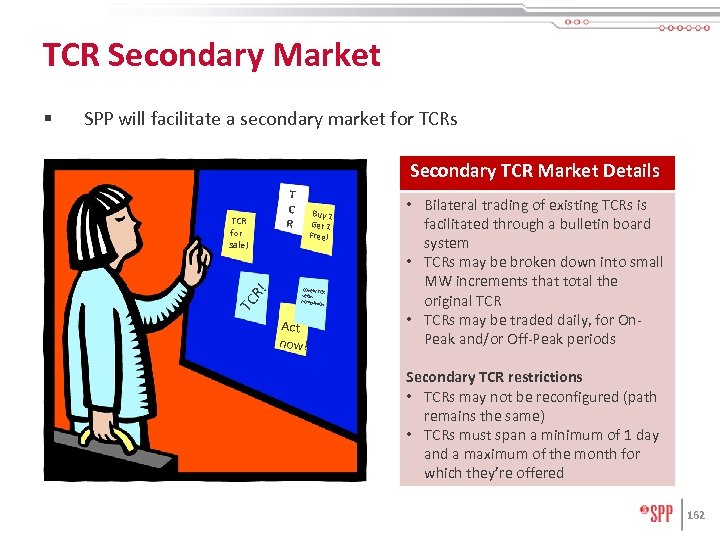 TCR Secondary Market SPP will facilitate a secondary market for TCRs Secondary TCR Market Details TCR for sale! TC R! § T C R Buy 1 Get 1 Free! Lonely TC R seeks companion Act now! • Bilateral trading of existing TCRs is facilitated through a bulletin board system • TCRs may be broken down into small MW increments that total the original TCR • TCRs may be traded daily, for On. Peak and/or Off-Peak periods Secondary TCR restrictions • TCRs may not be reconfigured (path remains the same) • TCRs must span a minimum of 1 day and a maximum of the month for which they’re offered 162
 TCR Secondary Market • Market Participants contact each other directly to negotiate terms of sale • The TCR purchaser pays TCR seller directly • SPP accounts for transfer of TCR ownership • Purchaser must meet applicable credit requirements 163
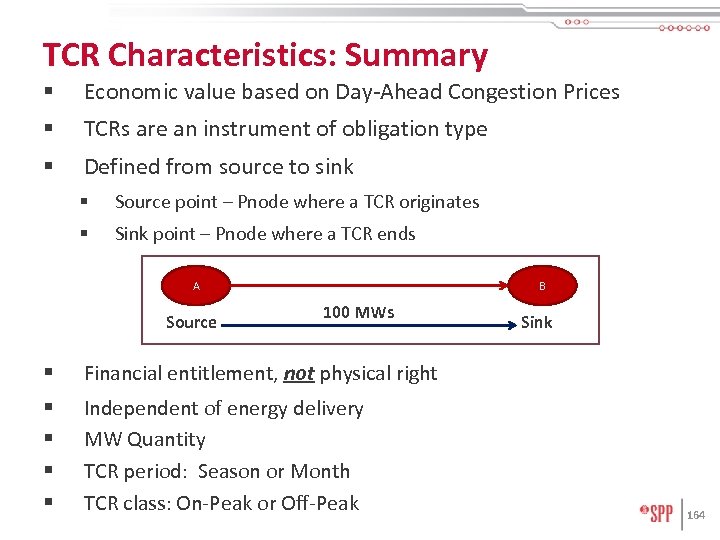 TCR Characteristics: Summary § Economic value based on Day-Ahead Congestion Prices § TCRs are an instrument of obligation type § Defined from source to sink § Source point – Pnode where a TCR originates § Sink point – Pnode where a TCR ends A Source B 100 MWs § Financial entitlement, not physical right § § Independent of energy delivery MW Quantity TCR period: Season or Month TCR class: On-Peak or Off-Peak Sink 164
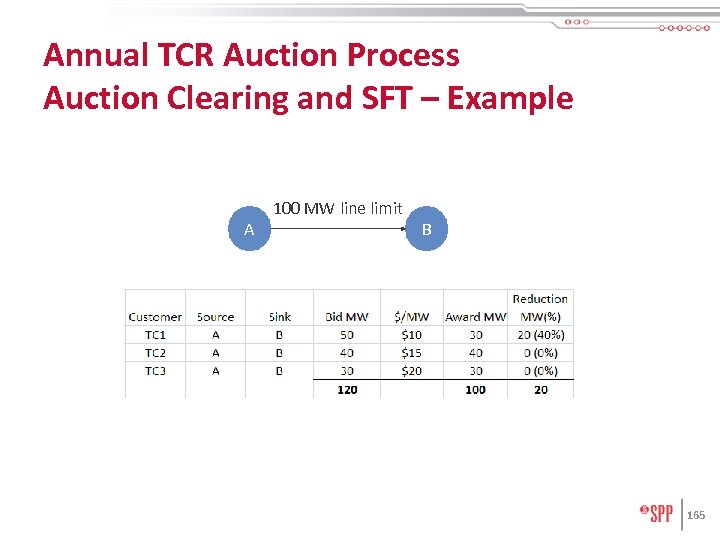 Annual TCR Auction Process Auction Clearing and SFT – Example A 100 MW line limit B 165
 ARR/TCR PROCESS: AUCTION REVENUE RIGHTS AND TRANSMISSION CONGESTION RIGHTS SETTLEMENT VALUATION 166
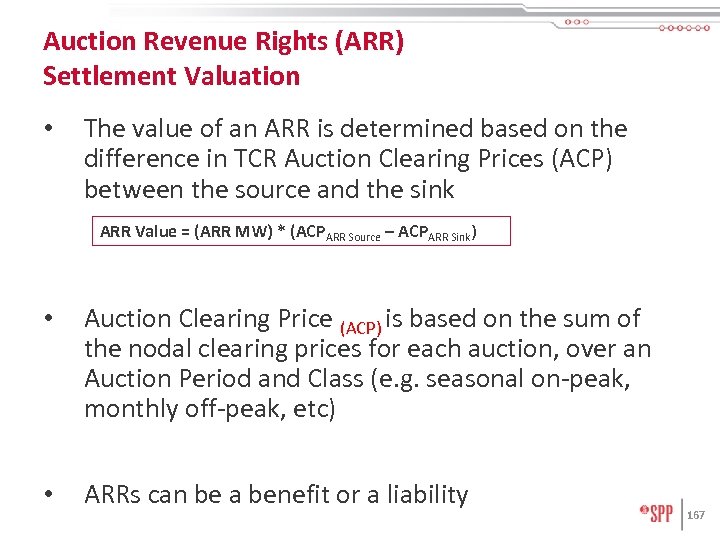 Auction Revenue Rights (ARR) Settlement Valuation • The value of an ARR is determined based on the difference in TCR Auction Clearing Prices (ACP) between the source and the sink ARR Value = (ARR MW) * (ACPARR Source – ACPARR Sink) • Auction Clearing Price (ACP) is based on the sum of the nodal clearing prices for each auction, over an Auction Period and Class (e. g. seasonal on-peak, monthly off-peak, etc) • ARRs can be a benefit or a liability 167
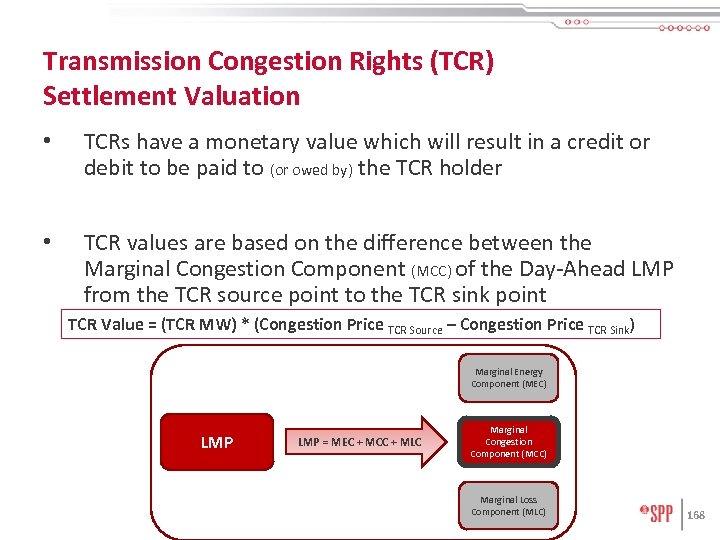 Transmission Congestion Rights (TCR) Settlement Valuation • TCRs have a monetary value which will result in a credit or debit to be paid to (or owed by) the TCR holder • TCR values are based on the difference between the Marginal Congestion Component (MCC) of the Day-Ahead LMP from the TCR source point to the TCR sink point TCR Value = (TCR MW) * (Congestion Price TCR Source – Congestion Price TCR Sink) Marginal Energy Component (MEC) LMP = MEC + MCC + MLC Marginal Congestion Component (MCC) Marginal Loss Component (MLC) 168
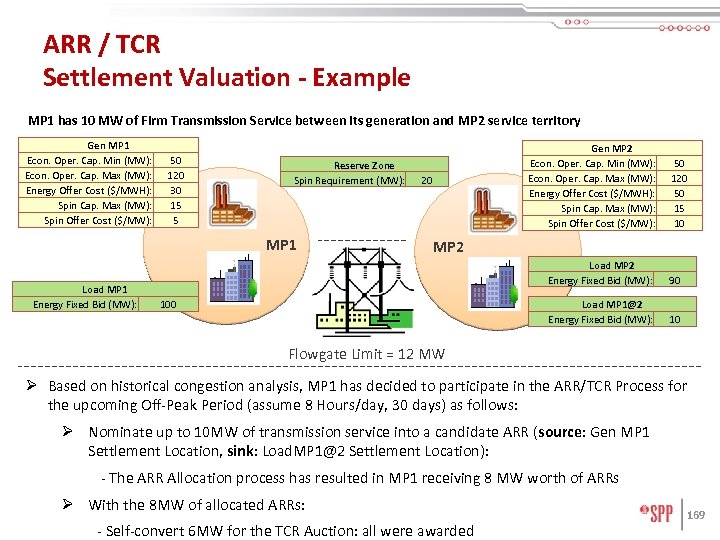 ARR / TCR Settlement Valuation - Example MP 1 has 10 MW of Firm Transmission Service between its generation and MP 2 service territory Gen MP 1 Econ. Oper. Cap. Min (MW): Econ. Oper. Cap. Max (MW): Energy Offer Cost ($/MWH): Spin Cap. Max (MW): Spin Offer Cost ($/MW): 50 120 30 15 5 Reserve Zone Spin Requirement (MW): MP 1 Load MP 1 Energy Fixed Bid (MW): Gen MP 2 Econ. Oper. Cap. Min (MW): Econ. Oper. Cap. Max (MW): Energy Offer Cost ($/MWH): Spin Cap. Max (MW): Spin Offer Cost ($/MW): 20 50 15 10 MP 2 Load MP 2 Energy Fixed Bid (MW): Load MP 1@2 Energy Fixed Bid (MW): 100 90 10 Flowgate Limit = 12 MW Ø Based on historical congestion analysis, MP 1 has decided to participate in the ARR/TCR Process for the upcoming Off-Peak Period (assume 8 Hours/day, 30 days) as follows: Ø Nominate up to 10 MW of transmission service into a candidate ARR (source: Gen MP 1 Settlement Location, sink: Load. MP 1@2 Settlement Location): - The ARR Allocation process has resulted in MP 1 receiving 8 MW worth of ARRs Ø With the 8 MW of allocated ARRs: - Self-convert 6 MW for the TCR Auction: all were awarded 169
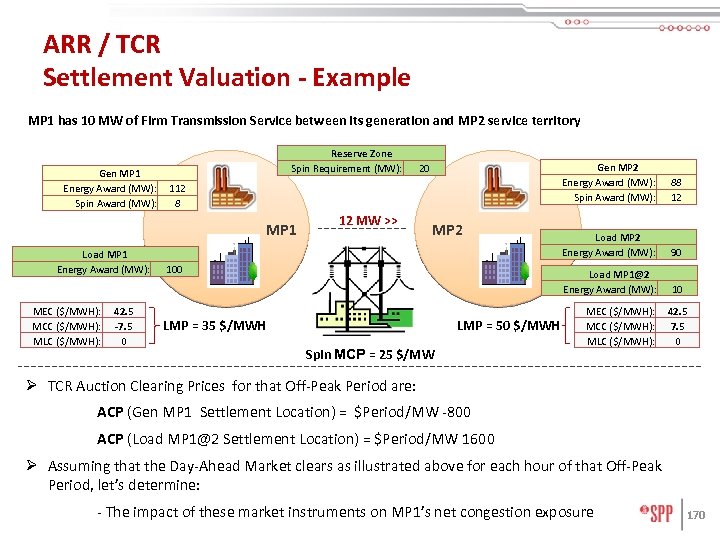 ARR / TCR Settlement Valuation - Example MP 1 has 10 MW of Firm Transmission Service between its generation and MP 2 service territory Gen MP 1 Energy Award (MW): Spin Award (MW): Reserve Zone Spin Requirement (MW): MEC ($/MWH): MCC ($/MWH): MLC ($/MWH): 42. 5 -7. 5 0 12 MW >> MP 2 100 LMP = 35 $/MWH LMP = 50 $/MWH Spin MCP = 25 $/MW 88 12 Load MP 2 Energy Award (MW): 90 Load MP 1@2 Energy Award (MW): 112 8 MP 1 Load MP 1 Energy Award (MW): Gen MP 2 Energy Award (MW): Spin Award (MW): 20 10 MEC ($/MWH): MCC ($/MWH): MLC ($/MWH): 42. 5 7. 5 0 Ø TCR Auction Clearing Prices for that Off-Peak Period are: ACP (Gen MP 1 Settlement Location) = $Period/MW -800 ACP (Load MP 1@2 Settlement Location) = $Period/MW 1600 Ø Assuming that the Day-Ahead Market clears as illustrated above for each hour of that Off-Peak Period, let’s determine: - The impact of these market instruments on MP 1’s net congestion exposure 170
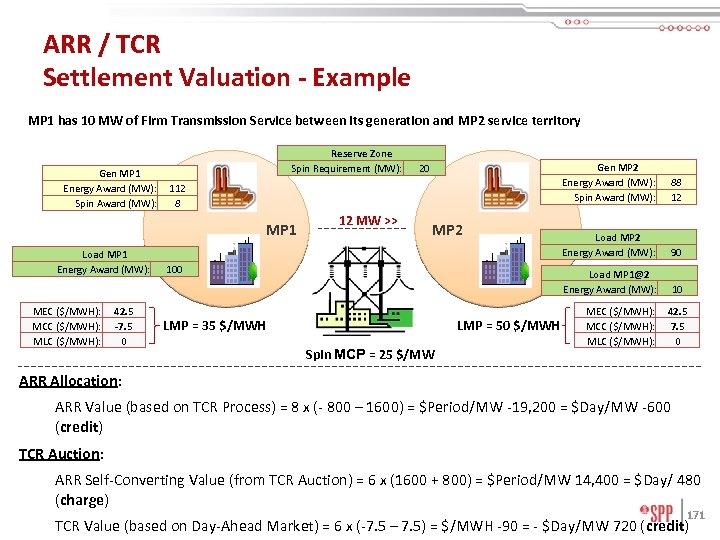 ARR / TCR Settlement Valuation - Example MP 1 has 10 MW of Firm Transmission Service between its generation and MP 2 service territory Gen MP 1 Energy Award (MW): Spin Award (MW): Reserve Zone Spin Requirement (MW): MEC ($/MWH): MCC ($/MWH): MLC ($/MWH): 42. 5 -7. 5 0 12 MW >> MP 2 100 LMP = 35 $/MWH LMP = 50 $/MWH Spin MCP = 25 $/MW 88 12 Load MP 2 Energy Award (MW): 90 Load MP 1@2 Energy Award (MW): 112 8 MP 1 Load MP 1 Energy Award (MW): Gen MP 2 Energy Award (MW): Spin Award (MW): 20 10 MEC ($/MWH): MCC ($/MWH): MLC ($/MWH): 42. 5 7. 5 0 ARR Allocation: ARR Value (based on TCR Process) = 8 x (- 800 – 1600) = $Period/MW -19, 200 = $Day/MW -600 (credit) TCR Auction: ARR Self-Converting Value (from TCR Auction) = 6 x (1600 + 800) = $Period/MW 14, 400 = $Day/ 480 (charge) 171 TCR Value (based on Day-Ahead Market) = 6 x (-7. 5 – 7. 5) = $/MWH -90 = - $Day/MW 720 (credit)
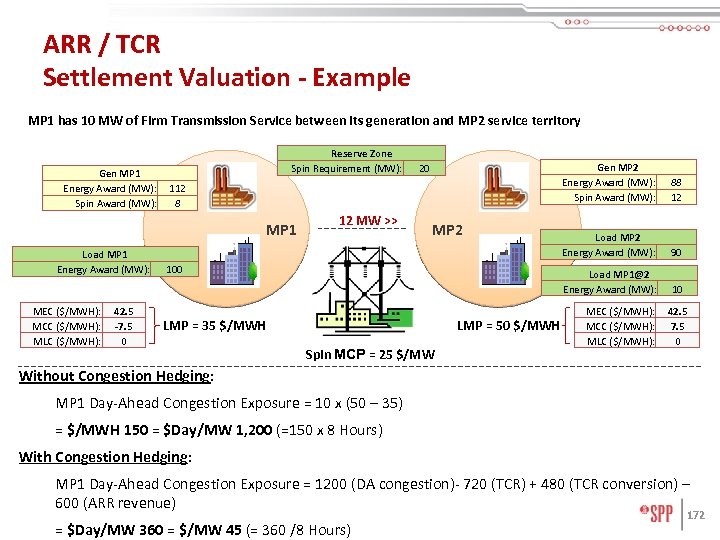 ARR / TCR Settlement Valuation - Example MP 1 has 10 MW of Firm Transmission Service between its generation and MP 2 service territory Gen MP 1 Energy Award (MW): Spin Award (MW): Reserve Zone Spin Requirement (MW): MEC ($/MWH): MCC ($/MWH): MLC ($/MWH): 42. 5 -7. 5 0 12 MW >> MP 2 100 LMP = 35 $/MWH LMP = 50 $/MWH Spin MCP = 25 $/MW 88 12 Load MP 2 Energy Award (MW): 90 Load MP 1@2 Energy Award (MW): 112 8 MP 1 Load MP 1 Energy Award (MW): Gen MP 2 Energy Award (MW): Spin Award (MW): 20 10 MEC ($/MWH): MCC ($/MWH): MLC ($/MWH): 42. 5 7. 5 0 Without Congestion Hedging: MP 1 Day-Ahead Congestion Exposure = 10 x (50 – 35) = $/MWH 150 = $Day/MW 1, 200 (=150 x 8 Hours) With Congestion Hedging: MP 1 Day-Ahead Congestion Exposure = 1200 (DA congestion)- 720 (TCR) + 480 (TCR conversion) – 600 (ARR revenue) = $Day/MW 360 = $/MW 45 (= 360 /8 Hours) 172
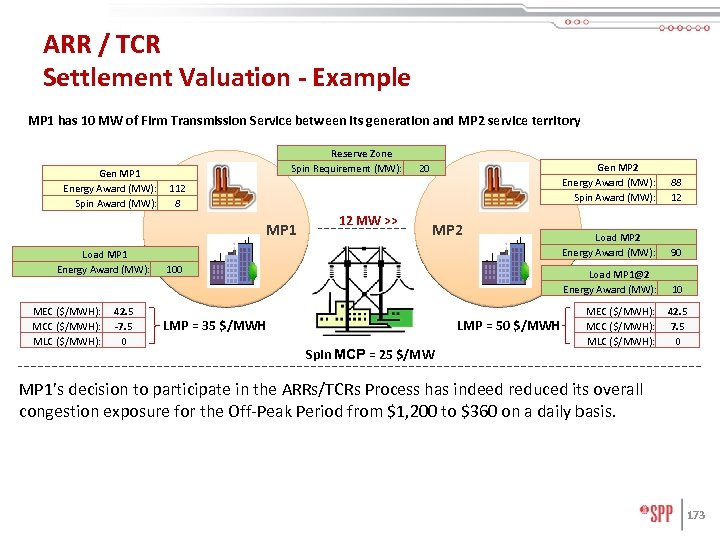 ARR / TCR Settlement Valuation - Example MP 1 has 10 MW of Firm Transmission Service between its generation and MP 2 service territory Gen MP 1 Energy Award (MW): Spin Award (MW): Reserve Zone Spin Requirement (MW): MEC ($/MWH): MCC ($/MWH): MLC ($/MWH): 42. 5 -7. 5 0 12 MW >> MP 2 100 LMP = 35 $/MWH LMP = 50 $/MWH Spin MCP = 25 $/MW 88 12 Load MP 2 Energy Award (MW): 90 Load MP 1@2 Energy Award (MW): 112 8 MP 1 Load MP 1 Energy Award (MW): Gen MP 2 Energy Award (MW): Spin Award (MW): 20 10 MEC ($/MWH): MCC ($/MWH): MLC ($/MWH): 42. 5 7. 5 0 MP 1’s decision to participate in the ARRs/TCRs Process has indeed reduced its overall congestion exposure for the Off-Peak Period from $1, 200 to $360 on a daily basis. 173
 TCR Market: Financial Reconciliation • TCRs are fully funded on a daily basis from the congestion revenue collected • Any revenue deficiencies will be handled through the TCR Daily Uplift on a pro-rata share • Monthly Payback will attempt to pay back deficiencies collected within that month • Annual Payback will attempt to pay back deficiencies collected throughout the year • To the extent that there is an excess amount of net charges collected for the year and all deficiencies have been fully reimbursed, the excess is distributed to ARR holders in proportion to their ARR Nomination Caps 174
 Section 7 POST REAL-TIME MARKET ACTIVITIES 175
 Topics Covered • Market Settlements: Definition • Meter Data Submission Responsibilities • Settlement Statements vs. Resettlement Statements • Settlement Invoice: Content and Deadlines • Charge Type: Definition • Dispute Process 176
 Post Real-Time Market Activities Market Settlements • Market Settlements represent the financial settling of market activities between Market Participants in the SPP footprint • SPP will issue an Initial and Final settlement statement for each Operating Day that will include: • Day-Ahead Market Activity • Real-Time Market Activity • Transmission Congestion Rights (TCR) Activity • Settlement Statements will be issued at the Market Participant (MP) and Asset Owner (AO) level • Meter Data will be used to settle Real-Time charges 177
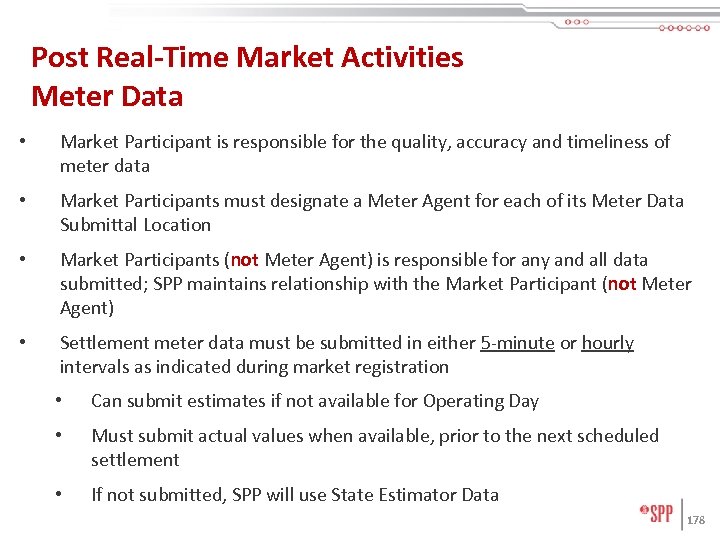 Post Real-Time Market Activities Meter Data • Market Participant is responsible for the quality, accuracy and timeliness of meter data • Market Participants must designate a Meter Agent for each of its Meter Data Submittal Location • Market Participants (not Meter Agent) is responsible for any and all data submitted; SPP maintains relationship with the Market Participant (not Meter Agent) • Settlement meter data must be submitted in either 5 -minute or hourly intervals as indicated during market registration • Can submit estimates if not available for Operating Day • Must submit actual values when available, prior to the next scheduled settlement • If not submitted, SPP will use State Estimator Data 178
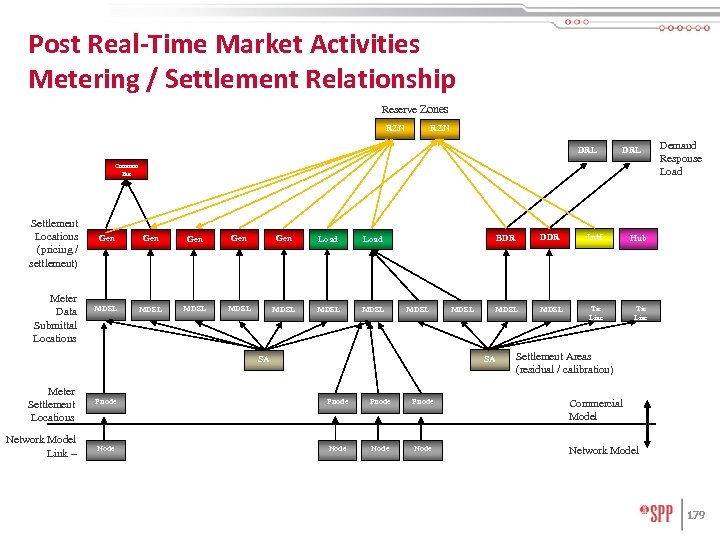 Post Real-Time Market Activities Metering / Settlement Relationship Reserve Zones RZN DRL Common Bus Settlement Locations (pricing / settlement) Meter Data Submittal Locations Gen Gen Gen Load MDSL MDSL DDR Intf Hub MDSL Tie Line Load MDSL BDR MDSL SA SA Demand Response Load Settlement Areas (residual / calibration) Meter Settlement Locations Pnode Commercial Model Network Model Link – Node Network Model 179
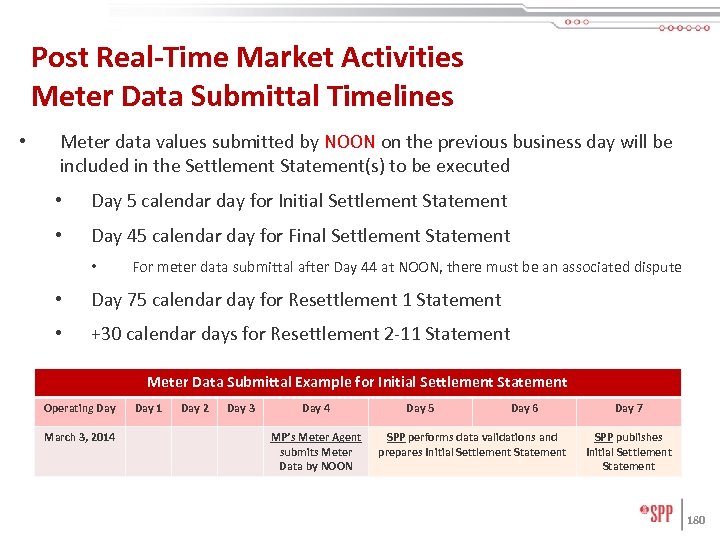 Post Real-Time Market Activities Meter Data Submittal Timelines • Meter data values submitted by NOON on the previous business day will be included in the Settlement Statement(s) to be executed • Day 5 calendar day for Initial Settlement Statement • Day 45 calendar day for Final Settlement Statement • For meter data submittal after Day 44 at NOON, there must be an associated dispute • Day 75 calendar day for Resettlement 1 Statement • +30 calendar days for Resettlement 2 -11 Statement Meter Data Submittal Example for Initial Settlement Statement Operating Day March 3, 2014 Day 1 Day 2 Day 3 Day 4 MP’s Meter Agent submits Meter Data by NOON Day 5 Day 6 SPP performs data validations and prepares Initial Settlement Statement Day 7 SPP publishes Initial Settlement Statement 180
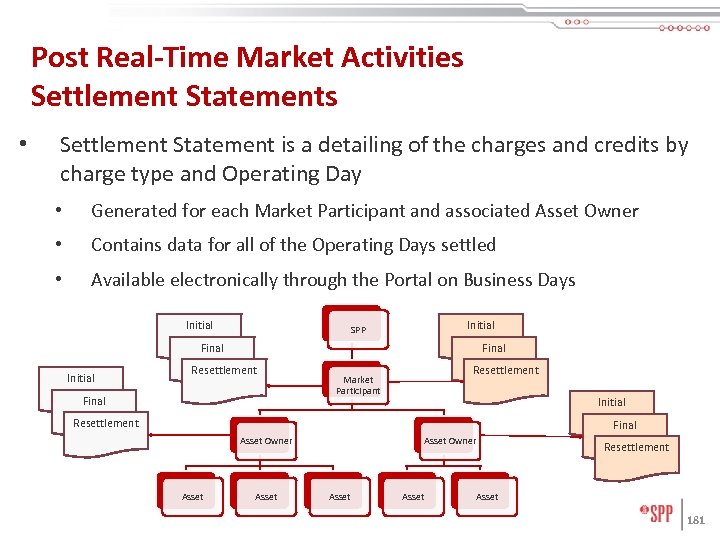 Post Real-Time Market Activities Settlement Statements • Settlement Statement is a detailing of the charges and credits by charge type and Operating Day • Generated for each Market Participant and associated Asset Owner • Contains data for all of the Operating Days settled • Available electronically through the Portal on Business Days Initial SPP Final Initial Final Resettlement Market Participant Initial Resettlement Final Asset Owner Asset Resettlement Asset 181
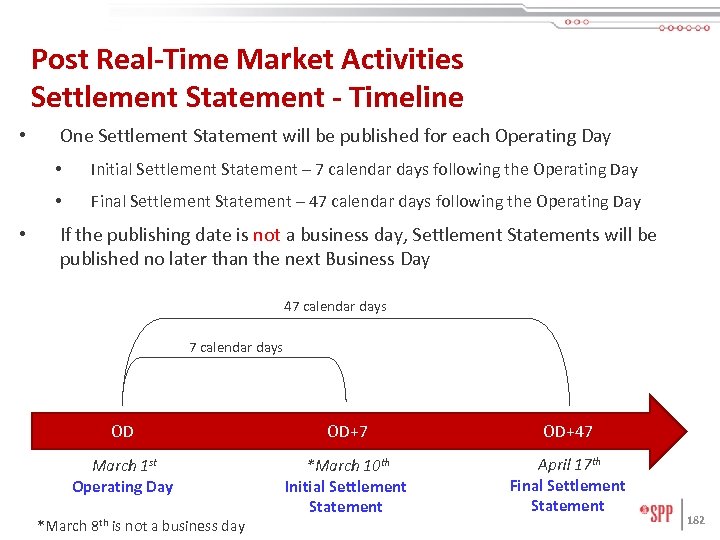 Post Real-Time Market Activities Settlement Statement - Timeline • One Settlement Statement will be published for each Operating Day • • • Initial Settlement Statement – 7 calendar days following the Operating Day Final Settlement Statement – 47 calendar days following the Operating Day If the publishing date is not a business day, Settlement Statements will be published no later than the next Business Day 47 calendar days OD OD+7 OD+47 March 1 st Operating Day *March 10 th Initial Settlement Statement April 17 th Final Settlement Statement *March 8 th is not a business day 182
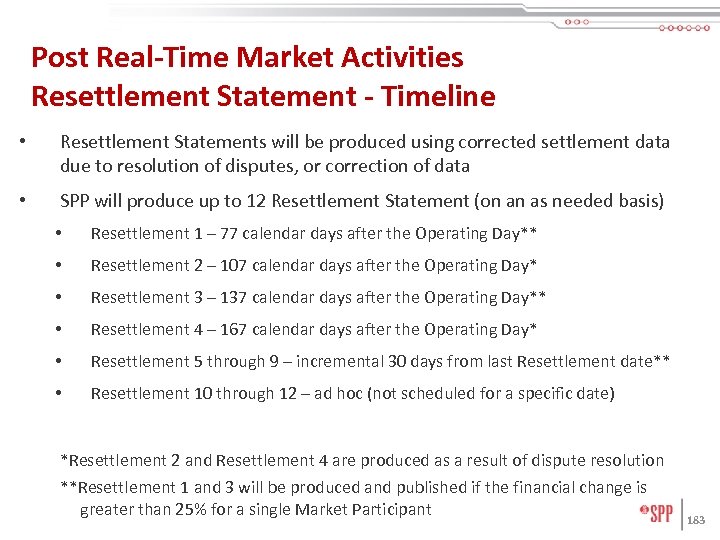 Post Real-Time Market Activities Resettlement Statement - Timeline • Resettlement Statements will be produced using corrected settlement data due to resolution of disputes, or correction of data • SPP will produce up to 12 Resettlement Statement (on an as needed basis) • Resettlement 1 – 77 calendar days after the Operating Day** • Resettlement 2 – 107 calendar days after the Operating Day* • Resettlement 3 – 137 calendar days after the Operating Day** • Resettlement 4 – 167 calendar days after the Operating Day* • Resettlement 5 through 9 – incremental 30 days from last Resettlement date** • Resettlement 10 through 12 – ad hoc (not scheduled for a specific date) *Resettlement 2 and Resettlement 4 are produced as a result of dispute resolution **Resettlement 1 and 3 will be produced and published if the financial change is greater than 25% for a single Market Participant 183
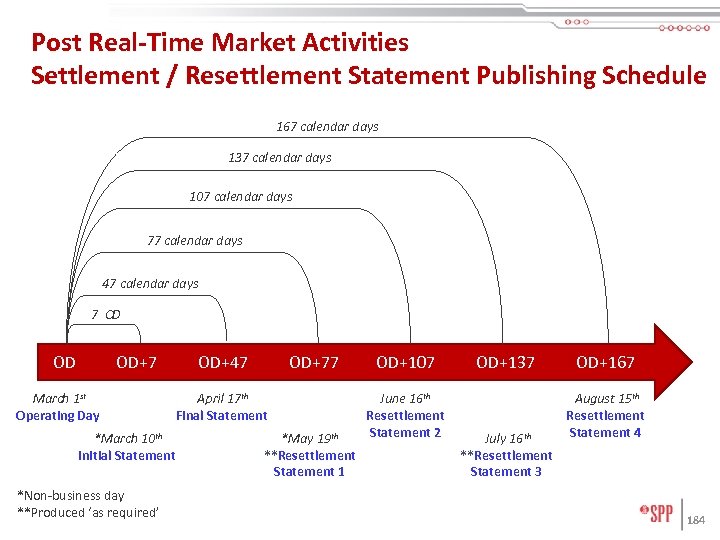 Post Real-Time Market Activities Settlement / Resettlement Statement Publishing Schedule 167 calendar days 137 calendar days 107 calendar days 77 calendar days 47 calendar days 7 CD OD OD+7 March 1 st Operating Day *March 10 th Initial Statement *Non-business day **Produced ‘as required’ OD+47 OD+77 April 17 th Final Statement *May 19 th **Resettlement Statement 1 OD+107 June 16 th Resettlement Statement 2 OD+137 July 16 th **Resettlement Statement 3 OD+167 August 15 th Resettlement Statement 4 184
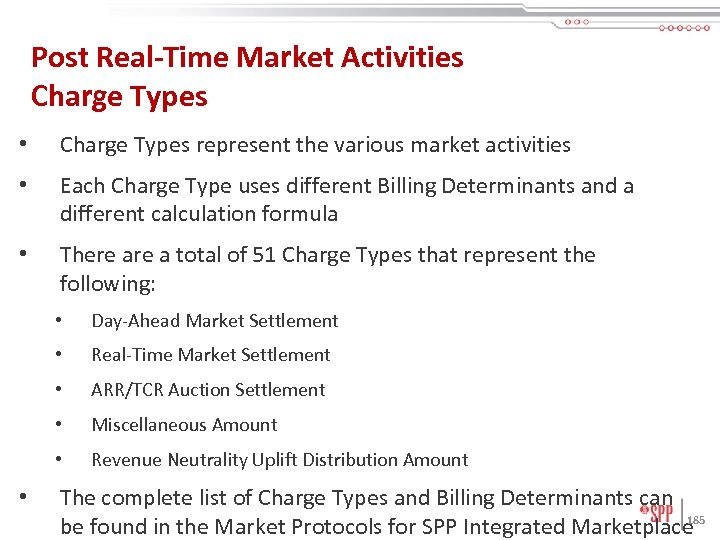 Post Real-Time Market Activities Charge Types • Charge Types represent the various market activities • Each Charge Type uses different Billing Determinants and a different calculation formula • There a total of 51 Charge Types that represent the following: • • Real-Time Market Settlement • ARR/TCR Auction Settlement • Miscellaneous Amount • • Day-Ahead Market Settlement Revenue Neutrality Uplift Distribution Amount The complete list of Charge Types and Billing Determinants can 185 be found in the Market Protocols for SPP Integrated Marketplace
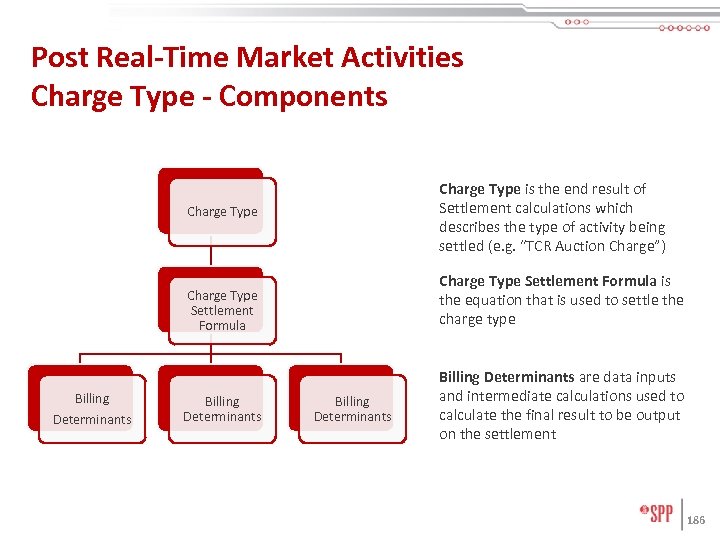 Post Real-Time Market Activities Charge Type - Components Charge Type is the end result of Settlement calculations which describes the type of activity being settled (e. g. “TCR Auction Charge”) Charge Type Settlement Formula is the equation that is used to settle the charge type Charge Type Settlement Formula Billing Determinants are data inputs and intermediate calculations used to calculate the final result to be output on the settlement 186
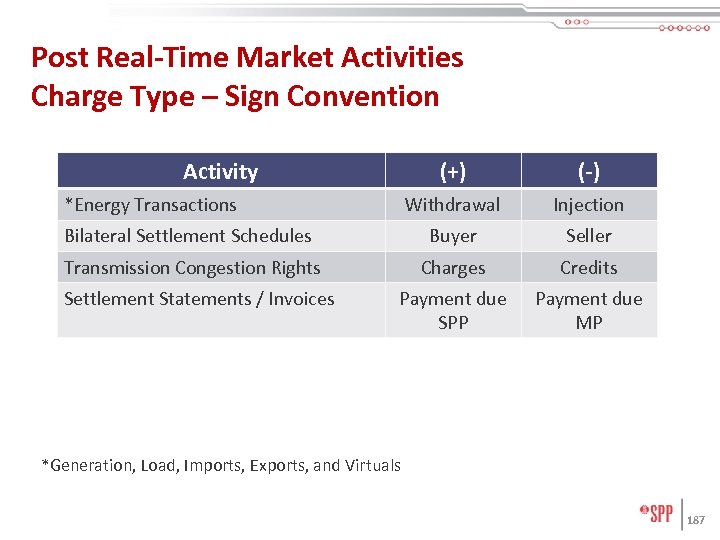 Post Real-Time Market Activities Charge Type – Sign Convention Activity (+) (-) Withdrawal Injection Bilateral Settlement Schedules Buyer Seller Transmission Congestion Rights Charges Credits Payment due SPP Payment due MP *Energy Transactions Settlement Statements / Invoices *Generation, Load, Imports, Exports, and Virtuals 187
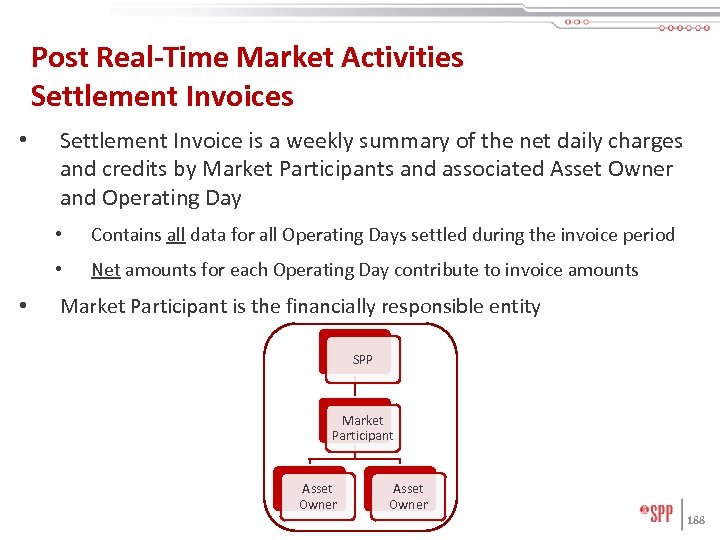 Post Real-Time Market Activities Settlement Invoices • Settlement Invoice is a weekly summary of the net daily charges and credits by Market Participants and associated Asset Owner and Operating Day • • • Contains all data for all Operating Days settled during the invoice period Net amounts for each Operating Day contribute to invoice amounts Market Participant is the financially responsible entity SPP Market Participant Asset Owner 188
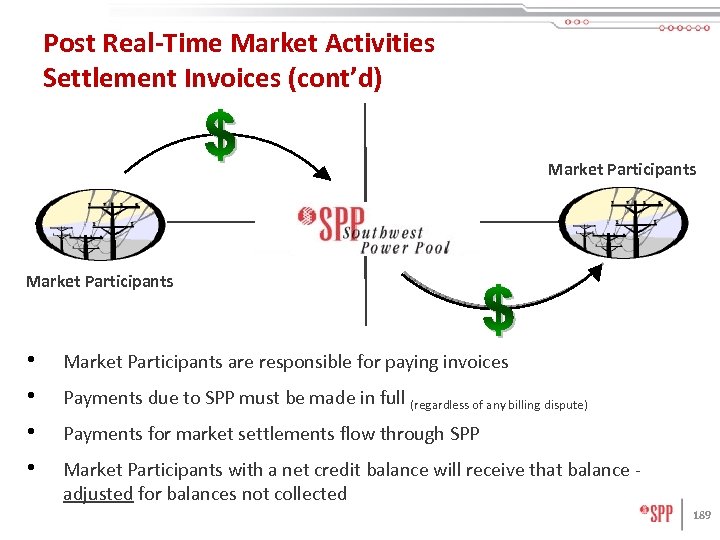 Post Real-Time Market Activities Settlement Invoices (cont’d) Market Participants • • Market Participants are responsible for paying invoices Payments due to SPP must be made in full (regardless of any billing dispute) Payments for market settlements flow through SPP Market Participants with a net credit balance will receive that balance adjusted for balances not collected 189
 Post Real-Time Market Activities Disputes • A dispute is a discrepancy Market Participants uncover when reviewing their Settlement Statement • Market Participants may dispute items set forth in any Settlement Statement (initial, final, resettlement) • • NOTE: In case of a resettlement, only incremental differences can be disputed Dispute Submission Timeline • Market Participants can begin submission immediately after the receipt of their initial settlement statement • Market Participants have up to 90 calendar days after the final settlement statement to file a dispute for that Operating Day • Any adjustments from a resolved dispute will be posted to a subsequent settlement statement 190
 Post Real-Time Market Activities Disputes (cont’d) Resettlements R 1 (OD+77) and R 3 (OD+137) will be utilized if the dispute resolution results in at least a 25% financial change in a Market Participant’s Settlement Statement SPP publishes Initial Settlement Statement SPP publishes Final Settlement Statement OD +7 OD+47 Resettlements R 2 (OD+107) and R 4 (OD+167) require a dispute regardless of financial impact OD+77 OD+107 OD+137 OD+167 Dispute Filing Period for Initial and Final Settlement Statements 191
 Post Real-Time Market Activities Disputes (cont’d) • Disputes must be filed on the Request Management System using the Contents of Notice dispute form • Each dispute is tracked throughout the process and assigned the following statuses: • Open • Closed • Denied • Granted with Exceptions • Withdrawn 192
 Market Participant Milestones TCR Market Trials Begins 193
 Carrie Simpson Lead Analyst, Market Design 501 -688 -1757 csimpson@spp. org Heather Starnes Manager, Regulatory Policy 501 -516 -0041 hstarnes@spp. org Debbie James Manager, Market Design 501 -614 -3577 djames@spp. org 194