


 Скачать презентацию Integrated internationalism interpretation and implementation in UK HE
7b99add43e5657b2bc0596c498ee6325.ppt
- Количество слайдов: 24
 Integrated internationalism: interpretation and implementation in UK HE Vicky Lewis Head of International & Corporate Relations Bournemouth University
 Structure of session • • • Definitions of HE internationalisation Common rationales and global variations UK national context Relationship with institutional agendas National survey responses – a snapshot of the state of play in UK HE in summer 2005 • Initial impressions from institutional case studies • Discussion
 Definitions (1) • Evolution over past 25 years • Updated generic definition: – the process of integrating an international, intercultural or global dimension into the purpose, functions or delivery of postsecondary education (Knight 2003) • Note terms “process” and “integrating”
 Definitions (2) • 2005 study more culturally (UK) and temporally specific • Seeks to define “integrated internationalism” as – the presence of an international or intercultural dimension in all core functions of the institution (students and learning, research, business and community relations), deliberately coordinated as part of a vision which clearly (and publicly) articulates the nature and focus of the institution’s international effort (Lewis 2005) • Horizontal and vertical integration; public articulation
 Universities as inherently international? • Nature of academic endeavour and values to “escape inward-looking parochialism” and seek “relevance and confirmation not only on local or national but also on global levels”. (Sadlak 1998) • Academic motivation often combined with (obscured by? ) economic motivations
 Rationales • Political / diplomatic (linked also to Prestige / profile) • Economic / commercial • Social / cultural • Academic / educational Not mutually exclusive Can be mutually supportive Global variations
 UK national context • Commercially driven • Prime Minister’s Initiative (Phase 1) success measured in numerical and cash terms • Df. ES International Strategy: “putting the world into world-class education” • Whose world? Continuing Anglo-centrism? • Fragmentation at national level – Government – National organisations (contrast with USA)
 UK institutional context • Often mirrors national fragmentation / inconsistency • Self-centred vs. outward-looking • Focus on partial or whole community • Gilligan’s argument for a change in managerial mindsets in 2003 • How far have we got?
 2005 primary research • Two stages • National survey of International Office staff – Snapshot of current state of play across sector • Institutional case studies – Opportunity to explore in greater depth the practice at those institutions perceived to be at the forefront of “integrated internationalism” – taking into account differences in mission and vision
 Survey – respondent profile • 54 individuals from 46 member institutions of the British Universities’ International Liaison Association • 38% institutional response rate (42% if non. Uni HEIs excluded) • 50% of respondents Director of IO; most others worked in international recruitment • Pretty representative spread in terms of size, geographical location and institutional type
 Institutional rationales – practitioner perceptions (1) • 4 statements used as proxies for the 4 “standard” rationales – (Political/Prestige; Economic; Social/cultural; Academic) • Respondents asked to allocate 20 points across the 4 statements, so as to reflect the priority attached by their institution to each
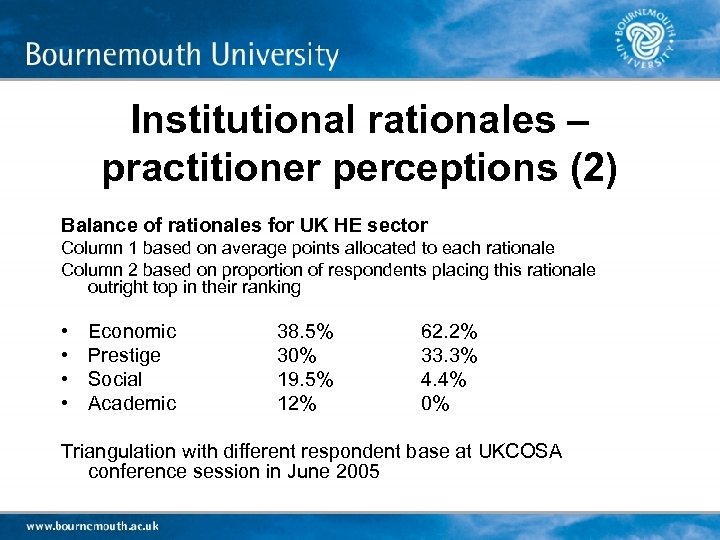 Institutional rationales – practitioner perceptions (2) Balance of rationales for UK HE sector Column 1 based on average points allocated to each rationale Column 2 based on proportion of respondents placing this rationale outright top in their ranking • • Economic Prestige Social Academic 38. 5% 30% 19. 5% 12% 62. 2% 33. 3% 4. 4% 0% Triangulation with different respondent base at UKCOSA conference session in June 2005
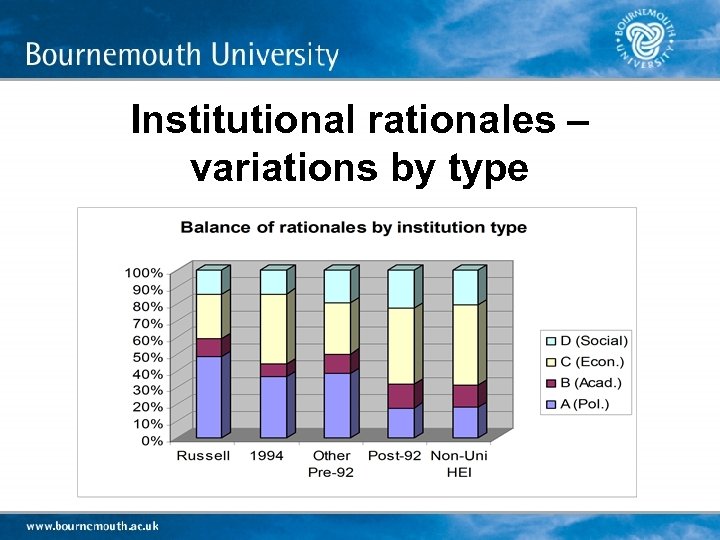 Institutional rationales – variations by type
 Key benefits of internationalisation (1) • Respondents were asked what their top management team would consider top 3 benefits, then asked what they themselves consider top 3 benefits • Respondents themselves prioritised the – social benefits (“Enriched campus culture and enhanced employability of UK students by equipping them with intercultural skills”), followed by – economic (“Diversifying income streams” ) and – academic benefits (“Perspective on global issues – combating prejudice, promoting peace and human rights”), with – prestige benefits (“Contributes to achieving our aim to become a world class institution”) least significant
 Key benefits of internationalisation (2) • Respondents felt top management teams would prioritise the economic benefits, though it was felt they also appreciated the social benefits (ahead of the prestige and academic ones) • Additional benefit articulated at UKCOSA conference session that internationalisation had brought enhanced understanding between academic departments and support services within the institution.
 Headline survey results • Ranking of institutional rationales for internationalisation (taking the UK HE sector as a whole) - as perceived by those involved in international education – appears to be: Economic, Prestige, Social, Academic • 74% of respondents’ institutional mission statements mention “international” (or similar) • 33% of respondents’ institutions currently have a written internationalisation strategy (a further 30% currently working on one) • 30% of Heads / Directors of IO report directly to a member of the top management team (varies by institutional type) • Additional comments: long way to go; need for institutional coordination and oversight; echoes of Gilligan’s plea for true internationalisation; interest in sharing good practice
 The case studies • Case studies with three very different institutions perceived to demonstrate “good practice” • Interviews with between 3 and 5 staff per institution completed • Formal interview analysis and documentary analysis not yet undertaken – comments therefore based on first impressions • Interviews reinforced by rationale prioritisation exercises completed by interviewees
 Institutional variations: revisiting the rationales • Arguments presented: – Prestige rationale paramount as incorporates all the others – Economic rationale must be stressed because none of the rest can happen without sustainable financial underpinning – Social/cultural and Academic rationales difficult to distinguish • Consideration of final point in UK context: – Academic and Social/cultural rationales as points on a continuum rather than distinguishable drivers? – Logical to combine into single rationale driven by need for global perspectives: the Global rationale?
 Institutional classifications • Institution A: Prestige Player • Institution B: Economic Wizard • Institution C: Global Citizen
 The Global Citizen institution: some tentative observations (1) • No “one size fits all” approach • Familiarity of staff with mission statement (which articulates “world-wide horizons) • Change in leadership a catalyst • Internationalisation agenda ethically driven • Shift in staff view from cynicism to engagement
 The Global Citizen institution: some tentative observations (2) • Mechanisms for cultural change – Internationalisation strategy – Strategic plan (objectives and vocabulary of global perspectives embedded) – Internal communication (and debate) – Repetition of messages to develop understanding
 The Global Citizen institution: some tentative observations (3) • Practice on the ground – Lack of division between curricular and co-curricular, supported by institutional structures – Key element of student and staff development – Internationalisation research group (academic and admin)
 The Global Citizen institution: some tentative observations (4) • Sharing of good practice between staff involved in specific and generic “international” programmes / units • Mechanisms to embed cross-cultural capability in all programmes • Driven in part by global employment market but also to develop ethically engaged graduates (UG business curriculum includes core themes of Globalisation and Ethics / Values)
 What next? • Project exploring “integrated internationalism” a work in progress • Findings that most institutions driven by economic and prestige considerations not surprising • But…. global perspectives agenda playing a significant role for some institutions • Good practice available to be shared