


 Скачать презентацию Integrated Health Care Survey Designs Analytical Enhancements Achieved
c2900087b7e89e73930fc8de56dbd386.ppt
- Количество слайдов: 32
 Integrated Health Care Survey Designs: Analytical Enhancements Achieved Through Linkage of Surveys and Administrative Data 2008 European Conference on Quality in Official Statistics (Q 2008) Steven B. Cohen, Ph. D.
 Purpose of Discussion n Integrated survey design features n Related enhancements to data quality and analytical capacity n Capacity to reduce bias attributable to survey nonresponse n Applications to AHRQ Data Portfolio and Research Initiatives to inform health outcomes n Limitations n Future model for consideration
 Advancing Excellence in Health Care Health Outcomes Focus Part of AHRQ’s Mission AHRQ Mission: To improve the quality, safety, efficiency, and effectiveness of health care for all Americans
 Advancing Excellence in Health Care Integrated survey design features n Direct linkage between sample members in core survey with larger host survey; administrative records; or follow-up surveys n Use of secondary data (e. g. aggregate data at the county/state level) as core component of survey n Prior survey record of call data informs data collection strategies n Informs sample design, nonresponse and poststratification adjustments, imputation and data supplement for item nonresponse n Need for greater attention to ensuring confidentiality: limitations in public use data
 Advancing Excellence in Health Care Capacity to reduce bias attributable to survey nonresponse Adjustments for unit nonresponse n Detailed information available on demographic/socioeconomic characteristics of both respondents/and nonrespondents from sample frame of host survey administrative records n Incorporation of secondary data Adjustments for item nonresponse n Data replacement n Cold deck imputation
 Agency for Healthcare Research and Quality Advancing Excellence in Health Care • www. ahrq. gov
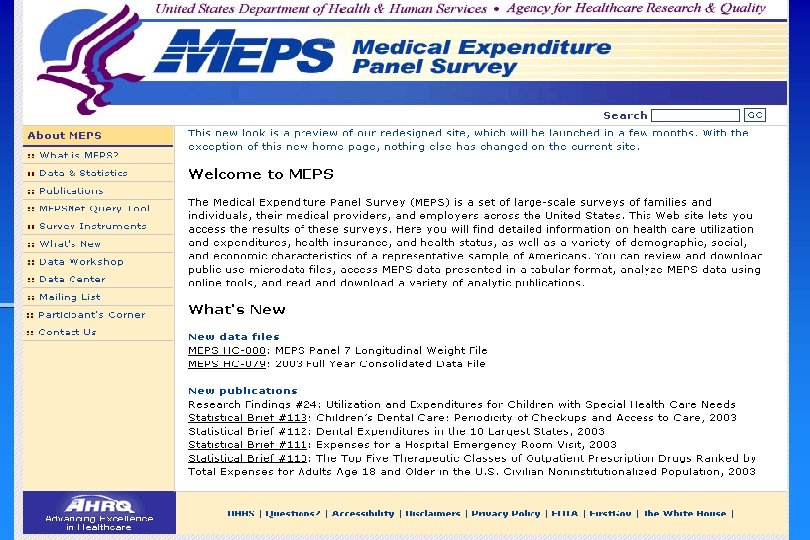
 Advancing Excellence in Health Care Medical Expenditure Panel Survey (MEPS) Annual Survey of 15, 000 households: provides national estimates of health care use, expenditures, insurance coverage, sources of payment, access to care and health care quality Permits studies of: n n n Distribution of expenditures and sources of payment Role of demographics, family structure, insurance Measurement of expenditures in managed care Expenditures for specific conditions Trends over time
 Advancing Excellence in Health Care Design Specifications n Target Precision Specifications for national and regional estimates; policy relevant subgroups n Overall Design effect of 1. 6 n 200 PSU design (Max) n Overall/round specific survey response rate requirements n Linkage to NHIS n Multistage design n Disproportional sampling n Longitudinal design n Minimize survey cost for fixed precision
 Advancing Excellence in Health Care Key Features of MEPS-HC n Survey of U. S. civilian noninstitutionalized population n Sub-sample of respondents to the National Health Interview Survey (NHIS) n Oversample of minorities and other target groups n Panel Survey – new panel introduced each year – Continuous data collection over 2 ½ year period – 5 in-person interviews (CAPI) – Data from 1 st year of new panel combined with data from 2 nd year of previous panel
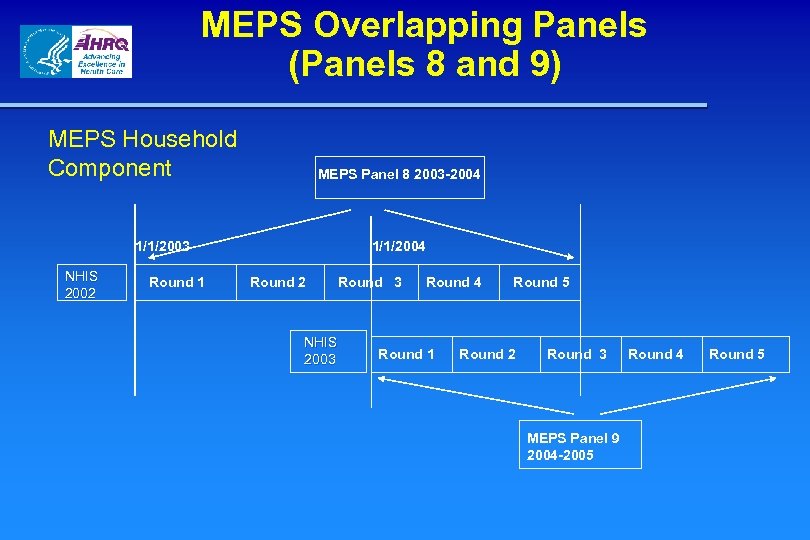 MEPS Overlapping Panels (Panels 8 and 9) MEPS Household Component MEPS Panel 8 2003 -2004 1/1/2003 NHIS 2002 Round 1 1/1/2004 Round 2 Round 3 NHIS 2003 Round 4 Round 1 Round 5 Round 2 Round 3 MEPS Panel 9 2004 -2005 Round 4 Round 5
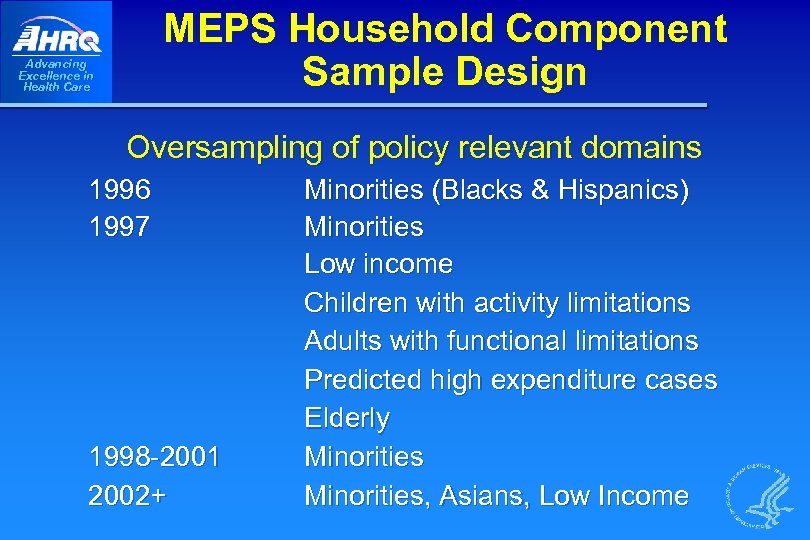 MEPS Household Component Sample Design Advancing Excellence in Health Care Oversampling of policy relevant domains 1996 1997 1998 -2001 2002+ Minorities (Blacks & Hispanics) Minorities Low income Children with activity limitations Adults with functional limitations Predicted high expenditure cases Elderly Minorities, Asians, Low Income
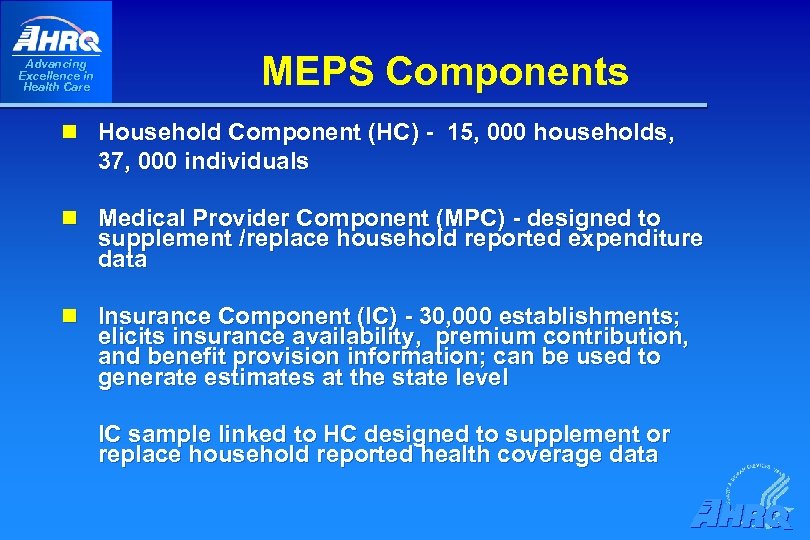 Advancing Excellence in Health Care MEPS Components n Household Component (HC) - 15, 000 households, 37, 000 individuals n Medical Provider Component (MPC) - designed to supplement /replace household reported expenditure data n Insurance Component (IC) - 30, 000 establishments; elicits insurance availability, premium contribution, and benefit provision information; can be used to generate estimates at the state level IC sample linked to HC designed to supplement or replace household reported health coverage data
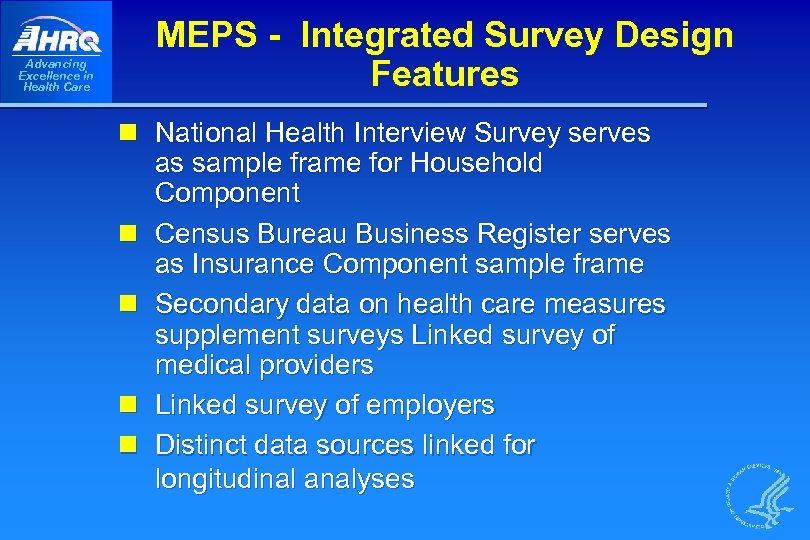 Advancing Excellence in Health Care MEPS - Integrated Survey Design Features n National Health Interview Survey serves as sample frame for Household Component n Census Bureau Business Register serves as Insurance Component sample frame n Secondary data on health care measures supplement surveys Linked survey of medical providers n Linked survey of employers n Distinct data sources linked for longitudinal analyses
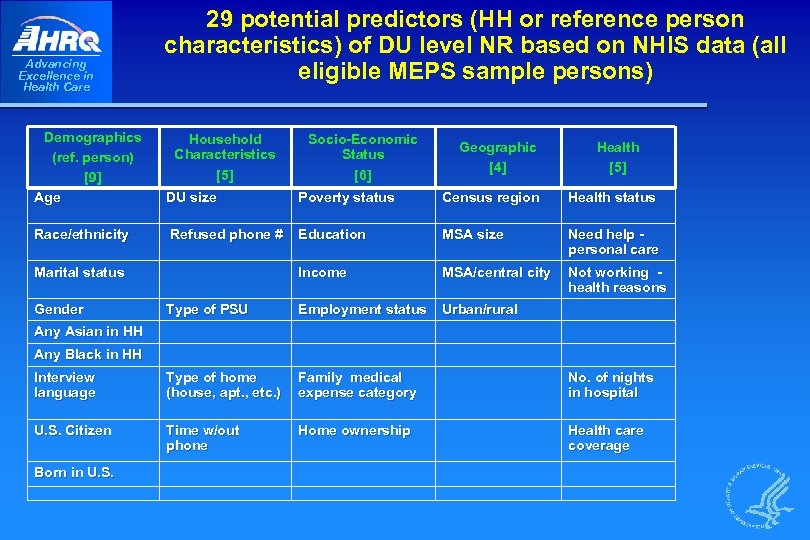 Advancing Excellence in Health Care 29 potential predictors (HH or reference person characteristics) of DU level NR based on NHIS data (all eligible MEPS sample persons) Demographics (ref. person) [9] Age DU size Poverty status Census region Health status Race/ethnicity Refused phone # Education MSA size Need help personal care Income MSA/central city Not working health reasons Type of PSU Employment status Urban/rural Interview language Type of home (house, apt. , etc. ) Family medical expense category No. of nights in hospital U. S. Citizen Time w/out phone Home ownership Health care coverage Household Characteristics [5] Marital status Gender Socio-Economic Status [6] Geographic [4] Health [5] Any Asian in HH Any Black in HH Born in U. S.
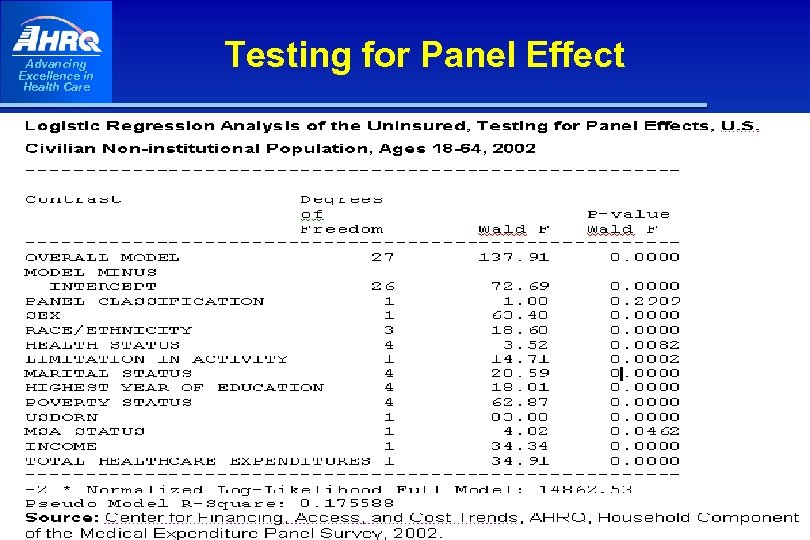 Advancing Excellence in Health Care Testing for Panel Effect
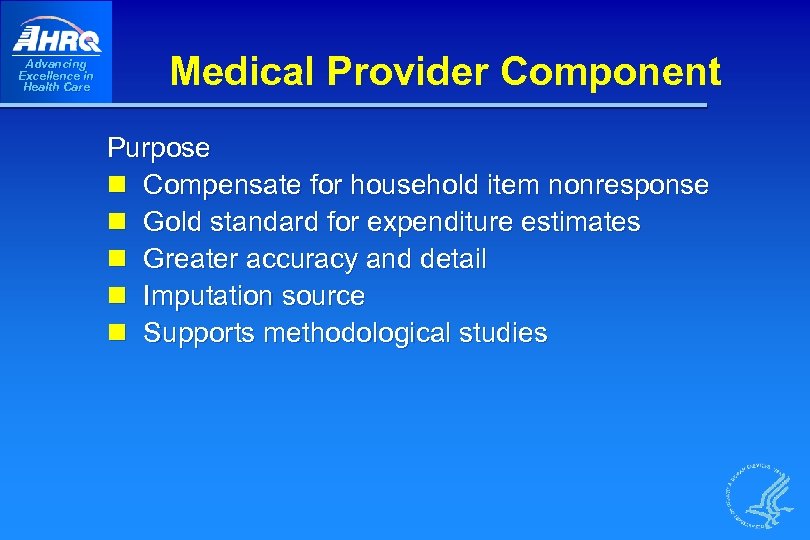 Advancing Excellence in Health Care Medical Provider Component Purpose n Compensate for household item nonresponse n Gold standard for expenditure estimates n Greater accuracy and detail n Imputation source n Supports methodological studies
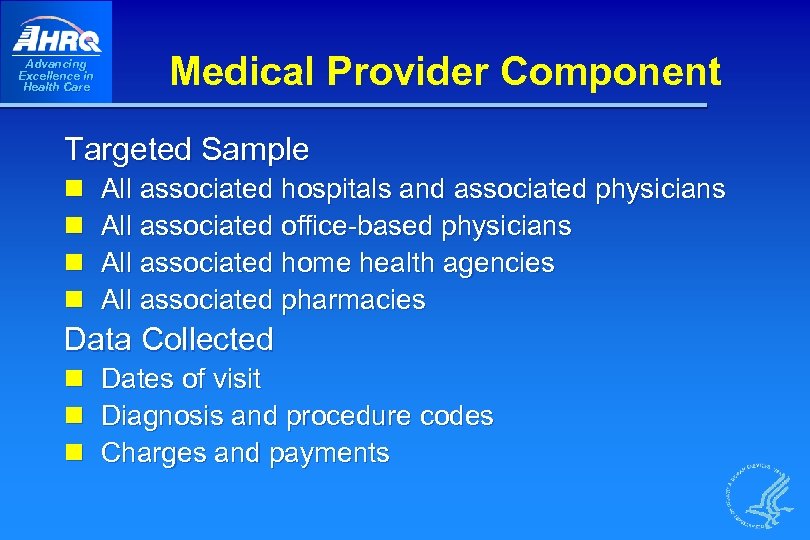 Advancing Excellence in Health Care Medical Provider Component Targeted Sample n n All associated hospitals and associated physicians All associated office-based physicians All associated home health agencies All associated pharmacies Data Collected n Dates of visit n Diagnosis and procedure codes n Charges and payments
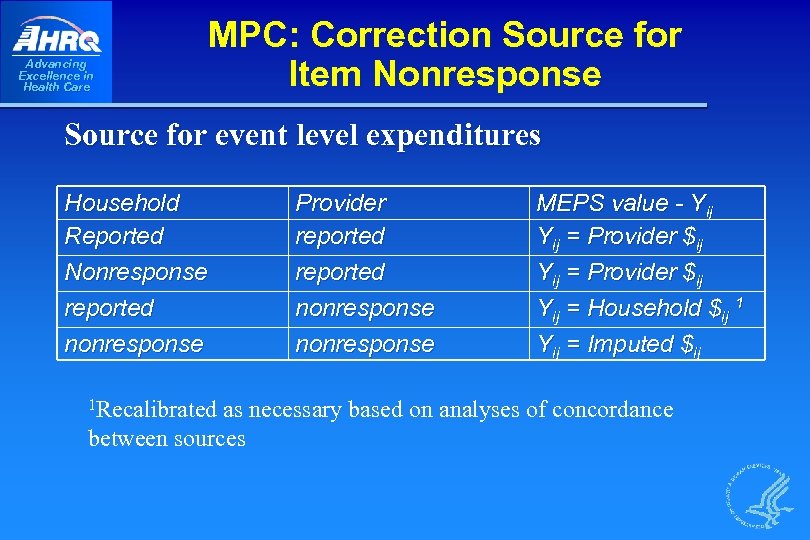 Advancing Excellence in Health Care MPC: Correction Source for Item Nonresponse Source for event level expenditures Household Reported Nonresponse reported nonresponse 1 Recalibrated Provider reported nonresponse MEPS value - Yij = Provider $ij Yij = Household $ij 1 Yij = Imputed $ij as necessary based on analyses of concordance between sources
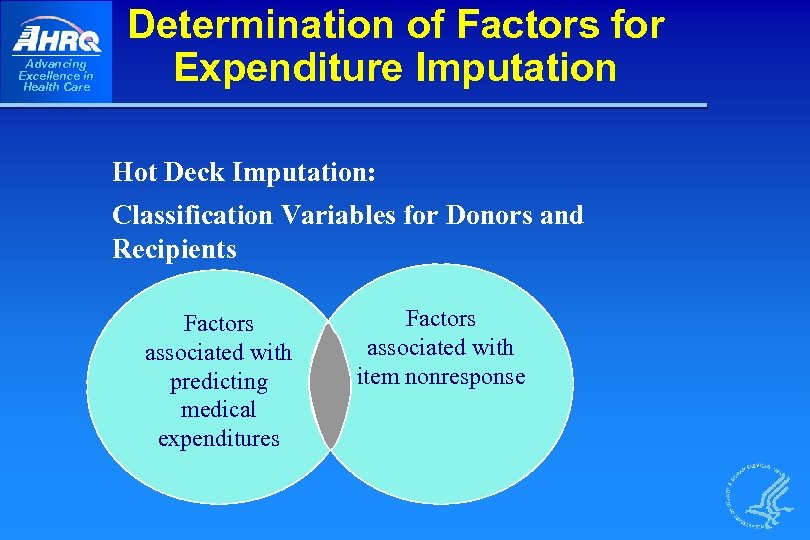 Advancing Excellence in Health Care Determination of Factors for Expenditure Imputation Hot Deck Imputation: Classification Variables for Donors and Recipients Factors associated with predicting medical expenditures Factors associated with item nonresponse
 Agency for Healthcare Research and Quality Advancing Excellence in Health Care • www. ahrq. gov The Utility of Extended Longitudinal Profiles in Predicting Future Health Care Expenditures
 Advancing Excellence in Health Care Predictive Models n Model 1: Logistic Model with prior year’s medical expenditures and precursor information (t-1). (Y=1 top 10% in $s; 0 otherwise) n Model 2: Logistic Model with prior year’s medical expenditures (t-1) and precursor information (t-1 and t-2).
 Advancing Excellence in Health Care Evaluation of Model Performance Develop Model on 2004 -2005 MEPS Panel, 2003 NHIS Validate Model on 2006 -2007 MEPS Panel, 2005 NHIS n Model 1: Logistic Model with prior year’s medical expenditures and precursor information (t-1). n Model 2: Logistic Model with prior year’s medical expenditures (t-1) and precursor information (t-1 and t 2).
 Advancing Excellence in Health Care n n Insurance Component - Purpose Availability of health insurance Access to health insurance Cost of health insurance Benefit and payment provisions of private health insurance
 Advancing Excellence in Health Care Insurance Component - Sample n 30, 000 establishments: derived from Census Bureau frame n Supports national and state estimates n Employers linked to HC sample n Data released in tabular form on MEPS website
 Advancing Excellence in Health Care 1. 2. 3. 4. 5. 6. 7. 8. Key Administrative Data Available for MEPS Insurance Component Industry Payroll Age of Firm Establishment Size Enterprise Size Location Multi/Single Unit Firm Form of Organization
 Advancing Excellence in Health Care 1. 2. 3. 4. 5. 6. Uses of Administrative Data in the Insurance Component Sampling Imputation Editing Modeling Table Production Weight Adjustment for Non Response and Control Totals
 Advancing Excellence in Health Care 1. 2. 3. 4. 5. 6. Key Improvements Due to Use of Administrative Data in the Insurance Component Reduces Respondent Burden Improves Sampling Precision Helps Find Respondent Errors Improves Weight Adjustment Allows Estimates Be Made for Numerous Key Categories Essential for Modeling and Research
 Advancing Excellence in Health Care Health Workforce Analysis: Area Resource File (ARF) is a health resource information system that enables policymakers, researchers, planners and others to analyze the current state of health care access at the county level. Content includes geographic codes and classifications; health professions supply and detailed demographics; health facility numbers and types; hospital utilization; population characteristics and economic data; environment; and health professions training resources. Sponsored by HRSA
 AHRQ Data Center Advancing Excellence in Health Care n Provides researchers access to non-public use MEPS data (except directly identifiable information) and other restricted data sets; n Mode of data analysis – – – on a secure LAN at AHRQ, Rockville task order agreement with data contractor combinations of both.
 Advancing Excellence in Health Care n Data Type and/or Source – – – – n User Supplied Secondary Data Area Resource File Health Care Market Variables @ zip code level Proprietary county level HMO variables State and MSA level data from Interstudy Publications State level Medicaid and poverty variables County level unemployment rates State level data from BLS NHIS Urban Institute Academy for Health Services Research and Policy Census Bureau HCFA Proprietary state level data State income tax rates Centers for Medicare and Medicaid Services Research Focus – – – Changes in Medicaid and SCHIP Access to Care Issues Changes in Health Insurance Coverage Disparities in Health Care Expenditures for Families State Level Health Care Expenditures
 Advancing Excellence in Health Care Limitations n Greater restrictions in data access for public use n Competing demands on host sample frames n More frequent survey contacts reduce overall response rate n Requires greater coordination across data sources and organizations
 Advancing Excellence in Health Care Summary n Capacity of integrated survey designs to serve as cost efficient sampling frames n Capacity of integrated survey designs to reduce bias attributable to nonresponse n Related enhancements to data quality and analytical capacity n MEPS applications n Limitations n Discussion questions