


 Скачать презентацию Integrated Early Childhood Development at UNICEF Targeting the
ca65bb7b201a206e063ac97821c37cd9.ppt
- Количество слайдов: 17
 Integrated Early Childhood Development at UNICEF: Targeting the Mother-Child Dyad Vital to MTSP Success UNICEF Programme Division Nutrition Section
 What is Optimal Infant and Young Child Feeding? l l Continued breastfeeding with appropriate complementary foods and feeding for 2 years and beyond l Related maternal nutrition and care l UNICEF Six months exclusive breastfeeding (Birth Interval of 3 years or more)
 A World Fit for Children By 2010: l Reduction of child malnutrition among children under five years of age by at least one-third, with special attention to children under two years of age, and reduction in the rate of low birth weight by at least one third of the current rate. l Other Millenium Goals for <5 MR and MMR UNICEF
 Nutrition related MTSP target indicators l l > 60% of pregnant women use adequate antenatal services l UNICEF Reduction in anemia prevalence among women of reproductive age by 15% > 60% of children receive appropriate home care for prevention and treatment of malnutrition
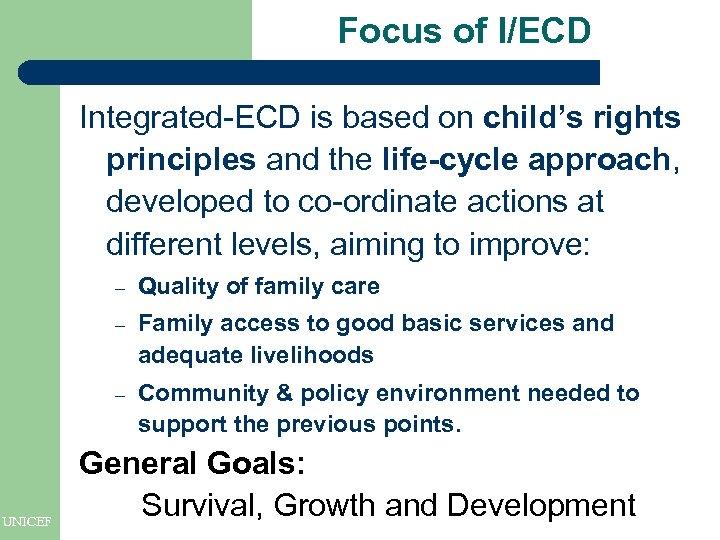 Focus of I/ECD Integrated-ECD is based on child’s rights principles and the life-cycle approach, developed to co-ordinate actions at different levels, aiming to improve: – – Family access to good basic services and adequate livelihoods – UNICEF Quality of family care Community & policy environment needed to support the previous points. General Goals: Survival, Growth and Development
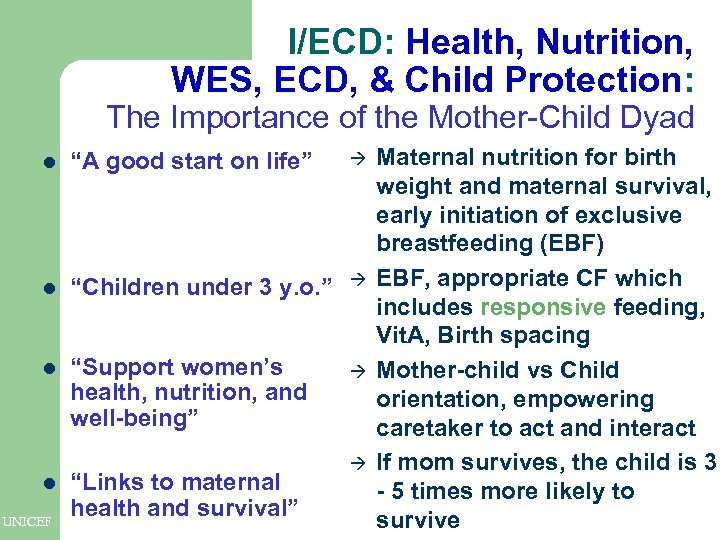 I/ECD: Health, Nutrition, WES, ECD, & Child Protection: The Importance of the Mother-Child Dyad l “A good start on life” à l “Children under 3 y. o. ” à l “Support women’s health, nutrition, and well-being” à l UNICEF “Links to maternal health and survival” à Maternal nutrition for birth weight and maternal survival, early initiation of exclusive breastfeeding (EBF) EBF, appropriate CF which includes responsive feeding, Vit. A, Birth spacing Mother-child vs Child orientation, empowering caretaker to act and interact If mom survives, the child is 3 - 5 times more likely to survive
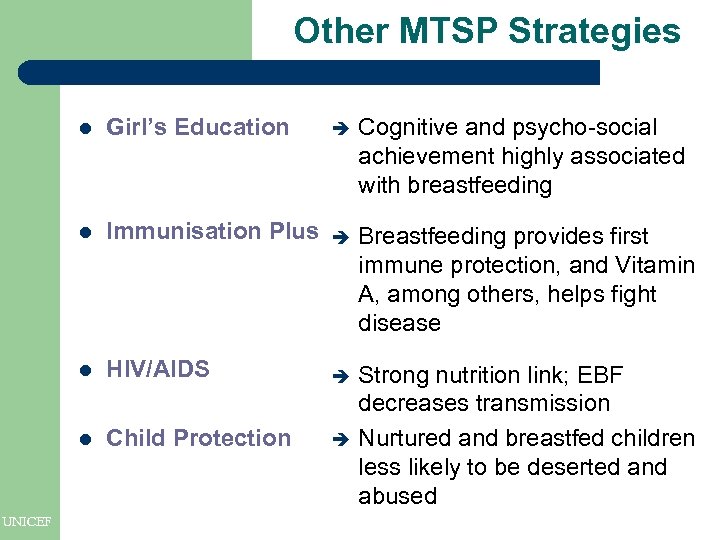 Other MTSP Strategies l è Cognitive and psycho-social achievement highly associated with breastfeeding l Immunisation Plus è Breastfeeding provides first immune protection, and Vitamin A, among others, helps fight disease l HIV/AIDS è l UNICEF Girl’s Education Child Protection è Strong nutrition link; EBF decreases transmission Nurtured and breastfed children less likely to be deserted and abused
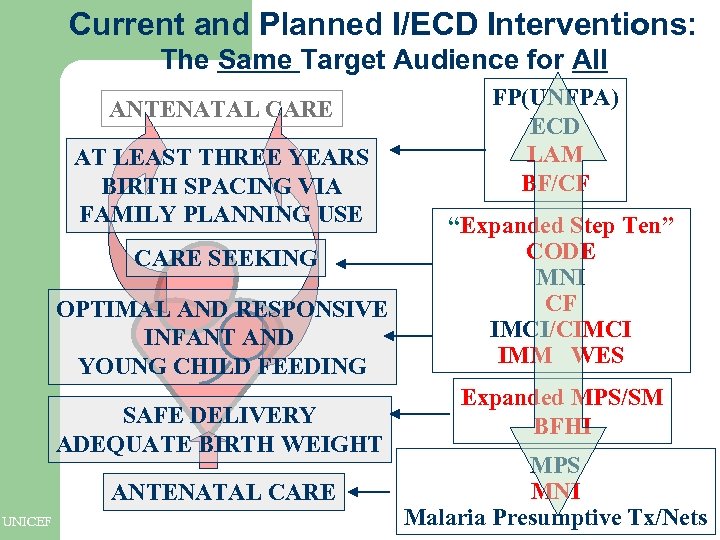 Current and Planned I/ECD Interventions: The Same Target Audience for All ANTENATAL CARE AT LEAST THREE YEARS BIRTH SPACING VIA FAMILY PLANNING USE CARE SEEKING OPTIMAL AND RESPONSIVE INFANT AND YOUNG CHILD FEEDING SAFE DELIVERY ADEQUATE BIRTH WEIGHT ANTENATAL CARE UNICEF FP(UNFPA) ECD LAM BF/CF “Expanded Step Ten” CODE MNI CF IMCI/CIMCI IMM WES Expanded MPS/SM BFHI MPS MNI Malaria Presumptive Tx/Nets
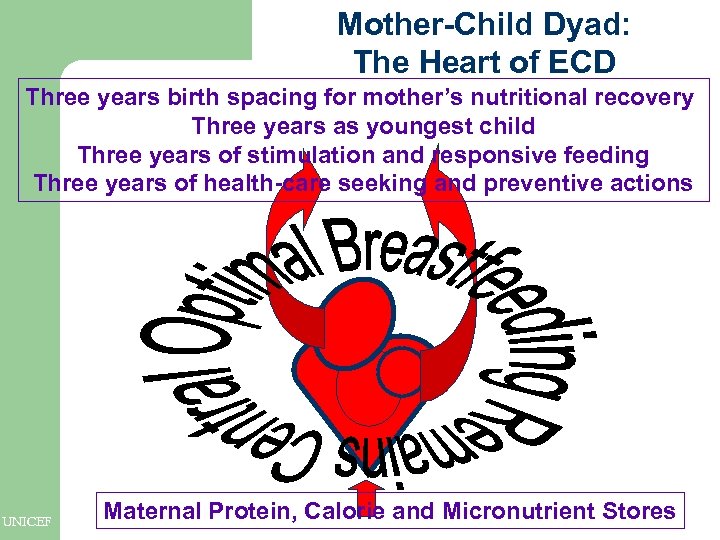 Mother-Child Dyad: The Heart of ECD Three years birth spacing for mother’s nutritional recovery Three years as youngest child Three years of stimulation and responsive feeding Three years of health-care seeking and preventive actions UNICEF Maternal Protein, Calorie and Micronutrient Stores
 Baby Friendly and Beyond l l UNICEF l Is it time to expand beyond BFHI? If so, in what direction? How can we support the World Fit for Children goals, the new UNICEF priorities, the war on HIV, while maintaining support and interest in best start for children: the caring of an empowered mother? What specific components would extend the effort towards increased empowerment of women while maintaining the focus on the importance of optimal breastfeeding? Other ideas?
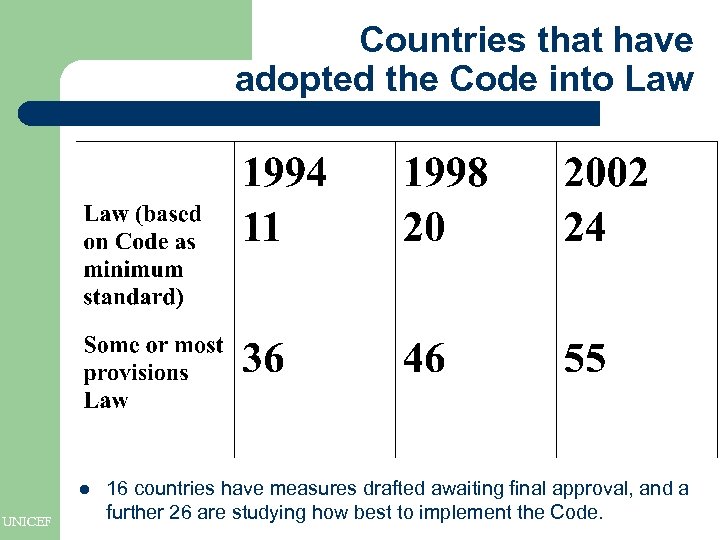 Countries that have adopted the Code into Law l UNICEF 16 countries have measures drafted awaiting final approval, and a further 26 are studying how best to implement the Code.
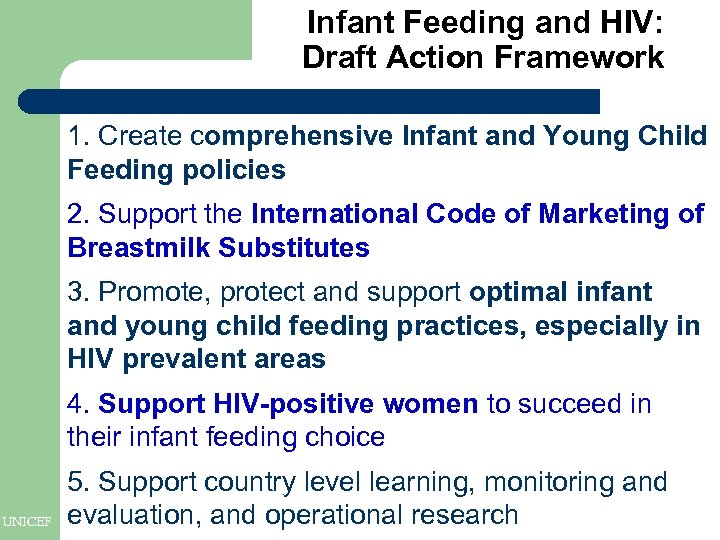 Infant Feeding and HIV: Draft Action Framework 1. Create comprehensive Infant and Young Child Feeding policies 2. Support the International Code of Marketing of Breastmilk Substitutes 3. Promote, protect and support optimal infant and young child feeding practices, especially in HIV prevalent areas 4. Support HIV-positive women to succeed in their infant feeding choice UNICEF 5. Support country level learning, monitoring and evaluation, and operational research
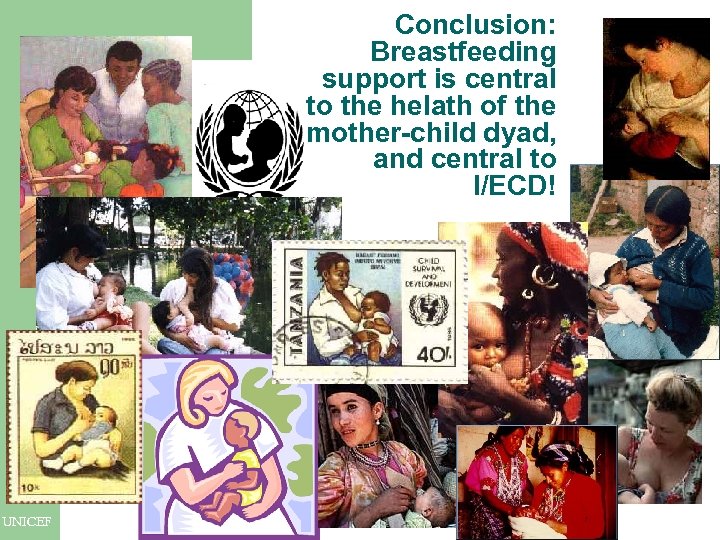 Conclusion: Breastfeeding support is central to the helath of the mother-child dyad, and central to I/ECD! UNICEF
 Thank you Asante-sana Salamat po Merci Gracias Danke Spasibo Abrigato UNICEF Barakallaofik
 Breastfeeding -> Early Childhood Development Increases in breastfeeding are associated with: l l l l UNICEF Decreased child desertion in hospitals Best growth in first 6 months Improved elements of neuro-psycho-motor development at age 1 -2, and up to 12 Improved vision from a few months to years Increased independence and parental trust Increased intelligence quotient (IQ) assessed at ages 8 and 9 years; at age 18 years Decreased infectious and chronic illness, and decreased impact of several metabolic conditions, supporting continued thriving
 Breastfeeding -> Early Childhood Development l l l UNICEF Increased adolescent perceptions of maternal caring Higher reading comprehension, mathematical ability, and scholastic ability assessed during the period from 10 to 13 years; Higher teacher ratings of reading and mathematics assessed at 8 and 12 years; Higher levels of attainment in school leaving examinations Contribution to birth intervals, allowing more attention to care and feeding, and maternal nutritional recovery: Result: children are alive and thrive!
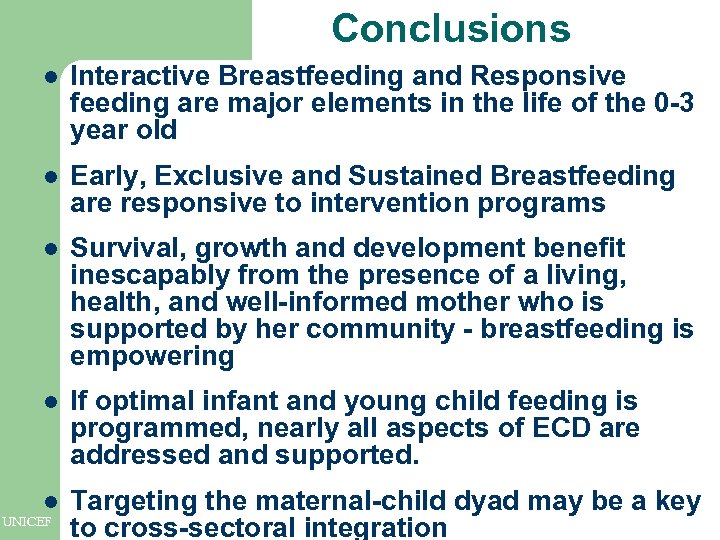 Conclusions l Interactive Breastfeeding and Responsive feeding are major elements in the life of the 0 -3 year old l Early, Exclusive and Sustained Breastfeeding are responsive to intervention programs l Survival, growth and development benefit inescapably from the presence of a living, health, and well-informed mother who is supported by her community - breastfeeding is empowering l If optimal infant and young child feeding is programmed, nearly all aspects of ECD are addressed and supported. l Targeting the maternal-child dyad may be a key to cross-sectoral integration UNICEF