


 Скачать презентацию Integrated crop protection some episodes from The Netherlands
5a85ae856468fafb8b830ae6e5727841.ppt
- Количество слайдов: 34
 Integrated crop protection, some episodes from The Netherlands Frank Wijnands Wageningen University and Research Centre Netherlands
 Road map n n n Short introduction in Integrated crop protection Research and results experimental farms 1980 -2000 The pilot farm networks approach 1990 -2004 The agricultural community, responsible network of stakeholders approach 2004 - ? Creating incentives ?
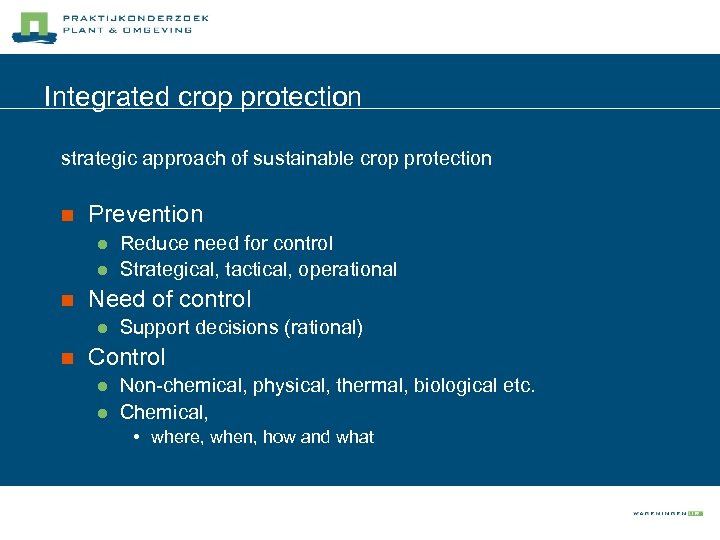 Integrated crop protection strategic approach of sustainable crop protection n Prevention l l n Need of control l n Reduce need for control Strategical, tactical, operational Support decisions (rational) Control l l Non-chemical, physical, thermal, biological etc. Chemical, • where, when, how and what
 Integrated Crop Protection & Integrated Farming Systems n IOBC - integrated fruit production - 70’ties Integrated crop protection Integrated farming systems n Development since 1979 n n l l n n Lautenbach (south germany) DFS Nagele NL, arable crops, clay soil, 72 ha Period from 1990 -2000, IOBC european network Disciplinary research
 IOBC n International Organization for the Biological and Integrated Control of Noxious Animals and Plants l n Scientific Non-profit, Non Governmental Organisation l n n http: //www. iobc-global. org/ since 1956 Studygroups, working groups and commissions Commission on IP guidelines since 1990 (http: //www. iobc. ch) l l Guidelines pome, stone and soft fruits, grapes, olives, citrus, vegetables, arable crops Toolbox to help organisations design ICP schemes
 ICP in the Netherlands – experimental farms n Development farming systems (integrated and organic) l l DFS Nagele Comparison conventional, organic and integrated 19782003 Conventional system stopped in 1990 More experimental sites in different regions and sectors period 19862003 Limited continuation after 2003, focus on elements and on pilot farm networks
 ICP methods & techniques - elements n n n n Proper crop rotation, optimal fertilisation Resistant and/or tolerant cultivars, seed treatments Decision support systems (traps, crop walking, weather based predictions etc. ), action tresholds Natural enemies, biological control Mechanical weed control, band spraying, robotisation Low dose techniques, contact instead of soil herbicides and insecticides Precision Farming, crop scans Emission reduction spraying techniques
 Results NL n Very convincing results around 1990, l l l n Period 1990 -2000 l l n The peak in North west european intensification and agrochemical use Reductions of use and impact (various parameters) up to 90% Competing economic results of th IFS systems Further reductions in use and impact More robust techniques, suitable for larger scale farms New pesticides contribute to firther reduction in impact Reductions of use and impact (various parameters) 80 -99% i. c. 1986 -1990 Perspectives good for application in practice
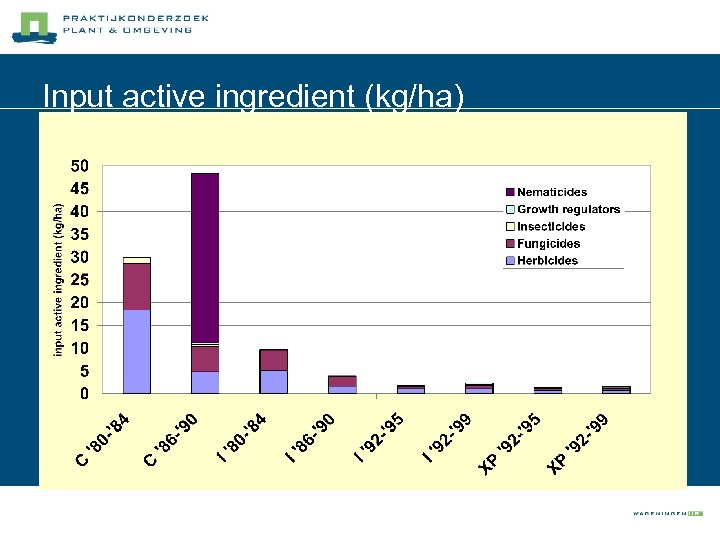 Input active ingredient (kg/ha)
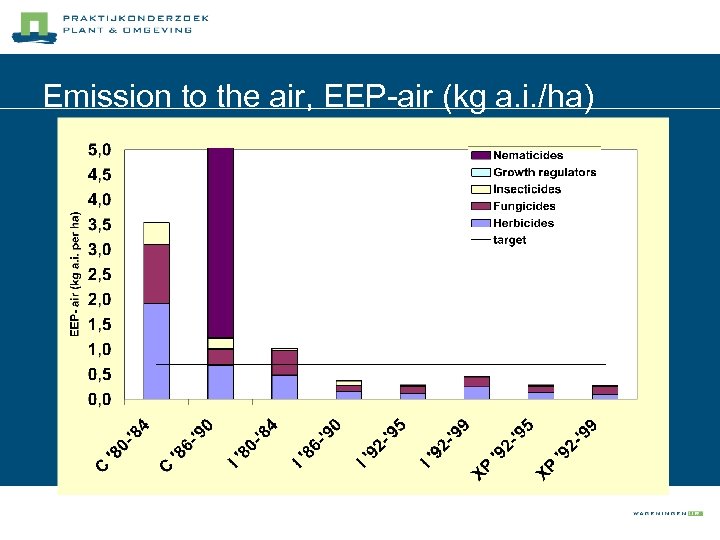 Emission to the air, EEP-air (kg a. i. /ha)
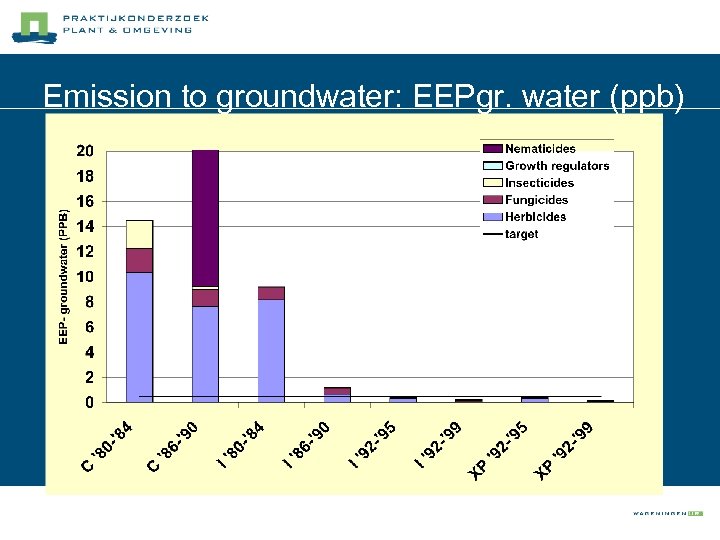 Emission to groundwater: EEPgr. water (ppb)
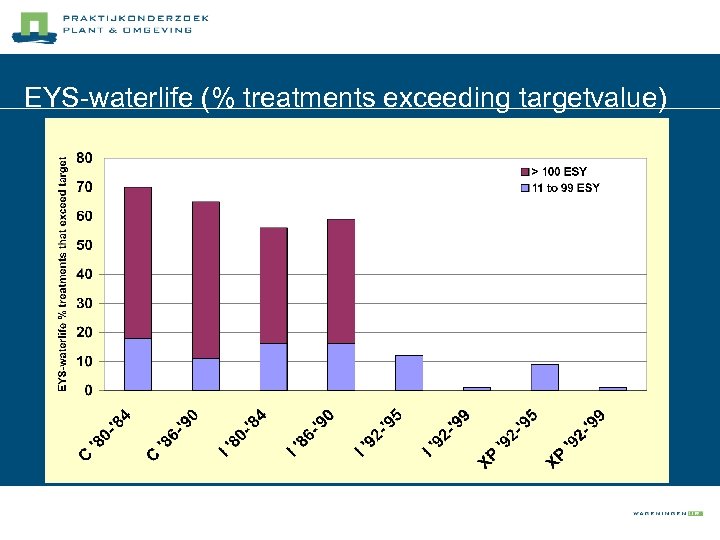 EYS-waterlife (% treatments exceeding targetvalue)
 Working with farmers pilot farm approaches
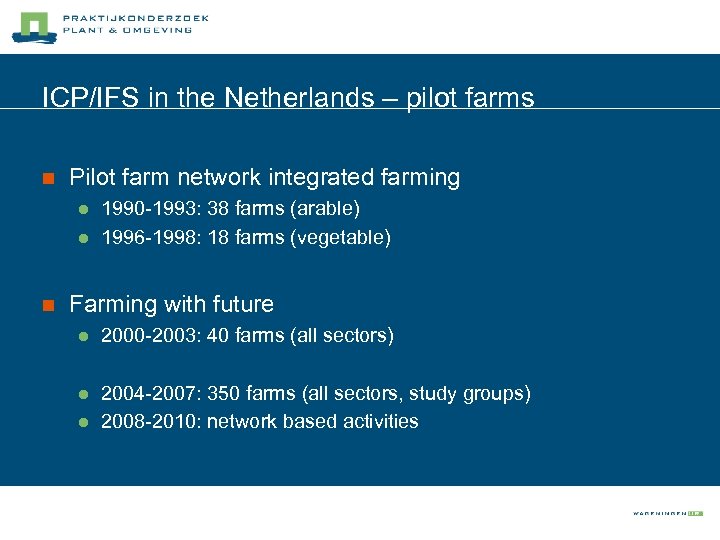 ICP/IFS in the Netherlands – pilot farms n Pilot farm network integrated farming l l n 1990 -1993: 38 farms (arable) 1996 -1998: 18 farms (vegetable) Farming with future l 2000 -2003: 40 farms (all sectors) l 2004 -2007: 350 farms (all sectors, study groups) 2008 -2010: network based activities l
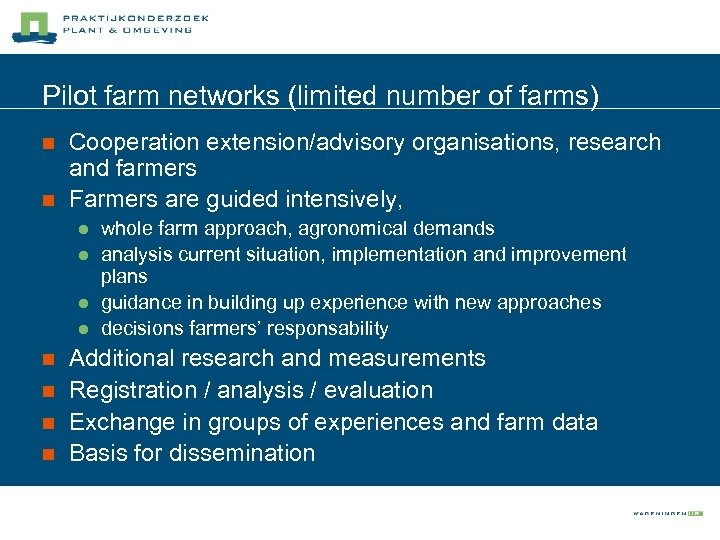 Pilot farm networks (limited number of farms) n n Cooperation extension/advisory organisations, research and farmers Farmers are guided intensively, l l n n whole farm approach, agronomical demands analysis current situation, implementation and improvement plans guidance in building up experience with new approaches decisions farmers’ responsability Additional research and measurements Registration / analysis / evaluation Exchange in groups of experiences and farm data Basis for dissemination
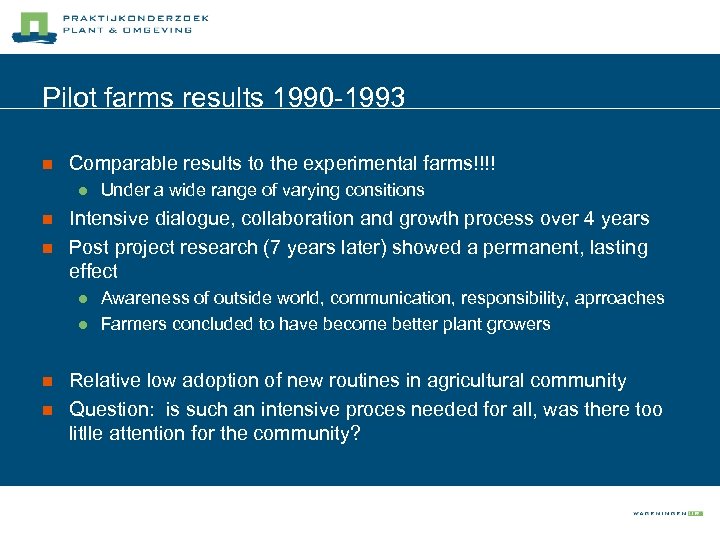 Pilot farms results 1990 -1993 n Comparable results to the experimental farms!!!! l n n Intensive dialogue, collaboration and growth process over 4 years Post project research (7 years later) showed a permanent, lasting effect l l n n Under a wide range of varying consitions Awareness of outside world, communication, responsibility, aprroaches Farmers concluded to have become better plant growers Relative low adoption of new routines in agricultural community Question: is such an intensive proces needed for all, was there too litlle attention for the community?
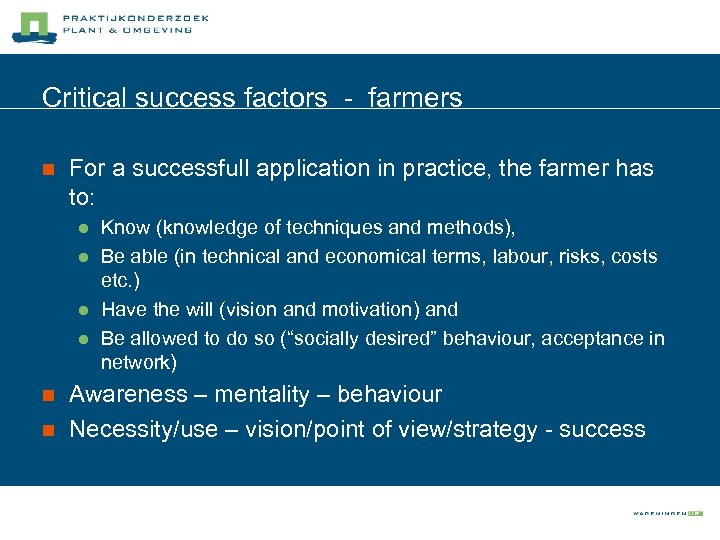 Critical success factors - farmers n For a successfull application in practice, the farmer has to: l l n n Know (knowledge of techniques and methods), Be able (in technical and economical terms, labour, risks, costs etc. ) Have the will (vision and motivation) and Be allowed to do so (“socially desired” behaviour, acceptance in network) Awareness – mentality – behaviour Necessity/use – vision/point of view/strategy - success
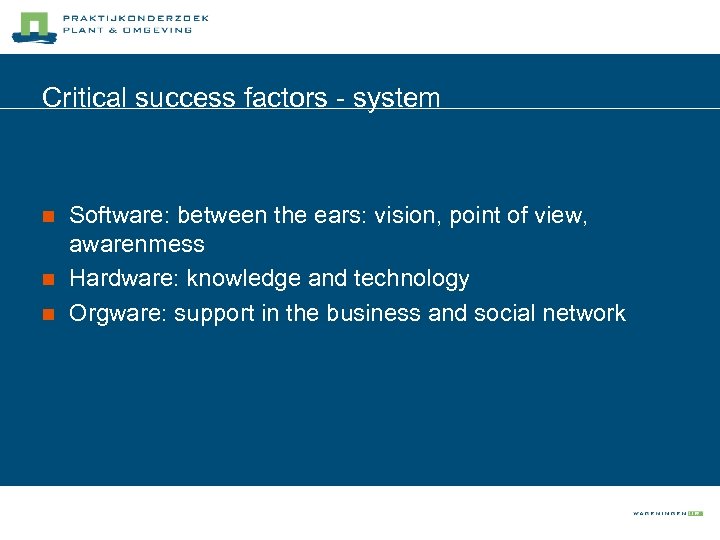 Critical success factors - system n n n Software: between the ears: vision, point of view, awarenmess Hardware: knowledge and technology Orgware: support in the business and social network
 Working in the agricultural community New pilot approaches
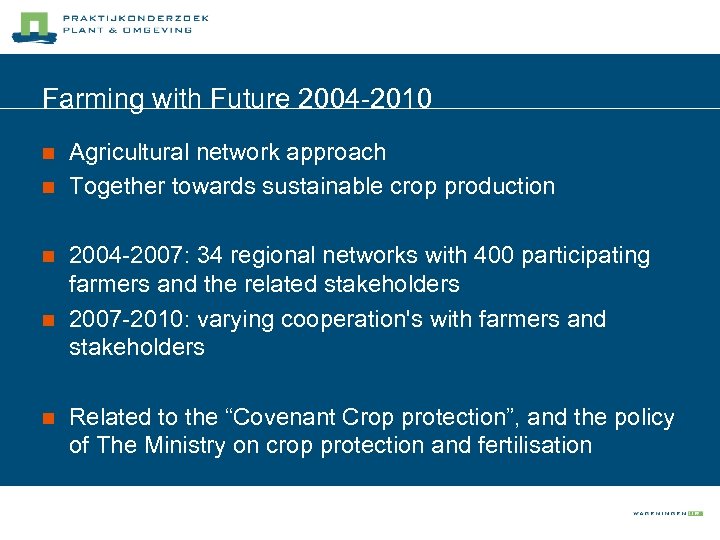 Farming with Future 2004 -2010 n n n Agricultural network approach Together towards sustainable crop production 2004 -2007: 34 regional networks with 400 participating farmers and the related stakeholders 2007 -2010: varying cooperation's with farmers and stakeholders Related to the “Covenant Crop protection”, and the policy of The Ministry on crop protection and fertilisation
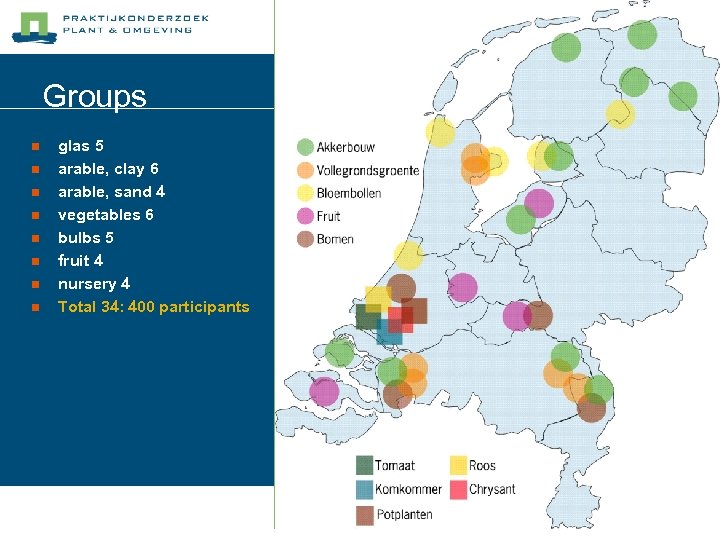 Groups n n n n glas 5 arable, clay 6 arable, sand 4 vegetables 6 bulbs 5 fruit 4 nursery 4 Total 34: 400 participants Accent glasgroepen in westen van het land, deelnemers echter in meerdere teeltgebieden
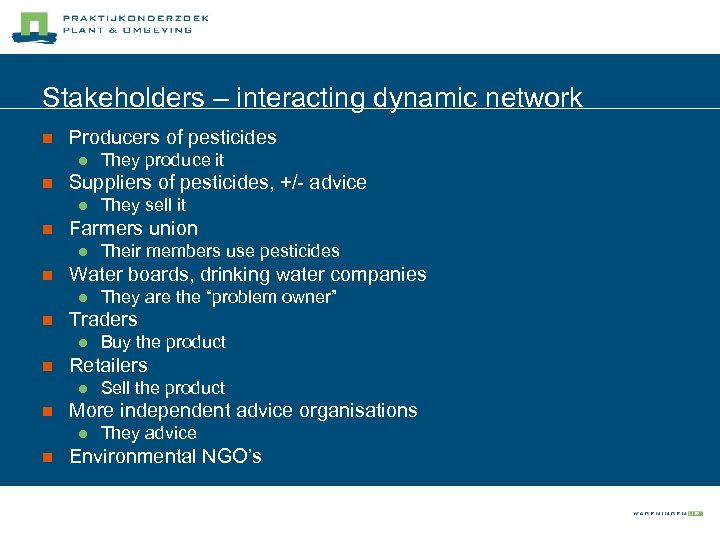 Stakeholders – interacting dynamic network n Producers of pesticides l n Suppliers of pesticides, +/- advice l n Sell the product More independent advice organisations l n Buy the product Retailers l n They are the “problem owner” Traders l n Their members use pesticides Water boards, drinking water companies l n They sell it Farmers union l n They produce it They advice Environmental NGO’s
 Major objectives 1. New relevant knowledge l l l 2. 3. On-farm testing and developing Best practices with farmers and stakeholders (Best practices) Best practices are the promising new methods & techniques from research feasable and effective methods Realising impact and increasing responsibility stakeholders
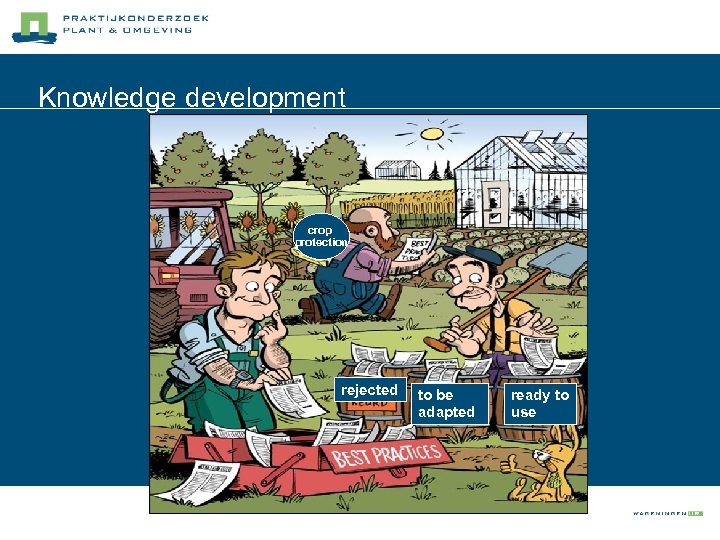 Knowledge development crop protection rejected to be adapted ready to use
 In the heart of knowledge development n Uses the newest knowledge l n Links this with l n n The practical experience and innovative powers of farmers Develops and tests l n From government sponsored research programmes on crop protection Together with famers practicable effective and feasible methods for more sustainable farming systems Disseminates new knowledge via the network of advisory, agri-business et. Gives feedback to research and policy (agenda)
 Major objectives 1. New relevant knowledge 2. Realising impact l l l 3. Increasing the use of these new methods in agricultural practices Knowledge dissemination together with, traders, suplliers, advisory organisations etc, all relevant stakeholders Working on solutions for specific problemes, often water qualirty issues Stimulating stakeholders to take more responsibilty for sustainabilty in their actions
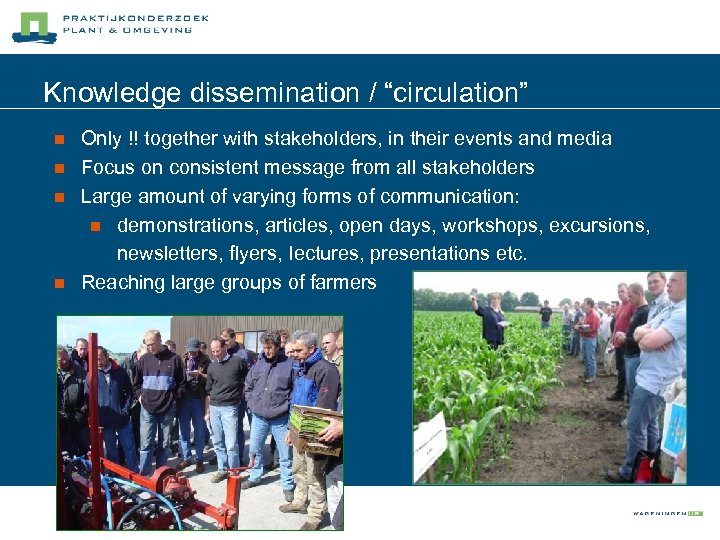 Knowledge dissemination / “circulation” n n Only !! together with stakeholders, in their events and media Focus on consistent message from all stakeholders Large amount of varying forms of communication: n demonstrations, articles, open days, workshops, excursions, newsletters, flyers, lectures, presentations etc. Reaching large groups of farmers
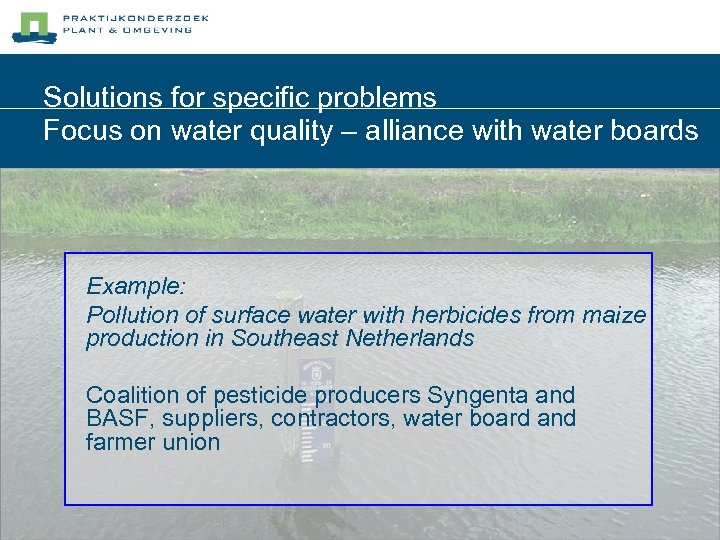 Solutions for specific problems Focus on water quality – alliance with water boards Example: Pollution of surface water with herbicides from maize production in Southeast Netherlands Coalition of pesticide producers Syngenta and BASF, suppliers, contractors, water board and farmer union
 Results of the project (2004 -2007) n 70 best practices ready for practice n l n Reaching 1000’s of farmers by l n n that are effective and feasible described in leaflets and broadly disseminated Yearly some 100 activities organised together with stakeholders to disseminate sustainable (best) practices More stakholders involved in the knowledge dissemination New coalitions of stakeholders for sustainable agriculture in varying composition
 However n n Existing routines are hard to change, They got the “power of reality” Changing behaviour of farmers and stakeholders is difficult and takes time. From inform to advice!!!
 Lessons learned – success factors n Excellent technology l l l n Increasingly hard to find Innovations needed, new principles, new approaches Substantial contribution New, more sustainable approaches should be profitable. Requires vision, policy, money, courage and support Road tested technology l l Tested with farmers and stakeholders Feasible and effective Basis for dissemination Requires participatory approaches, networks, advisory services, research, farmers
 Lessons learned – success factors n Involve agricultural community – stakeholders l l l n Social contract – agreement start Responsability – first steps Link interests – whats at stake for SH with the sustainabilty issue Increasing interest in sustainability, higher on ladder of interests From the freedom the choose to the responsibilty to choose Requires continuous stakeholdermanagement Support these developments by an organisation – project l l Independent, Flexible Highly knowledgeble, expertise Skill in process and content
 statement n n n n n Never underestimate the possibilities of the stakeholders They are the professionals in the agricultural business They cause! the current situation – hostage situation When they take sustainability serious anything can happen We must make it their business As one of my board members stated Everyone must want to do what they can do The stakeholders have the key to sustainabilty But only in cooperation
 Incentives n Economically n n Ethical – ecological – environmental n n n New technology makes you money!! Government EU support, public concerns, support methods and techniques – ICP ladder Market- demands certification Responsibel behaviour – ssustainablity Make it the “norm” Legal n n Pesticide registration Additional rules (buffer strips, control machinery etc)