


 Скачать презентацию Integrated Care Records Service Durham and Darlington 22
325b370adfe19bba8df00672e80806a2.ppt
- Количество слайдов: 28
 Integrated Care Records Service Durham and Darlington 22 October 2002
 National Programme Overview
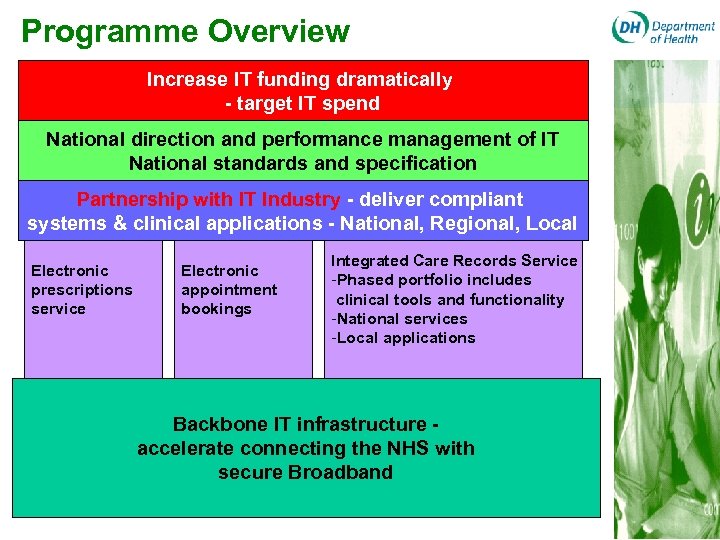 Programme Overview Increase IT funding dramatically - target IT spend National direction and performance management of IT National standards and specification Partnership with IT Industry - deliver compliant systems & clinical applications - National, Regional, Local Electronic prescriptions service Electronic appointment bookings Integrated Care Records Service -Phased portfolio includes clinical tools and functionality -National services -Local applications Backbone IT infrastructure accelerate connecting the NHS with secure Broadband
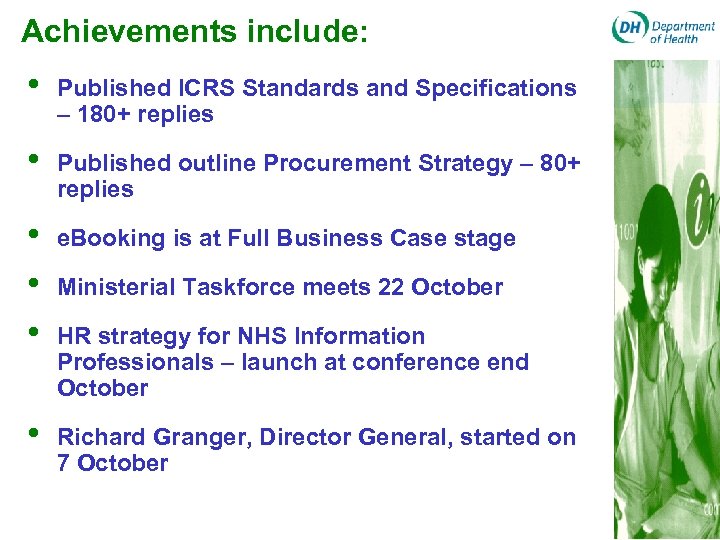 Achievements include: • Published ICRS Standards and Specifications – 180+ replies • Published outline Procurement Strategy – 80+ replies • • • e. Booking is at Full Business Case stage • Richard Granger, Director General, started on 7 October Ministerial Taskforce meets 22 October HR strategy for NHS Information Professionals – launch at conference end October
 Delivery • Over 96% of NHS Consultants have desktop PC access to NHSnet • e. Mail & Directory Services Contract signed 27 September • e. Booking Information Broker Service live 12 September (www. nhs. uk) • Health Records Infrastructure pilot in Walsall from end October • Establishment of CIOs in St. HAs
 Key Priorities…. • Provide central direction, local implementation, eg in PPF guidance • • Stakeholder inclusion, time to contribute Target increased funding Establishing standards Pragmatic implementation at high speed, while keeping the vision alive Deliver better patient care.
 Integrated Care Records Service
 Phase 0 – Research • ERDIP Demonstrators • Patient Survey • Supplier Relations • International exemplars • Exemplar sites
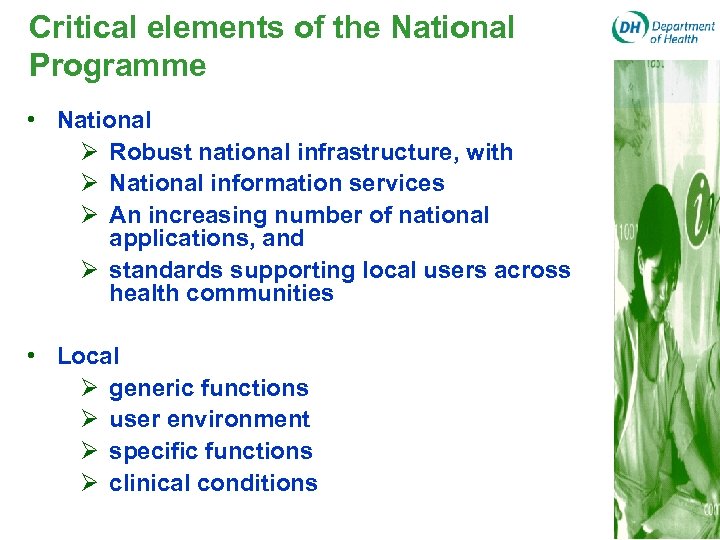 Critical elements of the National Programme • National Ø Robust national infrastructure, with Ø National information services Ø An increasing number of national applications, and Ø standards supporting local users across health communities • Local Ø generic functions Ø user environment Ø specific functions Ø clinical conditions
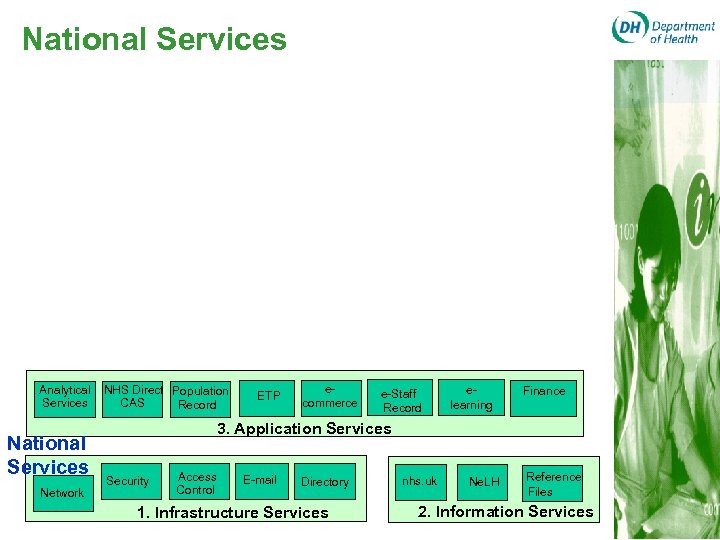 National Services Analytical Services National Services Network NHS Direct Population CAS Record ETP ecommerce e-Staff Record elearning . Finance 3. Application Services Security Access Control E-mail Directory 1. Infrastructure Services nhs. uk Ne. LH Reference Files 2. Information Services
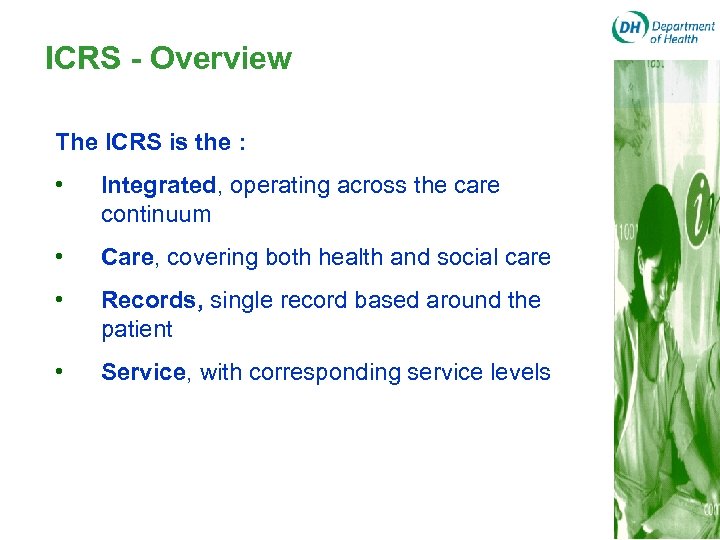 ICRS - Overview The ICRS is the : • Integrated, operating across the care continuum • Care, covering both health and social care • Records, single record based around the patient • Service, with corresponding service levels
 What is the purpose of ICRS ? The purpose of ICRS is to support the provision of high quality patient care across the whole health community
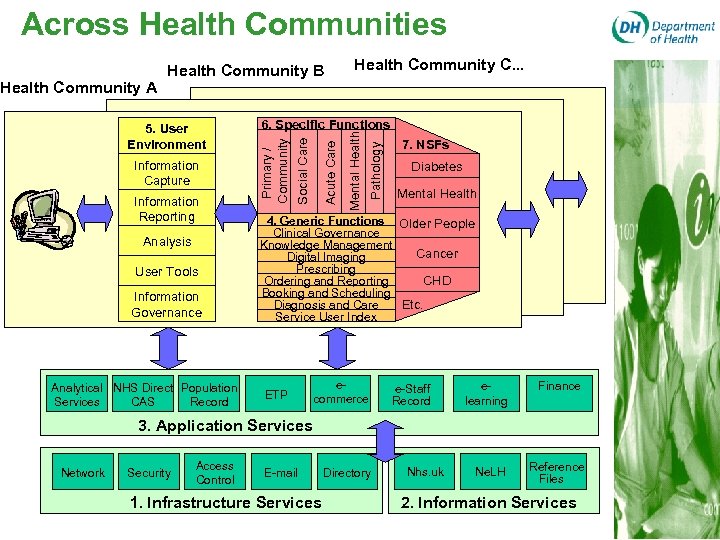 Across Health Communities Local Services Analysis User Tools Information Governance Pathology Mental Health Information Reporting Acute Care Information Capture Health Community C. . . 6. Specific Functions Social Care 5. User Environment Primary / Community Health Community A Health Community B 7. NSFs Diabetes Mental Health 4. Generic Functions Older People Clinical Governance Knowledge Management Cancer Digital Imaging Prescribing Ordering and Reporting CHD Booking and Scheduling Diagnosis and Care Etc. Service User Index Standards Analytical NHS Direct Population Services CAS Record ETP ecommerce e-Staff. Record e. Finance learning Finance Ne. LH Reference Files 3. Application Services National Network Services Security Access Control E-mail 1. Infrastructure Services Directory Nhs. uk 2. Information Services
 Phase 1 – Consultation • Output Specification for ICRS • Procurement Synopsis • CIO Preparation • Work with exemplar sites • Industry consultation
 ICRS Consultation Exercise • 186 responses (as at 27 September) Ø 74 from the NHS Ø 62 from suppliers Ø 50 others • Workshops • Structured Walkthrough
 ICRS Consultation – Main Issues • Vision and description – need more on benefits • Clarification of procurement and implementation plan • Need to phase implementation • Suggestions on functional requirements – eg NSFs • Need for Design and Architecture
 Phase 2 - Planning • Project Definition • Project Initiation ØProject plan ØRisk register ØDependencies within the programme • National Business Case
 Objectives for ICRS Procurement • Procure Integrated Care Records Services in a way that: • provides a coherent national, top-down approach that will be capable of delivering the targets in the National Programme • is sensitive to local requirements, both in terms of business objectives and technical / system legacy.
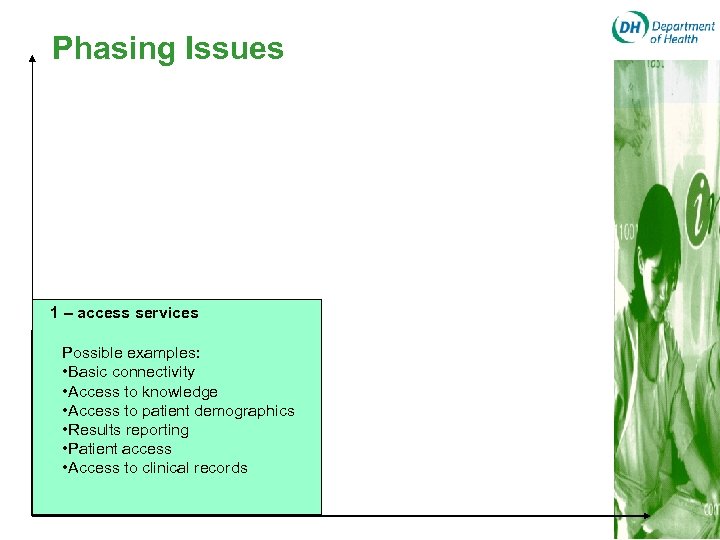 Phasing Issues 1 – access services Possible examples: • Basic connectivity • Access to knowledge • Access to patient demographics • Results reporting • Patient access • Access to clinical records
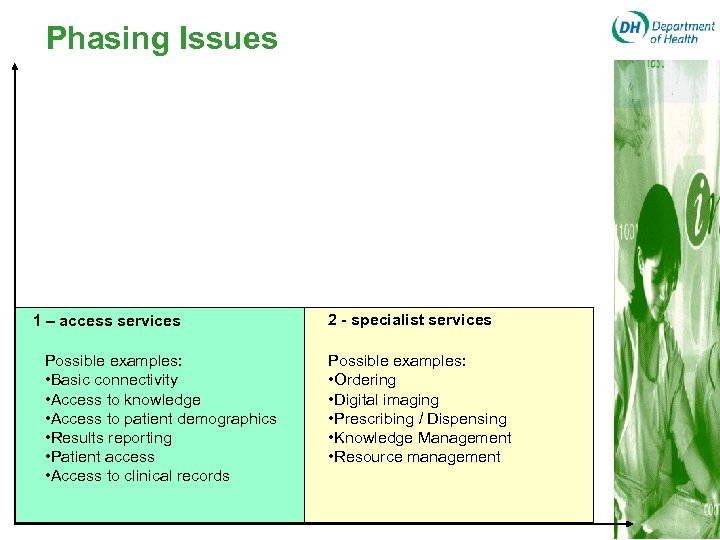 Phasing Issues 1 – access services Possible examples: • Basic connectivity • Access to knowledge • Access to patient demographics • Results reporting • Patient access • Access to clinical records 2 - specialist services Possible examples: • Ordering • Digital imaging • Prescribing / Dispensing • Knowledge Management • Resource management
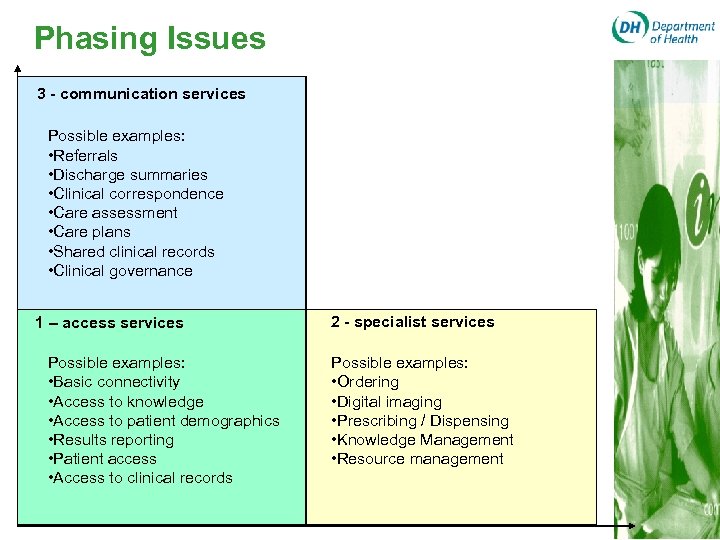 Phasing Issues 3 - communication services Possible examples: • Referrals • Discharge summaries • Clinical correspondence • Care assessment • Care plans • Shared clinical records • Clinical governance 1 – access services Possible examples: • Basic connectivity • Access to knowledge • Access to patient demographics • Results reporting • Patient access • Access to clinical records 2 - specialist services Possible examples: • Ordering • Digital imaging • Prescribing / Dispensing • Knowledge Management • Resource management
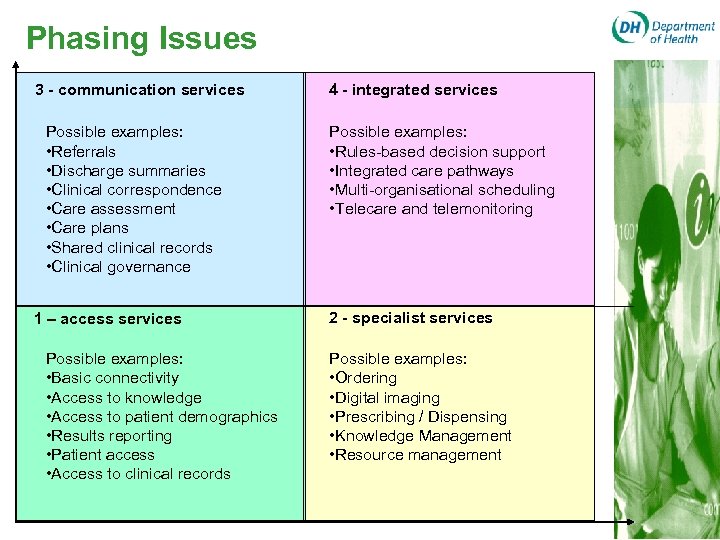 Phasing Issues 3 - communication services Possible examples: • Referrals • Discharge summaries • Clinical correspondence • Care assessment • Care plans • Shared clinical records • Clinical governance 1 – access services Possible examples: • Basic connectivity • Access to knowledge • Access to patient demographics • Results reporting • Patient access • Access to clinical records 4 - integrated services Possible examples: • Rules-based decision support • Integrated care pathways • Multi-organisational scheduling • Telecare and telemonitoring 2 - specialist services Possible examples: • Ordering • Digital imaging • Prescribing / Dispensing • Knowledge Management • Resource management
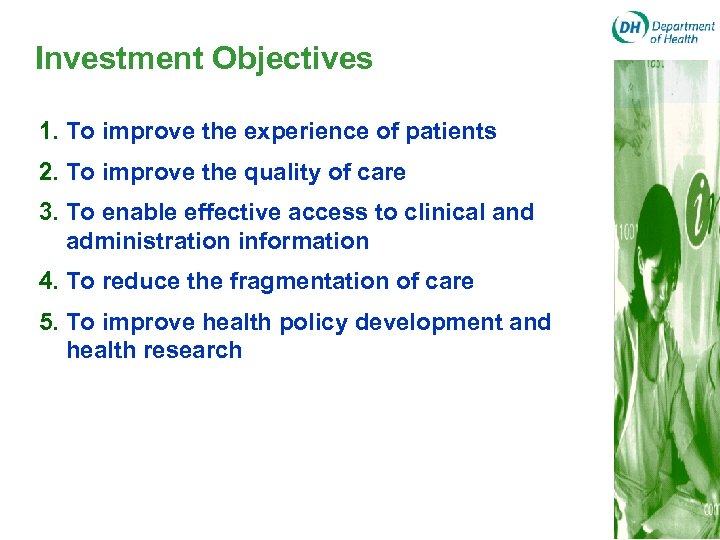 Objectives Investment Objectives 1. To improve the experience of patients 2. To improve the quality of care 3. To enable effective access to clinical and administration information 4. To reduce the fragmentation of care 5. To improve health policy development and health research
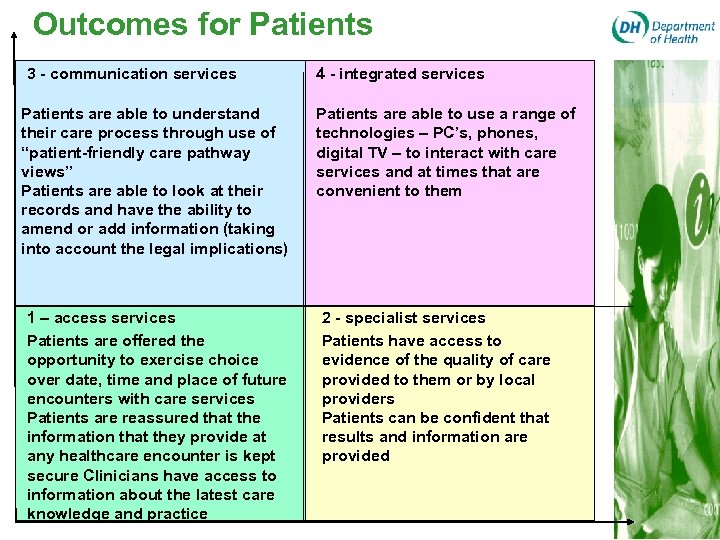 Outcomes for Patients 3 - communication services Patients are able to understand their care process through use of “patient-friendly care pathway views” Patients are able to look at their records and have the ability to amend or add information (taking into account the legal implications) 1 – access services Patients are offered the opportunity to exercise choice over date, time and place of future encounters with care services Patients are reassured that the information that they provide at any healthcare encounter is kept secure Clinicians have access to information about the latest care knowledge and practice 4 - integrated services Patients are able to use a range of technologies – PC’s, phones, digital TV – to interact with care services and at times that are convenient to them 2 - specialist services Patients have access to evidence of the quality of care provided to them or by local providers Patients can be confident that results and information are provided
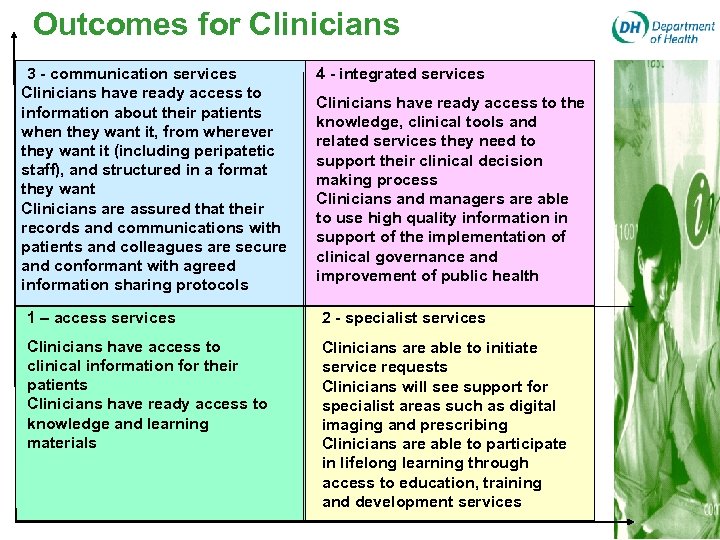 Outcomes for Clinicians 3 - communication services Clinicians have ready access to information about their patients when they want it, from wherever they want it (including peripatetic staff), and structured in a format they want Clinicians are assured that their records and communications with patients and colleagues are secure and conformant with agreed information sharing protocols 4 - integrated services Clinicians have ready access to the knowledge, clinical tools and related services they need to support their clinical decision making process Clinicians and managers are able to use high quality information in support of the implementation of clinical governance and improvement of public health 1 – access services 2 - specialist services Clinicians have access to clinical information for their patients Clinicians have ready access to knowledge and learning materials Clinicians are able to initiate service requests Clinicians will see support for specialist areas such as digital imaging and prescribing Clinicians are able to participate in lifelong learning through access to education, training and development services
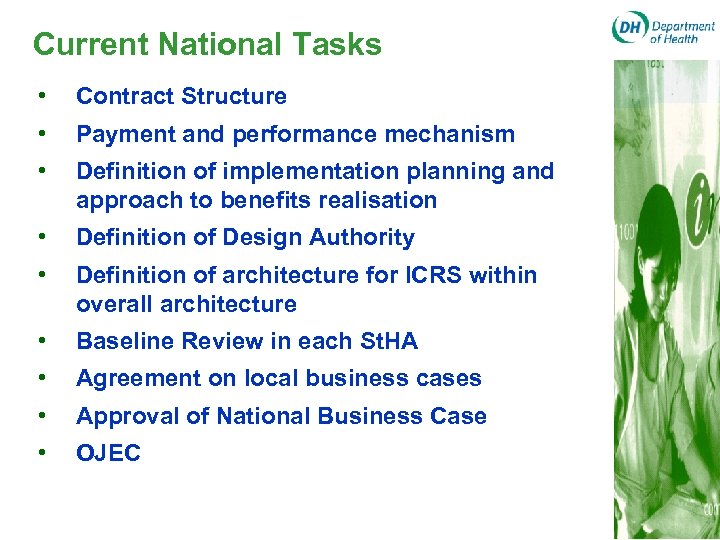 Current National Tasks • Contract Structure • Payment and performance mechanism • Definition of implementation planning and approach to benefits realisation • Definition of Design Authority • Definition of architecture for ICRS within overall architecture • Baseline Review in each St. HA • Agreement on local business cases • Approval of National Business Case • OJEC
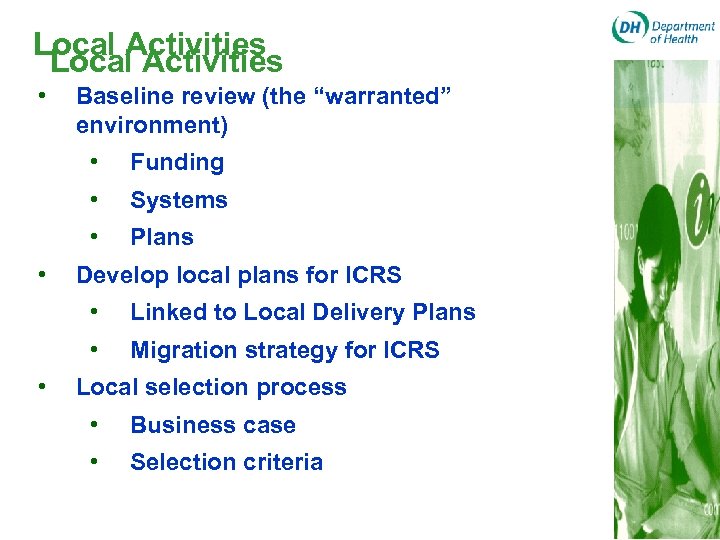 Local Activities • Baseline review (the “warranted” environment) • • Systems • • Funding Plans Develop local plans for ICRS • • • Linked to Local Delivery Plans Migration strategy for ICRS Local selection process • Business case • Selection criteria
 Any Questions ?