 Скачать презентацию Integrated Bachelor s and Master s Degree Program In Accounting
55623a70d2306afa19d3c4081186a4c6.ppt
- Количество слайдов: 23



Integrated Bachelor’s and Master’s Degree Program In Accounting and Business Management (IBMP) Faculty of Commerce and Accountancy, Thammasat University กธ. 322 กลยทธ และการดำเนนธรกจระดบโลก BI. 322 Global Business and Strategy 13 November 2009 Mr. Gavintorn Atthakor Email: gavin. boat@gmail. com
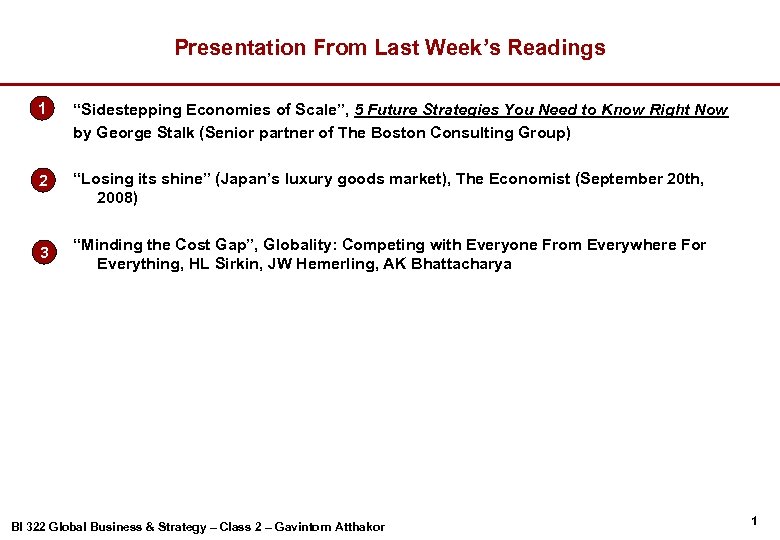
Presentation From Last Week’s Readings 1 “Sidestepping Economies of Scale”, 5 Future Strategies You Need to Know Right Now by George Stalk (Senior partner of The Boston Consulting Group) 2 “Losing its shine” (Japan’s luxury goods market), The Economist (September 20 th, 2008) 3 “Minding the Cost Gap”, Globality: Competing with Everyone From Everywhere For Everything, HL Sirkin, JW Hemerling, AK Bhattacharya BI 322 Global Business & Strategy – Class 2 – Gavintorn Atthakor 1
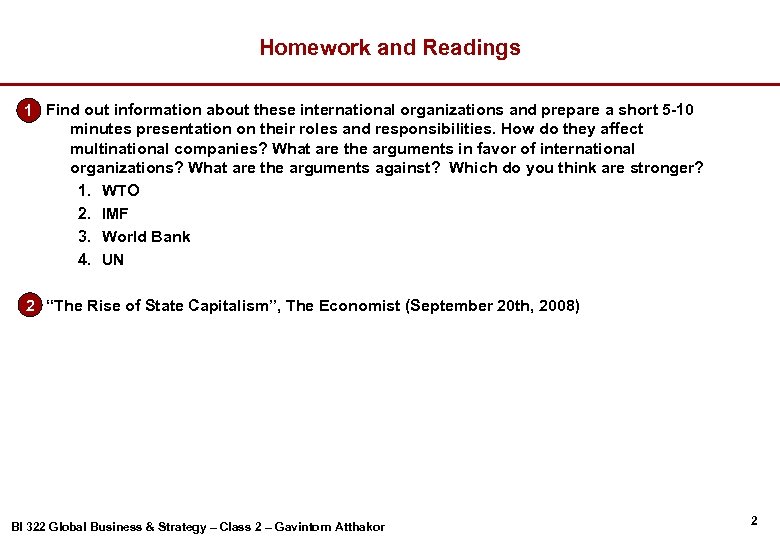
Homework and Readings 1 Find out information about these international organizations and prepare a short 5 -10 minutes presentation on their roles and responsibilities. How do they affect multinational companies? What are the arguments in favor of international organizations? What are the arguments against? Which do you think are stronger? 1. WTO 2. IMF 3. World Bank 4. UN 2 “The Rise of State Capitalism”, The Economist (September 20 th, 2008) BI 322 Global Business & Strategy – Class 2 – Gavintorn Atthakor 2
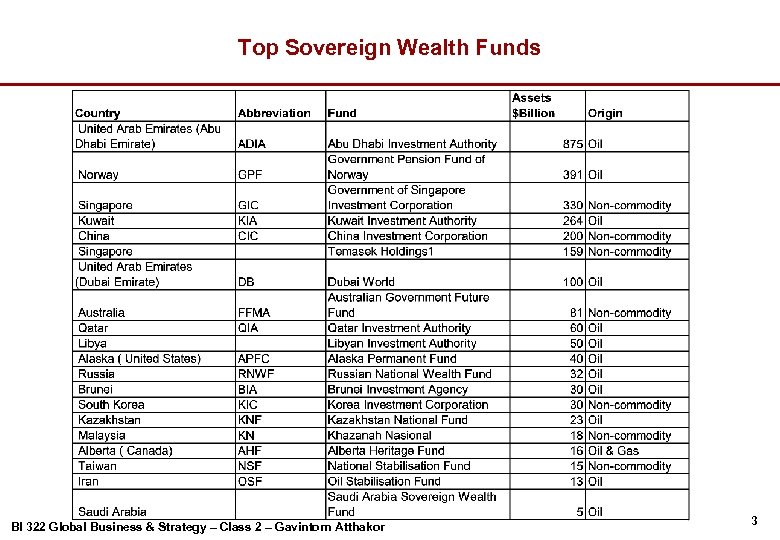
Top Sovereign Wealth Funds BI 322 Global Business & Strategy – Class 2 – Gavintorn Atthakor 3
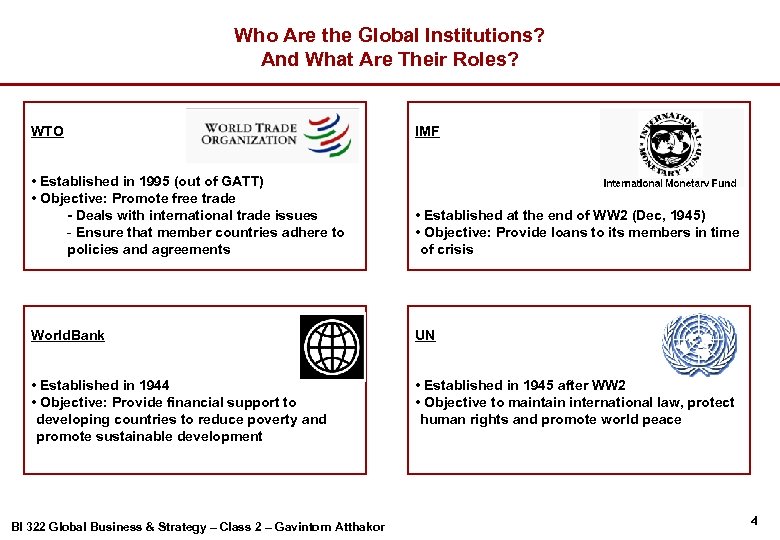
Who Are the Global Institutions? And What Are Their Roles? WTO IMF • Established in 1995 (out of GATT) • Objective: Promote free trade - Deals with international trade issues - Ensure that member countries adhere to policies and agreements • Established at the end of WW 2 (Dec, 1945) • Objective: Provide loans to its members in time of crisis World. Bank UN • Established in 1944 • Objective: Provide financial support to developing countries to reduce poverty and promote sustainable development • Established in 1945 after WW 2 • Objective to maintain international law, protect human rights and promote world peace BI 322 Global Business & Strategy – Class 2 – Gavintorn Atthakor 4
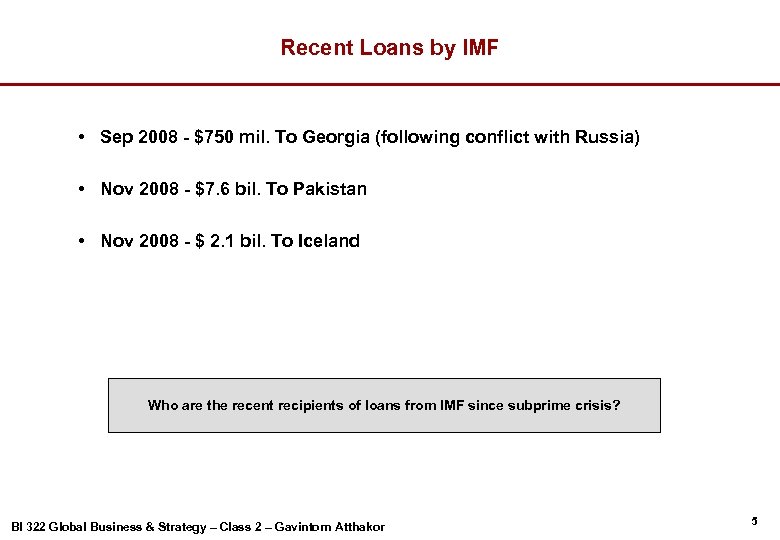
Recent Loans by IMF • Sep 2008 - $750 mil. To Georgia (following conflict with Russia) • Nov 2008 - $7. 6 bil. To Pakistan • Nov 2008 - $ 2. 1 bil. To Iceland Who are the recent recipients of loans from IMF since subprime crisis? BI 322 Global Business & Strategy – Class 2 – Gavintorn Atthakor 5
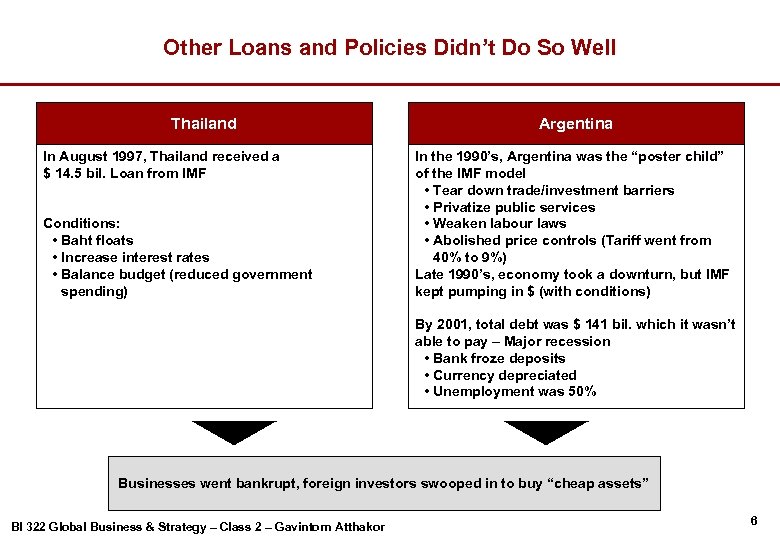
Other Loans and Policies Didn’t Do So Well Thailand In August 1997, Thailand received a $ 14. 5 bil. Loan from IMF Conditions: • Baht floats • Increase interest rates • Balance budget (reduced government spending) Argentina In the 1990’s, Argentina was the “poster child” of the IMF model • Tear down trade/investment barriers • Privatize public services • Weaken labour laws • Abolished price controls (Tariff went from 40% to 9%) Late 1990’s, economy took a downturn, but IMF kept pumping in $ (with conditions) By 2001, total debt was $ 141 bil. which it wasn’t able to pay – Major recession • Bank froze deposits • Currency depreciated • Unemployment was 50% Businesses went bankrupt, foreign investors swooped in to buy “cheap assets” BI 322 Global Business & Strategy – Class 2 – Gavintorn Atthakor 6
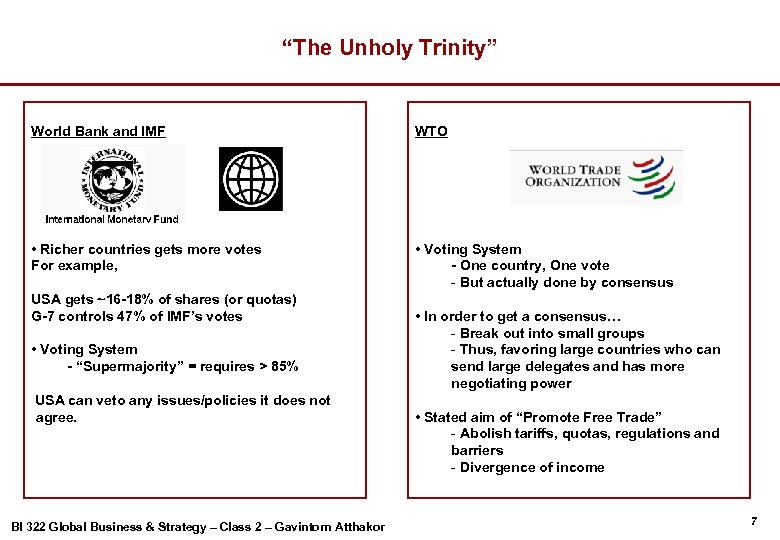
“The Unholy Trinity” World Bank and IMF WTO • Richer countries gets more votes For example, • Voting System - One country, One vote - But actually done by consensus USA gets ~16 -18% of shares (or quotas) G-7 controls 47% of IMF’s votes • Voting System - “Supermajority” = requires > 85% USA can veto any issues/policies it does not agree. BI 322 Global Business & Strategy – Class 2 – Gavintorn Atthakor • In order to get a consensus… - Break out into small groups - Thus, favoring large countries who can send large delegates and has more negotiating power • Stated aim of “Promote Free Trade” - Abolish tariffs, quotas, regulations and barriers - Divergence of income 7
How Does Politics Impact Business ? Political uncertainty leads to poor public (domestic and international) sentiments. Uncertainty usually leads to lower retail (consumer) spending and business investments. • Reduced foreign direct investments • Adverse affects on tourism • Disrupts trade (imports and exports) BI 322 Global Business & Strategy – Class 2 – Gavintorn Atthakor 8
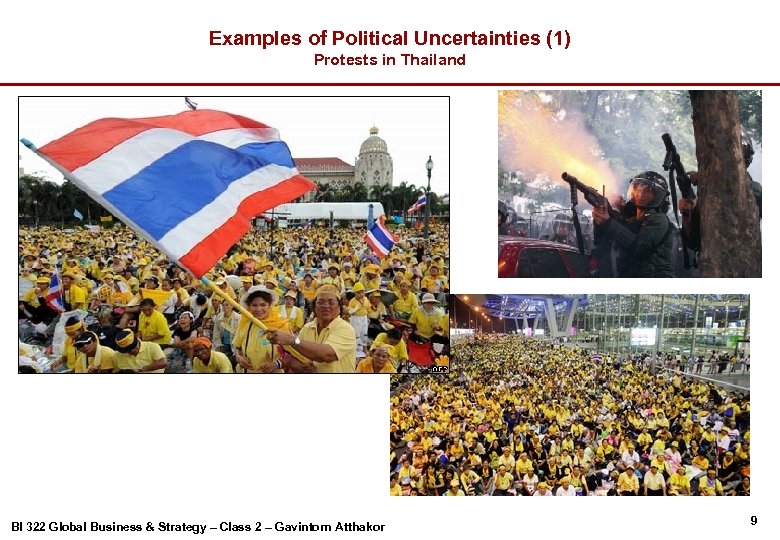
Examples of Political Uncertainties (1) Protests in Thailand BI 322 Global Business & Strategy – Class 2 – Gavintorn Atthakor 9
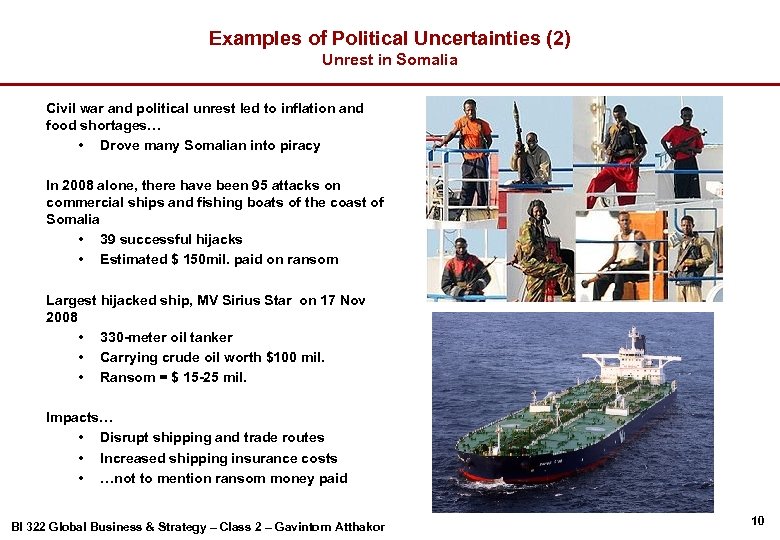
Examples of Political Uncertainties (2) Unrest in Somalia Civil war and political unrest led to inflation and food shortages… • Drove many Somalian into piracy In 2008 alone, there have been 95 attacks on commercial ships and fishing boats of the coast of Somalia • 39 successful hijacks • Estimated $ 150 mil. paid on ransom Largest hijacked ship, MV Sirius Star on 17 Nov 2008 • 330 -meter oil tanker • Carrying crude oil worth $100 mil. • Ransom = $ 15 -25 mil. Impacts… • Disrupt shipping and trade routes • Increased shipping insurance costs • …not to mention ransom money paid BI 322 Global Business & Strategy – Class 2 – Gavintorn Atthakor 10
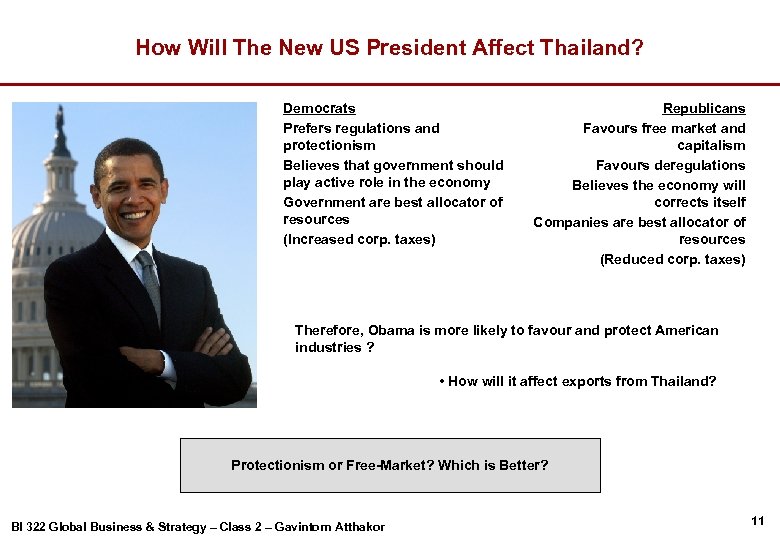
How Will The New US President Affect Thailand? Democrats Prefers regulations and protectionism Believes that government should play active role in the economy Government are best allocator of resources (Increased corp. taxes) Republicans Favours free market and capitalism Favours deregulations Believes the economy will corrects itself Companies are best allocator of resources (Reduced corp. taxes) Therefore, Obama is more likely to favour and protect American industries ? • How will it affect exports from Thailand? Protectionism or Free-Market? Which is Better? BI 322 Global Business & Strategy – Class 2 – Gavintorn Atthakor 11
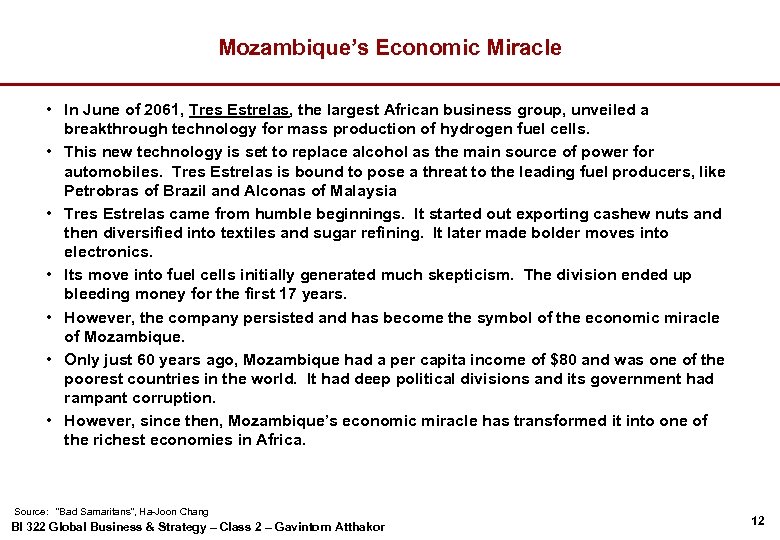
Mozambique’s Economic Miracle • In June of 2061, Tres Estrelas, the largest African business group, unveiled a breakthrough technology for mass production of hydrogen fuel cells. • This new technology is set to replace alcohol as the main source of power for automobiles. Tres Estrelas is bound to pose a threat to the leading fuel producers, like Petrobras of Brazil and Alconas of Malaysia • Tres Estrelas came from humble beginnings. It started out exporting cashew nuts and then diversified into textiles and sugar refining. It later made bolder moves into electronics. • Its move into fuel cells initially generated much skepticism. The division ended up bleeding money for the first 17 years. • However, the company persisted and has become the symbol of the economic miracle of Mozambique. • Only just 60 years ago, Mozambique had a per capita income of $80 and was one of the poorest countries in the world. It had deep political divisions and its government had rampant corruption. • However, since then, Mozambique’s economic miracle has transformed it into one of the richest economies in Africa. Source: “Bad Samaritans”, Ha-Joon Chang BI 322 Global Business & Strategy – Class 2 – Gavintorn Atthakor 12
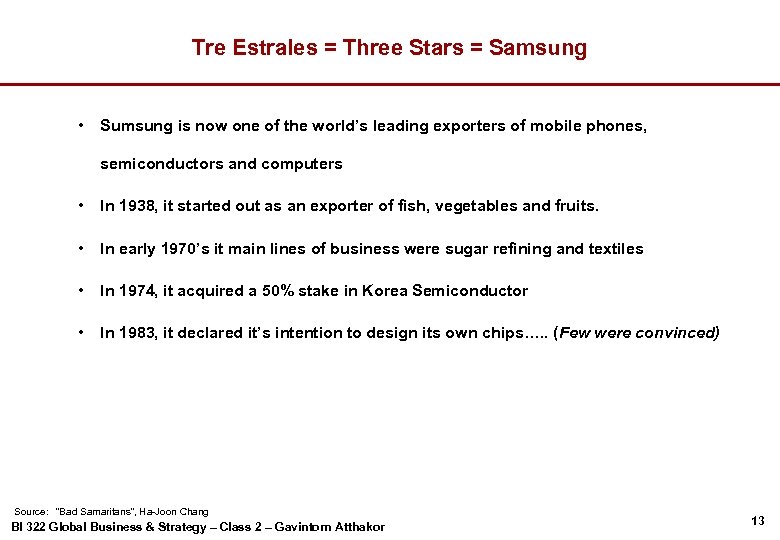
Tre Estrales = Three Stars = Samsung • Sumsung is now one of the world’s leading exporters of mobile phones, semiconductors and computers • In 1938, it started out as an exporter of fish, vegetables and fruits. • In early 1970’s it main lines of business were sugar refining and textiles • In 1974, it acquired a 50% stake in Korea Semiconductor • In 1983, it declared it’s intention to design its own chips…. . (Few were convinced) Source: “Bad Samaritans”, Ha-Joon Chang BI 322 Global Business & Strategy – Class 2 – Gavintorn Atthakor 13
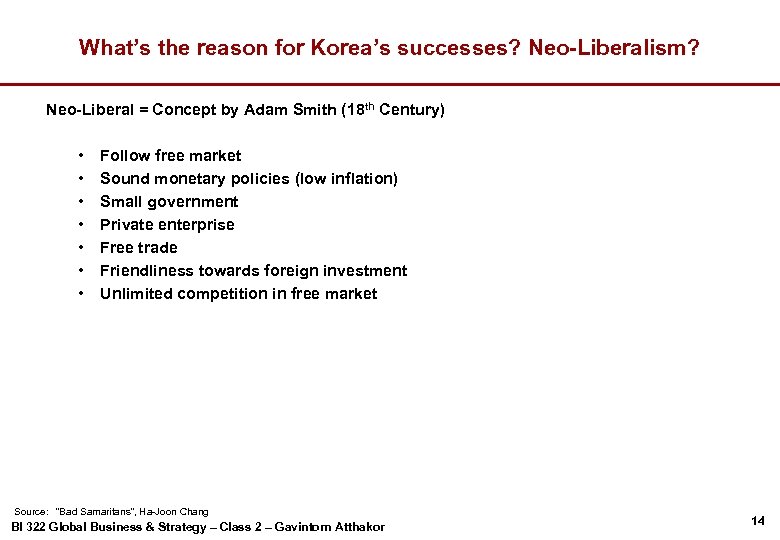
What’s the reason for Korea’s successes? Neo-Liberalism? Neo-Liberal = Concept by Adam Smith (18 th Century) • • Follow free market Sound monetary policies (low inflation) Small government Private enterprise Free trade Friendliness towards foreign investment Unlimited competition in free market Source: “Bad Samaritans”, Ha-Joon Chang BI 322 Global Business & Strategy – Class 2 – Gavintorn Atthakor 14
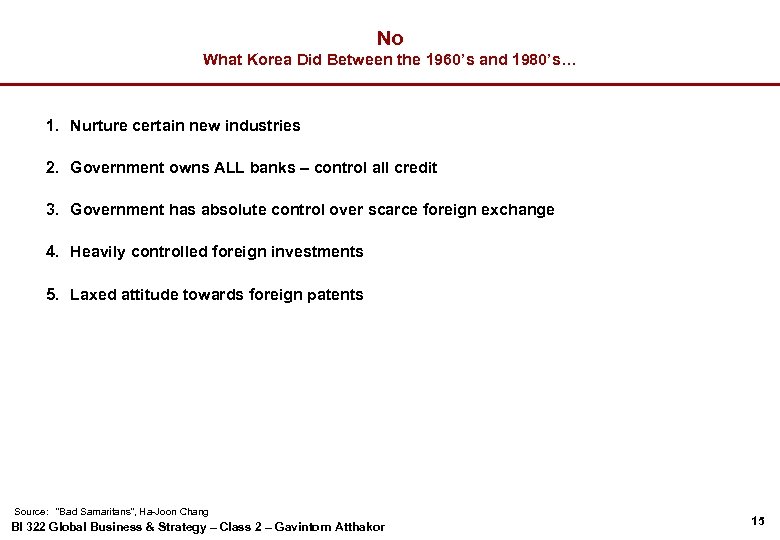
No What Korea Did Between the 1960’s and 1980’s… 1. Nurture certain new industries 2. Government owns ALL banks – control all credit 3. Government has absolute control over scarce foreign exchange 4. Heavily controlled foreign investments 5. Laxed attitude towards foreign patents Source: “Bad Samaritans”, Ha-Joon Chang BI 322 Global Business & Strategy – Class 2 – Gavintorn Atthakor 15
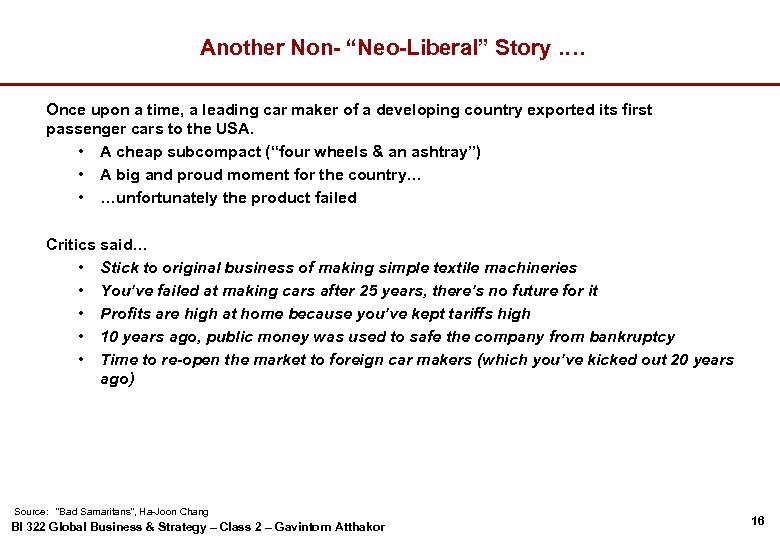
Another Non- “Neo-Liberal” Story. … Once upon a time, a leading car maker of a developing country exported its first passenger cars to the USA. • A cheap subcompact (“four wheels & an ashtray”) • A big and proud moment for the country… • …unfortunately the product failed Critics said… • Stick to original business of making simple textile machineries • You’ve failed at making cars after 25 years, there’s no future for it • Profits are high at home because you’ve kept tariffs high • 10 years ago, public money was used to safe the company from bankruptcy • Time to re-open the market to foreign car makers (which you’ve kicked out 20 years ago) Source: “Bad Samaritans”, Ha-Joon Chang BI 322 Global Business & Strategy – Class 2 – Gavintorn Atthakor 16
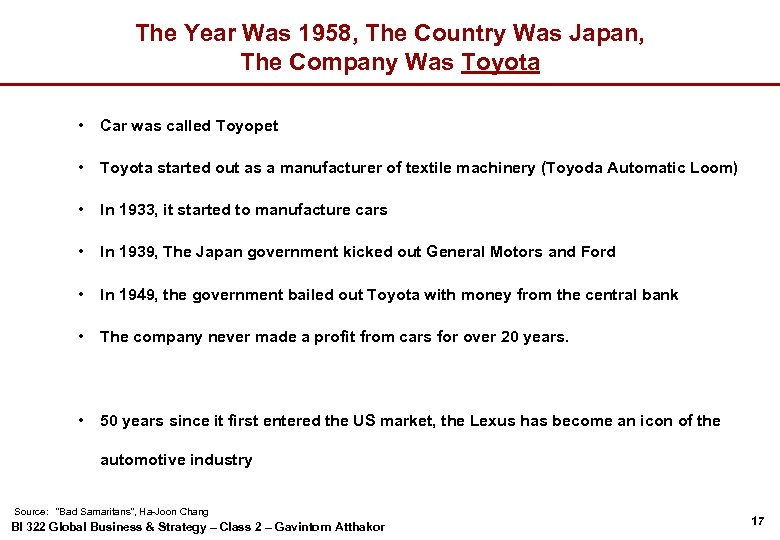
The Year Was 1958, The Country Was Japan, The Company Was Toyota • Car was called Toyopet • Toyota started out as a manufacturer of textile machinery (Toyoda Automatic Loom) • In 1933, it started to manufacture cars • In 1939, The Japan government kicked out General Motors and Ford • In 1949, the government bailed out Toyota with money from the central bank • The company never made a profit from cars for over 20 years. • 50 years since it first entered the US market, the Lexus has become an icon of the automotive industry Source: “Bad Samaritans”, Ha-Joon Chang BI 322 Global Business & Strategy – Class 2 – Gavintorn Atthakor 17
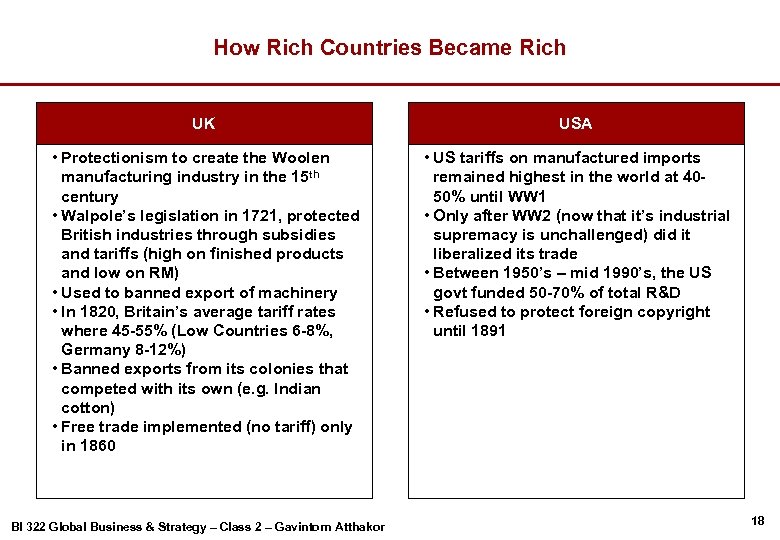
How Rich Countries Became Rich UK USA • Protectionism to create the Woolen manufacturing industry in the 15 th century • Walpole’s legislation in 1721, protected British industries through subsidies and tariffs (high on finished products and low on RM) • Used to banned export of machinery • In 1820, Britain’s average tariff rates where 45 -55% (Low Countries 6 -8%, Germany 8 -12%) • Banned exports from its colonies that competed with its own (e. g. Indian cotton) • Free trade implemented (no tariff) only in 1860 • US tariffs on manufactured imports remained highest in the world at 4050% until WW 1 • Only after WW 2 (now that it’s industrial supremacy is unchallenged) did it liberalized its trade • Between 1950’s – mid 1990’s, the US govt funded 50 -70% of total R&D • Refused to protect foreign copyright until 1891 BI 322 Global Business & Strategy – Class 2 – Gavintorn Atthakor 18
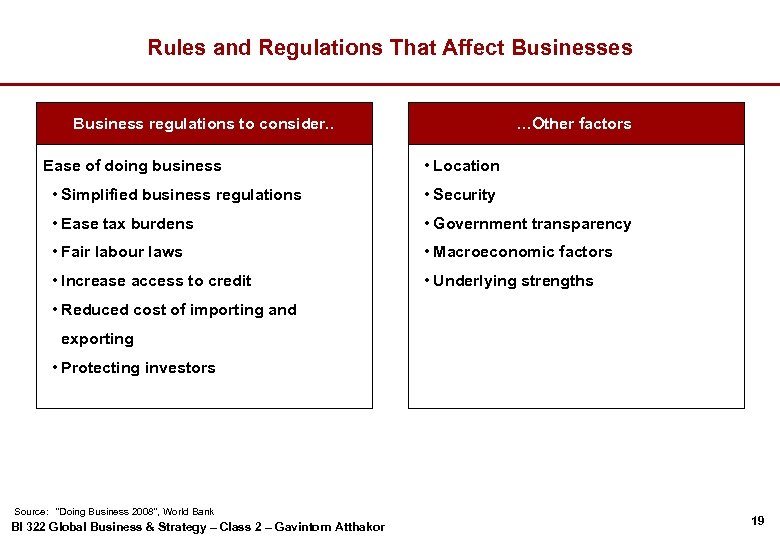
Rules and Regulations That Affect Businesses Business regulations to consider. . Ease of doing business …Other factors • Location • Simplified business regulations • Security • Ease tax burdens • Government transparency • Fair labour laws • Macroeconomic factors • Increase access to credit • Underlying strengths • Reduced cost of importing and exporting • Protecting investors Source: “Doing Business 2008”, World Bank BI 322 Global Business & Strategy – Class 2 – Gavintorn Atthakor 19
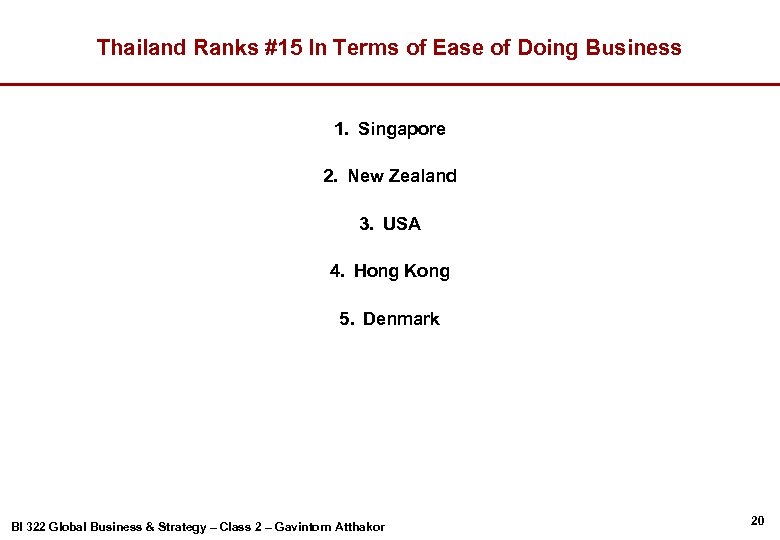
Thailand Ranks #15 In Terms of Ease of Doing Business 1. Singapore 2. New Zealand 3. USA 4. Hong Kong 5. Denmark BI 322 Global Business & Strategy – Class 2 – Gavintorn Atthakor 20
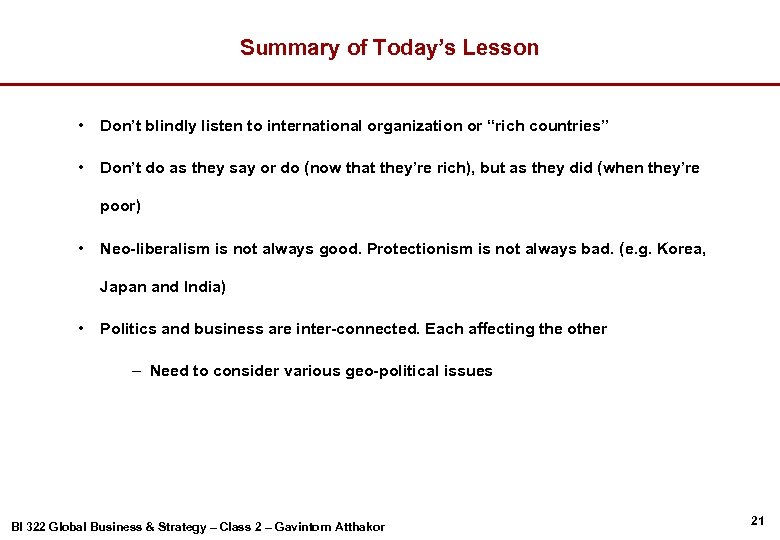
Summary of Today’s Lesson • Don’t blindly listen to international organization or “rich countries” • Don’t do as they say or do (now that they’re rich), but as they did (when they’re poor) • Neo-liberalism is not always good. Protectionism is not always bad. (e. g. Korea, Japan and India) • Politics and business are inter-connected. Each affecting the other – Need to consider various geo-political issues BI 322 Global Business & Strategy – Class 2 – Gavintorn Atthakor 21
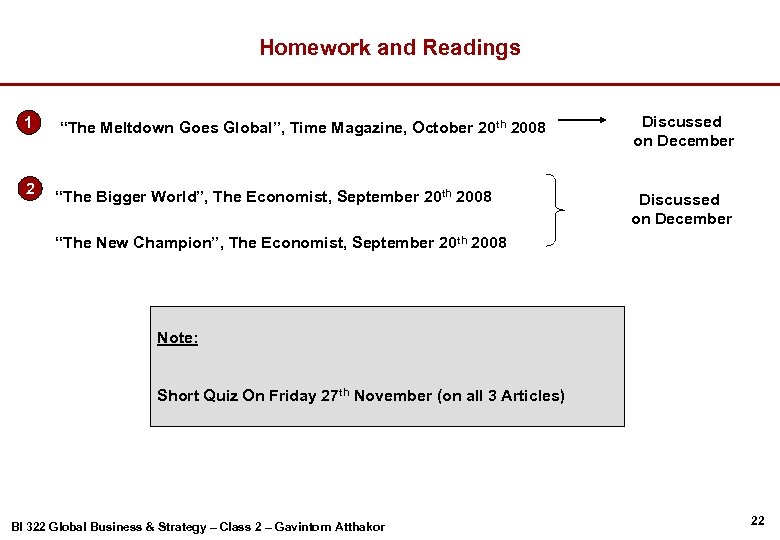
Homework and Readings 1 “The Meltdown Goes Global”, Time Magazine, October 20 th 2008 Discussed on December 2 “The Bigger World”, The Economist, September 20 th 2008 Discussed on December “The New Champion”, The Economist, September 20 th 2008 Note: Short Quiz On Friday 27 th November (on all 3 Articles) BI 322 Global Business & Strategy – Class 2 – Gavintorn Atthakor 22
Скачать презентацию Integrated Bachelor s and Master s Degree Program In Accounting
55623a70d2306afa19d3c4081186a4c6.ppt