


 Скачать презентацию Integrated Approach to Nuclear Security and Safeguards Dr
9d5a35d663b01035fa01708874d6b51f.ppt
- Количество слайдов: 47
 Integrated Approach to Nuclear Security and Safeguards Dr. Sukesh Aghara Director, Integrated Nuclear Security and Safeguards University of Massachusetts Lowell
 Prof. Sukesh Aghara – UMass - Lowell Ph. D. Nuclear Engineering - University of Texas, Austin, 2003 Associate Professor, Nuclear Engineering Experience • 2014 – p: Director, Integrated Nuclear Security and Safeguards Laboratory (INSSL) • 2013 – p: Director, Nuclear Energy Education Training (NEET) • 2010 – 12: Director, NSF Center for Energy and Environmental Sustainability (CEES) • 2007 – 09: NASA Administrator’s Fellow, Langley Research Center • 2004 – 12: Associate Professor, Texas A&M University, Prairie View Teaching & Training Web: www. uml. edu/inssl Radiation transport, Radiation Shielding, Nuclear Fuel Cycles, Email: sukesh_aghara@uml. edu Nuclear Energy Policy, Nuclear Security Ph: 978 -934 -3115 Research Nuclear analytical techniques, Nuclear Non-proliferation and Safeguards, Space Radiation Prof. S. K. Aghara
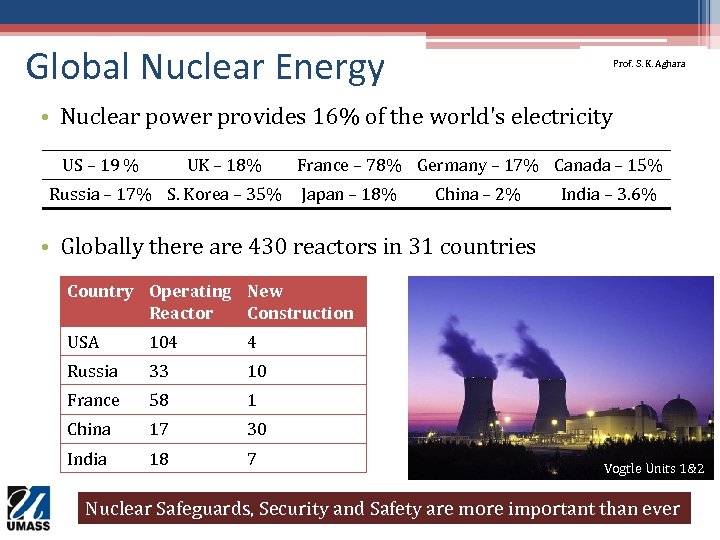 Global Nuclear Energy Prof. S. K. Aghara • Nuclear power provides 16% of the world's electricity US – 19 % UK – 18% Russia – 17% S. Korea – 35% France – 78% Germany – 17% Canada – 15% Japan – 18% China – 2% India – 3. 6% • Globally there are 430 reactors in 31 countries Country Operating New Reactor Construction USA 104 4 Russia 33 10 France 58 1 China 17 30 India 18 7 Vogtle Units 1&2 Source: World Nuclear Association Nuclear Safeguards, Security and Safety are more important than ever
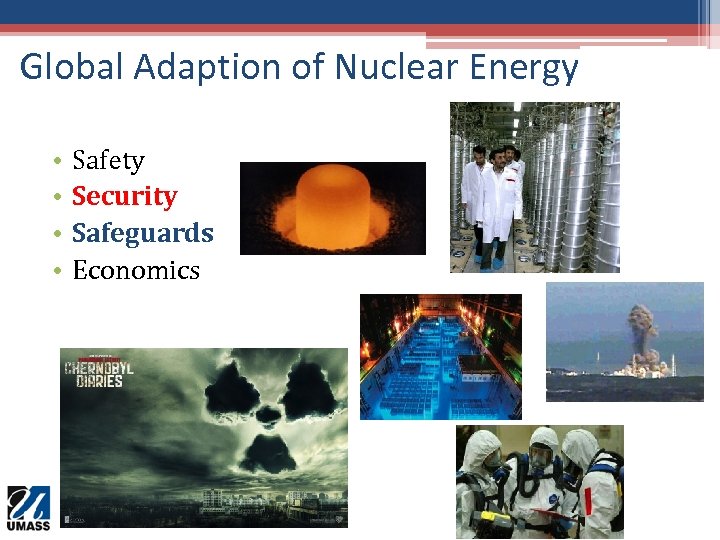 Global Adaption of Nuclear Energy • • Safety Security Safeguards Economics
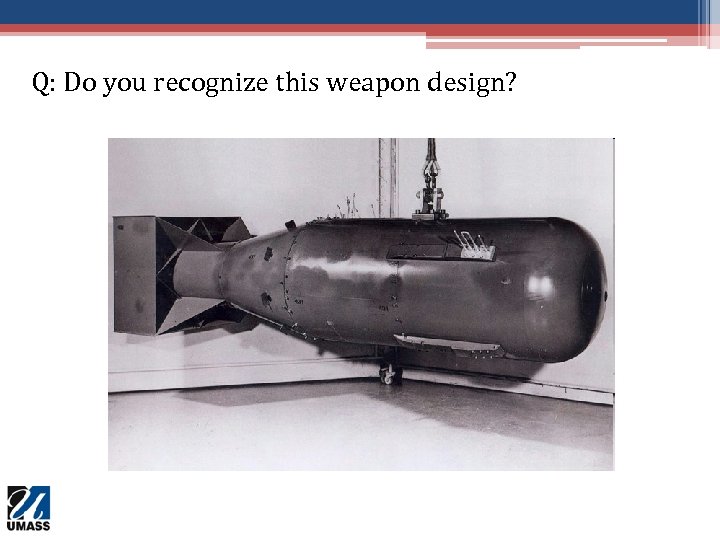 Q: Do you recognize this weapon design?
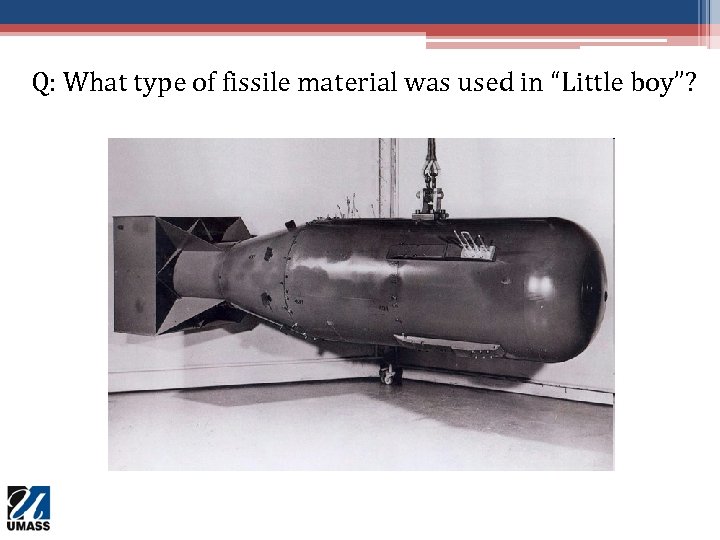 Q: What type of fissile material was used in “Little boy”?
 Safeguards objective ▫ Provide the international community with credible assurances about the exclusively peaceful use of nuclear material and facilities, through objective and independent verification that States are honouring their safeguards obligations.
 IAEA Safeguards - Milestones • 1950 s-1960 s: as nations started to trade in nuclear plants and fuel the IAEA safeguards system was established to ensure that this did not lead to the spread of nuclear weapons ▫ INFCIRC/66 • 1968 -1991: following the signing of the NPT, the IAEA was tasked to apply safeguards on all the nuclear material in the non-nuclear weapons states (NNWS) ▫ INFCIRC/153 • 1991 -present: came about due to the clandestine nuclear weapon program in Iraq, problems in applying safeguards in the DPRK, and the experience gained in verifying the denuclearization of South Africa. Additional Protocol (AP) was first adopted in 1997 ▫ INFCIRC/540 Prof. S. K. Aghara
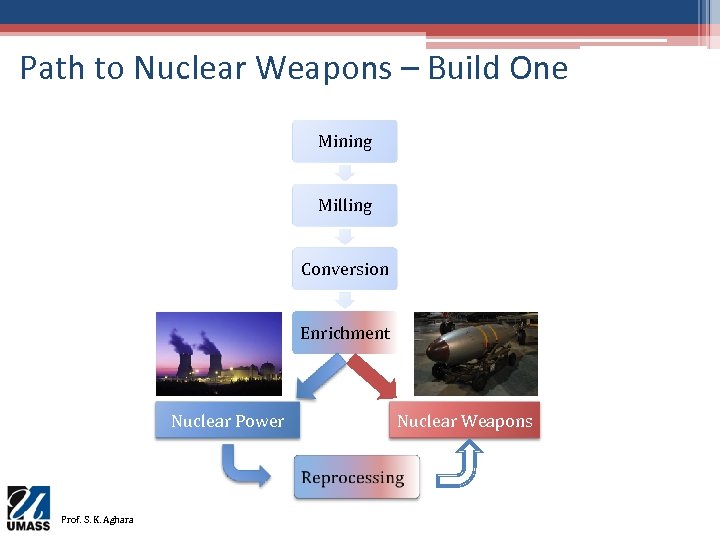 Path to Nuclear Weapons – Build One Mining Milling Conversion Enrichment Nuclear Power Prof. S. K. Aghara Nuclear Weapons
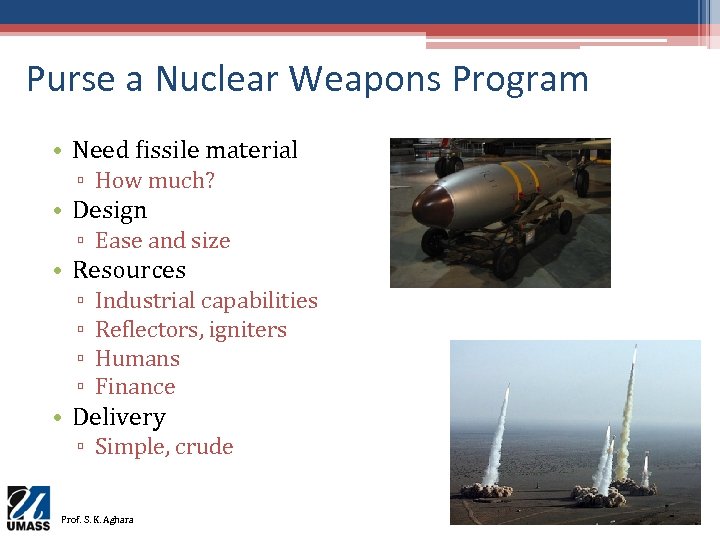 Purse a Nuclear Weapons Program • Need fissile material ▫ How much? • Design ▫ Ease and size • Resources ▫ ▫ Industrial capabilities Reflectors, igniters Humans Finance • Delivery ▫ Simple, crude Prof. S. K. Aghara
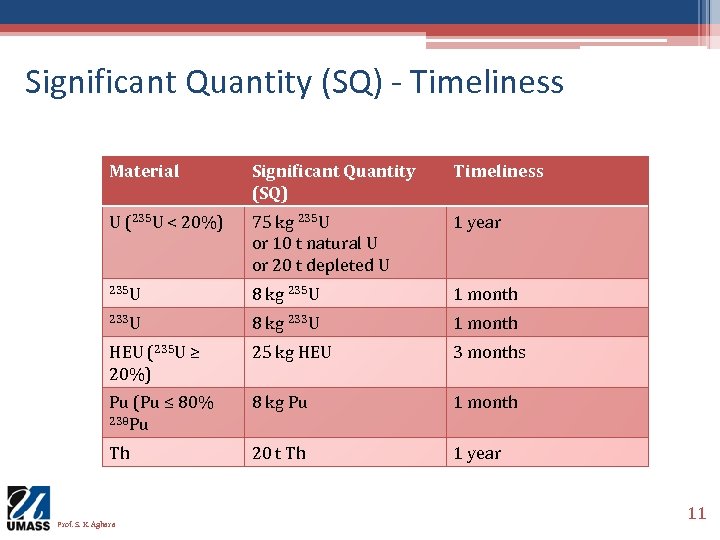 Significant Quantity (SQ) - Timeliness Material Significant Quantity (SQ) Timeliness U (235 U < 20%) 75 kg 235 U or 10 t natural U or 20 t depleted U 1 year 235 U 8 kg 235 U 1 month 233 U 8 kg 233 U 1 month HEU (235 U ≥ 20%) 25 kg HEU 3 months Pu (Pu ≤ 80% 238 Pu 8 kg Pu 1 month Th 20 t Th 1 year Prof. S. K. Aghara 11
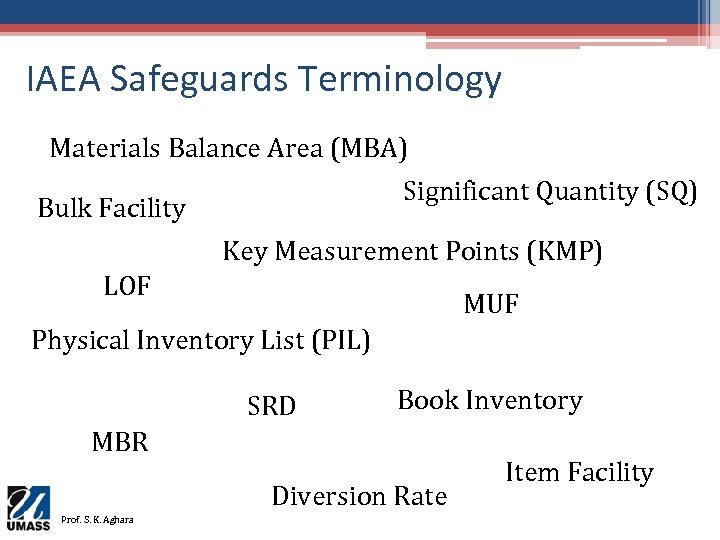 IAEA Safeguards Terminology Materials Balance Area (MBA) Significant Quantity (SQ) Bulk Facility Key Measurement Points (KMP) LOF MUF Physical Inventory List (PIL) SRD Book Inventory MBR Diversion Rate Prof. S. K. Aghara Item Facility
 State Level Motivations • International security • Regional Issues • Lack of confidence on International Security • Prestige/Hegemony Prof. S. K. Aghara 13
 Safeguards Regime • As early as 1960’s there was some concern about small groups pursing nuclear weapons ▫ Lawrence Livermore Laboratory conducted an elaborate controlled experiment in 1964 where 3 Ph. D nuclear physicists were randomly picked and were asked to design a nuclear weapon 28 months later they presented a design that was confirmed by the LLNL scientists that it would work!! Never became a serious concern for the Safeguards Regime, Why? Prof. S. K. Aghara
 Safeguards Regime • Building a nuclear bomb would require a team of specialists with knowledge of physics, the properties of nuclear material, metallurgy, and explosives • And the team would need some special equipment • The undertaking would be dangerous • The outcome would be uncertain Too costly, not achievable – This has been a true assumption so far Prof. S. K. Aghara
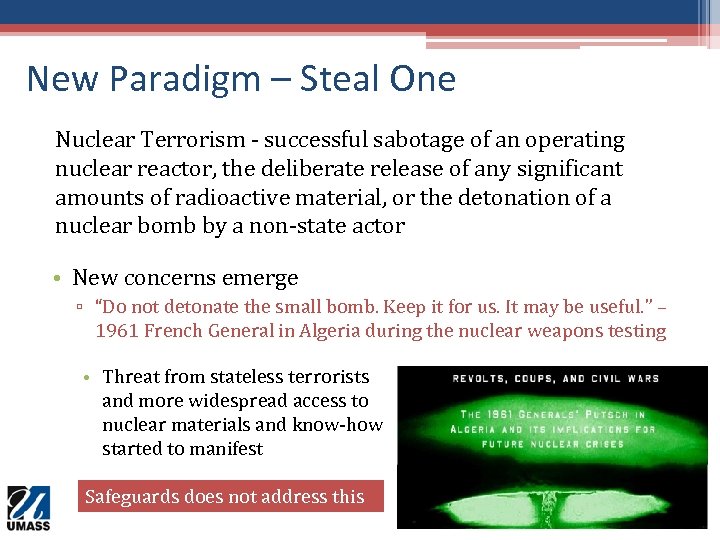 New Paradigm – Steal One Nuclear Terrorism - successful sabotage of an operating nuclear reactor, the deliberate release of any significant amounts of radioactive material, or the detonation of a nuclear bomb by a non-state actor • New concerns emerge ▫ “Do not detonate the small bomb. Keep it for us. It may be useful. ” – 1961 French General in Algeria during the nuclear weapons testing • Threat from stateless terrorists and more widespread access to nuclear materials and know-how started to manifest Safeguards does not address this
 Threat – Nuclear Terrorism • The twentieth-century nuclear stalemate is turning into the twenty-first – century era of nuclear terrorism, failed states, sophisticating terrorist networks ▫ Huge inventory of nuclear warheads and new nuclear weapons state ~70, 000 (1990’s) to ~22, 000 (2012) 90% percent are US and Russian India and Pakistan (1998) confirm their possession of nuclear weapons North Korea (2006) conducted a successful nuclear weapons test A 58 percent increase (since 2010) in the number of jihadist groups, a doubling of jihadist fighters and a tripling of attacks by al Qaeda affiliates – RAND study 2014 Prof. S. K. Aghara
 Will Terrorists Go Nuclear? – Brian Jenkins • Nuclear terrorism is about a serious threat — the possibility that terrorists might somehow obtain and detonate a nuclear weapon • Nuclear terror is about the anticipation of that event. • Nuclear terrorism is about terrorists' capabilities, while nuclear terror is about imagination. New Paradigm – Political Science ”A campaign of terror might even yield what an act of terrorism could not” Prof. S. K. Aghara
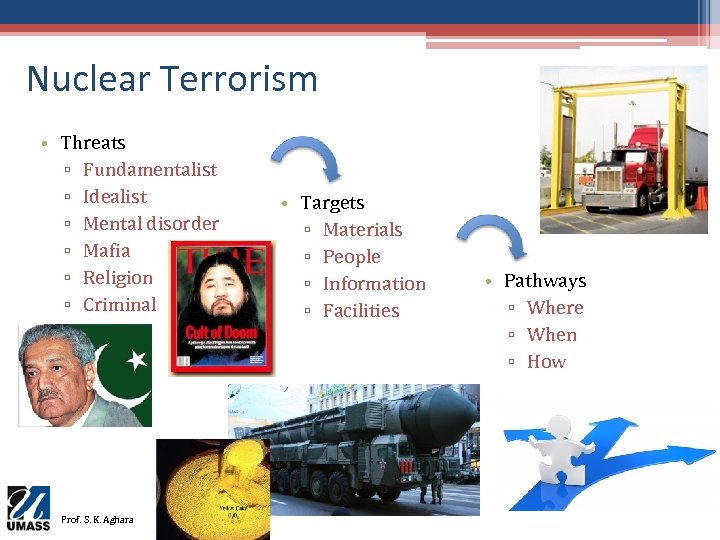 Nuclear Terrorism • Threats ▫ Fundamentalist ▫ Idealist ▫ Mental disorder ▫ Mafia ▫ Religion ▫ Criminal Prof. S. K. Aghara • Targets ▫ Materials ▫ People ▫ Information ▫ Facilities • Pathways ▫ Where ▫ When ▫ How
 Safeguards to Security • From 1950 – 1990: proliferation of nuclear weapons and technology ▫ IAEA, Nuclear Safeguards, NPT • From 1990 – 2001: illicit trafficking of nuclear weapons and material from ▫ Nunn–Lugar Act or Cooperative Threat Reduction (CTR) program ▫ Focused on Former Soviet Union (FSU) countries • Present: Nuclear terrorism from sophisticated non-state actors ▫ Global Threat Reduction Initiatives (GTRI), Nuclear Security Summit ▫ Comprehensive needs (safeguard and secure) ü Terrorist capabilities, motivations, and opportunities have changed Prof. S. K. Aghara
 Safeguards to Security • Change in the makeup of Non-State groups since the 1990’s ▫ Sustained motivations to cause devastating mass destruction (organized) ▫ Significant resources: financial, material, and trained (resourced) ▫ Permissive sanctuary for operations (networked) • Opportunities to acquire nuclear weapons components and capabilities more pervasive ▫ Security of Russian weapon storage facilities imperfect ▫ Large global inventory of nuclear material ▫ Nontraditional weapon designs and material
 Nuclear Security Threat Assessment: “Over a hundred incidents of thefts and other unauthorized activities involving nuclear and radioactive material are reported to the [IAEA] every year. ” —Director General Yukiya Amano of the International Atomic Energy Agency Prof. S. K. Aghara
 Nuclear Security Incidents • NTI reports 1000 s of nuclear smuggling incidents (~20 involving HEU or Pu) over past 20 yrs. ▫ Many more cases likely unreported or undetected • Effective policy requires understanding the causes of lapses in security that, under different circumstances, could have been catastrophic: Y-12 (U. S. ) security breach (2012) Pelindaba (South Africa) break-in (2007) Kurchatov Institute (Russia) accounting problem (2001) Project Sapphire – 600 kgs of 90% percent U-235 (1998) Aum Shinrikyo – religious cult, solicitation for nuclear weapons and materials, Chemical Weapon (1995) ▫ A. Q. Khan network – Al Qaeda and Iran; Proliferation and Illicit Trafficking (1990 – 2001) ▫ ▫ ▫ Prof. S. K. Aghara
 Identify Insider Theft • Uranium Enrichment Facility ▫ Individual earned a Ph. D in a foreign country and gained a secret clearance ▫ Often seen in sensitive work areas taking notes and collecting items ▫ Fellow employee saw secret documents in his home ▫ Suspicious managers move employee to less-sensitive position ▫ Eventually family to home country for a vacation and never returns ▫ Continued to ask employees for additional sensitive information from home country Prof. S. K. Aghara
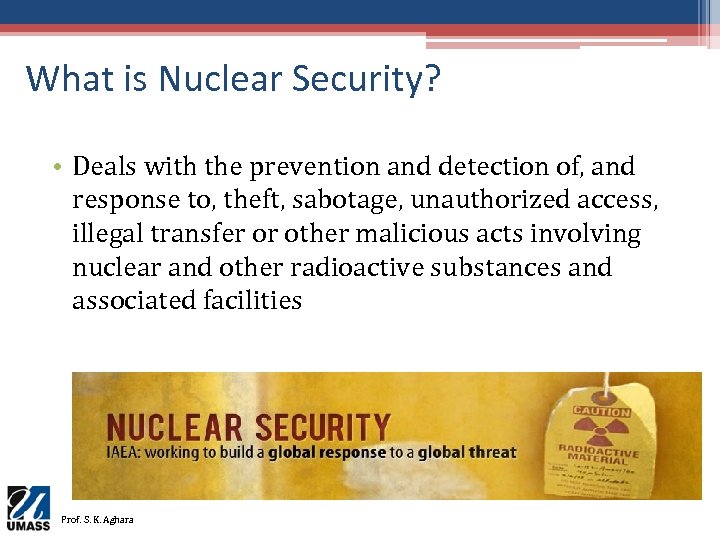 What is Nuclear Security? • Deals with the prevention and detection of, and response to, theft, sabotage, unauthorized access, illegal transfer or other malicious acts involving nuclear and other radioactive substances and associated facilities Prof. S. K. Aghara
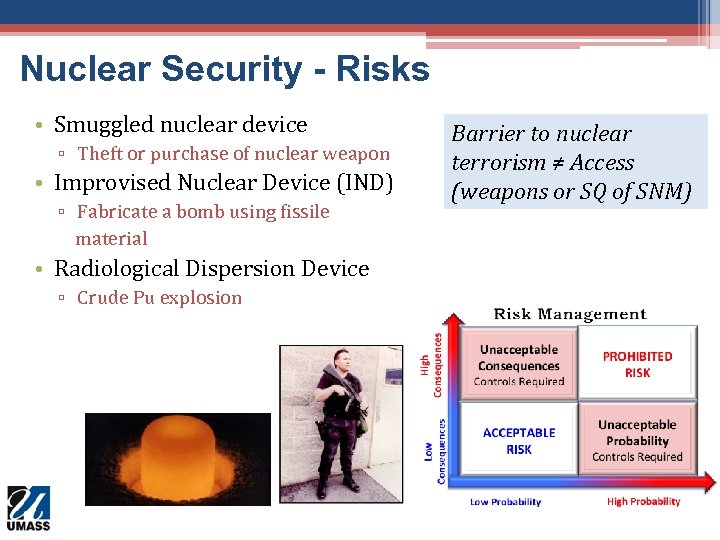 Nuclear Security - Risks • Smuggled nuclear device ▫ Theft or purchase of nuclear weapon • Improvised Nuclear Device (IND) ▫ Fabricate a bomb using fissile material • Radiological Dispersion Device ▫ Crude Pu explosion Barrier to nuclear terrorism ≠ Access (weapons or SQ of SNM)
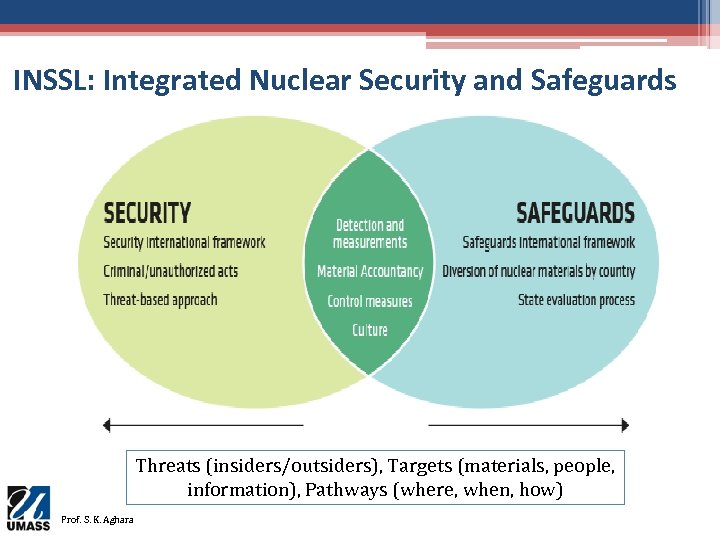 INSSL: Integrated Nuclear Security and Safeguards Threats (insiders/outsiders), Targets (materials, people, information), Pathways (where, when, how) Prof. S. K. Aghara
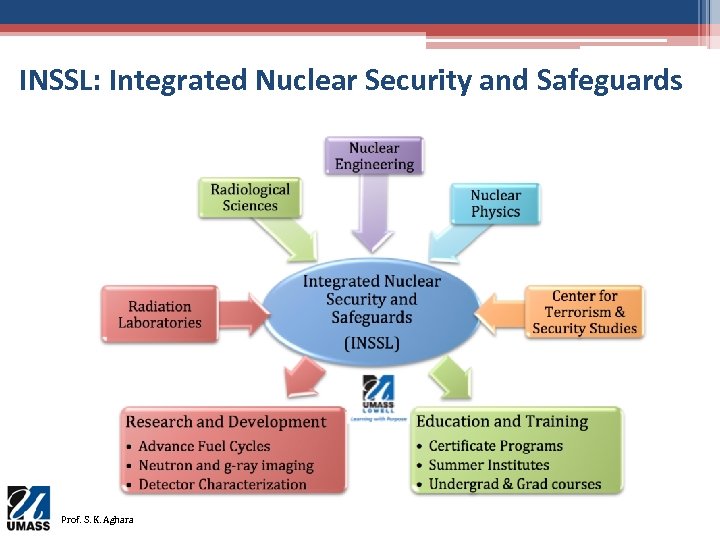 INSSL: Integrated Nuclear Security and Safeguards Prof. S. K. Aghara
 Exercise 1 - Identify, Evaluate, Understand Prof. S. K. Aghara
 Exercise 1 - Identify, Evaluate, Understand • Scenario: A shipment of nuclear warheads are loaded in a train and are being transported • Blue Team – Goal is to transport the war heads safely. • Red Team – Goal is to acquire nuclear war heads for nefarious purposes. • Anchor your discussions within your teams on: Critical elements of security Vulnerabilities in security What are the potential threats Pathways to avoid these threats Prof. S. K. Aghara
 Exercise 1 - Discussions • Observations ▫ Guards and gates ▫ Layered approach ▫ Sealed cargo - password protected • Issues ▫ ▫ ▫ Large cargo Two person rule absent Central control All the guards in one car Too many people involved at a large weapons complex Prof. S. K. Aghara
 IAEA Nuclear Security Framework • There is no single international instrument that addresses nuclear security in a comprehensive manner • Legal foundation for nuclear security comprises of international instruments and recognized principles designed to control nuclear material and other radioactive substances • Advance science and technology for interdiction and forensics Prof. S. K. Aghara
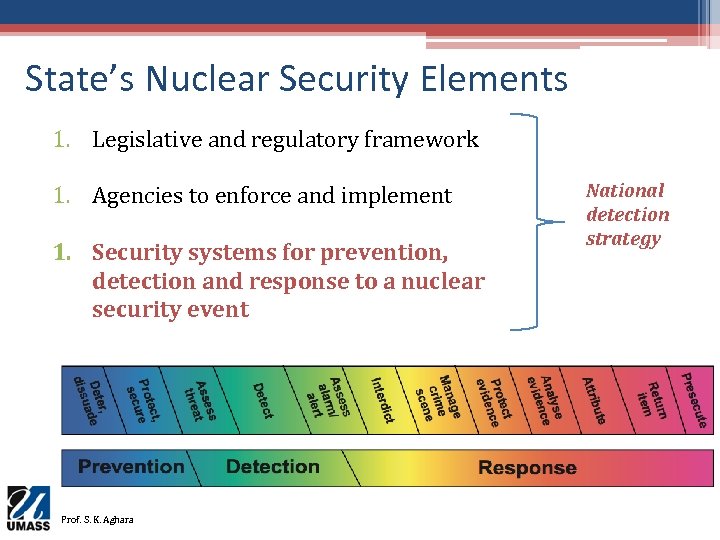 State’s Nuclear Security Elements 1. Legislative and regulatory framework 1. Agencies to enforce and implement 1. Security systems for prevention, detection and response to a nuclear security event Prof. S. K. Aghara National detection strategy
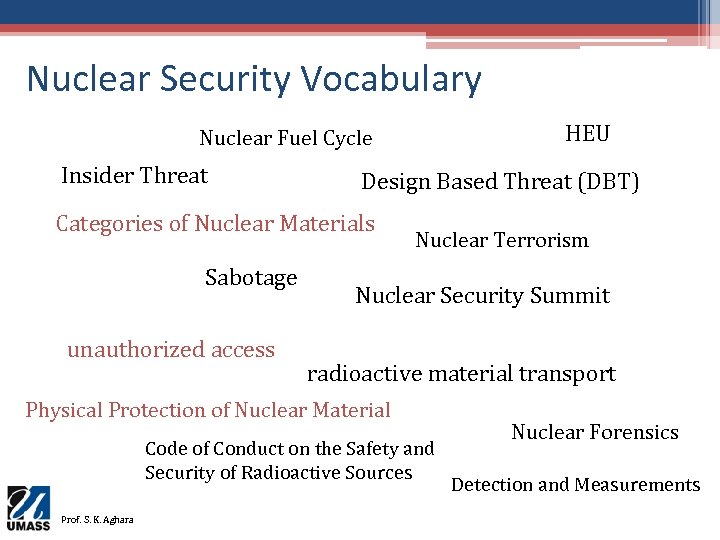 Nuclear Security Vocabulary HEU Nuclear Fuel Cycle Insider Threat Design Based Threat (DBT) Categories of Nuclear Materials Sabotage unauthorized access Nuclear Terrorism Nuclear Security Summit radioactive material transport Physical Protection of Nuclear Material Code of Conduct on the Safety and Security of Radioactive Sources Prof. S. K. Aghara Nuclear Forensics Detection and Measurements
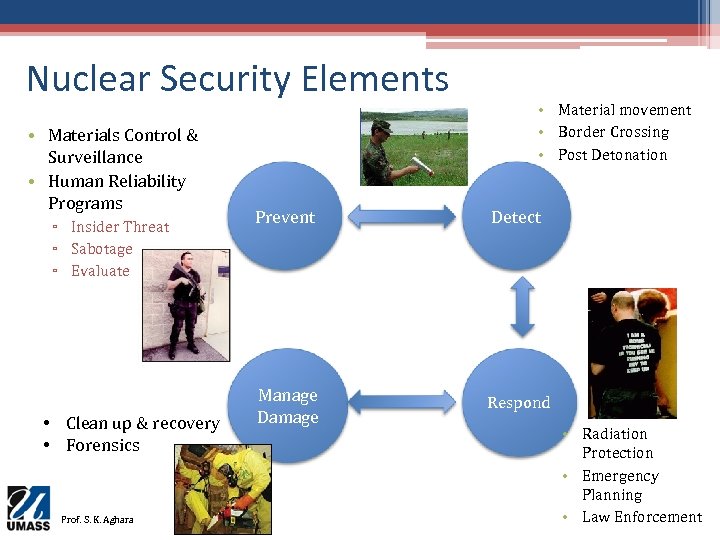 Nuclear Security Elements • Materials Control & Surveillance • Human Reliability Programs ▫ Insider Threat ▫ Sabotage ▫ Evaluate • Clean up & recovery • Forensics Prof. S. K. Aghara • Material movement • Border Crossing • Post Detonation Prevent Detect Manage Damage Respond • Radiation Protection • Emergency Planning • Law Enforcement
 Exercise 2
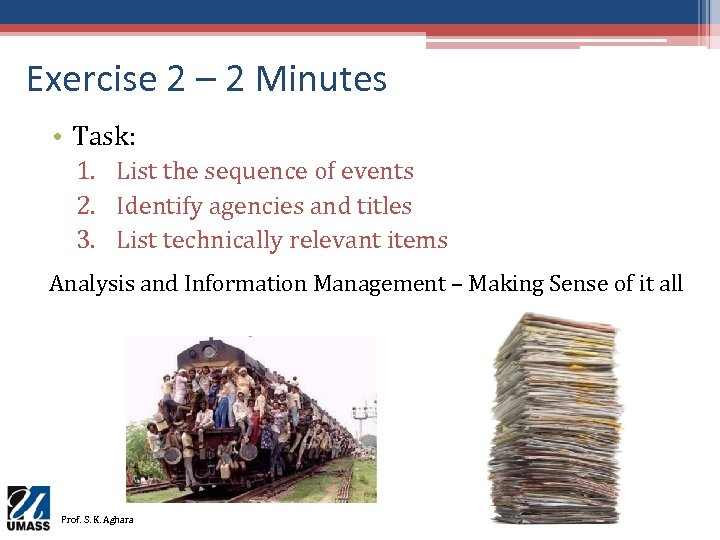 Exercise 2 – 2 Minutes • Task: 1. List the sequence of events 2. Identify agencies and titles 3. List technically relevant items Analysis and Information Management – Making Sense of it all Prof. S. K. Aghara
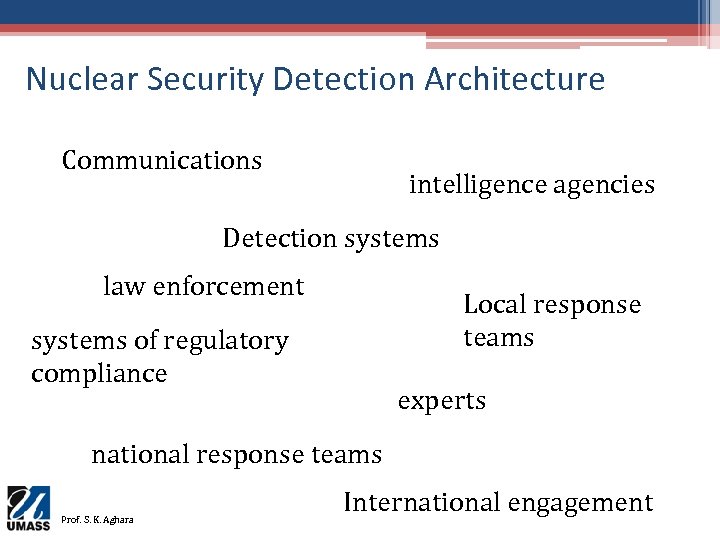 Nuclear Security Detection Architecture Communications intelligence agencies Detection systems law enforcement Local response teams systems of regulatory compliance experts national response teams Prof. S. K. Aghara International engagement
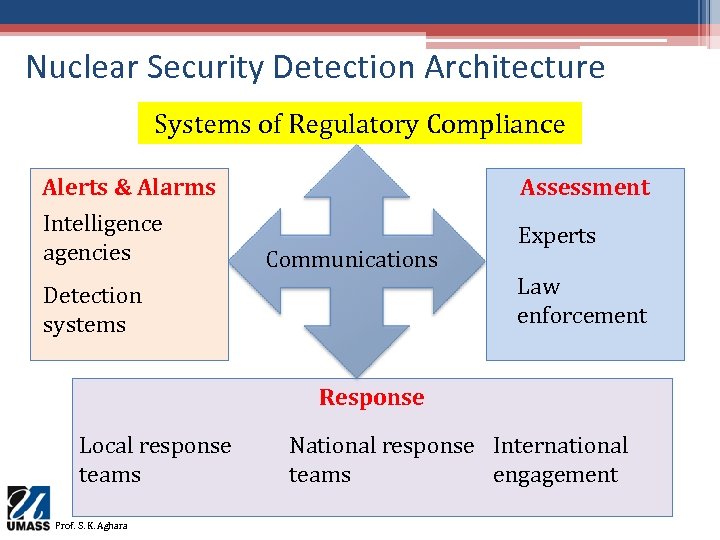 Nuclear Security Detection Architecture Systems of Regulatory Compliance Alerts & Alarms Intelligence agencies Assessment Communications Detection systems Experts Law enforcement Response Local response teams Prof. S. K. Aghara National response International teams engagement
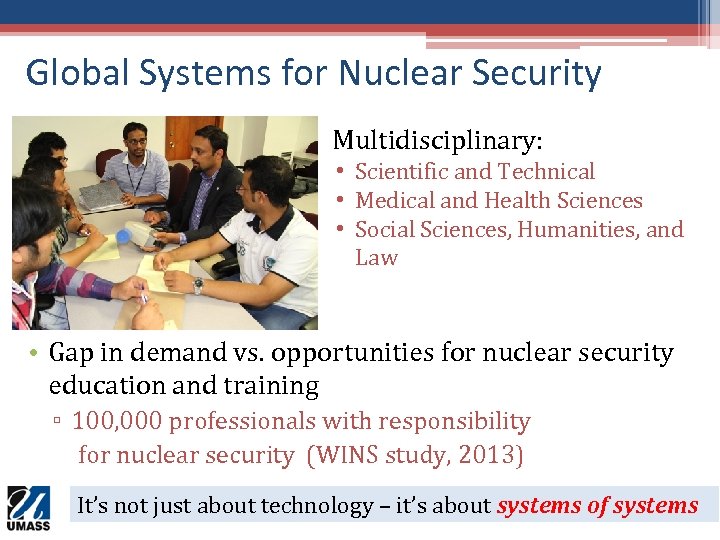 Global Systems for Nuclear Security Multidisciplinary: • Scientific and Technical • Medical and Health Sciences • Social Sciences, Humanities, and Law • Gap in demand vs. opportunities for nuclear security education and training ▫ 100, 000 professionals with responsibility for nuclear security (WINS study, 2013) It’s not just about technology – it’s about systems of systems
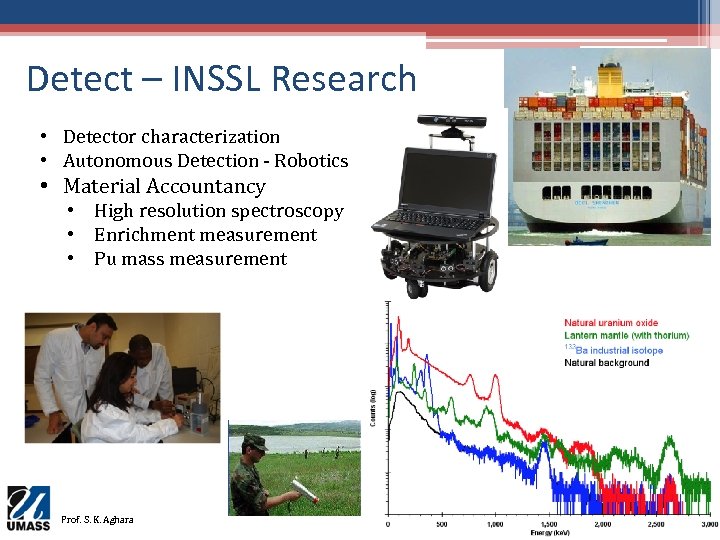 Detect – INSSL Research • Detector characterization • Autonomous Detection - Robotics • Material Accountancy • High resolution spectroscopy • Enrichment measurement • Pu mass measurement Prof. S. K. Aghara
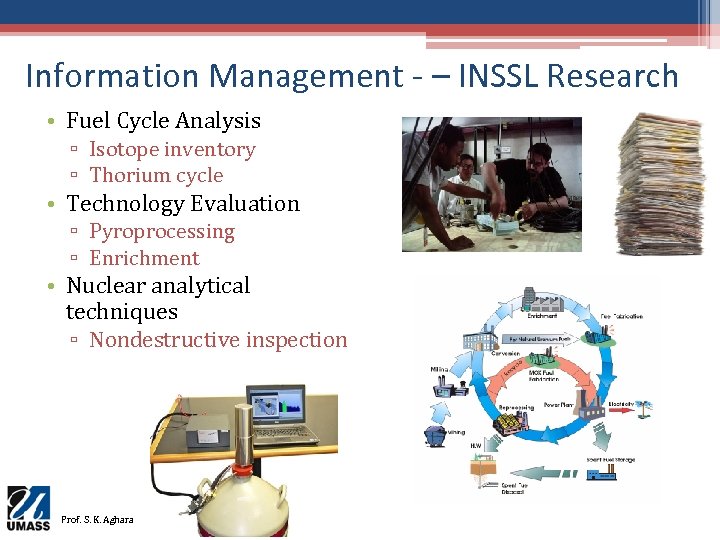 Information Management - – INSSL Research • Fuel Cycle Analysis ▫ Isotope inventory ▫ Thorium cycle • Technology Evaluation ▫ Pyroprocessing ▫ Enrichment • Nuclear analytical techniques ▫ Nondestructive inspection Prof. S. K. Aghara
 Education & Training – INSSL Activities • Education • • • Fundaments of Nuclear Security and Safeguards Weapons of Mass Destruction Nuclear Fuel Cycle Threat Assessment and Risk Management Nuclear Instrumentation Safeguards Approaches and Verification Techniques • Training • • Workshops Certificate programs Summer programs Professional Development Courses (PDC) Prof. S. K. Aghara
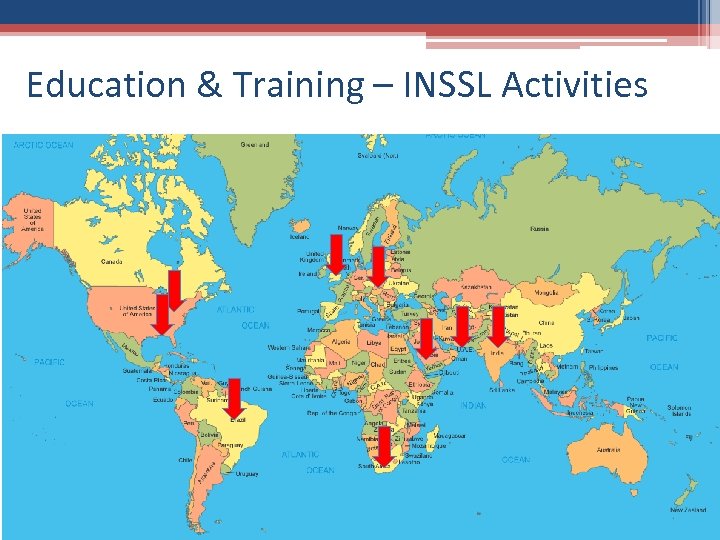 Education & Training – INSSL Activities
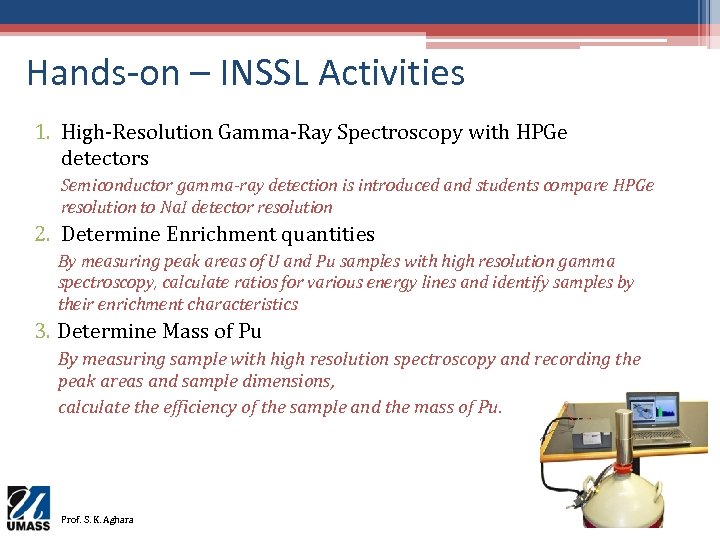 Hands-on – INSSL Activities 1. High-Resolution Gamma-Ray Spectroscopy with HPGe detectors Semiconductor gamma-ray detection is introduced and students compare HPGe resolution to Na. I detector resolution 2. Determine Enrichment quantities By measuring peak areas of U and Pu samples with high resolution gamma spectroscopy, calculate ratios for various energy lines and identify samples by their enrichment characteristics 3. Determine Mass of Pu By measuring sample with high resolution spectroscopy and recording the peak areas and sample dimensions, calculate the efficiency of the sample and the mass of Pu. Prof. S. K. Aghara
 Take Away • There is a growing demand for employees with nuclear security training and education ▫ Limited scope for a dedicated programs • Cross-disciplinary programs designed with international prospective are vital for developing a global nuclear security community Prof. S. K. Aghara
 Questions? Prof. S. K. Aghara