 Скачать презентацию Integrated and Sustained Ocean Observing System IOOS Chris
b6fbfe53226deb65923f7f9d001903f5.ppt
- Количество слайдов: 17



Integrated and Sustained Ocean Observing System (IOOS) Chris Mooers RSMAS/UM and IOOS - MAST Chair NCEP Operational Ocean Modeling WS 14/15 JAN 08
OUTLINE • IOOS introduction, especially the Modeling and Analysis Steering Team (MAST) (charge, members, general needs, and “passions”) • IOOS Regional Associations (RAs) and “operational” Regional Coastal Ocean Observing Systems (RCOOSs) • RCOOS modeling and related requirements
AN IOOS GOAL STATEMENT • Provide ocean state estimation on a continuing, robust, reliable, resilient basis to support – Marine Emergency Management – Maritime Operations – Stewardship of Marine Living and Non-Living Resources in the Presence of Natural and Anthropogenic Global Change In order to Sustain and Enhance Economic Development, Marine Ecosystems, and National Security NOTE: requires simulation, detection, prediction, attribution, and mitigation capabilities
IOOS COMPONENTS • National Backbone of Operational Observations • National Backbone of Operational Model Products • Global Ocean – – – • NCEP NAVO CPO/OAR Coastal Ocean (EEZ) • CSDL/CO-OPS • 11 Regional Associations (RAs) and their Regional Coastal Ocean Observing Systems (RCOOSs)
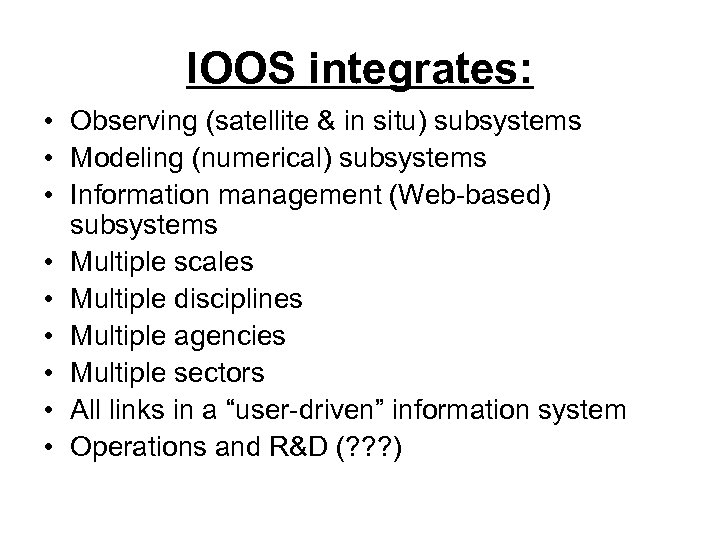
IOOS integrates: • Observing (satellite & in situ) subsystems • Modeling (numerical) subsystems • Information management (Web-based) subsystems • Multiple scales • Multiple disciplines • Multiple agencies • Multiple sectors • All links in a “user-driven” information system • Operations and R&D (? ? ? )
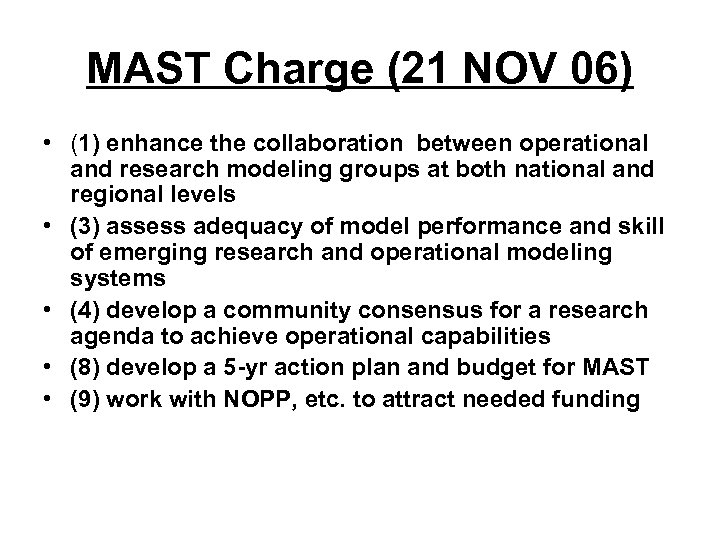
MAST Charge (21 NOV 06) • (1) enhance the collaboration between operational and research modeling groups at both national and regional levels • (3) assess adequacy of model performance and skill of emerging research and operational modeling systems • (4) develop a community consensus for a research agenda to achieve operational capabilities • (8) develop a 5 -yr action plan and budget for MAST • (9) work with NOPP, etc. to attract needed funding
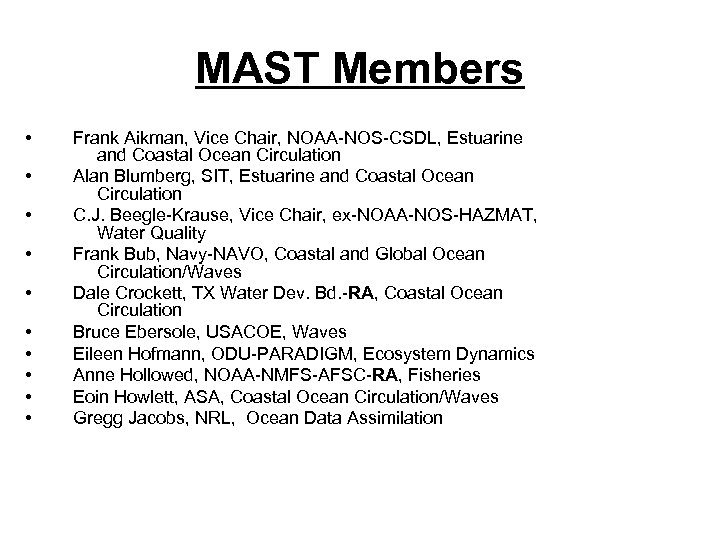
MAST Members • • • Frank Aikman, Vice Chair, NOAA-NOS-CSDL, Estuarine and Coastal Ocean Circulation Alan Blumberg, SIT, Estuarine and Coastal Ocean Circulation C. J. Beegle-Krause, Vice Chair, ex-NOAA-NOS-HAZMAT, Water Quality Frank Bub, Navy-NAVO, Coastal and Global Ocean Circulation/Waves Dale Crockett, TX Water Dev. Bd. -RA, Coastal Ocean Circulation Bruce Ebersole, USACOE, Waves Eileen Hofmann, ODU-PARADIGM, Ecosystem Dynamics Anne Hollowed, NOAA-NMFS-AFSC-RA, Fisheries Eoin Howlett, ASA, Coastal Ocean Circulation/Waves Gregg Jacobs, NRL, Ocean Data Assimilation
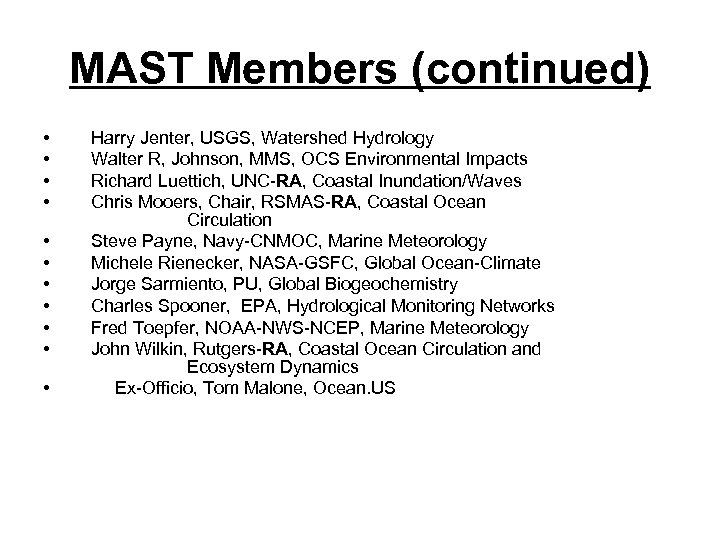
MAST Members (continued) • • • Harry Jenter, USGS, Watershed Hydrology Walter R, Johnson, MMS, OCS Environmental Impacts Richard Luettich, UNC-RA, Coastal Inundation/Waves Chris Mooers, Chair, RSMAS-RA, Coastal Ocean Circulation Steve Payne, Navy-CNMOC, Marine Meteorology Michele Rienecker, NASA-GSFC, Global Ocean-Climate Jorge Sarmiento, PU, Global Biogeochemistry Charles Spooner, EPA, Hydrological Monitoring Networks Fred Toepfer, NOAA-NWS-NCEP, Marine Meteorology John Wilkin, Rutgers-RA, Coastal Ocean Circulation and Ecosystem Dynamics Ex-Officio, Tom Malone, Ocean. US
RCOOS “operational” model types needed • for the Coastal Ocean (i. e. , semienclosed seas, continental margins, estuaries, and Great Lakes)
RCOOS model needs (continued) • • • 3 D coastal ocean (baroclinic) circulation 2 D/3 DLagrangian trajectory and dispersion 2 D/3 D storm surge/inundation Tide Surface gravity waves NPZD etc. ecosystem, fisheries, etc. Sediment transport Ice dynamics Biogeochemical, bio-optical, bio-acoustic, etc. Mesoscale atmospheric
RCOOS circulation model forcing needs • • Hi-res, accurate bottom topography Mesoscale atmospheric forcing Tidal forcing Runoff forcing (weakest now) Open boundary forcing Surface waves Typically, 1 hr temporal res. , 1 km horizontal res. , and 10 m (non-uniform) vertical res. • Experiments are needed to determine adequacy of the forcing in terms of coastal ocean response
RCOOS circulation model verification/data assimilation data needs • Sea surface temperature, winds, pressure, etc. time series (NDBC buoys and C-MAN stations) and maps (satellite IR and NWP) • Horizontal velocity vertical profiles (NDBC buoys & RCOOSs (? ? ? )) • Horizontal velocity (directional wave (? )) surface maps from coastal HF-radar (RCOOSs) • Surface (USCG and ? ? ? ) and subsurface drifters (? ? ? ) • Sea surface salinity time series and maps (? ) • Coastal sea level (tide gauges) time series • Temperature and salinity vertical profiles (gliders (RCOOSs (? ? ? )) • Sea surface height field (satellite radar altimetry (? ))
RCOOS special skill assessment needs • The quality of the velocity, temperature, and salinity open boundary conditions provided in downscaling from basin or global ocean models to the coastal ocean needs focused and sustained skill assessment • The coastal ocean is significantly externally forced but also has internal dynamics and, hence, “ocean weather” (viz. , mesoscale eddies, fronts, and meandering jets) for which there is a forecast skill challenge
RCOOS Physical Information Transfer to Ecosystem Models or Modelers • Many ecosystem applications require Lagrangian transport and dispersion estimates • Other applications require basic characterization of physical habitats (temperature, salinity, currents, and turbulence time series of maps) • However, the perceived need is for 100 m or much finer resolution = non-hydrostatic models
MAST’s “Passions” • Improve transition process from R&D to operations – Community-based for buy-in – Testbeds (sustained) – Experiments, jointly between R&D and OPS
MAST “PASSIONS” (continued) • Establish program of rigorous OSEs & OSSEs for observing system design • Establish program of re-analyses for diagnostic studies • Establish model output archival hierarchy • Establish updatable model inventory (for users of varied levels of sophistication) • Establish model skill assessment standards (based on not just statistics but also on phenomenology)
RCOOS/IOOS needs • Consistent and long-term funding • Concept-of-Operations (CONOPS): to define functions, roles and responsibilities, resource and management issues, etc. ; to identify “marine weather forecasters” (i. e. , “super users”); Etc. • Series of combined field and numerical, regional scale prediction experiments, conducted jointly between R&D and OPS personnel to quantify capability and errors in the context of application requirements • Education of needed human resources for OPS and R&D • Facilitation of rapid advances in modeling and scientific understanding by the R&D community
Скачать презентацию Integrated and Sustained Ocean Observing System IOOS Chris
b6fbfe53226deb65923f7f9d001903f5.ppt