 Скачать презентацию Intangible Capital and the Valuation of Companies A
8c8c7bb6d56d8645d0e5dff6ac69ab80.ppt
- Количество слайдов: 38



Intangible Capital and the Valuation of Companies: A Comparison of German and U. S. Corporations Charles Hulten University of Maryland, NBER & The Conference Board Janet Hao The Conference Board Kirsten Jaeger The Conference Board Project funded by the European Commission under the Seventh Framework Programme Grant No 217512 Website : www. coinvest. org. uk
Market to Book Value Puzzle The Puzzle Accounting Principle: Equity=Assets-Liabilities Theoretically: Equity=Market Value Actually: Equity<<Market value • Absence of most intangible assets from financial statements • Expenditure on intangibles produced within a firm often treated as a current expense, not as an investment in firm’s future. No output or value created. • No market transactions to measure the value of R&D and brand created within the company • Difference between stock-market value of a firm and the book value of its equity treated as “goodwill” and (more or less) loosely associated with intangibles. 2
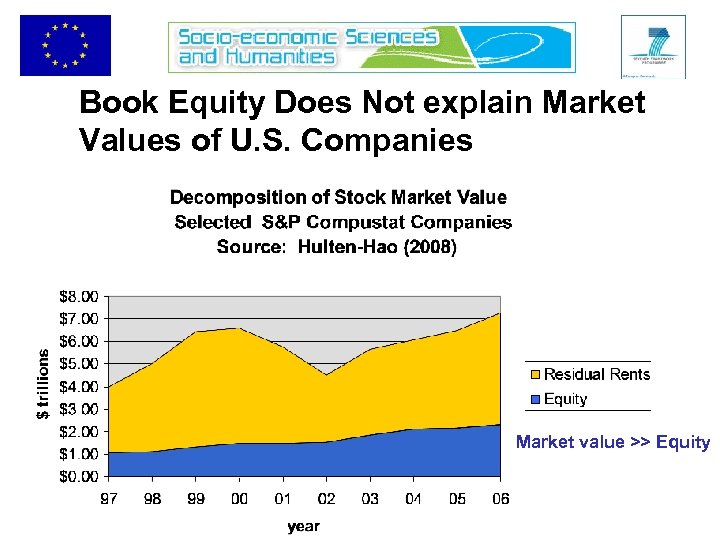
Book Equity Does Not explain Market Values of U. S. Companies Market value >> Equity
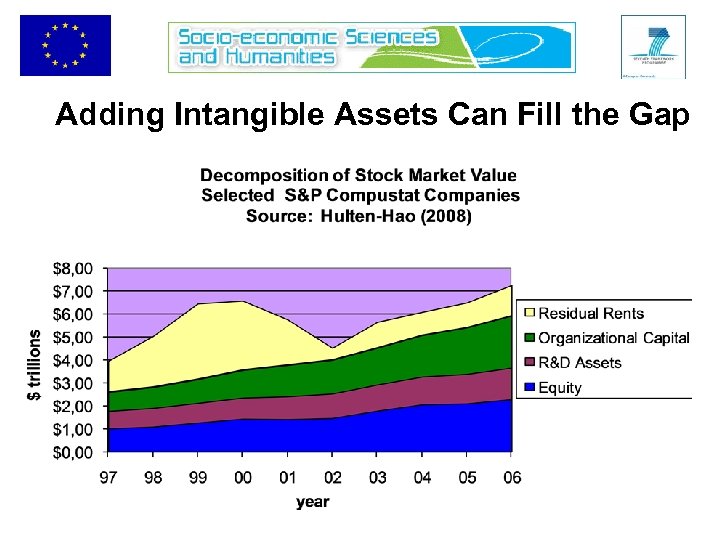
Adding Intangible Assets Can Fill the Gap
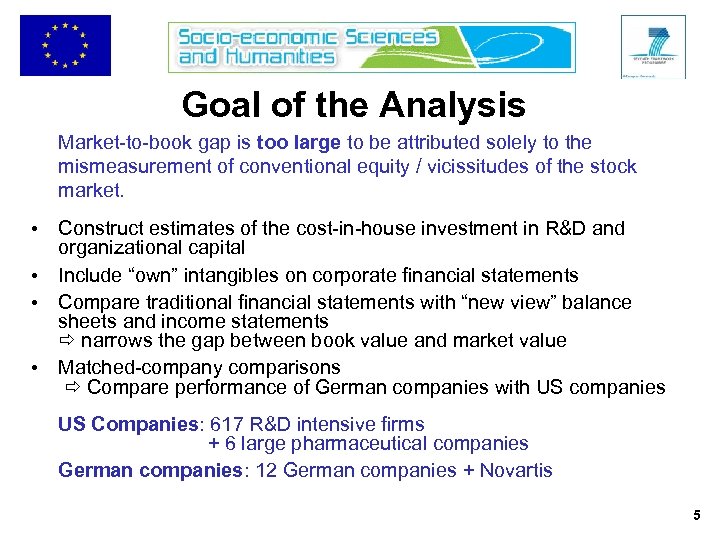
Goal of the Analysis Market-to-book gap is too large to be attributed solely to the mismeasurement of conventional equity / vicissitudes of the stock market. • Construct estimates of the cost-in-house investment in R&D and organizational capital • Include “own” intangibles on corporate financial statements • Compare traditional financial statements with “new view” balance sheets and income statements narrows the gap between book value and market value • Matched-company comparisons Compare performance of German companies with US companies US Companies: 617 R&D intensive firms + 6 large pharmaceutical companies German companies: 12 German companies + Novartis 5
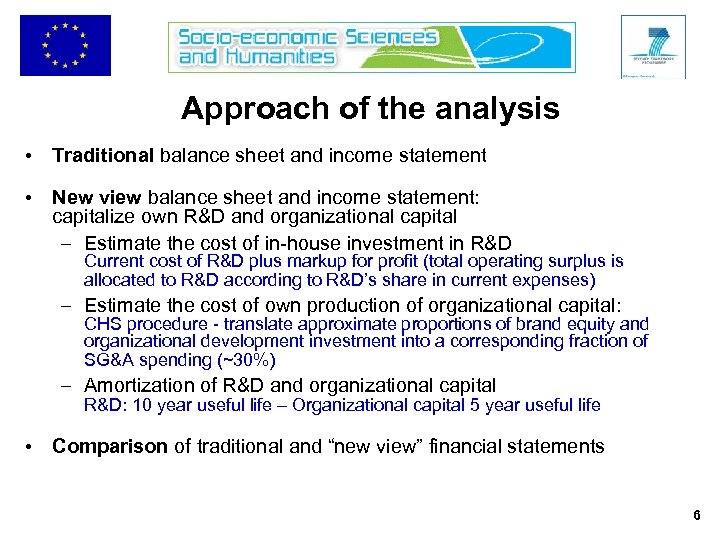
Approach of the analysis • Traditional balance sheet and income statement • New view balance sheet and income statement: capitalize own R&D and organizational capital – Estimate the cost of in-house investment in R&D Current cost of R&D plus markup for profit (total operating surplus is allocated to R&D according to R&D’s share in current expenses) – Estimate the cost of own production of organizational capital: CHS procedure - translate approximate proportions of brand equity and organizational development investment into a corresponding fraction of SG&A spending (~30%) – Amortization of R&D and organizational capital R&D: 10 year useful life – Organizational capital 5 year useful life • Comparison of traditional and “new view” financial statements 6
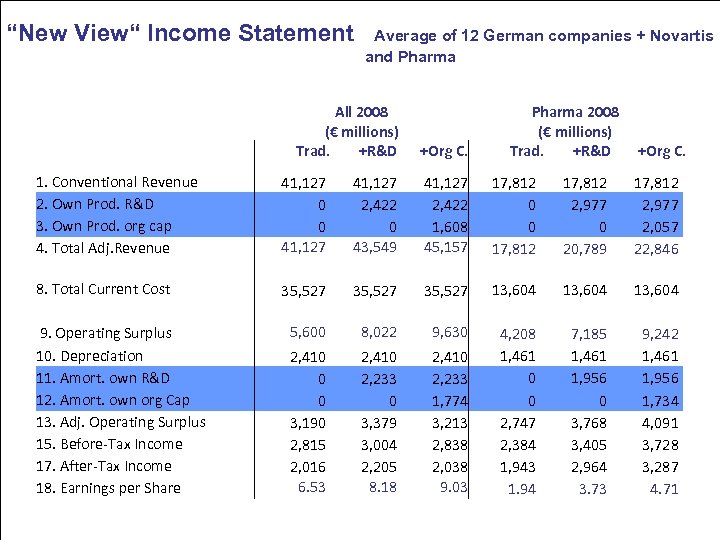
“New View“ Income Statement Average of 12 German companies + Novartis and Pharma All 2008 (€ millions) Trad. +R&D 1. Conventional Revenue 2. Own Prod. R&D 3. Own Prod. org cap 4. Total Adj. Revenue 41, 127 0 0 41, 127 2, 422 0 43, 549 +Org C. 41, 127 2, 422 1, 608 45, 157 Pharma 2008 (€ millions) Trad. +R&D +Org C. 17, 812 0 0 17, 812 2, 977 0 20, 789 8. Total Current Cost 9. Operating Surplus 10. Depreciation 11. Amort. own R&D 12. Amort. own org Cap 13. Adj. Operating Surplus 15. Before-Tax Income 17. After-Tax Income 18. Earnings per Share 17, 812 2, 977 2, 057 22, 846 35, 527 13, 604 5, 600 8, 022 9, 630 2, 410 0 0 3, 190 2, 815 2, 016 6. 53 2, 410 2, 233 0 3, 379 3, 004 2, 205 8. 18 2, 410 2, 233 1, 774 3, 213 2, 838 2, 038 9. 03 4, 208 1, 461 0 0 2, 747 2, 384 1, 943 1. 94 7, 185 1, 461 1, 956 0 3, 768 3, 405 2, 964 3. 73 9, 242 1, 461 1, 956 1, 734 4, 091 3, 728 3, 287 4. 71 7
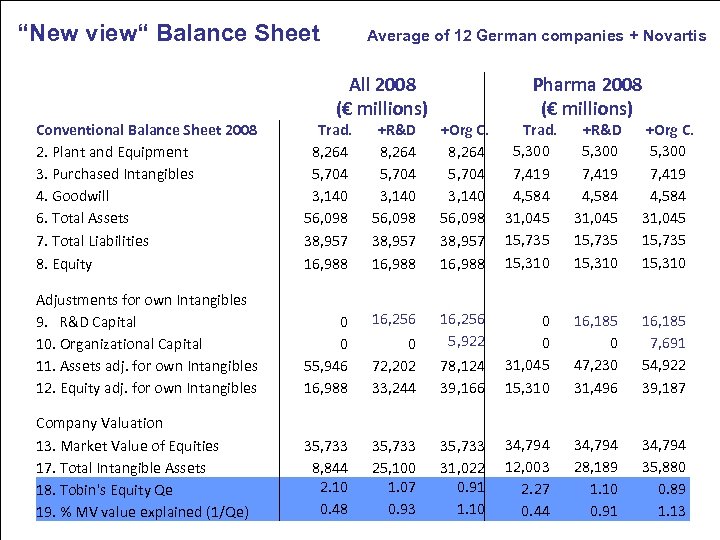
“New view“ Balance Sheet Average of 12 German companies + Novartis All 2008 (€ millions) Pharma 2008 (€ millions) Conventional Balance Sheet 2008 2. Plant and Equipment 3. Purchased Intangibles 4. Goodwill 6. Total Assets 7. Total Liabilities 8. Equity Trad. 8, 264 5, 704 3, 140 56, 098 38, 957 16, 988 +R&D 8, 264 5, 704 3, 140 56, 098 38, 957 16, 988 +Org C. 8, 264 5, 704 3, 140 56, 098 38, 957 16, 988 Trad. 5, 300 7, 419 4, 584 31, 045 15, 735 15, 310 +R&D 5, 300 7, 419 4, 584 31, 045 15, 735 15, 310 +Org C. 5, 300 7, 419 4, 584 31, 045 15, 735 15, 310 Adjustments for own Intangibles 9. R&D Capital 10. Organizational Capital 11. Assets adj. for own Intangibles 12. Equity adj. for own Intangibles 0 0 55, 946 16, 988 16, 256 5, 922 78, 124 39, 166 0 0 31, 045 15, 310 16, 185 0 47, 230 31, 496 16, 185 7, 691 54, 922 39, 187 Company Valuation 13. Market Value of Equities 17. Total Intangible Assets 18. Tobin's Equity Qe 19. % MV value explained (1/Qe) 35, 733 8, 844 2. 10 0. 48 35, 733 25, 100 1. 07 0. 93 35, 733 31, 022 0. 91 1. 10 34, 794 12, 003 2. 27 0. 44 34, 794 28, 189 1. 10 0. 91 34, 794 35, 880 0. 89 1. 13 8 0 72, 202 33, 244
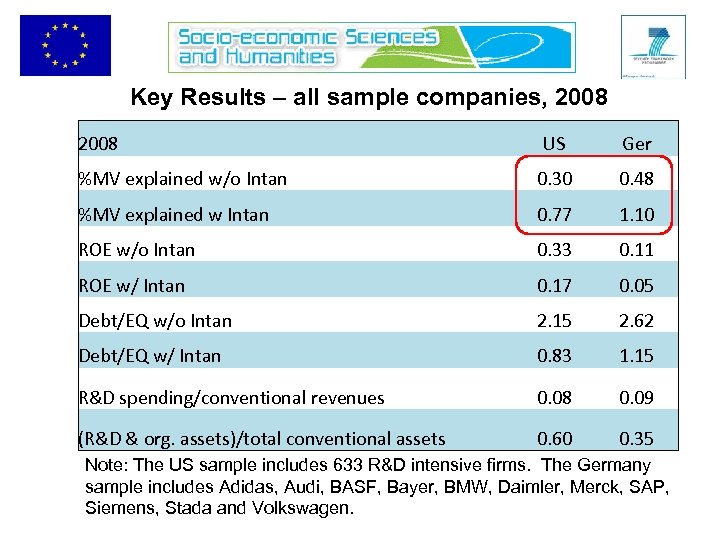
Key Results – all sample companies, 2008 US Ger %MV explained w/o Intan 0. 30 0. 48 %MV explained w Intan 0. 77 1. 10 ROE w/o Intan 0. 33 0. 11 ROE w/ Intan 0. 17 0. 05 Debt/EQ w/o Intan 2. 15 2. 62 Debt/EQ w/ Intan 0. 83 1. 15 R&D spending/conventional revenues 0. 08 0. 09 (R&D & org. assets)/total conventional assets 0. 60 0. 35 Note: The US sample includes 633 R&D intensive firms. The Germany sample includes Adidas, Audi, BASF, Bayer, BMW, Daimler, Merck, SAP, Siemens, Stada and Volkswagen.
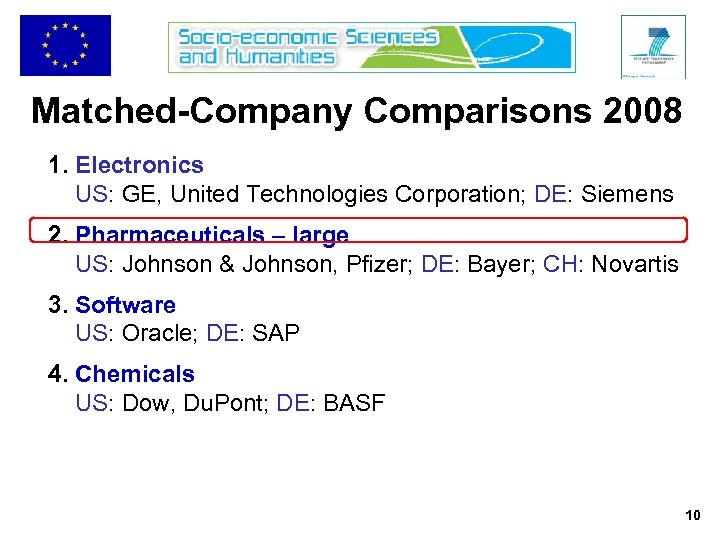
Matched-Company Comparisons 2008 1. Electronics US: GE, United Technologies Corporation; DE: Siemens 2. Pharmaceuticals – large US: Johnson & Johnson, Pfizer; DE: Bayer; CH: Novartis 3. Software US: Oracle; DE: SAP 4. Chemicals US: Dow, Du. Pont; DE: BASF 10
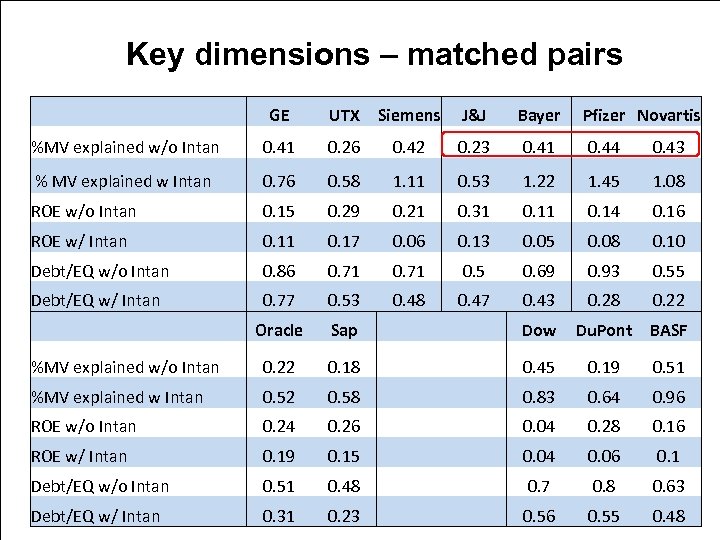
Key dimensions – matched pairs GE UTX Siemens J&J Bayer %MV explained w/o Intan 0. 41 0. 26 0. 42 0. 23 0. 41 0. 44 0. 43 % MV explained w Intan 0. 76 0. 58 1. 11 0. 53 1. 22 1. 45 1. 08 ROE w/o Intan 0. 15 0. 29 0. 21 0. 31 0. 14 0. 16 ROE w/ Intan 0. 11 0. 17 0. 06 0. 13 0. 05 0. 08 0. 10 Debt/EQ w/o Intan 0. 86 0. 71 0. 5 0. 69 0. 93 0. 55 Debt/EQ w/ Intan 0. 77 0. 53 0. 48 0. 47 0. 43 0. 28 0. 22 Oracle Sap Dow %MV explained w/o Intan 0. 22 0. 18 0. 45 0. 19 0. 51 %MV explained w Intan 0. 52 0. 58 0. 83 0. 64 0. 96 ROE w/o Intan 0. 24 0. 26 0. 04 0. 28 0. 16 ROE w/ Intan 0. 19 0. 15 0. 04 0. 06 0. 1 Debt/EQ w/o Intan 0. 51 0. 48 0. 7 0. 8 0. 63 Debt/EQ w/ Intan 0. 31 0. 23 0. 56 0. 55 0. 48 Pfizer Novartis Du. Pont BASF
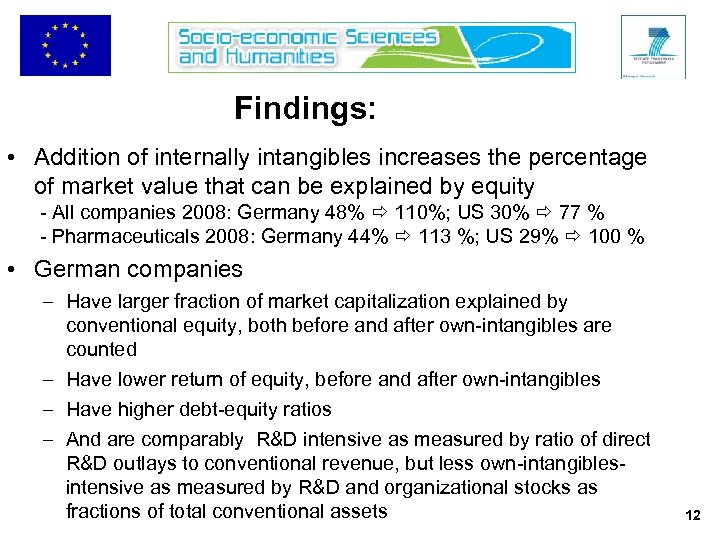
Findings: • Addition of internally intangibles increases the percentage of market value that can be explained by equity - All companies 2008: Germany 48% 110%; US 30% 77 % - Pharmaceuticals 2008: Germany 44% 113 %; US 29% 100 % • German companies – Have larger fraction of market capitalization explained by conventional equity, both before and after own-intangibles are counted – Have lower return of equity, before and after own-intangibles – Have higher debt-equity ratios – And are comparably R&D intensive as measured by ratio of direct R&D outlays to conventional revenue, but less own-intangiblesintensive as measured by R&D and organizational stocks as fractions of total conventional assets 12
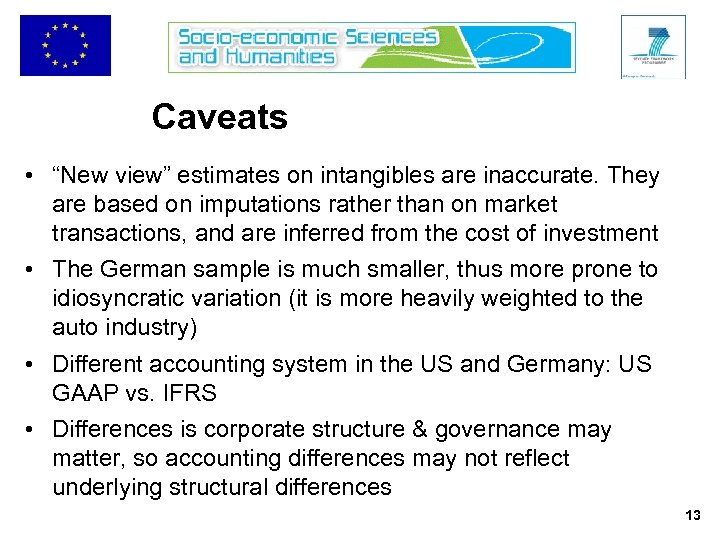
Caveats • “New view” estimates on intangibles are inaccurate. They are based on imputations rather than on market transactions, and are inferred from the cost of investment • The German sample is much smaller, thus more prone to idiosyncratic variation (it is more heavily weighted to the auto industry) • Different accounting system in the US and Germany: US GAAP vs. IFRS • Differences is corporate structure & governance may matter, so accounting differences may not reflect underlying structural differences 13
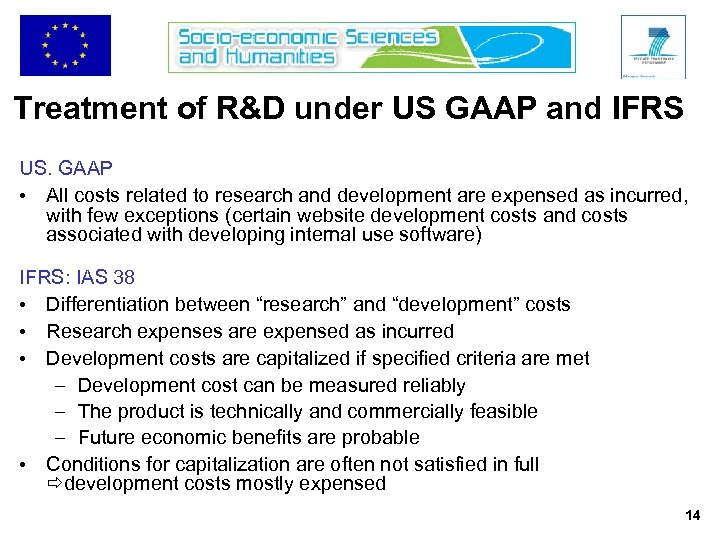
Treatment of R&D under US GAAP and IFRS US. GAAP • All costs related to research and development are expensed as incurred, with few exceptions (certain website development costs and costs associated with developing internal use software) IFRS: IAS 38 • Differentiation between “research” and “development” costs • Research expenses are expensed as incurred • Development costs are capitalized if specified criteria are met – Development cost can be measured reliably – The product is technically and commercially feasible – Future economic benefits are probable • Conditions for capitalization are often not satisfied in full development costs mostly expensed 14
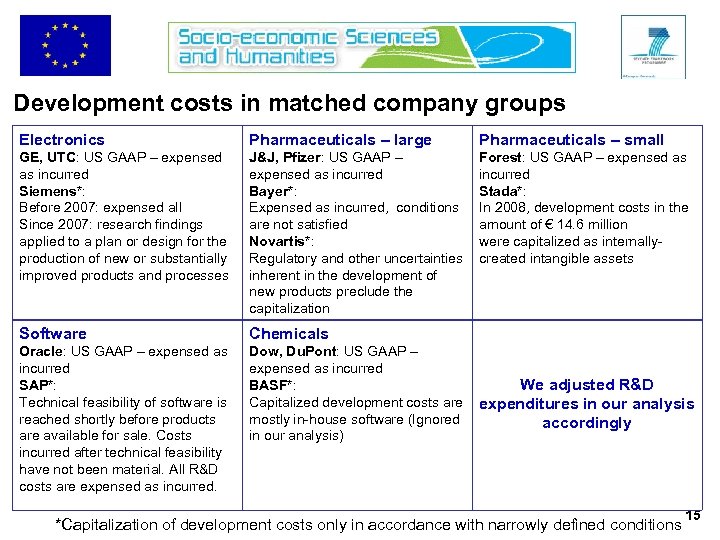
Development costs in matched company groups Electronics Pharmaceuticals – large Pharmaceuticals – small GE, UTC: US GAAP – expensed as incurred Siemens*: Before 2007: expensed all Since 2007: research findings applied to a plan or design for the production of new or substantially improved products and processes J&J, Pfizer: US GAAP – expensed as incurred Bayer*: Expensed as incurred, conditions are not satisfied Novartis*: Regulatory and other uncertainties inherent in the development of new products preclude the capitalization Forest: US GAAP – expensed as incurred Stada*: In 2008, development costs in the amount of € 14. 6 million were capitalized as internallycreated intangible assets Software Chemicals Oracle: US GAAP – expensed as incurred SAP*: Technical feasibility of software is reached shortly before products are available for sale. Costs incurred after technical feasibility have not been material. All R&D costs are expensed as incurred. Dow, Du. Pont: US GAAP – expensed as incurred BASF*: Capitalized development costs are mostly in-house software (Ignored in our analysis) We adjusted R&D expenditures in our analysis accordingly *Capitalization of development costs only in accordance with narrowly defined conditions 15
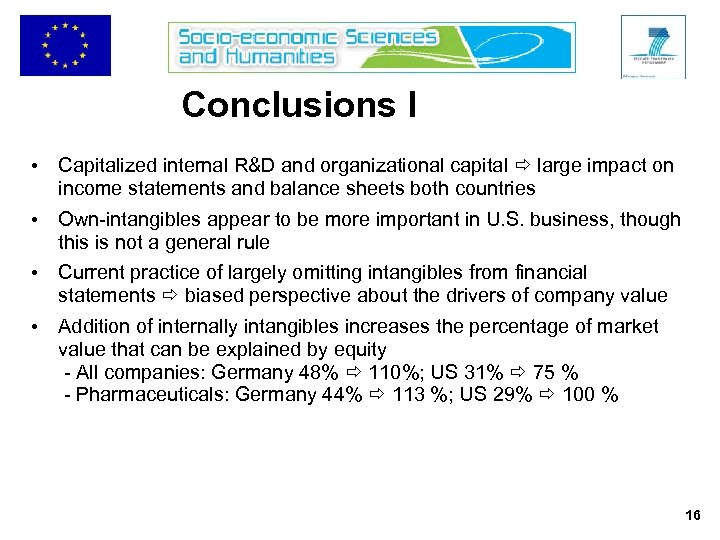
Conclusions I • Capitalized internal R&D and organizational capital large impact on income statements and balance sheets both countries • Own-intangibles appear to be more important in U. S. business, though this is not a general rule • Current practice of largely omitting intangibles from financial statements biased perspective about the drivers of company value • Addition of internally intangibles increases the percentage of market value that can be explained by equity - All companies: Germany 48% 110%; US 31% 75 % - Pharmaceuticals: Germany 44% 113 %; US 29% 100 % 16
Conclusions II • Over-explanation may be caused by our assumptions on own R&D and organizational capital • Intangibles can explain most (or all) of the market-to-book gap does not necessarily mean that they actually do explain the gap. • But: intangibles = important factor to determine the value of companies on both sides of the Atlantic. • Direct company comparisons generally support previous findings, but there are exceptions. • Note that Siemens, BASF, SAP, Bayer, and Novartis are global companies, as are the U. S. counterparts, and may therefore not be representative of the average 17
Back-up charts 18
Accounting Issues: General areas with significant differences between US GAAP & IFRS (I) • Equity and financial liabilities (IAS 1, IAS 27, IAS 32, IAS 39)* e. g. IFRS: Components of compound financial instruments with liability and equity characteristics, are accounted for separately. ; US GAAP: Instruments with characteristics of both debt and equity are not always split up • (Post ) Employee benefits (IAS 19, IFRIC 14)* e. g. IFRS: No further differentiation between post-employment benefits; US GAAP: Division of post-employment benefits into post-retirement benefits and other postemployment benefits. Accounting for post-employment benefits depends on the type of benefit provided • Income taxes (IAS 12, SIC-25)* e. g. IFRS: Deferred tax liability is recognised for the difference in tax bases between jurisdictions as a result of an intra-group transfer of assets, US GAAP: is not recognised. . . *See back-up slides for more details 19
US GAAP & IFRS: General areas with significant differences (II) • Inventories (IAS 2)* e. g. IFRS inventories measured at the lower of cost and net realisable value; US GAAP measured at the lower of cost and market. • Property, Plant, and Equipment (IAS 16, IAS 23, IFRIC 1)* e. g. IFRS revaluation possible under certain circumstances; US GAAP not permitted • Impairment of Assets (IAS 36, IFRIC 10)* e. g. IFRS goodwill allocated to cash-generating units, US GAAP goodwill allocated to reporting units • Intangible Assets (IFRS 3, IAS 36, IAS 38, SIC– 32) next slides In general, IFRS is substantially similar to US GAAP *See back-up slides for more details 20
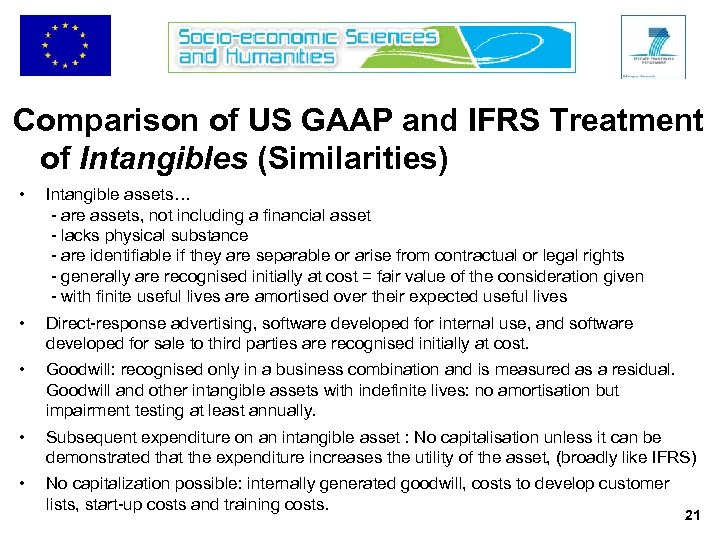
Comparison of US GAAP and IFRS Treatment of Intangibles (Similarities) • Intangible assets… - are assets, not including a financial asset - lacks physical substance - are identifiable if they are separable or arise from contractual or legal rights - generally are recognised initially at cost = fair value of the consideration given - with finite useful lives are amortised over their expected useful lives • Direct-response advertising, software developed for internal use, and software developed for sale to third parties are recognised initially at cost. • Goodwill: recognised only in a business combination and is measured as a residual. Goodwill and other intangible assets with indefinite lives: no amortisation but impairment testing at least annually. • Subsequent expenditure on an intangible asset : No capitalisation unless it can be demonstrated that the expenditure increases the utility of the asset, (broadly like IFRS) • No capitalization possible: internally generated goodwill, costs to develop customer lists, start-up costs and training costs. 21
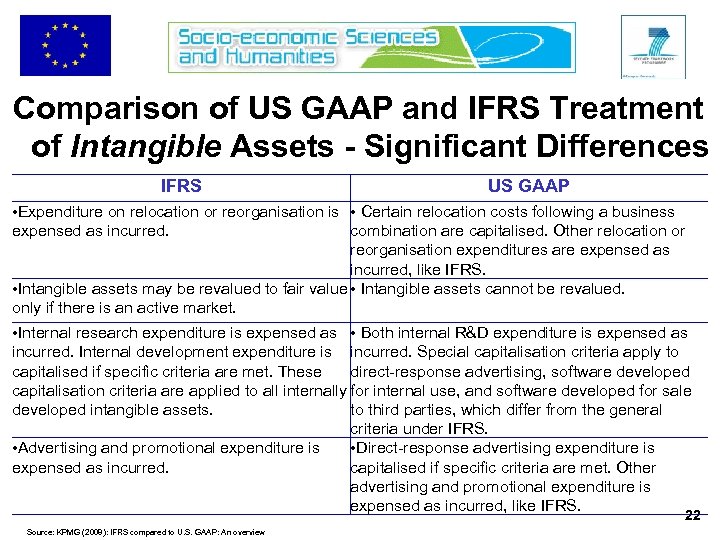
Comparison of US GAAP and IFRS Treatment of Intangible Assets - Significant Differences IFRS US GAAP • Expenditure on relocation or reorganisation is • Certain relocation costs following a business expensed as incurred. combination are capitalised. Other relocation or reorganisation expenditures are expensed as incurred, like IFRS. • Intangible assets may be revalued to fair value • Intangible assets cannot be revalued. only if there is an active market. • Internal research expenditure is expensed as • Both internal R&D expenditure is expensed as incurred. Internal development expenditure is incurred. Special capitalisation criteria apply to capitalised if specific criteria are met. These direct-response advertising, software developed capitalisation criteria are applied to all internally for internal use, and software developed for sale developed intangible assets. to third parties, which differ from the general criteria under IFRS. • Advertising and promotional expenditure is • Direct-response advertising expenditure is expensed as incurred. capitalised if specific criteria are met. Other advertising and promotional expenditure is expensed as incurred, like IFRS. 22 Source: KPMG (2008): IFRS compared to U. S. GAAP: An overview
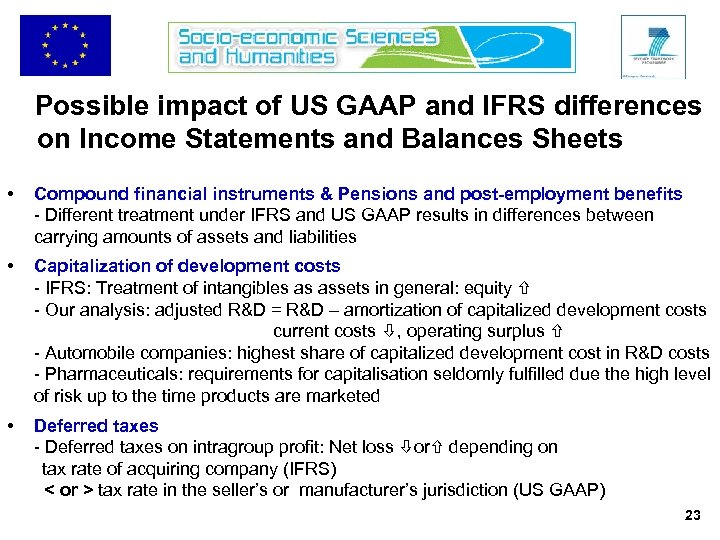
Possible impact of US GAAP and IFRS differences on Income Statements and Balances Sheets • Compound financial instruments & Pensions and post-employment benefits - Different treatment under IFRS and US GAAP results in differences between carrying amounts of assets and liabilities • Capitalization of development costs - IFRS: Treatment of intangibles as assets in general: equity - Our analysis: adjusted R&D = R&D – amortization of capitalized development costs current costs , operating surplus - Automobile companies: highest share of capitalized development cost in R&D costs - Pharmaceuticals: requirements for capitalisation seldomly fulfilled due the high level of risk up to the time products are marketed • Deferred taxes - Deferred taxes on intragroup profit: Net loss or depending on tax rate of acquiring company (IFRS) < or > tax rate in the seller’s or manufacturer’s jurisdiction (US GAAP) 23
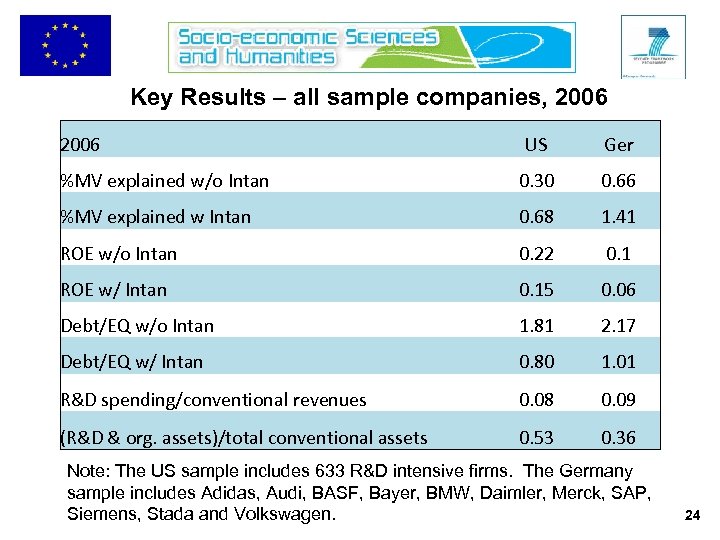
Key Results – all sample companies, 2006 US Ger %MV explained w/o Intan 0. 30 0. 66 %MV explained w Intan 0. 68 1. 41 ROE w/o Intan 0. 22 0. 1 ROE w/ Intan 0. 15 0. 06 Debt/EQ w/o Intan 1. 81 2. 17 Debt/EQ w/ Intan 0. 80 1. 01 R&D spending/conventional revenues 0. 08 0. 09 (R&D & org. assets)/total conventional assets 0. 53 0. 36 Note: The US sample includes 633 R&D intensive firms. The Germany sample includes Adidas, Audi, BASF, Bayer, BMW, Daimler, Merck, SAP, Siemens, Stada and Volkswagen. 24
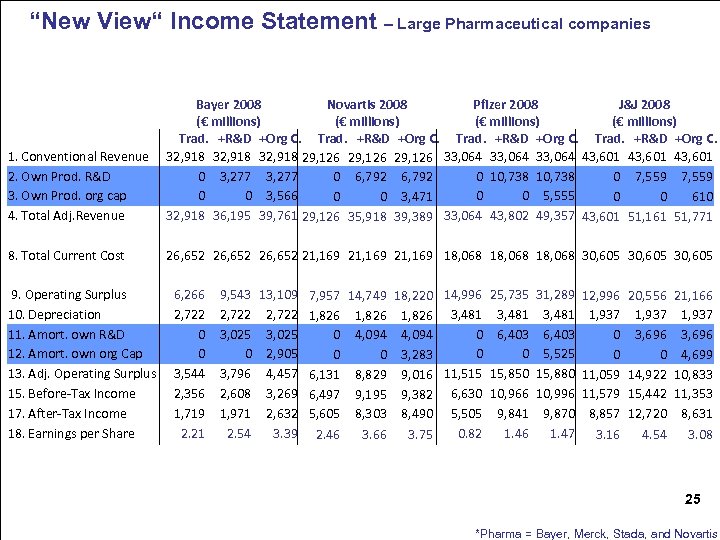
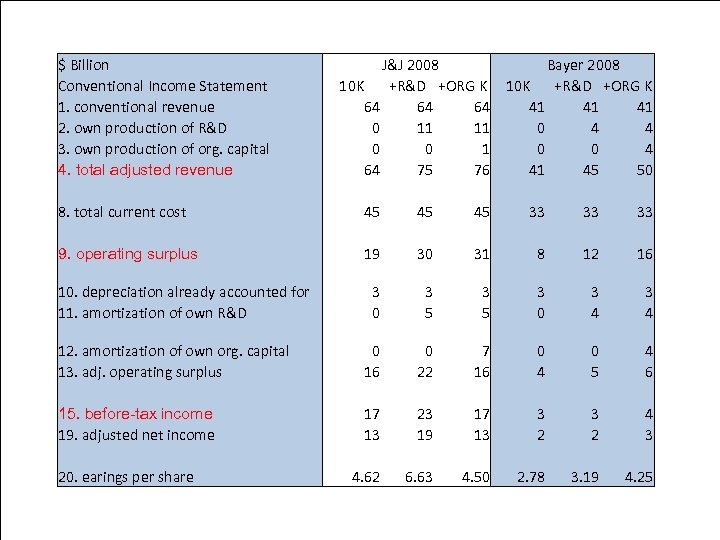
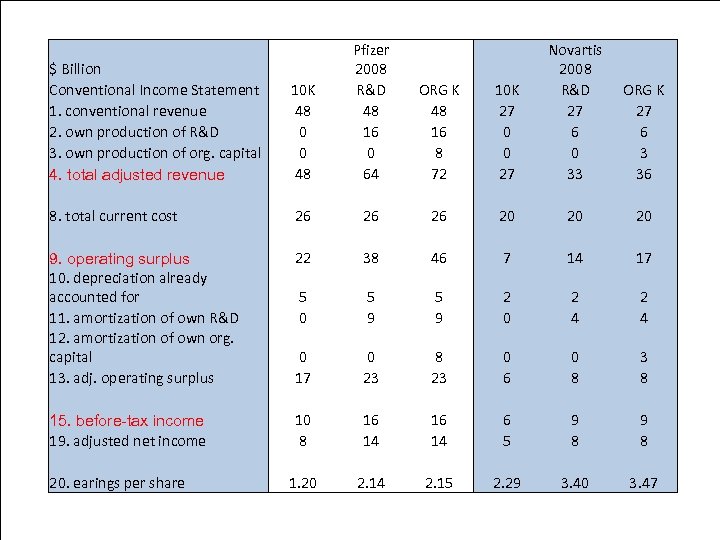
“New View“ Income Statement – Large Pharmaceutical companies 1. Conventional Revenue 2. Own Prod. R&D 3. Own Prod. org cap 4. Total Adj. Revenue Bayer 2008 Novartis 2008 Pfizer 2008 J&J 2008 (€ millions) Trad. +R&D +Org C. 32, 918 29, 126 33, 064 43, 601 0 3, 277 0 10, 738 0 7, 559 0 6, 792 0 0 3, 566 0 0 5, 555 0 0 610 0 0 3, 471 32, 918 36, 195 39, 761 29, 126 35, 918 39, 389 33, 064 43, 802 49, 357 43, 601 51, 161 51, 771 8. Total Current Cost 26, 652 21, 169 18, 068 30, 605 9. Operating Surplus 10. Depreciation 11. Amort. own R&D 12. Amort. own org Cap 13. Adj. Operating Surplus 15. Before-Tax Income 17. After-Tax Income 18. Earnings per Share 6, 266 2, 722 0 0 3, 544 2, 356 1, 719 2. 21 9, 543 13, 109 7, 957 14, 749 18, 220 14, 996 25, 735 31, 289 12, 996 20, 556 21, 166 2, 722 1, 826 3, 481 1, 937 3, 025 0 6, 403 0 3, 696 0 4, 094 0 2, 905 0 0 5, 525 0 0 4, 699 0 0 3, 283 3, 796 4, 457 6, 131 8, 829 9, 016 11, 515 15, 850 15, 880 11, 059 14, 922 10, 833 2, 608 3, 269 6, 497 9, 195 9, 382 6, 630 10, 966 10, 996 11, 579 15, 442 11, 353 1, 971 2, 632 5, 605 8, 303 8, 490 5, 505 9, 841 9, 870 8, 857 12, 720 8, 631 2. 54 3. 39 2. 46 0. 82 1. 46 1. 47 3. 16 4. 54 3. 08 3. 66 3. 75 25 *Pharma = Bayer, Merck, Stada, and Novartis
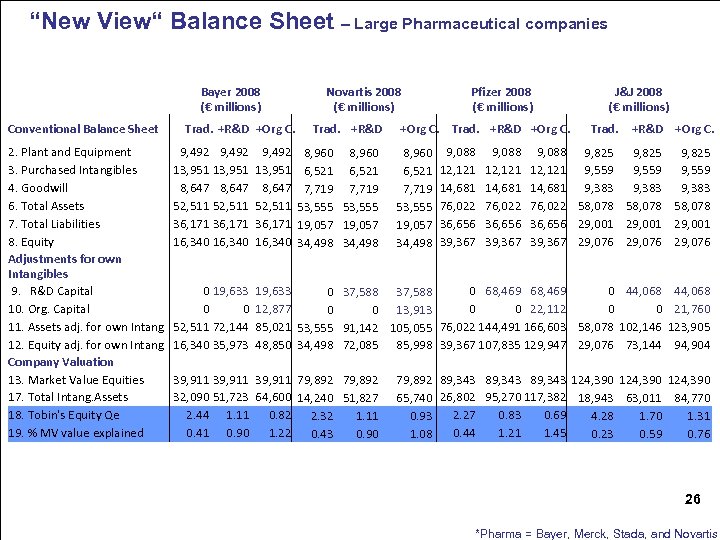
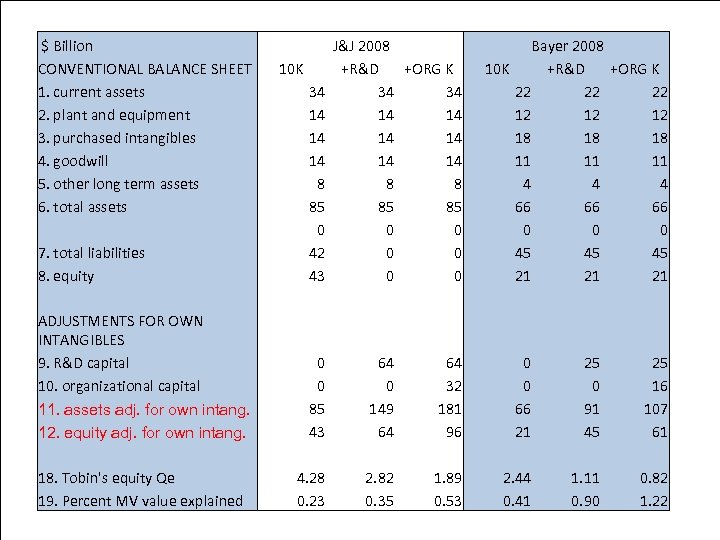
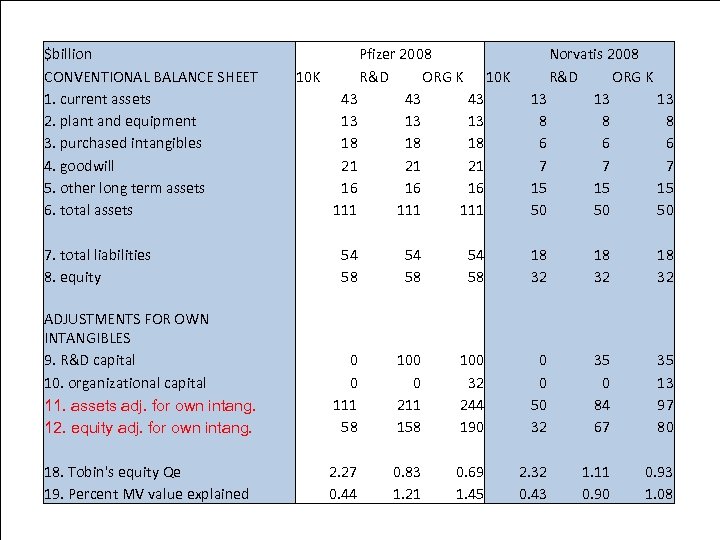
“New View“ Balance Sheet – Large Pharmaceutical companies Bayer 2008 (€ millions) Conventional Balance Sheet 2. Plant and Equipment 3. Purchased Intangibles 4. Goodwill 6. Total Assets 7. Total Liabilities 8. Equity Adjustments for own Intangibles 9. R&D Capital 10. Org. Capital 11. Assets adj. for own Intang 12. Equity adj. for own Intang Company Valuation 13. Market Value Equities 17. Total Intang. Assets 18. Tobin's Equity Qe 19. % MV value explained Trad. +R&D +Org C. Novartis 2008 (€ millions) Trad. +R&D Pfizer 2008 (€ millions) +Org C. Trad. +R&D +Org C. 9, 492 13, 951 8, 647 52, 511 36, 171 16, 340 0 19, 633 0 0 52, 511 72, 144 16, 340 35, 973 19, 633 0 68, 469 0 44, 068 0 37, 588 12, 877 0 0 22, 112 0 0 13, 913 85, 021 53, 555 91, 142 105, 055 76, 022 144, 491 166, 603 58, 078 102, 146 48, 850 34, 498 72, 085 85, 998 39, 367 107, 835 129, 947 29, 076 73, 144 39, 911 79, 892 32, 090 51, 723 64, 600 14, 240 51, 827 2. 44 1. 11 0. 82 2. 32 1. 11 0. 41 0. 90 1. 22 0. 43 0. 90 8, 960 6, 521 7, 719 53, 555 19, 057 34, 498 9, 088 12, 121 14, 681 76, 022 36, 656 39, 367 Trad. 9, 492 13, 951 8, 647 52, 511 36, 171 16, 340 8, 960 6, 521 7, 719 53, 555 19, 057 34, 498 9, 088 12, 121 14, 681 76, 022 36, 656 39, 367 J&J 2008 (€ millions) 9, 088 9, 825 12, 121 9, 559 14, 681 9, 383 76, 022 58, 078 36, 656 29, 001 39, 367 29, 076 44, 068 21, 760 123, 905 94, 904 79, 892 89, 343 124, 390 65, 740 26, 802 95, 270 117, 382 18, 943 63, 011 84, 770 2. 27 0. 83 0. 69 4. 28 1. 70 1. 31 0. 93 0. 44 1. 21 1. 45 0. 23 0. 59 0. 76 1. 08 26 *Pharma = Bayer, Merck, Stada, and Novartis
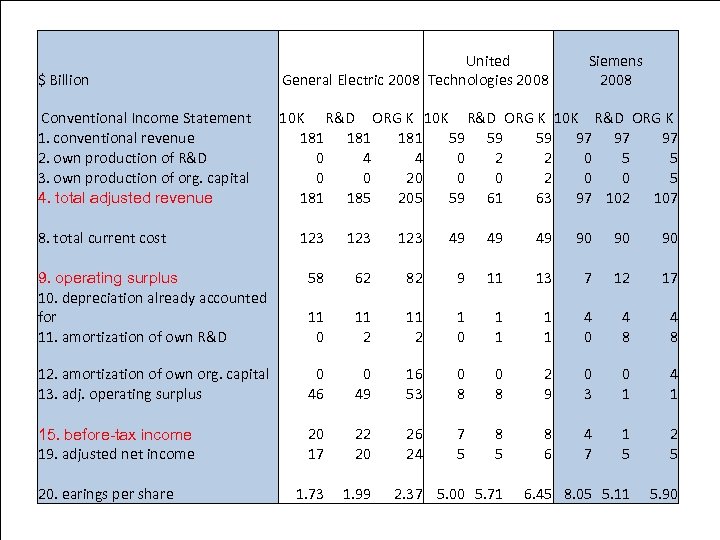
Electronics $ Billion Siemens 2008 United General Electric 2008 Technologies 2008 Conventional Income Statement 10 K R&D ORG K 1. conventional revenue 181 181 59 59 59 97 97 97 2. own production of R&D 0 4 4 0 2 2 0 5 5 3. own production of org. capital 0 0 20 0 0 2 0 0 5 181 185 205 59 61 63 97 102 107 4. total adjusted revenue 8. total current cost 123 123 49 49 49 90 90 90 58 62 82 9 11 13 7 12 17 9. operating surplus 10. depreciation already accounted for 11 11 11 1 4 4 4 11. amortization of own R&D 0 2 2 0 1 1 0 8 8 12. amortization of own org. capital 0 13. adj. operating surplus 46 20 15. before-tax income 19. adjusted net income 17 20. earings per share 1. 73 0 49 16 53 22 20 0 8 26 24 1. 99 0 8 2 9 7 5 8 5 2. 37 5. 00 5. 71 0 3 8 6 0 1 4 7 4 1 1 5 6. 45 8. 05 5. 11 2 5 5. 90
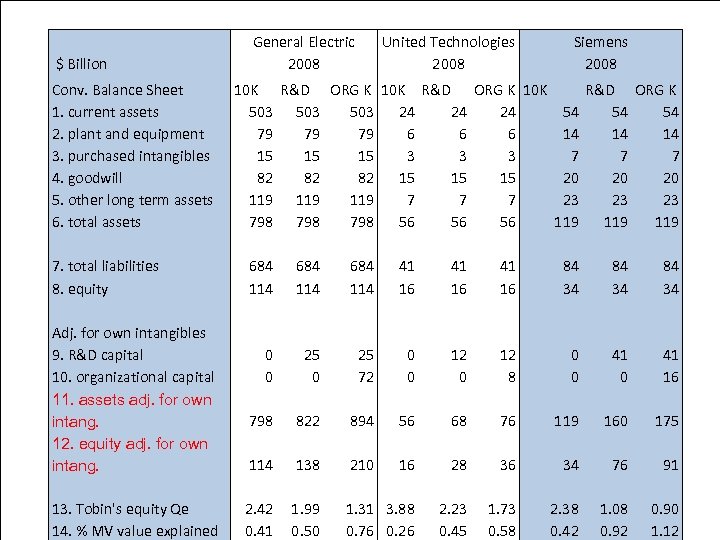
Electronics General Electric 2008 $ Billion Conv. Balance Sheet 1. current assets 2. plant and equipment 3. purchased intangibles 4. goodwill 5. other long term assets 6. total assets 7. total liabilities 8. equity Adj. for own intangibles 9. R&D capital 10. organizational capital 11. assets adj. for own intang. 12. equity adj. for own intang. 13. Tobin's equity Qe 14. % MV value explained 10 K R&D 503 79 79 15 15 82 82 119 798 684 114 0 25 0 0 ORG K 503 79 15 82 119 798 684 114 25 72 United Technologies 2008 10 K R&D ORG K 24 24 24 6 6 6 3 3 3 15 15 15 7 7 7 56 56 56 41 41 41 16 16 16 0 12 12 0 0 8 Siemens 2008 10 K 0 0 R&D 54 14 7 20 23 119 84 34 41 0 ORG K 54 14 7 20 23 119 84 34 41 16 54 14 7 20 23 119 84 34 798 822 894 56 68 76 119 160 175 114 138 210 16 28 36 34 76 91 2. 42 0. 41 1. 99 0. 50 1. 31 3. 88 0. 76 0. 26 2. 23 0. 45 1. 73 0. 58 2. 38 0. 42 1. 08 0. 92 0. 90 1. 12
Pharmaceuticals (1) $ Billion Conventional Income Statement 1. conventional revenue 2. own production of R&D 3. own production of org. capital 4. total adjusted revenue 8. total current cost 9. operating surplus J&J 2008 Bayer 2008 10 K +R&D +ORG K 64 64 64 41 41 41 0 11 11 0 4 4 0 0 1 0 0 4 64 75 76 41 45 50 45 45 45 33 33 33 19 30 31 8 12 16 10. depreciation already accounted for 11. amortization of own R&D 12. amortization of own org. capital 13. adj. operating surplus 15. before-tax income 19. adjusted net income 20. earings per share 3 0 3 5 3 0 3 4 0 16 0 22 7 16 0 4 0 5 4 6 17 13 23 19 17 13 4. 62 6. 63 3 2 4. 50 3 2 2. 78 4 3 3. 19 4. 25
Pharmaceuticals (1) $ Billion CONVENTIONAL BALANCE SHEET 1. current assets 2. plant and equipment 3. purchased intangibles 4. goodwill 5. other long term assets 6. total assets 7. total liabilities 8. equity ADJUSTMENTS FOR OWN INTANGIBLES 9. R&D capital 10. organizational capital 11. assets adj. for own intang. 12. equity adj. for own intang. 18. Tobin's equity Qe 19. Percent MV value explained J&J 2008 10 K +R&D +ORG K 34 34 34 14 14 14 8 85 85 85 0 0 0 42 0 0 43 0 0 85 43 64 0 149 64 4. 28 0. 23 64 32 181 96 2. 82 0. 35 Bayer 2008 10 K +R&D +ORG K 22 22 22 12 18 18 18 11 11 11 4 4 4 66 66 66 0 0 0 45 45 45 21 21 21 0 0 66 21 1. 89 0. 53 25 0 91 45 2. 44 0. 41 25 16 107 61 1. 11 0. 90 0. 82 1. 22
Pharmaceuticals (2) $ Billion Conventional Income Statement 1. conventional revenue 2. own production of R&D 3. own production of org. capital 4. total adjusted revenue 8. total current cost 9. operating surplus 10. depreciation already accounted for 11. amortization of own R&D 12. amortization of own org. capital 13. adj. operating surplus 15. before-tax income 19. adjusted net income 20. earings per share 38 ORG K 48 16 8 72 26 46 10 K 27 0 0 27 20 7 Novartis 2008 R&D 27 6 0 33 20 14 5 0 5 9 2 0 2 4 0 17 10 8 1. 20 0 23 8 23 16 14 2. 15 0 6 6 5 2. 29 0 8 9 8 3. 40 3 8 9 8 3. 47 10 K 48 0 0 48 26 22 Pfizer 2008 R&D 48 16 0 64 26 16 14 2. 14 ORG K 27 6 3 36 20 17
Pharmaceuticals (2) $billion CONVENTIONAL BALANCE SHEET 1. current assets 2. plant and equipment 3. purchased intangibles 4. goodwill 5. other long term assets 6. total assets 7. total liabilities 8. equity ADJUSTMENTS FOR OWN INTANGIBLES 9. R&D capital 10. organizational capital 11. assets adj. for own intang. 12. equity adj. for own intang. 18. Tobin's equity Qe 19. Percent MV value explained 10 K Pfizer 2008 R&D ORG K 10 K 43 43 43 13 18 18 18 21 21 21 16 16 16 111 111 54 54 54 58 58 58 0 0 111 58 100 0 211 158 2. 27 0. 44 100 32 244 190 0. 83 1. 21 Norvatis 2008 R&D ORG K 13 13 13 8 8 8 6 6 6 7 7 7 15 15 15 50 50 50 18 18 18 32 32 32 0 0 50 32 0. 69 1. 45 35 0 84 67 2. 32 0. 43 35 13 97 80 1. 11 0. 90 0. 93 1. 08
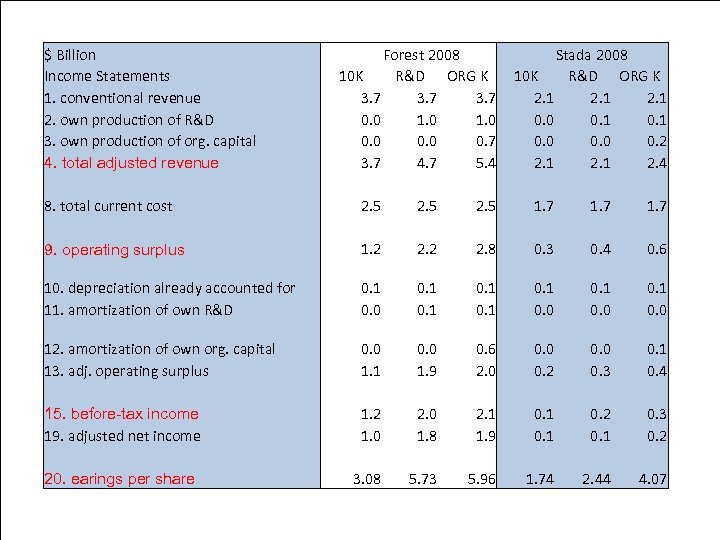
Pharmaceuticals (3) $ Billion Income Statements 1. conventional revenue 2. own production of R&D 3. own production of org. capital 4. total adjusted revenue 8. total current cost 9. operating surplus Forest 2008 Stada 2008 10 K R&D ORG K 3. 7 2. 1 0. 0 1. 0 0. 1 0. 0 0. 7 0. 0 0. 2 3. 7 4. 7 5. 4 2. 1 2. 4 2. 5 1. 7 1. 2 2. 8 0. 3 0. 4 0. 6 10. depreciation already accounted for 11. amortization of own R&D 0. 1 0. 0 0. 1 0. 0 12. amortization of own org. capital 13. adj. operating surplus 15. before-tax income 19. adjusted net income 20. earings per share 0. 0 1. 1 0. 0 1. 9 0. 6 2. 0 0. 2 0. 0 0. 3 0. 1 0. 4 1. 2 1. 0 2. 0 1. 8 2. 1 1. 9 3. 08 5. 73 0. 1 5. 96 0. 2 0. 1 1. 74 0. 3 0. 2 2. 44 4. 07
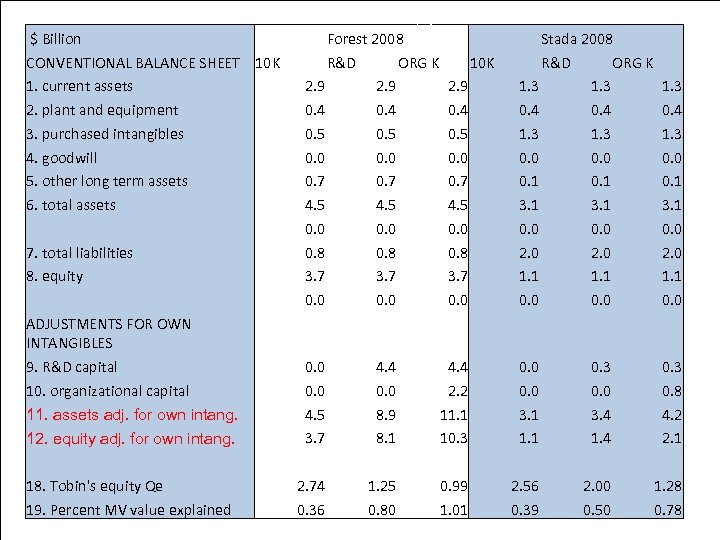
Pharmaceuticals (3) $ Billion CONVENTIONAL BALANCE SHEET 10 K 1. current assets 2. plant and equipment 3. purchased intangibles 4. goodwill 5. other long term assets 6. total assets 7. total liabilities 8. equity ADJUSTMENTS FOR OWN INTANGIBLES 9. R&D capital 10. organizational capital 11. assets adj. for own intang. 12. equity adj. for own intang. 18. Tobin's equity Qe 19. Percent MV value explained Forest 2008 R&D ORG K 2. 9 0. 4 0. 5 0. 0 0. 7 4. 5 0. 0 0. 8 3. 7 0. 0 4. 5 3. 7 4. 4 0. 0 8. 9 8. 1 10 K 4. 4 2. 2 11. 1 10. 3 2. 74 0. 36 1. 25 0. 80 1. 3 0. 4 1. 3 0. 0 0. 1 3. 1 0. 0 2. 0 1. 1 0. 0 3. 1 1. 1 2. 9 0. 4 0. 5 0. 0 0. 7 4. 5 0. 0 0. 8 3. 7 0. 0 Stada 2008 R&D ORG K 1. 3 0. 4 1. 3 0. 0 0. 1 3. 1 0. 0 2. 0 1. 1 0. 0 0. 3 0. 8 4. 2 2. 1 0. 99 1. 01 0. 3 0. 0 3. 4 1. 4 2. 56 0. 39 2. 00 0. 50 1. 28 0. 78
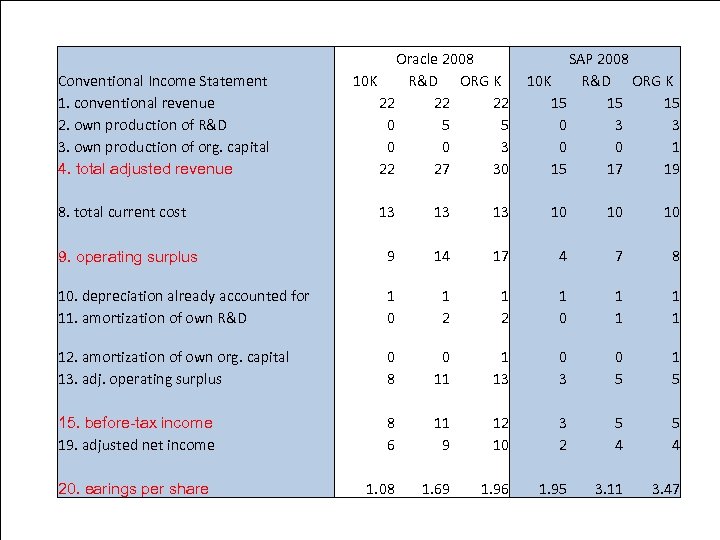
Software Conventional Income Statement 1. conventional revenue 2. own production of R&D 3. own production of org. capital 4. total adjusted revenue 8. total current cost 9. operating surplus Oracle 2008 SAP 2008 10 K R&D ORG K 22 22 22 15 15 15 0 5 5 0 3 3 0 0 1 22 27 30 15 17 19 13 13 13 10 10 10 9 14 17 4 7 8 10. depreciation already accounted for 11. amortization of own R&D 1 0 1 2 1 0 1 1 12. amortization of own org. capital 13. adj. operating surplus 15. before-tax income 19. adjusted net income 20. earings per share 0 8 0 11 1 13 0 5 1 5 8 6 11 9 12 10 1. 08 1. 69 3 2 1. 96 5 4 1. 95 5 4 3. 11 3. 47
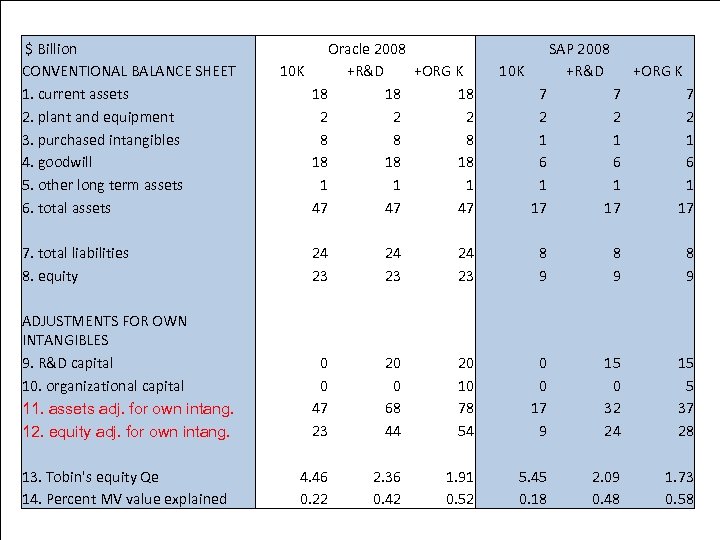
Software $ Billion CONVENTIONAL BALANCE SHEET 1. current assets 2. plant and equipment 3. purchased intangibles 4. goodwill 5. other long term assets 6. total assets 7. total liabilities 8. equity ADJUSTMENTS FOR OWN INTANGIBLES 9. R&D capital 10. organizational capital 11. assets adj. for own intang. 12. equity adj. for own intang. 13. Tobin's equity Qe 14. Percent MV value explained Oracle 2008 10 K +R&D +ORG K 18 18 18 2 2 2 8 8 8 18 1 1 1 47 47 47 SAP 2008 10 K +R&D +ORG K 7 7 7 2 2 2 1 1 1 6 6 6 1 17 17 17 24 23 8 9 8 9 0 0 47 23 20 0 68 44 20 10 78 54 0 0 17 9 15 0 32 24 15 5 37 28 4. 46 0. 22 2. 36 0. 42 1. 91 0. 52 5. 45 0. 18 2. 09 0. 48 1. 73 0. 58
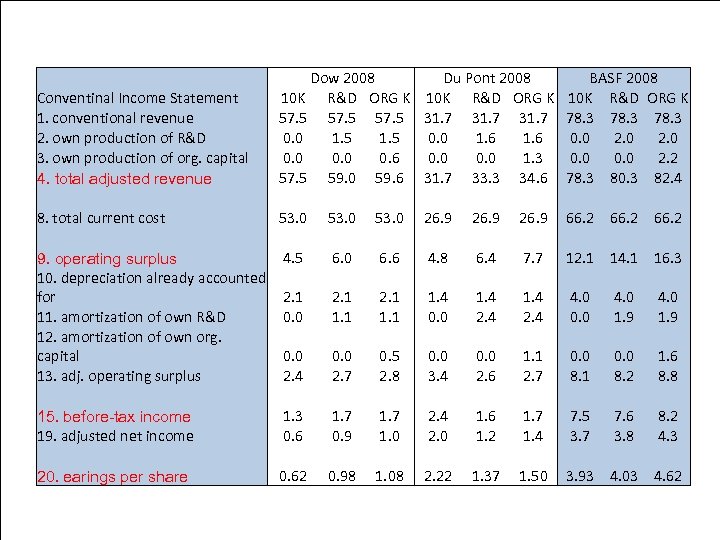
Chemicals Conventinal Income Statement 1. conventional revenue 2. own production of R&D 3. own production of org. capital 4. total adjusted revenue 8. total current cost 9. operating surplus 10. depreciation already accounted for 11. amortization of own R&D 12. amortization of own org. capital 13. adj. operating surplus 15. before-tax income 19. adjusted net income 20. earings per share Dow 2008 10 K R&D ORG K 57. 5 0. 0 1. 5 0. 0 0. 6 57. 5 59. 0 59. 6 53. 0 4. 5 6. 0 6. 6 Du Pont 2008 10 K R&D ORG K 31. 7 0. 0 1. 6 0. 0 1. 3 31. 7 33. 3 34. 6 26. 9 4. 8 6. 4 7. 7 BASF 2008 10 K R&D ORG K 78. 3 0. 0 2. 0 0. 0 2. 2 78. 3 80. 3 82. 4 66. 2 12. 1 14. 1 16. 3 2. 1 0. 0 2. 1 1. 4 0. 0 1. 4 2. 4 4. 0 0. 0 2. 4 1. 3 0. 62 0. 0 2. 7 0. 5 2. 8 1. 7 1. 08 0. 0 3. 4 2. 4 2. 0 2. 22 0. 0 2. 6 1. 1 2. 7 1. 7 1. 4 1. 50 0. 0 1. 6 8. 1 8. 2 8. 8 7. 5 7. 6 8. 2 3. 7 3. 8 4. 3 3. 93 4. 03 4. 62 1. 7 0. 98 1. 6 1. 2 1. 37 4. 0 1. 9
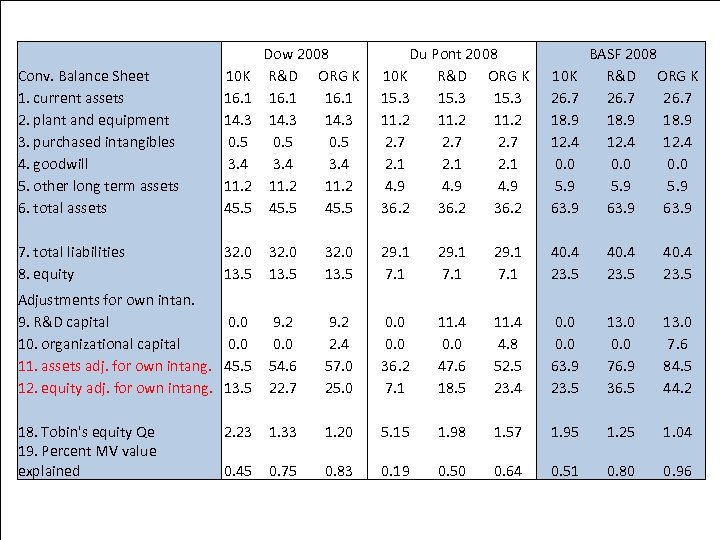
Chemicals Conv. Balance Sheet 1. current assets 2. plant and equipment 3. purchased intangibles 4. goodwill 5. other long term assets 6. total assets 7. total liabilities 8. equity Adjustments for own intan. 9. R&D capital 10. organizational capital 11. assets adj. for own intang. 12. equity adj. for own intang. 18. Tobin's equity Qe 19. Percent MV value explained 10 K 16. 1 14. 3 0. 5 3. 4 11. 2 45. 5 32. 0 13. 5 Dow 2008 R&D ORG K 16. 1 14. 3 0. 5 3. 4 11. 2 45. 5 32. 0 13. 5 Du Pont 2008 10 K R&D ORG K 15. 3 11. 2 2. 7 2. 1 4. 9 36. 2 29. 1 7. 1 10 K 26. 7 18. 9 12. 4 0. 0 5. 9 63. 9 40. 4 23. 5 BASF 2008 R&D ORG K 26. 7 18. 9 12. 4 0. 0 5. 9 63. 9 40. 4 23. 5 0. 0 45. 5 13. 5 2. 23 9. 2 0. 0 54. 6 22. 7 1. 33 9. 2 2. 4 57. 0 25. 0 1. 20 0. 0 36. 2 7. 1 5. 15 11. 4 0. 0 47. 6 18. 5 1. 98 11. 4 4. 8 52. 5 23. 4 1. 57 0. 0 63. 9 23. 5 1. 95 13. 0 0. 0 76. 9 36. 5 1. 25 13. 0 7. 6 84. 5 44. 2 1. 04 0. 45 0. 75 0. 83 0. 19 0. 50 0. 64 0. 51 0. 80 0. 96
Скачать презентацию Intangible Capital and the Valuation of Companies A
8c8c7bb6d56d8645d0e5dff6ac69ab80.ppt