 Скачать презентацию Int l Monetary Crisis — III Nationalist Battles
d5d190342359bab9af67f20c59eaca72.ppt
- Количество слайдов: 19



Int’l Monetary Crisis - III Nationalist Battles & Domestic Forces
Readings $ articles from section E on the Fall of 1987 $ articles from section F on 1992 -1993 EMS Crisis
Turning Points $ Five important turning points: ¢ 1. Formation of EMS & ERM in 1979 ¢ 2. Carter-Reagan-Volcker tight money that drove dollar skyward and touched off Great Depresion of ‘ 80 s, debt crisis, and lost decade of development ¢ 3. 1985 Plaza Agreement when G-7 agreed to drive the dollar down ¢ 4. Fall 1987 Crisis (Stock Market Crash, drop in dollar that led to G-7 effort to stabilize it ¢ 5. EMS Crisis of 1992 when UK & Italy withdrew from the ERM which led to German reversal of interest rate policy & widening of band
Fall 1987 Crisis $ Feb ‘ 87 Louvre Accord to stabilize dollar after drop following Plaza Agreement in ‘ 85 $ Spring - Summer 1987 G-7 Central banks spend some $70 billion to achieve this $ Fall 1987: agreement to discord ¢ US vs Germany ¢ US wanted Germany to stimulate its economy ¢ Germany wanted US to reduce Fed. deficit
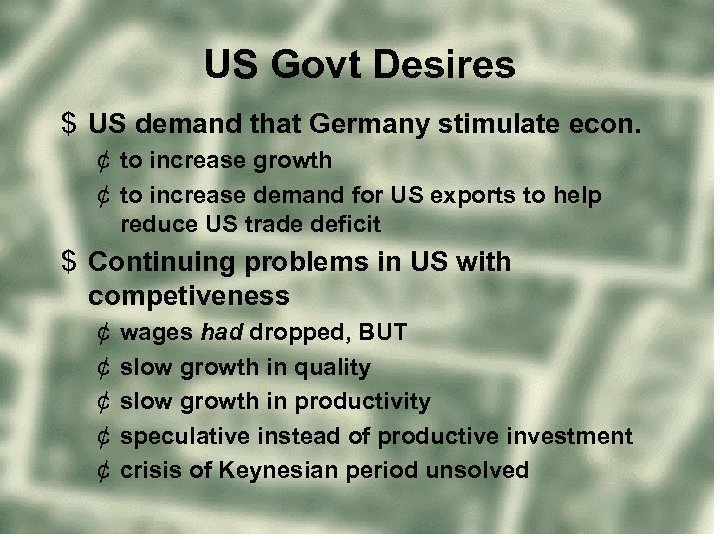
US Govt Desires $ US demand that Germany stimulate econ. ¢ to increase growth ¢ to increase demand for US exports to help reduce US trade deficit $ Continuing problems in US with competiveness ¢ ¢ ¢ wages had dropped, BUT slow growth in quality slow growth in productivity speculative instead of productive investment crisis of Keynesian period unsolved
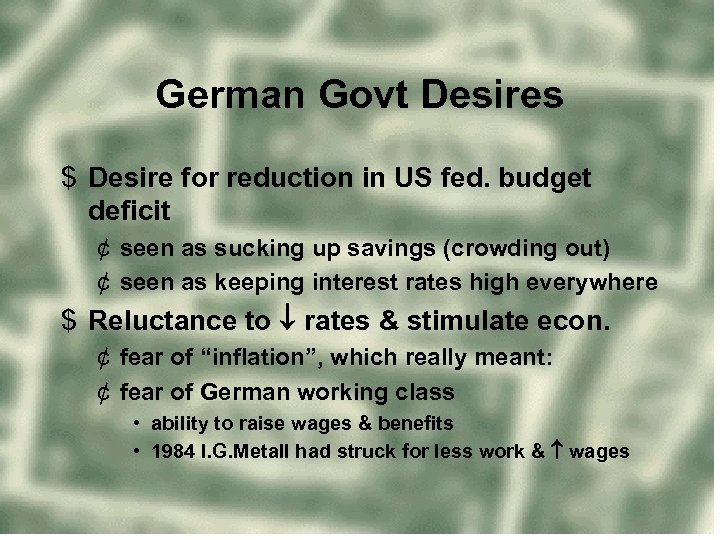
German Govt Desires $ Desire for reduction in US fed. budget deficit ¢ seen as sucking up savings (crowding out) ¢ seen as keeping interest rates high everywhere $ Reluctance to rates & stimulate econ. ¢ fear of “inflation”, which really meant: ¢ fear of German working class • ability to raise wages & benefits • 1984 I. G. Metall had struck for less work & wages
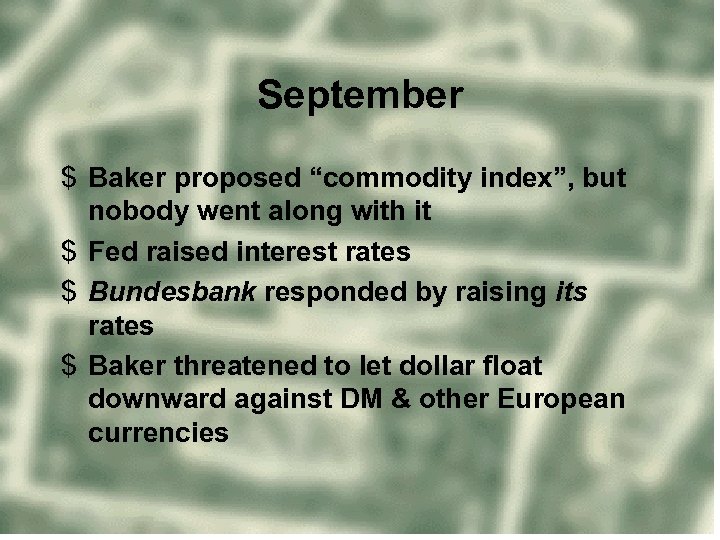
September $ Baker proposed “commodity index”, but nobody went along with it $ Fed raised interest rates $ Bundesbank responded by raising its rates $ Baker threatened to let dollar float downward against DM & other European currencies
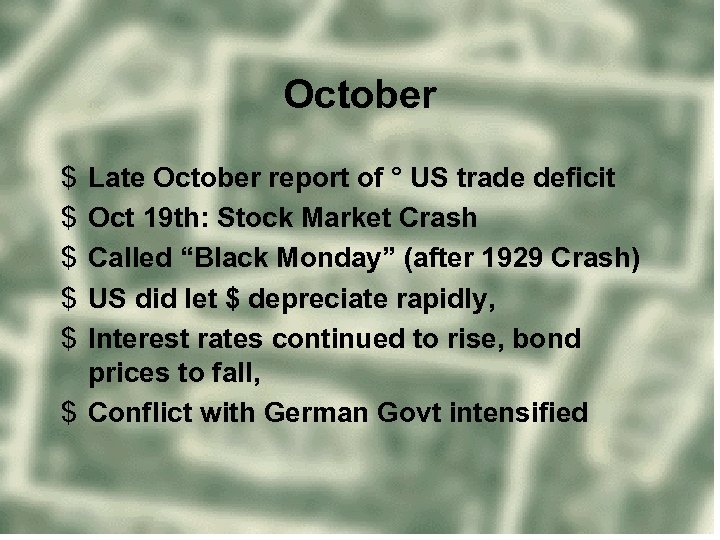
October $ $ $ Late October report of ° US trade deficit Oct 19 th: Stock Market Crash Called “Black Monday” (after 1929 Crash) US did let $ depreciate rapidly, Interest rates continued to rise, bond prices to fall, $ Conflict with German Govt intensified
November $ White House and Congress came to agreement on budget deficit reduction ¢ increasing consensus on attacking welfare state, social programs, not defense etc. $ Germany responded by cutting interest rates, tit for tat ¢ allowing some stimulation ¢ allowing some increase in imports of US goods
Dec ‘ 87 - Jan ‘ 88 $ December: G-7 agreed to stabilize dollar, i. e. , not allow it to fall further $ G-7 implements agreement with massive central bank dollar purchases $ Increase in demand for dollar brings drop to an end by early January 1988
ERM Crisis - Background - I $ Collapse of Wall & Communism (1989) ¢ driven by grassroots struggle ¢ underground resistance emerged above ground $ German reunification ¢ driven by grassroots migration from East to West Germany, via Hungary then thru broken Wall ¢ East Germans refused requests to stop coming ¢ only stopped by reunification & promises
ERM Crisis Background - II $ Germany decided to finance reunification via borrowing $ cost expected to > $100 billion $ cost high because: ¢ 1 - 1 currency conversion ¢ labor achieved leveling up ¢ Kohl’s desire to avoid raising taxes
ERM Crisis Background - III $ Strikes for wage in Germany in April &May, 1990 $ Maastricht Treaty, 1990 ¢ Danish rejection in June ¢ Near French rejection in Summer $ Opposition Gathering in Venice 1991 $ Anti-immigrant riots/murders in Germany $ All symptoms of discontent with high unemployment and falling real wages
ERM Crisis $ Sept 13, 1992: Italians devalued lire $ Sept 15: Slight cut in German interest rate $ Speculative attack on £ (pound) forces UK to pull out of EMS, govt floats £ & cuts i $ UK followed by Italy & then by Spain $ EMS has ruptured!
Crisis Attack on Germany $ Intensified attack on German monetary policy for tight money, high rates $ Walter Russel Mead in Foreign Affairs says unification financed by high rates $ Moelleman responds NO, not so, high rates are for hot money, long term rates are similar to US rates
Chronicle $ UK pulls out, cuts interest rates $ by Jan 1993, rates cut to lowest level since 1977 $ Kohl seeks “solidarity pact” with labor to allow cuts in wages and social services $ German business accelerates movement into Eastern Europe with its low wages $ Feb 1994: Speculative attack fores Ireland to devalue punt $ Feb 1994: French attack on “social dumping”by UK
“Social Dumping? ” $ Hoover moves from France to Scotland $ French accuse firm & UK of “social dumping” = low wage/benefits to undercut $ Low wages & benefits result of sucess of Thatcher attacks on UK workers $ Wall Street Journal editorial calls for “leveling down” instead of up! $ Feb: Bundesbank lowers interest rates $ Aug: ERM widens band to ± 15%, UK out

Peso Crisis Articles $ Until packet becomes available, you can read most of the material at URL: $ gopher to eco dept, mailing lists, Chiapas 95, Peso Crisis/ $ Or, go to http: //www. eco. utexas. edu/faculty/Cl eaver/chiapas 95. html and look for the section on “The Peso Crisis” with a hotlink to the articles.
--END--
Скачать презентацию Int l Monetary Crisis — III Nationalist Battles
d5d190342359bab9af67f20c59eaca72.ppt