


 Скачать презентацию Insurance Companies and Pension Plans Chapter 3 Risk
37f0bb033d5a331a80fe42f522dda43d.ppt
- Количество слайдов: 20
 Insurance Companies and Pension Plans Chapter 3 Risk Management and Financial Institutions 2 e, Chapter 3, Copyright © John C. Hull 2009 1
 Types of Life Insurance (pages 40 -43) l l l Term life Whole life Variable life Universal life Endowment life Group life Risk Management and Financial Institutions 2 e, Chapter 3, Copyright © John C. Hull 2009 2
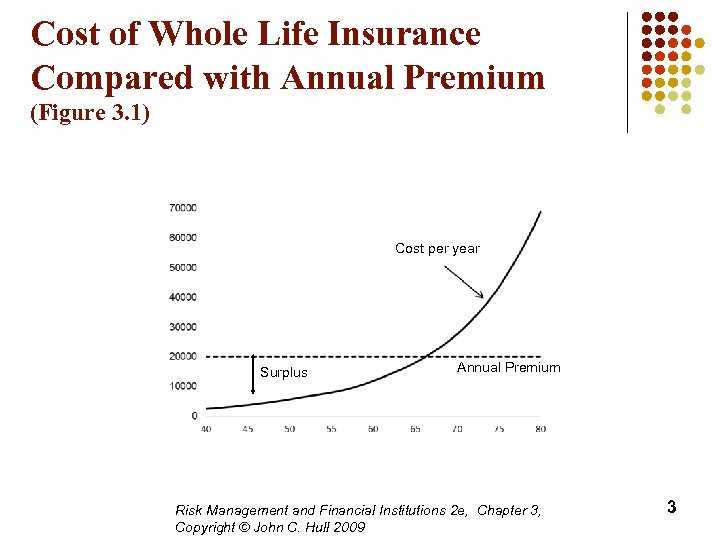 Cost of Whole Life Insurance Compared with Annual Premium (Figure 3. 1) Cost per year Surplus Annual Premium Risk Management and Financial Institutions 2 e, Chapter 3, Copyright © John C. Hull 2009 3
 Investment of Surplus l l Some contracts allow the policyholder to choose how the surplus is invested There are tax deferral advantages compared with a regular investment because no tax is paid until there is a payout on the policy Risk Management and Financial Institutions 2 e, Chapter 3, Copyright © John C. Hull 2009 4
 Annuity Contracts (pages 43 -44) l l l Typically a lump sum payment is used to buy a life-time annuity Annuity can be fixed or variable Annuity can start immediately or be deferred Accumulated value can depend in a complicated way on the performance of stock indices There may be penalty-free withdrawals Risk Management and Financial Institutions 2 e, Chapter 3, Copyright © John C. Hull 2009 5
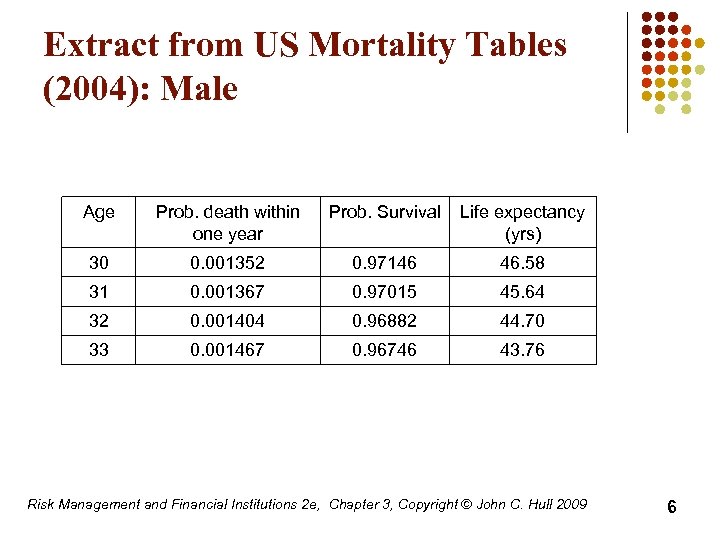 Extract from US Mortality Tables (2004): Male Age Prob. death within one year Prob. Survival Life expectancy (yrs) 30 0. 001352 0. 97146 46. 58 31 0. 001367 0. 97015 45. 64 32 0. 001404 0. 96882 44. 70 33 0. 001467 0. 96746 43. 76 Risk Management and Financial Institutions 2 e, Chapter 3, Copyright © John C. Hull 2009 6
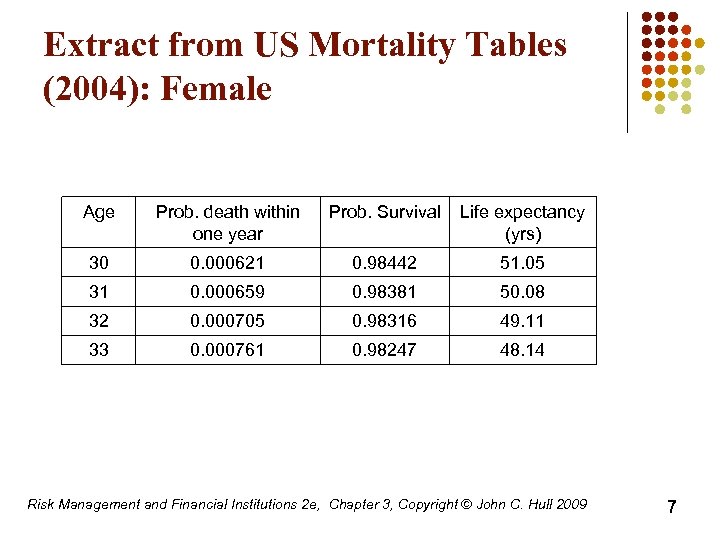 Extract from US Mortality Tables (2004): Female Age Prob. death within one year Prob. Survival Life expectancy (yrs) 30 0. 000621 0. 98442 51. 05 31 0. 000659 0. 98381 50. 08 32 0. 000705 0. 98316 49. 11 33 0. 000761 0. 98247 48. 14 Risk Management and Financial Institutions 2 e, Chapter 3, Copyright © John C. Hull 2009 7
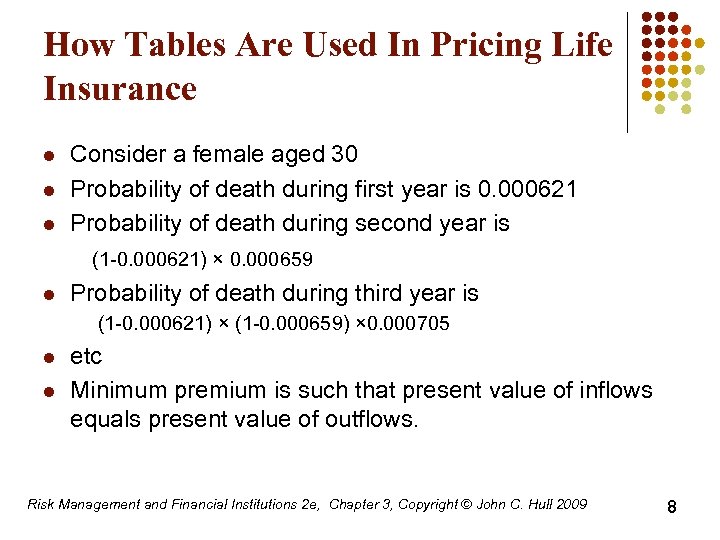 How Tables Are Used In Pricing Life Insurance l l l Consider a female aged 30 Probability of death during first year is 0. 000621 Probability of death during second year is (1 -0. 000621) × 0. 000659 l Probability of death during third year is (1 -0. 000621) × (1 -0. 000659) × 0. 000705 l l etc Minimum premium is such that present value of inflows equals present value of outflows. Risk Management and Financial Institutions 2 e, Chapter 3, Copyright © John C. Hull 2009 8
 Longevity Derivatives (page 48) l l Used by life insurance companies and pension funds A population is defined and coupon on a bond depends on the number of members of the population still alive Risk Management and Financial Institutions 2 e, Chapter 3, Copyright © John C. Hull 2009 9
 Property-Casualty Insurance l l l Property insurance is concerned with loss or damage to property from fire, theft, etc Casualty insurance is concerned legal liability exposures What are the biggest risks facing propertycasualty insurers? Risk Management and Financial Institutions 2 e, Chapter 3, Copyright © John C. Hull 2009 10
 CAT Bonds (page 49 -50) l l l CAT bonds are an alternative to traditional reinsurance This is a bond issued by a subsidiary of an insurance company that pays a higherthan-normal interest rate. If claims of a certain type are above a certain level, the interest and possibly the principal on the bond are used to meet claims Risk Management and Financial Institutions 2 e, Chapter 3, Copyright © John C. Hull 2009 11
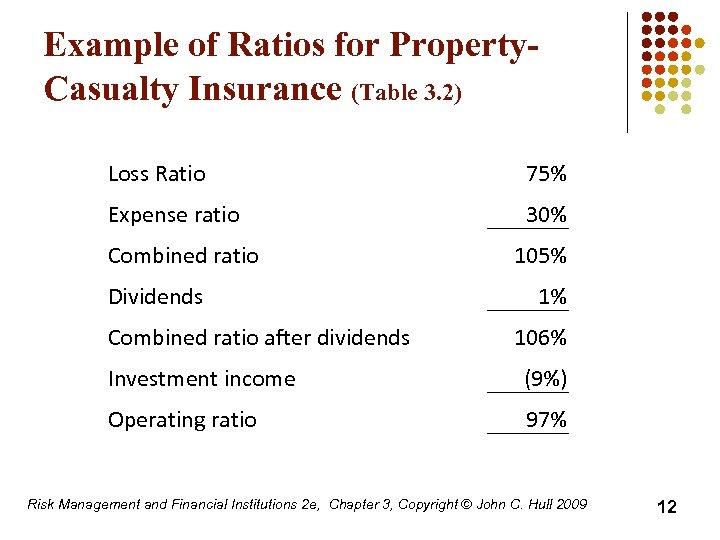 Example of Ratios for Property. Casualty Insurance (Table 3. 2) Loss Ratio 75% Expense ratio 30% Combined ratio Dividends Combined ratio after dividends 105% 1% 106% Investment income (9%) Operating ratio 97% Risk Management and Financial Institutions 2 e, Chapter 3, Copyright © John C. Hull 2009 12
 When Do Premiums Change? l l l In life insurance premiums typically stay the same throughout the life of the contract In property-casualty insurance premiums are changed from year to year as risks are reassessed In heath insurance premiums can rise because of the overall cost of health care but not because the health risks of the policyholder increase Risk Management and Financial Institutions 2 e, Chapter 3, Copyright © John C. Hull 2009 13
 Moral Hazard and Adverse Selection (pages 52 -53) l l Moral hazard is the risk that the existence of the insurance policy causes the policyholder to take more risks Adverse selection is the tendency for an insurance company to attract bad risks when it cannot perfectly distinguish between good and bad risks Risk Management and Financial Institutions 2 e, Chapter 3, Copyright © John C. Hull 2009 14
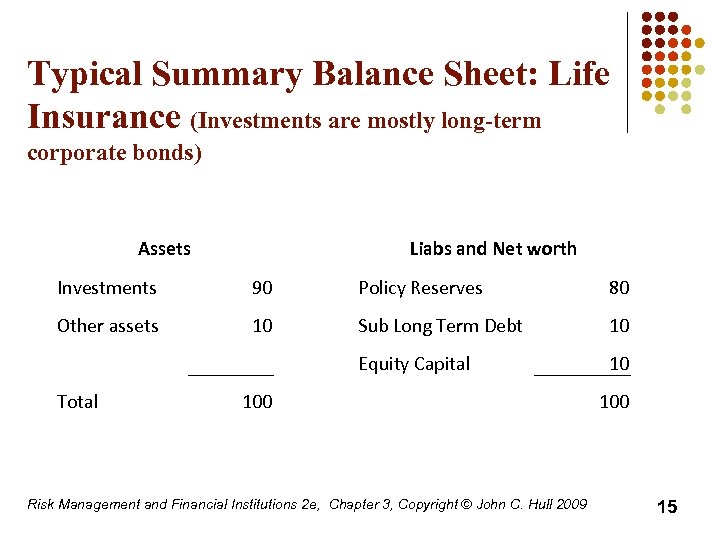 Typical Summary Balance Sheet: Life Insurance (Investments are mostly long-term corporate bonds) Assets Liabs and Net worth Investments 90 Policy Reserves 80 Other assets 10 Sub Long Term Debt 10 Equity Capital 10 Total 100 Risk Management and Financial Institutions 2 e, Chapter 3, Copyright © John C. Hull 2009 100 15
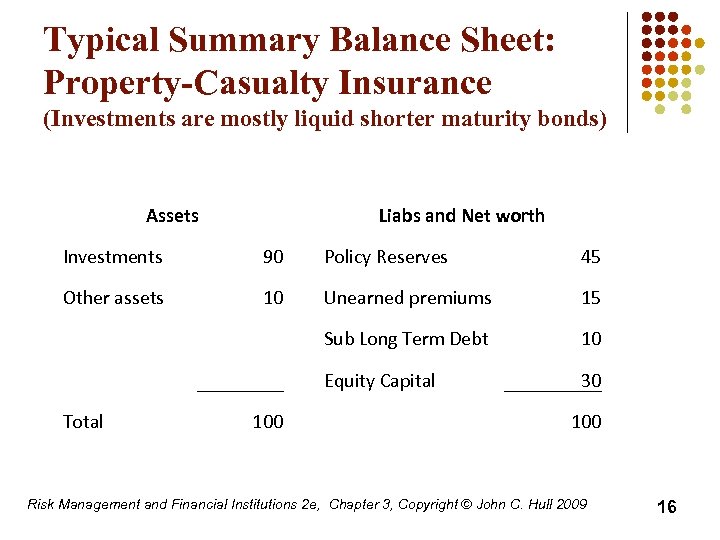 Typical Summary Balance Sheet: Property-Casualty Insurance (Investments are mostly liquid shorter maturity bonds) Assets Liabs and Net worth Investments 90 Policy Reserves 45 Other assets 10 Unearned premiums 15 Sub Long Term Debt 10 Equity Capital 30 Total 100 Risk Management and Financial Institutions 2 e, Chapter 3, Copyright © John C. Hull 2009 16
 Regulation of Insurance Companies l l US: Mostly at the state level Europe: Mostly at the EU level Risk Management and Financial Institutions 2 e, Chapter 3, Copyright © John C. Hull 2009 17
 Pension Plans l Defined benefit plan l l l Contributions are pooled Benefits are determined by a formula dependent on the final salary of the employee and the number of years of service Defined contribution plan l l Contributions for each employee are kept separate and invested on behalf of the employee When the employee retires the accumulated value of the contributions is usually converted to an annuity Risk Management and Financial Institutions 2 e, Chapter 3, Copyright © John C. Hull 2009 18
 Defined Benefit Plans l l Actuaries estimate liabilities and calculate a surplus or deficit for the plan. The discount rate used is the AA borrowing rate Deficits must be funded by the company within a prescribed period A perfect storm: Declining equity prices coupled with declining interest rates Risk Management and Financial Institutions 2 e, Chapter 3, Copyright © John C. Hull 2009 19
 Are Defined Benefit Plans Viable? l l Employer plus employee contributions are typically 15% of salary or less Actuarial estimates show that about 25% of salary is necessary to fund most plans Funds typically invest 60% in equities and are relying on good investment returns from equity investments to meet obligations Should members of DB plans bear some of the risk associated with equity returns? Risk Management and Financial Institutions 2 e, Chapter 3, Copyright © John C. Hull 2009 20