


 Скачать презентацию Instruments for maintenance of airplane Kit of tools
04_Tools.ppt
- Количество слайдов: 10
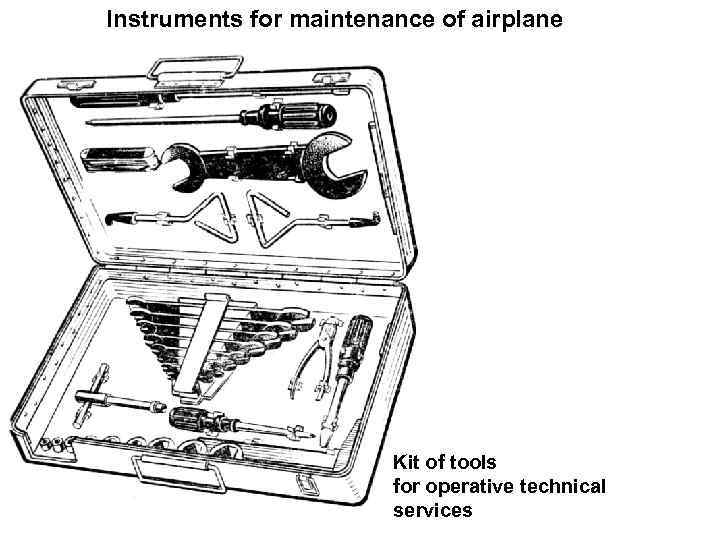 Instruments for maintenance of airplane Kit of tools for operative technical services
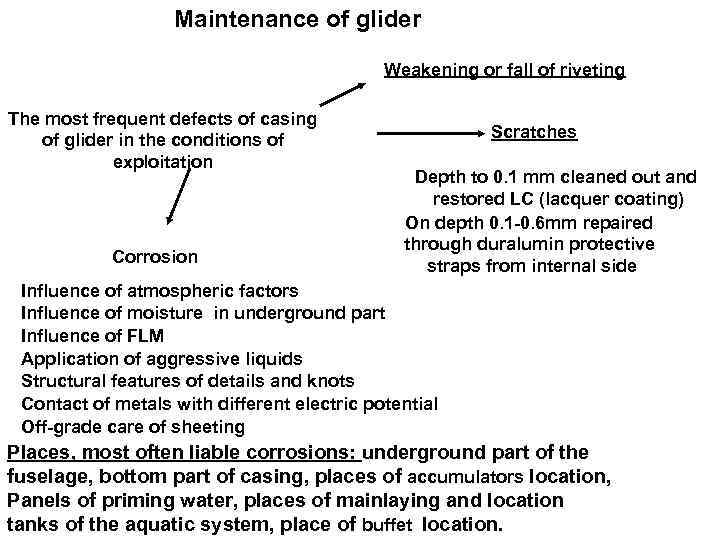 Maintenance of glider Weakening or fall of riveting The most frequent defects of casing of glider in the conditions of exploitation Corrosion Scratches Depth to 0. 1 mm cleaned out and restored LC (lacquer coating) On depth 0. 1 -0. 6 mm repaired through duralumin protective straps from internal side Influence of atmospheric factors Influence of moisture in underground part Influence of FLM Application of aggressive liquids Structural features of details and knots Contact of metals with different electric potential Off-grade care of sheeting Places, most often liable corrosions: underground part of the fuselage, bottom part of casing, places of accumulators location, Panels of priming water, places of mainlaying and location tanks of the aquatic system, place of buffet location.
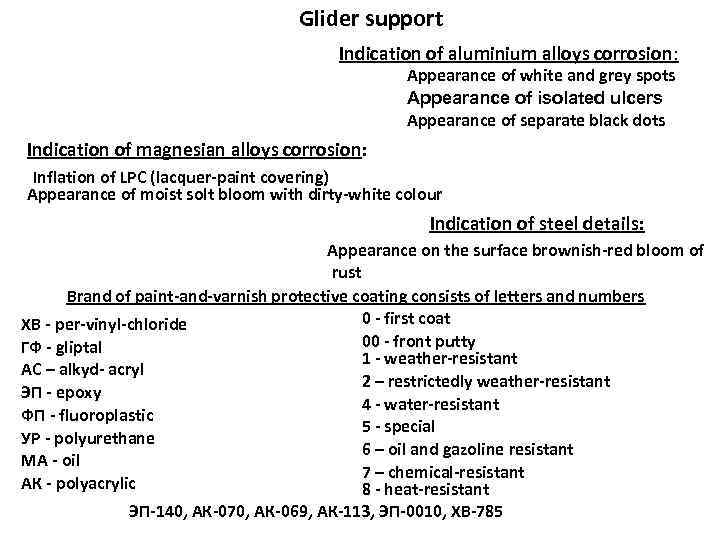 Glider support Indication of aluminium alloys corrosion: Appearance of white and grey spots Appearance of isolated ulcers Appearance of separate black dots Indication of magnesian alloys corrosion: Inflation of LPC (lacquer-paint covering) Appearance of moist solt bloom with dirty-white colour Indication of steel details: Appearance on the surface brownish-red bloom of rust Brand of paint-and-varnish protective coating consists of letters and numbers 0 - first coat ХВ - per-vinyl-chloride 00 - front putty ГФ - gliptal 1 - weather-resistant АС – alkyd- acryl 2 – restrictedly weather-resistant ЭП - epoxy 4 - water-resistant ФП - fluoroplastic 5 - special УР - polyurethane 6 – oil and gazoline resistant МА - oil 7 – chemical-resistant АК - polyacrylic 8 - heat-resistant ЭП-140, АК-070, АК-069, АК-113, ЭП-0010, ХВ-785
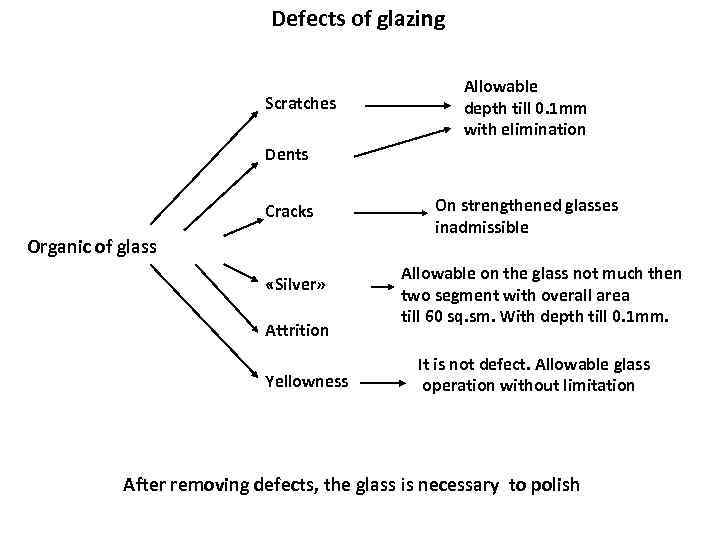 Defects of glazing Scratches Allowable depth till 0. 1 mm with elimination Dents Cracks Organic of glass «Silver» Attrition Yellowness On strengthened glasses inadmissible Allowable on the glass not much then two segment with overall area till 60 sq. sm. With depth till 0. 1 mm. It is not defect. Allowable glass operation without limitation After removing defects, the glass is necessary to polish
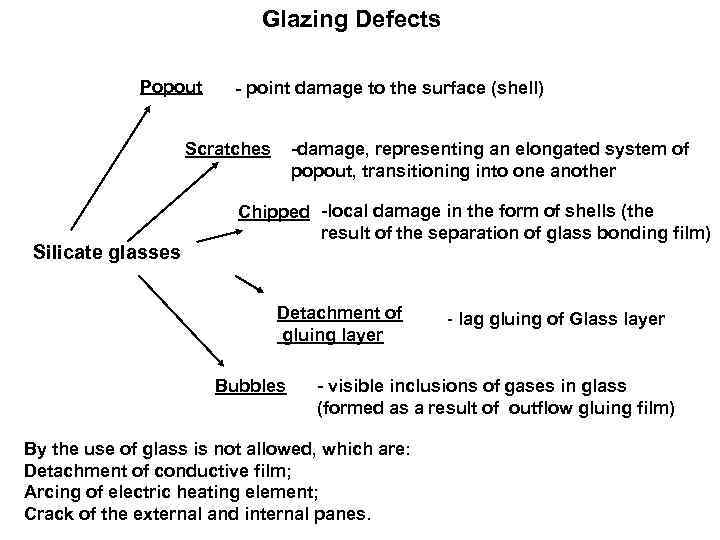 Glazing Defects Popout - point damage to the surface (shell) -damage, representing an elongated system of popout, transitioning into one another Scratches Silicate glasses Chipped -local damage in the form of shells (the result of the separation of glass bonding film) Detachment of gluing layer Bubbles - lag gluing of Glass layer - visible inclusions of gases in glass (formed as a result of outflow gluing film) By the use of glass is not allowed, which are: Detachment of conductive film; Arcing of electric heating element; Crack of the external and internal panes.
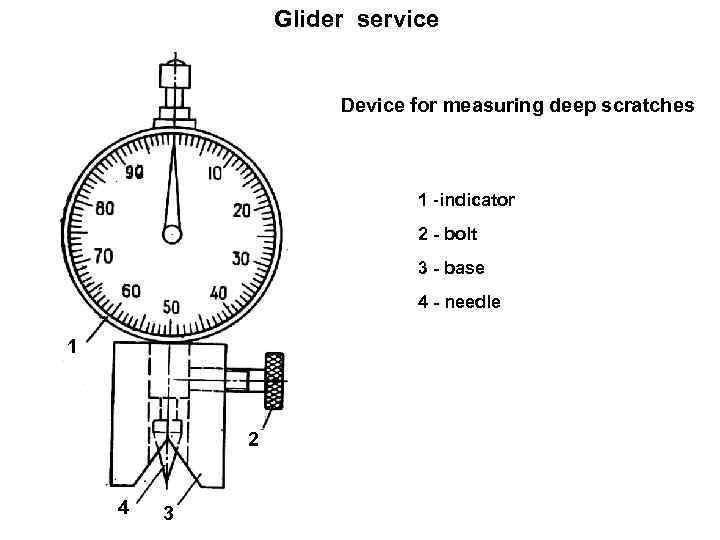 Glider service Device for measuring deep scratches 1 -indicator 2 - bolt 3 - base 4 - needle 1 2 4 3
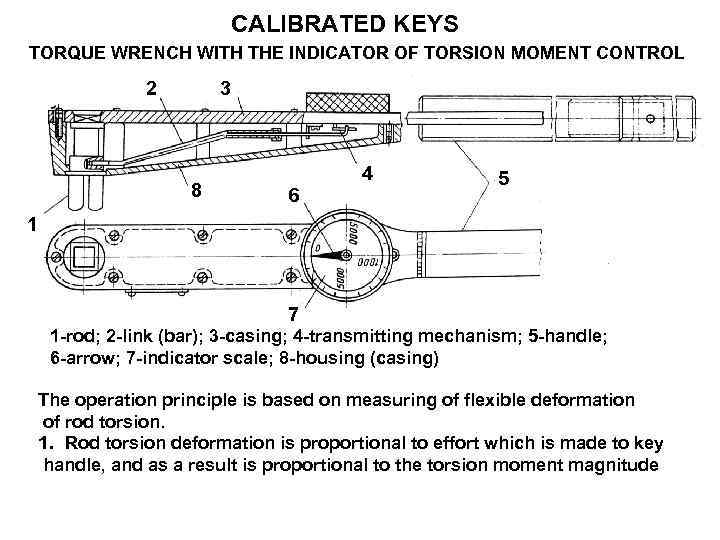 CALIBRATED KEYS TORQUE WRENCH WITH THE INDICATOR OF TORSION MOMENT CONTROL 2 3 8 4 6 5 1 7 1 -rod; 2 -link (bar); 3 -casing; 4 -transmitting mechanism; 5 -handle; 6 -arrow; 7 -indicator scale; 8 -housing (casing) The operation principle is based on measuring of flexible deformation of rod torsion. 1. Rod torsion deformation is proportional to effort which is made to key handle, and as a result is proportional to the torsion moment magnitude
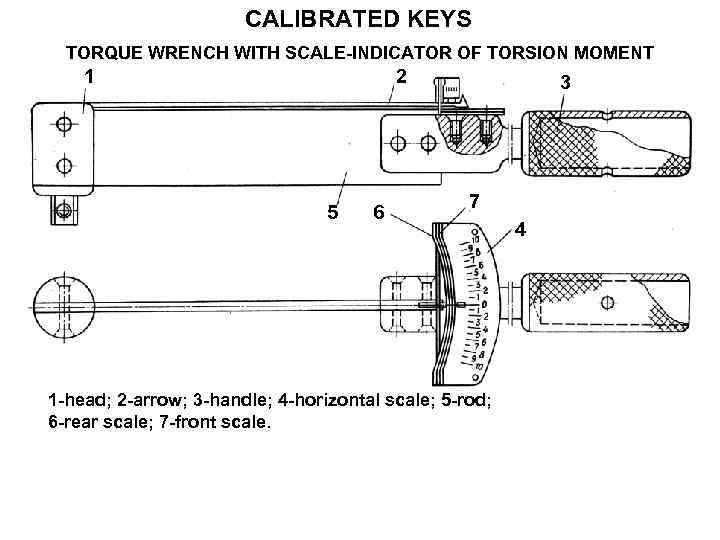 CALIBRATED KEYS TORQUE WRENCH WITH SCALE-INDICATOR OF TORSION MOMENT 1 2 5 6 3 7 1 -head; 2 -arrow; 3 -handle; 4 -horizontal scale; 5 -rod; 6 -rear scale; 7 -front scale. 4
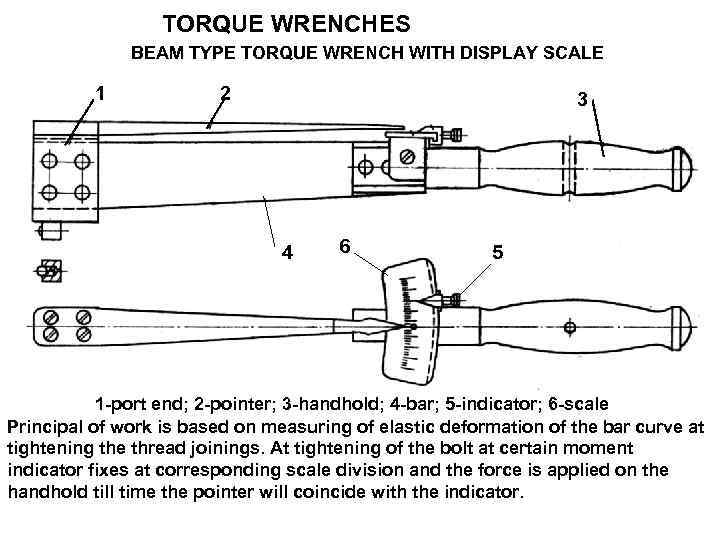 TORQUE WRENCHES BEAM TYPE TORQUE WRENCH WITH DISPLAY SCALE 1 2 3 4 6 5 1 -port end; 2 -pointer; 3 -handhold; 4 -bar; 5 -indicator; 6 -scale Principal of work is based on measuring of elastic deformation of the bar curve at tightening the thread joinings. At tightening of the bolt at certain moment indicator fixes at corresponding scale division and the force is applied on the handhold till time the pointer will coincide with the indicator.
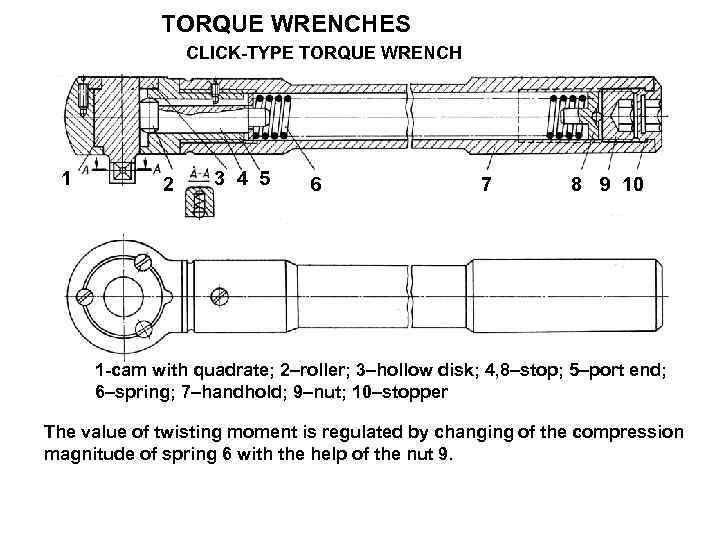 TORQUE WRENCHES CLICK-TYPE TORQUE WRENCH 1 2 3 4 5 6 7 8 9 10 1 -cam with quadrate; 2–roller; 3–hollow disk; 4, 8–stop; 5–port end; 6–spring; 7–handhold; 9–nut; 10–stopper The value of twisting moment is regulated by changing of the compression magnitude of spring 6 with the help of the nut 9.