 Скачать презентацию Instrumental Philanthropy Trade and the Geographical Distribution of
9bbb30e46ddf7ffe9196d439c4d36c41.ppt
- Количество слайдов: 9



Instrumental Philanthropy: Trade and the Geographical Distribution of Foreign Aid Erik Lundsgaarde, Christian Breunig, and Aseem Prakash Department of Political Science University of Washington IPES Inaugural Conference November 18, 2006
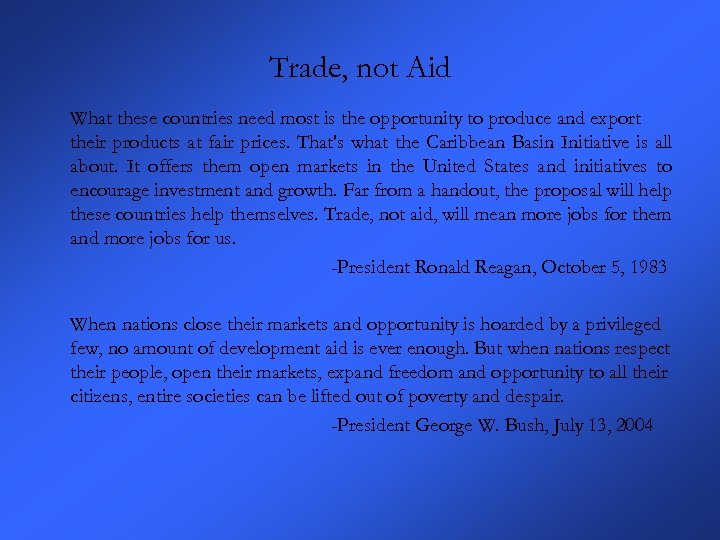
Trade, not Aid What these countries need most is the opportunity to produce and export their products at fair prices. That's what the Caribbean Basin Initiative is all about. It offers them open markets in the United States and initiatives to encourage investment and growth. Far from a handout, the proposal will help these countries help themselves. Trade, not aid, will mean more jobs for them and more jobs for us. -President Ronald Reagan, October 5, 1983 When nations close their markets and opportunity is hoarded by a privileged few, no amount of development aid is ever enough. But when nations respect their people, open their markets, expand freedom and opportunity to all their citizens, entire societies can be lifted out of poverty and despair. -President George W. Bush, July 13, 2004
Main Question Given the perceived development benefits of trade and the shortcomings of aid as a policy instrument, have donors allowed trade to displace aid at the bilateral level? Or, have donors used aid to strengthen commercial ties with recipient countries?
Commercial Interest and Foreign Aid Reasons to suspect that commercial interests drive aid allocations: § Link between aid and export promotion § Aid can support investments made by donor firms in recipient country, strengthen production capacity, improve investment climate § Desire to maintain access to raw materials
Empirical Analysis • Examination of Determinants of Aid Flows from 22 OECD Donor Countries to 187 Recipients from 19802002 • Dependent Variable: Net ODA Flow • Key Independent Variables: – Trade Volume – Per Capita Income, Literacy, External Debt – Freedom House Measures of Political Rights and Civil Liberties – Natural Disasters
Method • Two-stage Heckman Selection Model – Stage 1: Evaluate whether aid flows are likely to occur at all (Probit) – Stage 2: How much aid is allocated to countries that receive aid (OLS) – In selection stage, instruments used are Colony, Language, and Distance – Lagged DV included – Explanatory variables also lagged
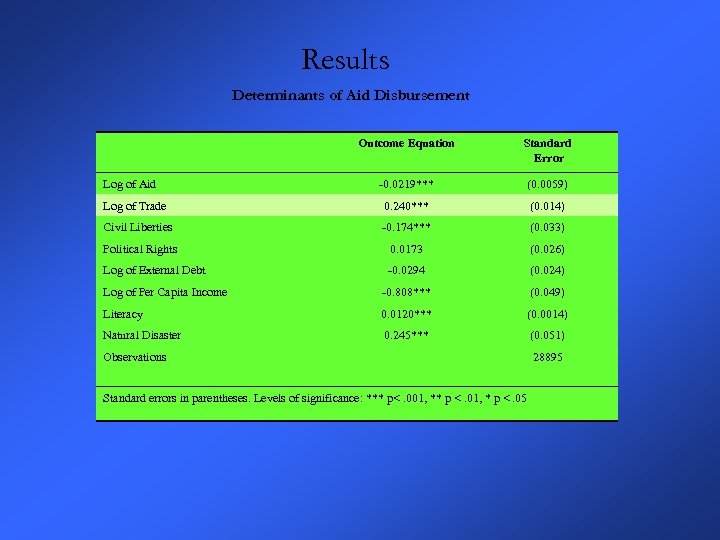
Results Determinants of Aid Disbursement Outcome Equation Standard Error -0. 0219*** (0. 0059) Log of Trade 0. 240*** (0. 014) Civil Liberties -0. 174*** (0. 033) Political Rights 0. 0173 (0. 026) Log of External Debt -0. 0294 (0. 024) Log of Per Capita Income -0. 808*** (0. 049) Literacy 0. 0120*** (0. 0014) Natural Disaster 0. 245*** (0. 051) Log of Aid Observations Standard errors in parentheses. Levels of significance: *** p<. 001, ** p <. 01, * p <. 05 28895
Extensions Are there notable variations across regions in donor motivations for providing aid? How do the commercial motivations of individual donors compare? How has the influence of commercial interest over aid policy evolved over time?
Conclusion • • Donors privilege recipients with which they have stronger commercial ties A potentially mutually advantageous situation for donors and recipients However, raises questions about how countries disadvantaged in global trade networks can attract capital Aid may accentuate rather than diminish intercountry inequalities in developing world
Скачать презентацию Instrumental Philanthropy Trade and the Geographical Distribution of
9bbb30e46ddf7ffe9196d439c4d36c41.ppt