 Скачать презентацию Instructions for use Below is a copy of
46fbe72e5bb4545f783cf877c68c992e.ppt
- Количество слайдов: 193



Instructions for use Below is a copy of the training presentation delivered at the Spring into summer 2013 training series for new to role exams officers. We suggest you use this presentation to disseminate information to relevant colleagues within your centre by either: § sending them the link to the slide set on the EDSU website; § emailing them a copy of the slides only relevant to them; § or using this Power. Point presentation to deliver your own training/information session. Please be aware that the presenter notes found in this presentation are to provide further information about the slide (for the benefit of the presenter) but have not been proofed or had the acronyms expanded.
Spring into summer 2013 Training for new exams officers
Welcome and introduction Continuity presenter EDSU
Induction programme Support available for new to role exams officers: § § § CSO support Induction handbook Training events EDSU email updates EDSU website and news
Following the induction programme Your ongoing support will now be provided by your awarding organisation(s), the JCQ and the EOA § EDSU will contact you periodically to ensure that the information we hold regarding your centre is kept up-to-date § The CSOs provide advice and signposting to relevant resources and tools. Support is available by phone or email on: – 0300 100 0100 – EDSU@education. gov. uk § You can also still receive information via: • EDSU email updates • EDSU website and news
Today’s objectives § § § To give you an overview of the exams cycle Provide presentations around key processes for this term Provide key deadlines for this period Give hints and tips on how to prepare for these deadlines To provide contact information to encourage networking To give you confidence to manage and administer exams in your centre
Format of workbook Split into sections of the exam cycle Each section has space for notes: § Key points § What is ‘new to you’ § Actions for when back in centre Includes activities

Developed by:
Activities at tables Introduce yourself Name RM
Your exams community Name EOA
Your exam community Today – meet and make contacts from around your table Keep in touch using the EOA’s Local Network Tool Use My Exam Office Year (MEOY) to support you in your role § helps you with your various tasks § complies with all awarding organisations and JCQ practices and procedures Join your own profession’s organisation – EOA § www. examofficers. org. uk
Activities at tables Activity 1: Spring checklist Name EOA
Activity 1 - Instructions Turn to page 5 Discuss with your table and facilitator how you are progressing with the specified activities You have 10 minutes
The exams cycle Continuity Presenter EDSU
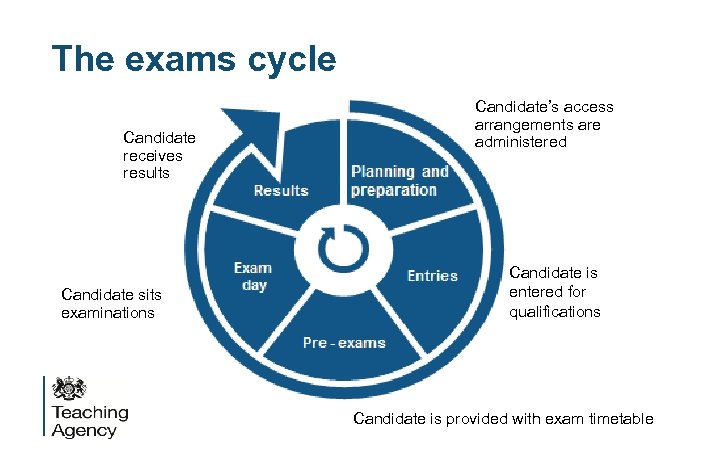
The exams cycle Candidate receives results Candidate sits examinations Candidate’s access arrangements are administered Candidate is entered for qualifications Candidate is provided with exam timetable
Exams cycle Planning Continuity Presenter EDSU
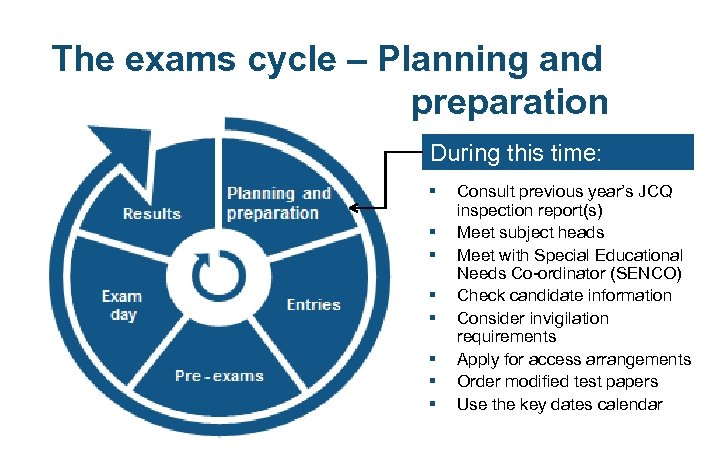
The exams cycle – Planning and preparation During this time: § § § § Consult previous year’s JCQ inspection report(s) Meet subject heads Meet with Special Educational Needs Co-ordinator (SENCO) Check candidate information Consider invigilation requirements Apply for access arrangements Order modified test papers Use the key dates calendar
Planning § EDSU – Induction handbook – Good practice – Diploma checklist § Key dates – Key dates calendar – JCQ calendar – Awarding organisations’ websites – BBC faith calendar § The EOA’s My Exam Office Year (MEOY)
What should have been done? § Modified papers and access arrangements § Invigilation recruitment § Contingency planning § Planning and preparation for summer series e. g. rooming
Exams cycle Entries Continuity Presenter EDSU
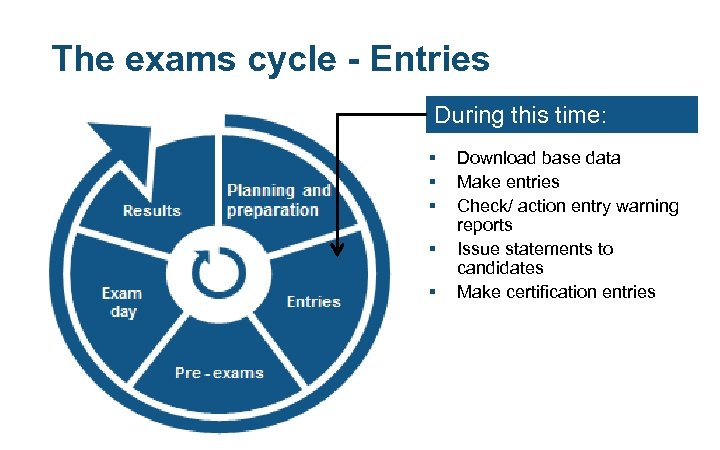
The exams cycle - Entries During this time: § § § Download base data Make entries Check/ action entry warning reports Issue statements to candidates Make certification entries
Entries Estimated entries § Provide an early estimate to the awarding organisations of how many candidates you expect will be sitting each exam Final entries § A final confirmation of how many candidates are entering each exam § You provide detailed data for each candidate
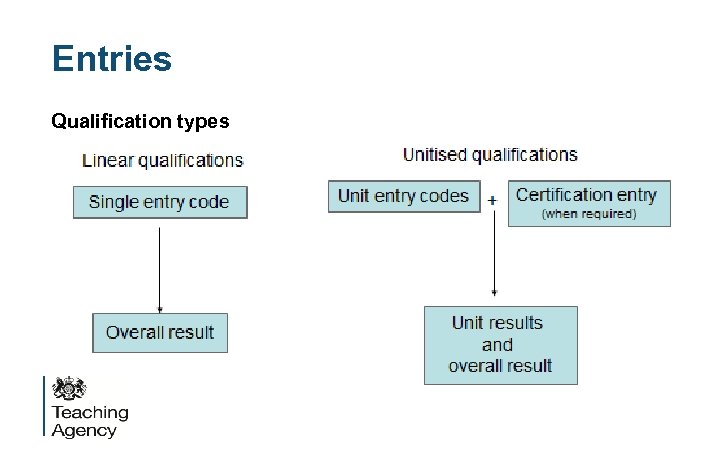
Entries Qualification types
Certification/cash-in All unitised qualifications have certification entry codes (e. g. GCSE, GCE) A certification entry should be made when a candidate requires a final qualification grade
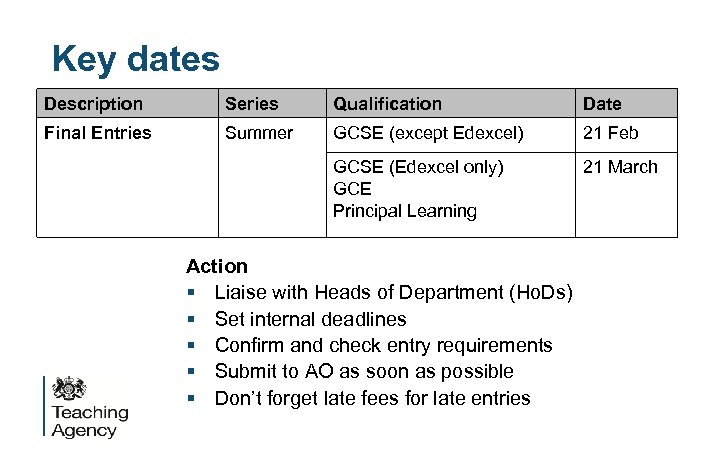
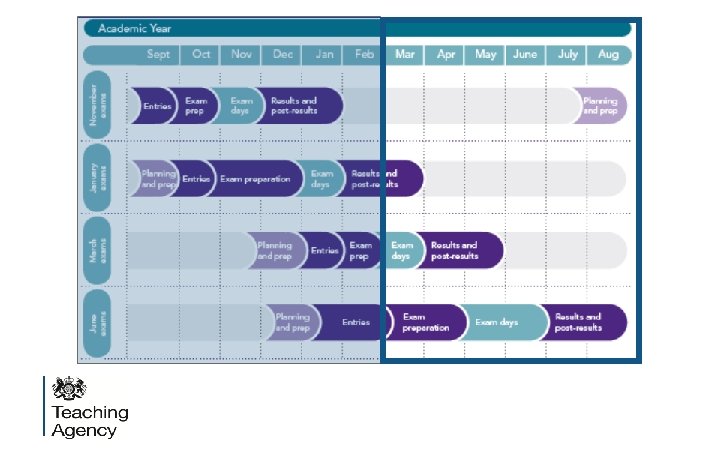
Key dates Description Series Qualification Date Final Entries Summer GCSE (except Edexcel) 21 Feb GCSE (Edexcel only) GCE Principal Learning 21 March Action § Liaise with Heads of Department (Ho. Ds) § Set internal deadlines § Confirm and check entry requirements § Submit to AO as soon as possible § Don’t forget late fees for late entries
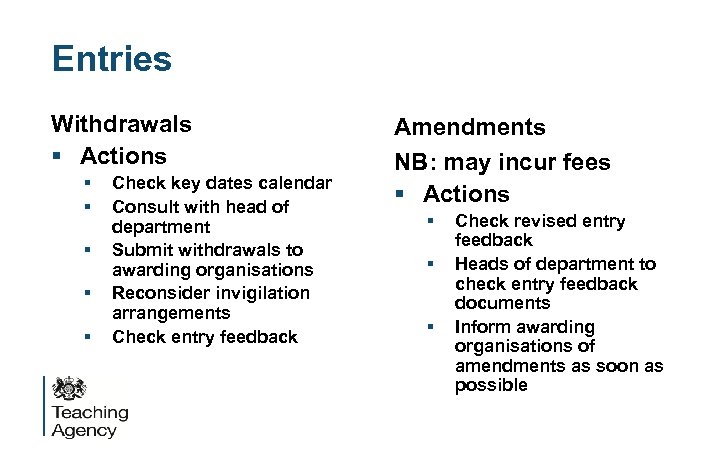
Entries Withdrawals § Actions § § § Check key dates calendar Consult with head of department Submit withdrawals to awarding organisations Reconsider invigilation arrangements Check entry feedback Amendments NB: may incur fees § Actions § § § Check revised entry feedback Heads of department to check entry feedback documents Inform awarding organisations of amendments as soon as possible
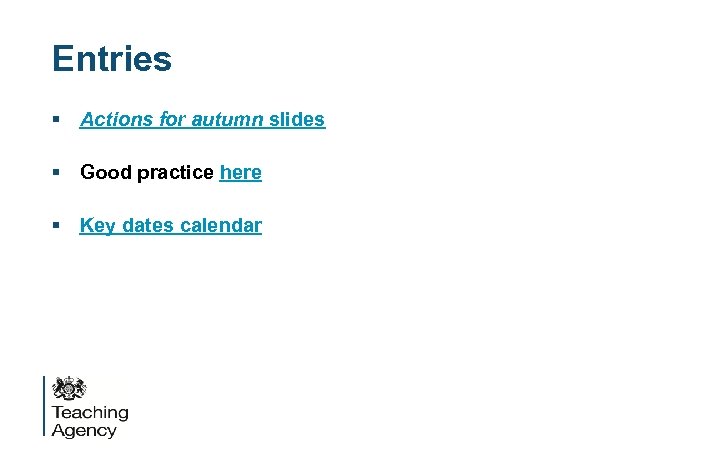
Entries § Actions for autumn slides § Good practice here § Key dates calendar
Activities at tables Activity 2: Entries Name ESDU
Activity 2 - Instructions There are five scenarios on page 9 You do not have to complete them all. Your facilitator will split you into groups and allocate two scenarios for you to discuss You have 15 minutes
Activity 2 - Solutions Aims of this activity were for EOs to: § Be prepared for issues related to making entries § Begin to consider incorporating contingency measures when making entries § Be proactive when making entries and to ensure planning which mitigates against potential issues To be aware that awarding organisations will do their very best to help resolve a situation before it affects the candidate.

Break
Entries Entry Warning Reports Continuity Presenter OCR
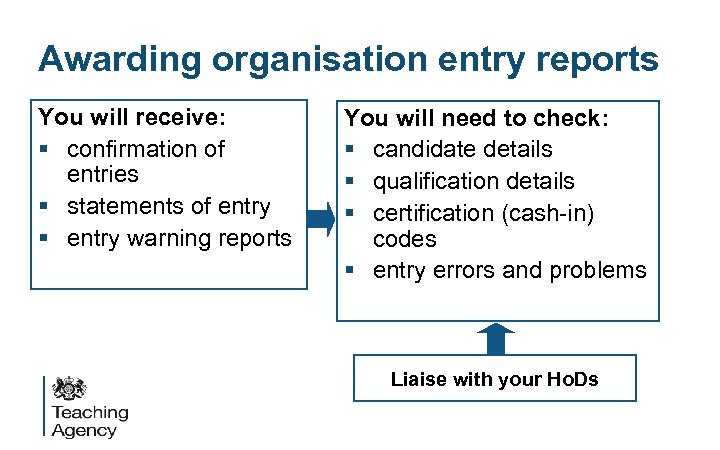
Awarding organisation entry reports You will receive: § confirmation of entries § statements of entry § entry warning reports You will need to check: § candidate details § qualification details § certification (cash-in) codes § entry errors and problems Liaise with your Ho. Ds
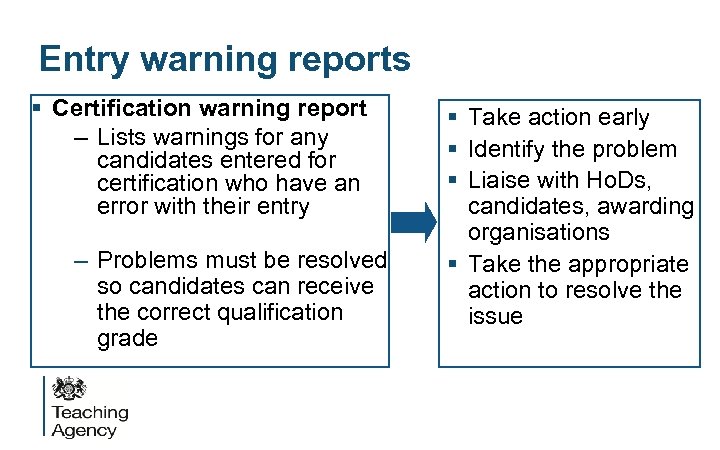
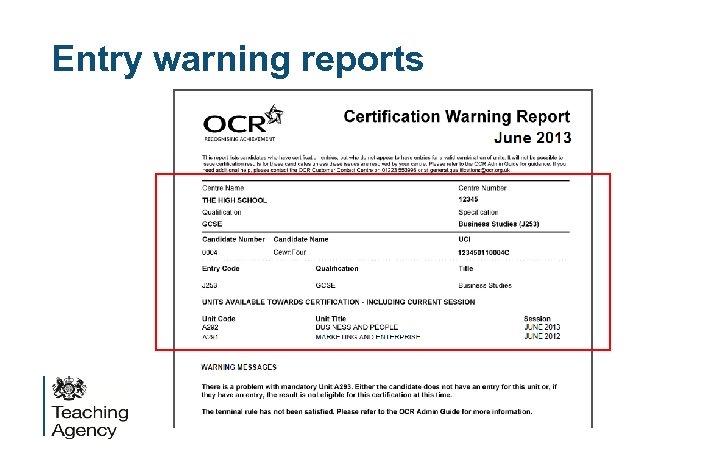
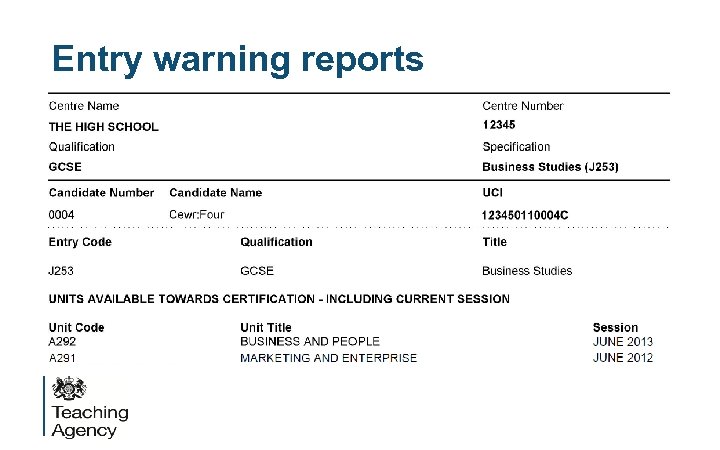
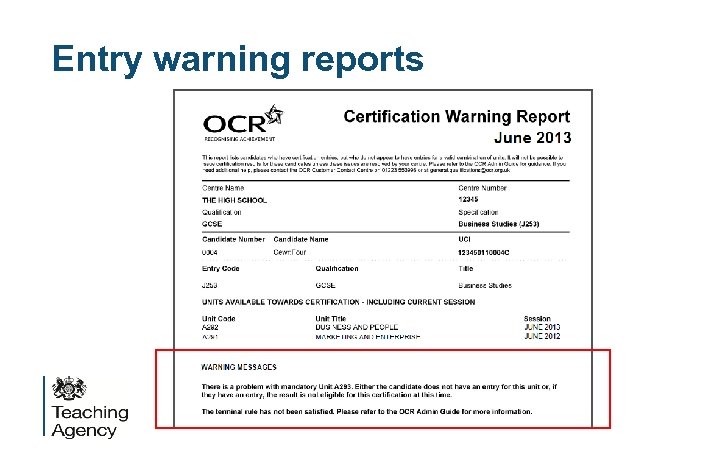
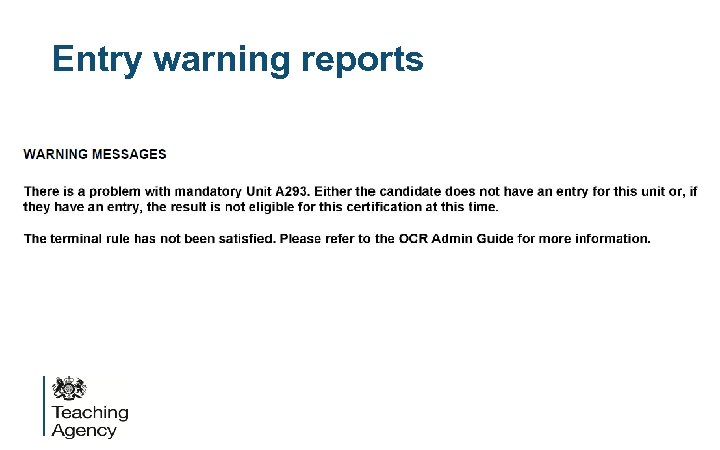
Entry warning reports § Certification warning report – Lists warnings for any candidates entered for certification who have an error with their entry – Problems must be resolved so candidates can receive the correct qualification grade § Take action early § Identify the problem § Liaise with Ho. Ds, candidates, awarding organisations § Take the appropriate action to resolve the issue
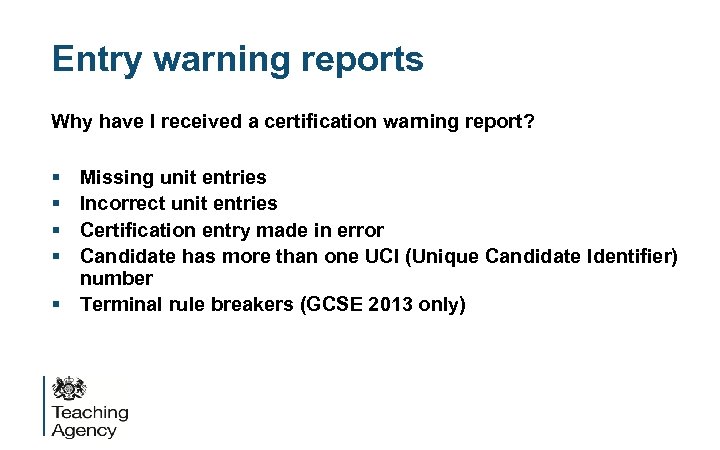
Entry warning reports Why have I received a certification warning report? § § Missing unit entries Incorrect unit entries Certification entry made in error Candidate has more than one UCI (Unique Candidate Identifier) number § Terminal rule breakers (GCSE 2013 only)
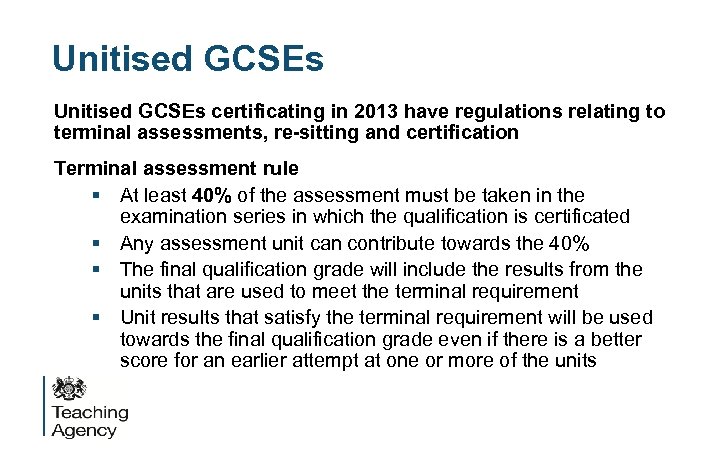
Unitised GCSEs certificating in 2013 have regulations relating to terminal assessments, re-sitting and certification Terminal assessment rule § At least 40% of the assessment must be taken in the examination series in which the qualification is certificated § Any assessment unit can contribute towards the 40% § The final qualification grade will include the results from the units that are used to meet the terminal requirement § Unit results that satisfy the terminal requirement will be used towards the final qualification grade even if there is a better score for an earlier attempt at one or more of the units
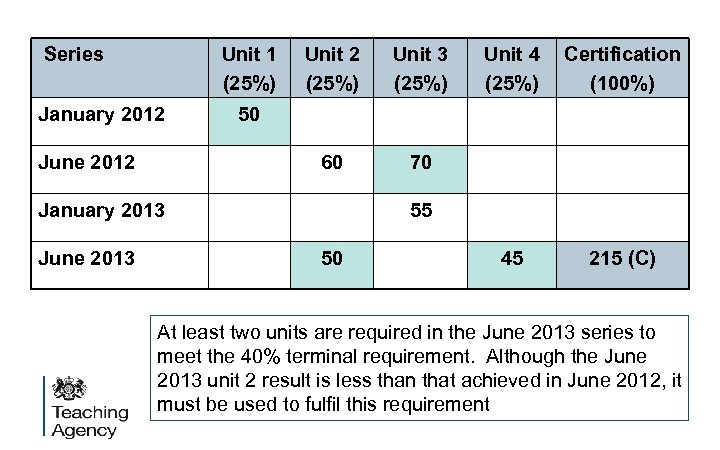
Series Unit 1 (25%) June 2012 Unit 3 (25%) 60 January 2012 Unit 2 (25%) Certification (100%) 70 45 215 (C) 50 January 2013 June 2013 Unit 4 (25%) 55 50 At least two units are required in the June 2013 series to meet the 40% terminal requirement. Although the June 2013 unit 2 result is less than that achieved in June 2012, it must be used to fulfil this requirement
Entry warning reports
Entry warning reports
Entry warning reports
Entry warning reports
Entry warning reports Certification warning reports Reports differ between awarding organisations § Presentation § Language However, the content is essentially the same
Activities at tables Activity 3: Certification warning reports Name OCR
Activity 3 - Instructions Answer the questions on page 10 and 11 Use the table on page 10 and the certification warning report on page 11 to help you answer the questions You have 5 minutes
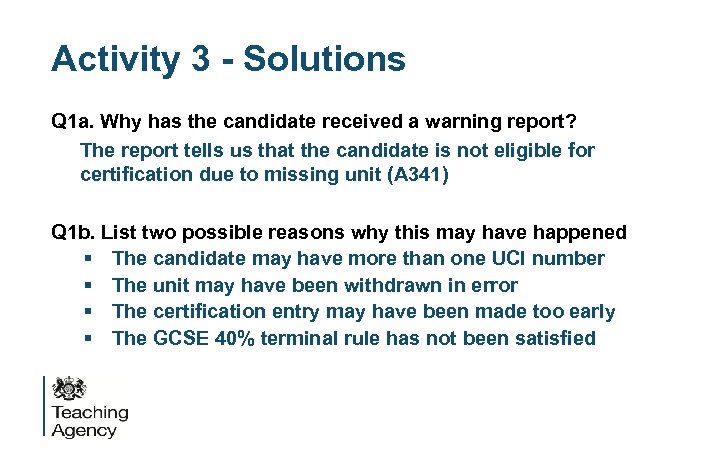
Activity 3 - Solutions Q 1 a. Why has the candidate received a warning report? The report tells us that the candidate is not eligible for certification due to missing unit (A 341) Q 1 b. List two possible reasons why this may have happened § The candidate may have more than one UCI number § The unit may have been withdrawn in error § The certification entry may have been made too early § The GCSE 40% terminal rule has not been satisfied
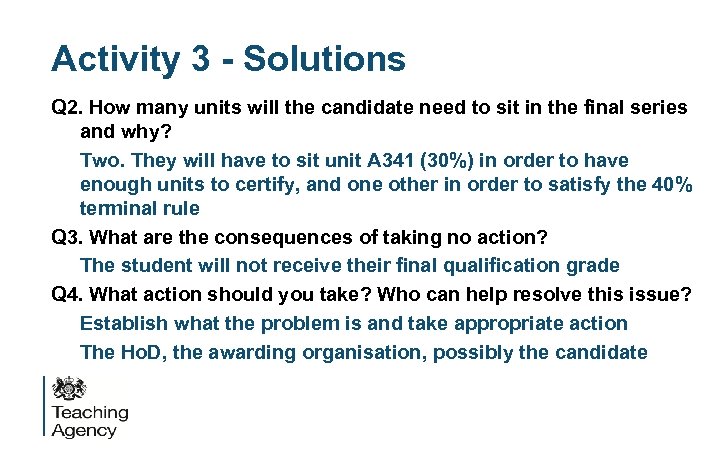
Activity 3 - Solutions Q 2. How many units will the candidate need to sit in the final series and why? Two. They will have to sit unit A 341 (30%) in order to have enough units to certify, and one other in order to satisfy the 40% terminal rule Q 3. What are the consequences of taking no action? The student will not receive their final qualification grade Q 4. What action should you take? Who can help resolve this issue? Establish what the problem is and take appropriate action The Ho. D, the awarding organisation, possibly the candidate
Entries Recap Continuity Presenter EDSU
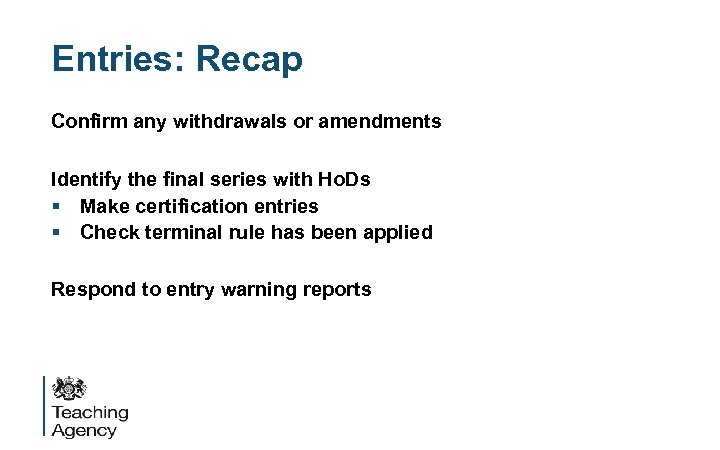
Entries: Recap Confirm any withdrawals or amendments Identify the final series with Ho. Ds § Make certification entries § Check terminal rule has been applied Respond to entry warning reports
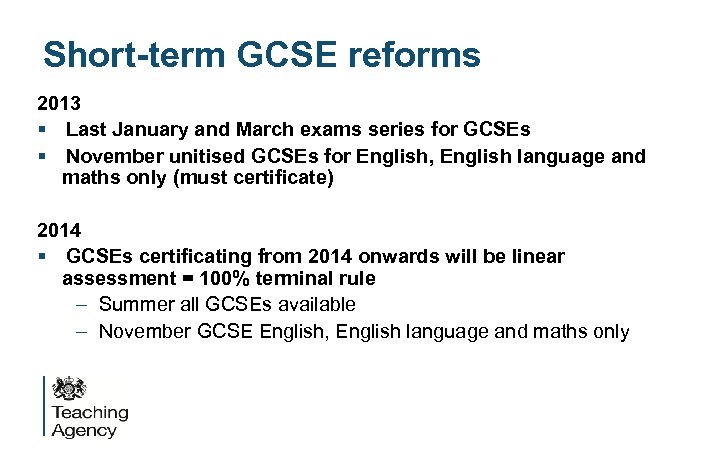
Short-term GCSE reforms 2013 § Last January and March exams series for GCSEs § November unitised GCSEs for English, English language and maths only (must certificate) 2014 § GCSEs certificating from 2014 onwards will be linear assessment = 100% terminal rule – Summer all GCSEs available – November GCSE English, English language and maths only
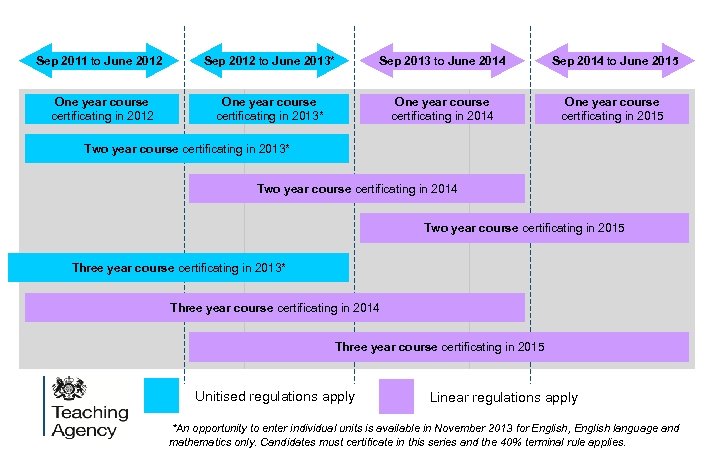
Sep 2011 to June 2012 Sep 2012 to June 2013* Sep 2013 to June 2014 Sep 2014 to June 2015 One year course certificating in 2012 One year course certificating in 2013* One year course certificating in 2014 One year course certificating in 2015 Two year course certificating in 2013* Two year course certificating in 2014 Two year course certificating in 2015 Three year course certificating in 2013* Three year course certificating in 2014 Three year course certificating in 2015 Unitised regulations apply Linear regulations apply *An opportunity to enter individual units is available in November 2013 for English, English language and mathematics only. Candidates must certificate in this series and the 40% terminal rule applies.
Exams cycle Pre-exams Continuity Presenter EDSU
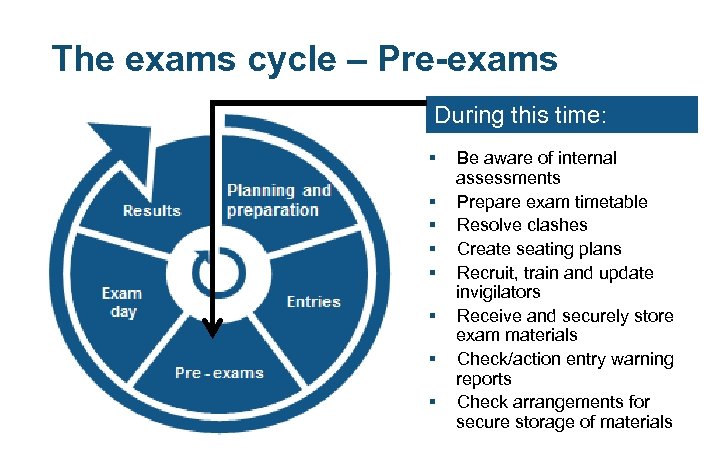
The exams cycle – Pre-exams During this time: § § § § Be aware of internal assessments Prepare exam timetable Resolve clashes Create seating plans Recruit, train and update invigilators Receive and securely store exam materials Check/action entry warning reports Check arrangements for secure storage of materials
Pre-exams - Resources EDSU § Online examinations timetable, as an alternative to use of a management information system (MIS) § Good practice online JCQ § Instructions for conducting examinations (ICE) § Instructions for conducting controlled assessment § Instructions for conducting coursework Awarding organisations’ entry manuals
Pre-Exams Timetabling, clashes and rooming Continuity Presenter OCR
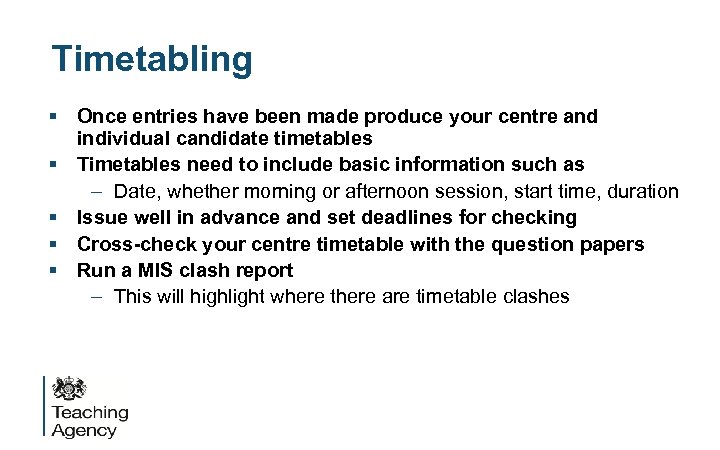
Timetabling § Once entries have been made produce your centre and individual candidate timetables § Timetables need to include basic information such as – Date, whether morning or afternoon session, start time, duration § Issue well in advance and set deadlines for checking § Cross-check your centre timetable with the question papers § Run a MIS clash report – This will highlight where there are timetable clashes
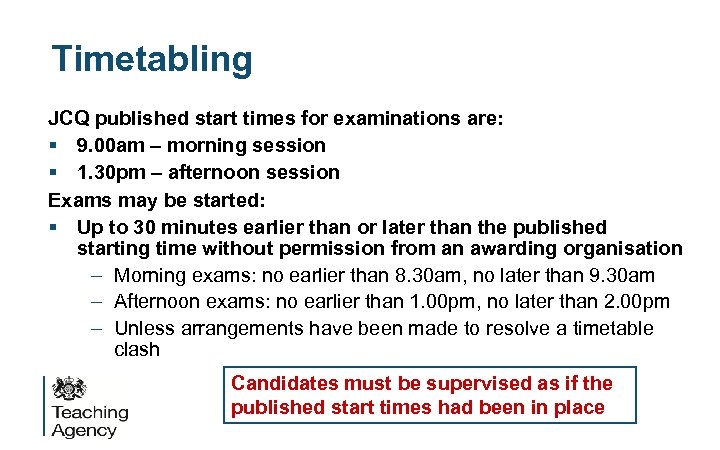
Timetabling JCQ published start times for examinations are: § 9. 00 am – morning session § 1. 30 pm – afternoon session Exams may be started: § Up to 30 minutes earlier than or later than the published starting time without permission from an awarding organisation – Morning exams: no earlier than 8. 30 am, no later than 9. 30 am – Afternoon exams: no earlier than 1. 00 pm, no later than 2. 00 pm – Unless arrangements have been made to resolve a timetable clash Candidates must be supervised as if the published start times had been in place
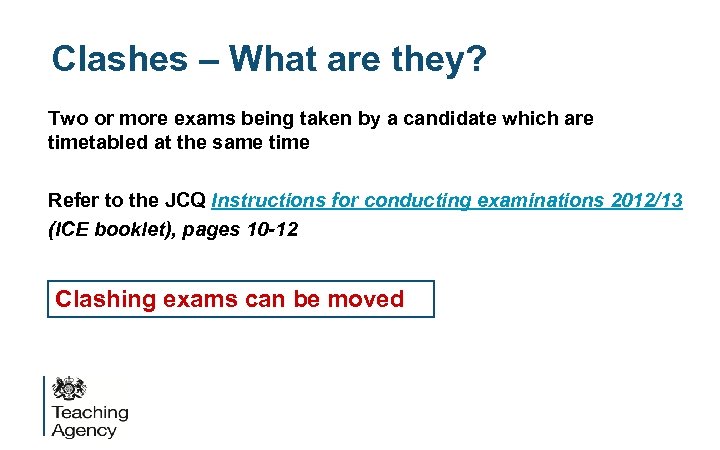
Clashes – What are they? Two or more exams being taken by a candidate which are timetabled at the same time Refer to the JCQ Instructions for conducting examinations 2012/13 (ICE booklet), pages 10 -12 Clashing exams can be moved
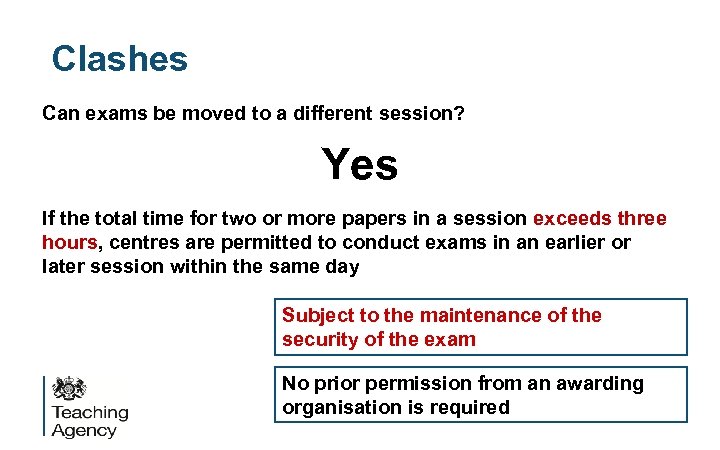
Clashes Can exams be moved to a different session? Yes If the total time for two or more papers in a session exceeds three hours, centres are permitted to conduct exams in an earlier or later session within the same day Subject to the maintenance of the security of the exam No prior permission from an awarding organisation is required
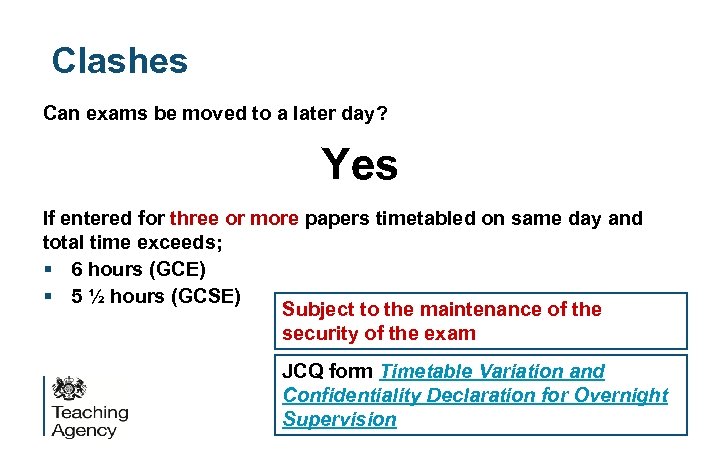
Clashes Can exams be moved to a later day? Yes If entered for three or more papers timetabled on same day and total time exceeds; § 6 hours (GCE) § 5 ½ hours (GCSE) Subject to the maintenance of the security of the exam JCQ form Timetable Variation and Confidentiality Declaration for Overnight Supervision
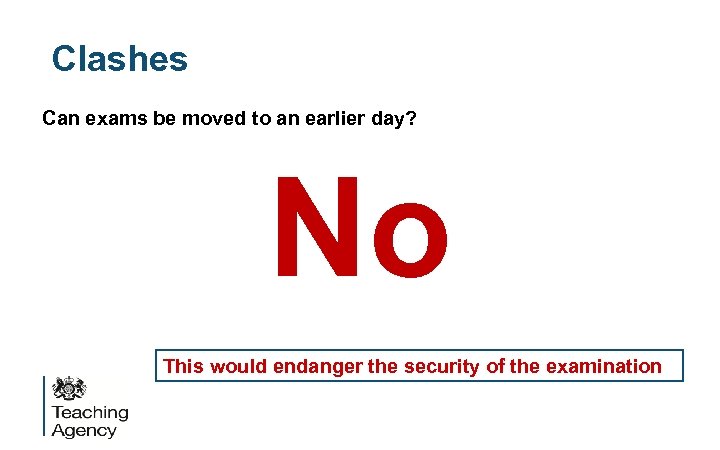
Clashes Can exams be moved to an earlier day? No This would endanger the security of the examination
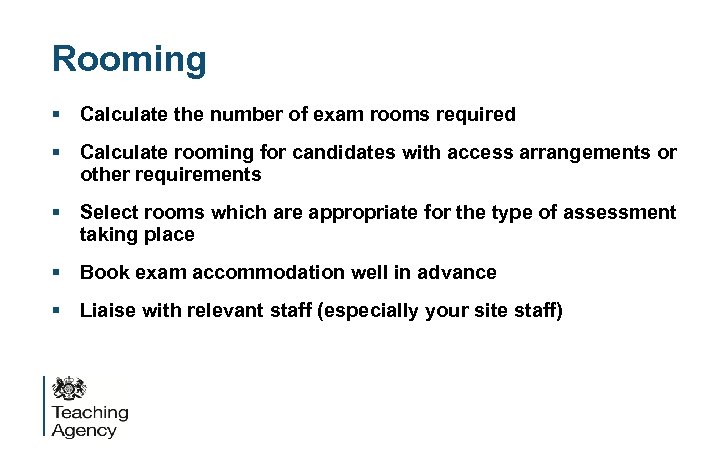
Rooming § Calculate the number of exam rooms required § Calculate rooming for candidates with access arrangements or other requirements § Select rooms which are appropriate for the type of assessment taking place § Book exam accommodation well in advance § Liaise with relevant staff (especially your site staff)
Rooming § Rooms must provide candidates with appropriate conditions for taking the exam § Each exam room needs to be set up in accordance with the JCQ Instructions for conducting examinations § Make sure you have sufficient invigilators – Build clash supervision into your invigilator planning § A seating plan must be created for each exam room
Seating plans – Consider and plan § The best way to seat candidates in each room – What is the room layout and capacity? – What exams are running? – Are there any candidates with access arrangements or other requirements? – Have you any clash candidates? § How to publish and display the seating plans in advance § How to brief your invigilators before the start of the exam
Who can be in the exam room? Only those members of staff authorised by the head of centre and agreed with the examinations officer should be present in the examination room Refer to JCQ Notice to Centres – The people present in the examination room (Instructions for conducting examinations 2012/13, page 58)
Further information JCQ § Instructions for conducting examinations 2012/13 – Timetabling: pages 8 -9 – Timetable variations: pages 10 -12 – Accommodation: pages 14 -16 – Invigilation: pages 17 -20, 43 -44 § General regulations for approved centres EDSU § Induction handbook § Exam room checklist § Invigilation materials
Activities at tables Activity 4: Rooming, clashes and invigilation Name OCR
Activity 4 - Instructions Use the information in your workbook on page 13 to work through parts A and B of the activity You will be asked to attempt; § a centre floor plan § a seating plan You have 20 minutes
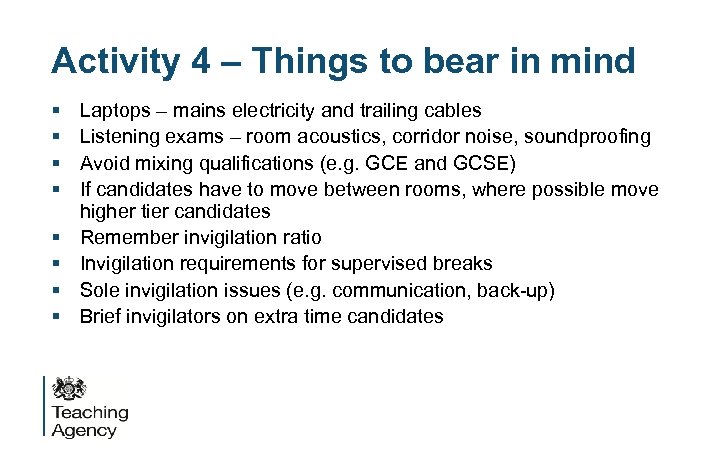
Activity 4 – Things to bear in mind § § § § Laptops – mains electricity and trailing cables Listening exams – room acoustics, corridor noise, soundproofing Avoid mixing qualifications (e. g. GCE and GCSE) If candidates have to move between rooms, where possible move higher tier candidates Remember invigilation ratio Invigilation requirements for supervised breaks Sole invigilation issues (e. g. communication, back-up) Brief invigilators on extra time candidates
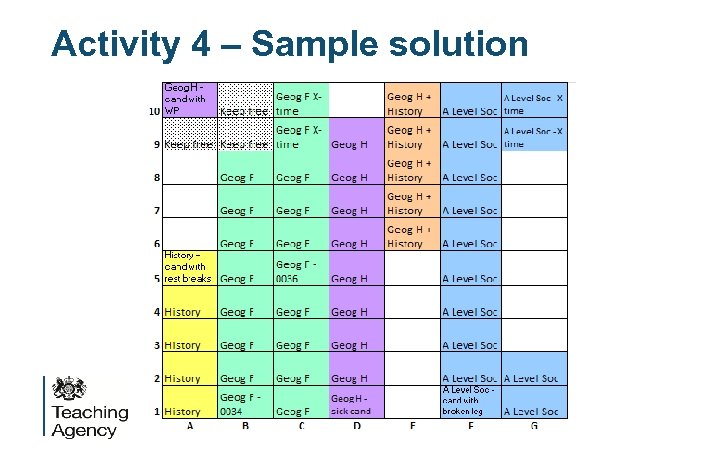
Activity 4 – Sample solution
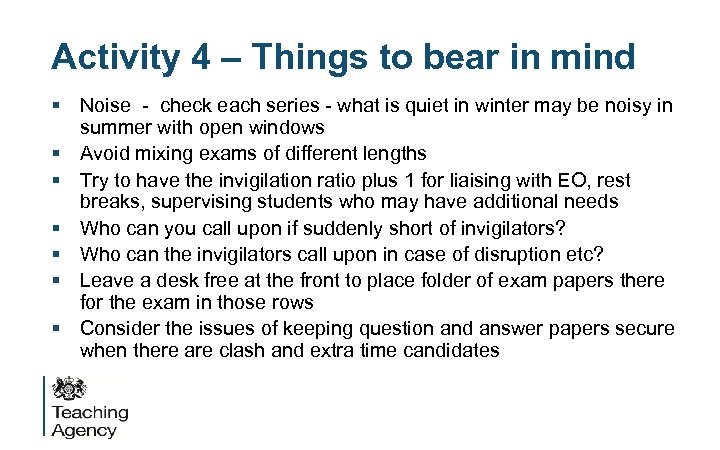
Activity 4 – Things to bear in mind § Noise - check each series - what is quiet in winter may be noisy in summer with open windows § Avoid mixing exams of different lengths § Try to have the invigilation ratio plus 1 for liaising with EO, rest breaks, supervising students who may have additional needs § Who can you call upon if suddenly short of invigilators? § Who can the invigilators call upon in case of disruption etc? § Leave a desk free at the front to place folder of exam papers there for the exam in those rows § Consider the issues of keeping question and answer papers secure when there are clash and extra time candidates

Lunch
Welcome back
Assessment materials Continuity Presenter WJEC
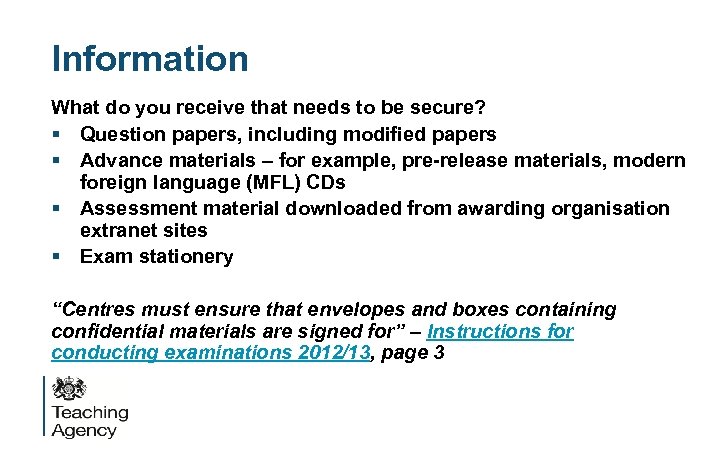
Information What do you receive that needs to be secure? § Question papers, including modified papers § Advance materials – for example, pre-release materials, modern foreign language (MFL) CDs § Assessment material downloaded from awarding organisation extranet sites § Exam stationery “Centres must ensure that envelopes and boxes containing confidential materials are signed for” – Instructions for conducting examinations 2012/13, page 3
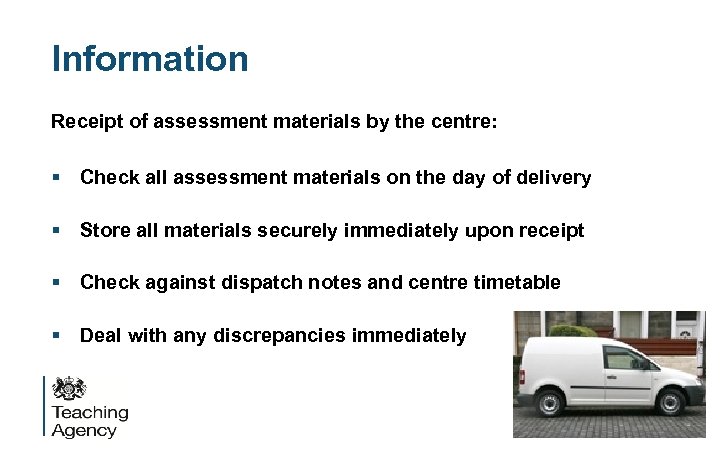
Information Receipt of assessment materials by the centre: § Check all assessment materials on the day of delivery § Store all materials securely immediately upon receipt § Check against dispatch notes and centre timetable § Deal with any discrepancies immediately
Information § All exam stationery and materials must be stored securely at all times § Unauthorised persons must not have access to such materials § All confidential materials which may be opened in advance should be stored securely, including; – Instructions for practical exams – Pre-recorded items which must be tested as instructed by awarding organisations – Electronic exam material
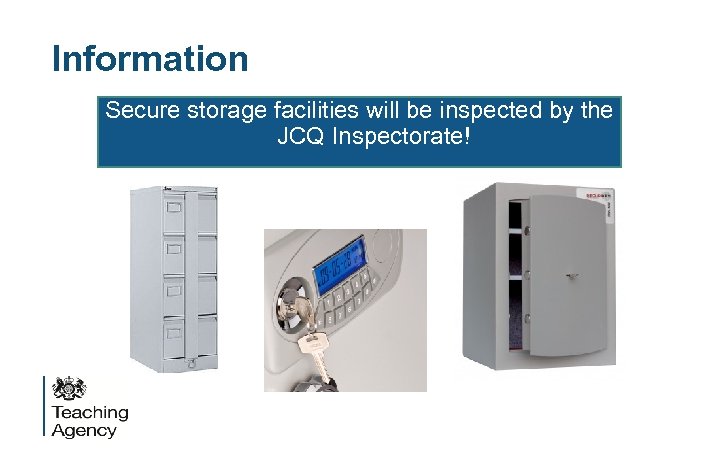
Information Secure storage facilities will be inspected by the JCQ Inspectorate!
Summary § Storage facilities must comply with JCQ requirements § Ensure a system is in place to log any assessment materials in and out of secure storage § Ensure paper security during the exam day, e. g. opening times, opening in front of candidates etc. § Ensure appropriate storage of completed scripts that have to be stored overnight § Check the exams policy is up to date regarding the security of assessment materials
Activities at tables Activity 5: Secure arrangements assessment Name WJEC
Activity 5 - Instructions Read each scenario on pages 19 to 21 For each, consider what is most likely to happen in your centre Select from A, B or C You have 10 minutes
Activity 5 - Solutions Answer ‘C’ reflects the correct application of JCQ regulations Where you answered ‘A’ you must take action to improve security arrangements in your centre Where you answered ‘B’ you need to check to see if security arrangements can be improved
Pre-exams Access arrangements Continuity Presenter JCQ
Access arrangements What are they? § Access arrangements are agreed before an assessment § They allow candidates with special educational needs, disabilities or temporary injuries to access exams § They allow candidates to show what they know and can do without changing the demands of the assessment § They should reflect the candidate’s normal way of working within the centre For more information, download the Actions for autumn slides
Access arrangements Top three approved access arrangements 2011 -2012 § Extra time of up to 25% § Reader § Scribe 90% of all applications processed online relate to extra time of up to 25%, readers and scribes Chapter 2 of the JCQ Access Arrangements, Reasonable Adjustments and Special Consideration 2012/13
Access arrangements Extra time of up to 25% § For candidates with a learning difficulty or disability § Liaise with your SENCO who will provide you with a list of all candidates eligible for extra time § Ensure that appropriate timetabling, rooming and invigilation arrangements are in place
Access arrangements Readers – some reminders § Your SENCO will decide which candidates require 1: 1 reading assistance § Your SENCO will decide whether a reader reading to 3 or 4 candidates would work § Your SENCO may consider alternatives such as a computer reader, read aloud or a modified language paper If the candidate and reader are accommodated in a separate room you must allocate a separate invigilator and ensure the JCQ notices are displayed appropriately.
Access arrangements Scribes – some reminders § A scribe cannot be shared § As an alternative to a scribe, your SENCO may consider alternatives such as a word processor, a word processor with the spelling and grammar check facility switched on (a scribe) or voice activated software If the candidate and scribe are accommodated in a separate room you must allocate a separate invigilator and ensure the JCQ notices are displayed as appropriate.
Access arrangements Word processors § The centre must decide whether a candidate may use a word processor in his/her examinations § Must reflect the candidate's normal way of working in the centre, maybe in some or all of their subjects § You may need a separate room and invigilator
Access arrangements Word processors – some reminders § Candidates cannot bring a word processor from home for use in external assessments § The word processor must meet the requirements of the JCQ Instructions for conducting examinations § At the end of the examination you must complete JCQ Form 4 and attach it to the candidate’s typed script § You may wish to consider having a centre policy for the use of word processors
Access arrangements Applications for access arrangements must be processed through Access arrangements online (AAO) § AAO enables centres to make a single application for a candidate requiring access arrangements § You may use any of the awarding organisations’ extranet sites to gain access to AAO § AAO will provide you with an instant response § Can be referred to an awarding organisation if an application is refused
Access arrangements AAO – a reminder § Use AAO to identify accommodation and invigilation requirements § Use AAO to generate pre-populated cover sheets where required See page 39 of the JCQ Access Arrangements, Reasonable Adjustments and Special Consideration 2012/13 for details of access arrangements that may be granted by the centre which do not need to be recorded.
Pre-exams Recap Continuity Presenter EDSU
Pre-exams: recap § Check timetable for clashes § Rooming – Invigilators – Appropriate accommodation – Site staff § Secure storage of materials § Access arrangements
Exams cycle Exam day Continuity Presenter EDSU
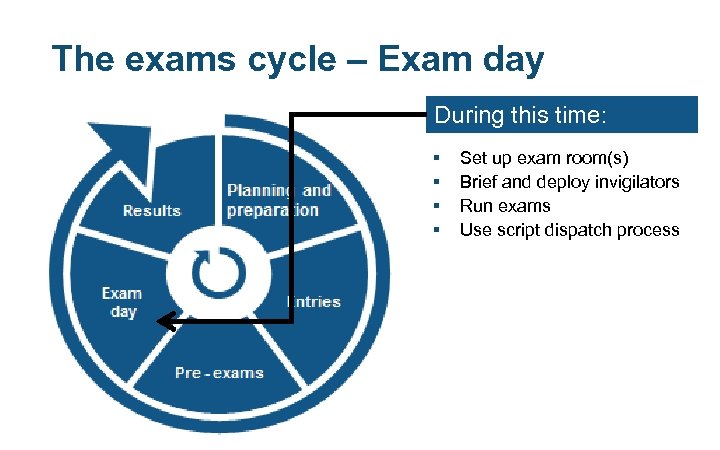
The exams cycle – Exam day During this time: § § Set up exam room(s) Brief and deploy invigilators Run exams Use script dispatch process
Exam days - Resources JCQ § Instructions for conducting examinations EDSU § Exam room checklist § Exam day checklist § Dispatch of scripts - the Yellow label service
Exam Day Temporary access arrangements Continuity Presenter JCQ
What are ‘temporary access arrangements’? Definition: “Temporary access arrangements … for candidates with a temporary illness or injury, such as a broken arm” See Access Arrangements, Reasonable Adjustments and Special Consideration 2012/13, pages 63 -64
Scenario A Year 11 candidate comes to you minutes prior to his GCSE Maths exam with his right arm in plaster. He writes using his right hand. What do you do?
Scenario § As a priority on the day, process an application for: – A scribe and extra time of up to 25%. Your centre can decide whether to award supervised rest breaks. § On the application for extra time of up to 25% say ‘YES’ to medical condition and ‘YES’ to temporary injury § Type a short note to support the application § Keep the approval sheet and note on file for inspection purposes § When appropriate get the candidate to sign the data protection notice to confirm their consent for the arrangement(s) If the candidate brings a note from his GP confirming the injury, add this to your file for inspection purposes.
Scenario As for the exam itself § You will need a separate room with an invigilator present at all times § Someone trained to act as a scribe (for example, a teaching assistant, classroom assistant, laboratory assistant or a member of your invigilation team) § If the candidate is in pain you will need to submit an application for special consideration
Temporary access arrangements § Must use AAO for candidates with a temporary illness or injury, such as a broken arm § Arrangements can be applied for as the need arises and will last for that exam series § Centre must ensure appropriate documentation is on file to support arrangements § Ensure a contingency plan is in place for any emergency access arrangements such as spare invigilators and rooms
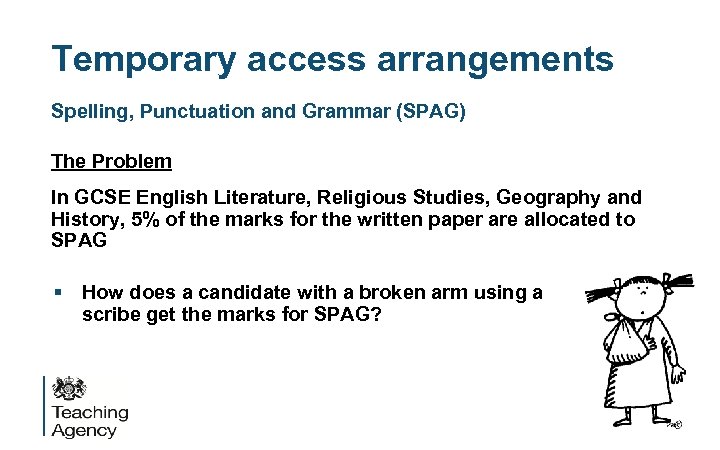
Temporary access arrangements Spelling, Punctuation and Grammar (SPAG) The Problem In GCSE English Literature, Religious Studies, Geography and History, 5% of the marks for the written paper are allocated to SPAG § How does a candidate with a broken arm using a scribe get the marks for SPAG?
Temporary access arrangements Spelling, Punctuation and Grammar (SPAG) The Solution (For the questions that assess SPAG) 1. The candidate dictates all SPAG to the scribe. 2. The candidate uses a word processor (spell check disabled) with their other hand. In both cases the candidate could be allowed extra time and would be eligible for special consideration. Don’t forget to record what arrangements you make on the cover sheet
Hints & tips – temporary access arrangements § Keep to the deadlines for submitting applications § Ensure you have space to accommodate them § Ensure you have sufficient equipment (e. g. word processors) § Ensure you have sufficient invigilators to supervise them
Exam Day Irregularities and special consideration Continuity Presenter AQA
Our examination chances are in ruins because…
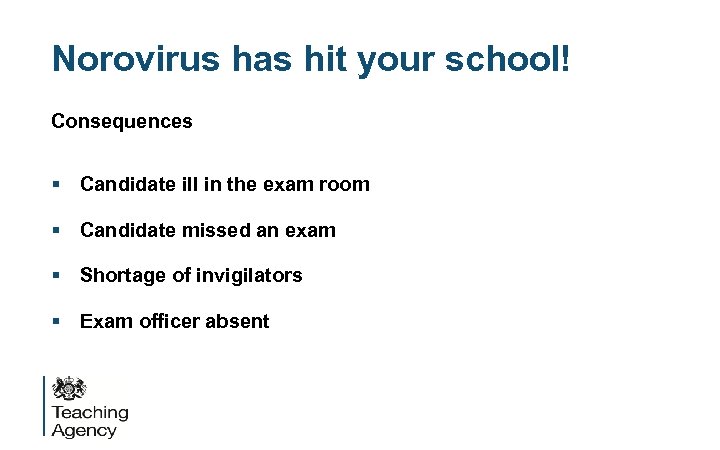
Norovirus has hit your school! Consequences § Candidate ill in the exam room § Candidate missed an exam § Shortage of invigilators § Exam officer absent
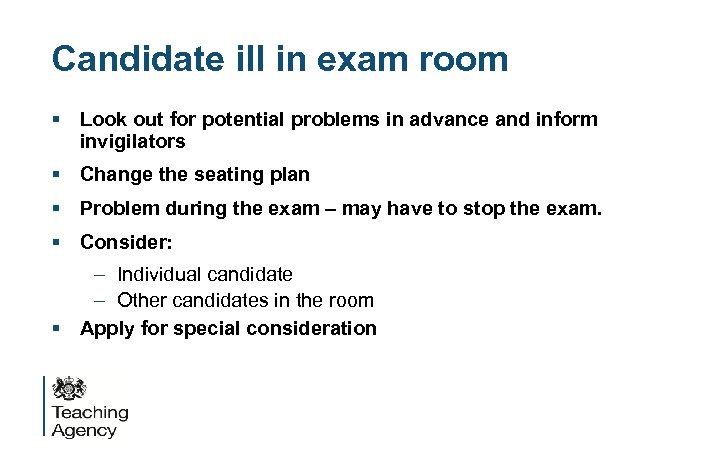
Candidate ill in exam room § Look out for potential problems in advance and inform invigilators § Change the seating plan § Problem during the exam – may have to stop the exam. § Consider: – Individual candidate – Other candidates in the room § Apply for special consideration
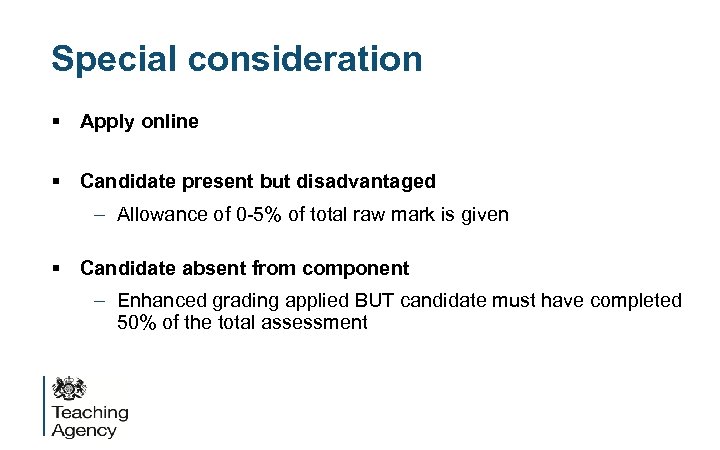
Special consideration § Apply online § Candidate present but disadvantaged – Allowance of 0 -5% of total raw mark is given § Candidate absent from component – Enhanced grading applied BUT candidate must have completed 50% of the total assessment
Contingency planning § Where could you get extra invigilators at short notice? § Is there a plan in place for the exam to go ahead if you aren’t there?
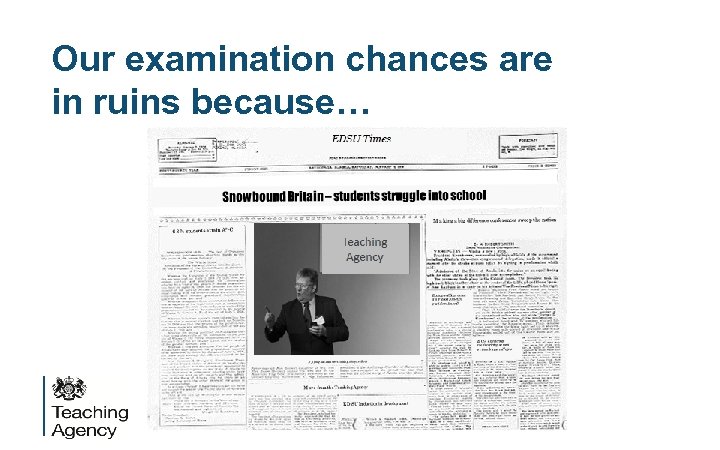
Our examination chances are in ruins because…
Snowbound Britain – students struggle into school Consequences § Candidates late/very late/absent § Invigilators late/very late/absent § Exams officer late/very late/absent § Centre closed
Very late arrivals § Published starting times are 9. 00 am and 1. 30 pm. § Exam lasting 1 hour or longer – candidate is very late if they arrive after 10. 00 am or 2. 30 pm. § Exam lasting less than 1 hour – candidate is very late if they arrive after the published finishing time or half an hour after the published starting time, whichever is later. § For very late arrivals – complete JCQ Form JCQ/VLA – very late arrivals
Candidate unable to get to centre/centre closed § Opportunity to take exam at next session, withdraw and reenter § Candidates sitting units as part of terminal exam (or no re-sit opportunity available) – apply for special consideration. Candidate must meet criteria for enhanced grading
Our examination chances are in ruins because…
Family feud spills over into exam room Consequences § Candidates involved in fight § Other candidates in room
Disruptive candidates § Identify potential problems in advance § Check seating plan carefully § If problem occurs, stop exam, remove disruptive candidates, restart exam § Supervise disruptive candidates § Allow remaining candidates the full time for exam if possible, apply for special consideration if appropriate § Disruption is malpractice – report on JCQ Form JCQ/M 1 – report of suspected malpractice
Malpractice § Disruptive behaviour § Unauthorised materials including mobile phones § Copying/colluding § Plagiarism § Personation
Penalties for malpractice § A warning § Loss of marks for – a section – a component – a unit § Disqualification from – a unit – a number of units – the qualification – all qualifications in that series § Barred from entering for exams for a specified period
Our examination chances are in ruins because…
Exam in progress § Evacuate – leave any question papers/scripts in the exam room § Supervise the candidates § Note the time of the evacuation § Allow the candidates the full time for the exam if possible § Submit a full report to the awarding organisation
Exam about to take place § Rooms still available § Question papers still secure/accessible § Candidates’ coursework/controlled assessment affected § Facilities damaged e. g. workshops/labs etc. § Inform awarding organisation as soon as possible
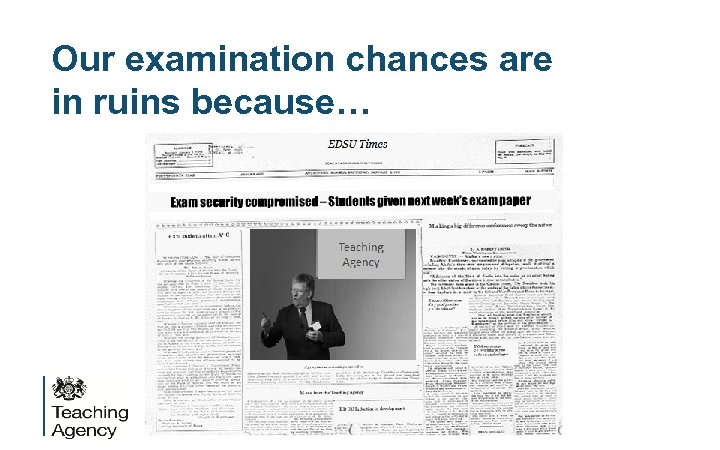
Our examination chances are in ruins because…
Security breaches § Inform awarding organisation immediately § Awarding organisation will detail action to be taken and will require a full report § Obtain statements from everyone involved – candidates, invigilators, exams office staff, teaching staff § Remember – if the candidates are not at fault the awarding organisation will do everything possible to protect the interests of the candidates
What is ‘special consideration’? Definition: “Post-examination adjustment of a candidate’s mark or grade to reflect temporary illness, injury or indisposition at the time of the examination” See Access Arrangements, Reasonable Adjustments and Special Consideration 2012/13 pages 79 -88 Special consideration will not necessarily match the estimated grade
Special consideration Three types of special consideration: § Candidates present but disadvantaged § Candidates absent for part of an external assessment § Candidates absent for the whole of an external assessment
Present but disadvantaged Typical examples: § Temporary illness or accident/injury § Bereavement § Domestic crisis § Serious disturbance during an exam § Wrong exam paper, defective paper or CD § Access arrangement, approved but not given to the candidate … which affects the candidate at the time of the assessment
Special consideration Candidates present but disadvantaged: § Normally given by applying an allowance of marks to the exam/assessment affected § Decision based on timing, the nature and extent of the illness or misfortune § Max. allowance = 5% of total raw mark for component concerned
Present but disadvantaged Page 82 of the JCQ Access Arrangements, Reasonable Adjustments and Special Consideration 2012/13 ’ gives examples of the tariff system § 5% - terminal illness of the candidate or parent § 4%- severe disease or major surgery at or near the time of the exam § 3% - recently broken limbs or recent domestic crisis § 2% - broken limb on the mend, extreme distress on the day of the exam § 1% - headache, illness of another candidate in the room § 0% - consideration given, but mark allowance not appropriate The most common special consideration allowance given by the awarding organisations is 2%
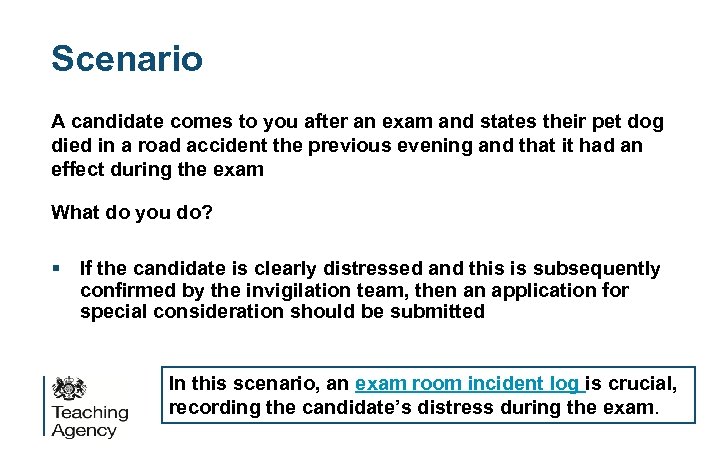
Scenario A candidate comes to you after an exam and states their pet dog died in a road accident the previous evening and that it had an effect during the exam What do you do? § If the candidate is clearly distressed and this is subsequently confirmed by the invigilation team, then an application for special consideration should be submitted In this scenario, an exam room incident log is crucial, recording the candidate’s distress during the exam.
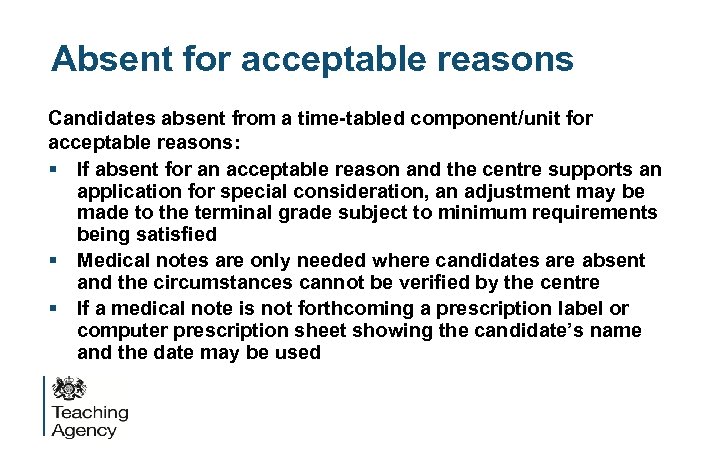
Absent for acceptable reasons Candidates absent from a time-tabled component/unit for acceptable reasons: § If absent for an acceptable reason and the centre supports an application for special consideration, an adjustment may be made to the terminal grade subject to minimum requirements being satisfied § Medical notes are only needed where candidates are absent and the circumstances cannot be verified by the centre § If a medical note is not forthcoming a prescription label or computer prescription sheet showing the candidate’s name and the date may be used
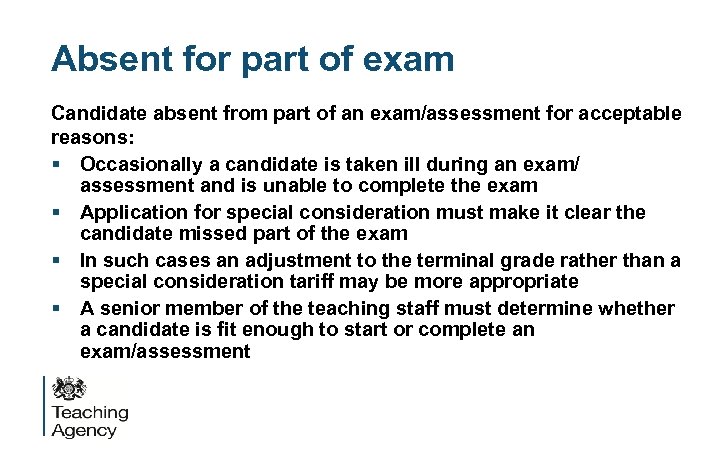
Absent for part of exam Candidate absent from part of an exam/assessment for acceptable reasons: § Occasionally a candidate is taken ill during an exam/ assessment and is unable to complete the exam § Application for special consideration must make it clear the candidate missed part of the exam § In such cases an adjustment to the terminal grade rather than a special consideration tariff may be more appropriate § A senior member of the teaching staff must determine whether a candidate is fit enough to start or complete an exam/assessment
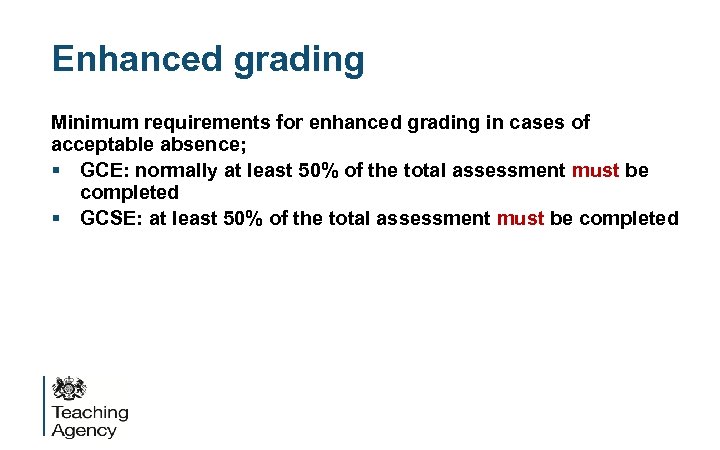
Enhanced grading Minimum requirements for enhanced grading in cases of acceptable absence; § GCE: normally at least 50% of the total assessment must be completed § GCSE: at least 50% of the total assessment must be completed
Processing applications for special consideration (GCSE and GCE) qualifications: § Applications for special consideration must be made online § Online applications are made through e-AQA, Edexcel Online, OCR Interchange and WJEC Secure Website § In the majority of cases the online system will provide an instant decision See Chapter 11 of the JCQ Access Arrangements, Reasonable Adjustments and Special Consideration 2012/13 for further details.
Hints & tips – special consideration § Be aware of which candidates will and will not be eligible for special consideration § Brief your invigilators on how to spot and to handle emerging situations § Ensure invigilators keep an exam room incident log

Break
Exam Day JCQ Inspections Continuity Presenter WJEC
Information Rationale… To maintain the security and integrity of the examinations by confirming compliance with requirements of JCQ booklets – Instructions for Conducting Examinations (ICE) and General Regulations Not to check on the exams officer
How can I prepare for an inspection? § § § § Ensure you are familiar with the JCQ booklets Look at last year’s JCQ report Be aware of potential security breaches Ensure all exam rooms in use are prepared in accordance with the regulations Be aware of possible invigilator issues Ensure you are aware of the whereabouts of all required documentation Ensure that all required forms are completed, e. g. change of venue, overnight supervision, data protection notice etc. Ensure each exam room has some form of incident log
Information What is inspected? § § § Suitability of exam accommodation Arrangement of the exam room Invigilation and supervision Security of exam material Access arrangement files Documentation
Information Access arrangement evidence § As part of the normal centre inspection, all access arrangements files should be available § A possible separate visit may occur for a detailed inspection of all documents relating to the access arrangements applications, which will be a more in-depth inspection of specifically requested evidence
Good practice § Ensure there is always an appropriate person on hand to accompany the inspector § Ensure all exam room layouts are checked against JCQ requirements on a daily basis § Remember it is the centre that is being inspected, not you
Exam Day Yellow label service Continuity Presenter EDSU

Yellow label service What is covered? § Centres in England only § GCSE, GCE, principal learning, functional skills, entry level certificates, free-standing maths and advanced extension awards § Exam scripts, externally marked coursework/controlled assessments, CDs and memory sticks Which awarding organisations? § AQA, Edexcel, OCR, VTCT and WJEC From summer 2013 will also include Ofqual accredited ‘i. GCSE-style’ qualifications for AQA, Edexcel, WJEC and Cambridge International Examinations (CIE)
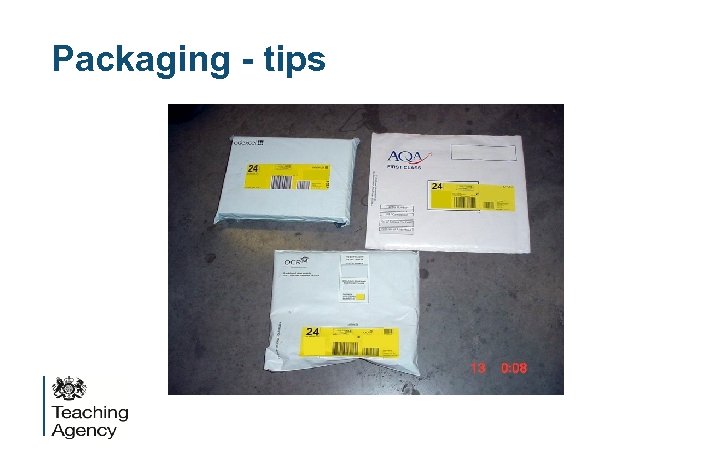
Packaging - tips § Use the most recent pre-addressed yellow labels as provided by the awarding organisation § One package = one yellow label § Don’t put more than one yellow label on an envelope § Always use the large plastic envelopes supplied by the awarding organisations § Don’t put exam scripts from different exams into one envelope § Don’t overfill envelopes – AOs provide enough stationery § Pack out single script packages to avoid risk of loss
Packaging - tips
Parcelforce service Advice § Email sent to all exams officers with candidates participating in a series § Contains latest information and advice § EDSU website Questions and escalation of issues § Parcelforce exams helpdesk (0844 561 7998) § Exams Delivery Support Line (0300 100 0100) Please submit your feedback at the end of a series via the survey
Exam Day Recap Continuity Presenter EDSU
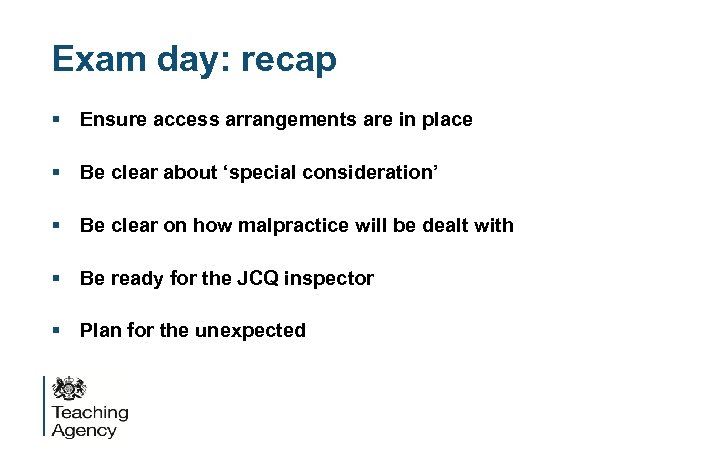
Exam day: recap § Ensure access arrangements are in place § Be clear about ‘special consideration’ § Be clear on how malpractice will be dealt with § Be ready for the JCQ inspector § Plan for the unexpected
Exams cycle Results and post-results Continuity Presenter EDSU
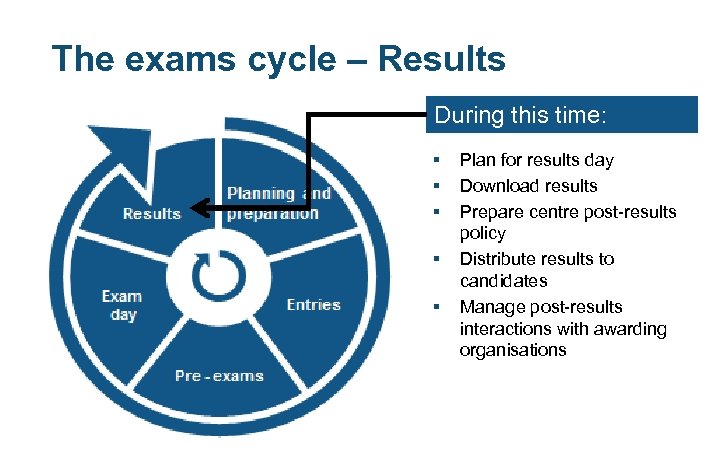
The exams cycle – Results During this time: § § § Plan for results day Download results Prepare centre post-results policy Distribute results to candidates Manage post-results interactions with awarding organisations
Results and post-results JCQ § Results here § Post-results here EDSU § Good practice here
Results Day Continuity Presenter Edexcel
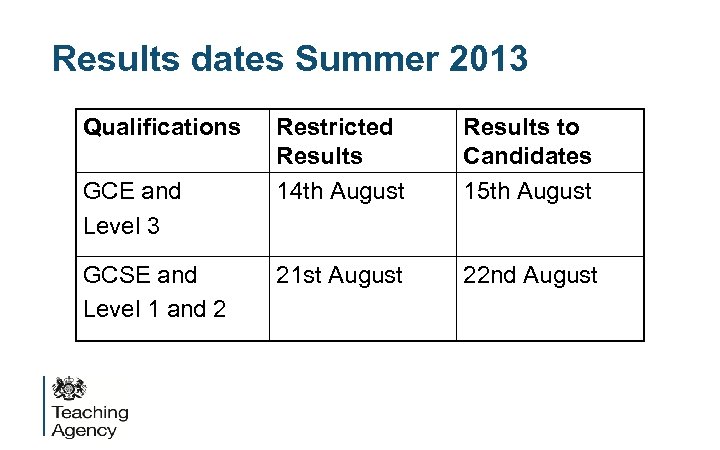
Results dates Summer 2013 Qualifications GCE and Level 3 GCSE and Level 1 and 2 Restricted Results 14 th August Results to Candidates 15 th August 21 st August 22 nd August
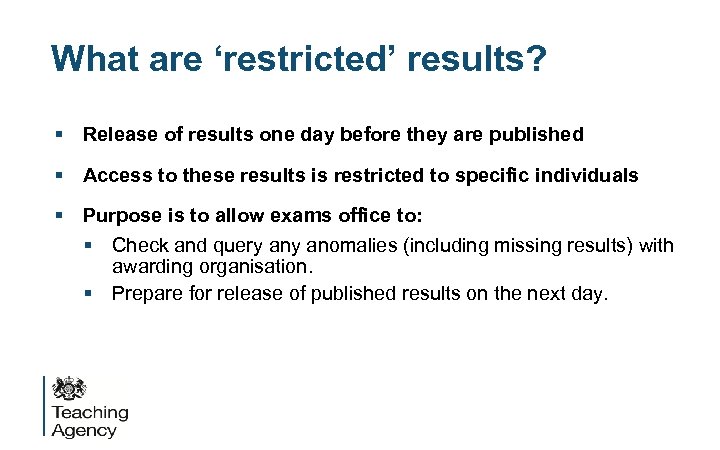
What are ‘restricted’ results? § Release of results one day before they are published § Access to these results is restricted to specific individuals § Purpose is to allow exams office to: § Check and query anomalies (including missing results) with awarding organisation. § Prepare for release of published results on the next day.
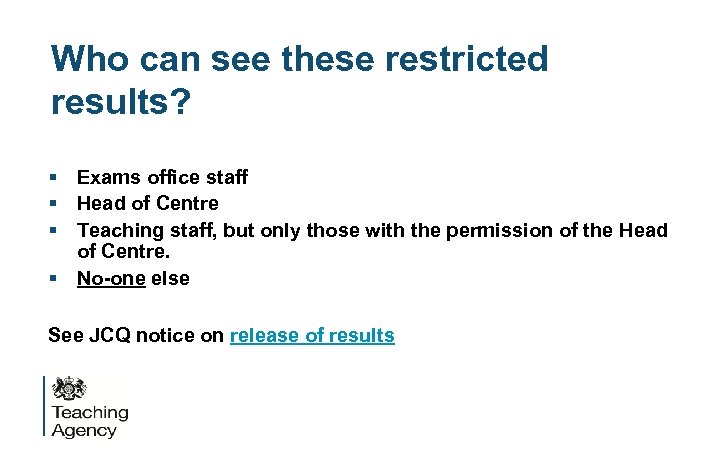
Who can see these restricted results? § Exams office staff § Head of Centre § Teaching staff, but only those with the permission of the Head of Centre. § No-one else See JCQ notice on release of results
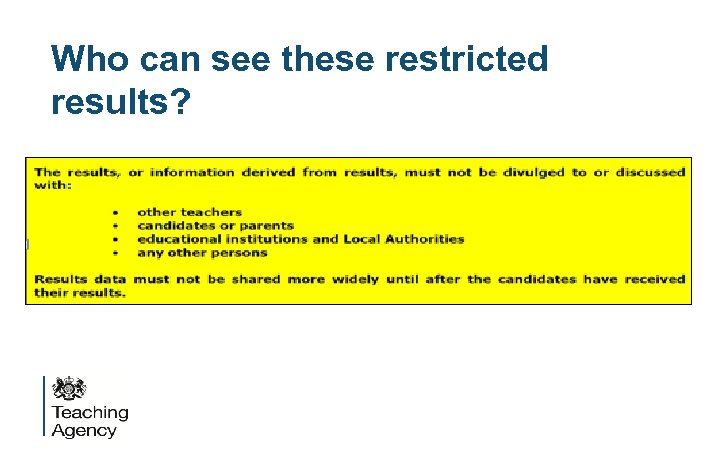
Who can see these restricted results?
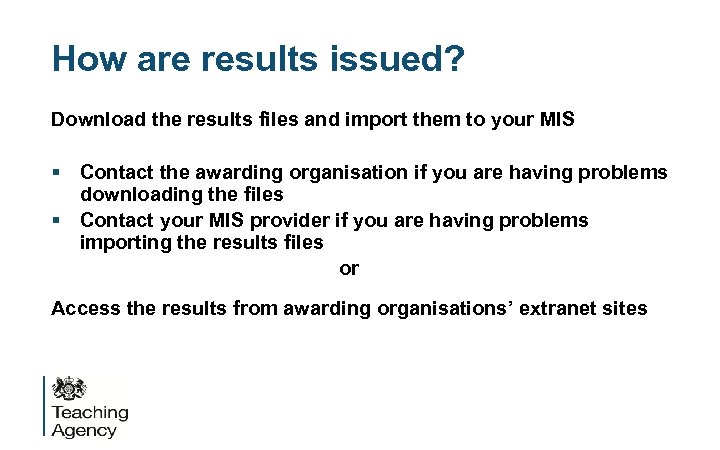
How are results issued? Download the results files and import them to your MIS § Contact the awarding organisation if you are having problems downloading the files § Contact your MIS provider if you are having problems importing the results files or Access the results from awarding organisations’ extranet sites
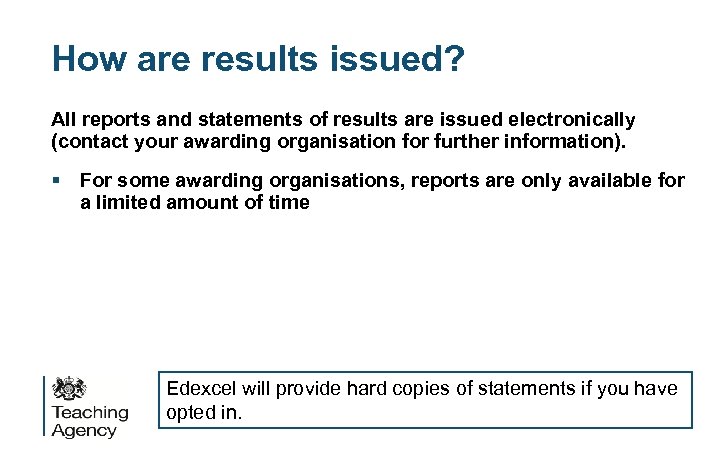
How are results issued? All reports and statements of results are issued electronically (contact your awarding organisation for further information). § For some awarding organisations, reports are only available for a limited amount of time Edexcel will provide hard copies of statements if you have opted in.
Preparation for results day § Site staff and IT staff § The rooms § Print and collate results slips § Who can collect the results? § Teaching staff available § Post-results services policy
Post Results Continuity Presenter Edexcel
Post results Four main elements to post results: § § Missing or incomplete results (MIR) Late cash-ins Enquiries about results (EAR) Access to scripts (ATS)
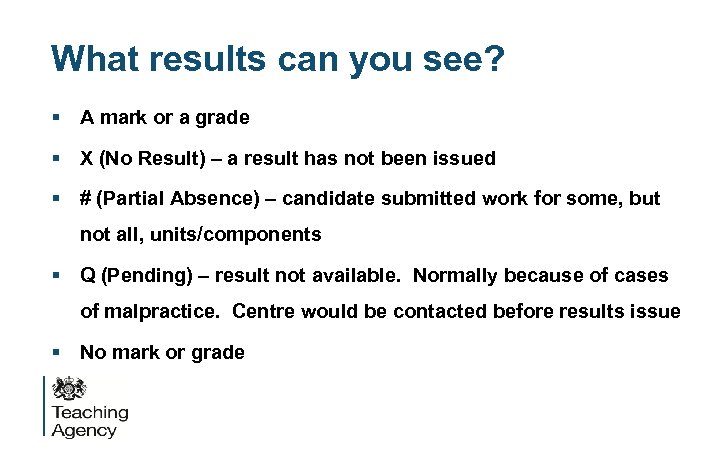
What results can you see? § A mark or a grade § X (No Result) – a result has not been issued § # (Partial Absence) – candidate submitted work for some, but not all, units/components § Q (Pending) – result not available. Normally because of cases of malpractice. Centre would be contacted before results issue § No mark or grade
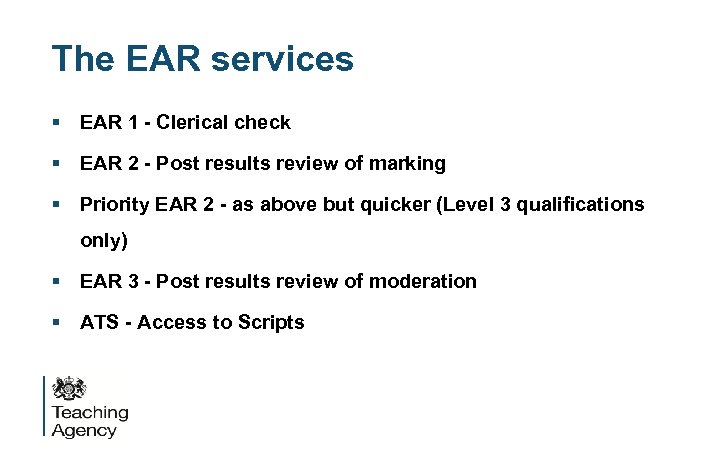
The EAR services § EAR 1 - Clerical check § EAR 2 - Post results review of marking § Priority EAR 2 - as above but quicker (Level 3 qualifications only) § EAR 3 - Post results review of moderation § ATS - Access to Scripts
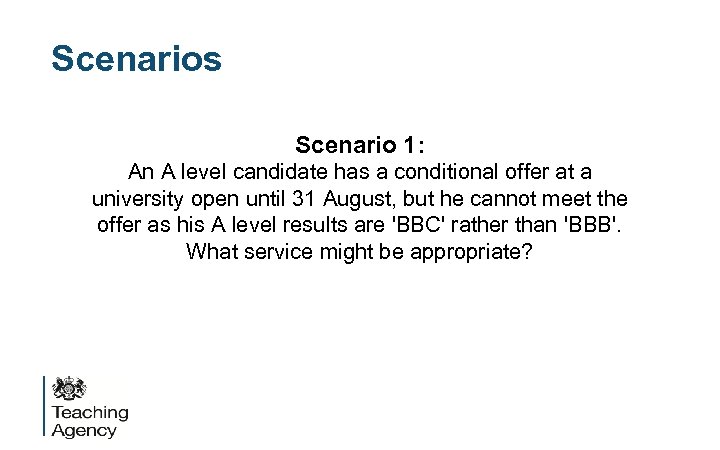
Scenarios Scenario 1: An A level candidate has a conditional offer at a university open until 31 August, but he cannot meet the offer as his A level results are 'BBC' rather than 'BBB'. What service might be appropriate?
Scenarios Priority EAR 2
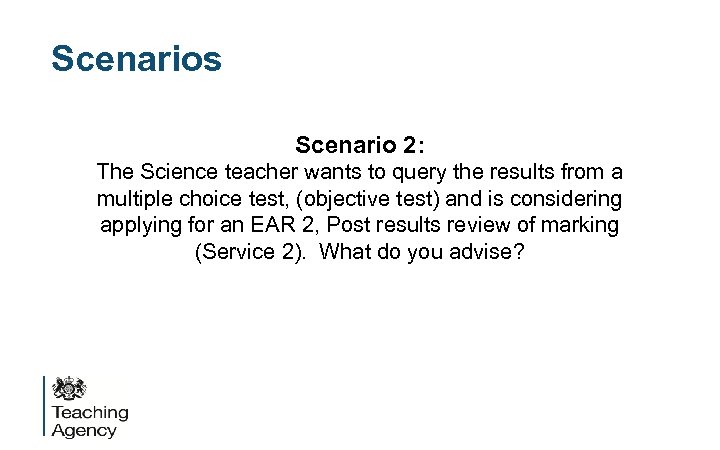
Scenarios Scenario 2: The Science teacher wants to query the results from a multiple choice test, (objective test) and is considering applying for an EAR 2, Post results review of marking (Service 2). What do you advise?
Scenarios Only EAR clerical re-checks (Service 1) can be requested for objective tests (multiple choice tests).
Scenarios Scenario 3: After the result for an EAR 2 you requested has come back, you find that the marks have actually gone down. Can the original, higher mark be reinstated?

Scenarios No
Scenarios Scenario 4: You have been asked to process a request for an EAR 3. You submit the request and it comes back as declined. Why might this be?
Scenarios The marks might have been accepted without change and so therefore an EAR 3 cannot be done.
Scenarios Scenario 5: A teacher has requested an EAR 2 for an A level candidate and they would like to see the exam paper after it has been through the review of marking process. What service do you apply for?
Scenarios EAR 2 with a copy of the reviewed script
Things to bear in mind § Art, Drama and Languages § Receipts § Know how to order services, and the deadline dates § Have a centre policy on managing results, including for what the exams office is responsible for
Things to bear in mind EAR is the only process
Further information § JCQ Post Results Services booklet § Awarding organisation websites and documents § EDSU centre support officer
Results and post results Recap Continuity Presenter EDSU
Results and post results: recap § Plan for results day § Be aware of: – Cash in/certification – Diploma students § Have a policy for enquiries about results § Communicate process, dates, rules etc.
Updates Continuity Presenter EDSU
Updates § Consultation on National Curriculum - closes 16 April 2013 § Consultation on secondary schools accountability measures - closes 1 May 2013 § The Diploma aggregation service (DAS) - to close 30 September 2013 § Unique learner number (ULN) - to be mandated in maintained secondary schools from January 2014 for school census § Reforms to A Levels § Longer-term reform of GCSEs § Merger of the Teaching Agency and National College Further information can be found on the EDSU news website
Policies and best practice Presenter EOA
Policies and best practice JCQ inspection requirements: § § Compliance with the Equalities Act (2010) Procedure for emergency evacuation of the exam room Internal appeals procedure Controlled assessment policy
Policies and best practice Points to consider in an exam policy: § Storage, security and distribution of papers § Access arrangements criteria § Exam venues/accommodation § Results § IT § Academic roles and support § Contingency plans Exams policy and risk management templates available on EDSU’s website Exams office staff should be involved in developing internal centre policies to help fulfil external requirements, establish good practice and provide backup for their role
Activities at tables Activity 6: Actions for summer 2013 Name EDSU
Final comments and questions Continuity Presenter EDSU
Questions
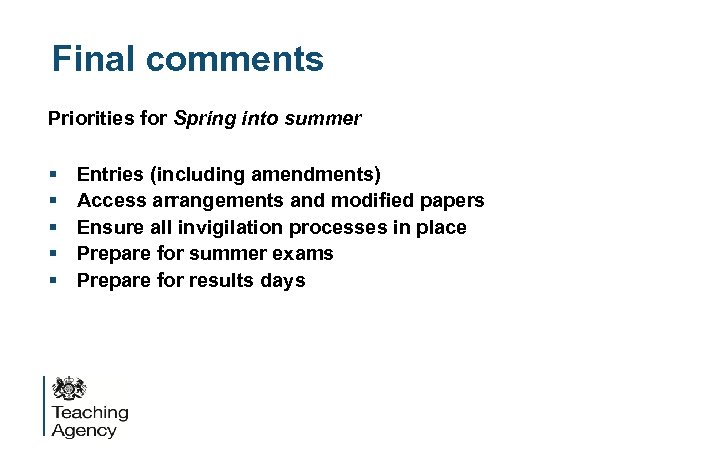
Final comments Priorities for Spring into summer § § § Entries (including amendments) Access arrangements and modified papers Ensure all invigilation processes in place Prepare for summer exams Prepare for results days
Final comments Support for the spring/summer term: § § § § Register with the induction programme Seek support from your line manager/SLT Attend Ho. D meetings Arrange a meeting with your SENCO Arrange an early visit with your CSO Use the key dates calendar Use the exams timetable Read last year’s JCQ inspection report
Additional support § EDSU centre support officer § Awarding Organisations § JCQ § Examination Officers’ Association (EOA) § Other exam officers § Local network meetings
Thank you Have a safe journey home
Скачать презентацию Instructions for use Below is a copy of
46fbe72e5bb4545f783cf877c68c992e.ppt