


 Скачать презентацию Instructional Technology and Distance Education in Nigeria Historical
d76ac88ca74f9a1a1b1a2bbb638f9a19.ppt
- Количество слайдов: 1
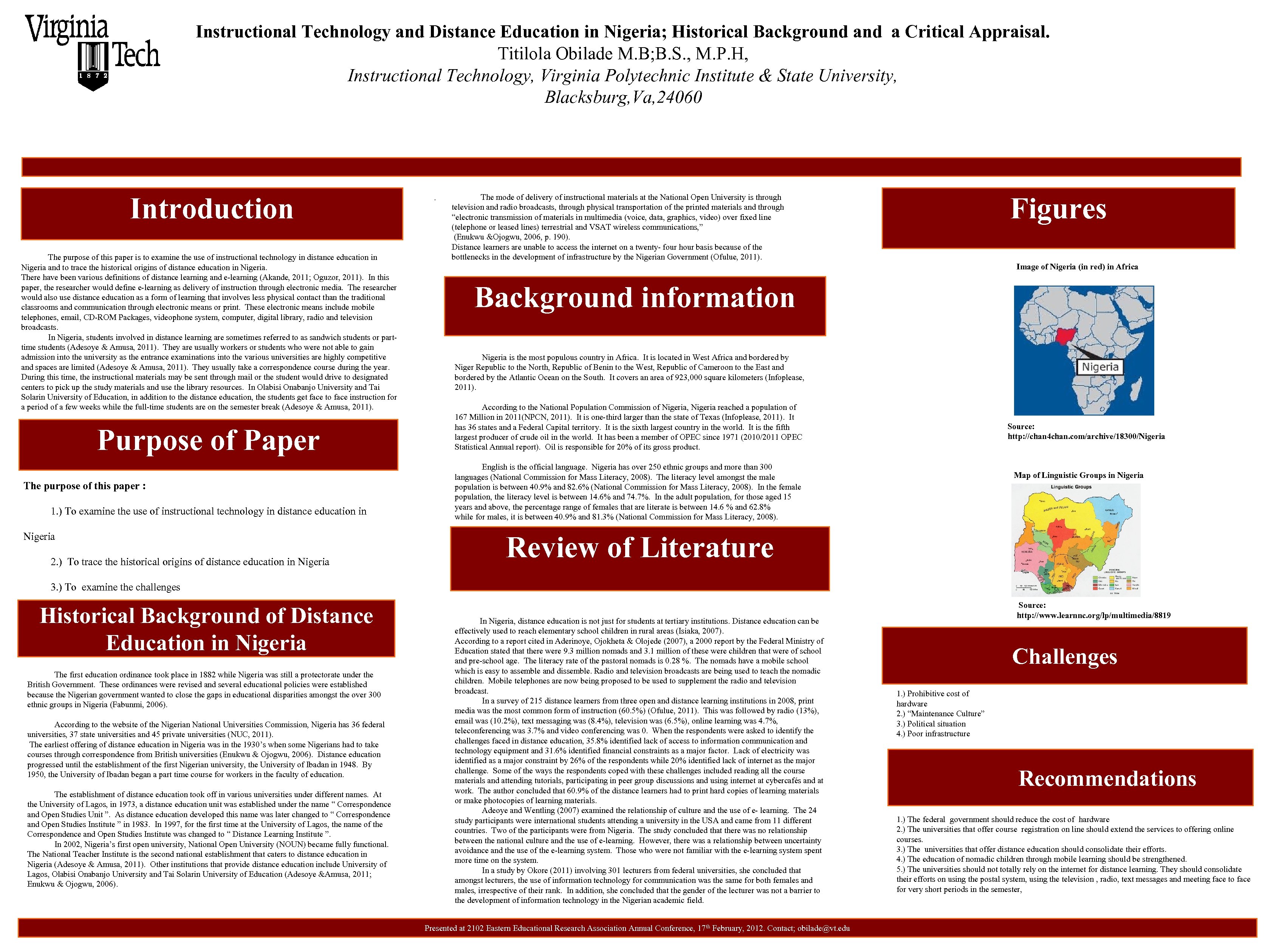 Instructional Technology and Distance Education in Nigeria; Historical Background a Critical Appraisal. Titilola Obilade M. B; B. S. , M. P. H, Instructional Technology, Virginia Polytechnic Institute & State University, Blacksburg, Va, 24060 Introduction The purpose of this paper is to examine the use of instructional technology in distance education in Nigeria and to trace the historical origins of distance education in Nigeria. There have been various definitions of distance learning and e-learning (Akande, 2011; Oguzor, 2011). In this paper, the researcher would define e-learning as delivery of instruction through electronic media. The researcher would also use distance education as a form of learning that involves less physical contact than the traditional classrooms and communication through electronic means or print. These electronic means include mobile telephones, email, CD-ROM Packages, videophone system, computer, digital library, radio and television broadcasts. In Nigeria, students involved in distance learning are sometimes referred to as sandwich students or parttime students (Adesoye & Amusa, 2011). They are usually workers or students who were not able to gain admission into the university as the entrance examinations into the various universities are highly competitive and spaces are limited (Adesoye & Amusa, 2011). They usually take a correspondence course during the year. During this time, the instructional materials may be sent through mail or the student would drive to designated centers to pick up the study materials and use the library resources. In Olabisi Onabanjo University and Tai Solarin University of Education, in addition to the distance education, the students get face to face instruction for a period of a few weeks while the full-time students are on the semester break (Adesoye & Amusa, 2011). Purpose of Paper The purpose of this paper : 1. ) To examine the use of instructional technology in distance education in Nigeria 2. ) To trace the historical origins of distance education in Nigeria . Figures The mode of delivery of instructional materials at the National Open University is through television and radio broadcasts, through physical transportation of the printed materials and through “electronic transmission of materials in multimedia (voice, data, graphics, video) over fixed line (telephone or leased lines) terrestrial and VSAT wireless communications, ” (Enukwu &Ojogwu, 2006, p. 190). Distance learners are unable to access the internet on a twenty- four hour basis because of the bottlenecks in the development of infrastructure by the Nigerian Government (Ofulue, 2011). Image of Nigeria (in red) in Africa Background information Nigeria is the most populous country in Africa. It is located in West Africa and bordered by Niger Republic to the North, Republic of Benin to the West, Republic of Cameroon to the East and bordered by the Atlantic Ocean on the South. It covers an area of 923, 000 square kilometers (Infoplease, 2011). According to the National Population Commission of Nigeria, Nigeria reached a population of 167 Million in 2011(NPCN, 2011). It is one-third larger than the state of Texas (Infoplease, 2011). It has 36 states and a Federal Capital territory. It is the sixth largest country in the world. It is the fifth largest producer of crude oil in the world. It has been a member of OPEC since 1971 (2010/2011 OPEC Statistical Annual report). Oil is responsible for 20% of its gross product. Source: http: //chan 4 chan. com/archive/18300/Nigeria English is the official language. Nigeria has over 250 ethnic groups and more than 300 languages (National Commission for Mass Literacy, 2008). The literacy level amongst the male population is between 40. 9% and 82. 6% (National Commission for Mass Literacy, 2008). In the female population, the literacy level is between 14. 6% and 74. 7%. In the adult population, for those aged 15 years and above, the percentage range of females that are literate is between 14. 6 % and 62. 8% while for males, it is between 40. 9% and 81. 3% (National Commission for Mass Literacy, 2008). Map of Linguistic Groups in Nigeria Review of Literature 3. ) To examine the challenges Historical Background of Distance Education in Nigeria The first education ordinance took place in 1882 while Nigeria was still a protectorate under the British Government. These ordinances were revised and several educational policies were established because the Nigerian government wanted to close the gaps in educational disparities amongst the over 300 ethnic groups in Nigeria (Fabunmi, 2006). According to the website of the Nigerian National Universities Commission, Nigeria has 36 federal universities, 37 state universities and 45 private universities (NUC, 2011). The earliest offering of distance education in Nigeria was in the 1930’s when some Nigerians had to take courses through correspondence from British universities (Enukwu & Ojogwu, 2006). Distance education progressed until the establishment of the first Nigerian university, the University of Ibadan in 1948. By 1950, the University of Ibadan began a part time course for workers in the faculty of education. The establishment of distance education took off in various universities under different names. At the University of Lagos, in 1973, a distance education unit was established under the name “ Correspondence and Open Studies Unit ”. As distance education developed this name was later changed to “ Correspondence and Open Studies Institute ” in 1983. In 1997, for the first time at the University of Lagos, the name of the Correspondence and Open Studies Institute was changed to “ Distance Learning Institute ”. In 2002, Nigeria’s first open university, National Open University (NOUN) became fully functional. The National Teacher Institute is the second national establishment that caters to distance education in Nigeria (Adesoye & Amusa, 2011). Other institutions that provide distance education include University of Lagos, Olabisi Onabanjo University and Tai Solarin University of Education (Adesoye &Amusa, 2011; Enukwu & Ojogwu, 2006). In Nigeria, distance education is not just for students at tertiary institutions. Distance education can be effectively used to reach elementary school children in rural areas (Isiaka, 2007). According to a report cited in Aderinoye, Ojokheta & Olojede (2007), a 2000 report by the Federal Ministry of Education stated that there were 9. 3 million nomads and 3. 1 million of these were children that were of school and pre-school age. The literacy rate of the pastoral nomads is 0. 28 %. The nomads have a mobile school which is easy to assemble and dissemble. Radio and television broadcasts are being used to teach the nomadic children. Mobile telephones are now being proposed to be used to supplement the radio and television broadcast. In a survey of 215 distance learners from three open and distance learning institutions in 2008, print media was the most common form of instruction (60. 5%) (Ofulue, 2011). This was followed by radio (13%), email was (10. 2%), text messaging was (8. 4%), television was (6. 5%), online learning was 4. 7%, teleconferencing was 3. 7% and video conferencing was 0. When the respondents were asked to identify the challenges faced in distance education, 35. 8% identified lack of access to information communication and technology equipment and 31. 6% identified financial constraints as a major factor. Lack of electricity was identified as a major constraint by 26% of the respondents while 20% identified lack of internet as the major challenge. Some of the ways the respondents coped with these challenges included reading all the course materials and attending tutorials, participating in peer group discussions and using internet at cybercafés and at work. The author concluded that 60. 9% of the distance learners had to print hard copies of learning materials or make photocopies of learning materials. Adeoye and Wentling (2007) examined the relationship of culture and the use of e- learning. The 24 study participants were international students attending a university in the USA and came from 11 different countries. Two of the participants were from Nigeria. The study concluded that there was no relationship between the national culture and the use of e-learning. However, there was a relationship between uncertainty avoidance and the use of the e-learning system. Those who were not familiar with the e-learning system spent more time on the system. In a study by Okore (2011) involving 301 lecturers from federal universities, she concluded that amongst lecturers, the use of information technology for communication was the same for both females and males, irrespective of their rank. In addition, she concluded that the gender of the lecturer was not a barrier to the development of information technology in the Nigerian academic field. Presented at 2102 Eastern Educational Research Association Annual Conference, 17 th February, 2012. Contact; obilade@vt. edu Source: http: //www. learnnc. org/lp/multimedia/8819 Challenges 1. ) Prohibitive cost of hardware 2. ) “Maintenance Culture” 3. ) Political situation 4. ) Poor infrastructure Recommendations 1. ) The federal government should reduce the cost of hardware 2. ) The universities that offer course registration on line should extend the services to offering online courses. 3. ) The universities that offer distance education should consolidate their efforts. 4. ) The education of nomadic children through mobile learning should be strengthened. 5. ) The universities should not totally rely on the internet for distance learning. They should consolidate their efforts on using the postal system, using the television , radio, text messages and meeting face to face for very short periods in the semester,