


 Скачать презентацию Institutional Transformation of Government in the Network Society
42366e1afcc74223dd17ae258cd8d85f.ppt
- Количество слайдов: 13
 Institutional Transformation of Government in the Network Society Jane E. Fountain Director, National Center for Digital Government Harvard University The Network Society and the Knowledge Economy: Portugal in the Global Context March 5 -6, 2005
 E-Government: the use of digital technologies to transform government operations in order to improve effectiveness, efficiency, and service delivery.
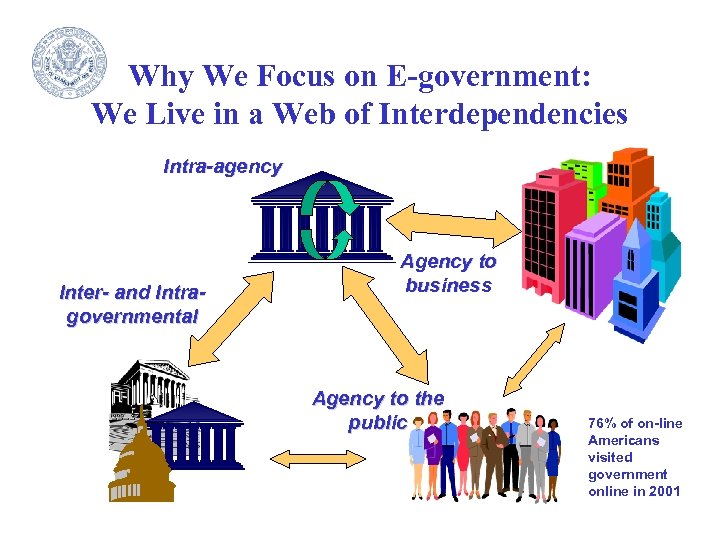 Why We Focus on E-government: We Live in a Web of Interdependencies Intra-agency Inter- and Intragovernmental Agency to business Agency to the public 76% of on-line Americans visited government online in 2001
 Chronic Problems in E-Government • Putting the Status Quo Online: Agencies automate political and institutional problems • Redundant Buying: Multiple agencies buy the same item • Program Management: Few IT projects delivered on time, on budget • Poor Modernization Strategies: Few agencies have business-driven enterprise architectures connecting IT investments to performance improvement • Islands of Automation: – Citizens deal with multiple agencies (22, 000 websites) for service – Agencies cannot easily collaborate for key missions Source: Mark Forman
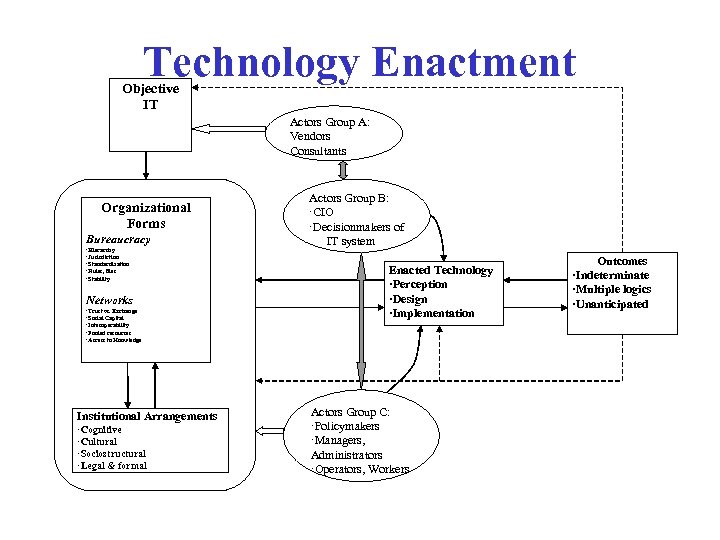 Technology Enactment Objective IT Actors Group A: Vendors Consultants Organizational Forms Bureaucracy ·Hierarchy ·Jurisdiction ·Standardization ·Rules, files ·Stability Networks ·Trust vs. Exchange ·Social Capital ·Interoperability ·Pooled resources ·Access to Knowledge Institutional Arrangements ·Cognitive ·Cultural ·Sociostructural ·Legal & formal Actors Group B: ·CIO ·Decisionmakers of IT system Enacted Technology ·Perception ·Design ·Implementation Actors Group C: ·Policymakers ·Managers, Administrators ·Operators, Workers Outcomes ·Indeterminate ·Multiple logics ·Unanticipated
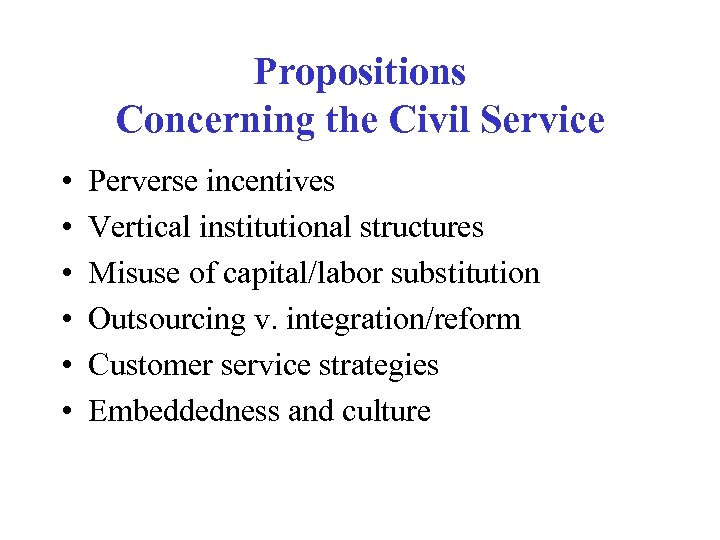 Propositions Concerning the Civil Service • • • Perverse incentives Vertical institutional structures Misuse of capital/labor substitution Outsourcing v. integration/reform Customer service strategies Embeddedness and culture
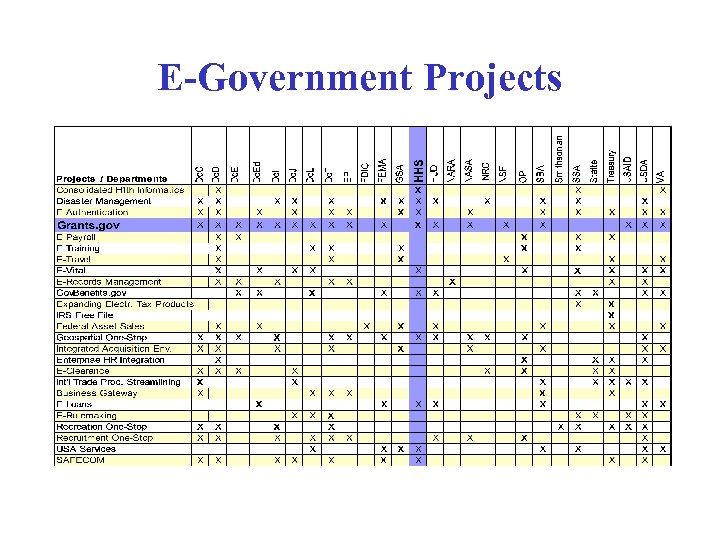
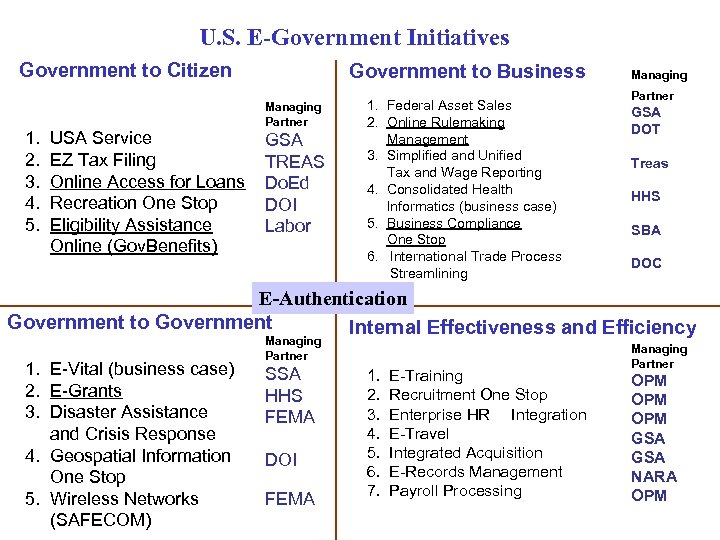 U. S. E-Government Initiatives Government to Citizen 1. 2. 3. 4. 5. USA Service EZ Tax Filing Online Access for Loans Recreation One Stop Eligibility Assistance Online (Gov. Benefits) Government to Business Managing Partner GSA TREAS Do. Ed DOI Labor 1. Federal Asset Sales 2. Online Rulemaking Management 3. Simplified and Unified Tax and Wage Reporting 4. Consolidated Health Informatics (business case) 5. Business Compliance One Stop 6. International Trade Process Streamlining Managing Partner GSA DOT Treas HHS SBA DOC E-Authentication Government to Government Internal Effectiveness and Efficiency 1. E-Vital (business case) 2. E-Grants 3. Disaster Assistance and Crisis Response 4. Geospatial Information One Stop 5. Wireless Networks (SAFECOM) Managing Partner SSA HHS FEMA DOI FEMA 1. 2. 3. 4. 5. 6. 7. E-Training Recruitment One Stop Enterprise HR Integration E-Travel Integrated Acquisition E-Records Management Payroll Processing Managing Partner OPM OPM GSA NARA OPM
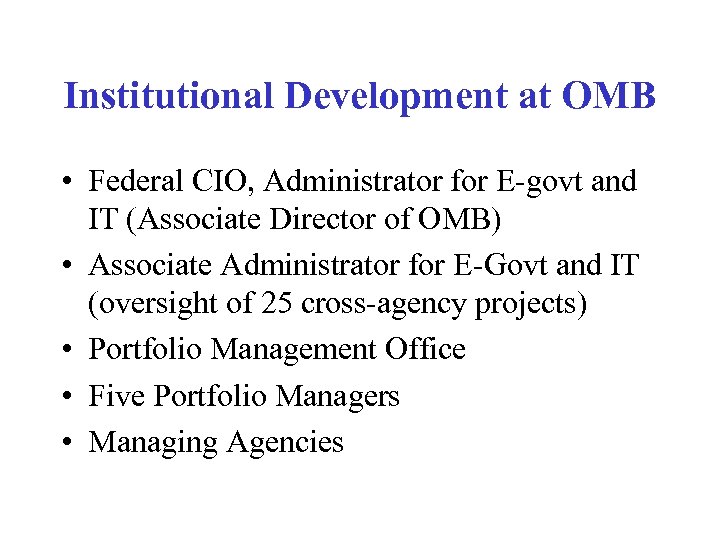 Institutional Development at OMB • Federal CIO, Administrator for E-govt and IT (Associate Director of OMB) • Associate Administrator for E-Govt and IT (oversight of 25 cross-agency projects) • Portfolio Management Office • Five Portfolio Managers • Managing Agencies
 E-Government Projects
 The IT Budget • U. S. federal IT spending: from $36. 4 billion (2001) to $59. 3 billion (2004) • 80% for consultants • Cross-agency projects “not a favorite of Congress” – $5 million (2002, 2003), $3 million (2004)
 From E-Government to the Virtual State The virtual state is intersectoral, interagency, and intergovernmental. But it achieves this fluidity and cross-boundary character through standardization, rationalization, and the management of interdependence.
 Recommendations for Portugal • • What is central to Portuguese identity? Link e-government to reform initiatives Consider necessary institutional changes Consider all levels of government and their interconnections • Where will knowledgeable IT experts come from?
 www. ncdg. org