 Скачать презентацию Institutional Repositories their contribution to sustainable development
8f1e3b3b577ded5100f70524c90119ec.ppt
- Количество слайдов: 21



Institutional Repositories: their contribution to sustainable development
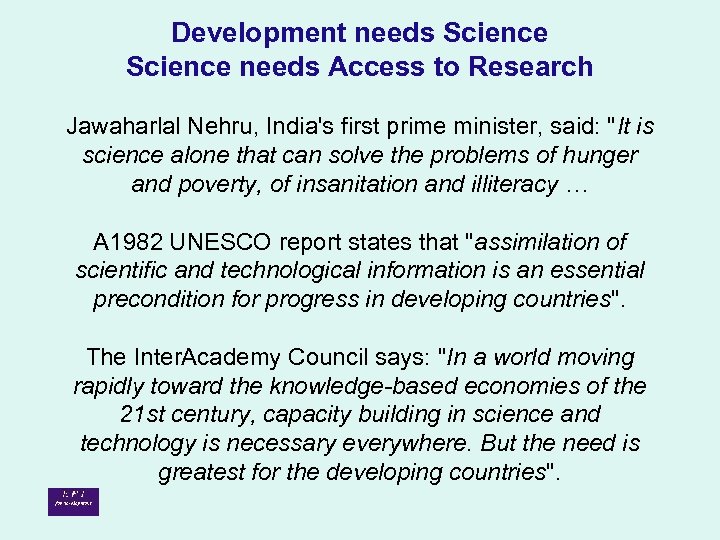
Development needs Science needs Access to Research Jawaharlal Nehru, India's first prime minister, said: "It is science alone that can solve the problems of hunger and poverty, of insanitation and illiteracy … A 1982 UNESCO report states that "assimilation of scientific and technological information is an essential precondition for progress in developing countries". The Inter. Academy Council says: "In a world moving rapidly toward the knowledge-based economies of the 21 st century, capacity building in science and technology is necessary everywhere. But the need is greatest for the developing countries".
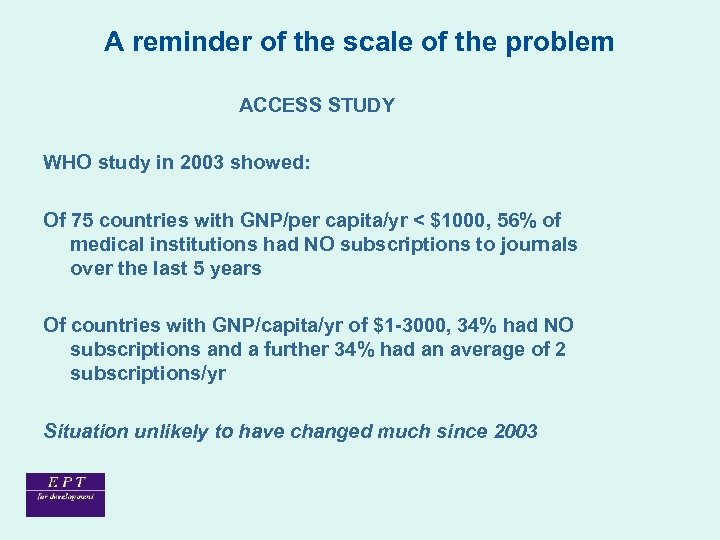
A reminder of the scale of the problem ACCESS STUDY WHO study in 2003 showed: Of 75 countries with GNP/per capita/yr < $1000, 56% of medical institutions had NO subscriptions to journals over the last 5 years Of countries with GNP/capita/yr of $1 -3000, 34% had NO subscriptions and a further 34% had an average of 2 subscriptions/yr Situation unlikely to have changed much since 2003
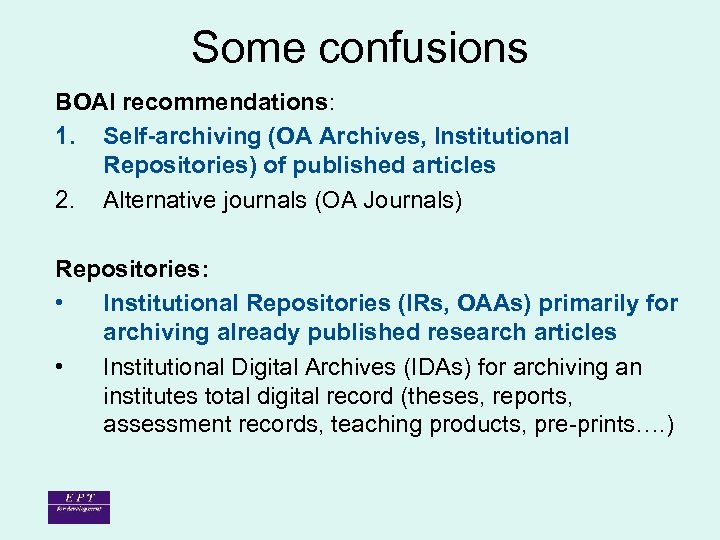
Some confusions BOAI recommendations: 1. Self-archiving (OA Archives, Institutional Repositories) of published articles 2. Alternative journals (OA Journals) Repositories: • Institutional Repositories (IRs, OAAs) primarily for archiving already published research articles • Institutional Digital Archives (IDAs) for archiving an institutes total digital record (theses, reports, assessment records, teaching products, pre-prints…. )
Institutional Repositories A global network of interoperable archives providing free access to already published research findings (author’s final version) Subsidiary, bottom-up access strategy working in parallel with OA or TA journals
Technical Benefits from Institutional Repositories – Free software, therefore appropriate for low-income countries – Easy to establish, technical help available – All IRs are interoperable, conforming to OAI-MPH international standards (www. oaister. org/about. html) – Distributed network, shared costs – Searchable by Google, Yahoo and specialised search programs (eg OAIster, SHERPA searches) – Usage (impact) statistics available – If embargo, immediate deposit gives email options
Strategic Benefits from Institutional Repositories • Content free to all with access to Internet (Good for readers) • Increases impact of articles (raises visibility of developing country science); increases usage, forges partnerships (Good for authors) • Maximises return on investments (already being mandated by institutes and funding bodies) (Good for funders) • Shows institutional achievement (Good for institutes) • Administrative tool (eg RAE) (Good for institutes) • Already ~900 established • Little change to existing publishing practice – no new models required
Any problems? Yes! Researchers are merely humans and don’t bother to archive their publications (in spite of the fact that their work makes a far higher impact)! So IRs are proving slow to fill. Studies show (A. Swan; A. Sale) researchers willingly archive if told [or mandated] to do so. Like most of us, researchers respond to sticks and carrots!
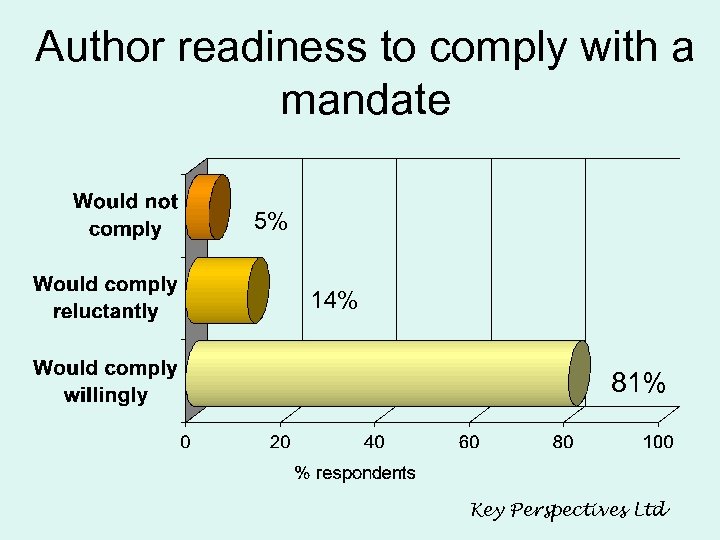
Author readiness to comply with a mandate 5% 14% 81% Key Perspectives Ltd
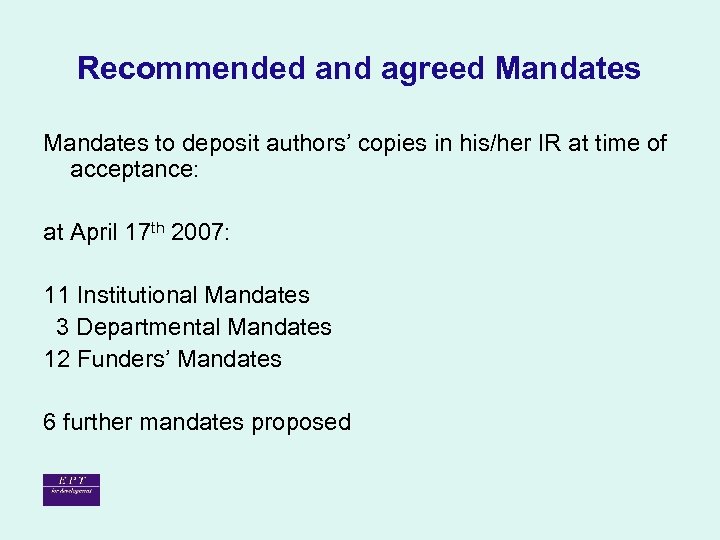
Recommended and agreed Mandates to deposit authors’ copies in his/her IR at time of acceptance: at April 17 th 2007: 11 Institutional Mandates 3 Departmental Mandates 12 Funders’ Mandates 6 further mandates proposed
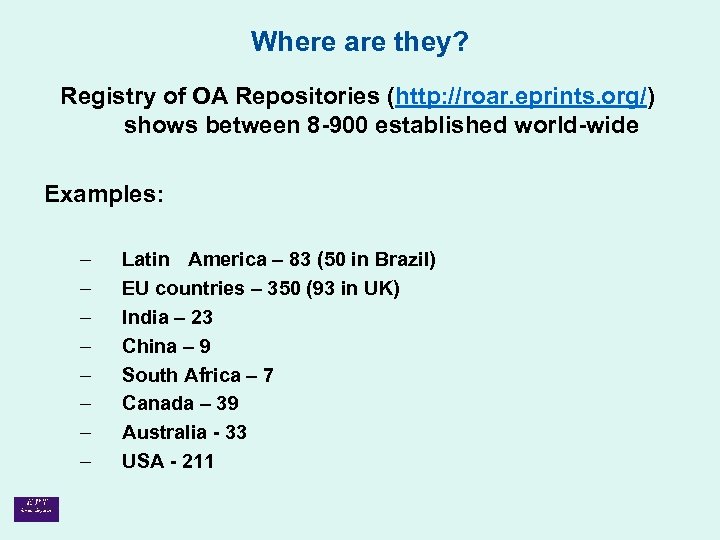
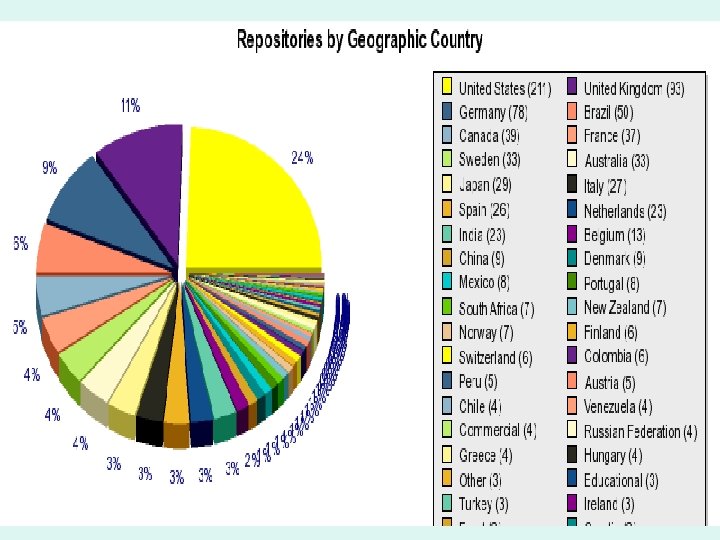
Where are they? Registry of OA Repositories (http: //roar. eprints. org/) shows between 8 -900 established world-wide Examples: – – – – Latin America – 83 (50 in Brazil) EU countries – 350 (93 in UK) India – 23 China – 9 South Africa – 7 Canada – 39 Australia - 33 USA - 211
And the cost is? In India, for example: • • NCCR ‘Not very much’ ‘Depends if you have to buy a PC and if you can use existing staff’ IISc (India) says new PC costs ~$555 IISc deposits papers and formats abstracts/references for authors; two people’s salary costs $5500 per annum. Total $6055 NIC (India) says they ‘used existing resources, so not very expensive’
Driver Repository Infrastructure Vision for European Research The long-term vision: Pan-European Digital Repository Infrastructure http: //www. driver-repository. eu/
The Depot deposit service Welcome to the DEPOT. The DEPOT is a supporting service of the JISC Repositories and Preservation programme. Researchers based at UK institutions of higher and further education are welcome to use this national facility to deposit their peer-reviewed papers, articles, and book chapters (e-prints). The Depot contains full-text post-print research papers, with associated metadata and subject classification. The Depot is an OAI-compliant repository allowing your e-prints to be discovered and accessed through harvesting services and search engines anywhere in the world. The Depot conforms to W 3 C standards for conformity and validation, and Section 508 for accessibility. http: //depot. edina. ac. uk/ Part of the JISC IR Roadmap programme
►And in the USA Inter. Agency Working Group on Digital Data, not articles as yet 22 agencies to develop infrastructure ►And in AUSTRALIA Partnership for Sustainable Repositories Online Research Collections Australia: ORCA Network ORCA Registry
►And globally >25, 000 research individuals (including >1000 research organisations) signed petition in support of recommendation A 1 of EU study: “GUARANTEE PUBLIC ACCESS TO PUBLICLYFUNDED RESEARCH RESULTS SHORTLY AFTER PUBLICATION“ Sponsors: De. FF JISC SPARC Europe SURF
IRs for sustainable development? A light at the end of the tunnel…. .
NEED ACCESS NOW! (think malaria, HIV AIDS, climate change, avian ‘flu, tsunamis, conservation, taxonomy…. . ) IRs should not be delayed while mega$ programmes are agreed and implemented. There is an urgent need to support: • Establishment of Institutional Repositories • Mandating author-deposit (and providing incentives) • Consider networking programmes for IRs (cf DRIVER and DEPOT programmes, JISC Roadmap)
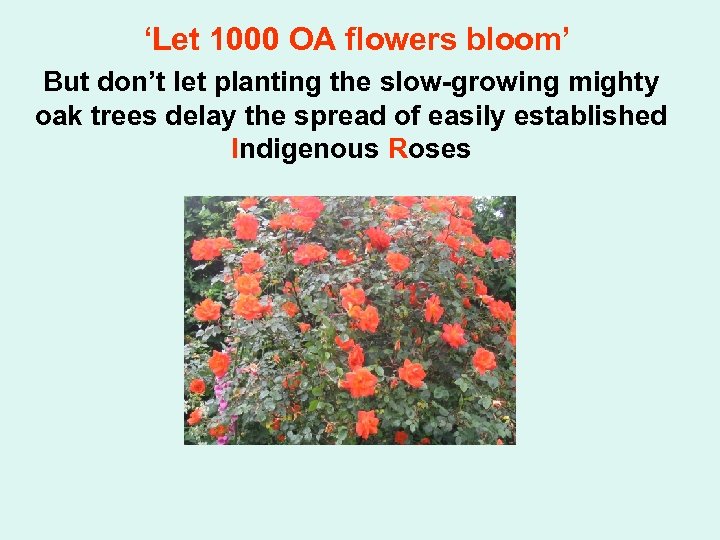
‘Let 1000 OA flowers bloom’ But don’t let planting the slow-growing mighty oak trees delay the spread of easily established Indigenous Roses

Thank you Barbara Kirsop barbara@biostrat. demon. co. uk Electronic Publishing Trust for Development http: //www. epublishingtrust. org
Скачать презентацию Institutional Repositories their contribution to sustainable development
8f1e3b3b577ded5100f70524c90119ec.ppt