


 Скачать презентацию Institutional Mechanisms as Applied to Return Migrants in
8e706912e416039b6a73c12ee83193b6.ppt
- Количество слайдов: 48
 Institutional Mechanisms as Applied to Return Migrants in Contemporary China Kun Chen University of California, Berkeley USA The Third Consultative Meeting of the MIREM Project 3 -4 November 2008 European University Institute, Florence, Italy Kun Chen University of California, Berkeley
 Presentation Outline • • • I. Terminologies of Chinese returnees II. Structural framework III. Legal system IV. Institutional supports V. Reflections and open questions Kun Chen University of California, Berkeley 2
 I. Terminologies of Chinese Returnees • Traditional returnees: Guiqiao (general) • Contemporary returnees: Haigui (specific) Kun Chen University of California, Berkeley 3
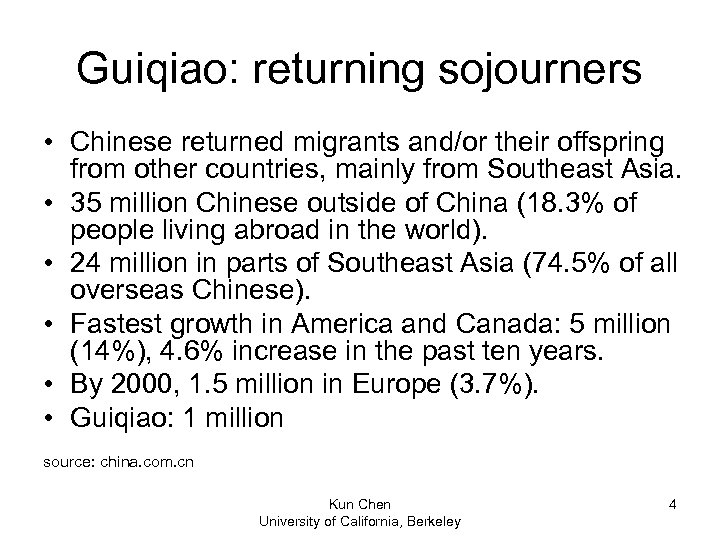 Guiqiao: returning sojourners • Chinese returned migrants and/or their offspring from other countries, mainly from Southeast Asia. • 35 million Chinese outside of China (18. 3% of people living abroad in the world). • 24 million in parts of Southeast Asia (74. 5% of all overseas Chinese). • Fastest growth in America and Canada: 5 million (14%), 4. 6% increase in the past ten years. • By 2000, 1. 5 million in Europe (3. 7%). • Guiqiao: 1 million source: china. com. cn Kun Chen University of California, Berkeley 4
 Haigui: returnees from overseas • Highly educated professionals and students from America, Canada, Europe, Australia, Japan, etc after the economic reforms (the late 1970 s) Kun Chen University of California, Berkeley 5
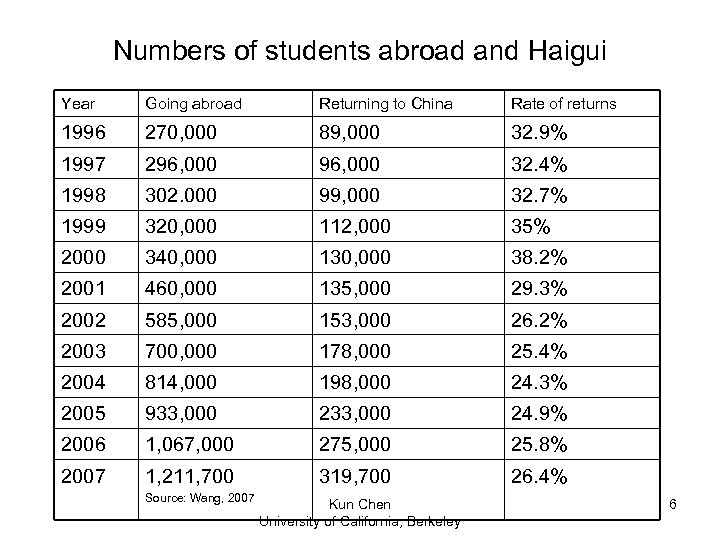 Numbers of students abroad and Haigui Year Going abroad Returning to China Rate of returns 1996 270, 000 89, 000 32. 9% 1997 296, 000 32. 4% 1998 302. 000 99, 000 32. 7% 1999 320, 000 112, 000 35% 2000 340, 000 130, 000 38. 2% 2001 460, 000 135, 000 29. 3% 2002 585, 000 153, 000 26. 2% 2003 700, 000 178, 000 25. 4% 2004 814, 000 198, 000 24. 3% 2005 933, 000 24. 9% 2006 1, 067, 000 275, 000 25. 8% 2007 1, 211, 700 319, 700 26. 4% Source: Wang, 2007 Kun Chen University of California, Berkeley 6
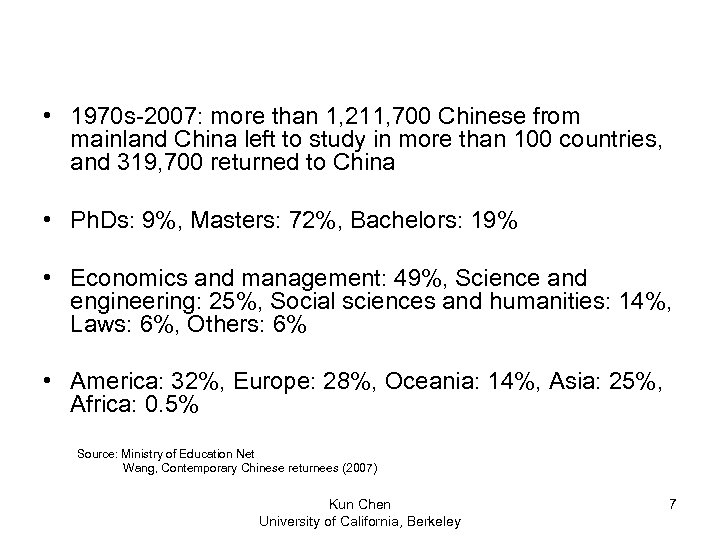 • 1970 s-2007: more than 1, 211, 700 Chinese from mainland China left to study in more than 100 countries, and 319, 700 returned to China • Ph. Ds: 9%, Masters: 72%, Bachelors: 19% • Economics and management: 49%, Science and engineering: 25%, Social sciences and humanities: 14%, Laws: 6%, Others: 6% • America: 32%, Europe: 28%, Oceania: 14%, Asia: 25%, Africa: 0. 5% Source: Ministry of Education Net Wang, Contemporary Chinese returnees (2007) Kun Chen University of California, Berkeley 7
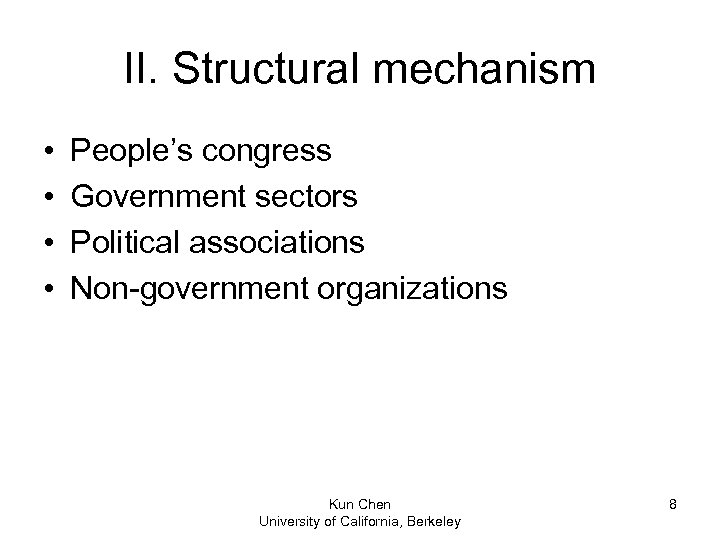 II. Structural mechanism • • People’s congress Government sectors Political associations Non-government organizations Kun Chen University of California, Berkeley 8
 Structural mechanism • Overseas Chinese Affairs Committee of the National People’s Congress - the highest institution in charge of overseas Chinese affairs including Chinese living abroad and Chinese returnees - legislation and relevant political proposals Kun Chen University of California, Berkeley 9
 Structural mechanism • • Overseas Chinese Affairs Office of the State Council Overseas Chinese Affairs Office at the provincial and municipal levels -Policy making and implementation -Relevant affairs Kun Chen University of California, Berkeley 10
 Structural mechanism • Chinese embassies in other countries -provide support and assistance to Chinese living abroad. -provide relevant documents for overseas Chinese before they return to China Kun Chen University of California, Berkeley 11
 Structural mechanism • Hong Kong, Macau, Taiwan and Overseas Chinese Affairs Committee of the Chinese People’s Political Consultative Conference -discuss policies and laws related to overseas Chinese and returnees -monitor the implementation of polices and laws Kun Chen University of California, Berkeley 12
 Structural mechanism • China Zhi Gong Party -a political party in China -members are Chinese returnees or relatives of overseas Chinese Kun Chen University of California, Berkeley 13
 Structural mechanism • Chinese Association of Returned Overseas Chinese (QL) -an association that provides services to returned Chinese -in charge of political, business, cultural, social, and other grassroots affairs related to returned Chinese Kun Chen University of California, Berkeley 14
 Structural mechanism • Chinese Association of Overseas Exchange -organization to promote economic and cultural exchanges between Chinese returnees and foreign countries Kun Chen University of California, Berkeley 15
 Structural mechanism • Other government sectors in charge of relevant work: Ministry of Education, Ministry of Foreign Affairs, Ministry of Science and Technology, Ministry of Human Resources and Social Security Kun Chen University of California, Berkeley 16
 Structural mechanism Beijing Chinese Language and Culture College, Jinan University, Huaqiao University, Chinese Enterprise Management Consulting Company Chinese QL Public Welfare Management Service Center Overseas Chinese Historical Museum Overseas Chinese History Research Institute Chinese QL Institutional Service Center Overseas Chinese Magazine, At Home and Overseas Magazine The Chinese Overseas Publishing House Chinaqw. com. cn Kun Chen University of California, Berkeley 17
 III. Legal system: Constitution of PRC - Article 50: Overseas Chinese, returnees and their family members’ rights and interests are protected in China. - Article 70: Overseas Chinese Committee in the National People’s Congress has the right to study, discuss, and make relevant proposals regarding overseas Chinese and returnees. - Article 89 (12): The State Council has the right to protect overseas Chinese and returnees and their family members’ legal rights and interests. Kun Chen University of California, Berkeley 18
 Other Laws • Law of PRC on the Protection of the Rights and Interests of Returned Overseas Chinese and the Family Members of Overseas Chinese (implement: 1991; amendment: 2000) - basic rights, residence, employment status, political participation, housing, health care, travel, education, social welfare, etc Kun Chen University of California, Berkeley 19
 Other Laws • Measures for the Implementation of the Law of PRC on the Protection of the Rights and Interests of Returned Overseas Chinese and the Family Members of Overseas Chinese (implement: 1993; amendment 2004) Kun Chen University of California, Berkeley 20
 IV. Institutional supports - Current supports mainly focus on attracting highly educated overseas Chinese to return to China (Haigui—those who study and/or work abroad and return to China) - Fundamental policy: “supporting Chinese to study abroad, encouraging them to return to China, and creating a free environment of traveling back and forth” Kun Chen University of California, Berkeley 21
 Relevant policies • 1981: “Open policy for self-financed students to study abroad” • 1985: “Abolishment of the qualification evaluation for self-financed students to study abroad” • 1992: “Notification about related issues regarding Chinese studying abroad” • 2000: “Opinions about encouraging overseas highprofile Chinese studying abroad to return to work in China ” Kun Chen University of California, Berkeley 22
 Relevant policies • 2001: “Several suggestions about encouraging Chinese studying abroad to serve the home country in multiple ways” • 2006: “the Eleventh five year planning for returned overseas students ” • 2007: “Several suggestions about further strengthening the work to attract overseas outstanding talents” ; “Suggestions about building the green channel for highprofile returned overseas students” (eight qualifications) Kun Chen University of California, Berkeley 23
 Service agencies • Western Returned Scholars Association • Chinese Overseas Educated Scholars Association • Chinese Service Center for Scholarly Exchange • Association of Overseas Chinese Enterprises Kun Chen University of California, Berkeley 24
 Financial support • Starting funding for returned overseas researchers, teachers, and startups, etc • Tax exemption and benefits Kun Chen University of California, Berkeley 25
 Human resource programs • Overseas Young Scholars back to China Plans (1990) • New Century’s Outstanding Talents Plans (1991) • National Outstanding Young Scientist Funds (1994) • Hundred People Plans (1994) • Chunhui (Spring sunshine) Plans (1996) • Yangtze River Scholar Plans (1998) Kun Chen University of California, Berkeley 26
 Educational support • Academic exchange programs to finance students and scholars to study abroad • Scholarships for students abroad Kun Chen University of California, Berkeley 27
 Infrastructural support • More than one hundred Returned Overseas Chinese Parks and high-tech zones housing 6, 000 companies started by returnees Kun Chen University of California, Berkeley 28
 Residential and family support • Housing and residency benefits • Spouses and Children’s benefits Kun Chen University of California, Berkeley 29
 Information support • Specialized information centers • Websites • Job/project fairs and database Kun Chen University of California, Berkeley 30
 V. Reflections: Pros • 1. Positive historical discourses of returnees by the government, media, schools and the mass Returnees = success + value (collectively and individually) Kun Chen University of California, Berkeley 31
 • 2. Strong ideology of returned overseas Chinese The meanings and motives of going abroad and returning: nationalism (serve the country), sentiments (homesickness), strategies (self-development) Kun Chen University of California, Berkeley 32
 • 3. Relatively mature ecosystem to support overseas Chinese both when they live abroad and return Kun Chen University of California, Berkeley 33
 • 4. Strong tangible supports from the government to legitimate returnees Kun Chen University of California, Berkeley 34
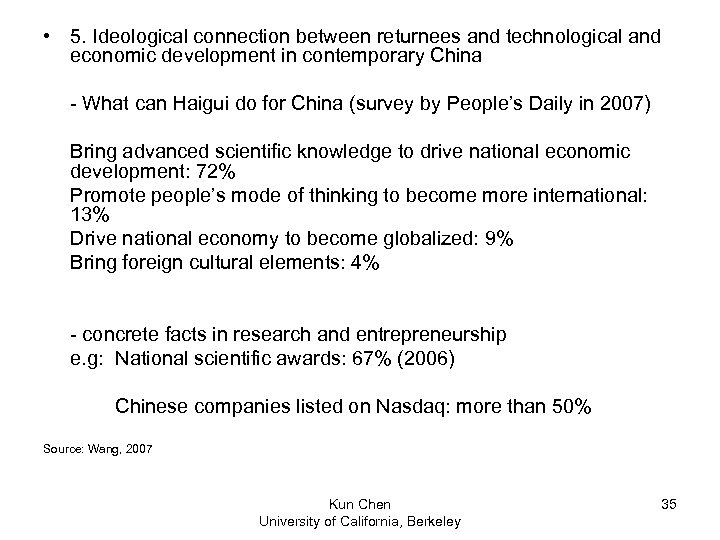 • 5. Ideological connection between returnees and technological and economic development in contemporary China - What can Haigui do for China (survey by People’s Daily in 2007) Bring advanced scientific knowledge to drive national economic development: 72% Promote people’s mode of thinking to become more international: 13% Drive national economy to become globalized: 9% Bring foreign cultural elements: 4% - concrete facts in research and entrepreneurship e. g: National scientific awards: 67% (2006) Chinese companies listed on Nasdaq: more than 50% Source: Wang, 2007 Kun Chen University of California, Berkeley 35
 Pros of the Chinese return migration mechanisms (cont. ) • 6. Strong returnee associations/political party to protect their own rights and interests Kun Chen University of California, Berkeley 36
 • 7. Established returnee culture in key returnee clusters -Clusters of returnees e. g. Zhongguancun high-tech park, and CBD in east Beijing - Conferences and clubs - Informal events - Third places: bars, coffee shops, dining, shopping, etc Kun Chen University of California, Berkeley 37
 • 8. New trend of returnees and flexible system: “Seagulls”: Haiou-travelling back and forth Kun Chen University of California, Berkeley 38
 Cons • 1. Less attention to low-skilled returnees and compelled returnees • 2. Institutional supports are concentrated in the fields of science and technology, and business, but not in social sciences and humanities, etc Kun Chen University of California, Berkeley 39
 • 3 a. Uneven geographical distribution of returnees: too much attention in Beijing, Shanghai, Guangdong, and costal cities, and less attention in the West and North of China Costal cities in southeast: 46% BJ, SH and GD: 24% Hong Kong, Macao, and Taiwan: 28% Others: 2% Source: Wang, 2007 Kun Chen University of California, Berkeley 40
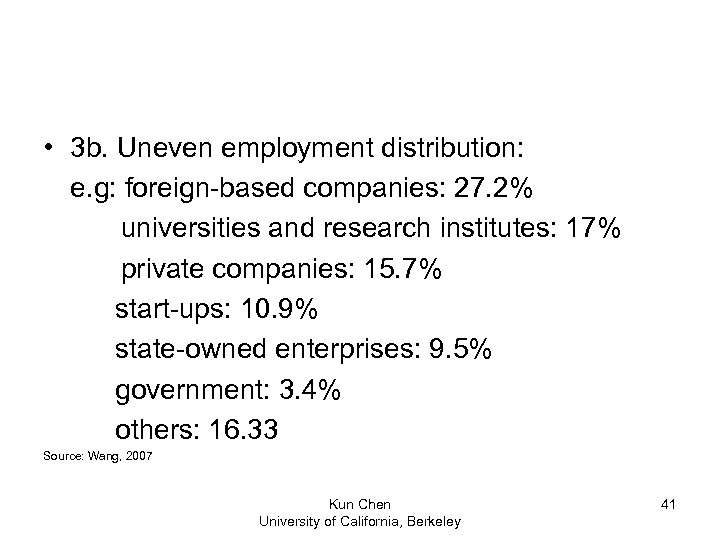 • 3 b. Uneven employment distribution: e. g: foreign-based companies: 27. 2% universities and research institutes: 17% private companies: 15. 7% start-ups: 10. 9% state-owned enterprises: 9. 5% government: 3. 4% others: 16. 33 Source: Wang, 2007 Kun Chen University of California, Berkeley 41
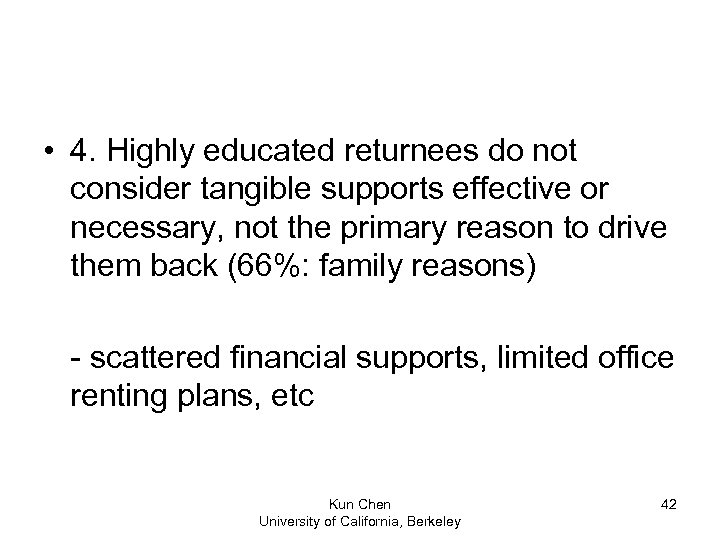 • 4. Highly educated returnees do not consider tangible supports effective or necessary, not the primary reason to drive them back (66%: family reasons) - scattered financial supports, limited office renting plans, etc Kun Chen University of California, Berkeley 42
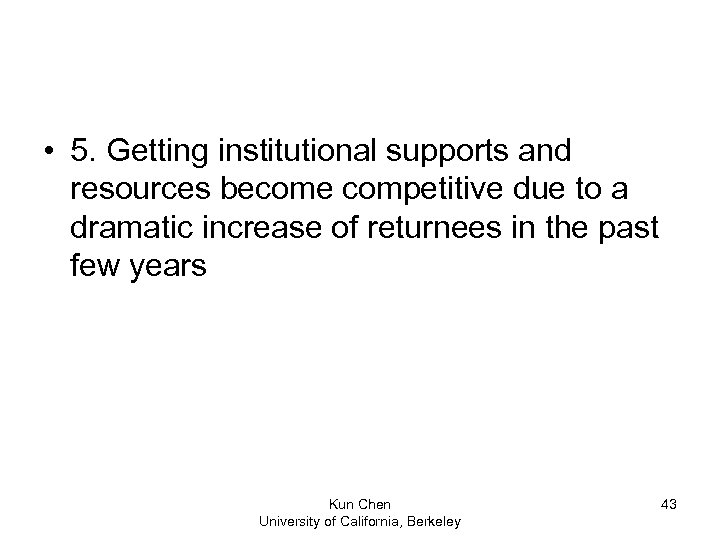 • 5. Getting institutional supports and resources become competitive due to a dramatic increase of returnees in the past few years Kun Chen University of California, Berkeley 43
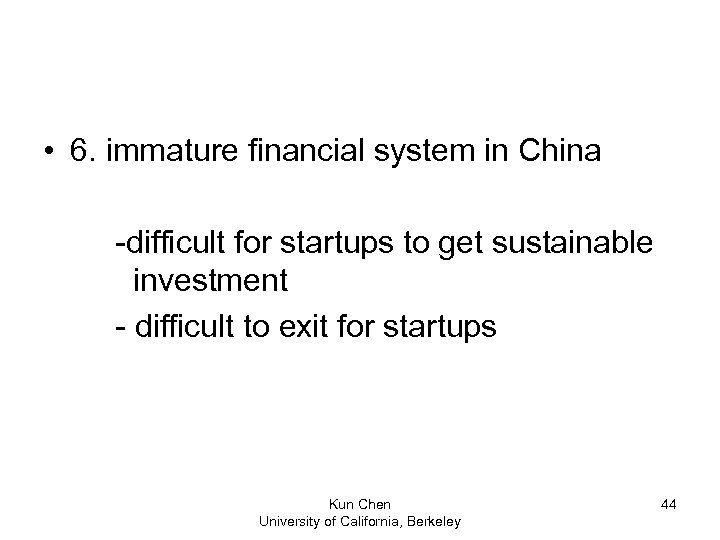 • 6. immature financial system in China -difficult for startups to get sustainable investment - difficult to exit for startups Kun Chen University of California, Berkeley 44
 • 7. The uncertainty of intangible resources, social capital, education due to cultural limits e. g. guanxi politics (social relations) different education cultures for returnees’ children Kun Chen University of California, Berkeley 45
 Open Questions • 1. double citizenship? No double citizenship according to the Chinese law Vague strategies Kun Chen University of California, Berkeley 46
 • 2. More work is needed to consider the future return migration trend. How does China deal with the surplus labor market in rural China? How to build a mechanism to deal with the reintegration of rural migrant returnees? Kun Chen University of California, Berkeley 47
 Thank you! kunchen@berkeley. edu Kun Chen University of California, Berkeley 48