 Скачать презентацию Institutional Ethnography of Rehabilitation Programs — normativity knowledge
98983955924c300425df9038850857c7.ppt
- Количество слайдов: 20



Institutional Ethnography of Rehabilitation Programs - normativity, knowledge and praxis Kjeld Høgsbro August 2010
Institution and Lifeworld Then I got such strange thoughts. I used appreciate being together with people. Then I went to a chiropractor, because I thought something strange had happened to my head. I thought it would have something to do with my neck. So I went to see him for a while. Then he said: “I think you need a psychiatrist”. Then I said: “What is that”? I had no idea of what it was. Then he said: “I think you have got weak nerves (‘dårlige nerver’ a popular phrase for being mentally ill)”. Then I said: “This, I certainly do not have”. But yes – I had to go and visit the psychiatrist. Somewhere in the city centre. I got a bag full of pills to bring with me home. So it was – and I ought to do something. I could not find out what to do. I was just sitting here – sleeping. My kids were neither washed or anything. I was confined to my bed. Then I was … at the local hospital. I was … - my husband was against pills – he did not want me to take any medicine. While I was there, he did not want to visit me. He did not like ‘such places’. Then I became even worse. I was put in a straitjacket (spændetrøje) and things like that, and I did not want to eat and I fought with the staff, I was shouting and destroyed everything. Can’t mention anything I did not do. (Interview from Hidden Life-worlds).
Stigma, social exclusion and social network To be noticed: It is important to be aware of the way patients understand the disability before they become patients themselves and to notice how their relatives understand the situation. This is an important context of the stigma, anger and shame they experience during the following phase of personal crisis.
Impression management A middle-aged woman told me that almost six months have passed when she was seriously influenced by the illness without her family recognising anything wrong. She spent all the day in bed and only got up half an hour before her first child came home. Then she undertook the task as ’mother’, telling her child that it had to go to the grocery in order to buy the food she forgot earlier this morning. She laughed when she told me this because the family members did not wonder how she could forget so much. As a matter of fact, she was not able to leave the house. She did not dare to shop anymore. In the end, a close friend of the family realised that something was wrong and persuaded her to visit a psychiatrist. (Ethnografic note) To be noticed: some families, networks and patients were excellent in dealing with impression management. They were able to hide the illness until it got worse and reached a rather high level.
Stigma and Research All kinds of explanations stigmatise certain categories of people: The anti-psychiatry movement of the early 1970 s stigmatised the patient’s mother and lead to a disastrous situation of blame and guilt among the relatives. The following period of biological explanations left the patient in a hopeless situation of being without value to others for the rest of their life. The recent trend of recovery opens the possibility of blaming the patient, the close relatives and the professionals when recovery fails. Explanations become important elements in the construction of a new life story because they identify: what had happened in the past. what might happen in the future. what you have to do. who is the friend, the supportive, the enemy and the obstacles.
Vulnerability Two outpatients were interviewed about the staff members’s attitudes at a certain place they both were connected to. The first patient told that the staff members were very nice. They always addressed her when she arrived, asking her about her situation and what they could do for her. The other outpatient told that the staff members were incredible chauvinistic, always treating the patients as if they were small children. The two patients experienced the same kind of communication but received it from two different perspectives, two different phases of personal development. The first patient needed protection, the second patient needed respect and autonomy. (Ethnografic note). Stigma is not independently linked to certain expressions of recognition and respect. This case shows us that what might be stigmatising to one person might be experienced as a relevant caring attitude by another. It all depends on the situation and the image you have of yourself.
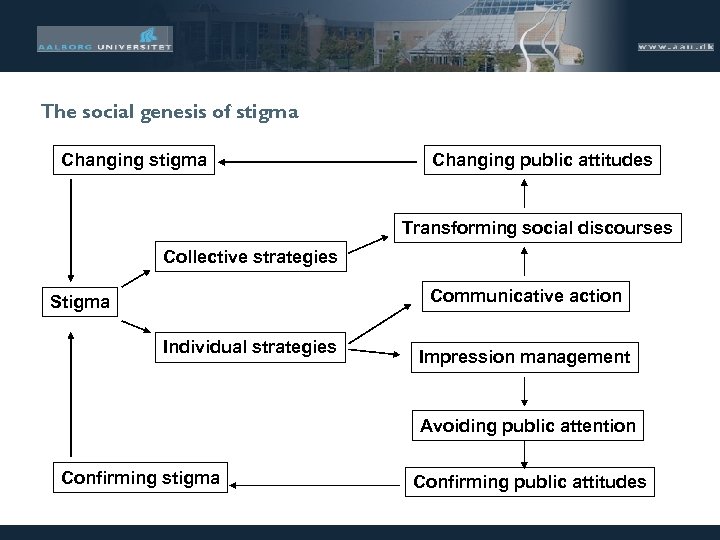
The social genesis of stigma Changing public attitudes Transforming social discourses Collective strategies Communicative action Stigma Individual strategies Impression management Avoiding public attention Confirming stigma Confirming public attitudes
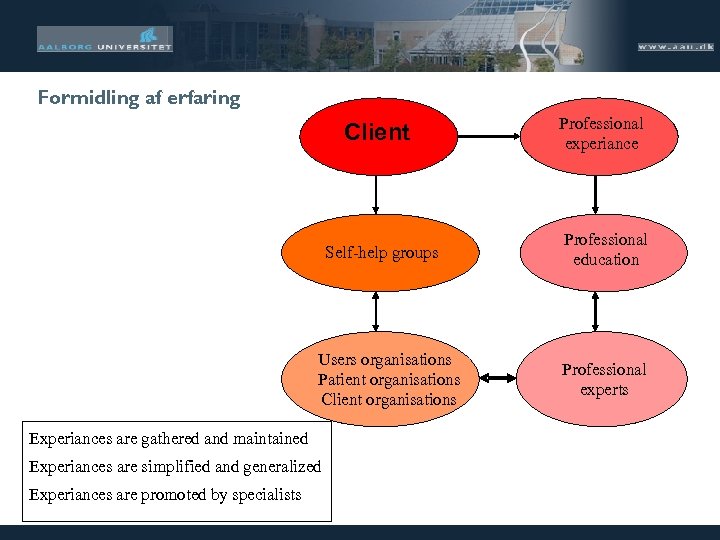
Formidling af erfaring Client Professional experiance Self-help groups Professional education Users organisations Patient organisations Client organisations Experiances are gathered and maintained Experiances are simplified and generalized Experiances are promoted by specialists Professional experts
Institutional discourses When patients, during the course of their treatment, learn that they are suffering from Schizofrenia, their experiance of illness and of themselves is transformed. (Barret 1996 s. 3) This ideal end product was the ’person with schizofrenia’. Such persons were bounded and inner-focused: They could distinguish clearly between the self and the external environment and could see that thoughts, perceptions, and actions stemmed from within. Internally, they were integrated, subjective, self-controlled persons who could separate their schizofrenia as a small part inside them and treat it as an object that could be contained and controlled. (Barret 1996: 290)
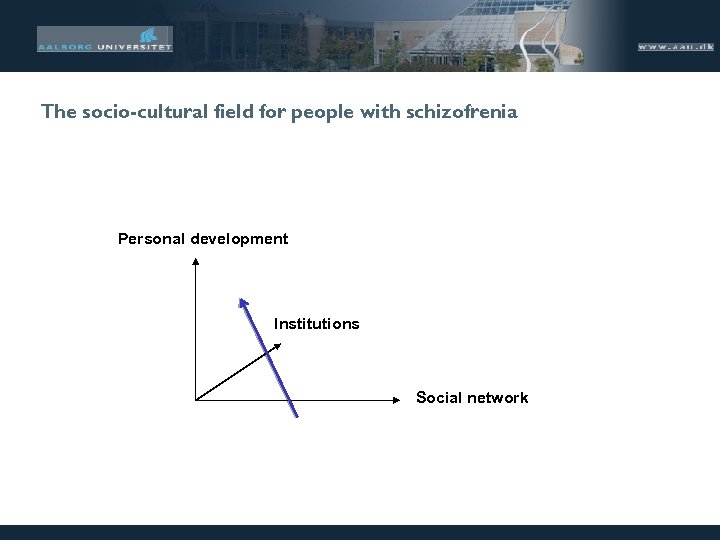
The socio-cultural field for people with schizofrenia Personal development Institutions Social network
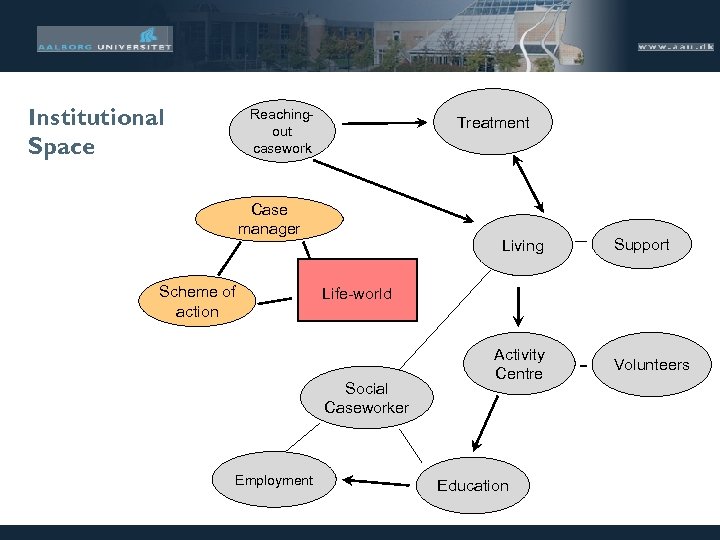
Institutional Space Reachingout casework Treatment Case manager Scheme of action Living Life-world Social Caseworker Employment Support Activity Centre Education Volunteers
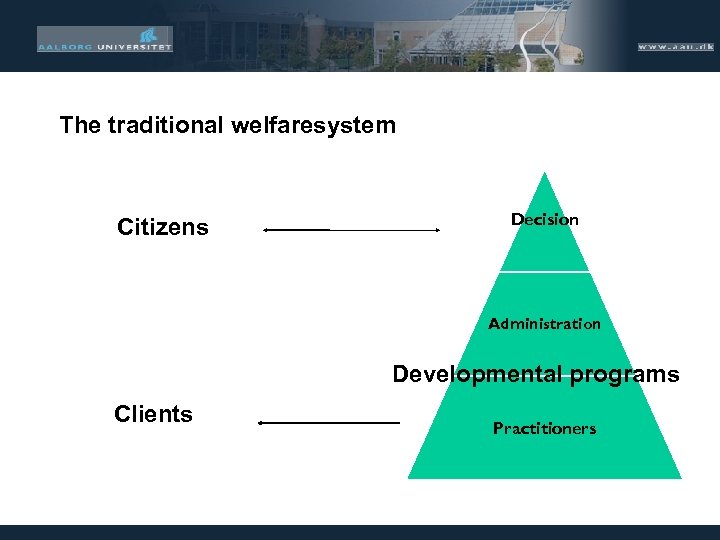
The traditional welfaresystem Citizens Decision Administration Developmental programs Clients Practitioners
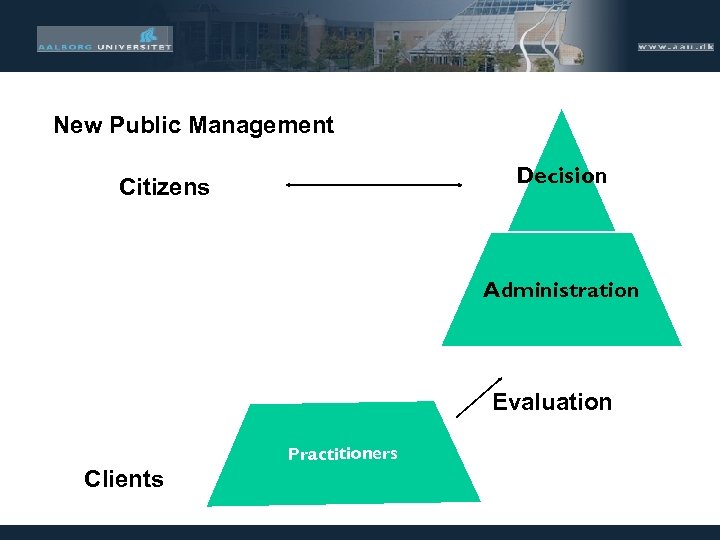
New Public Management Decision Citizens Administration Evaluation Practitioners Clients
Скачать презентацию Institutional Ethnography of Rehabilitation Programs — normativity knowledge
98983955924c300425df9038850857c7.ppt