


 Скачать презентацию Institute of Transportation Studies University of California Davis
38cacc0f33952e630d4e01bd79dfa5db.ppt
- Количество слайдов: 29
 Institute of Transportation Studies University of California, Davis The California Model for Combating Climate Change Daniel Sperling UC Davis and CARB Beyond Science: The Economics and Politics of Responding to Climate Change Rice University February 8, 2008
 Model: “something that is copied or used as the basis for a related idea, process, or system” Model: “an excellent example that deserves to be imitated”
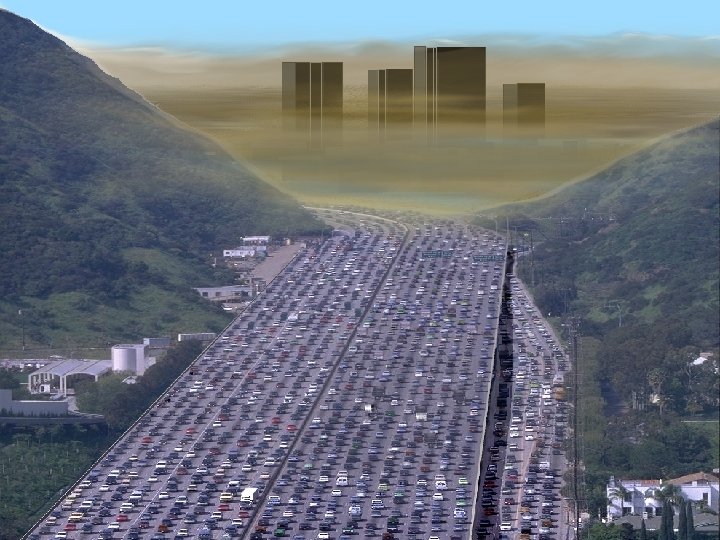
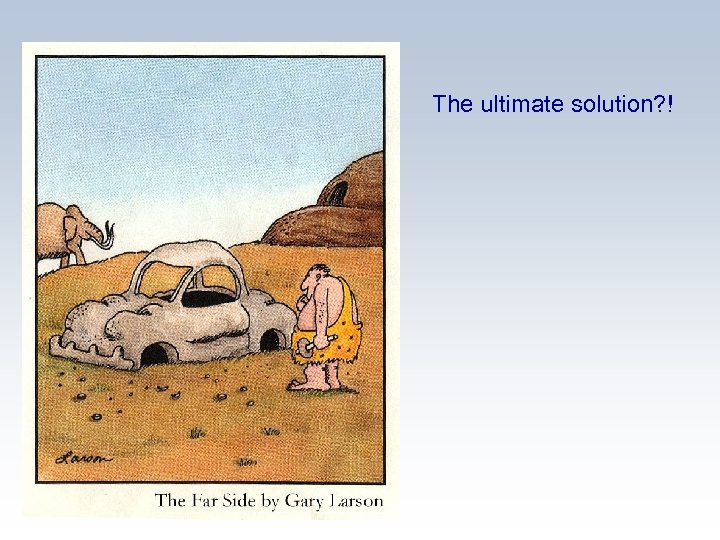 The ultimate solution? !
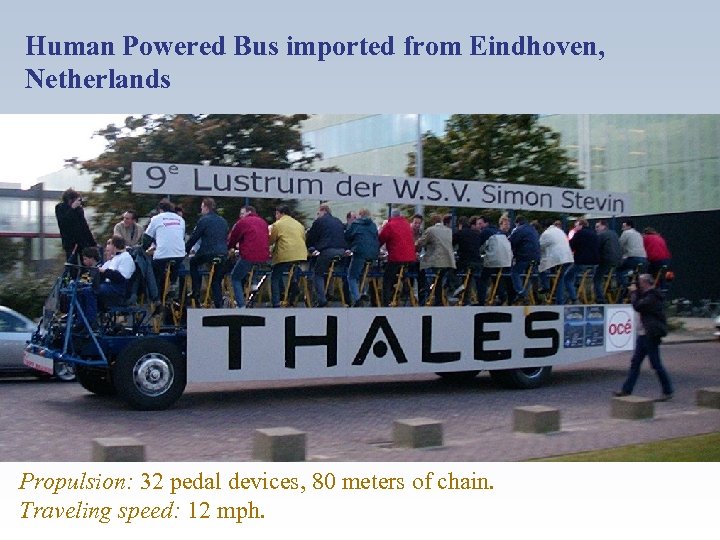 Human Powered Bus imported from Eindhoven, Netherlands Propulsion: 32 pedal devices, 80 meters of chain. Traveling speed: 12 mph.
 California Well Positioned to Lead on Climate Policy • Large, relatively isolated market • Political space: § Coal and Detroit car companies have little political power in California; § bi-partisan political support • Innovative consumers • Innovative industry: home to venture capital and past industrial revolutions (IT and Biotech) A laboratory for others to learn from
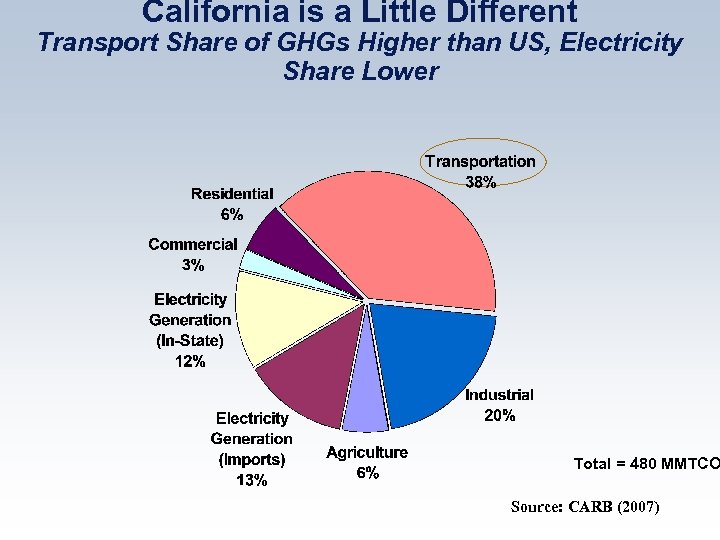 California is a Little Different Transport Share of GHGs Higher than US, Electricity Share Lower Total = 480 MMTCO Source: CARB (2007)
 Early California GHG Initiatives Voluntary and Regulatory • Green Building Standards: construction materials and practices, lighting, HVAC standards • Energy Efficiency Appliance Standards • California Climate Action Registry: voluntary reporting of direct and indirect greenhouse gas emissions by private and public sector • Electric Utility Renewable Portfolio Standard: 20% of utility retail sales of electricity by 2017, or an increase of at least 1% per year. • Vehicle GHG Standards: Law passed in 2002, regs finalized in 2004, now tied up in litigation (more on this later) • 2050 Target: Executive Order (June 2005) to Reduce GHG emissions 80% below 1990 levels by 2050
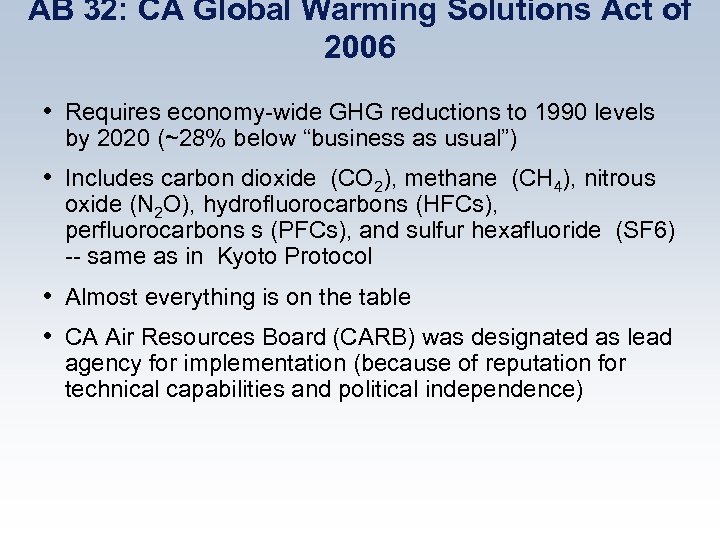 AB 32: CA Global Warming Solutions Act of 2006 • Requires economy-wide GHG reductions to 1990 levels by 2020 (~28% below “business as usual”) • Includes carbon dioxide (CO 2), methane (CH 4), nitrous oxide (N 2 O), hydrofluorocarbons (HFCs), perfluorocarbons s (PFCs), and sulfur hexafluoride (SF 6) -- same as in Kyoto Protocol • Almost everything is on the table • CA Air Resources Board (CARB) was designated as lead agency for implementation (because of reputation for technical capabilities and political independence)
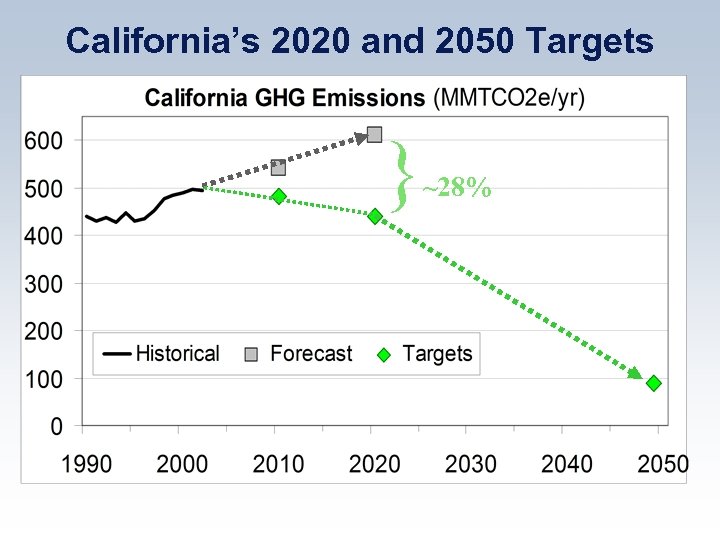 California’s 2020 and 2050 Targets } ~28%
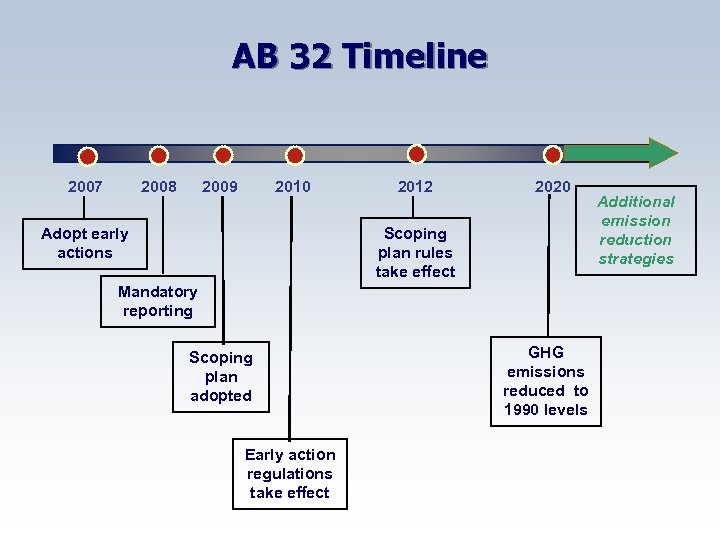 AB 32 Timeline 2008 2007 2009 2010 2012 2020 Scoping plan rules take effect Adopt early actions Mandatory reporting Scoping plan adopted Early action regulations take effect GHG emissions reduced to 1990 levels Additional emission reduction strategies
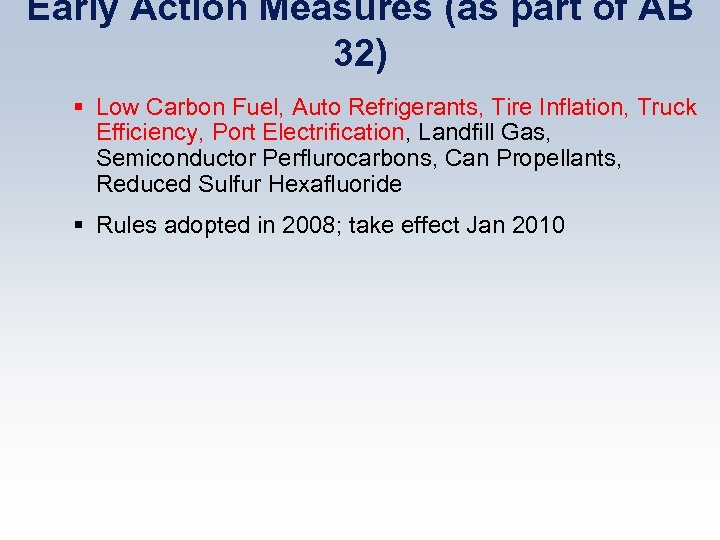 Early Action Measures (as part of AB 32) § Low Carbon Fuel, Auto Refrigerants, Tire Inflation, Truck Efficiency, Port Electrification, Landfill Gas, Semiconductor Perflurocarbons, Can Propellants, Reduced Sulfur Hexafluoride § Rules adopted in 2008; take effect Jan 2010
 Policy and Political Issues • Bipartisan and industry support for Climate Policy (AB 32), but … § Tension about Schwarzenegger (R) “stealing” this issue from Democrats § Fights over “details” by industry and business • Each sector must assume its “fair share”? • How to address emissions in diffuse sectors such as agriculture, land use, vehicle travel? • Market vs regulatory instruments? Cap and trade? ? • CARB can’t do it alone § How to engage public (to take responsibility) § How to engage other govt agencies (transportation, forestry, ag, PUC, local govts etc) § Need help from Feds with air and maritime
 3 Strategies to Reduce GHG Emissions from Transport Sector … What CA is Doing I. More Efficient Vehicles II. Lower Carbon Fuels III. Less VMT (via changes in land use, infrastructure, modal shifts, travel policies) Two Observations Ø 80% reduction (or even 30%) will require transformation of oil and automotive industries, and eventually transport sector. • Probably possible to get these reductions via technology, but it would result in a very expensive and inefficient transportation system) Ø Should transport sector have same reductions as other sectors? Ø Conventional wisdom says no, because cheaper and easier in other sectors … but economic analyses largely ignores innovation processes and possible shifts in consumer preferences
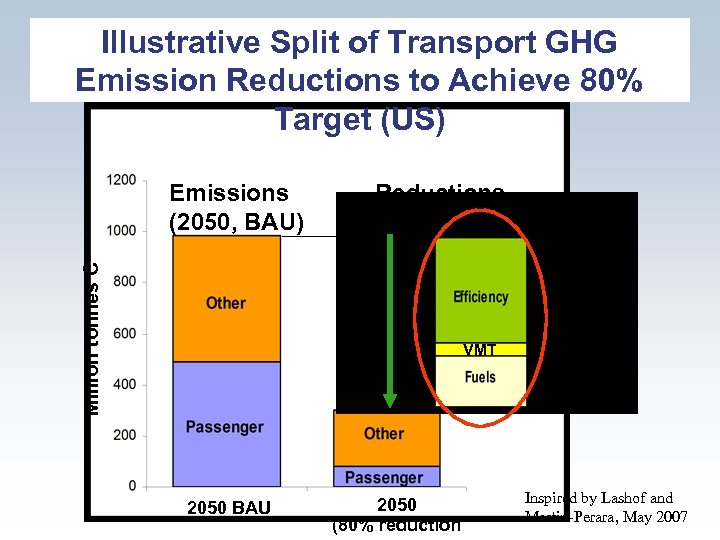 Illustrative Split of Transport GHG Emission Reductions to Achieve 80% Target (US) Reductions (2050) Million tonnes C Emissions (2050, BAU) VMT 2050 BAU 2050 (80% reduction Inspired by Lashof and Martin-Perara, May 2007
 I. Vehicles • Addressed by 2002 Pavley law (AB 1493) § § • Requires 30% reduction in GHG emissions/mile from new light duty vehicles by 2016 12 other states adopted this California law The tortured history of Pavley law § § • Auto Industry sued, lost in 2007 to Vermont and California, but now appealing EPA rejected California waiver to enact regulations in December 2007, and California is now suing EPA My expectation: Next Administration will approve waiver, or Congress will pass a law enabling CA and other states to proceed
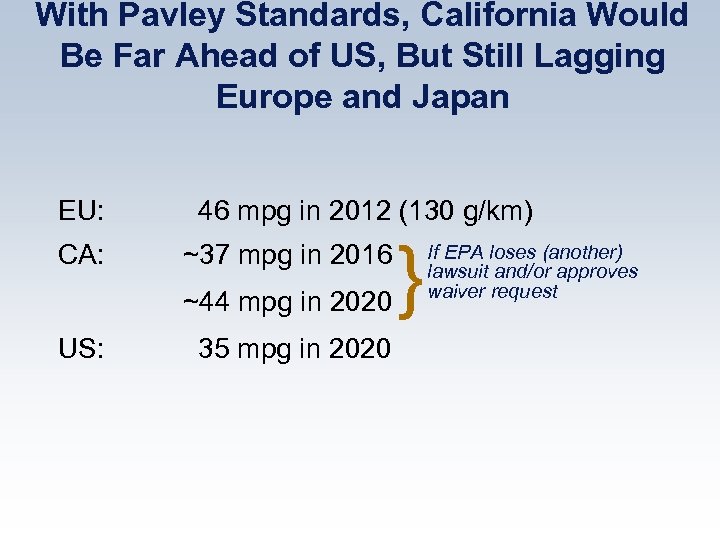 With Pavley Standards, California Would Be Far Ahead of US, But Still Lagging Europe and Japan EU: CA: 46 mpg in 2012 (130 g/km) ~37 mpg in 2016 ~44 mpg in 2020 US: 35 mpg in 2020 } If EPA loses (another) lawsuit and/or approves waiver request
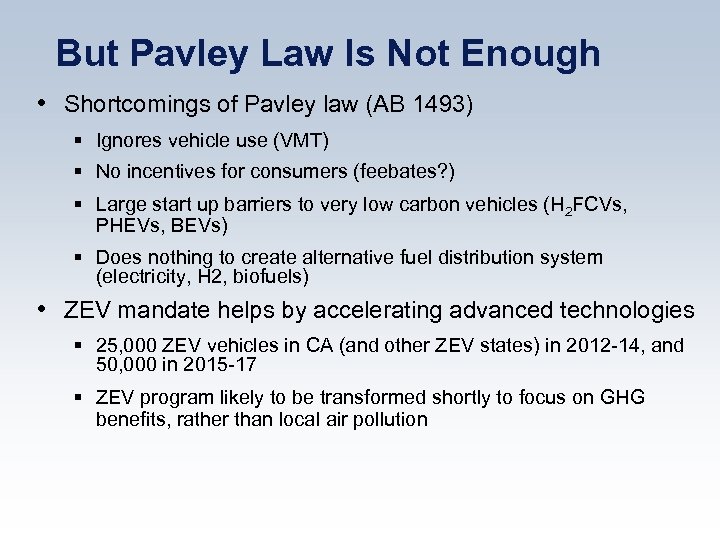 But Pavley Law Is Not Enough • Shortcomings of Pavley law (AB 1493) § Ignores vehicle use (VMT) § No incentives for consumers (feebates? ) § Large start up barriers to very low carbon vehicles (H 2 FCVs, PHEVs, BEVs) § Does nothing to create alternative fuel distribution system (electricity, H 2, biofuels) • ZEV mandate helps by accelerating advanced technologies § 25, 000 ZEV vehicles in CA (and other ZEV states) in 2012 -14, and 50, 000 in 2015 -17 § ZEV program likely to be transformed shortly to focus on GHG benefits, rather than local air pollution
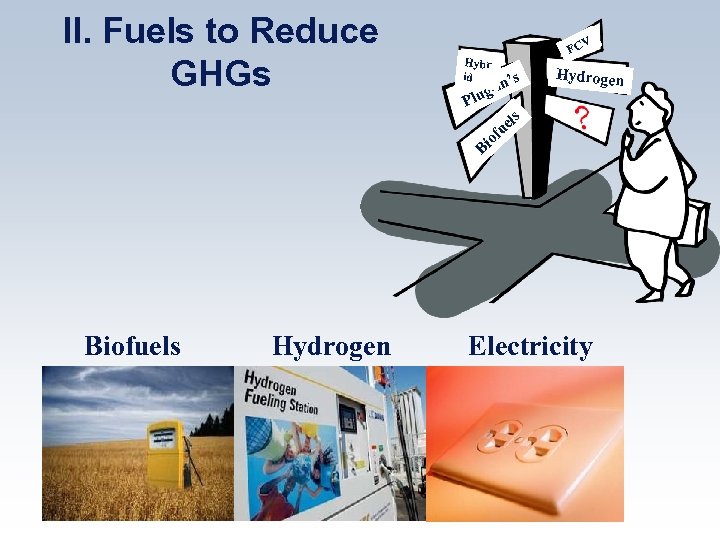 II. Fuels to Reduce GHGs V FC Hybr id s ’ g-in Plu Hydrogen ls ue f o Bi Biofuels Hydrogen Electricity
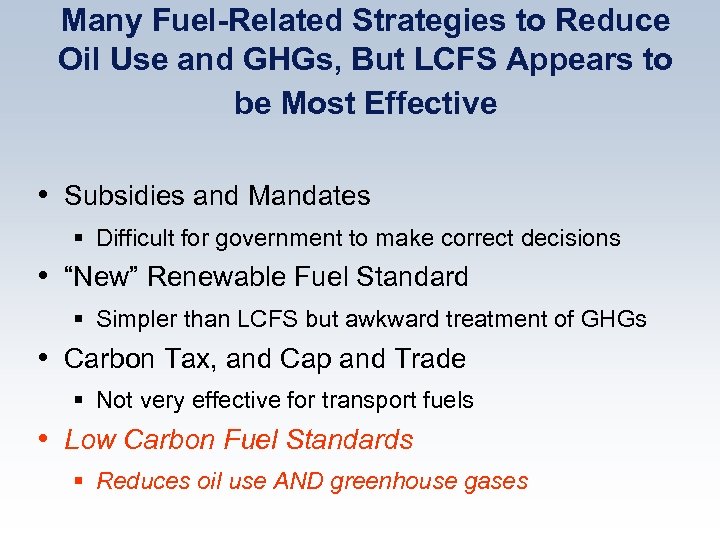 Many Fuel-Related Strategies to Reduce Oil Use and GHGs, But LCFS Appears to be Most Effective • Subsidies and Mandates § Difficult for government to make correct decisions • “New” Renewable Fuel Standard § Simpler than LCFS but awkward treatment of GHGs • Carbon Tax, and Cap and Trade § Not very effective for transport fuels • Low Carbon Fuel Standards § Reduces oil use AND greenhouse gases
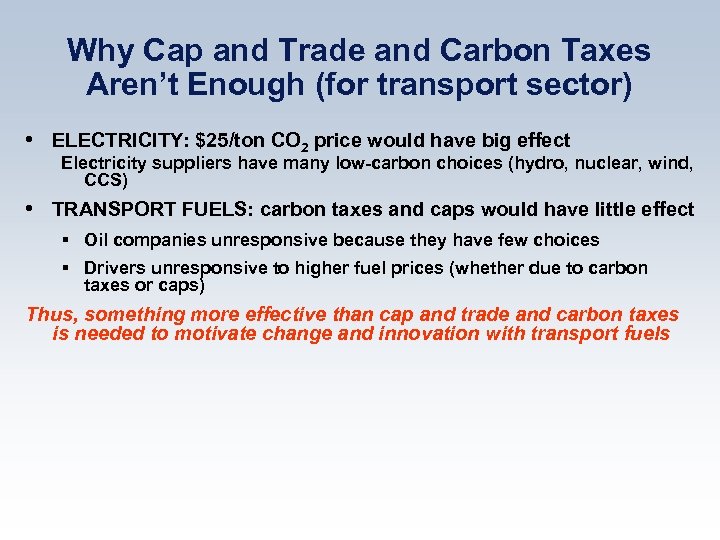 Why Cap and Trade and Carbon Taxes Aren’t Enough (for transport sector) • ELECTRICITY: $25/ton CO 2 price would have big effect Electricity suppliers have many low-carbon choices (hydro, nuclear, wind, CCS) • TRANSPORT FUELS: carbon taxes and caps would have little effect § Oil companies unresponsive because they have few choices § Drivers unresponsive to higher fuel prices (whether due to carbon taxes or caps) Thus, something more effective than cap and trade and carbon taxes is needed to motivate change and innovation with transport fuels
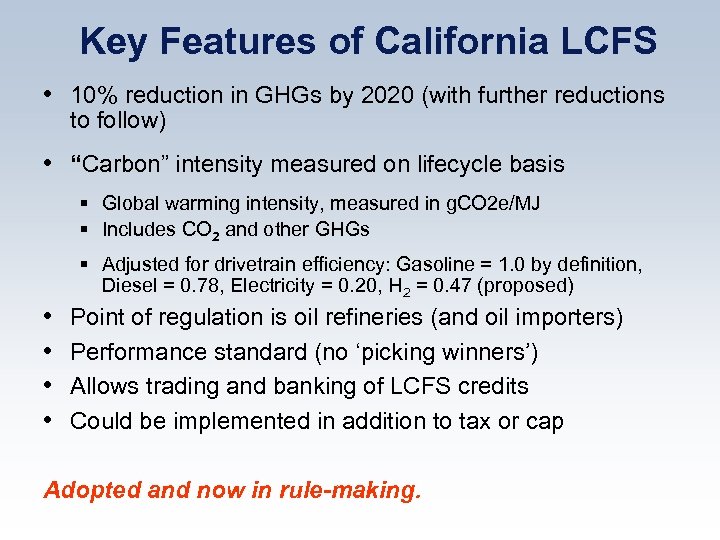 Key Features of California LCFS • 10% reduction in GHGs by 2020 (with further reductions to follow) • “Carbon” intensity measured on lifecycle basis § Global warming intensity, measured in g. CO 2 e/MJ § Includes CO 2 and other GHGs • • § Adjusted for drivetrain efficiency: Gasoline = 1. 0 by definition, Diesel = 0. 78, Electricity = 0. 20, H 2 = 0. 47 (proposed) Point of regulation is oil refineries (and oil importers) Performance standard (no ‘picking winners’) Allows trading and banking of LCFS credits Could be implemented in addition to tax or cap Adopted and now in rule-making.
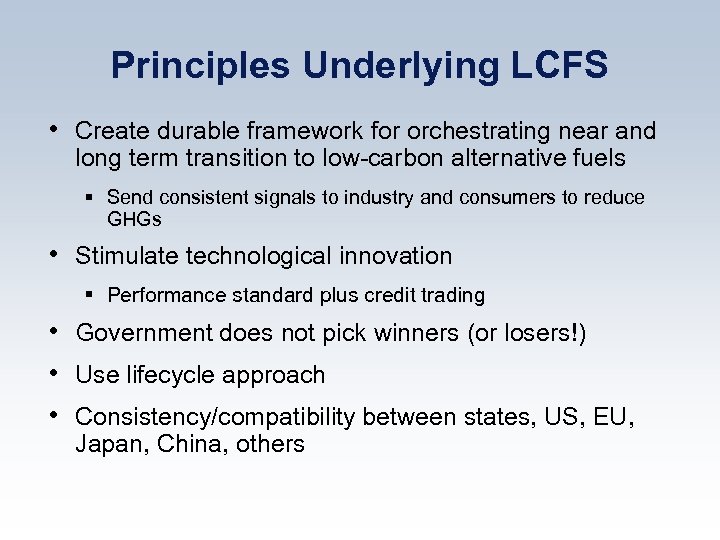 Principles Underlying LCFS • Create durable framework for orchestrating near and long term transition to low-carbon alternative fuels § Send consistent signals to industry and consumers to reduce GHGs • Stimulate technological innovation § Performance standard plus credit trading • Government does not pick winners (or losers!) • Use lifecycle approach • Consistency/compatibility between states, US, EU, Japan, China, others
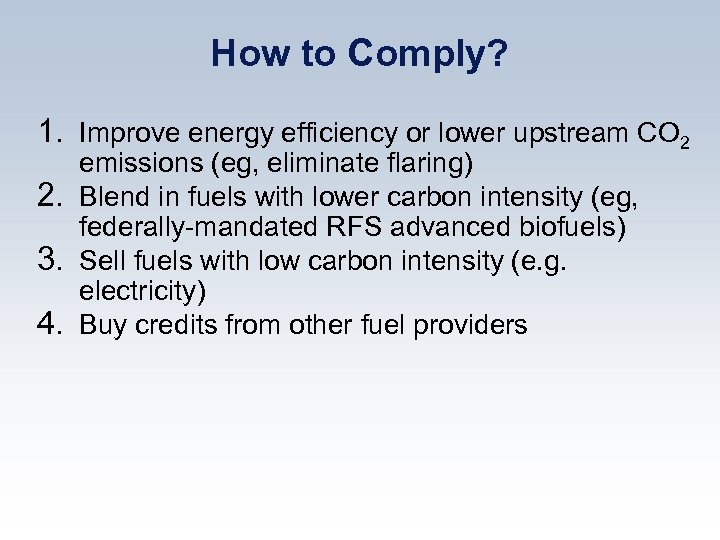 How to Comply? 1. Improve energy efficiency or lower upstream CO 2 emissions (eg, eliminate flaring) 2. Blend in fuels with lower carbon intensity (eg, federally-mandated RFS advanced biofuels) 3. Sell fuels with low carbon intensity (e. g. electricity) 4. Buy credits from other fuel providers
 Other Possible Fuel Policies/Rules • Minimum requirements for H 2 distribution by fuel suppliers • Additional incentives for non-petroleum vehicles (especially electricity and H 2) • Carbon taxes or cap and trade (economy-wide) with auctions to generate revenue to pay “transition costs” (start-up barriers, R&D, equity) § but ‘triiple-regulation’ is not appreciated by oil companies
 III. VMT/Land Use • Note that transport is least innovative sector, and that VMT is largely ignored in energy/climate debates • California: Nothing in place, but Attorney General Jerry Brown is “requiring” cities and others to fully consider GHGs in all environmental reviews Ideas under consideration in California • • • Pricing of roads, vehicle use GHG criteria in allocating federal and state transport funds Conformity of transport and GHG plans City/county carbon budgets Invest in low-carbon transport modes (high speed rail, enhanced transit, etc) • Reform transit and taxi monopolies to encourage innovation • Reform transport financing to support innovative mobility services
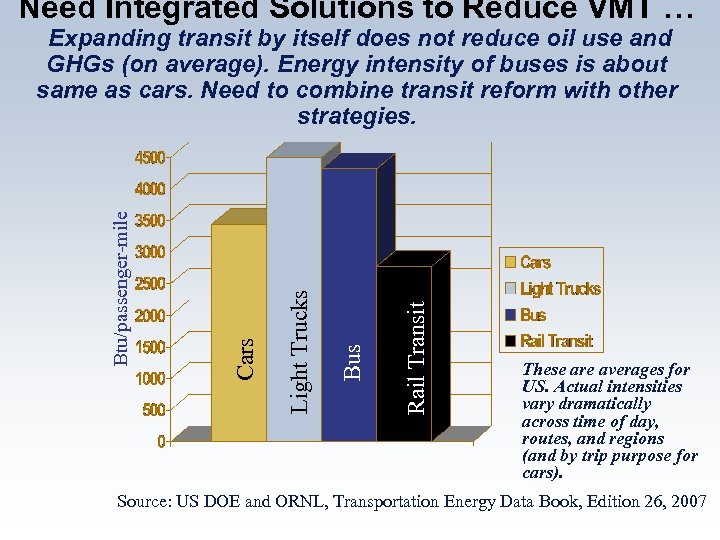 Need Integrated Solutions to Reduce VMT … Rail Transit Bus Light Trucks Cars Btu/passenger-mile Expanding transit by itself does not reduce oil use and GHGs (on average). Energy intensity of buses is about same as cars. Need to combine transit reform with other strategies. These are averages for US. Actual intensities vary dramatically across time of day, routes, and regions (and by trip purpose for cars). Source: US DOE and ORNL, Transportation Energy Data Book, Edition 26, 2007
 Sperling’s (and California’s? ) Policy Principles for Climate Change § Do not pick winners § Push responsibility downstream as much as possible (cities, HHs, companies) § Create choice (vehicles, modes, fuels), which opens up the policy/politics envelope § Create durable policy frameworks for carbon • Vehicle and fuel stds, feebates, fuel tax restructuring, “conformity” of GHG and transport plans, perhaps carbon caps for cities/counties § Target market failures and start-up barriers (esp for non-liquid fuels) § Reform transport sector (together with MPOs and locals) • Reform “transit” (esp use of innovative mobility services) • Encourage private investment (and innovation) § Encourage bottom-up and top-down policy experimentation (within overlapping federal-state-local responsibilities)
 dsperling@ucdavis. edu, www. its. ucdavis. edu CARB Climate Change Web Site http: //www. arb. ca. gov/cc/cc. htm