


 Скачать презентацию Institute of Photogrammetry and Geo Information Section 1
1a2e1b904e3133773113f086f4a617ae.ppt
- Количество слайдов: 17
 Institute of Photogrammetry and Geo. Information Section 1 Introduction (definition of HR, current HR sensors, main characteristics, technological alternatives) Emmanuel Baltsavias ISPRS Technical Commission I Symposium “From Sensors To Imagery”, Paris – Marne la Vallée, France, 3 -6 July 2006
 Institute of Photogrammetry and Geo. Information Role of satellite imagery • Imagery an increasingly important source for geodata acquisition and update • Satellite images generally cheaper than aerial images • Repetitive coverage, increasing temporal resolution • Increasing spatial, radiometric and spectral resolution • Many satellites, increasing number in future ISPRS Technical Commission I Symposium “From Sensors To Imagery”, Paris – Marne la Vallée, France, 3 -6 July 2006
 Institute of Photogrammetry and Geo. Information High spatial resolution (HR) satellites • Ground Sampling Distance (GSD) down to 0. 61 m, 0. 4 m in 2007, 0. 25 in 2008? • Almost all are stereo capable • High geometric accuracy potential • Increasing support by commercial software packages • Increasing number (5 new systems from mid 2005 to mid 2006) But, • Some too new, very little known about them • Not high availability. Hopes for improved availability with more such systems planned • High costs for many sensors. Hopes for lower costs with increasing competition and noncommercial systems (like Japanese ALOS-PRISM, Indian CARTOSAT-1) and small, low-cost HR satellites (like Topsat, UK) ISPRS Technical Commission I Symposium “From Sensors To Imagery”, Paris – Marne la Vallée, France, 3 -6 July 2006
 Institute of Photogrammetry and Geo. Information How is a HR sensor defined here? • Definition changes with time. 10 years ago, 10 m GSD was considered HR, not now • Here HR, if panchromatic (PAN) GSD max. about 3 m • Multispectral channels (MS) usually employed and have 2 -4 times larger GSD • Here only optical sensors, not microwave or laser scanners • Pure military systems not treated here • Most optical HR sensors use linear CCDs • Many have military heritage, and are still used for dual purposes • Some data for HR sensors kept secret. Useful source of info http: //directory. eoportal. org/ ISPRS Technical Commission I Symposium “From Sensors To Imagery”, Paris – Marne la Vallée, France, 3 -6 July 2006
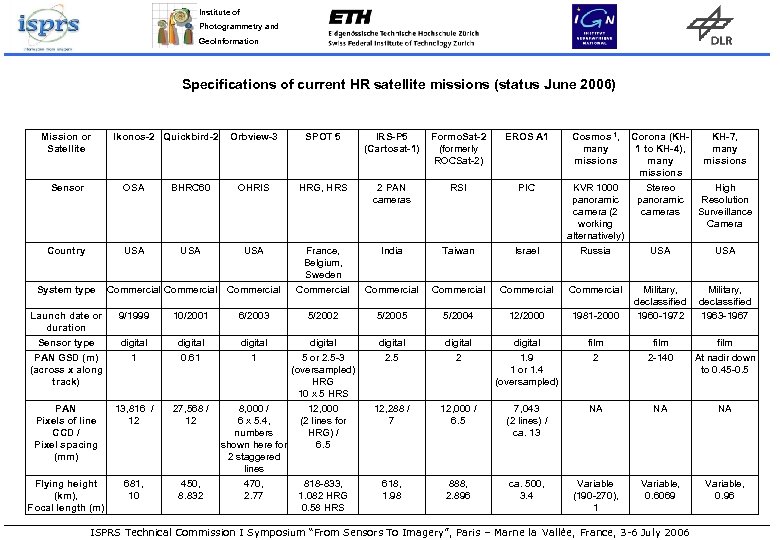 Institute of Photogrammetry and Geo. Information Specifications of current HR satellite missions (status June 2006) Mission or Satellite Ikonos-2 Quickbird-2 Orbview-3 SPOT 5 IRS-P 5 (Cartosat-1) Formo. Sat-2 (formerly ROCSat-2) EROS A 1 Cosmos 1, many missions Corona (KHKH-7, 1 to KH-4), many missions KVR 1000 Stereo High panoramic Resolution camera (2 cameras Surveillance working Camera alternatively) Russia USA Sensor OSA BHRC 60 OHRIS HRG, HRS 2 PAN cameras RSI PIC Country USA USA France, Belgium, Sweden Commercial India Taiwan Israel Commercial 5/2002 5/2005 5/2004 12/2000 digital 2. 5 digital 2 12, 288 / 7 618, 1. 98 System type Commercial Launch date or duration Sensor type PAN GSD (m) (across x along track) 9/1999 10/2001 6/2003 digital 1 digital 0. 61 digital 1 PAN Pixels of line CCD / Pixel spacing (mm) 13, 816 / 12 27, 568 / 12 Flying height (km), Focal length (m) 681, 10 450, 8. 832 digital 5 or 2. 5 -3 (oversampled) HRG 10 x 5 HRS 8, 000 / 12, 000 6 x 5. 4, (2 lines for numbers HRG) / shown here for 6. 5 2 staggered lines 470, 818 -833, 2. 77 1. 082 HRG 0. 58 HRS 1981 -2000 Military, declassified 1960 -1972 Military, declassified 1963 -1967 digital 1. 9 1 or 1. 4 (oversampled) film 2 -140 film At nadir down to 0. 45 -0. 5 12, 000 / 6. 5 7, 043 (2 lines) / ca. 13 NA NA NA 888, 2. 896 ca. 500, 3. 4 Variable (190 -270), 1 Variable, 0. 6069 Variable, 0. 96 ISPRS Technical Commission I Symposium “From Sensors To Imagery”, Paris – Marne la Vallée, France, 3 -6 July 2006
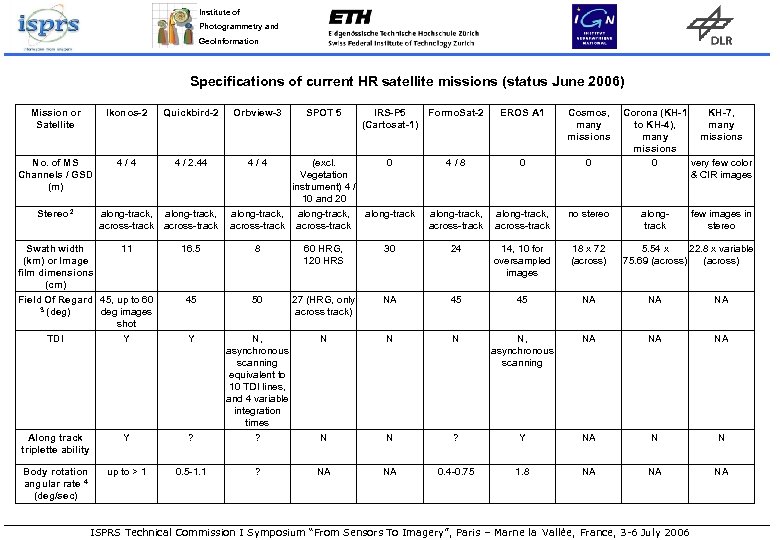 Institute of Photogrammetry and Geo. Information Specifications of current HR satellite missions (status June 2006) Mission or Satellite Ikonos-2 Quickbird-2 Orbview-3 No. of MS Channels / GSD (m) 4 / 4 4 / 2. 44 4 / 4 Stereo 2 along-track, across-track Swath width 11 (km) or Image film dimensions (cm) Field Of Regard 45, up to 60 3 (deg) deg images shot TDI Y SPOT 5 IRS-P 5 (Cartosat-1) (excl. 0 Vegetation instrument) 4 / 10 and 20 along-track, along-track across-track Formo. Sat-2 EROS A 1 Cosmos, many missions 4 / 8 0 0 along-track, across-track no stereo Corona (KH-1 KH-7, to KH-4), many missions 0 very few color & CIR images alongtrack few images in stereo 16. 5 8 60 HRG, 120 HRS 30 24 14, 10 for oversampled images 18 x 72 (across) 45 50 27 (HRG, only across track) NA 45 45 NA NA NA Y N N, asynchronous scanning NA NA NA N N ? Y NA N N NA NA 0. 4 -0. 75 1. 8 NA NA NA Along track triplette ability Y ? N, asynchronous scanning equivalent to 10 TDI lines, and 4 variable integration times ? Body rotation angular rate 4 (deg/sec) up to > 1 0. 5 -1. 1 ? 5. 54 x 22. 8 x variable 75. 69 (across) ISPRS Technical Commission I Symposium “From Sensors To Imagery”, Paris – Marne la Vallée, France, 3 -6 July 2006
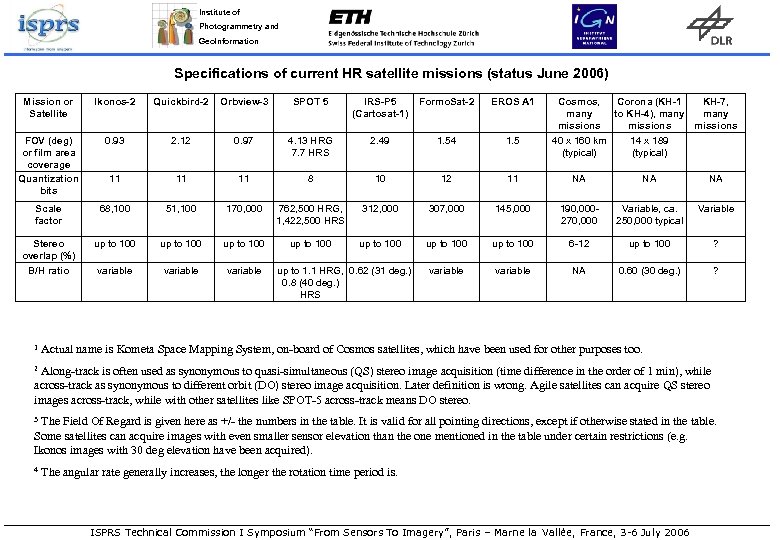 Institute of Photogrammetry and Geo. Information Specifications of current HR satellite missions (status June 2006) Mission or Satellite Ikonos-2 Quickbird-2 Orbview-3 SPOT 5 IRS-P 5 (Cartosat-1) Formo. Sat-2 EROS A 1 FOV (deg) or film area coverage Quantization bits 0. 93 2. 12 0. 97 4. 13 HRG 7. 7 HRS 2. 49 1. 54 1. 5 11 11 11 8 10 12 11 NA NA NA Scale factor 68, 100 51, 100 170, 000 762, 500 HRG, 1, 422, 500 HRS 312, 000 307, 000 145, 000 190, 000270, 000 Variable, ca. 250, 000 typical Variable Stereo overlap (%) B/H ratio up to 100 up to 100 6 -12 up to 100 ? variable variable NA 0. 60 (30 deg. ) ? 1 up to 1. 1 HRG, 0. 62 (31 deg. ) 0. 8 (40 deg. ) HRS Cosmos, Corona (KH-1 KH-7, many to KH-4), many missions 40 x 160 km 14 x 189 (typical) Actual name is Kometa Space Mapping System, on-board of Cosmos satellites, which have been used for other purposes too. Along-track is often used as synonymous to quasi-simultaneous (QS) stereo image acquisition (time difference in the order of 1 min), while across-track as synonymous to different orbit (DO) stereo image acquisition. Later definition is wrong. Agile satellites can acquire QS stereo images across-track, while with other satellites like SPOT-5 across-track means DO stereo. 2 The Field Of Regard is given here as +/- the numbers in the table. It is valid for all pointing directions, except if otherwise stated in the table. Some satellites can acquire images with even smaller sensor elevation than the one mentioned in the table under certain restrictions (e. g. Ikonos images with 30 deg elevation have been acquired). 3 4 The angular rate generally increases, the longer the rotation time period is. ISPRS Technical Commission I Symposium “From Sensors To Imagery”, Paris – Marne la Vallée, France, 3 -6 July 2006
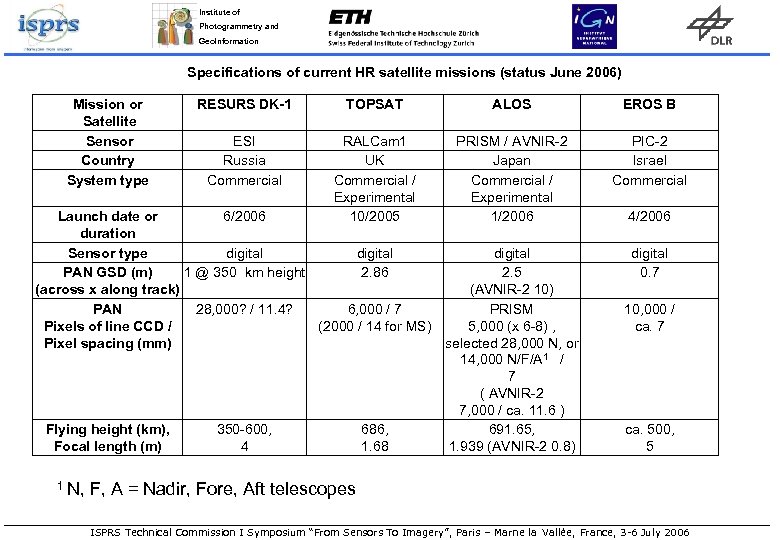 Institute of Photogrammetry and Geo. Information Specifications of current HR satellite missions (status June 2006) Mission or Satellite Sensor Country System type RESURS DK-1 TOPSAT ALOS EROS B ESI Russia Commercial RALCam 1 UK Commercial / Experimental 10/2005 PRISM / AVNIR-2 Japan Commercial / Experimental 1/2006 PIC-2 Israel Commercial digital 0. 7 686, 1. 68 digital 2. 5 (AVNIR-2 10) PRISM 5, 000 (x 6 -8) , selected 28, 000 N, or 14, 000 N/F/A 1 / 7 ( AVNIR-2 7, 000 / ca. 11. 6 ) 691. 65, 1. 939 (AVNIR-2 0. 8) Launch date or 6/2006 duration Sensor type digital PAN GSD (m) 1 @ 350 km height 2. 86 (across x along track) PAN 28, 000? / 11. 4? 6, 000 / 7 Pixels of line CCD / (2000 / 14 for MS) Pixel spacing (mm) Flying height (km), Focal length (m) 350 -600, 4 4/2006 10, 000 / ca. 7 ca. 500, 5 1 N, F, A = Nadir, Fore, Aft telescopes ISPRS Technical Commission I Symposium “From Sensors To Imagery”, Paris – Marne la Vallée, France, 3 -6 July 2006
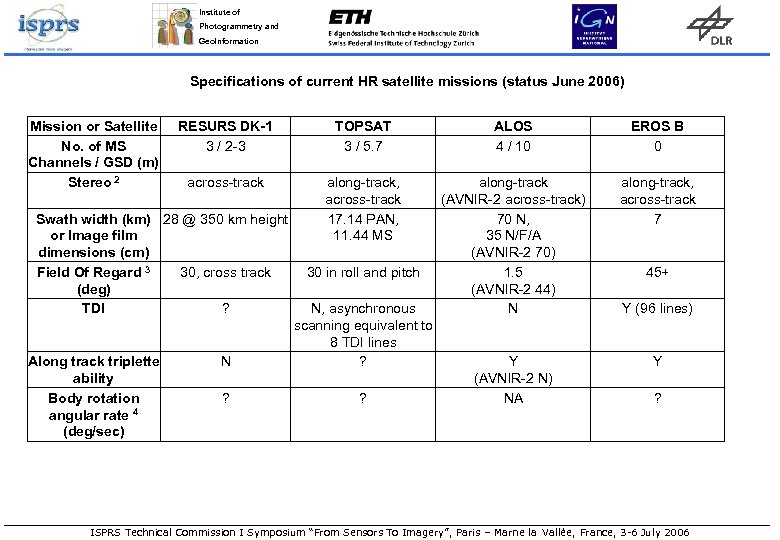 Institute of Photogrammetry and Geo. Information Specifications of current HR satellite missions (status June 2006) Mission or Satellite No. of MS Channels / GSD (m) Stereo 2 RESURS DK-1 3 / 2 -3 TOPSAT 3 / 5. 7 ALOS 4 / 10 EROS B 0 across-track along-track, across-track 17. 14 PAN, 11. 44 MS along-track (AVNIR-2 across-track) 70 N, 35 N/F/A (AVNIR-2 70) 1. 5 (AVNIR-2 44) N along-track, across-track 7 Y (AVNIR-2 N) NA Y Swath width (km) 28 @ 350 km height or Image film dimensions (cm) Field Of Regard 3 30, cross track (deg) TDI ? Along track triplette ability Body rotation angular rate 4 (deg/sec) 30 in roll and pitch N N, asynchronous scanning equivalent to 8 TDI lines ? ? ? 45+ Y (96 lines) ? ISPRS Technical Commission I Symposium “From Sensors To Imagery”, Paris – Marne la Vallée, France, 3 -6 July 2006
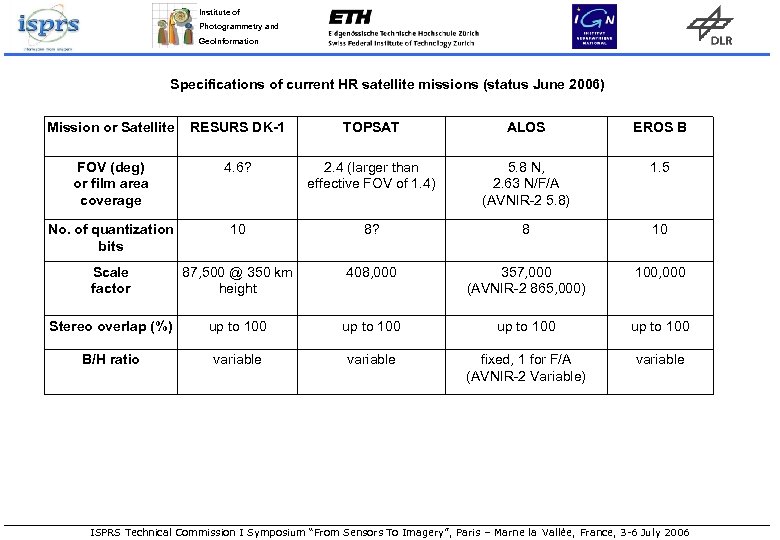 Institute of Photogrammetry and Geo. Information Specifications of current HR satellite missions (status June 2006) Mission or Satellite RESURS DK-1 TOPSAT ALOS EROS B FOV (deg) or film area coverage 4. 6? 2. 4 (larger than effective FOV of 1. 4) 5. 8 N, 2. 63 N/F/A (AVNIR-2 5. 8) 1. 5 No. of quantization bits 10 8? 8 10 Scale factor 87, 500 @ 350 km height 408, 000 357, 000 (AVNIR-2 865, 000) 100, 000 Stereo overlap (%) up to 100 B/H ratio variable fixed, 1 for F/A (AVNIR-2 Variable) variable ISPRS Technical Commission I Symposium “From Sensors To Imagery”, Paris – Marne la Vallée, France, 3 -6 July 2006
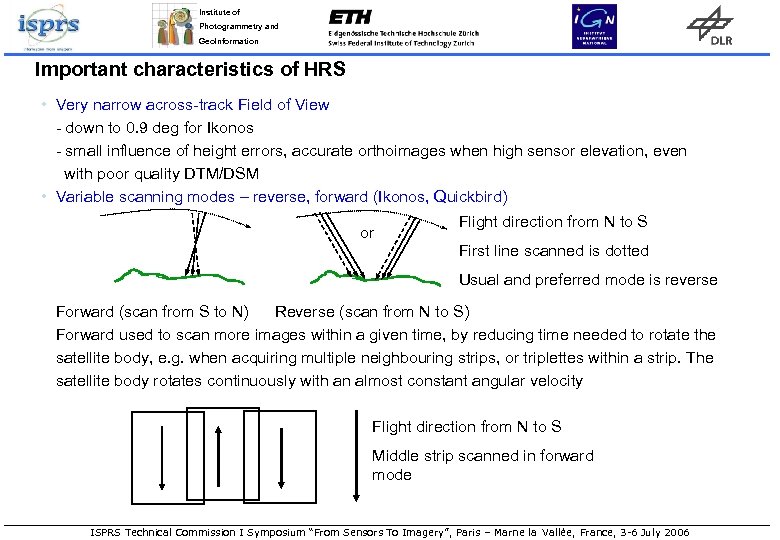 Institute of Photogrammetry and Geo. Information Important characteristics of HRS • Very narrow across-track Field of View - down to 0. 9 deg for Ikonos - small influence of height errors, accurate orthoimages when high sensor elevation, even with poor quality DTM/DSM • Variable scanning modes – reverse, forward (Ikonos, Quickbird) or Flight direction from N to S First line scanned is dotted Usual and preferred mode is reverse Forward (scan from S to N) Reverse (scan from N to S) Forward used to scan more images within a given time, by reducing time needed to rotate the satellite body, e. g. when acquiring multiple neighbouring strips, or triplettes within a strip. The satellite body rotates continuously with an almost constant angular velocity Flight direction from N to S Middle strip scanned in forward mode ISPRS Technical Commission I Symposium “From Sensors To Imagery”, Paris – Marne la Vallée, France, 3 -6 July 2006
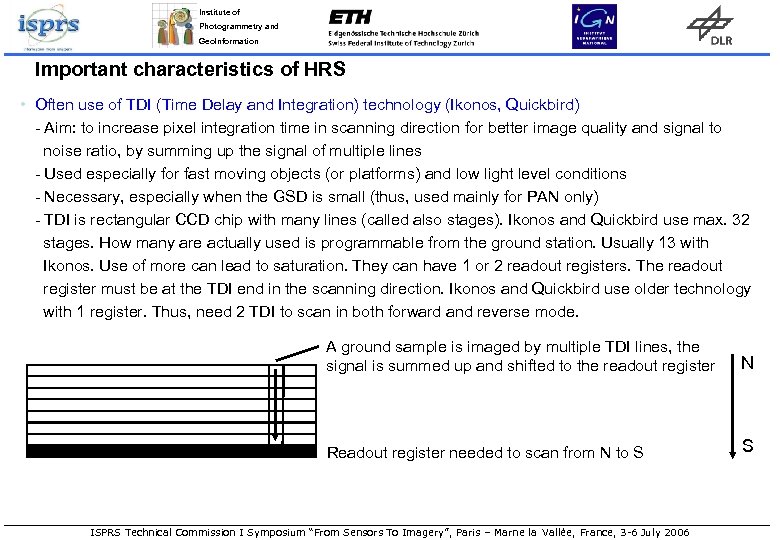 Institute of Photogrammetry and Geo. Information Important characteristics of HRS • Often use of TDI (Time Delay and Integration) technology (Ikonos, Quickbird) - Aim: to increase pixel integration time in scanning direction for better image quality and signal to noise ratio, by summing up the signal of multiple lines - Used especially for fast moving objects (or platforms) and low light level conditions - Necessary, especially when the GSD is small (thus, used mainly for PAN only) - TDI is rectangular CCD chip with many lines (called also stages). Ikonos and Quickbird use max. 32 stages. How many are actually used is programmable from the ground station. Usually 13 with Ikonos. Use of more can lead to saturation. They can have 1 or 2 readout registers. The readout register must be at the TDI end in the scanning direction. Ikonos and Quickbird use older technology with 1 register. Thus, need 2 TDI to scan in both forward and reverse mode. A ground sample is imaged by multiple TDI lines, the signal is summed up and shifted to the readout register N Readout register needed to scan from N to S S ISPRS Technical Commission I Symposium “From Sensors To Imagery”, Paris – Marne la Vallée, France, 3 -6 July 2006
 Institute of Photogrammetry and Geo. Information Important characteristics of HRS • Rotation of satellite from S to N done also for other reasons a) to achieve a smaller GSD (the nominal one) in flight direction With Quickbird, GSD in flight direction would be larger than 0. 61 m in PAN, for the given satellite speed and pixel integration time. Thus, the satellite rotates from S to N a bit to achieve 0. 621 m GSD. This happens in both Reverse and Forward mode ! Satellite body rotation can introduce nonlinearities in the imaging geometry. b) to increase pixel integration time and achieve better image quality, when the sensor does not use TDI, e. g. EROS A 1, Top. Sat This feature is inferior to TDI, can introduce nonlinearities in the imaging geometry and may cause pixel and edge smearing (unsharpness) In both cases, the imaged earth part (given often as line scan frequency for line CCDs), is shorter than the ground track of the satellite. A linescan frequency of e. g. 1500 lines/s, means 1/1500 s (0. 67 ms) integration time (IT). This is also called asynchronous scanning mode, espec. in case b) Note: linear CCDs can have an exposure time (effective IT) smaller than the nominal IT. We assume that satellite firms use the term IT in the sense of exposure time. ISPRS Technical Commission I Symposium “From Sensors To Imagery”, Paris – Marne la Vallée, France, 3 -6 July 2006
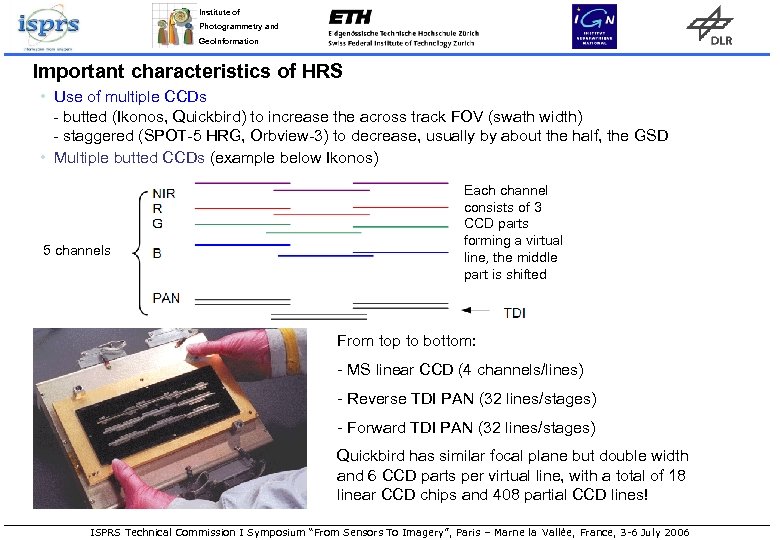 Institute of Photogrammetry and Geo. Information Important characteristics of HRS • Use of multiple CCDs - butted (Ikonos, Quickbird) to increase the across track FOV (swath width) - staggered (SPOT-5 HRG, Orbview-3) to decrease, usually by about the half, the GSD • Multiple butted CCDs (example below Ikonos) 5 channels Each channel consists of 3 CCD parts forming a virtual line, the middle part is shifted From top to bottom: - MS linear CCD (4 channels/lines) - Reverse TDI PAN (32 lines/stages) - Forward TDI PAN (32 lines/stages) Quickbird has similar focal plane but double width and 6 CCD parts per virtual line, with a total of 18 linear CCD chips and 408 partial CCD lines! ISPRS Technical Commission I Symposium “From Sensors To Imagery”, Paris – Marne la Vallée, France, 3 -6 July 2006
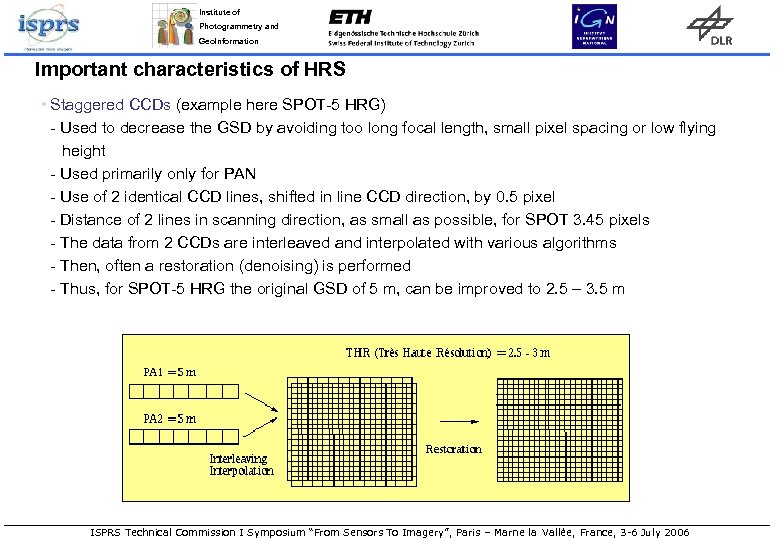 Institute of Photogrammetry and Geo. Information Important characteristics of HRS • Staggered CCDs (example here SPOT-5 HRG) - Used to decrease the GSD by avoiding too long focal length, small pixel spacing or low flying height - Used primarily only for PAN - Use of 2 identical CCD lines, shifted in line CCD direction, by 0. 5 pixel - Distance of 2 lines in scanning direction, as small as possible, for SPOT 3. 45 pixels - The data from 2 CCDs are interleaved and interpolated with various algorithms - Then, often a restoration (denoising) is performed - Thus, for SPOT-5 HRG the original GSD of 5 m, can be improved to 2. 5 – 3. 5 m ISPRS Technical Commission I Symposium “From Sensors To Imagery”, Paris – Marne la Vallée, France, 3 -6 July 2006
 Institute of Photogrammetry and Geo. Information Important characteristics of HRS • Multispectral CCDs - Often the pixel size given by the firms, e. g. 48 microns for Ikonos and Quickbird, is not correct. - Linear CCDs with so large pixel size not available in standard products - Usually the MS CCDs are identical to the PAN CCDs with very thin filters covering the pixels, thus for Ikonos and Quickbird they have 12 microns pixel size. - The larger effective pixel size (e. g. 48 microns) is achieved in scanning direction by increasing the integration time (e. g. for Ikonos by 4) and in the CCD line direction by averaging (binning) of pixels (e. g. 4 pixels) - This mode of generation leads to better image quality than producing images with real 48 microns pixel size. This may explain why geometric accuracy with MS images is only about 2 times worse than that of PAN, and not 4 times as might have been expected. ISPRS Technical Commission I Symposium “From Sensors To Imagery”, Paris – Marne la Vallée, France, 3 -6 July 2006
 Institute of Photogrammetry and Geo. Information Important characteristics of HRS – Stereo Acquisition • Along-track - Through satellite body pointing - Through multiple PAN CCDs (at least 2, usually 3) • Across-track - Through satellite body pointing - Through deflection of image rays (e. g. by mirror) Along-track and across-track mean here, quasi-simultaneous acquisition and acquisition from different orbits with time delay, respectively. NOTE: across-track stereo possible also quasi-simultaneously with sat body pointing, so above timerelated terminology is better. ISPRS Technical Commission I Symposium “From Sensors To Imagery”, Paris – Marne la Vallée, France, 3 -6 July 2006