


 Скачать презентацию Institute of Materials Research and Engineering Investigating Polaron
2bb4bd474b5054d6f81a4d5630324281.ppt
- Количество слайдов: 1
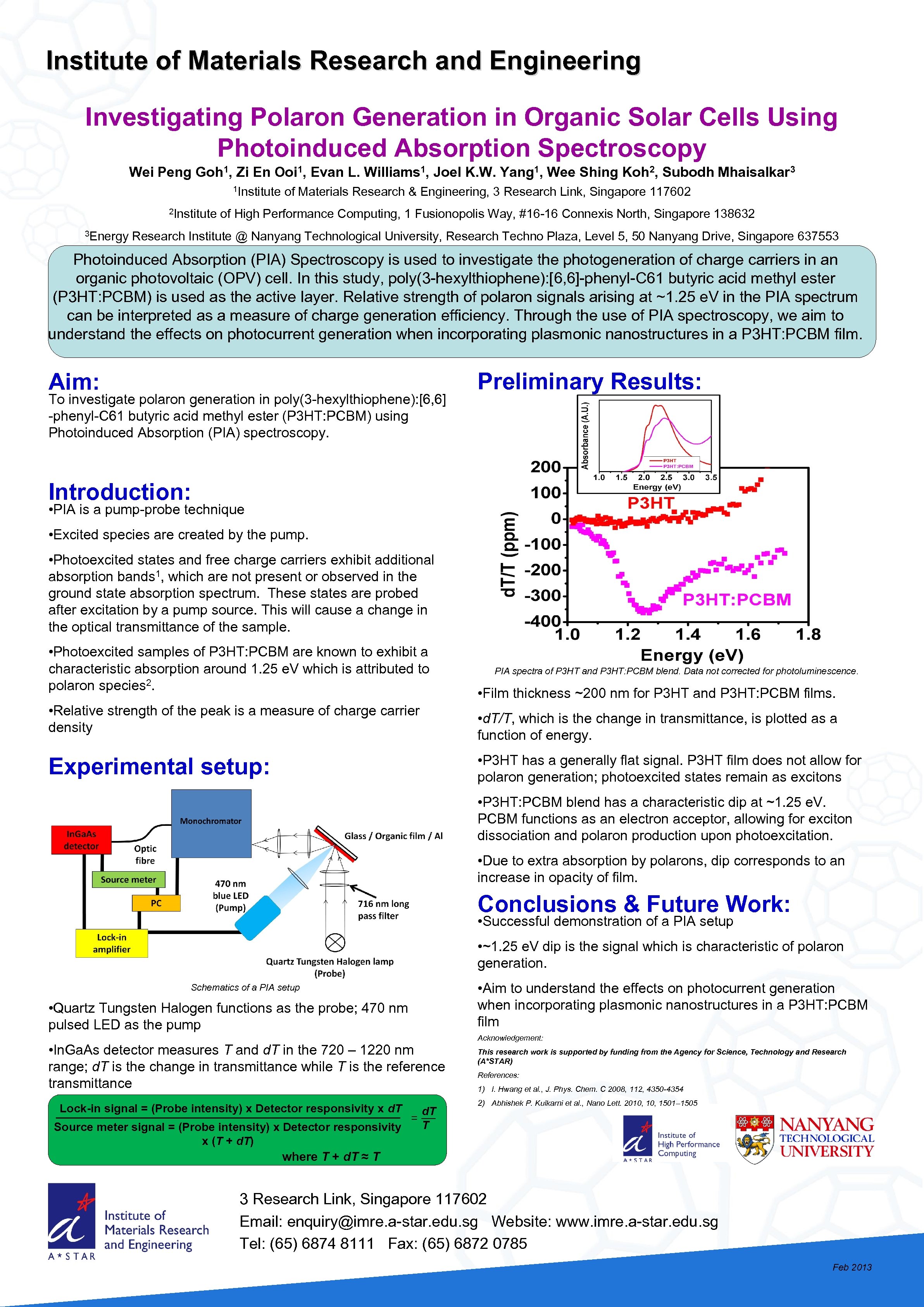 Institute of Materials Research and Engineering Investigating Polaron Generation in Organic Solar Cells Using Photoinduced Absorption Spectroscopy Wei Peng Goh 1, Zi En Ooi 1, Evan L. Williams 1, Joel K. W. Yang 1, Wee Shing Koh 2, Subodh Mhaisalkar 3 1 Institute 2 Institute 3 Energy of Materials Research & Engineering, 3 Research Link, Singapore 117602 of High Performance Computing, 1 Fusionopolis Way, #16 -16 Connexis North, Singapore 138632 Research Institute @ Nanyang Technological University, Research Techno Plaza, Level 5, 50 Nanyang Drive, Singapore 637553 Photoinduced Absorption (PIA) Spectroscopy is used to investigate the photogeneration of charge carriers in an organic photovoltaic (OPV) cell. In this study, poly(3 -hexylthiophene): [6, 6]-phenyl-C 61 butyric acid methyl ester (P 3 HT: PCBM) is used as the active layer. Relative strength of polaron signals arising at ~1. 25 e. V in the PIA spectrum can be interpreted as a measure of charge generation efficiency. Through the use of PIA spectroscopy, we aim to understand the effects on photocurrent generation when incorporating plasmonic nanostructures in a P 3 HT: PCBM film. Aim: To investigate polaron generation in poly(3 -hexylthiophene): [6, 6] -phenyl-C 61 butyric acid methyl ester (P 3 HT: PCBM) using Photoinduced Absorption (PIA) spectroscopy. Preliminary Results: Introduction: • PIA is a pump-probe technique • Excited species are created by the pump. • Photoexcited states and free charge carriers exhibit additional absorption bands 1, which are not present or observed in the ground state absorption spectrum. These states are probed after excitation by a pump source. This will cause a change in the optical transmittance of the sample. • Photoexcited samples of P 3 HT: PCBM are known to exhibit a characteristic absorption around 1. 25 e. V which is attributed to polaron species 2. • Relative strength of the peak is a measure of charge carrier density PIA spectra of P 3 HT and P 3 HT: PCBM blend. Data not corrected for photoluminescence. • Film thickness ~200 nm for P 3 HT and P 3 HT: PCBM films. • d. T/T, which is the change in transmittance, is plotted as a function of energy. • P 3 HT has a generally flat signal. P 3 HT film does not allow for polaron generation; photoexcited states remain as excitons Experimental setup: • P 3 HT: PCBM blend has a characteristic dip at ~1. 25 e. V. PCBM functions as an electron acceptor, allowing for exciton dissociation and polaron production upon photoexcitation. • Due to extra absorption by polarons, dip corresponds to an increase in opacity of film. Conclusions & Future Work: • Successful demonstration of a PIA setup • ~1. 25 e. V dip is the signal which is characteristic of polaron generation. Schematics of a PIA setup • Quartz Tungsten Halogen functions as the probe; 470 nm pulsed LED as the pump • In. Ga. As detector measures T and d. T in the 720 – 1220 nm range; d. T is the change in transmittance while T is the reference transmittance Lock-in signal = (Probe intensity) x Detector responsivity x d. T = T Source meter signal = (Probe intensity) x Detector responsivity x (T + d. T) • Aim to understand the effects on photocurrent generation when incorporating plasmonic nanostructures in a P 3 HT: PCBM film Acknowledgement: This research work is supported by funding from the Agency for Science, Technology and Research (A*STAR) References: 1) I. Hwang et al. , J. Phys. Chem. C 2008, 112, 4350 -4354 2) Abhishek P. Kulkarni et al. , Nano Lett. 2010, 1501– 1505 where T + d. T ≈ T 3 Research Link, Singapore 117602 Email: enquiry@imre. a-star. edu. sg Website: www. imre. a-star. edu. sg Tel: (65) 6874 8111 Fax: (65) 6872 0785 Feb 2013