


 Скачать презентацию Institute of Informatics Telecommunications NCSR Demokritos Athens
05c83fc23bad7802152b6ae6ba7320ff.ppt
- Количество слайдов: 35
 Institute of Informatics & Telecommunications NCSR “Demokritos”, Athens, Greece MMSEM background Dr Ioannis Pratikakis MMSEM – F 2 F meeting Amsterdam, 10 July 2006
 NCSR “Demokritos” Athens, GREECE The largest self-governing research organisation, under the supervision of the Greek Government It is composed of the following Institutes: n Biology n Materials Science n Microelectronics n Informatics & Telecommunications n Nuclear Technology & Radiation Protection n Nuclear Physics n Radioisotopes & Radiodiagnostic Producrs n Physical Chemistry MMSEM – F 2 F meeting, Amsterdam, 10/07/2006 2
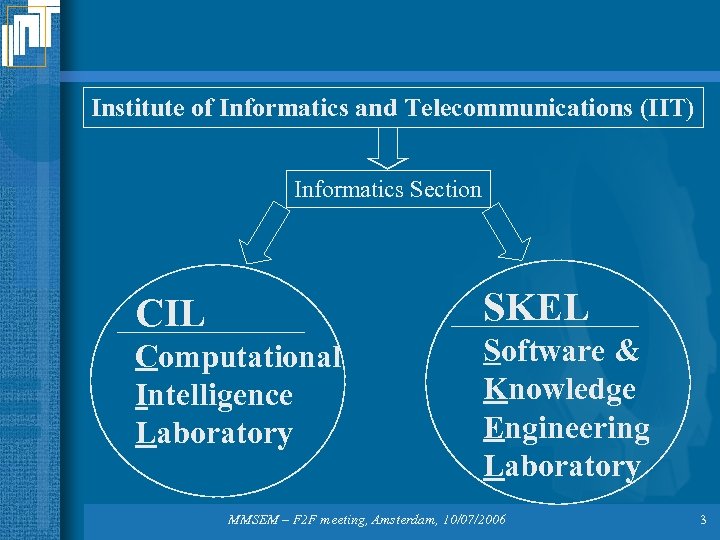 Institute of Informatics and Telecommunications (IIT) Informatics Section SKEL CIL Computational Intelligence Laboratory Software & Knowledge Engineering Laboratory MMSEM – F 2 F meeting, Amsterdam, 10/07/2006 3
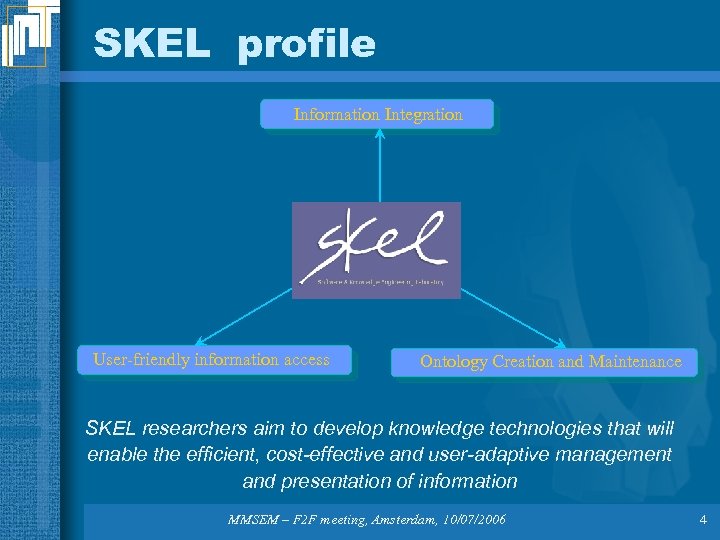 SKEL profile Information Integration User-friendly information access Ontology Creation and Maintenance SKEL researchers aim to develop knowledge technologies that will enable the efficient, cost-effective and user-adaptive management and presentation of information MMSEM – F 2 F meeting, Amsterdam, 10/07/2006 4
 Basic Research • Grammar induction • Active learning of classifiers • Focused crawling • Wrapper induction • Information extraction • Natural language generation • Evolving summarization • Ontology population and enrichment • Web usage mining MMSEM – F 2 F meeting, Amsterdam, 10/07/2006 5
 Applied Research – The general-purpose language engineering platform Ellogon (http: //www. ellogon. org/) – Language processing tools and resources – The i-DIP platform for developing web content collection and extraction systems – The QUATRO proxy server, for validating RDF labels of web resources – The FILTRON e-mail filter, that blocks unsolicited commercial e-mail (spam messages) – The Filter. X Web proxy filter, that blocks obscene Web content – Tools for creating and maintaining ontologies – The PServer general-purpose server for personalization – The KOINOTHTES system for knowledge discovery from web usage data – An authoring tool for porting language generation systems to new domains and languages MMSEM – F 2 F meeting, Amsterdam, 10/07/2006 6
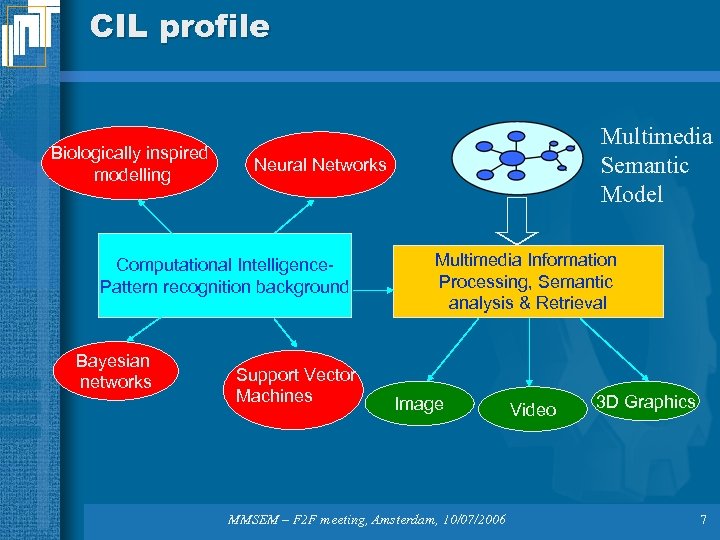 CIL profile Biologically inspired modelling Neural Networks Computational Intelligence. Pattern recognition background Bayesian networks Multimedia Semantic Model Support Vector Machines Multimedia Information Processing, Semantic analysis & Retrieval Image MMSEM – F 2 F meeting, Amsterdam, 10/07/2006 Video 3 D Graphics 7
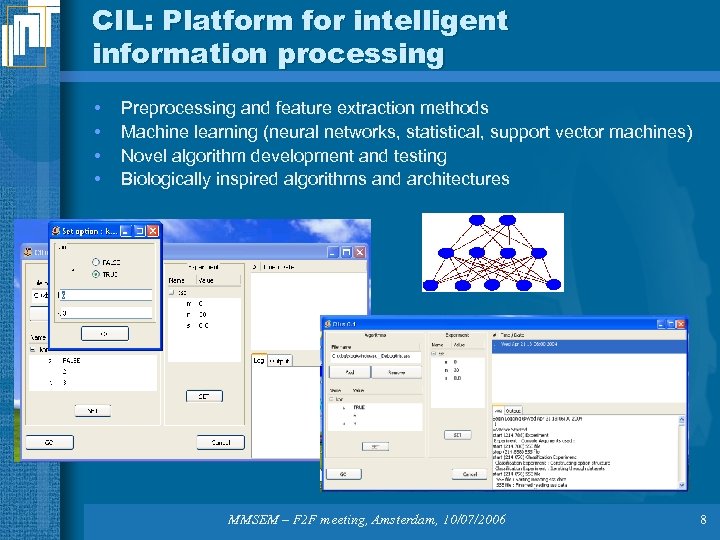 CIL: Platform for intelligent information processing • • Preprocessing and feature extraction methods Machine learning (neural networks, statistical, support vector machines) Novel algorithm development and testing Biologically inspired algorithms and architectures MMSEM – F 2 F meeting, Amsterdam, 10/07/2006 8
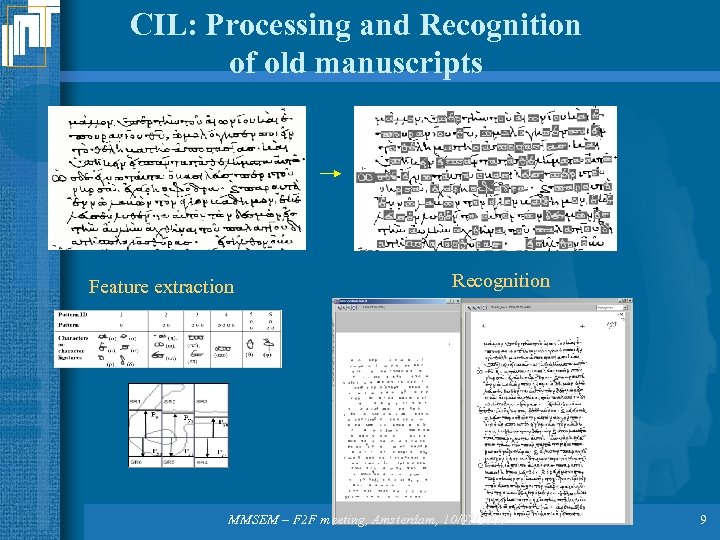 CIL: Processing and Recognition of old manuscripts Feature extraction Recognition MMSEM – F 2 F meeting, Amsterdam, 10/07/2006 9
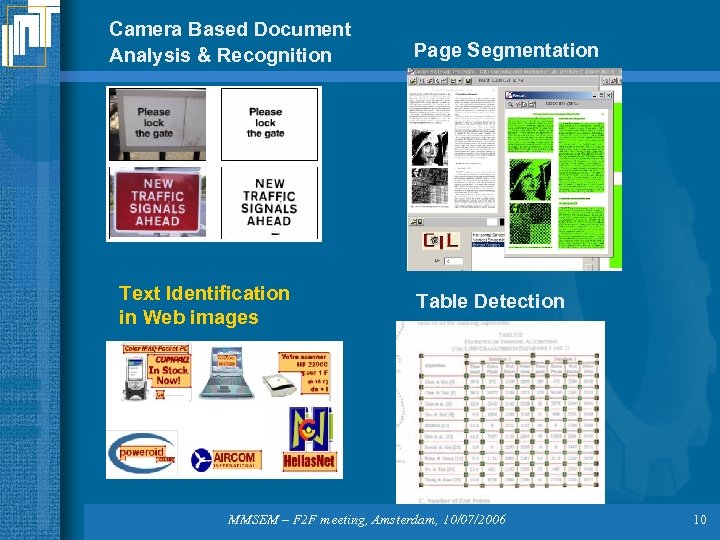 Camera Based Document Analysis & Recognition Text Identification in Web images Page Segmentation Table Detection MMSEM – F 2 F meeting, Amsterdam, 10/07/2006 10
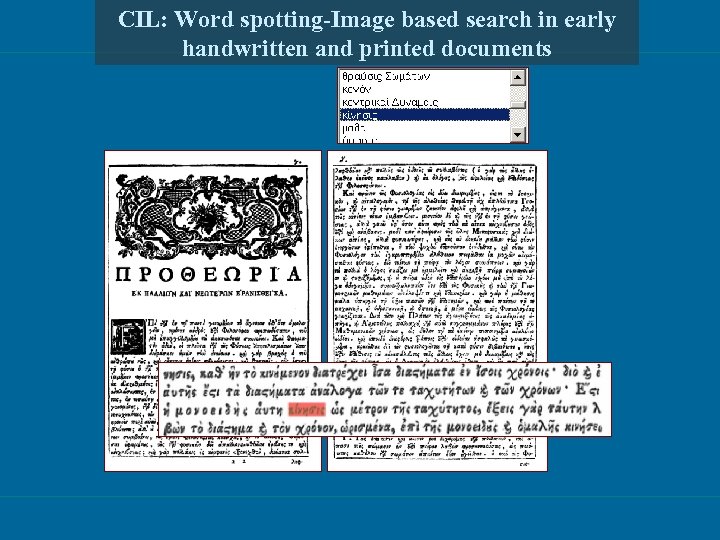 CIL: Word spotting-Image based search in early handwritten and printed documents
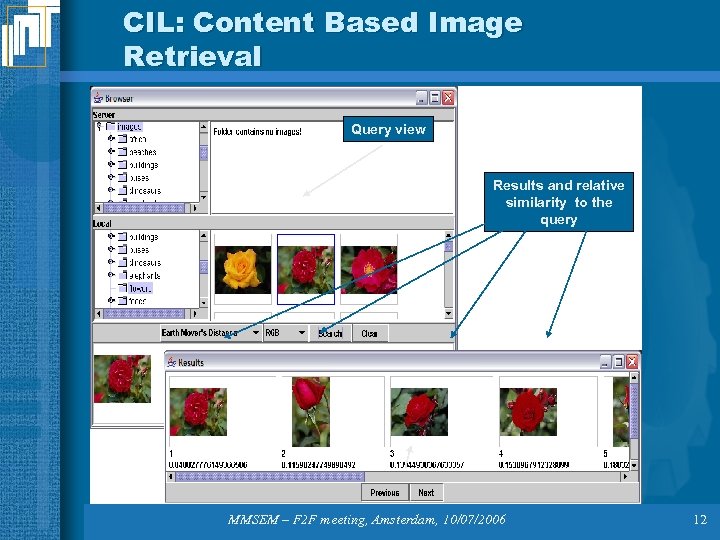 CIL: Content Based Image Retrieval Query view Results and relative similarity to the query MMSEM – F 2 F meeting, Amsterdam, 10/07/2006 12
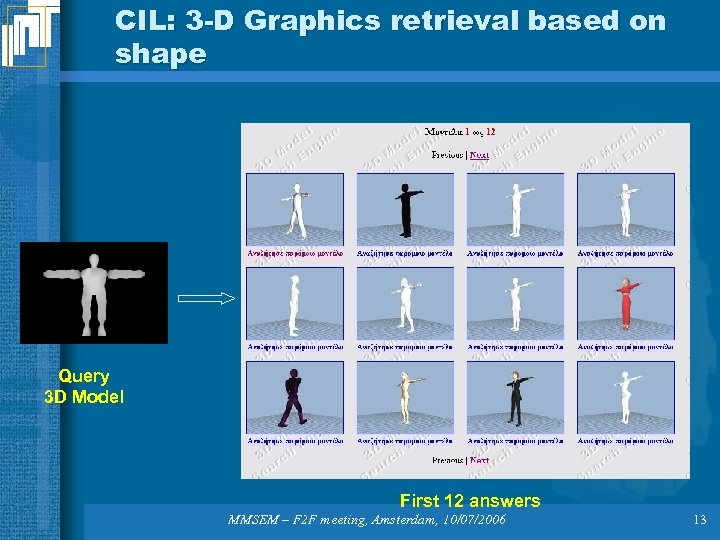 CIL: 3 -D Graphics retrieval based on shape Query 3 D Model First 12 answers MMSEM – F 2 F meeting, Amsterdam, 10/07/2006 13
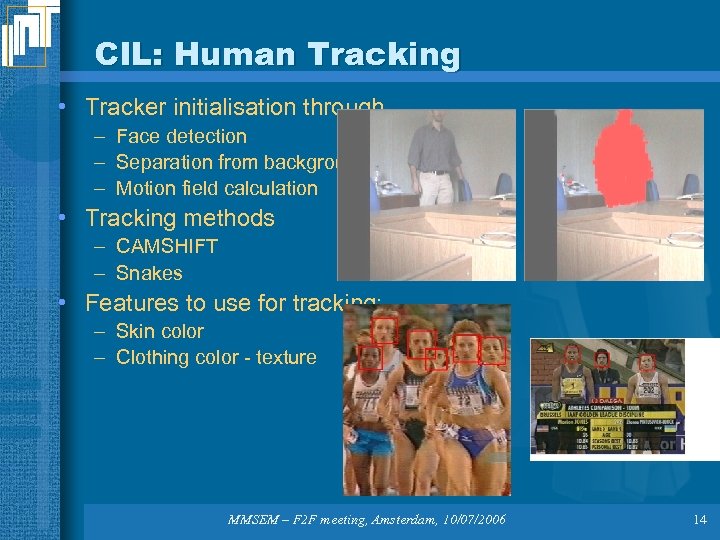 CIL: Human Tracking • Tracker initialisation through – Face detection – Separation from background – Motion field calculation • Tracking methods – CAMSHIFT – Snakes • Features to use for tracking: – Skin color – Clothing color - texture MMSEM – F 2 F meeting, Amsterdam, 10/07/2006 14
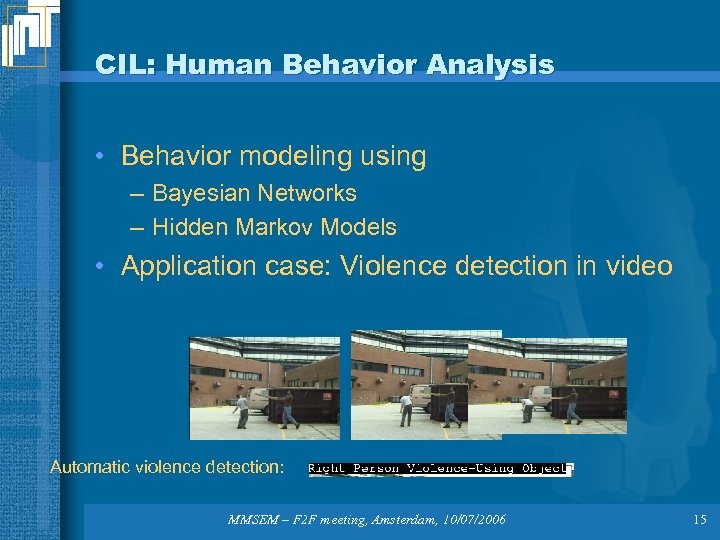 CIL: Human Behavior Analysis • Behavior modeling using – Bayesian Networks – Hidden Markov Models • Application case: Violence detection in video Automatic violence detection: MMSEM – F 2 F meeting, Amsterdam, 10/07/2006 15
 Institute of Informatics & Telecommunications NCSR “Demokritos”, Athens, Greece BOEMIE Bootstrapping Ontology Evolution with Multimedia Information Extraction Dr Ioannis Pratikakis MMSEM – F 2 F meeting Amsterdam, 10 July 2006
 Contents • Consortium • Motivation • BOEMIE proposal • Application scenario • Concluding remarks MMSEM – F 2 F meeting, Amsterdam, 10/07/2006 17
 BOEMIE project • Bootstrapping Ontology Evolution with Multimedia Information Extraction • STRP, IST-2004 -2. 4. 7 “Semantic-based Knowledge and Content Systems” – • Started: 01/03/2006, Duration: 36 months Consortium – Inst. of Informatics & Telecommunications, NCSR “Demokritos” (SKEL & CIL), Greece (Coordinator) – Fraunhofer Institute for Media Communication (Net. Media), Germany – Dip. di Informatica e Comunicazione, University of Milano (ISLab), Italy – Inst. of Telematics and Informatics CERTH (IPL), Greece – Hamburg University of Technology (STS), Germany – Tele Atlas, Belgium MMSEM – F 2 F meeting, Amsterdam, 10/07/2006 18
 Multimedia Content Analysis - I • Multimedia content grows with increasing rates • Hard to provide semantic indexing of multimedia content • Significant advances in automatic extraction of low-level features from visual content • Little progress in the identification of highlevel semantic features MMSEM – F 2 F meeting, Amsterdam, 10/07/2006 19
 Multimedia Content Analysis - II • Inadequate the analysis of single modalities • Little progress in the effective combination of semantic features from different modalities. • Significant effort in producing ontologies for semantic webs. • Hard to build and maintain domainspecific multimedia ontologies. MMSEM – F 2 F meeting, Amsterdam, 10/07/2006 20
 Existing approaches - I • Combination of modalities may serve as a verification method, a method compensating for inaccuracies, or as an additional information source • Combination methods may be iterated allowing for incremental use of context • Major open issues in combination concern – the efficient utilization of prior knowledge, – the specification of open architecture for the integration of information from multiple sources, and – the use of inference tools MMSEM – F 2 F meeting, Amsterdam, 10/07/2006 21
 Existing approaches - II • Most of the extraction approaches are based on machine learning methods • With the advent of promising methodologies in multimedia ontology engineering – knowledge-based approaches are expected to gain in popularity and – be combined with the machine learning methods MMSEM – F 2 F meeting, Amsterdam, 10/07/2006 22
 Existing approaches – III • Use of Ontologies to “drive” the information extraction process – providing high-level semantic information that helps disambiguating the labels assigned to MM objects • Major open issues in building and maintaining MM ontologies concern – automatic mapping between low level audio-visual features and high level domain concepts, – automated population and enrichment from unconstrained content, – employing of ontology coordination techniques when multiple ontologies are present MMSEM – F 2 F meeting, Amsterdam, 10/07/2006 23
 Existing approaches - IV • Synergy between information extraction and ontology learning through a bootstrapping process – to improve both the conceptual model and the extraction system through iterative refinement • Applied so far in knowledge acquisition from textual content – bootstrapping starts with an information extraction system that uses a domain ontology, or – bootstrapping starts with a seed ontology, usually small MMSEM – F 2 F meeting, Amsterdam, 10/07/2006 24
 BOEMIE proposal - I • Driven by domain-specific multimedia ontologies, BOEMIE systems will be able to identify high-level semantic features in image, video, audio and text and fuse these features for optimal extraction. • The ontologies will be continuously populated and enriched using the extracted semantic content. • This is a bootstrapping process, since the enriched ontologies will in turn be used to drive the multimedia information extraction system. MMSEM – F 2 F meeting, Amsterdam, 10/07/2006 25
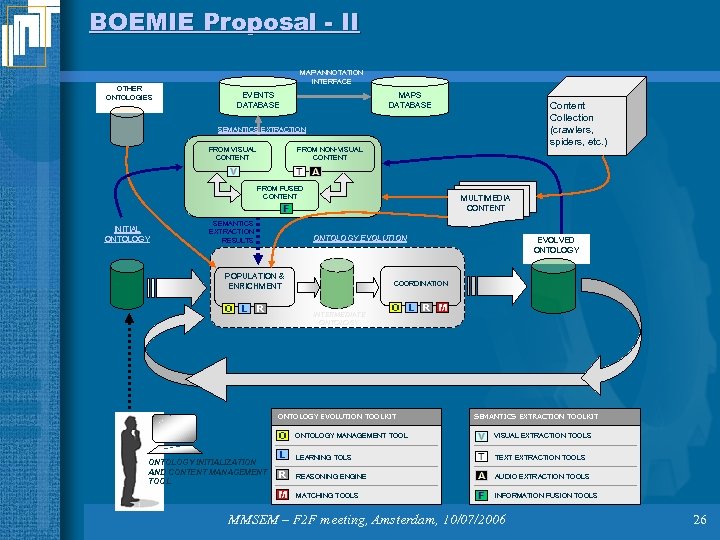 BOEMIE Proposal - II OTHER ONTOLOGIES MAP ANNOTATION INTERFACE EVENTS DATABASE MAPS DATABASE Content Collection (crawlers, spiders, etc. ) SEMANTICS EXTRACTION FROM VISUAL CONTENT FROM NON-VISUAL CONTENT FROM FUSED CONTENT INITIAL ONTOLOGY SEMANTICS EXTRACTION RESULTS MULTIMEDIA CONTENT ONTOLOGY EVOLUTION POPULATION & ENRICHMENT EVOLVED ONTOLOGY COORDINATION INTERMEDIATE ONTOLOGY EVOLUTION TOOLKIT SEMANTICS EXTRACTION TOOLKIT ONTOLOGY MANAGEMENT TOOL LEARNING TOLS TEXT EXTRACTION TOOLS REASONING ENGINE AUDIO EXTRACTION TOOLS MATCHING TOOLS ONTOLOGY INITIALIZATION AND CONTENT MANAGEMENT TOOL VISUAL EXTRACTION TOOLS INFORMATION FUSION TOOLS MMSEM – F 2 F meeting, Amsterdam, 10/07/2006 26
 BOEMIE proposal - III • Semantics extraction – Emphasis to visual content, from images and video, due to its richness and the difficulty of extracting useful information. – Non-visual content, audio/speech and text, will provide supportive evidence, to improve extraction precision. – Fusing information from multiple media sources is needed since • no single modality is powerful enough to encompass all aspects of the content and identify concepts precisely. MMSEM – F 2 F meeting, Amsterdam, 10/07/2006 27
 BOEMIE proposal - IV • Multimedia Semantic Model – development of a unifying representation, a “multimedia semantic model” to integrate: • a multimedia ontology which – describes the structure of multimedia content (content objects, such as a segment in a static image, a time window in audio, a video shot, . . . ), – describes visual characteristics of content objects in terms of low-level features (colour, shape, texture, motion, …) • a domain ontology which contains knowledge about the selected application domain, and • a geographic ontology which contains additional knowledge about the locations to be used MMSEM – F 2 F meeting, Amsterdam, 10/07/2006 28
 BOEMIE proposal – V • Ontology evolution involves – ontology population and enrichment, i. e. , addition of concepts, relations, properties and instances, – coordination of • homogeneous ontologies e. g. when more than one ontology for the same domain are available, and • heterogeneous ontologies, e. g. , updating the links between a modified domain ontology and a multimedia descriptor ontology, – maintenance of semantic consistency • any of the above changes may generate inconsistencies in other parts of the same ontology, in the linked ontologies or in the annotated content base. MMSEM – F 2 F meeting, Amsterdam, 10/07/2006 29
 Application scenario - I • Enrichment of digital maps with semantic information – Domain: sport events in a given area (big cities) • Sub-domain initially selected: athletics (running, jumping and throwing events) • Cities will be selected taking into account: number and frequency of sports events, availability of multimedia coverage in English of these events, availability of map and landmark data for the city – BOEMIE will collect multimedia coverage for sport events and strive to extract as much knowledge from the extracted features as possible, using and evolving the corresponding domain ontologies – The identified entities and their properties, will be linked to geographical locations and stored in a content server – The user will be provided with immediate access to the annotated content MMSEM – F 2 F meeting, Amsterdam, 10/07/2006 30
 Application scenario - II • Querying – The prototype will perform reasoning using knowledge from the domain ontology and geographical knowledge to deduce further information and answer user queries. – The user will be able to perform the following queries: • events in a time frame • events of a particular type • events at a certain location • persons related to events • events similar to a given one • events at nearby venues • points of interest near a venue • combinations of the above MMSEM – F 2 F meeting, Amsterdam, 10/07/2006 31
 Application scenario - II • Querying: an example – Find out the location of the venues in which Athlete A has participated in a high jump competition in the city X. • From transcribed radio commentary, the BOEMIE system knows that in 2001, the World Championships in Athletics were held in city X in venue Y. From the geographical data, it knows the exact location of venue Y in city X. • It has further analyzed a video snippet and identified it as a high jump event. From the meta data of the video, the system knows its date of recording in 2001, and in the audio of this snippet, the keywords “X” and A's name were spotted. • Therefore, the system can deduce that A has indeed participated in a high jump competition in city X, namely the World Championships in Athletics 2001. • As a result, the BOEMIE system presents all used multimedia assets as “prove” for its answer and gives the exact location of the venue where the World Championship in Athletics took place. MMSEM – F 2 F meeting, Amsterdam, 10/07/2006 32
 Concluding remarks - I • BOEMIE work aims to initiate a discussion on the problem of knowledge acquisition and the synergy of information extraction and ontology evolution • Several open issues: – the role of ontology in fusing information from multiple media – ways to learn the optimal combination of features derived from MM content – how existing ontology languages can be extended to tackle the requirements of MM content analysis – the application of existing ontology learning and inference techniques in the context of MM content – the application of the coordination task in a new context which involves not only homogeneous ontologies, but also heterogeneous ones MMSEM – F 2 F meeting, Amsterdam, 10/07/2006 33
 Concluding remarks - II • The main measurable objective of BOEMIE initiative is to improve significantly the performance of existing single-modality approaches in terms of scalability and precision. • Towards that goal, our aim is to – develop a new methodology for extraction and evolution, using a rich multimedia semantic model, and – realize it as an open architecture that will be coupled with the appropriate set of tools. MMSEM – F 2 F meeting, Amsterdam, 10/07/2006 34
 BOEMIE Bootstrapping Ontology Evolution with Multimedia Information Extraction http: //www. boemie. org THANK YOU !!! MMSEM – F 2 F meeting, Amsterdam, 10/07/2006 35