


 Скачать презентацию Institute for Transport Studies FACULTY OF ENVIRONMENT Evaluating
cc9cade69e758083d93ffdfd1a818050.ppt
- Количество слайдов: 20
 Institute for Transport Studies FACULTY OF ENVIRONMENT Evaluating transport and land use interventions in the face of disruption UTSG January 6 th-8 th 2014 Newcastle University James Laird, Greg Marsden, Jeremy Shires J. J. Laird@its. leeds. ac. uk
 Flooding in York
 Structure of presentation • Research questions • State of practice in CBA of disruptive events • Case studies – Snow and ice in the UK – Flooding in York • Problems with state of practice CBA and disruption • Conclusions and further research
 Research questions • Are user costs/benefits truly representative of the socioeconomic costs during periods of disruption? • Are cost benefit analysis methods appropriate for assessing policies/interventions that ameliorate disruption?
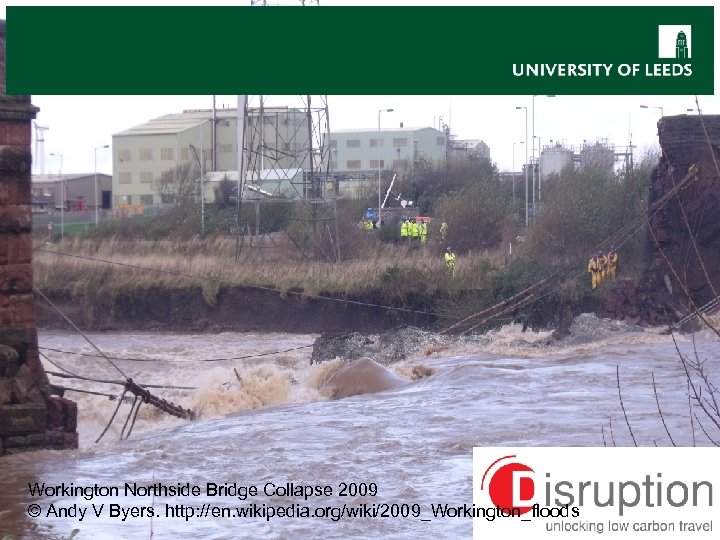 Workington Northside Bridge Collapse 2009 © Andy V Byers. http: //en. wikipedia. org/wiki/2009_Workington_floods
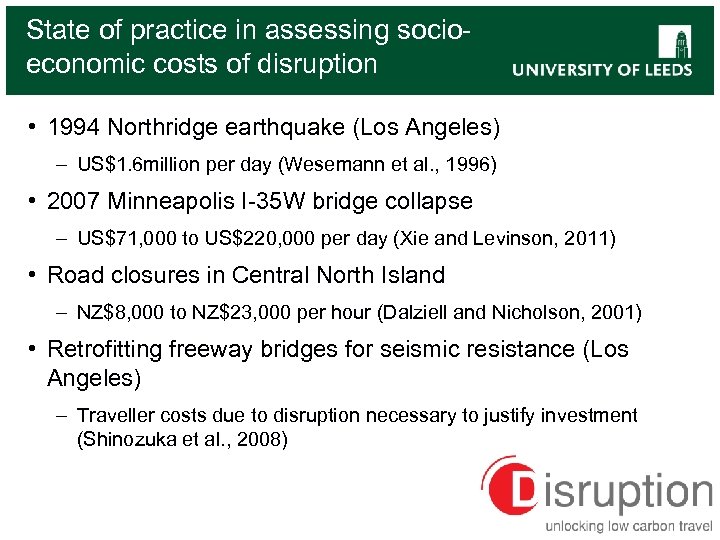 State of practice in assessing socioeconomic costs of disruption • 1994 Northridge earthquake (Los Angeles) – US$1. 6 million per day (Wesemann et al. , 1996) • 2007 Minneapolis I-35 W bridge collapse – US$71, 000 to US$220, 000 per day (Xie and Levinson, 2011) • Road closures in Central North Island – NZ$8, 000 to NZ$23, 000 per hour (Dalziell and Nicholson, 2001) • Retrofitting freeway bridges for seismic resistance (Los Angeles) – Traveller costs due to disruption necessary to justify investment (Shinozuka et al. , 2008)
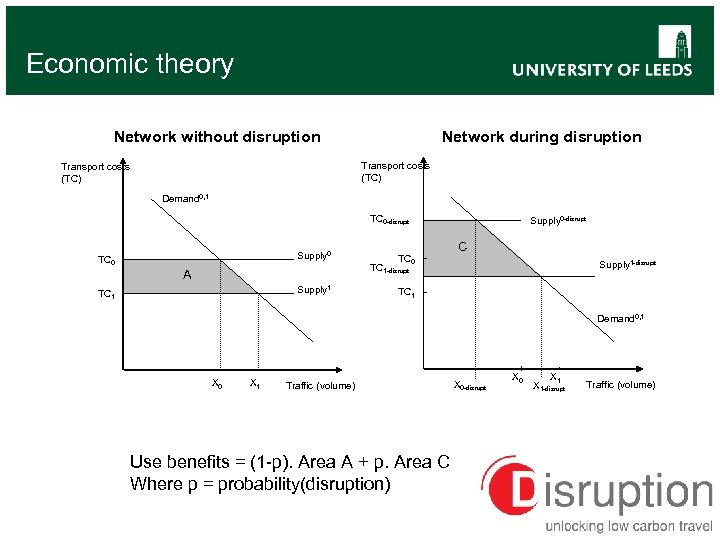 Economic theory Network during disruption Network without disruption Transport costs (TC) Demand 0, 1 TC 0 -disrupt Supply 0 TC 0 Supply 0 -disrupt C Supply 1 -disrupt TC 1 -disrupt A Supply 1 TC 1 Demand 0, 1 X 0 X 1 Traffic (volume) Use benefits = (1 -p). Area A + p. Area C Where p = probability(disruption) X 0 -disrupt X 0 X 1 -disrupt Traffic (volume)
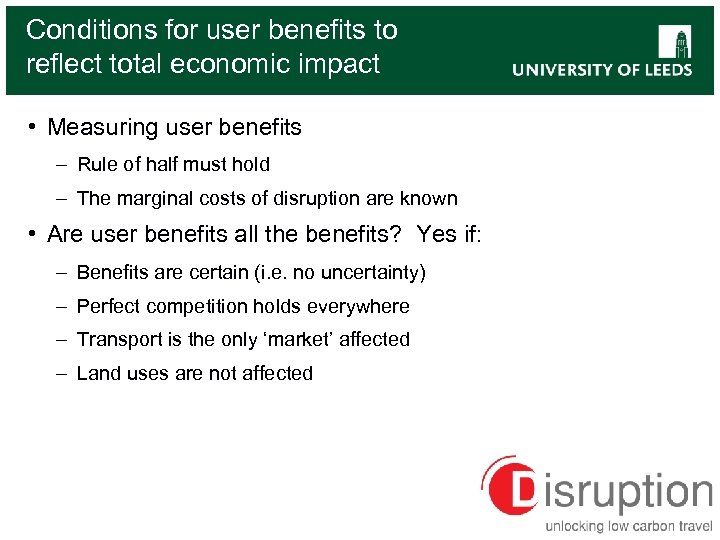 Conditions for user benefits to reflect total economic impact • Measuring user benefits – Rule of half must hold – The marginal costs of disruption are known • Are user benefits all the benefits? Yes if: – Benefits are certain (i. e. no uncertainty) – Perfect competition holds everywhere – Transport is the only ‘market’ affected – Land uses are not affected
 Snow at Heathrow © Caroline Cook. http: //www. airportsinternational. com/2010/01/snow-patrol/snow-heathrow-2
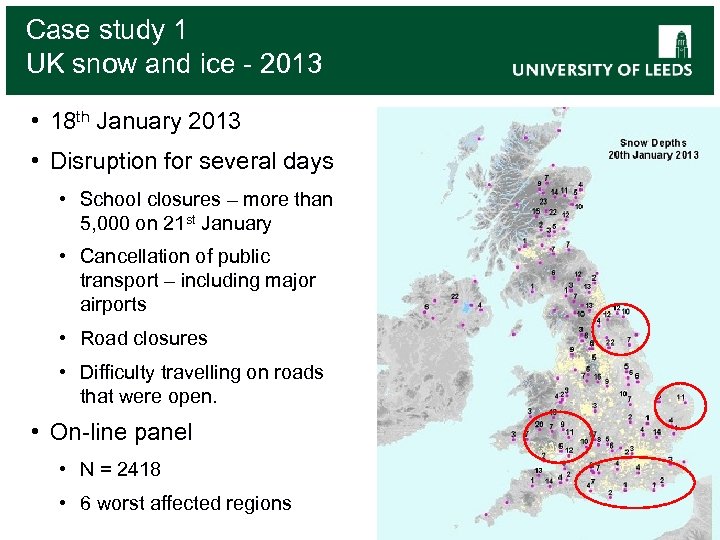 Case study 1 UK snow and ice - 2013 • 18 th January 2013 • Disruption for several days • School closures – more than 5, 000 on 21 st January • Cancellation of public transport – including major airports • Road closures • Difficulty travelling on roads that were open. • On-line panel • N = 2418 • 6 worst affected regions
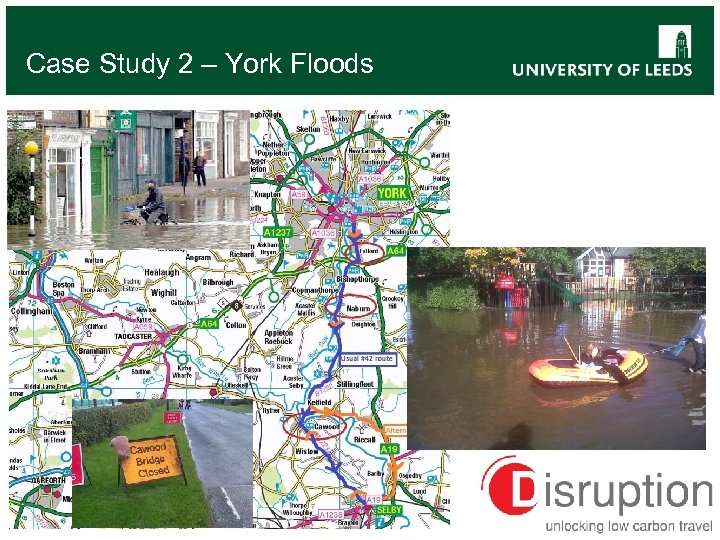 Case Study 2 – York Floods
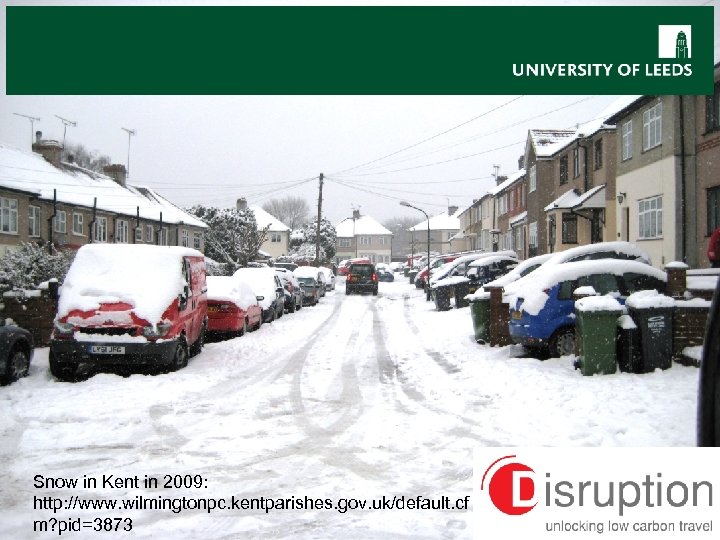 Snow in Kent in 2009: http: //www. wilmingtonpc. kentparishes. gov. uk/default. cf m? pid=3873
 Marginal costs of disruption • Can standard values of time be used? • Activity schedules – Time constraint bites harder as delays build up (Jenelius et al. , 2011) – Evidence from case studies: • Short term cancellation/postponment possible, but cannot delay indefinitely going to work, etc. • Tremendous heterogeneity in resilience and impact of disruption (e. g. childcare: stay at home mum vs single working mother vs dual income households) – Longer term expect activity schedules to adapt (for e. g. longer lasting disruption e. g. bridge collapse)
 Breakdown in rule of half • Large cost changes – UK Snow and ice: 41% of commute and business trips cancelled or postponed (indirect evidence of cost change) – York flooding: reported journey time increases of 1 hour on a ‘normal’ 15 min to 20 min journeys – Nellthorp and Hyman (2001) Ro. H error of >10%, de Jong et al (2007) error up to 32% • Loss of mode – York flooding: bus service was cancelled – Ro. H cannot be used • Analytical solution: – Numeric integration (Nellthorp and Hyman, 2001) or direct integration of demand curve (de Jong et al. , 2007)
 Treatment of uncertainty • In the presence of uncertainty (i) Expected use benefits are probabilistic (Captured in standard approach) (ii) There exists a risk premium/option value (not captured) – Expect households and businesses to adapt behaviour to changes in uncertainty. • Case study evidence: – Stress and difficulty of dealing with uncertainty – Loss of bus service and difficulties that caused – Benefit of stay-at-home mum is increased resilience (cost is income foregone). – Households with experience of flooding hold higher stocks • Analytical solution – Option values can impact on appraisal (Laird et al. , 2009, 2013). Expect option values of increased winter gritting capacity, flood defences, etc. – Need to model long run shift in supply curve (i. e. supply chain modelling/stock monitoring
 Impacts across markets • Some disruptive events confined to transport network only BUT: • Case study evidence: – Snow and ice: 5, 000 schools closed (impacts on education and employment). Premier league etc. football matches postponed. – Flooding: significant damage at 30 homes and businesses. York dungeon, Grand Opera House, Comedy Club, Badminton Horse Trials and Great Yorkshire Show all cancelled due to flooding. • Transport market analysis will not pick up all benefits. – Need a multi-market analysis
 Policies that promote resilience to disruption • Resilience policies – New infrastructure (transport and non-transport) – Softer measures: • Flexible working/tele-working • Land use intensification (walking trips least affected) • Appraisal issues for ‘non-transport’ projects – Flexible working etc. • Is ‘non-transport’ & needs to be assessed in a labour market paradigm – Land use intensification cannot be assessed using rule of half, as attractiveness of land alters through land use policy
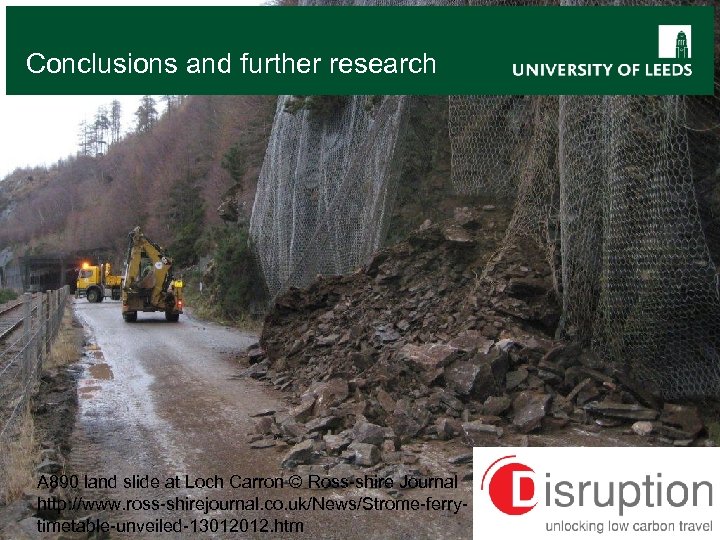 Conclusions and further research A 890 land slide at Loch Carron © Ross-shire Journal http: //www. ross-shirejournal. co. uk/News/Strome-ferrytimetable-unveiled-13012012. htm
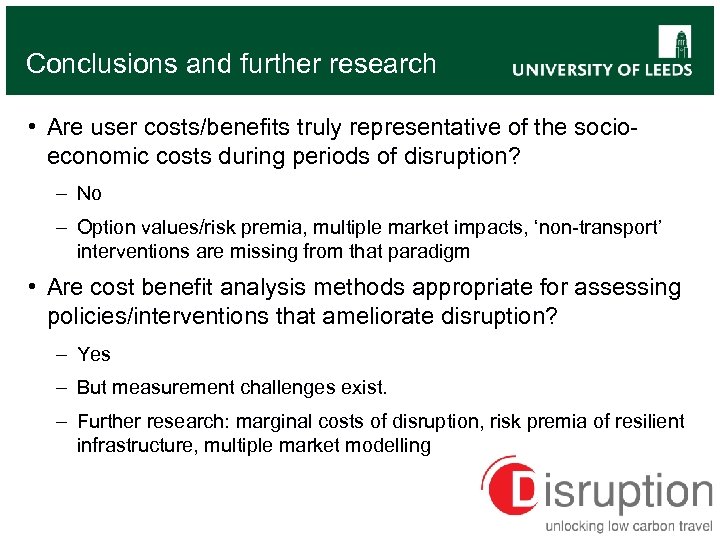 Conclusions and further research • Are user costs/benefits truly representative of the socioeconomic costs during periods of disruption? – No – Option values/risk premia, multiple market impacts, ‘non-transport’ interventions are missing from that paradigm • Are cost benefit analysis methods appropriate for assessing policies/interventions that ameliorate disruption? – Yes – But measurement challenges exist. – Further research: marginal costs of disruption, risk premia of resilient infrastructure, multiple market modelling
 Thank you for your attention