 Скачать презентацию Institute for Cyber Security A Framework for Risk-Aware
f83cd8a34834e6fad93aa69dace6948a.ppt
- Количество слайдов: 18



Institute for Cyber Security A Framework for Risk-Aware Role Based Access Control Khalid Zaman Bijon, Ram Krishnan and Ravi Sandhu Institute for Cyber Security University of Texas at San Antonio October 16, 2013 Safe. Config 2013: IEEE 6 th Symposium on Security Analytics and Automation World-Leading Research with Real-World Impact! 1
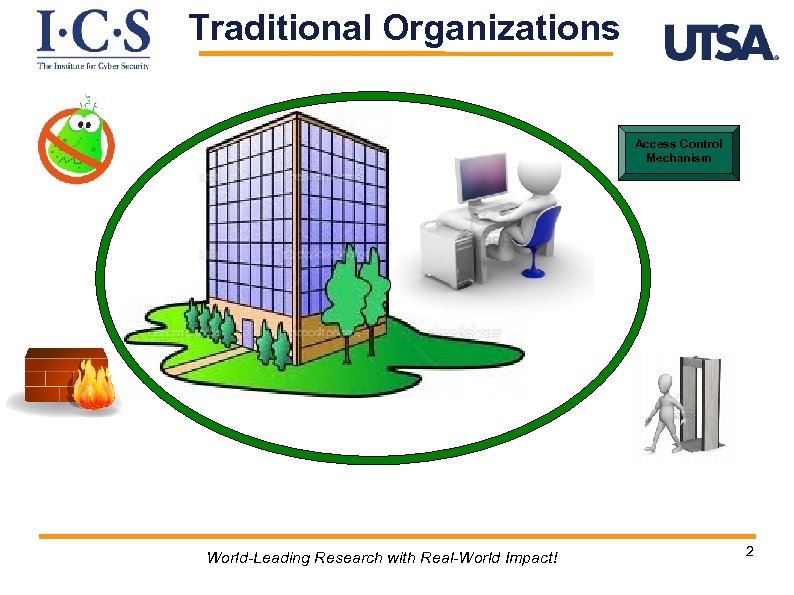
Traditional Organizations Access Control Mechanism World-Leading Research with Real-World Impact! 2
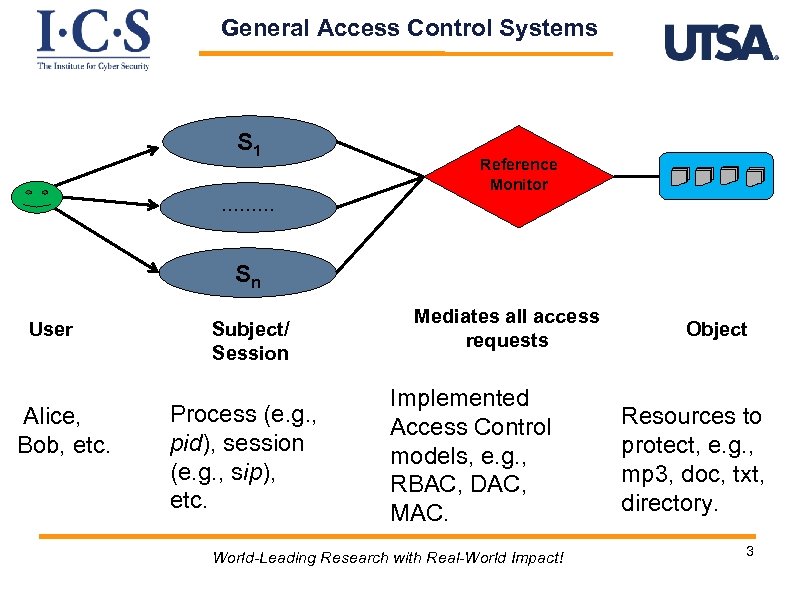
General Access Control Systems S 1 Reference Monitor ……… Sn User Alice, Bob, etc. Subject/ Session Process (e. g. , pid), session (e. g. , sip), etc. Mediates all access requests Implemented Access Control models, e. g. , RBAC, DAC, MAC. World-Leading Research with Real-World Impact! Object Resources to protect, e. g. , mp 3, doc, txt, directory. 3
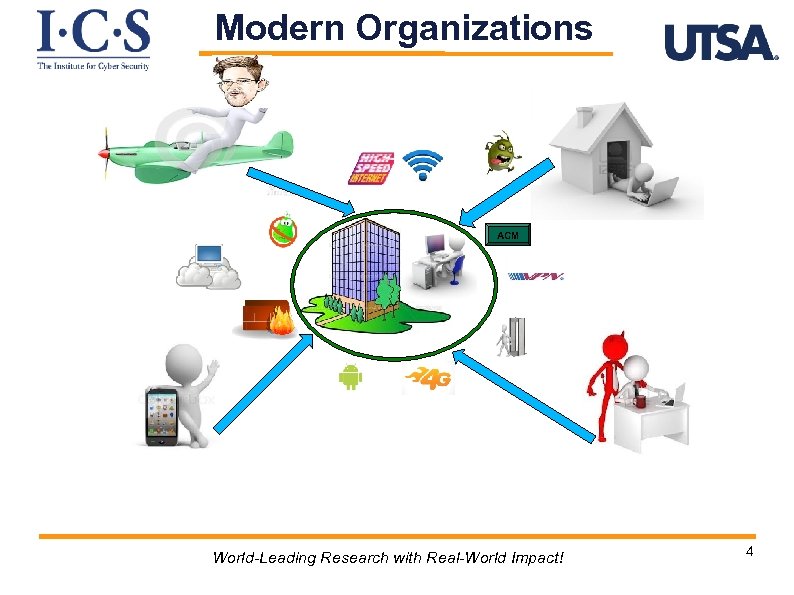
Modern Organizations ACM World-Leading Research with Real-World Impact! 4
Intro. & Motivation Possible Solutions? Ø Authenticate and grant same access everywhere Ø Is not sufficient Ø How do we know that the person in the other side is true employee Ø Secure every place/situation by antivirus/firewalls Ø Not scalable/feasible Ø Impractical Ø More dynamism in access control systems Ø Accept/Deny accesses based on security threats/risks involve in every situations/places instead of always giving same outcome for a user World-Leading Research with Real-World Impact! 5
Intro. & Motivation Overall Strategy Ø Risk-Awareness in Access Control Systems Ø Quantified Approach (Risk is represented as a metric) Ø Calculate risk value, involved in every situation Ø Grant access accordingly based on the estimated risk value World-Leading Research with Real-World Impact! 6
Intro. & Motivation (cont. ) Conducted Research in this Arena Ø MITRE Corporation Jason Program Office. Horizontal integration: Broader access models for realizing information dominance (2004) Ø Pioneer work in quantified risk-aware access control systems Ø Risk-awareness in Access Control Systems: Ø E. Celikel et al (2009), F. Salim et al (2011), L. Chen et al (2011), N. Baracaldo et al (2012), K. Bijon et al (2012), S. Chari et al (2012) and others: Risk-awareness in Role Based Access Control (RBAC) system (mainly focused on developing technique on riskestimation and utilization) Ø P. Cheng (2007), Q Ni (2010): Risk-awareness in Lattice Based Access Control (LBAC) Ø R. Mc. Graw (2009), Kandala et al(2011): Identify risk-factors for a risk-aware access control system Ø H. Khambhammettu et al (2013): a framework for various risk-assessment approaches in access control World-Leading Research with Real-World Impact! 7
A Framework for Risk-Aware RBAC Ø The Framework Ø Identify the Risk-Aware RBAC Components Ø Faces different types of security risk while performing their operations Ø Need to develop additional functionalities to support a risk-awareness Ø Different Types of Risk-Awareness Ø Traditional Approaches Ø Quantified Approaches Ø Non-adaptive approach Ø Adaptive approach World-Leading Research with Real-World Impact! 8
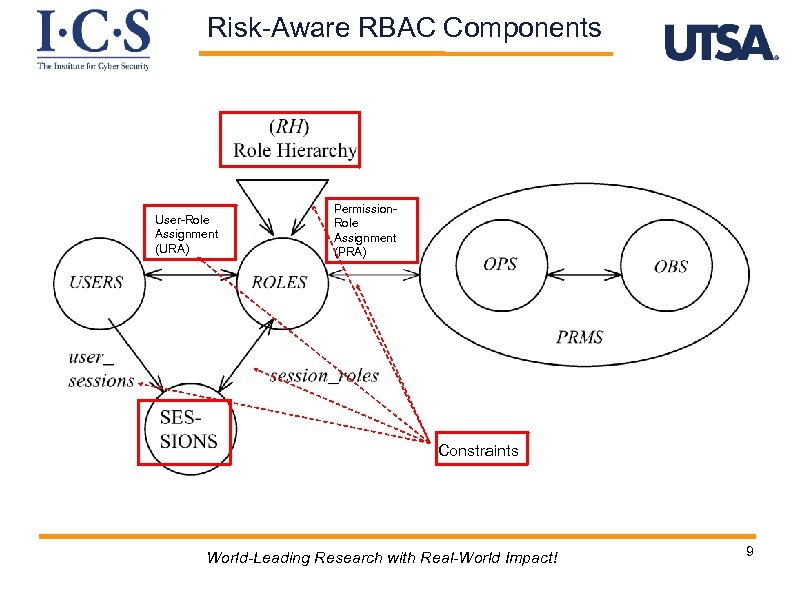
Risk-Aware RBAC Components User-Role Assignment (URA) Permission. Role Assignment (PRA) Constraints World-Leading Research with Real-World Impact! 9
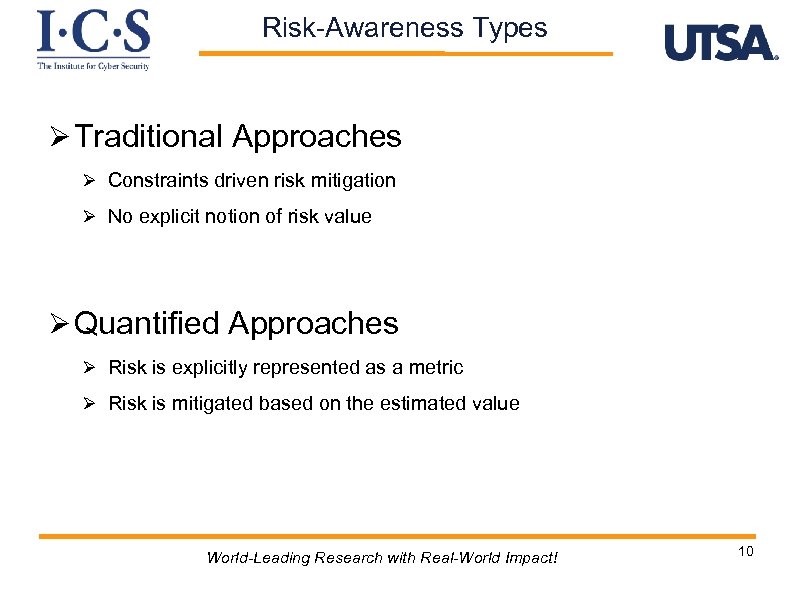
Risk-Awareness Types Ø Traditional Approaches Ø Constraints driven risk mitigation Ø No explicit notion of risk value Ø Quantified Approaches Ø Risk is explicitly represented as a metric Ø Risk is mitigated based on the estimated value World-Leading Research with Real-World Impact! 10
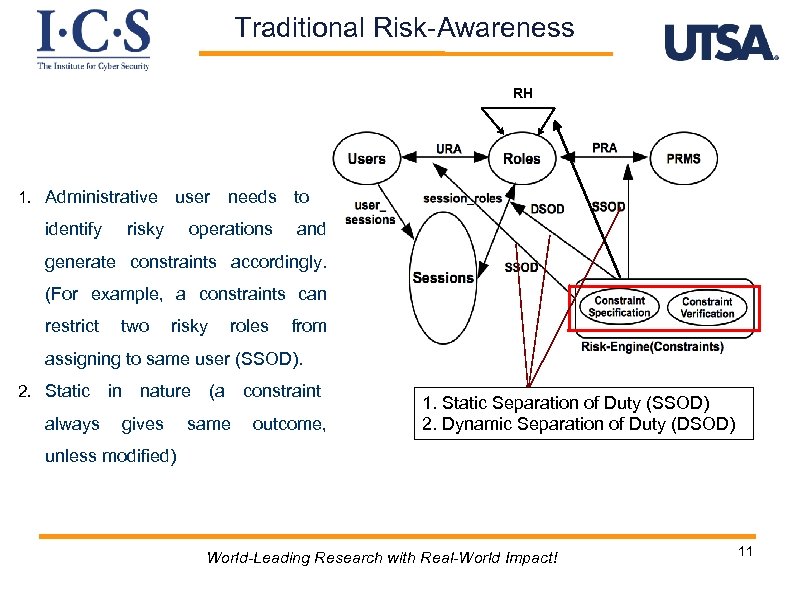
Traditional Risk-Awareness RH 1. Administrative identify user needs to risky operations and generate constraints accordingly. (For example, a constraints can restrict two risky roles from assigning to same user (SSOD). 2. Static always in nature gives (a same constraint outcome, 1. Static Separation of Duty (SSOD) 2. Dynamic Separation of Duty (DSOD) unless modified) World-Leading Research with Real-World Impact! 11
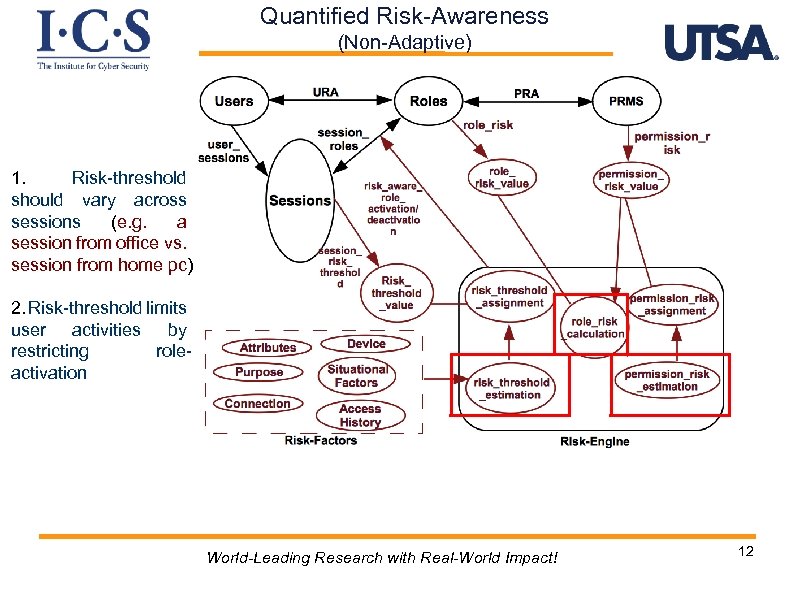
Quantified Risk-Awareness (Non-Adaptive) 1. Risk-threshold should vary across sessions (e. g. a session from office vs. session from home pc) 2. Risk-threshold limits user activities by restricting roleactivation World-Leading Research with Real-World Impact! 12
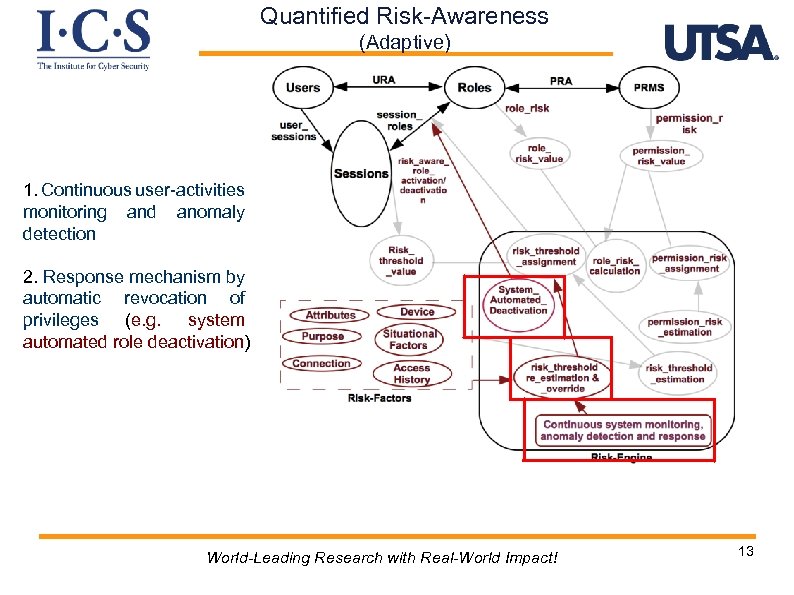
Quantified Risk-Awareness (Adaptive) 1. Continuous user-activities monitoring and anomaly detection 2. Response mechanism by automatic revocation of privileges (e. g. system automated role deactivation) World-Leading Research with Real-World Impact! 13
Formal Specification Formally enhance NIST Core RBAC model To support a session with adaptive risk-threshold Functions of the adaptive quantified risk-aware sessions Assign. Risk: assigns a risk value to a permission Role. Risk: returns estimated risk of a role Create. Session: user creates a session and system calculate risk-threshold for the session Add. Active. Role: called by users, tries to activate a particular Deactivation: called by Add. Active. Role to deactivate some already activated roles in order to activate that role SActivity. Monitor: This function monitors user sessions, if something is wrong it calls system automated deactivation (SADeactivation) function. SADeactivation: This function automatically identifies which roles need to deactivate and asks user to deactivate them. World-Leading Research with Real-World Impact! 14
Conclusion Ø To Summarize the framework: Ø The Risk-Aware RBAC Components are identified Ø Sessions, User-Role assignments, Permission-Role assignments, Role Hierarchy, Constraints Ø Each components should have different functionalities (need to be developed to support a Risk-Awareness) Ø Different Types of Risk-Awareness Approaches Ø Traditional Approaches Ø Constraints specific (implicit risk and static in nature) Ø Quantified Approaches Ø Non-adaptive approach (explicit notion of risk that varies across different situations) Ø Adaptive approach ( need run-time monitoring capabilities and additional system functions for automatic response) World-Leading Research with Real-World Impact! 15
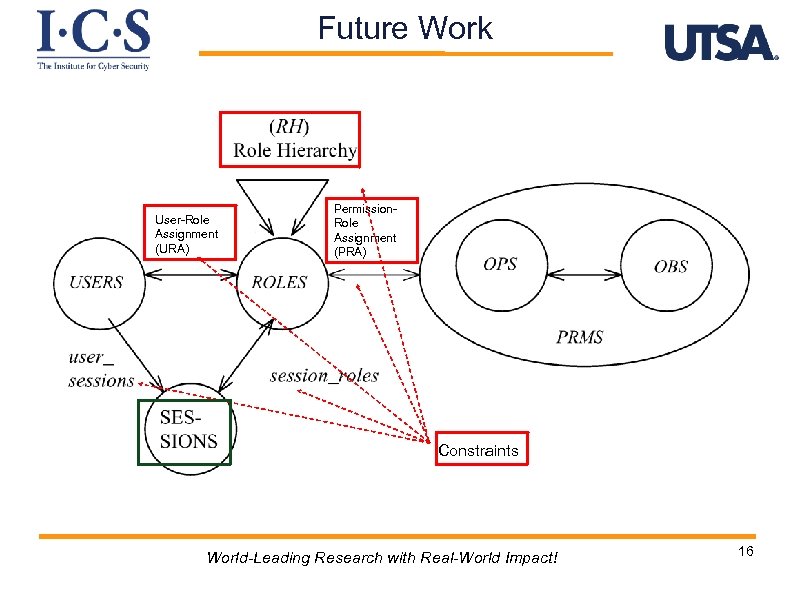
Future Work User-Role Assignment (URA) Permission. Role Assignment (PRA) Constraints World-Leading Research with Real-World Impact! 16
The End Questions? World-Leading Research with Real-World Impact! 17
Backup http: //www. forbes. com/sites/danschawbel/2013/03/29/da vid-heinemeier-hansson-every-employee-should-workfrom-home/
Скачать презентацию Institute for Cyber Security A Framework for Risk-Aware
f83cd8a34834e6fad93aa69dace6948a.ppt