 Скачать презентацию Institut für Web Science Technologien — We
8cd8d10408946b60574421f073b75376.ppt
- Количество слайдов: 52




Institut für Web Science & Technologien - We. ST Trust
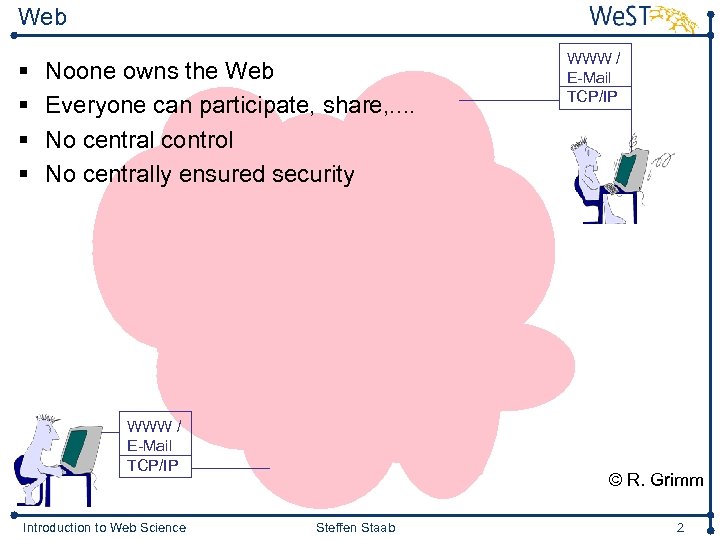
Web § § Noone owns the Web Everyone can participate, share, . . No central control No centrally ensured security WWW / E-Mail TCP/IP Introduction to Web Science WWW / E-Mail TCP/IP © R. Grimm Steffen Staab 2
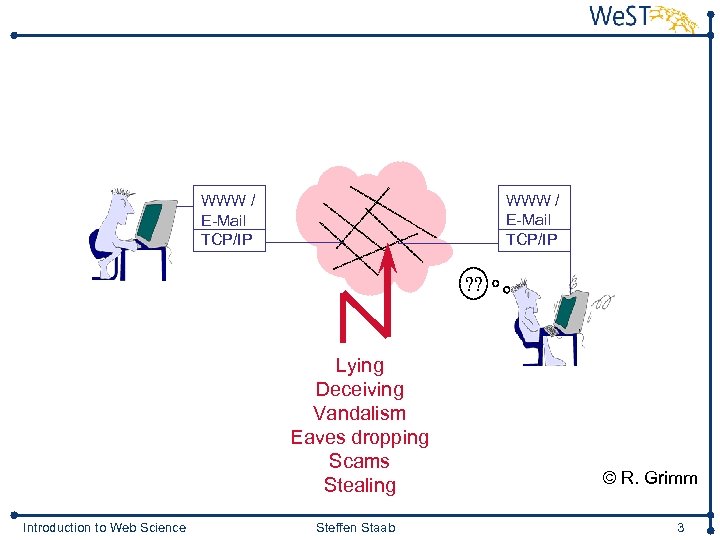
WWW / E-Mail TCP/IP ? ? Lying Deceiving Vandalism Eaves dropping Scams Stealing Introduction to Web Science Steffen Staab © R. Grimm 3
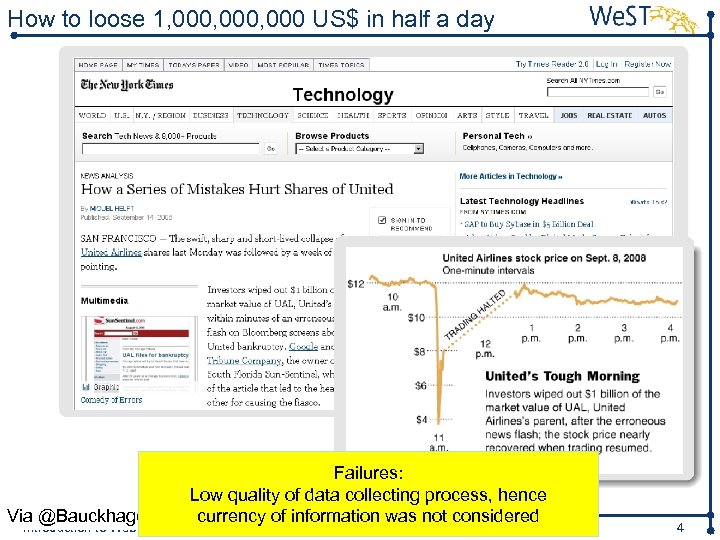
How to loose 1, 000, 000 US$ in half a day Via @Bauckhage Introduction to Web Science Failures: Low quality of data collecting process, hence currency of information was not considered Steffen Staab 4
WHAT IS TRUST? Introduction to Web Science Steffen Staab 5
![Definition of Trust http: //en. wikipedia. org/wiki/Trust_%28 social_sciences%29 Definitions of trust[2][3] typically refer to](https://present5.com/presentation/8cd8d10408946b60574421f073b75376/image-6.jpg "Definition of Trust http: //en. wikipedia. org/wiki/Trust_%28 social_sciences%29 Definitions of trust[2][3] typically refer to")
Definition of Trust http: //en. wikipedia. org/wiki/Trust_%28 social_sciences%29 Definitions of trust[2][3] typically refer to a situation characterised by the following aspects: § One party (trustor) is willing to rely on the actions of another party (trustee); § the situation is directed to the future; § the trustor (voluntarily or forcedly) abandons control over the actions performed by the trustee; § as a consequence, the trustor is uncertain about the outcome of the other's actions; he can only develop and evaluate expectations. The uncertainty involves the risk of failure or harm to the trustor if the trustee will not behave as desired. Introduction to Web Science Steffen Staab 6
Core Question What does it mean if I say that I trust person P performing action A or a System S trusts person or system P performing action A ? Introduction to Web Science Steffen Staab 7
Trust Perspectives § Information and communication § Education § Social science § Economic/risk management § Reputation § IT security Introduction to Web Science Steffen Staab 8
INFORMATION & COMMUNICATION PERSPECTIVE ON TRUST Introduction to Web Science Steffen Staab 9
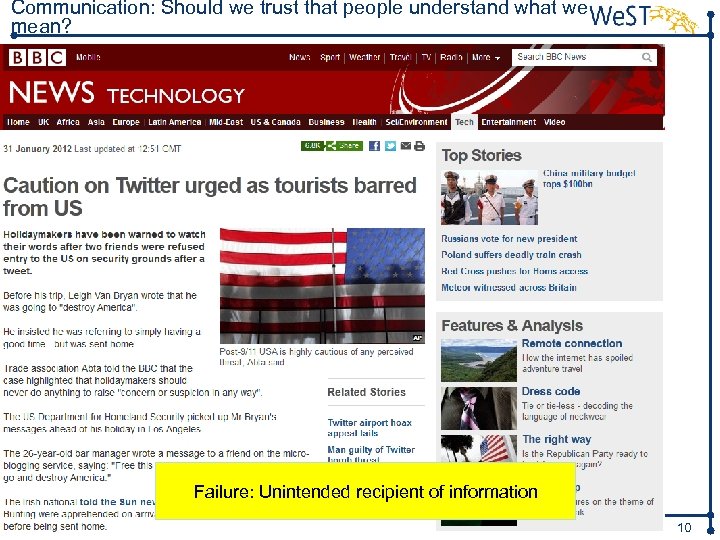
Communication: Should we trust that people understand what we mean? Failure: Unintended recipient of information Introduction to Web Science Steffen Staab 10
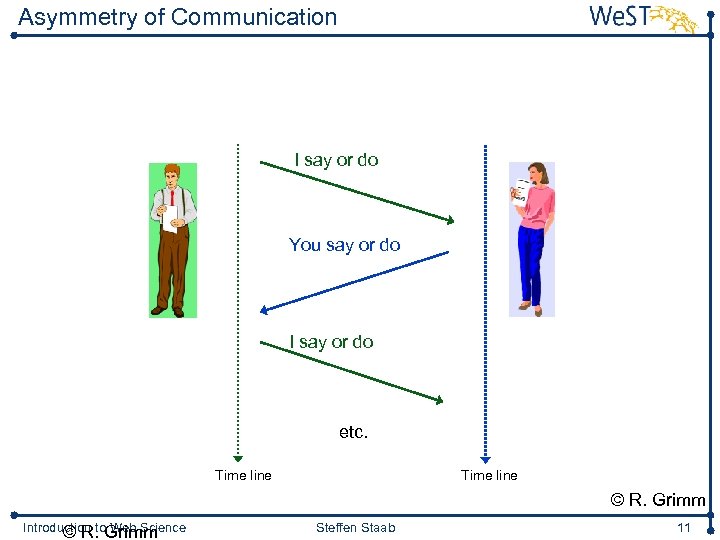
Asymmetry of Communication I say or do You say or do I say or do etc. Time line © R. Grimm Introduction to. Grimm © R. Web Science Steffen Staab 11
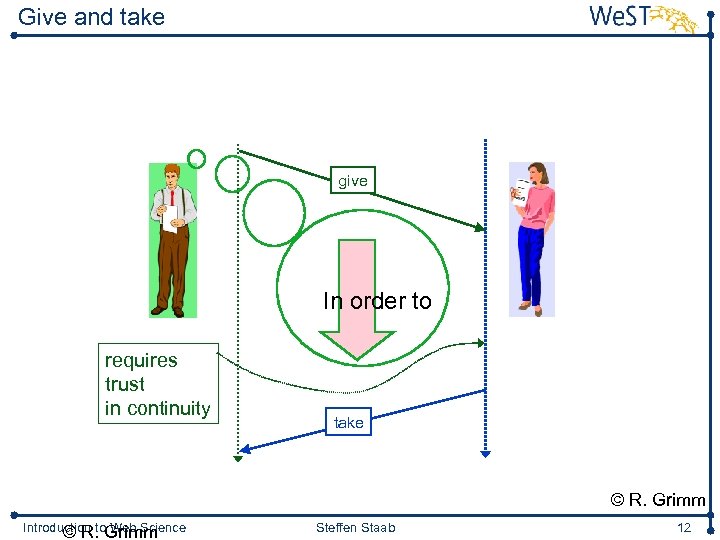
Give and take give In order to requires trust in continuity take © R. Grimm Introduction to. Grimm © R. Web Science Steffen Staab 12
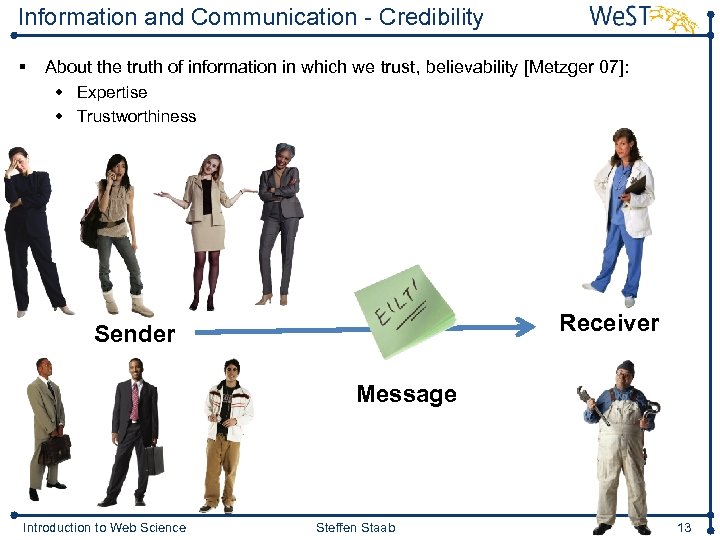
Information and Communication - Credibility § About the truth of information in which we trust, believability [Metzger 07]: w Expertise w Trustworthiness Receiver Sender Message Introduction to Web Science Steffen Staab 13
EDUCATION PERSPECTIVE ON TRUST Introduction to Web Science Steffen Staab 14
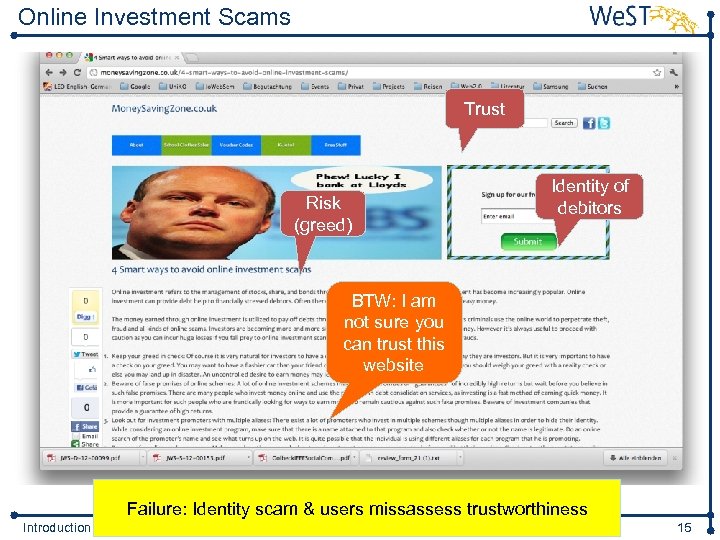
Online Investment Scams Trust Risk (greed) Identity of debitors BTW: I am not sure you can trust this website Failure: Identity scam & users missassess trustworthiness Introduction to Web Science Steffen Staab 15
The education perspective What do I need to teach someone such that If he trusts person P performing action A he does not suffer? [Metzger, 2007] A system S trusts person P performing action A if P satisfies the assessment criteria for trust Introduction to Web Science Steffen Staab 16
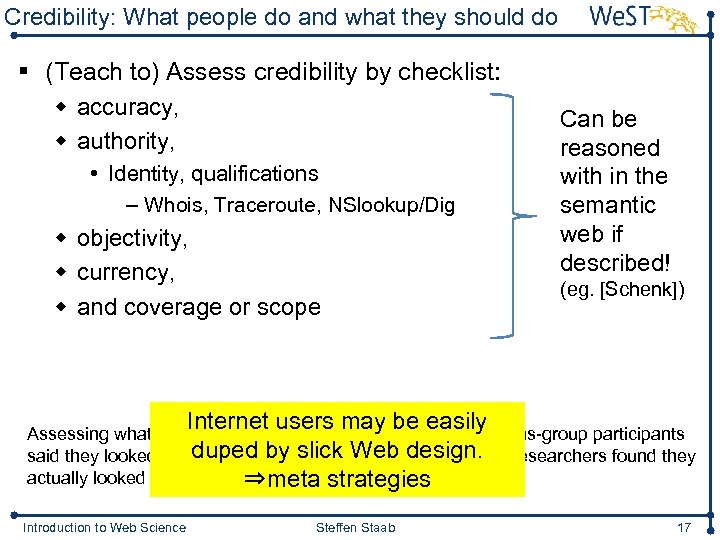
Credibility: What people do and what they should do § (Teach to) Assess credibility by checklist: w accuracy, w authority, • Identity, qualifications – Whois, Traceroute, NSlookup/Dig w objectivity, w currency, w and coverage or scope Can be reasoned with in the semantic web if described! (eg. [Schenk]) Internet users may be easily Assessing what people do on the Web: Interestingly, what focus-group participants duped by slick Web not what said they looked for in assessing credibility was design. the researchers found they actually looked at during the observational portion of the study. ⇒meta strategies Introduction to Web Science Steffen Staab 17
SOCIAL SCIENCE PERSPECTIVE ON TRUST Introduction to Web Science Steffen Staab 18
§ A system S trusts person P performing action A if P belongs to trusted group Introduction to Web Science Steffen Staab 19
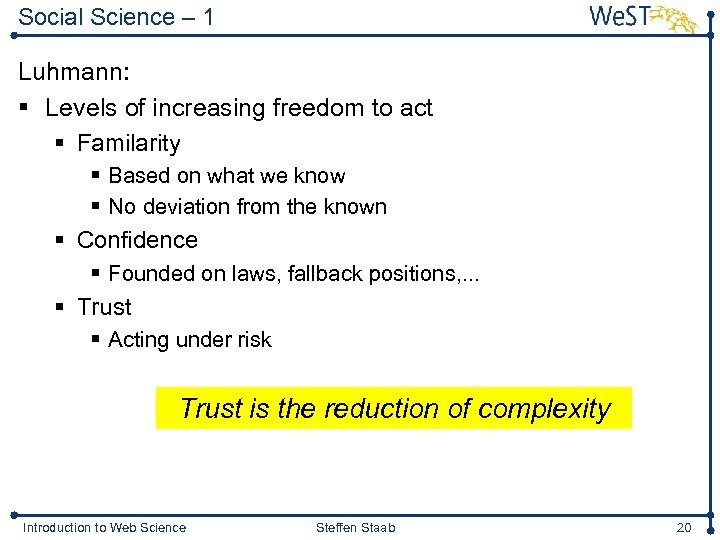
Social Science – 1 Luhmann: § Levels of increasing freedom to act § Familarity § Based on what we know § No deviation from the known § Confidence § Founded on laws, fallback positions, . . . § Trust § Acting under risk Trust is the reduction of complexity Introduction to Web Science Steffen Staab 20
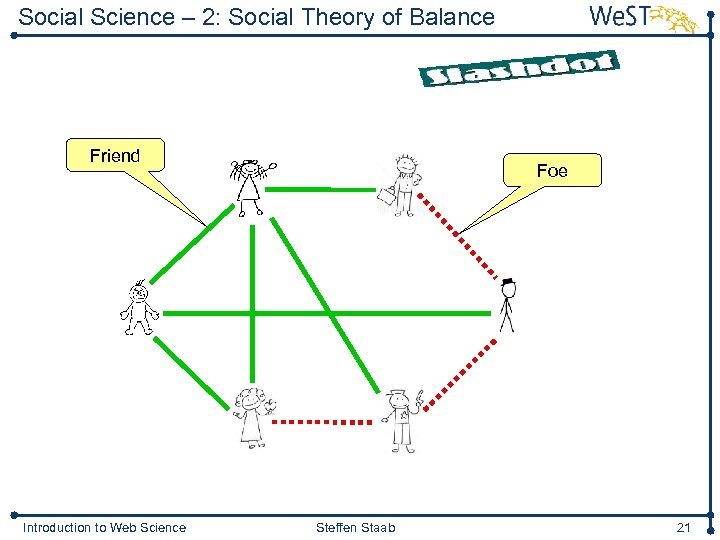
Social Science – 2: Social Theory of Balance Friend Introduction to Web Science Foe Steffen Staab 21
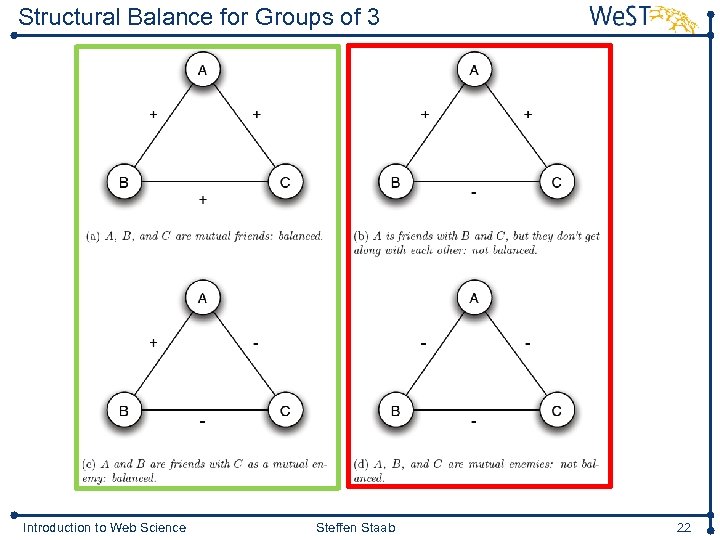
Structural Balance for Groups of 3 Introduction to Web Science Steffen Staab 22
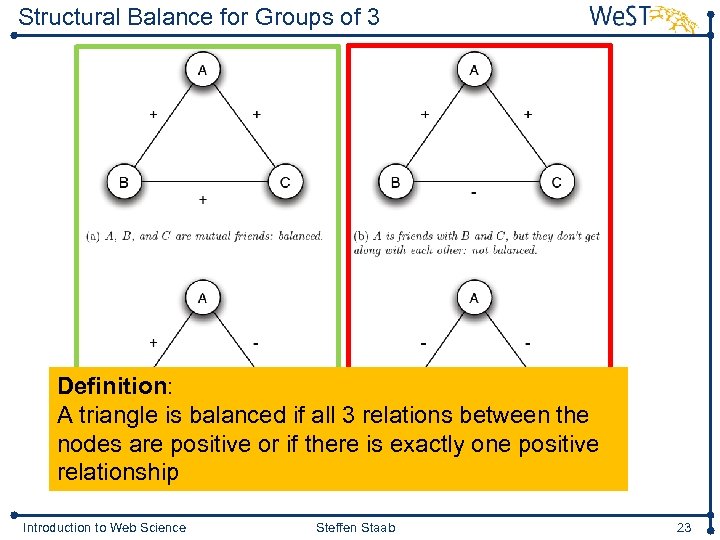
Structural Balance for Groups of 3 Definition: A triangle is balanced if all 3 relations between the nodes are positive or if there is exactly one positive relationship Introduction to Web Science Steffen Staab 23
Structural Balance for a Network Definition: A network is called structurally balanced if all groups of triangles are structurally balanced. Balance Theorem: If a labeled complete graph is balanced, then either all pairs of nodes are friend, or else the nodes can be divided into two groups, X and Y, w such that each pair of people in X likes each other, w each pair of people in Y likes each other, w and everyone in X is the enemy of everyone in Y. Introduction to Web Science Steffen Staab 24
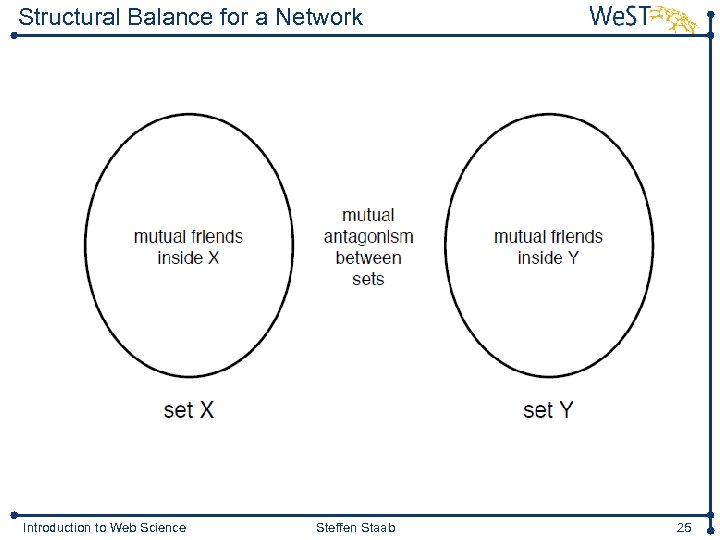
Structural Balance for a Network Introduction to Web Science Steffen Staab 25
Weakly Balanced Networks Definition of Weak Structural Balance Property: There is no set of three nodes § such that the edges among them consist of exactly two positive edges and one negative edge Introduction to Web Science Steffen Staab 26
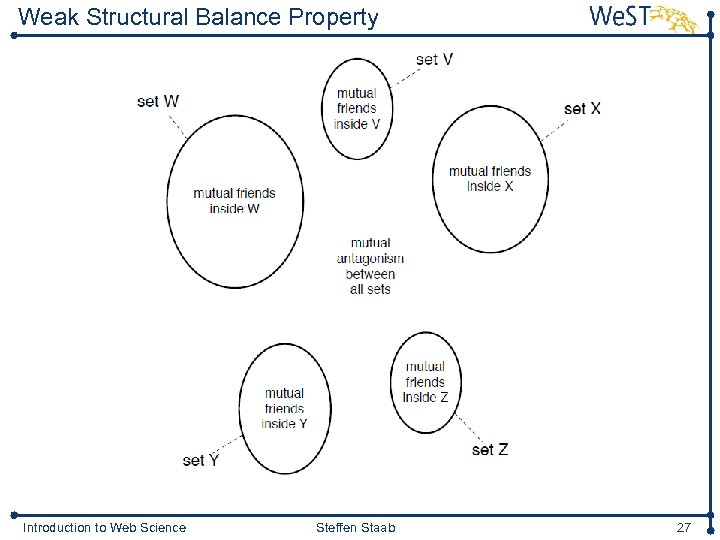
Weak Structural Balance Property Introduction to Web Science Steffen Staab 27
RISK MANAGEMENT/ECONOMIC PERSPECTIVE ON TRUST Introduction to Web Science Steffen Staab 28
Risk Management/Economic perspective § Risk is a pair w Value/Cost of an event arising w Probability that the event will arise § Trust means willingness to bear a risk § A system S trusts person P performing action A if the expected overall value/utility is positive § In particular trust issues arise in markets with information asymmetry – e. g. E-Bay Introduction to Web Science Steffen Staab 29
A Web Market Example § Trust issues arising in markets with information asymmetry – e. g. E-Bay w Assume 50 good cars, 50 bad cars could be for sale w 200 buyers willing to buy w Assume buyers are willing to pay up to 12 for good cars and up to 6 for bad cars w Assume sellers are willing to sell from 10 upwards and 5 upwards for good and bad cars respectively § Information Asymmetry: w Sellers judge good/bad accurately w Buyers cannot judge good/bad at all, but know about willingness of sellers to sell Introduction to Web Science Steffen Staab 30
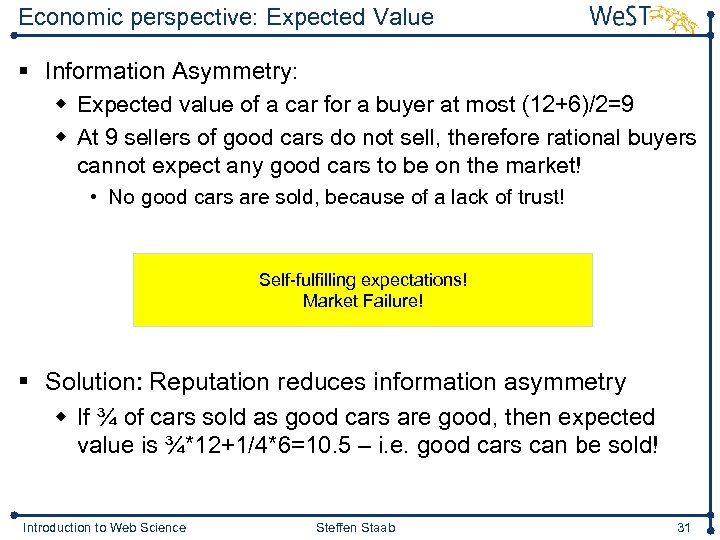
Economic perspective: Expected Value § Information Asymmetry: w Expected value of a car for a buyer at most (12+6)/2=9 w At 9 sellers of good cars do not sell, therefore rational buyers cannot expect any good cars to be on the market! • No good cars are sold, because of a lack of trust! Self-fulfilling expectations! Market Failure! § Solution: Reputation reduces information asymmetry w If ¾ of cars sold as good cars are good, then expected value is ¾*12+1/4*6=10. 5 – i. e. good cars can be sold! Introduction to Web Science Steffen Staab 31
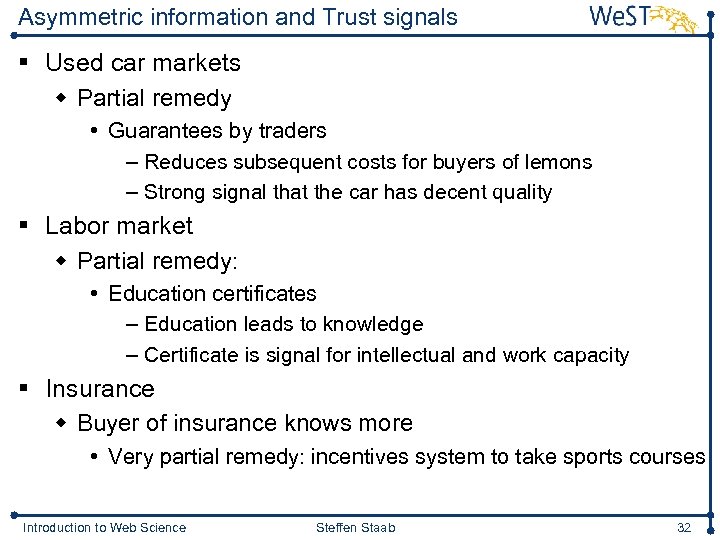
Asymmetric information and Trust signals § Used car markets w Partial remedy • Guarantees by traders – Reduces subsequent costs for buyers of lemons – Strong signal that the car has decent quality § Labor market w Partial remedy: • Education certificates – Education leads to knowledge – Certificate is signal for intellectual and work capacity § Insurance w Buyer of insurance knows more • Very partial remedy: incentives system to take sports courses Introduction to Web Science Steffen Staab 32
REPUTATION PERSPECTIVE ON TRUST Introduction to Web Science Steffen Staab 33
+++ „Los Angeles (dpa) – In der kalifornischen Kleinstadt Bluewater soll es nach einem Bericht des örtlichen Senders vpk-tv zu einem Selbstmordanschlag gekommen sein. Es habe in einem Restaurant zwei Explosionen gegeben. . . “ +++ German Press Agency DPA, 10 Sep 2009 Introduction to Web Science Steffen Staab 34
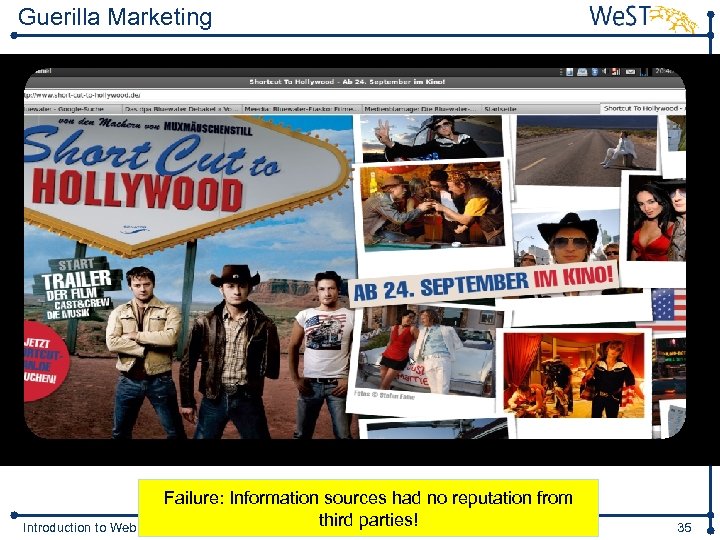
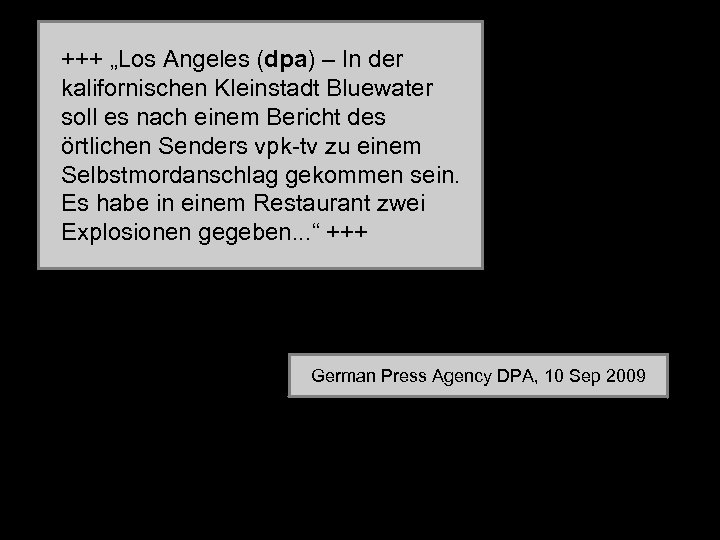
Guerilla Marketing Failure: Information sources had no reputation from third parties! Introduction to Web Science Steffen Staab 35
Reputation perspective Belief in benevolence vs believe in competence A system S trusts person P performing action A if sufficient reputation could be aggregated Introduction to Web Science Steffen Staab 36
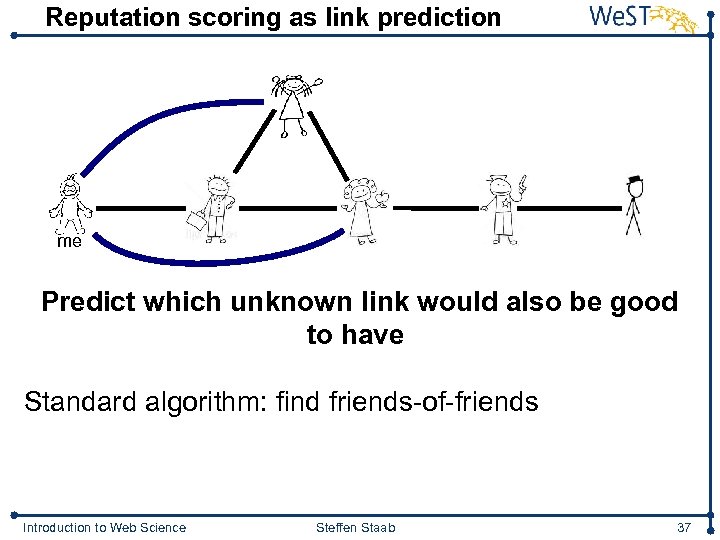
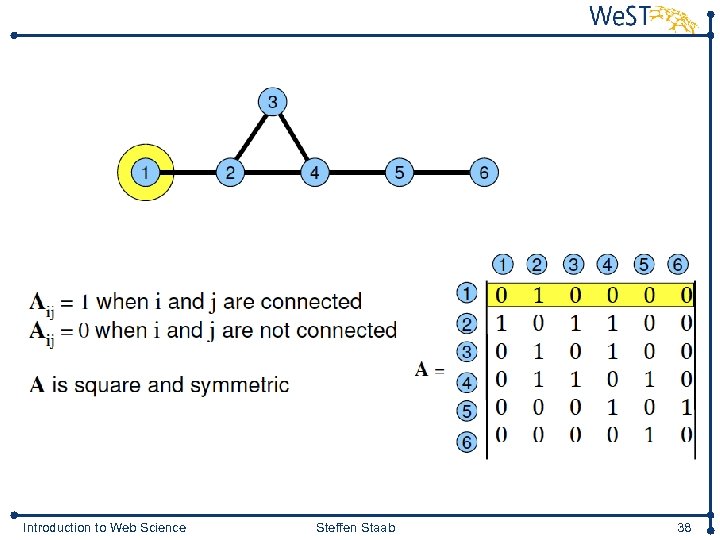
Reputation scoring as link prediction me Predict which unknown link would also be good to have Standard algorithm: find friends-of-friends Introduction to Web Science Steffen Staab 37
Introduction to Web Science Steffen Staab 38
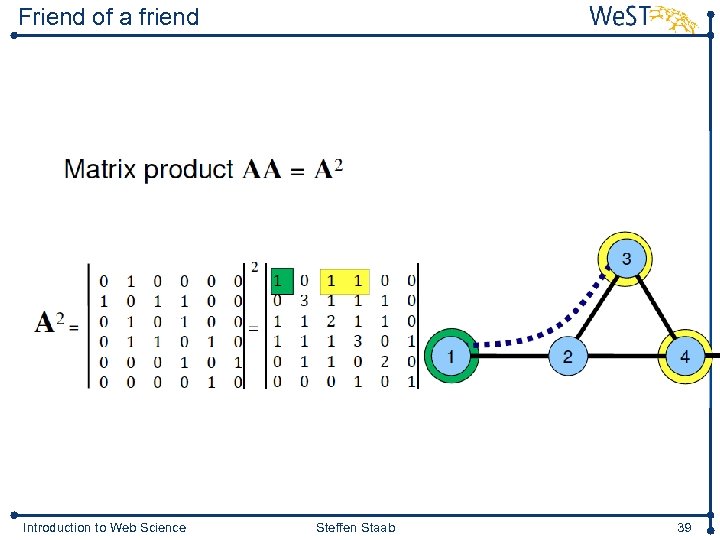
Friend of a friend Introduction to Web Science Steffen Staab 39
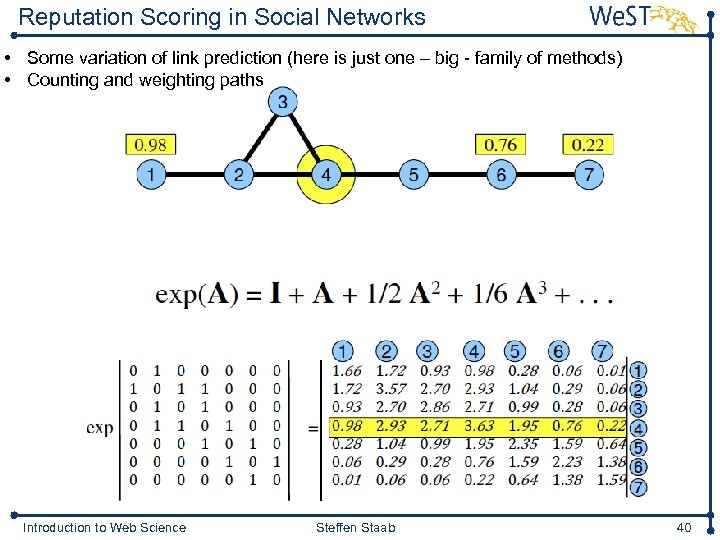
Reputation Scoring in Social Networks • Some variation of link prediction (here is just one – big - family of methods) • Counting and weighting paths Introduction to Web Science Steffen Staab 40
Introduction to Web Science Steffen Staab 41
Distrust computation Prediction of negative links § Few networks with negative links (Slashdot zoo) § Several methods for handling negative links available Social factors § Facebook unlinking prediction [Quercia et al] w Age gap w Low number of common friends (embeddedness) w No common female friend w One neurotic or introvert § Results seem to be comparable to „unlinking“ in real life Introduction to Web Science Steffen Staab 42
IT SECURITY PERSPECTIVE ON TRUST Introduction to Web Science Steffen Staab 43
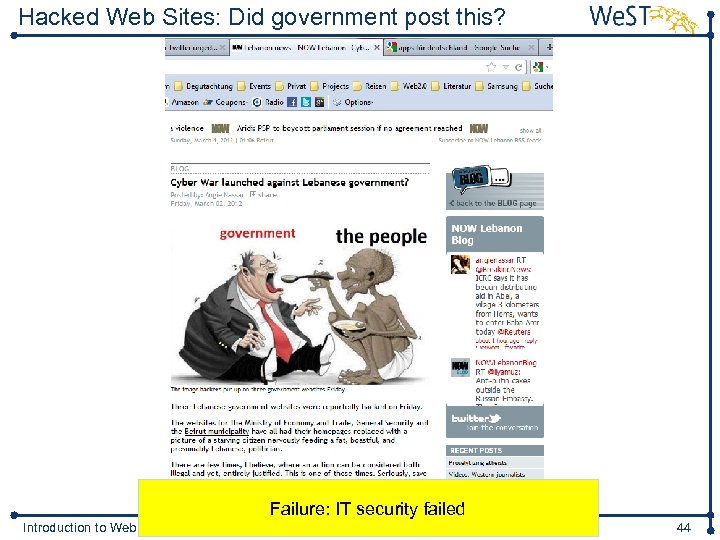
Hacked Web Sites: Did government post this? Failure: IT security failed Introduction to Web Science Steffen Staab 44
Security perspective § Authorization w Specific person P is allowed to do action A § Authentication w Proof to be a specific person § Sometimes: Tokens that lend authority and/or authentication via centralized or decentralized trust center § A system S trusts Person P to perform A if authentication and authorization can be proven Introduction to Web Science Steffen Staab 45
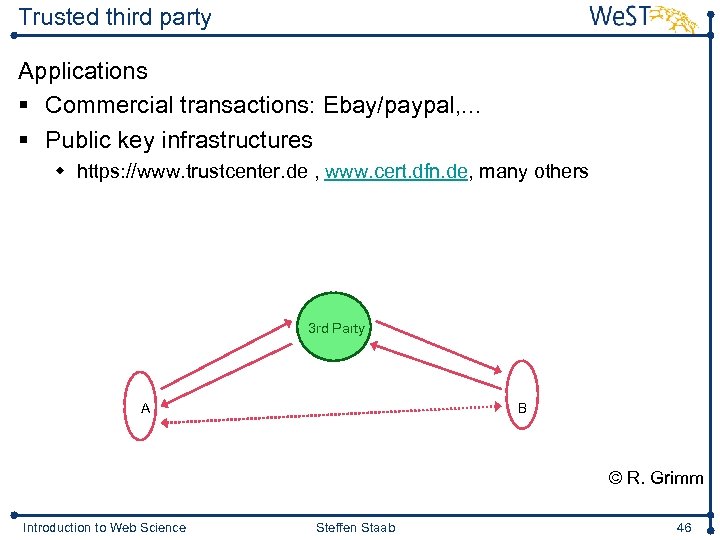
Trusted third party Applications § Commercial transactions: Ebay/paypal, . . . § Public key infrastructures w https: //www. trustcenter. de , www. cert. dfn. de, many others 3 rd Party A B © R. Grimm Introduction to Web Science Steffen Staab 46
CONCLUSION Introduction to Web Science Steffen Staab 47
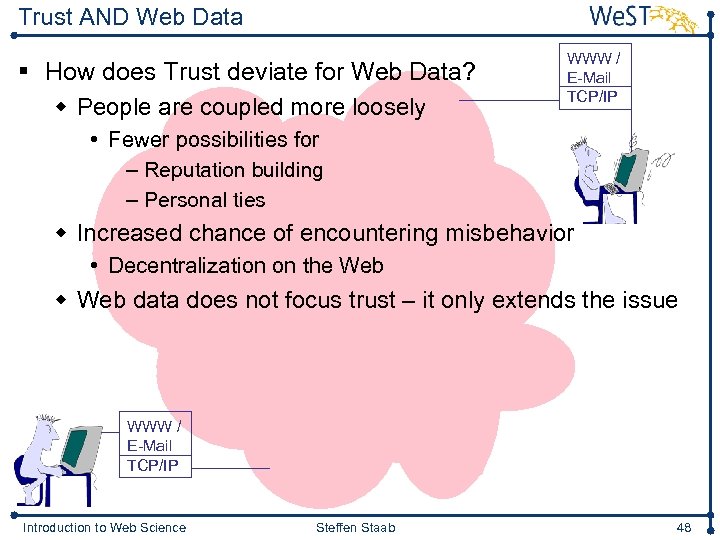
Trust AND Web Data § How does Trust deviate for Web Data? w People are coupled more loosely WWW / E-Mail TCP/IP • Fewer possibilities for – Reputation building – Personal ties w Increased chance of encountering misbehavior • Decentralization on the Web w Web data does not focus trust – it only extends the issue WWW / E-Mail TCP/IP Introduction to Web Science Steffen Staab 48
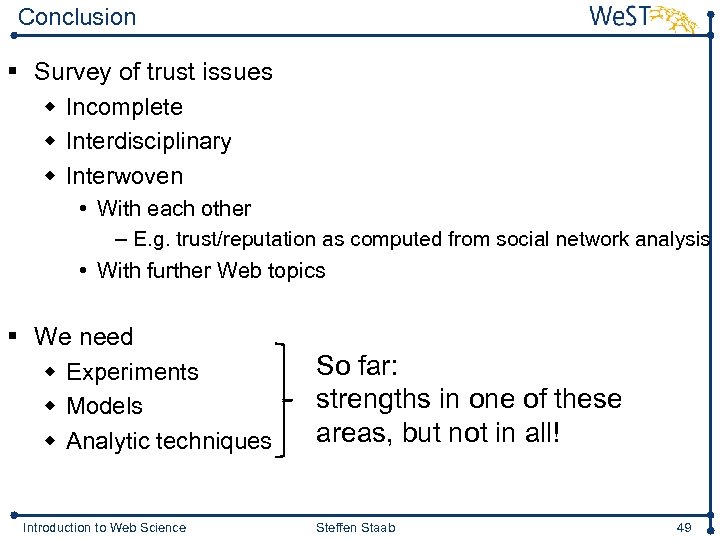
Conclusion § Survey of trust issues w Incomplete w Interdisciplinary w Interwoven • With each other – E. g. trust/reputation as computed from social network analysis • With further Web topics § We need w Experiments w Models w Analytic techniques Introduction to Web Science So far: strengths in one of these areas, but not in all! Steffen Staab 49
REFERENCES Introduction to Web Science Steffen Staab 50
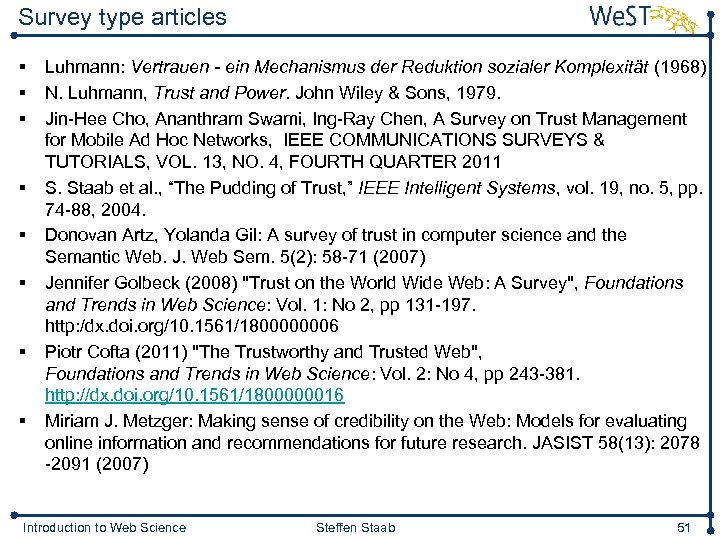
Survey type articles § § § § Luhmann: Vertrauen - ein Mechanismus der Reduktion sozialer Komplexität (1968) N. Luhmann, Trust and Power. John Wiley & Sons, 1979. Jin-Hee Cho, Ananthram Swami, Ing-Ray Chen, A Survey on Trust Management for Mobile Ad Hoc Networks, IEEE COMMUNICATIONS SURVEYS & TUTORIALS, VOL. 13, NO. 4, FOURTH QUARTER 2011 S. Staab et al. , “The Pudding of Trust, ” IEEE Intelligent Systems, vol. 19, no. 5, pp. 74 -88, 2004. Donovan Artz, Yolanda Gil: A survey of trust in computer science and the Semantic Web. J. Web Sem. 5(2): 58 -71 (2007) Jennifer Golbeck (2008) "Trust on the World Wide Web: A Survey", Foundations and Trends in Web Science: Vol. 1: No 2, pp 131 -197. http: /dx. doi. org/10. 1561/1800000006 Piotr Cofta (2011) "The Trustworthy and Trusted Web", Foundations and Trends in Web Science: Vol. 2: No 4, pp 243 -381. http: //dx. doi. org/10. 1561/1800000016 Miriam J. Metzger: Making sense of credibility on the Web: Models for evaluating online information and recommendations for future research. JASIST 58(13): 2078 -2091 (2007) Introduction to Web Science Steffen Staab 51
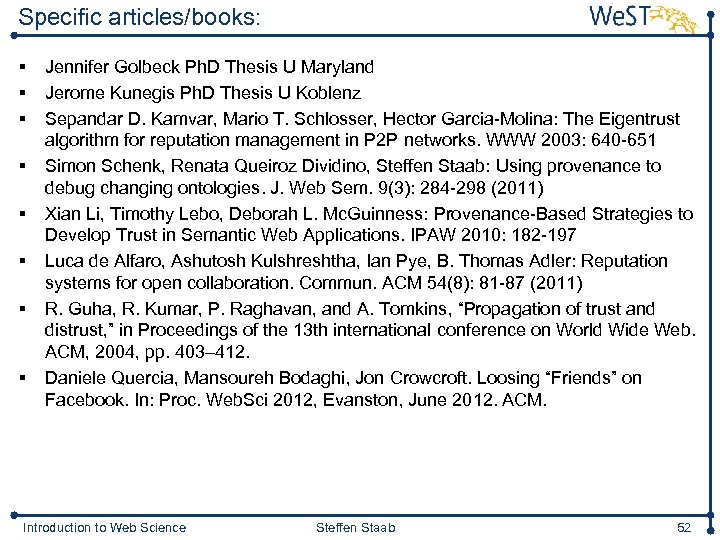
Specific articles/books: § § § § Jennifer Golbeck Ph. D Thesis U Maryland Jerome Kunegis Ph. D Thesis U Koblenz Sepandar D. Kamvar, Mario T. Schlosser, Hector Garcia-Molina: The Eigentrust algorithm for reputation management in P 2 P networks. WWW 2003: 640 -651 Simon Schenk, Renata Queiroz Dividino, Steffen Staab: Using provenance to debug changing ontologies. J. Web Sem. 9(3): 284 -298 (2011) Xian Li, Timothy Lebo, Deborah L. Mc. Guinness: Provenance-Based Strategies to Develop Trust in Semantic Web Applications. IPAW 2010: 182 -197 Luca de Alfaro, Ashutosh Kulshreshtha, Ian Pye, B. Thomas Adler: Reputation systems for open collaboration. Commun. ACM 54(8): 81 -87 (2011) R. Guha, R. Kumar, P. Raghavan, and A. Tomkins, “Propagation of trust and distrust, ” in Proceedings of the 13 th international conference on World Wide Web. ACM, 2004, pp. 403– 412. Daniele Quercia, Mansoureh Bodaghi, Jon Crowcroft. Loosing “Friends” on Facebook. In: Proc. Web. Sci 2012, Evanston, June 2012. ACM. Introduction to Web Science Steffen Staab 52
Скачать презентацию Institut für Web Science Technologien — We
8cd8d10408946b60574421f073b75376.ppt