


 Скачать презентацию Instead of high-tech rocket or electromagnetic forces the
a32a77c7a59e3776f363c529a6115226.ppt
- Количество слайдов: 64
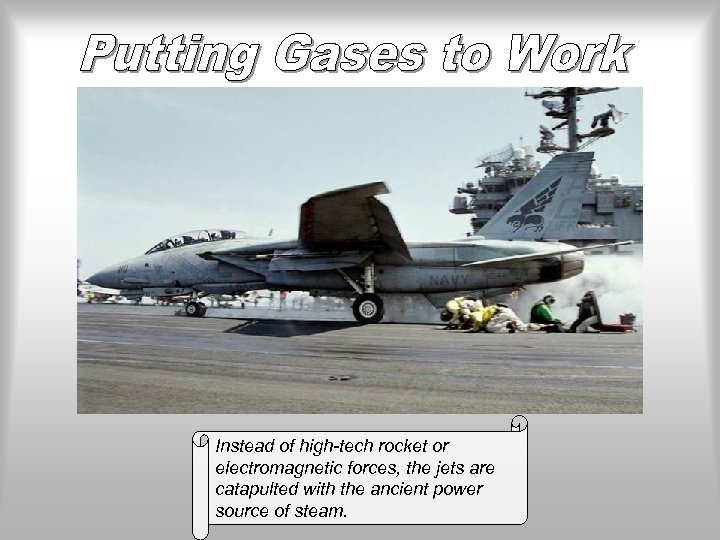 Instead of high-tech rocket or electromagnetic forces, the jets are catapulted with the ancient power source of steam.

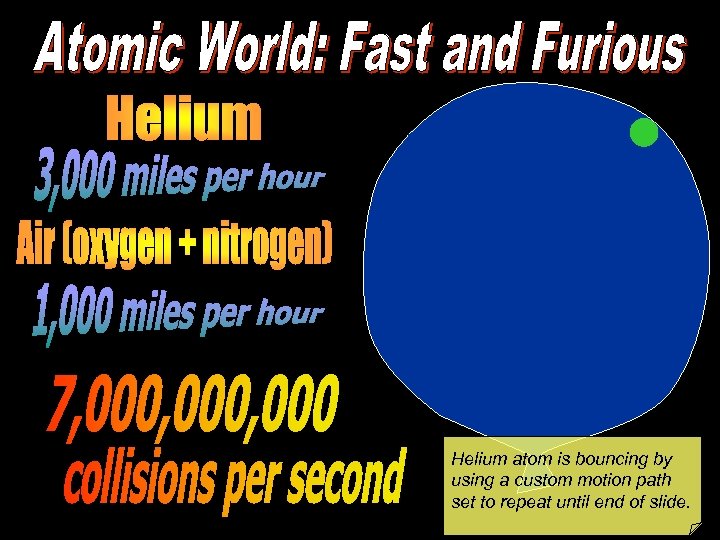 Helium atom is bouncing by using a custom motion path set to repeat until end of slide.
 So you see there is no such thing as still air. The air molecules are constantly moving at an average of 1, 000 miles per hour.
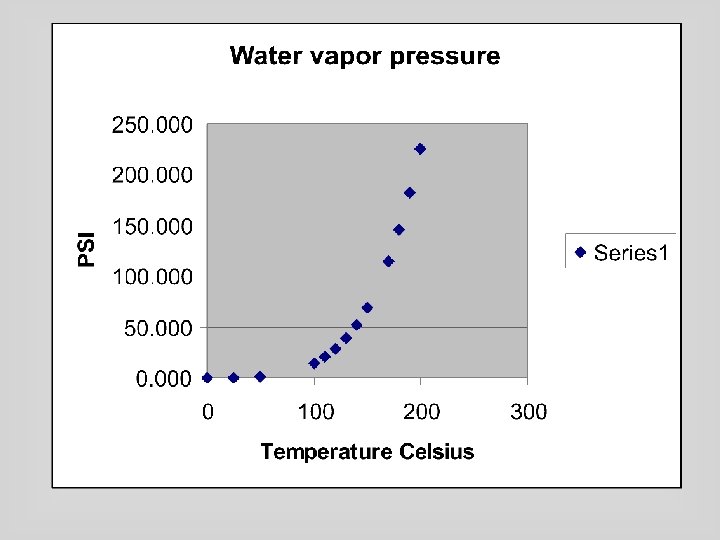
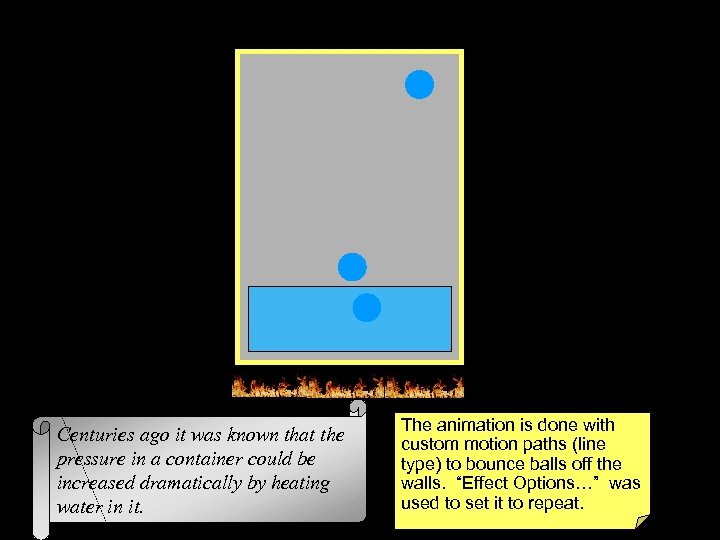 Centuries ago it was known that the pressure in a container could be increased dramatically by heating water in it. The animation is done with custom motion paths (line type) to bounce balls off the walls. “Effect Options…” was used to set it to repeat.
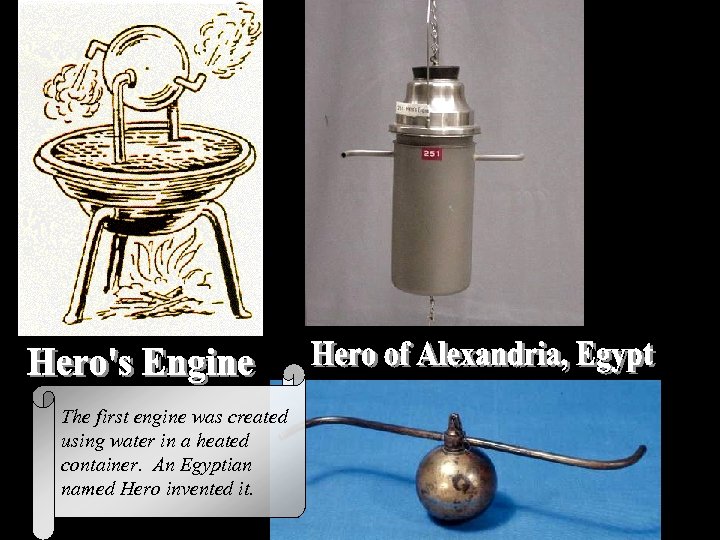 The first engine was created using water in a heated container. An Egyptian named Hero invented it.
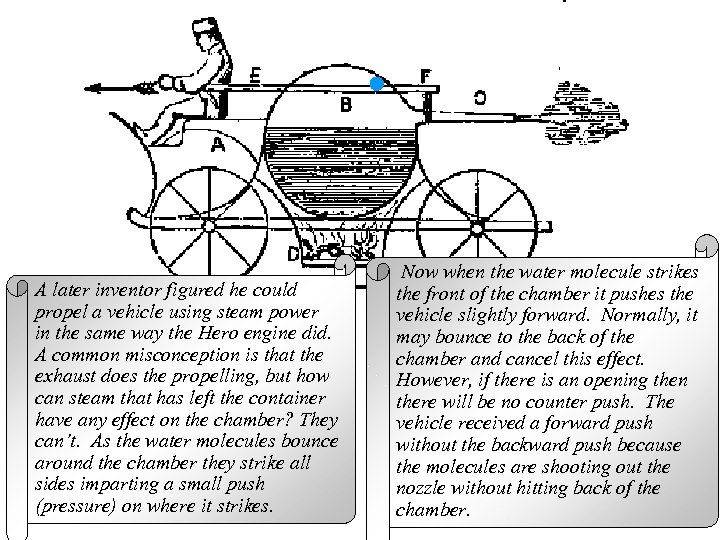 A later inventor figured he could propel a vehicle using steam power in the same way the Hero engine did. A common misconception is that the exhaust does the propelling, but how can steam that has left the container have any effect on the chamber? They can’t. As the water molecules bounce around the chamber they strike all sides imparting a small push (pressure) on where it strikes. Now when the water molecule strikes the front of the chamber it pushes the vehicle slightly forward. Normally, it may bounce to the back of the chamber and cancel this effect. However, if there is an opening then there will be no counter push. The vehicle received a forward push without the backward push because the molecules are shooting out the nozzle without hitting back of the chamber.
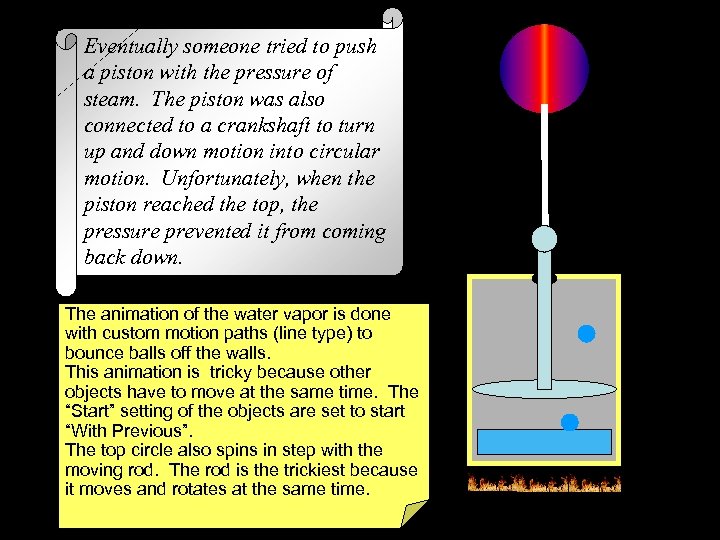 Eventually someone tried to push a piston with the pressure of steam. The piston was also connected to a crankshaft to turn up and down motion into circular motion. Unfortunately, when the piston reached the top, the pressure prevented it from coming back down. The animation of the water vapor is done with custom motion paths (line type) to bounce balls off the walls. This animation is tricky because other objects have to move at the same time. The “Start” setting of the objects are set to start “With Previous”. The top circle also spins in step with the moving rod. The rod is the trickiest because it moves and rotates at the same time.
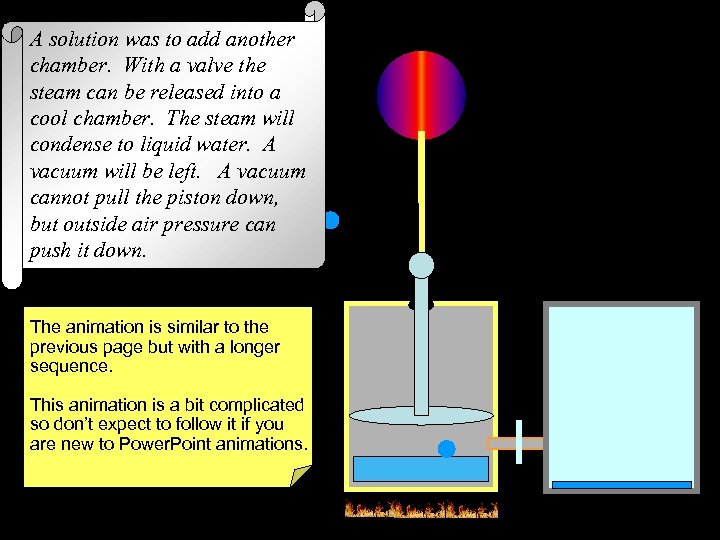 A solution was to add another chamber. With a valve the steam can be released into a cool chamber. The steam will condense to liquid water. A vacuum will be left. A vacuum cannot pull the piston down, but outside air pressure can push it down. The animation is similar to the previous page but with a longer sequence. This animation is a bit complicated so don’t expect to follow it if you are new to Power. Point animations.
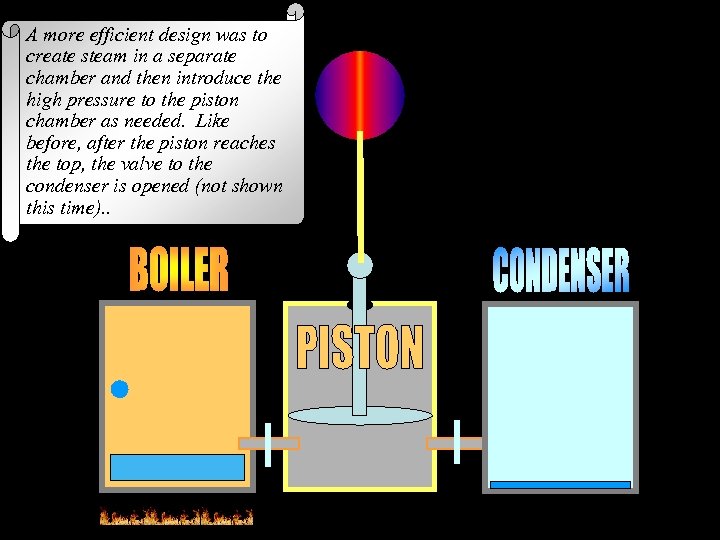 A more efficient design was to create steam in a separate chamber and then introduce the high pressure to the piston chamber as needed. Like before, after the piston reaches the top, the valve to the condenser is opened (not shown this time). .
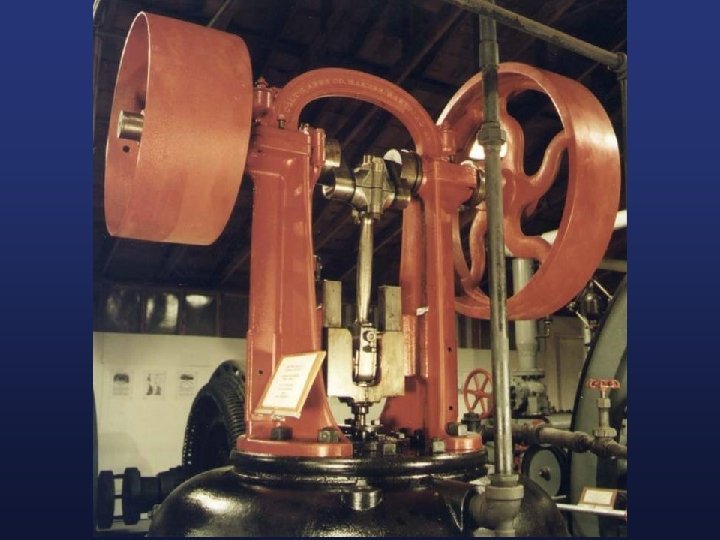
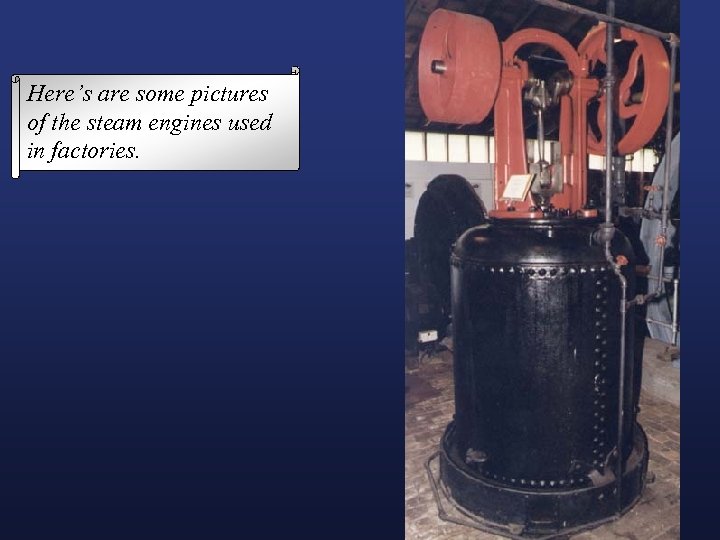 Here’s are some pictures of the steam engines used in factories.
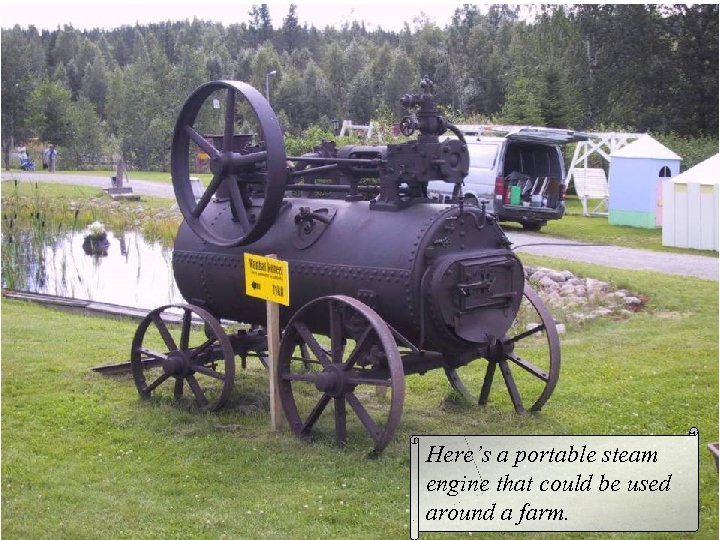 Here’s a portable steam engine that could be used around a farm.
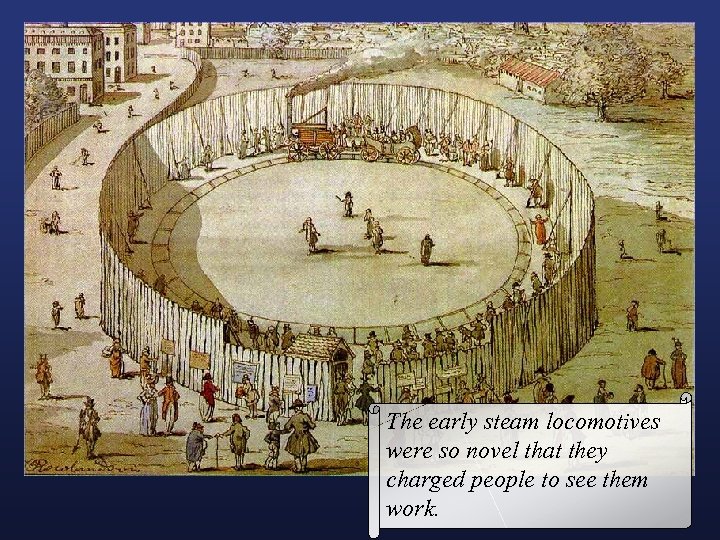 The early steam locomotives were so novel that they charged people to see them work.
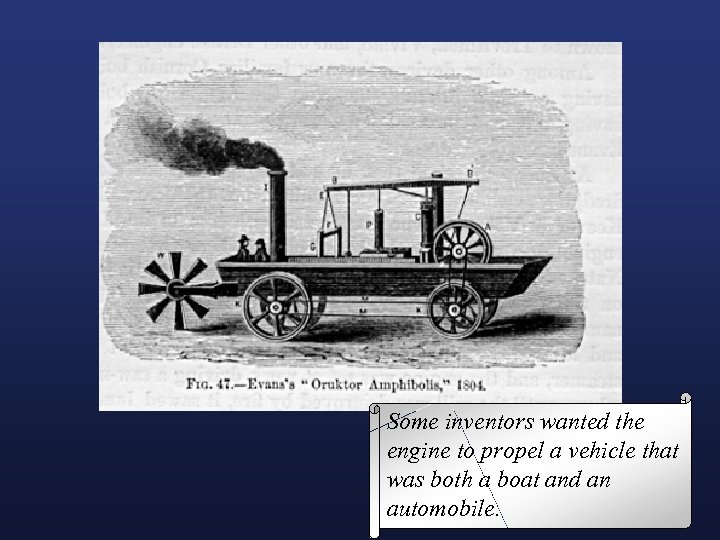 Some inventors wanted the engine to propel a vehicle that was both a boat and an automobile.
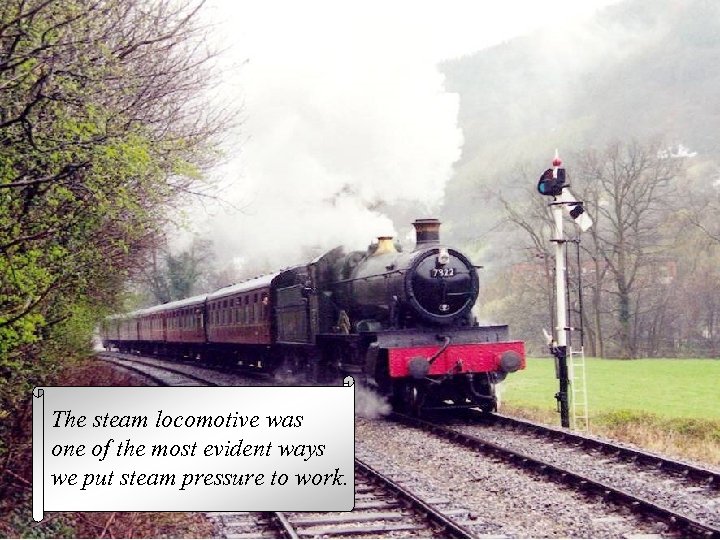 The steam locomotive was one of the most evident ways we put steam pressure to work.
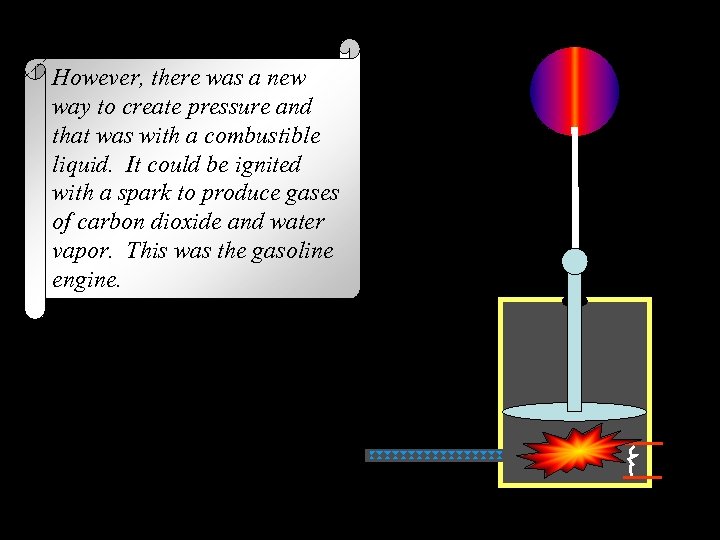 However, there was a new way to create pressure and that was with a combustible liquid. It could be ignited with a spark to produce gases of carbon dioxide and water vapor. This was the gasoline engine.
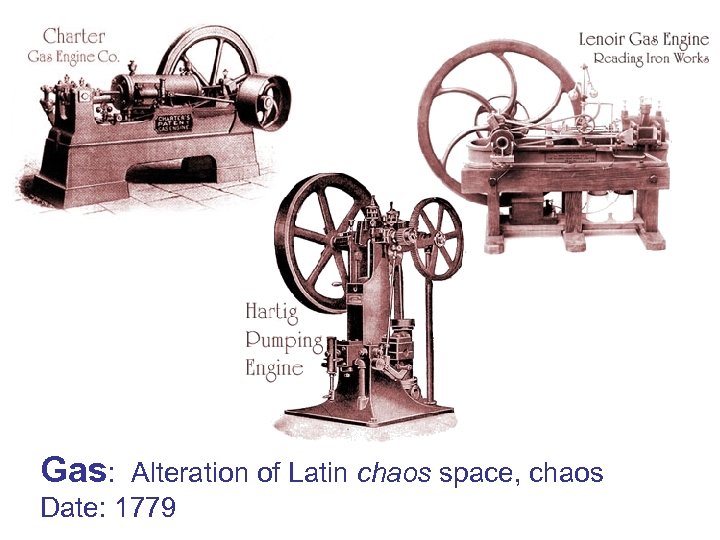 Gas: Alteration of Latin chaos space, chaos Date: 1779
 The gas engine is one of the wonders of the 19 th century. Now, within three years of the 20 th century, it is a novel machine, eagerly sought by many people. It is thought by persons who have not studied its principles that it is a steam-engine, using gas or gasoline as fuel for the purpose of making steam. This is erroneous. Gas and gasoline in specific proportion with air are explosive material.
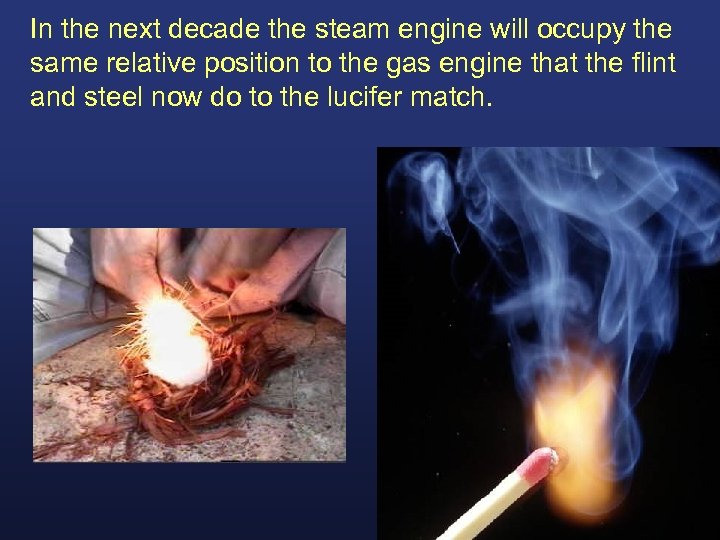 In the next decade the steam engine will occupy the same relative position to the gas engine that the flint and steel now do to the lucifer match.
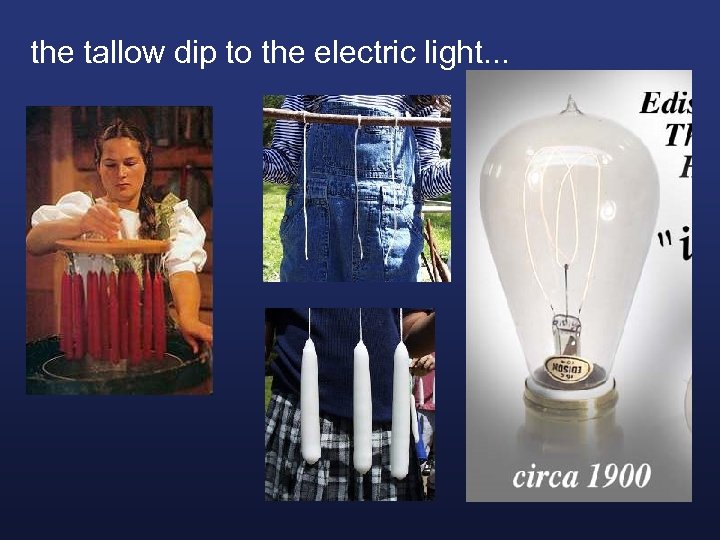 the tallow dip to the electric light. . .
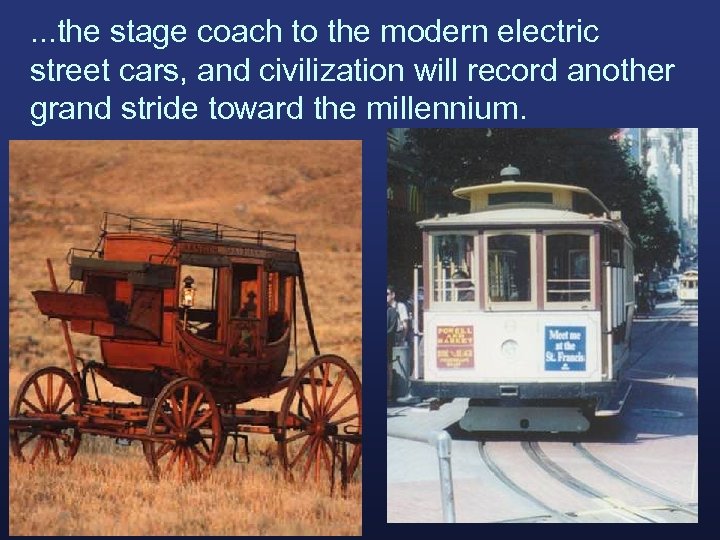 . . . the stage coach to the modern electric street cars, and civilization will record another grand stride toward the millennium.
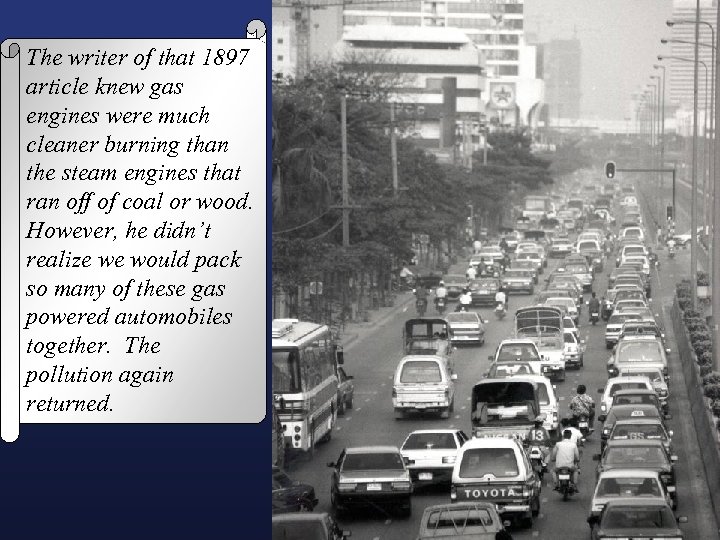 The writer of that 1897 article knew gas engines were much cleaner burning than the steam engines that ran off of coal or wood. However, he didn’t realize we would pack so many of these gas powered automobiles together. The pollution again returned.
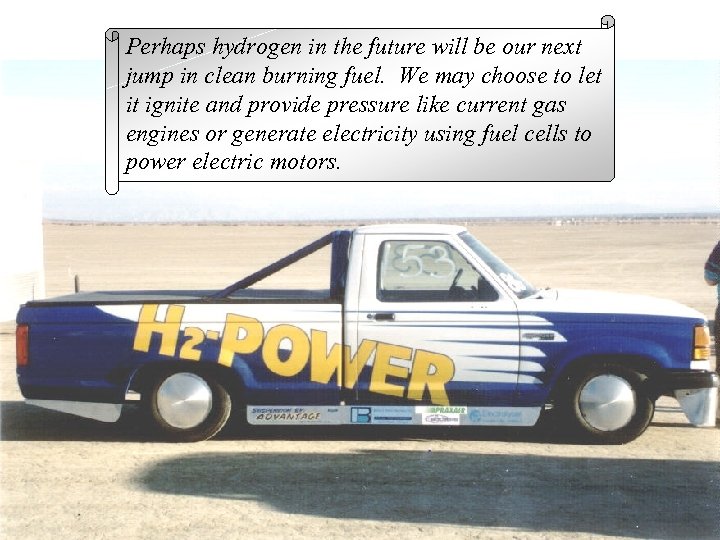 Perhaps hydrogen in the future will be our next jump in clean burning fuel. We may choose to let it ignite and provide pressure like current gas engines or generate electricity using fuel cells to power electric motors.
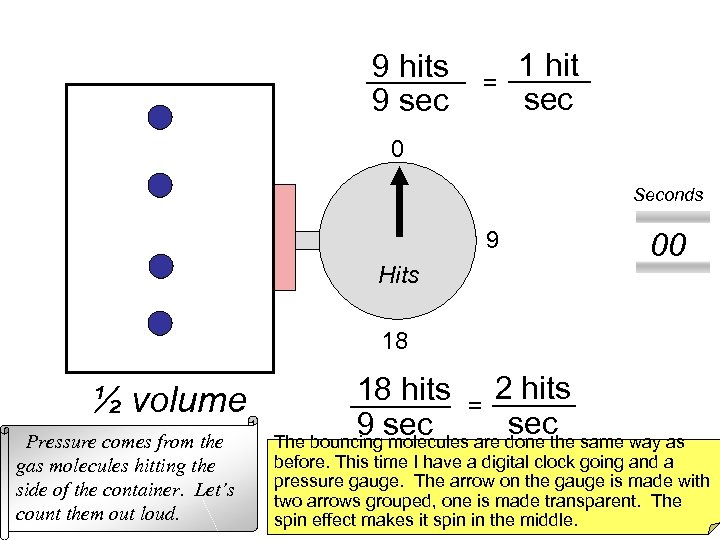 9 hits 9 sec = 1 hit sec 0 Seconds 9 00 Hits 01 02 18 03 18 hits = 2 hits 04 ½ volume sec 9 sec are done the same way as Pressure comes from the 05 The bouncing molecules before. This time I have a digital clock going and a gas molecules hitting the 06 pressure gauge. The arrow on the gauge is made with side of the container. Let’s two arrows grouped, one is made transparent. The count them out loud. 07 spin effect makes it spin in the middle.
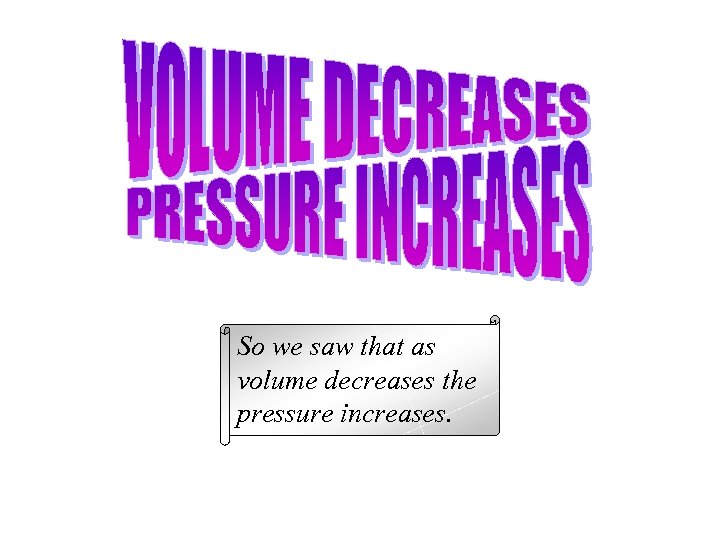 So we saw that as volume decreases the pressure increases.
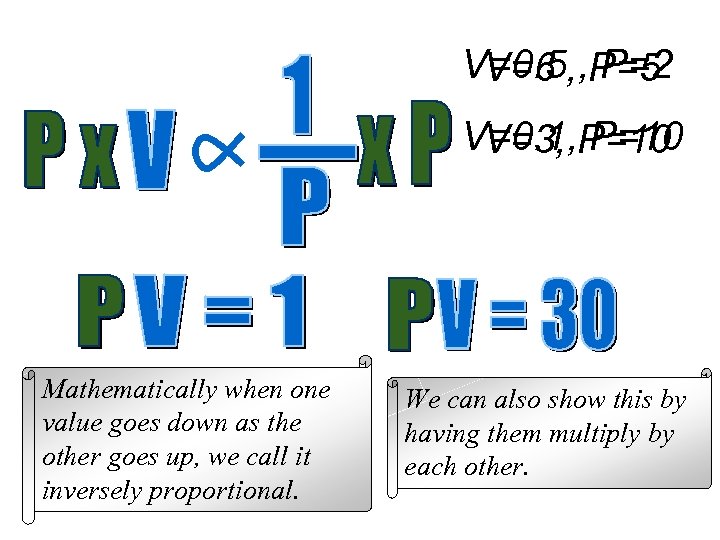 V=0. 5, , P=5 V=6 P=2 V=0. 1, P=10 V=3, P=10 Mathematically when one value goes down as the other goes up, we call it inversely proportional. We can also show this by having them multiply by each other.
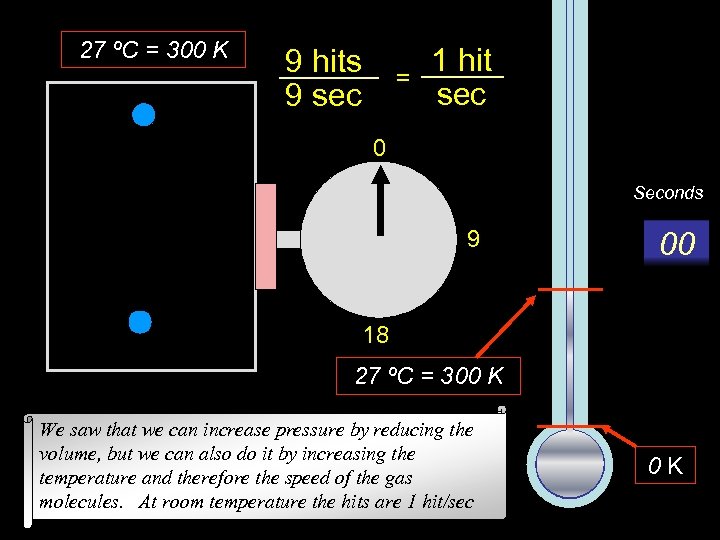 27 ºC = 300 K 9 hits 9 sec = 1 hit sec 0 Seconds 9 18 27 ºC = 300 K We saw that we can increase pressure by reducing the volume, but we can also do it by increasing the temperature and therefore the speed of the gas molecules. At room temperature the hits are 1 hit/sec 00 01 02 03 04 05 006 K 07
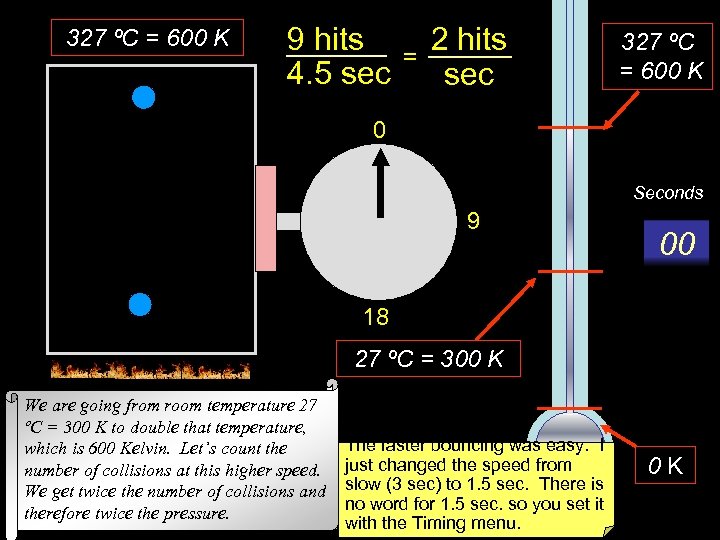 327 ºC = 600 K 9 hits 4. 5 sec = 2 hits sec 327 ºC = 600 K 0 Seconds 9 18 27 ºC = 300 K We are going from room temperature 27 ºC = 300 K to double that temperature, which is 600 Kelvin. Let’s count the number of collisions at this higher speed. We get twice the number of collisions and therefore twice the pressure. The faster bouncing was easy. I just changed the speed from slow (3 sec) to 1. 5 sec. There is no word for 1. 5 sec. so you set it with the Timing menu. 00 01 02 03 04 05 006 K 07
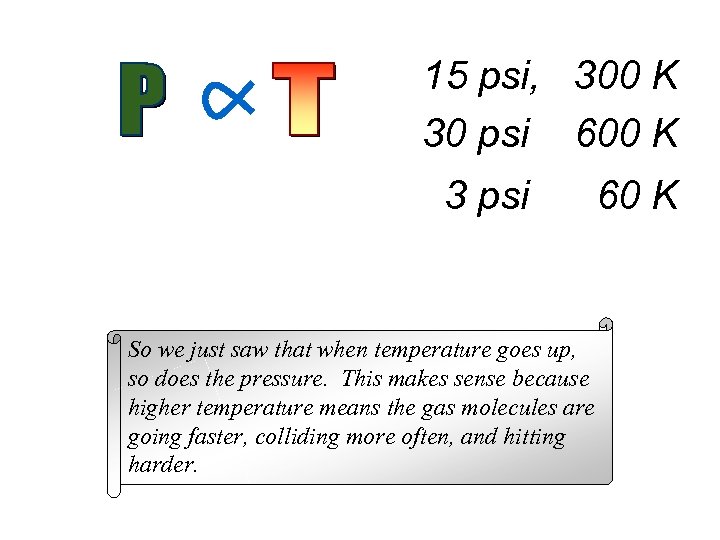 15 psi, 300 K 30 psi 600 K 3 psi So we just saw that when temperature goes up, so does the pressure. This makes sense because higher temperature means the gas molecules are going faster, colliding more often, and hitting harder. 60 K
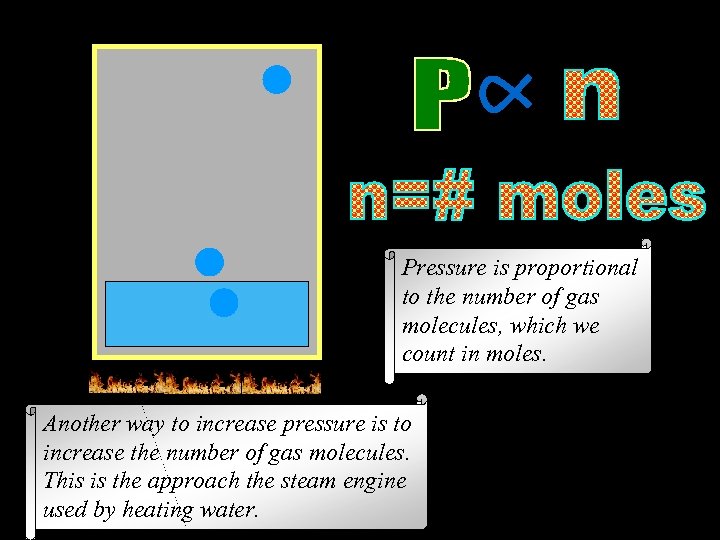 Pressure is proportional to the number of gas molecules, which we count in moles. Another way to increase pressure is to increase the number of gas molecules. This is the approach the steam engine used by heating water.
 This is also a safety problem. Any closed container that has liquid in and gets heated will likely increase pressure dramatically until the container bursts. This animation is a copy of the previous ones, but the sides of the container are separate lines that can be flown outward at the same time with an simultaneous explosion graphic (from Autoshapes). The sound is added with “Effect options…”
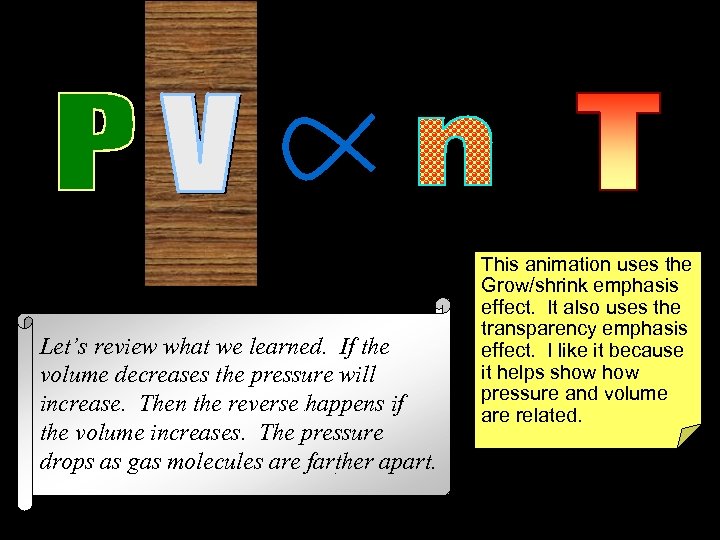 Let’s review what we learned. If the volume decreases the pressure will increase. Then the reverse happens if the volume increases. The pressure drops as gas molecules are farther apart. This animation uses the Grow/shrink emphasis effect. It also uses the transparency emphasis effect. I like it because it helps show pressure and volume are related.
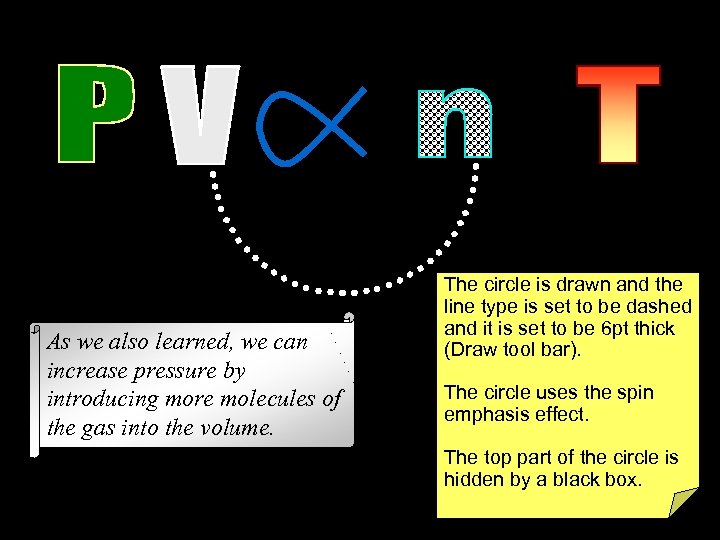 As we also learned, we can increase pressure by introducing more molecules of the gas into the volume. The circle is drawn and the line type is set to be dashed and it is set to be 6 pt thick (Draw tool bar). The circle uses the spin emphasis effect. The top part of the circle is hidden by a black box.
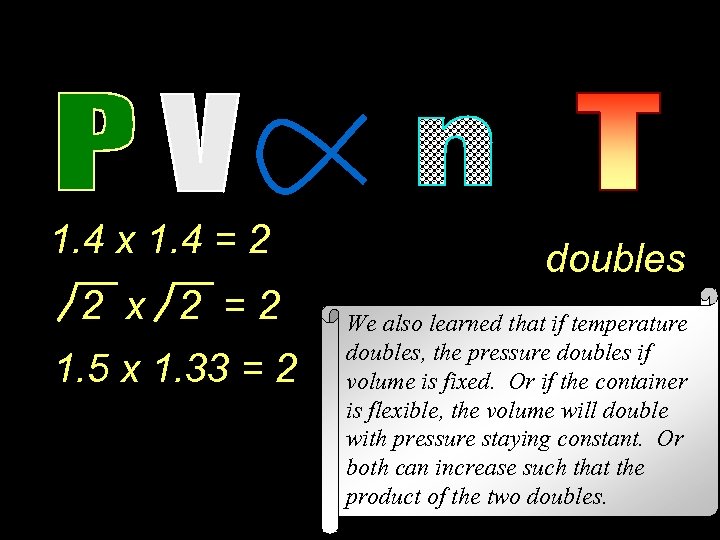 1. 4 x 1. 4 = 2 2 x 2 =2 1. 5 x 1. 33 = 2 doubles We also learned that if temperature doubles, the pressure doubles if volume is fixed. Or if the container is flexible, the volume will double with pressure staying constant. Or both can increase such that the product of the two doubles.
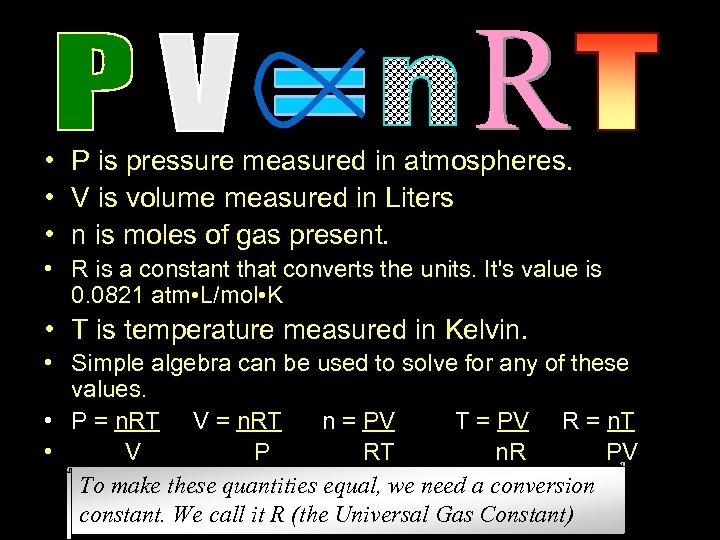 • P is pressure measured in atmospheres. • V is volume measured in Liters • n is moles of gas present. • R is a constant that converts the units. It's value is 0. 0821 atm • L/mol • K • T is temperature measured in Kelvin. • Simple algebra can be used to solve for any of these values. • P = n. RT V = n. RT n = PV T = PV R = n. T • V P RT n. R PV To make these quantities equal, we need a conversion constant. We call it R (the Universal Gas Constant)
 This is where I play an excerpt from the radio program “Car Talk. ” In the recording the Car Talk experts mentioned PV=n. RT when they were explaining why the pistons on someone’s hatchback wasn’t working in the winter.
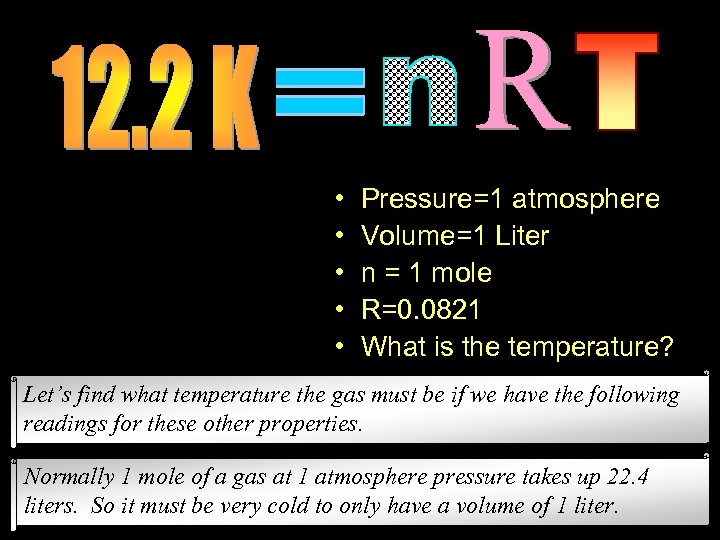 • • • Pressure=1 atmosphere Volume=1 Liter n = 1 mole R=0. 0821 What is the temperature? Let’s find what temperature the gas must be if we have the following readings for these other properties. Normally 1 mole of a gas at 1 atmosphere pressure takes up 22. 4 liters. So it must be very cold to only have a volume of 1 liter.
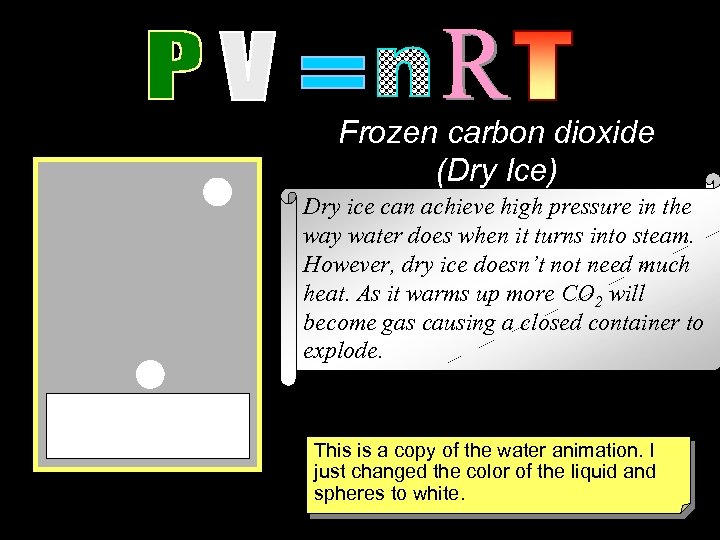 Frozen carbon dioxide (Dry Ice) Dry ice can achieve high pressure in the way water does when it turns into steam. However, dry ice doesn’t not need much heat. As it warms up more CO 2 will become gas causing a closed container to explode. This is a copy of the water animation. I just changed the color of the liquid and spheres to white.
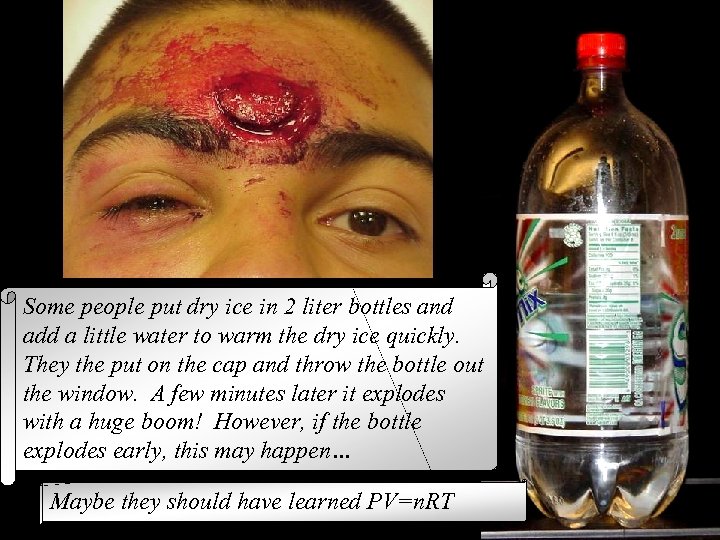 Some people put dry ice in 2 liter bottles and add a little water to warm the dry ice quickly. They the put on the cap and throw the bottle out the window. A few minutes later it explodes with a huge boom! However, if the bottle explodes early, this may happen… Maybe they should have learned PV=n. RT
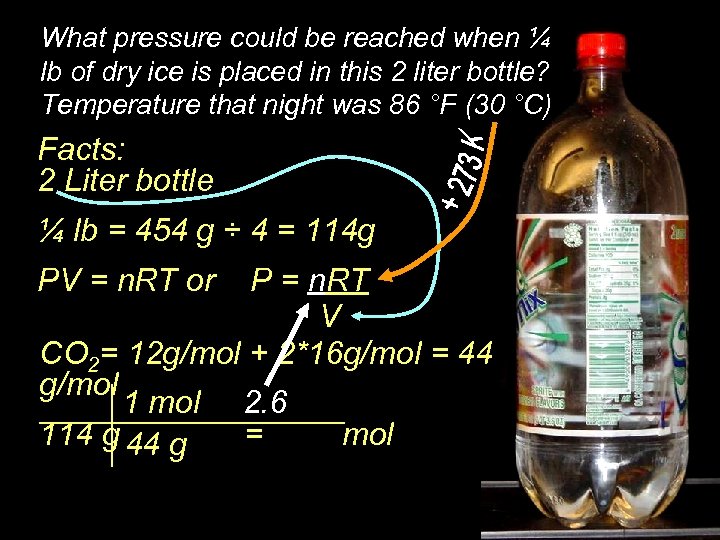 What pressure could be reached when ¼ lb of dry ice is placed in this 2 liter bottle? Temperature that night was 86 °F (30 °C) Facts: 2 Liter bottle ¼ lb = 454 g ÷ 4 = 114 g PV = n. RT or P = n. RT V CO 2= 12 g/mol + 2*16 g/mol = 44 g/mol 1 mol 2. 6 114 g 44 g = mol
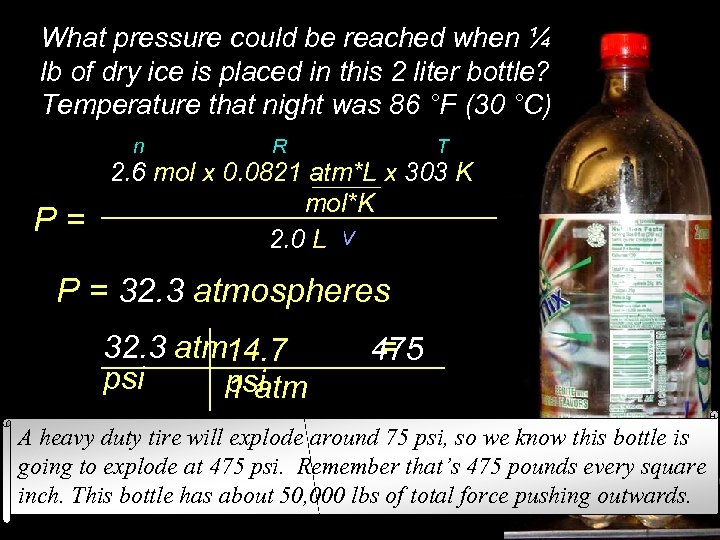 What pressure could be reached when ¼ lb of dry ice is placed in this 2 liter bottle? Temperature that night was 86 °F (30 °C) n P= R T 2. 6 mol x 0. 0821 atm*L x 303 K mol*K 2. 0 L V P = 32. 3 atmospheres 32. 3 atm 14. 7 psi 1 atm = 475 A heavy duty tire will explode around 75 psi, so we know this bottle is going to explode at 475 psi. Remember that’s 475 pounds every square inch. This bottle has about 50, 000 lbs of total force pushing outwards.
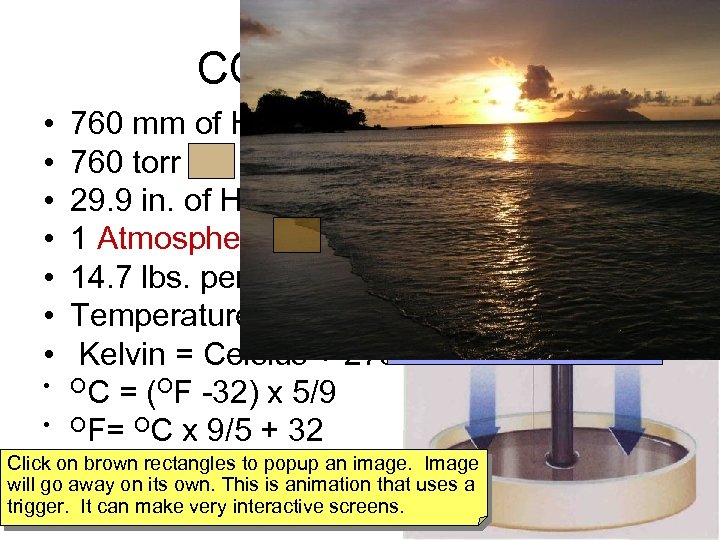 CONVERSIONS • • • 760 mm of Hg 760 torr All 29. 9 in. of Hg Equal 1 Atmosphere 14. 7 lbs. per sq. in. Temperature conversions: Kelvin = Celsius + 273 Evangelista Torricelli OC = (OF -32) x 5/9 OF= OC x 9/5 + 32 Click on brown rectangles to popup an image. Image will go away on its own. This is animation that uses a trigger. It can make very interactive screens.
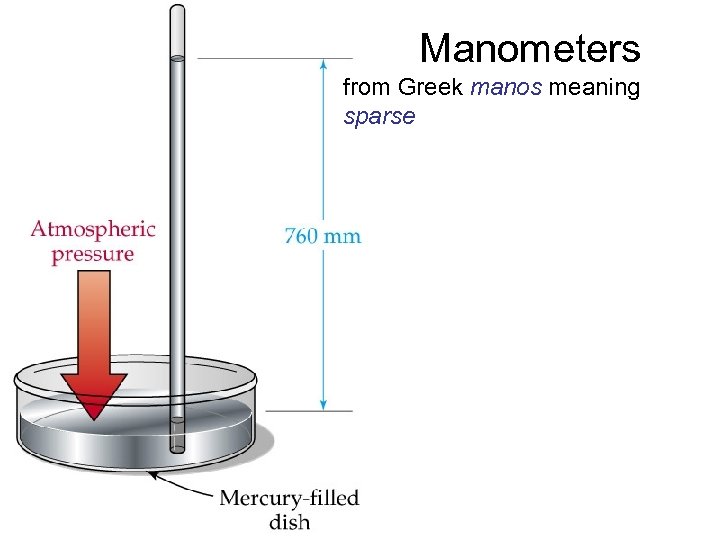 Manometers from Greek manos meaning sparse
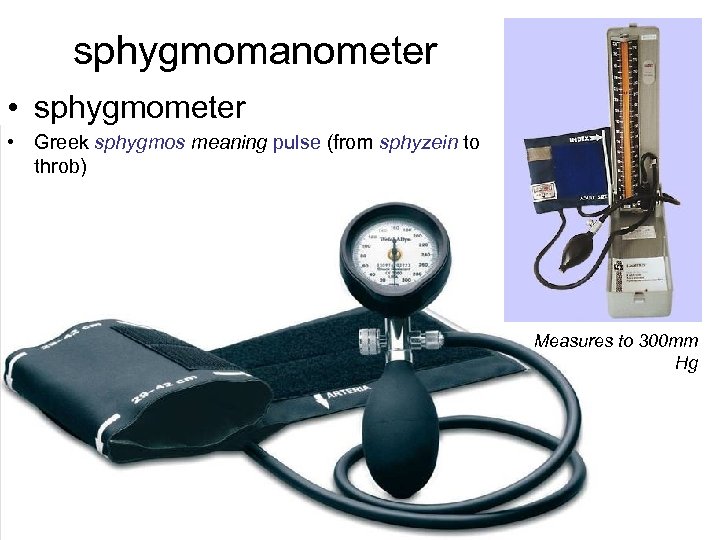 sphygmomanometer • sphygmometer • Greek sphygmos meaning pulse (from sphyzein to throb) Measures to 300 mm Hg
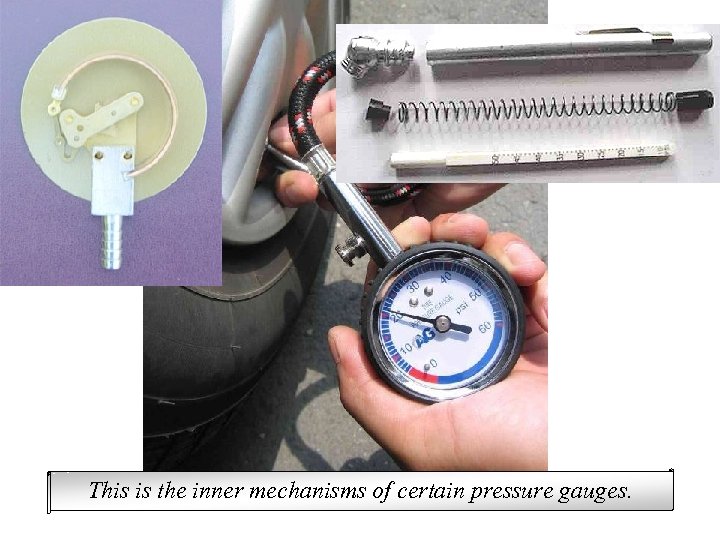 This is the inner mechanisms of certain pressure gauges.
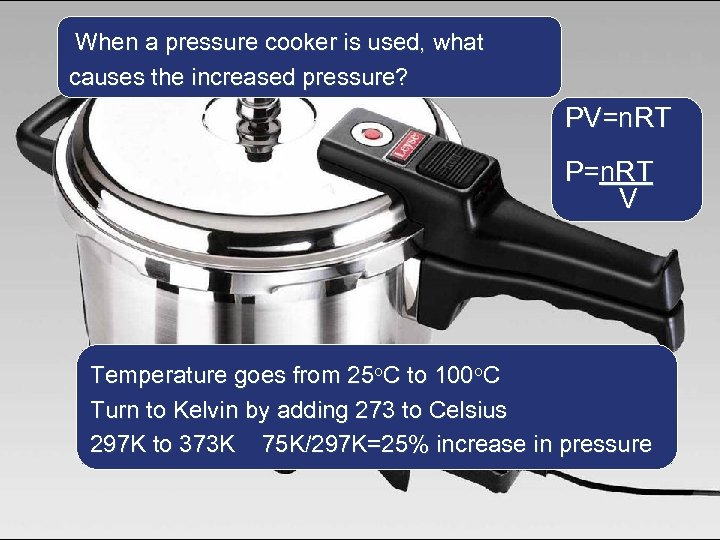 When a pressure cooker is used, what causes the increased pressure? PV=n. RT P=n. RT V Temperature goes from 25 o. C to 100 o. C Turn to Kelvin by adding 273 to Celsius 297 K to 373 K 75 K/297 K=25% increase in pressure
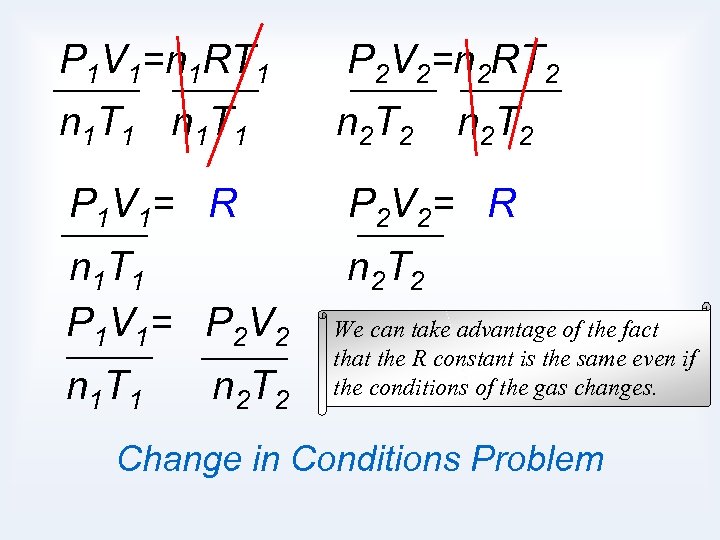 P 1 V 1=n 1 RT 1 P 2 V 2=n 2 RT 2 n 1 T 1 n 2 T 2 P 1 V 1= R P 2 V 2= R n 1 T 1 P 1 V 1= P 2 V 2 n 2 T 2 n 1 T 1 n 2 T 2 We can take advantage of the fact that the R constant is the same even if the conditions of the gas changes. Change in Conditions Problem
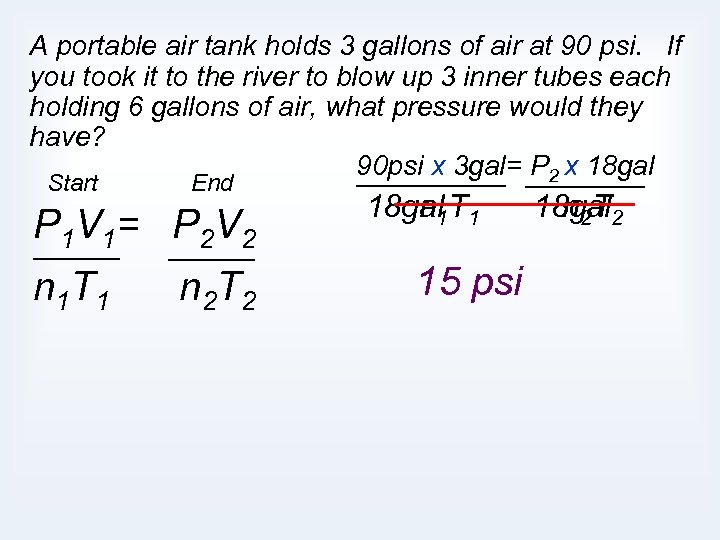 A portable air tank holds 3 gallons of air at 90 psi. If you took it to the river to blow up 3 inner tubes each holding 6 gallons of air, what pressure would they have? 90 psi x 3 gal= P 2 x 18 gal Start End P 1 V 1= P 2 V 2 n 1 T 1 n 2 T 2 18 gal T 1 n 1 15 psi 18 gal 2 n 2 T
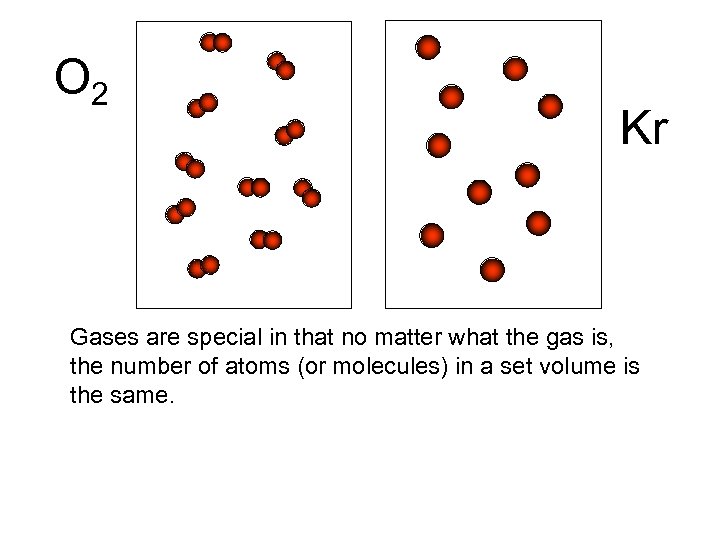 O 2 Kr Gases are special in that no matter what the gas is, the number of atoms (or molecules) in a set volume is the same.
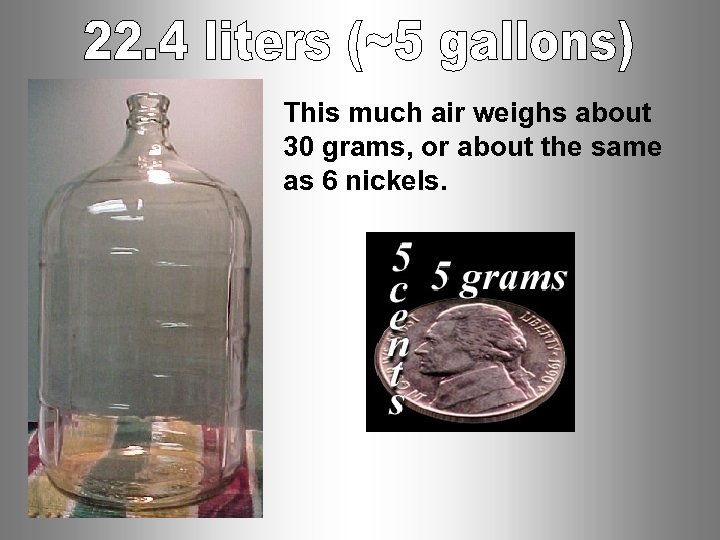 This much air weighs about 30 grams, or about the same as 6 nickels.
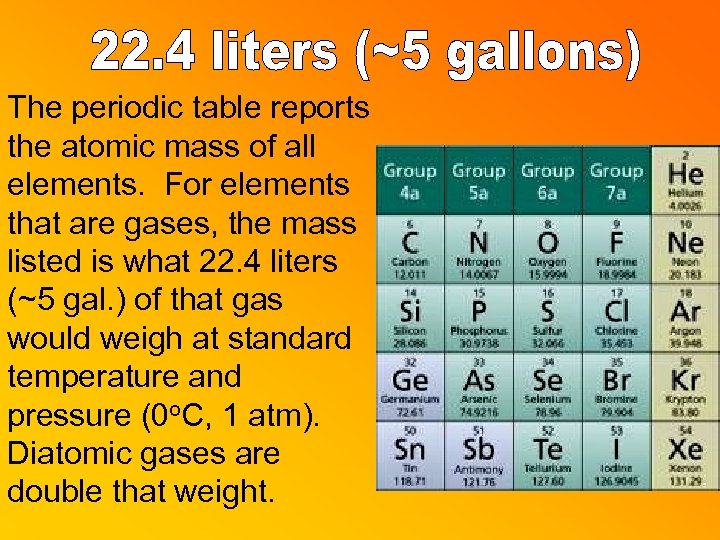 The periodic table reports the atomic mass of all elements. For elements that are gases, the mass listed is what 22. 4 liters (~5 gal. ) of that gas would weigh at standard temperature and pressure (0 o. C, 1 atm). Diatomic gases are double that weight.
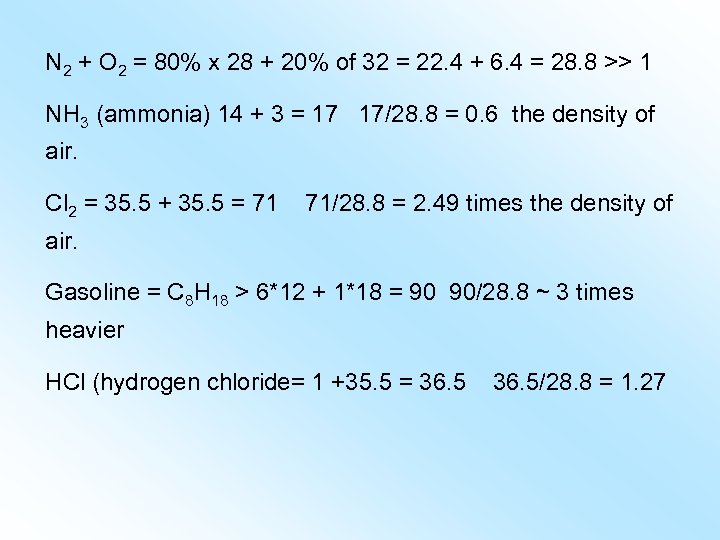 N 2 + O 2 = 80% x 28 + 20% of 32 = 22. 4 + 6. 4 = 28. 8 >> 1 NH 3 (ammonia) 14 + 3 = 17 17/28. 8 = 0. 6 the density of air. Cl 2 = 35. 5 + 35. 5 = 71 71/28. 8 = 2. 49 times the density of air. Gasoline = C 8 H 18 > 6*12 + 1*18 = 90 90/28. 8 ~ 3 times heavier HCl (hydrogen chloride= 1 +35. 5 = 36. 5/28. 8 = 1. 27
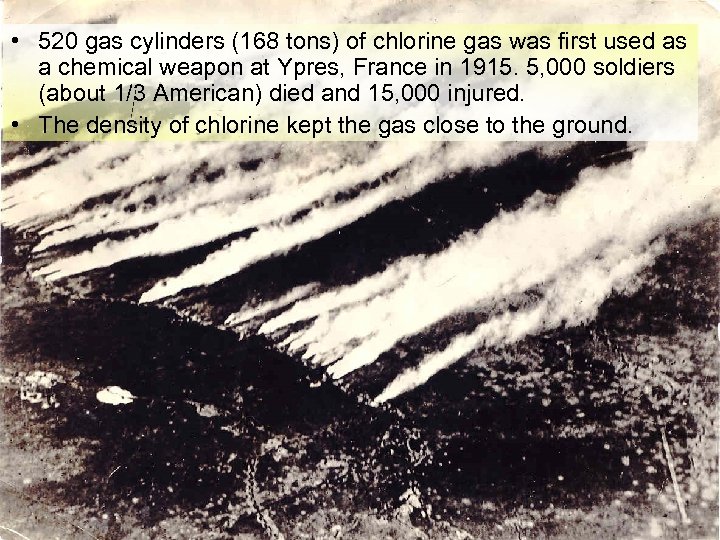 • 520 gas cylinders (168 tons) of chlorine gas was first used as a chemical weapon at Ypres, France in 1915. 5, 000 soldiers (about 1/3 American) died and 15, 000 injured. • The density of chlorine kept the gas close to the ground.
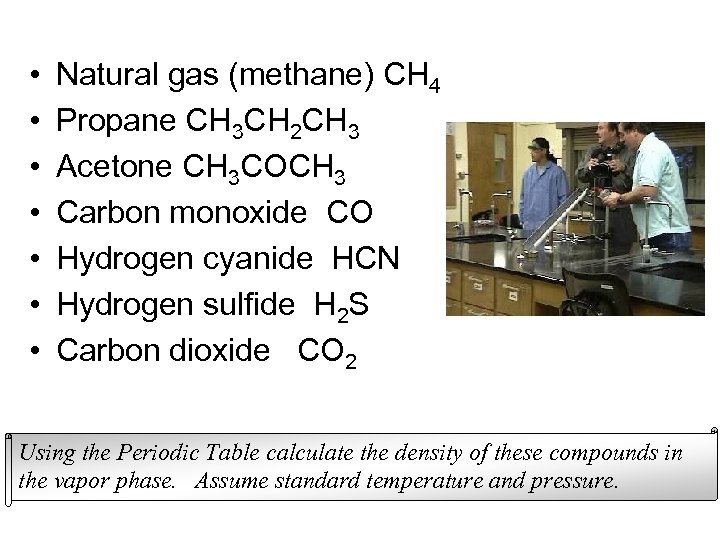 • • Natural gas (methane) CH 4 Propane CH 3 CH 2 CH 3 Acetone CH 3 COCH 3 Carbon monoxide CO Hydrogen cyanide HCN Hydrogen sulfide H 2 S Carbon dioxide CO 2 Using the Periodic Table calculate the density of these compounds in the vapor phase. Assume standard temperature and pressure.
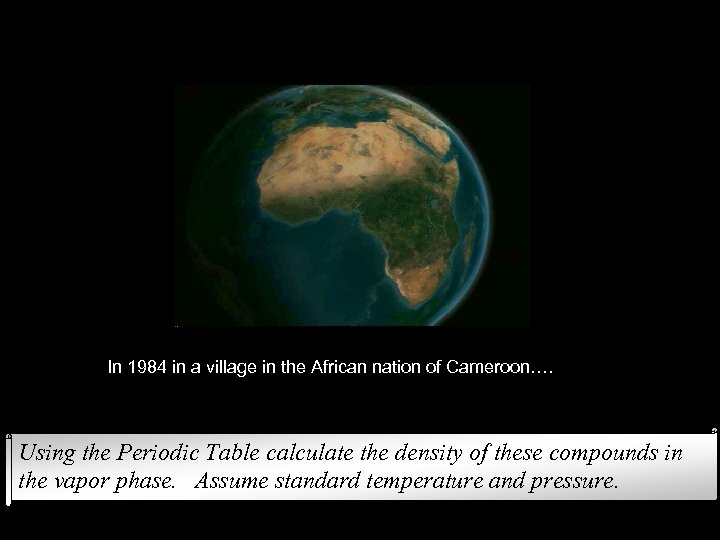 In 1984 in a village in the African nation of Cameroon…. Using the Periodic Table calculate the density of these compounds in the vapor phase. Assume standard temperature and pressure.
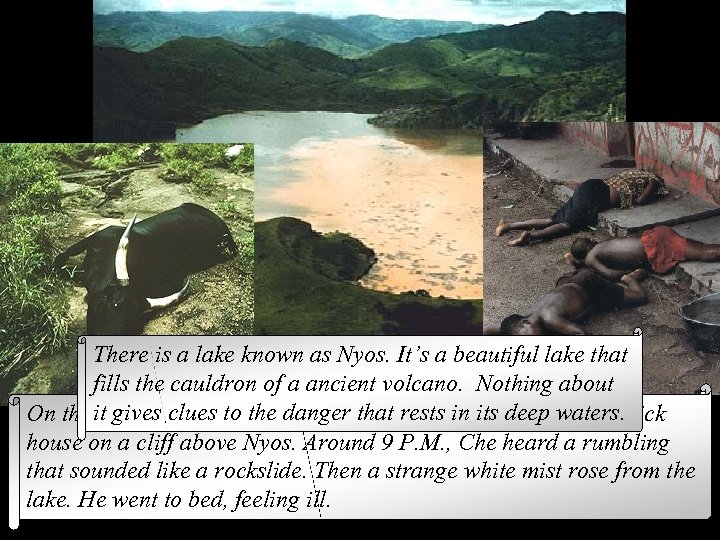 There is a lake known as Nyos. It’s a beautiful lake that fills the cauldron of a ancient volcano. Nothing about On the it gives cluesapocalypse, Ephriam Che wasdeep waters. night of the to the danger that rests in its in his mud brick house on a cliff above Nyos. Around 9 P. M. , Che heard a rumbling that sounded like a rockslide. Then a strange white mist rose from the lake. He went to bed, feeling ill.
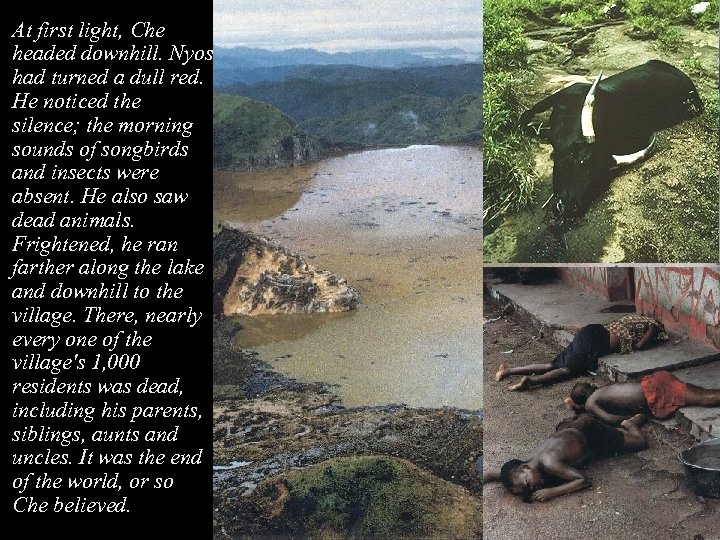 At first light, Che headed downhill. Nyos had turned a dull red. He noticed the silence; the morning sounds of songbirds and insects were absent. He also saw dead animals. Frightened, he ran farther along the lake and downhill to the village. There, nearly every one of the village's 1, 000 residents was dead, including his parents, siblings, aunts and uncles. It was the end of the world, or so Che believed.
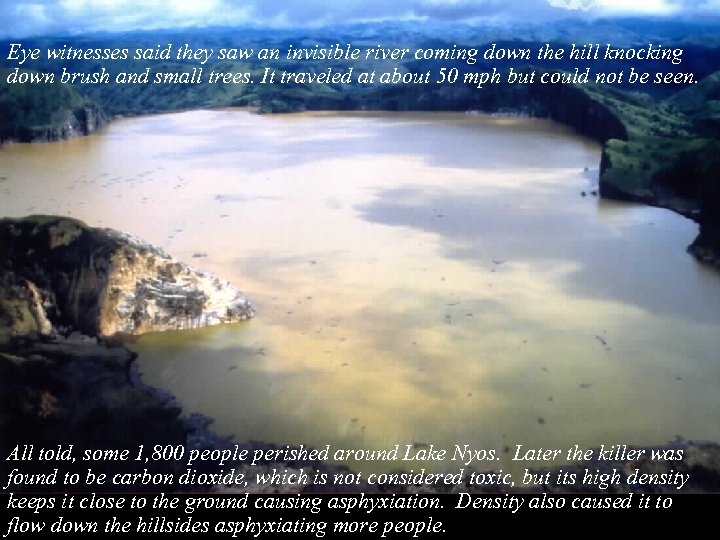 Eye witnesses said they saw an invisible river coming down the hill knocking down brush and small trees. It traveled at about 50 mph but could not be seen. All told, some 1, 800 people perished around Lake Nyos. Later the killer was found to be carbon dioxide, which is not considered toxic, but its high density keeps it close to the ground causing asphyxiation. Density also caused it to flow down the hillsides asphyxiating more people.
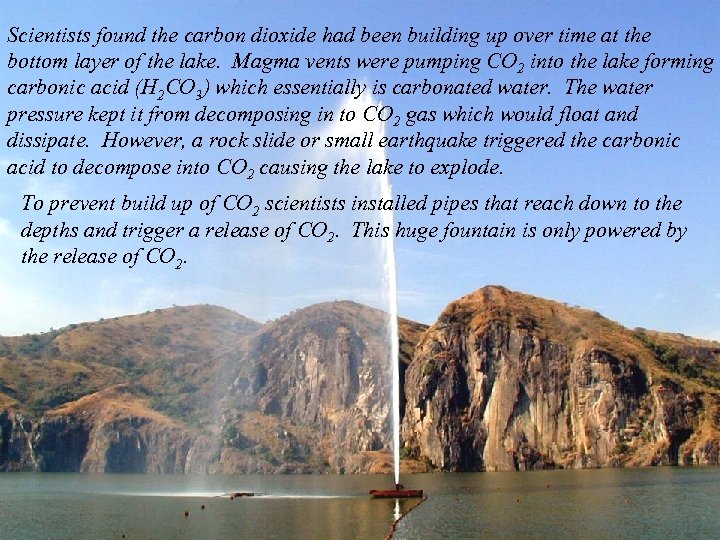 Scientists found the carbon dioxide had been building up over time at the bottom layer of the lake. Magma vents were pumping CO 2 into the lake forming carbonic acid (H 2 CO 3) which essentially is carbonated water. The water pressure kept it from decomposing in to CO 2 gas which would float and dissipate. However, a rock slide or small earthquake triggered the carbonic acid to decompose into CO 2 causing the lake to explode. To prevent build up of CO 2 scientists installed pipes that reach down to the depths and trigger a release of CO 2. This huge fountain is only powered by the release of CO 2.
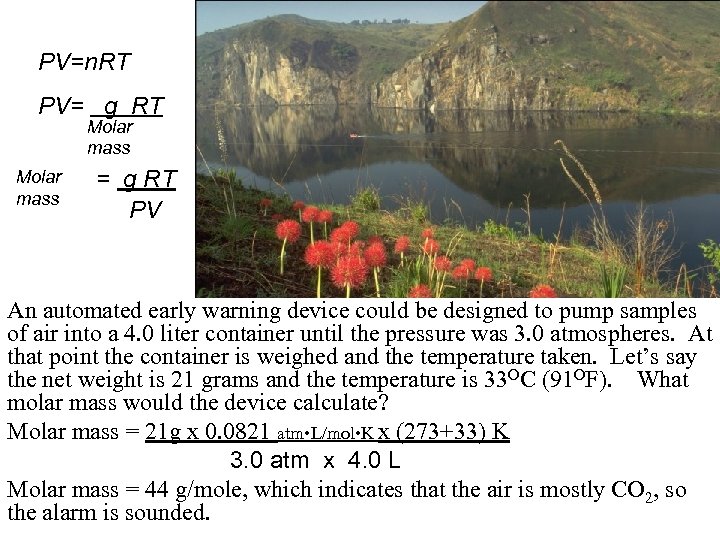 PV=n. RT PV= g RT Molar mass = g RT PV An automated early warning device could be designed to pump samples of air into a 4. 0 liter container until the pressure was 3. 0 atmospheres. At that point the container is weighed and the temperature taken. Let’s say the net weight is 21 grams and the temperature is 33 OC (91 OF). What molar mass would the device calculate? Molar mass = 21 g x 0. 0821 atm • L/mol • K x (273+33) K 3. 0 atm x 4. 0 L Molar mass = 44 g/mole, which indicates that the air is mostly CO 2, so the alarm is sounded.
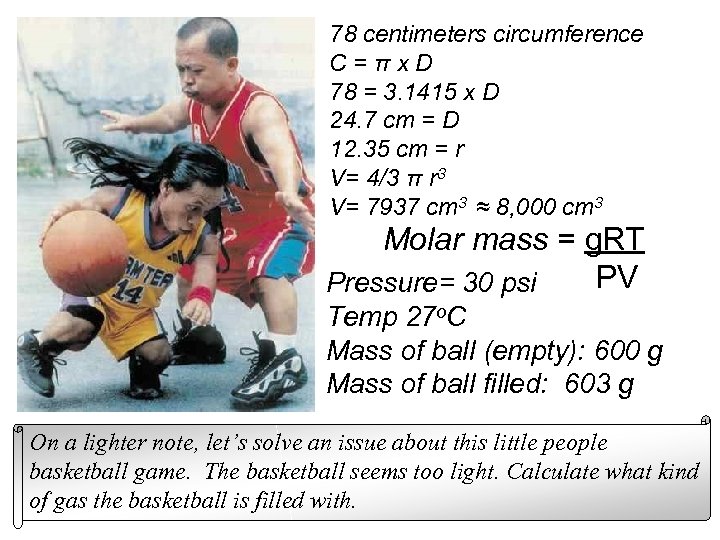 78 centimeters circumference C=πx. D 78 = 3. 1415 x D 24. 7 cm = D 12. 35 cm = r V= 4/3 π r 3 V= 7937 cm 3 ≈ 8, 000 cm 3 Molar mass = g. RT PV Pressure= 30 psi Temp 27 o. C Mass of ball (empty): 600 g Mass of ball filled: 603 g On a lighter note, let’s solve an issue about this little people basketball game. The basketball seems too light. Calculate what kind of gas the basketball is filled with.