 Скачать презентацию Installation of Treasury Functions in The Kyrgyz Republic
e1084f5604503b799facb440783459cc.ppt
- Количество слайдов: 14



Installation of Treasury Functions in The Kyrgyz Republic A Retrospective Kyrgyz Treasury
Kyrgyz Ministry of Finance: Budget execution arrangements prior to 1994 Systems inherited from the Former Soviet Union • Limited treasury services delivered by the Budget, Sectors, and Accounts Departments, and the Central Bank. • Government payment functions discharged using thousands of bank accounts. • No in-year fiscal reports except from the central bank which reported on revenues, and aggregate transfers to line ministries bank accounts. • Unreliable and much delayed annual financial accounts. • Non-transparent process governing use of public funds. • The systems did not promote tracking of expenditure arrears, cash planning, and reconciliation of accounts with bank balances Kyrgyz Treasury 2
Establishing Kyrgyz Treasury in 1994: Retrospective (1) Following factors contributed to successful installation of the Kyrgyz Treasury: • Exceptional level of political commitment to reform initiatives. • Effective leadership at the MOF and willingness to effect fundamental systemic changes to install the treasury. • Focused technical assistance, and its unquestioned acceptance. • Mobilization of skilled staff from wherever available and intensive hands-on training of field treasury staff. • High level of coordination and cooperation between the budget and treasury directorates. • Staying focussed on basic treasury operations, leaving ambitious IT plans for a later phase. Kyrgyz Treasury 3
Kyrgyz Treasury: Retrospective (2) The Kyrgyz Treasury model has been successfully adopted in Azerbaijan, Armenia, Turkmenistan (partly), and Tajikistan (partly) Key elements of the model are presently being implemented in Georgia. Essential approach adopted in the Kyrgyz Republic was: • Overhaul the inherited legal, institutional, and systemic framework before embarking upon full scale treasury functions. • Resist the temptation to computerize legacy systems. • Give priority to establishing core treasury services of consolidation of cash resources into TSA, payment system, classification structures, a simple reporting system, and government accounts based on TGL. • Generate annual government accounts from TGL, and reconcile these with parallel records built from the accounts rendered by the line ministries. Kyrgyz Treasury 4
Kyrgyz Treasury Overview: Strengths (1) Efficient operation in manual mode despite limited IT resources Fastest off the track among EITs: Basic functionality realized within one year during 1994 comprising: • Robust legal framework—Treasury Law • Central Treasury with 62 regional treasury offices (RTO) established within 6 months. • Modestly staffed with 435 staff • Unification of (most) of cash resources—budgetary, extrabudgetary, and foreign currency— of central and local governments into a shared TSA • GFSM 1986 compliant classification system installed by January 1995. Kyrgyz Treasury 5
Kyrgyz Treasury Overview: Strengths (2) • Centralized payment service for all central and local government budget instituions (BI) • All central and subnational revenues pass through the treasury • Shared taxes distributed daily at the RTOs • Budgetary and extrabudgetary expenditures of BI pass through the treasury • Centralized Treasury General Ledger (TGL) with subledgers at RTOs The treasury, as installed, remained operational without further outside help. Kyrgyz Treasury 6
Kyrgyz Treasury Overview: Weaknesses (1) A review conducted in 2002 found that lack of contemporary IT resources and frequent turnover of skilled treasury staff have stunted advanced treasury functions: • Timely fiscal reports of acceptable data quality • Effective control over expenditure commtiments and payment arrears • Effective control over TSA balances and cash management in real time • Short- and Medium-term cash flow forecasts—cash plans • GFSM 2001 based classification structures and chart of accounts to enable accrual-based reports on fiscal operations Kyrgyz Treasury 7
Kyrgyz Treasury Overview: Weaknesses (2) Some operational weaknesses in basic treasury functions have surfaced: • Absence of cash planning has led to day budget allocations and cash provisioning. • Some dergadations have surfaced: Ø Some BIs keep extrabudgetary resources outside treasury purview Ø Undesirable offset operations—akin to barter deals— have been allowed Ø Some government bank accounts continue to be operational outside the TSA Kyrgyz Treasury 8
Kyrgyz Treasury: Next Steps (1) Objectives of Computerized Treasury Information Management System (TIMS) Project. • Automation of bank and payment operations. Ø Central Treasury (CT) will have direct access to TSA, membership of RTGS, and SWIFT access code. The RTOs will participate in NACH through CT. Ø Direct payments into supplier’s bank accounts by RTO through NACH. The role of agency banks will be reduced to cash disbursements. Ø Direct daily settlment between RTO and TSA for transactions routed through agency banks. Ø Elimination of paper flow, except between BI and RTO. Ø Direct credit of revenues from taxpayer bank into TSA with parallel electronic information to TIMS. Ø Automatic sharing of revenues between governments by TIMS. Kyrgyz Treasury 9
Kyrgyz Treasury: Next Steps (2) • Full registration of expenditure commitments and automated reports on payment arrears. • Sophisticated module forecasting short- and medium-term cash flows—cash planning. • Prioritizing payments due based on cash plans. • A single TGL in the system operated in real time by the CT and RTOs, eliminating inter-treasury settlement operations. This will, for example, permit central treasury to directly credit budget allocations and cash limits into the ledger account of each BI. • The new Co. A for the TGL will be GFSM 2001 compliant. • The Co. A will be underpinned by relational data base and will record all dimensions of a transaction. • Full range of management reports • Automation of accounts keeping in real time. Kyrgyz Treasury 10
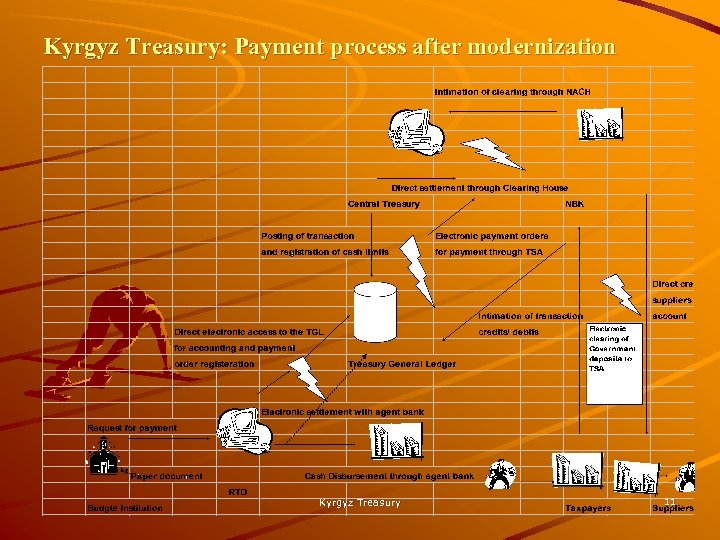
Kyrgyz Treasury: Payment process after modernization Kyrgyz Treasury 11
Kyrgyz Treasury: Modernization Plan Being funded by the World Bank Close cooperation between Fund and the Bank Project time span: 3 -4 years Estimates of cost: about US$8 million Kyrgyz Treasury 12
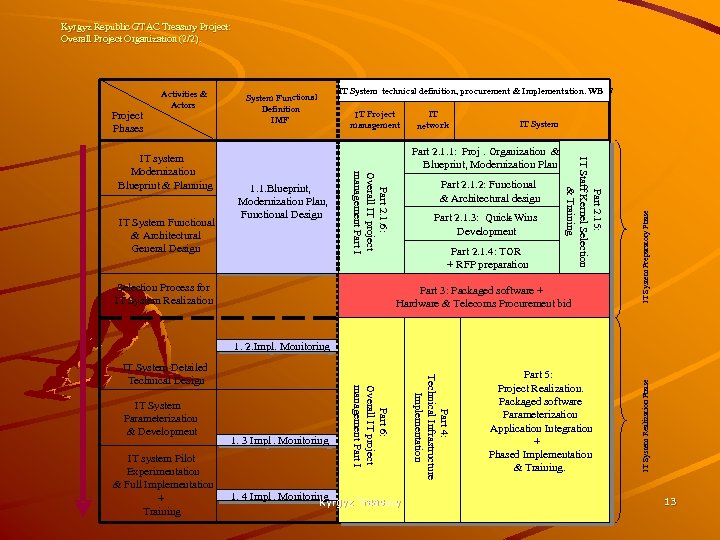
Kyrgyz Republic GTAC Treasury Project: Overall Project Organization (2/2). IT Project management Selection Process for IT System Realization IT network IT System Part 2. 1. 1: Proj. . Organization & Part 2. 1. 1: Proj Organization & Blueprint, Modernization Plan Part 2. 1. 2: Functional & Architectural design Part 2. 1. 3: Quick -Wins Part 2. 1. 3: Quick Development Part 2. 1. 4: TOR + RFP preparation Part 2. 15: IT Staff Kernel Selection & Training IT System Functional & Architectural General Design 1. 1. Blueprint, Modernization Plan, Functional Design IT System technical definition, procurement & Implementation. WB W IT System technical definition, procurement & Implementation. B Part 2. 1. 6: Overall IT project management Part II IT system Modernization Blueprint & Planning System Functional Definition IMF Part 3: Packaged software + Hardware & Telecoms Procurement bid IT System Preparatory Phase Project Phases Activities & Actors IT system Pilot Experimentation & Full Implementation + Training 1. 33 Impl. . Monitoring 1. Impl Monitoring 1. 44 Impl. . Monitoring 1. Impl Monitoring Kyrgyz Treasury Part 4: Technical Infrastructure Implementation IT System Parameterization & Development Part 6: Overall IT project management Part II IT System Detailed Technical Design Part 5: Project Realization. Packaged software Parameterization Application Integration + + Phased Implementation & Training. IT System Realization Phase 1. 2. Impl. Monitoring 13

Kyrgyz Treasury 14
Скачать презентацию Installation of Treasury Functions in The Kyrgyz Republic
e1084f5604503b799facb440783459cc.ppt