 Скачать презентацию inst eecs berkeley edu cs 61 c CS 61
0b96171038b3514b4abb60f3c3ac9107.ppt
- Количество слайдов: 24



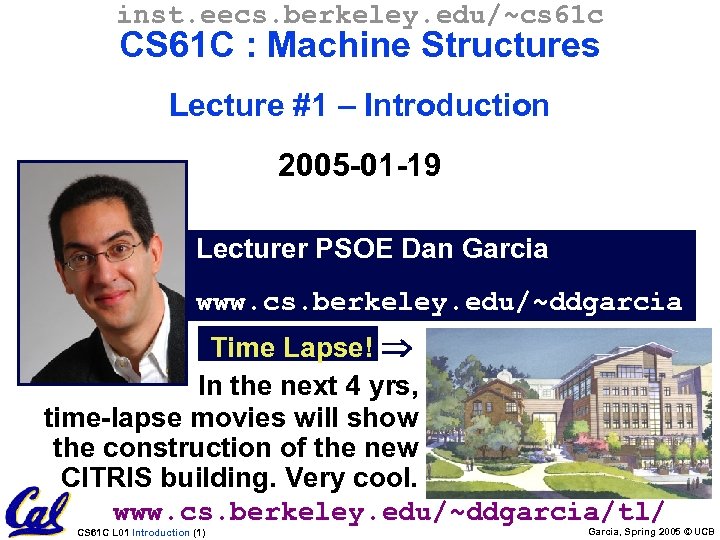
inst. eecs. berkeley. edu/~cs 61 c CS 61 C : Machine Structures Lecture #1 – Introduction 2005 -01 -19 Lecturer PSOE Dan Garcia www. cs. berkeley. edu/~ddgarcia Time Lapse! In the next 4 yrs, time-lapse movies will show the construction of the new CITRIS building. Very cool. www. cs. berkeley. edu/~ddgarcia/tl/ CS 61 C L 01 Introduction (1) Garcia, Spring 2005 © UCB
![Teaching Assistants ° Andy Carle [Head TA] ° Steven Kusalo ° Danny Krause °](https://present5.com/presentation/0b96171038b3514b4abb60f3c3ac9107/image-2.jpg "Teaching Assistants ° Andy Carle [Head TA] ° Steven Kusalo ° Danny Krause °")
Teaching Assistants ° Andy Carle [Head TA] ° Steven Kusalo ° Danny Krause ° Casey Ho CS 61 C L 01 Introduction (2) Garcia, Spring 2005 © UCB
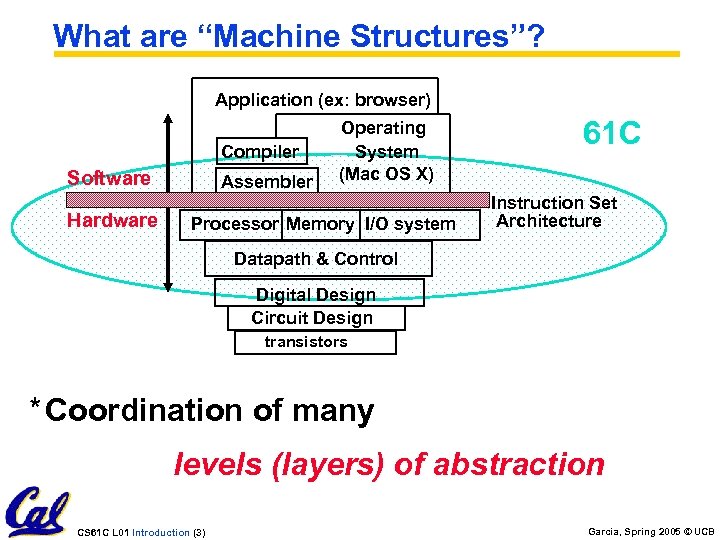
What are “Machine Structures”? Application (ex: browser) Compiler Software Hardware Assembler Operating System (Mac OS X) Processor Memory I/O system 61 C Instruction Set Architecture Datapath & Control Digital Design Circuit Design transistors * Coordination of many levels (layers) of abstraction CS 61 C L 01 Introduction (3) Garcia, Spring 2005 © UCB
![61 C Levels of Representation temp = v[k]; v[k] = v[k+1]; v[k+1] = temp;](https://present5.com/presentation/0b96171038b3514b4abb60f3c3ac9107/image-4.jpg "61 C Levels of Representation temp = v[k]; v[k] = v[k+1]; v[k+1] = temp;")
61 C Levels of Representation temp = v[k]; v[k] = v[k+1]; v[k+1] = temp; High Level Language Program (e. g. , C) Compiler Assembly Language Program (e. g. , MIPS) Assembler Machine Language Program (MIPS) Machine Interpretation lw lw sw sw 0000 1010 1100 0101 Hardware Architecture Description (e. g. , Verilog Language) Architecture Implementation Logic Circuit Description (Verilog Language) CS 61 C L 01 Introduction (4) $t 0, 0($2) $t 1, 4($2) $t 1, 0($2) $t 0, 4($2) 1001 1111 0110 1000 1100 0101 1010 0000 0110 1000 1111 1001 1010 0000 0101 1100 1111 1000 0110 0101 1100 0000 1010 1000 0110 1001 1111 wire [31: 0] data. Bus; reg. File registers (databus); ALUBlock (in. A, in. B, databus); wire w 0; XOR (w 0, a, b); AND (s, w 0, a); Garcia, Spring 2005 © UCB
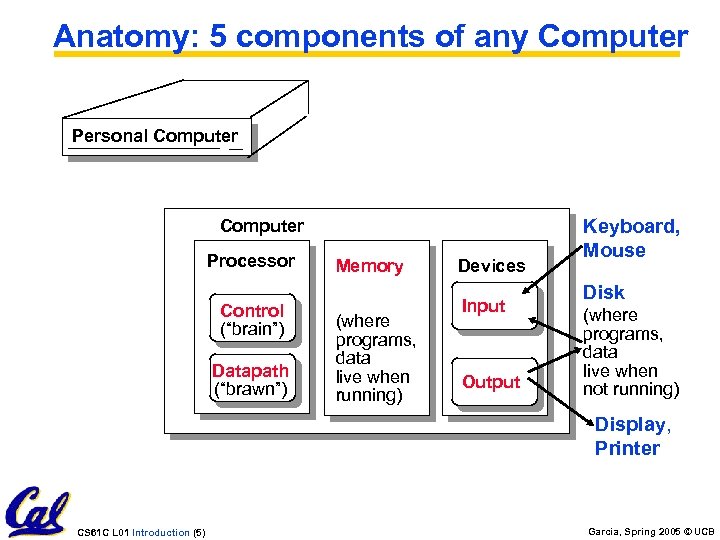
Anatomy: 5 components of any Computer Personal Computer Processor Control (“brain”) Datapath (“brawn”) Memory (where programs, data live when running) Devices Input Output Keyboard, Mouse Disk (where programs, data live when not running) Display, Printer CS 61 C L 01 Introduction (5) Garcia, Spring 2005 © UCB
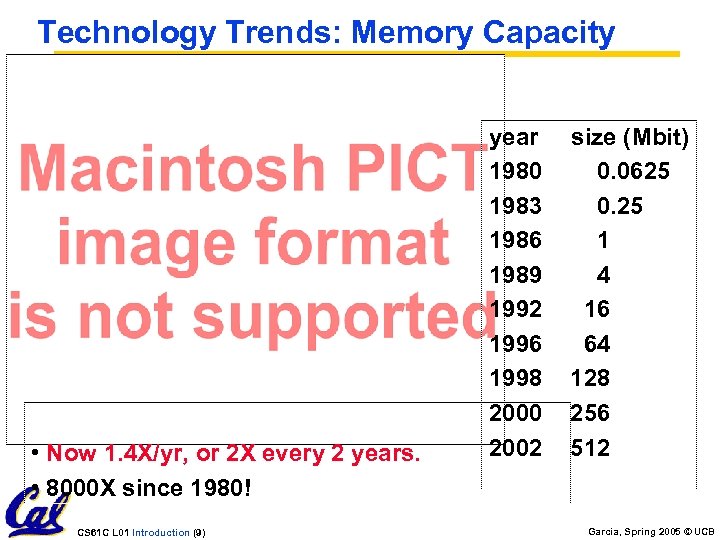
Technology Trends: Memory Capacity (Single-Chip DRAM) • Now 1. 4 X/yr, or 2 X every 2 years. • 8000 X since 1980! CS 61 C L 01 Introduction (9) year 1980 1983 1986 1989 1992 1996 1998 2000 2002 size (Mbit) 0. 0625 0. 25 1 4 16 64 128 256 512 Garcia, Spring 2005 © UCB
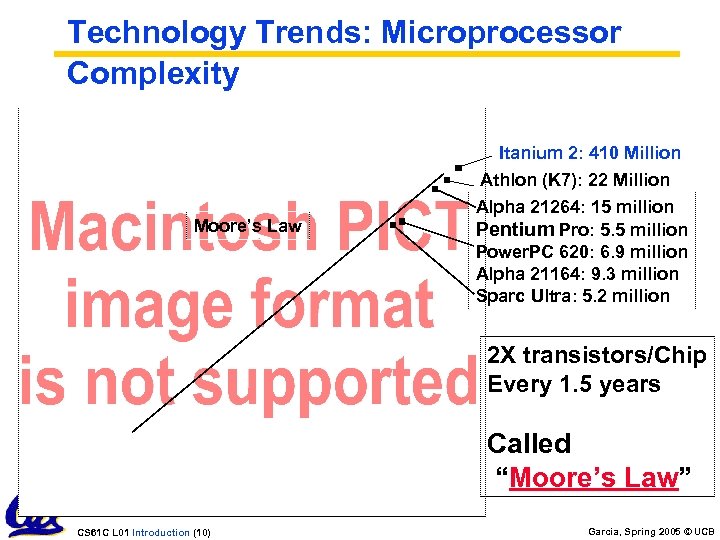
Technology Trends: Microprocessor Complexity Moore’s Law Itanium 2: 410 Million Athlon (K 7): 22 Million Alpha 21264: 15 million Pentium Pro: 5. 5 million Power. PC 620: 6. 9 million Alpha 21164: 9. 3 million Sparc Ultra: 5. 2 million 2 X transistors/Chip Every 1. 5 years Called “Moore’s Law” CS 61 C L 01 Introduction (10) Garcia, Spring 2005 © UCB
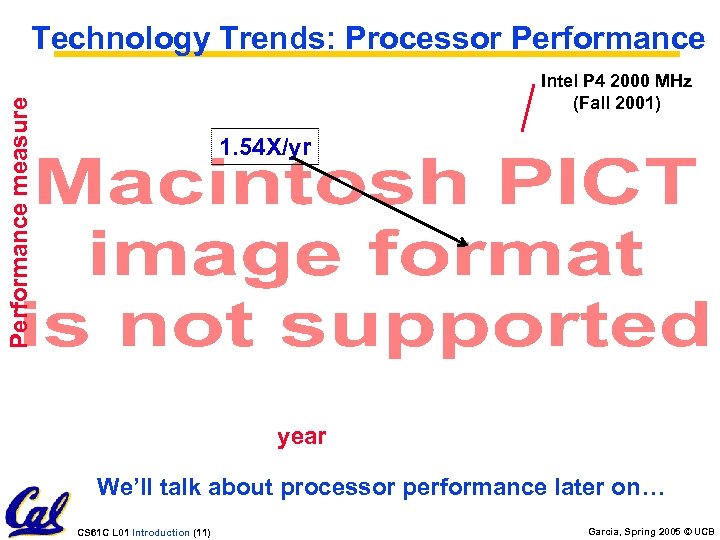
Technology Trends: Processor Performance measure Intel P 4 2000 MHz (Fall 2001) 1. 54 X/yr year We’ll talk about processor performance later on… CS 61 C L 01 Introduction (11) Garcia, Spring 2005 © UCB
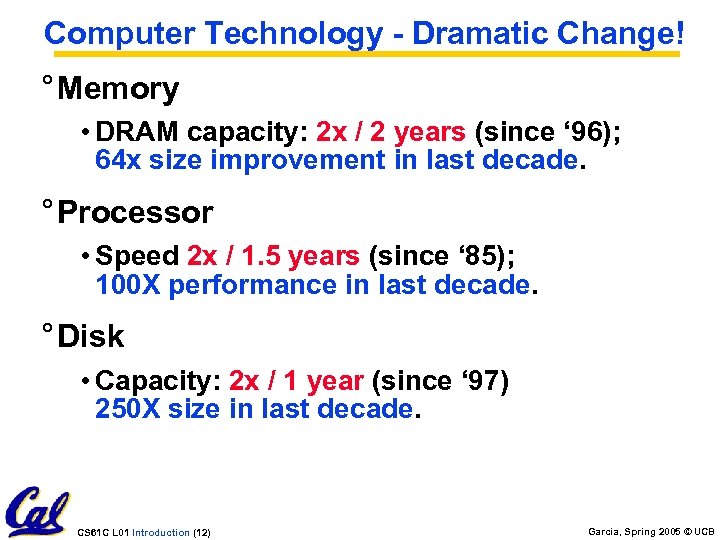
Computer Technology - Dramatic Change! ° Memory • DRAM capacity: 2 x / 2 years (since ‘ 96); 64 x size improvement in last decade. ° Processor • Speed 2 x / 1. 5 years (since ‘ 85); 100 X performance in last decade. ° Disk • Capacity: 2 x / 1 year (since ‘ 97) 250 X size in last decade. CS 61 C L 01 Introduction (12) Garcia, Spring 2005 © UCB
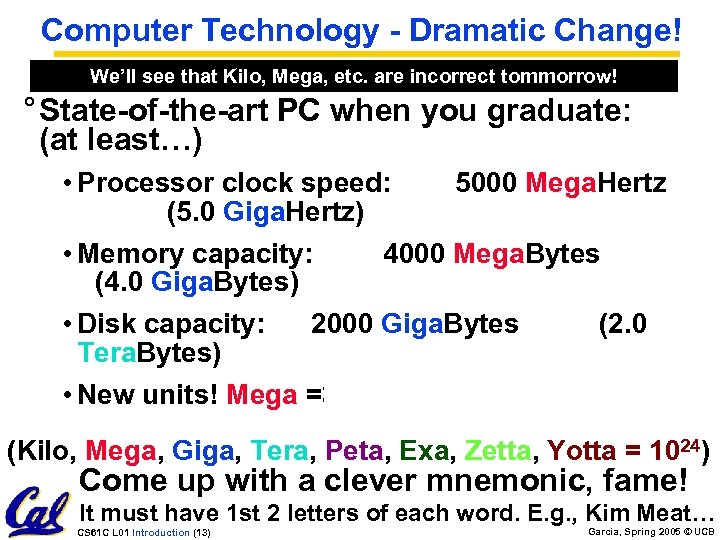
Computer Technology - Dramatic Change! We’ll see that Kilo, Mega, etc. are incorrect tommorrow! ° State-of-the-art PC when you graduate: (at least…) • Processor clock speed: 5000 Mega. Hertz (5. 0 Giga. Hertz) • Memory capacity: 4000 Mega. Bytes (4. 0 Giga. Bytes) • Disk capacity: 2000 Giga. Bytes (2. 0 Tera. Bytes) • New units! Mega => Giga, Giga => Tera (Kilo, Mega, Giga, Tera, Peta, Exa, Zetta, Yotta = 1024) Come up with a clever mnemonic, fame! It must have 1 st 2 letters of each word. E. g. , Kim Meat… CS 61 C L 01 Introduction (13) Garcia, Spring 2005 © UCB
CS 61 C: So what's in it for me? ° Learn some of the big ideas in CS & engineering: • 5 Classic components of a Computer • Data can be anything (integers, floating point, characters): a program determines what it is • Stored program concept: instructions just data • Principle of Locality, exploited via a memory hierarchy (cache) • Greater performance by exploiting parallelism • Principle of abstraction, used to build systems as layers • Compilation v. interpretation thru system layers • Principles/Pitfalls of Performance Measurement CS 61 C L 01 Introduction (15) Garcia, Spring 2005 © UCB
Others Skills learned in 61 C ° Learning C • If you know one, you should be able to learn another programming language largely on your own • Given that you know C++ or Java, should be easy to pick up their ancestor, C ° Assembly Language Programming • This is a skill you will pick up, as a side effect of understanding the Big Ideas ° Hardware design • We think of hardware at the abstract level, with only a little bit of physical logic to give things perspective • CS 150, 152 teach this CS 61 C L 01 Introduction (16) Garcia, Spring 2005 © UCB
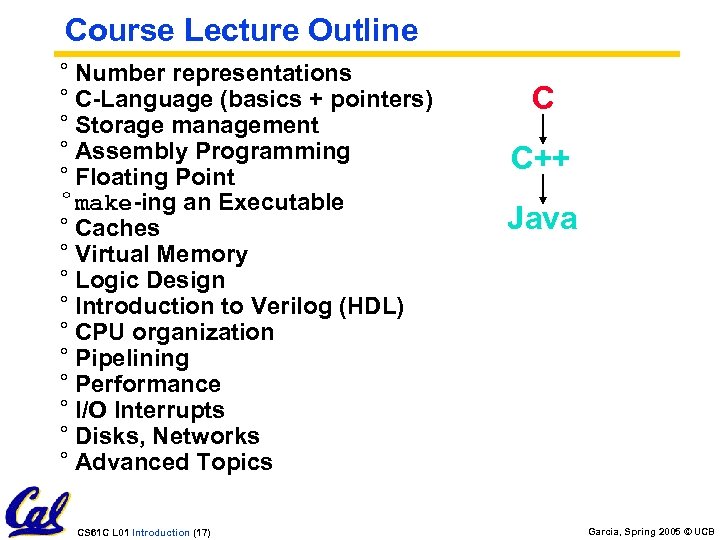
Course Lecture Outline ° Number representations ° C-Language (basics + pointers) ° Storage management ° Assembly Programming ° Floating Point ° make-ing an Executable ° Caches ° Virtual Memory ° Logic Design ° Introduction to Verilog (HDL) ° CPU organization ° Pipelining ° Performance ° I/O Interrupts ° Disks, Networks ° Advanced Topics CS 61 C L 01 Introduction (17) C C++ Java Garcia, Spring 2005 © UCB
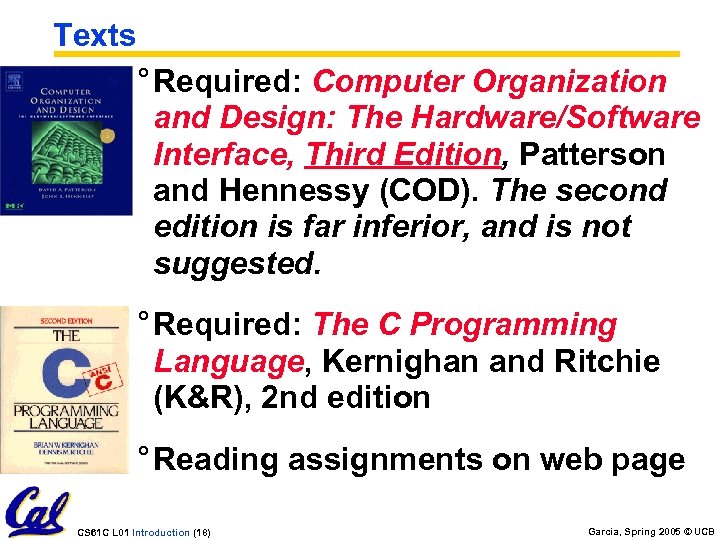
Texts ° Required: Computer Organization and Design: The Hardware/Software Interface, Third Edition, Patterson and Hennessy (COD). The second edition is far inferior, and is not suggested. ° Required: The C Programming Language, Kernighan and Ritchie (K&R), 2 nd edition ° Reading assignments on web page CS 61 C L 01 Introduction (18) Garcia, Spring 2005 © UCB
Tried-and-True Technique: Peer Instruction ° Increase real-time learning in lecture, test understanding of concepts vs. details ° As complete a “segment” ask multiple choice question • 1 -2 minutes to decide yourself • 3 minutes in pairs/triples to reach consensus. Teach others! • 5 -7 minute discussion of answers, questions, clarifications ° Buy PRS transmitters from ASUC student store or others calmatrix. berkeley. edu/Student%20 Life/Flea%20 Market/? 14@211. 3 sqla. J 3 dbgf. 2@ CS 61 C L 01 Introduction (19) Garcia, Spring 2005 © UCB
Peer Instruction ° Read textbook • Reduces examples have to do in class • Get more from lecture (also good advice) ° Fill out 3 -question Web Form on reading (released mondays, due every Friday before lecture) • Graded for effort, not correctness… • This counts for “E”ffort in EPA score CS 61 C L 01 Introduction (20) Garcia, Spring 2005 © UCB
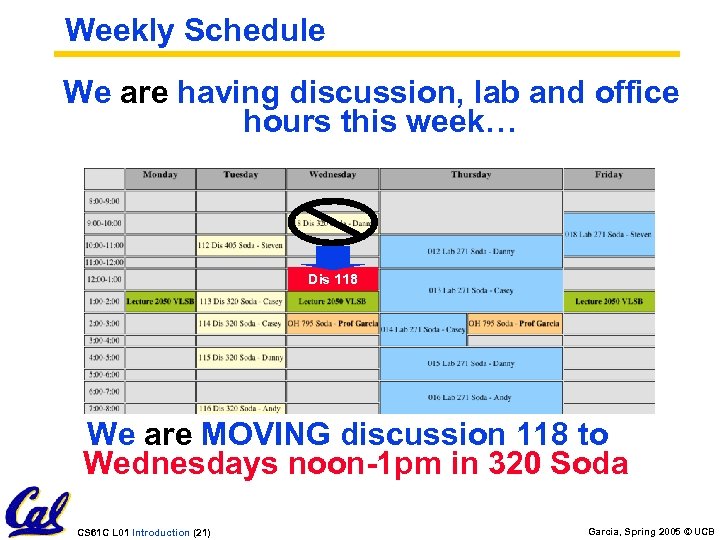
Weekly Schedule We are having discussion, lab and office hours this week… Dis 118 We are MOVING discussion 118 to Wednesdays noon-1 pm in 320 Soda CS 61 C L 01 Introduction (21) Garcia, Spring 2005 © UCB
Homeworks, Labs and Projects ° Lab exercises (every wk; due in that lab session unless extension given by TA) – extra point if you finish in 1 st hour! ° Homework exercises (~ every week; (HW 0) out now, due in section next week) ° Projects (every 2 to 3 weeks) ° All exercises, reading, homeworks, projects on course web page ° We will DROP your lowest HW, Lab! ° Only one {HW, Project, Midterm} / week CS 61 C L 01 Introduction (22) Garcia, Spring 2005 © UCB
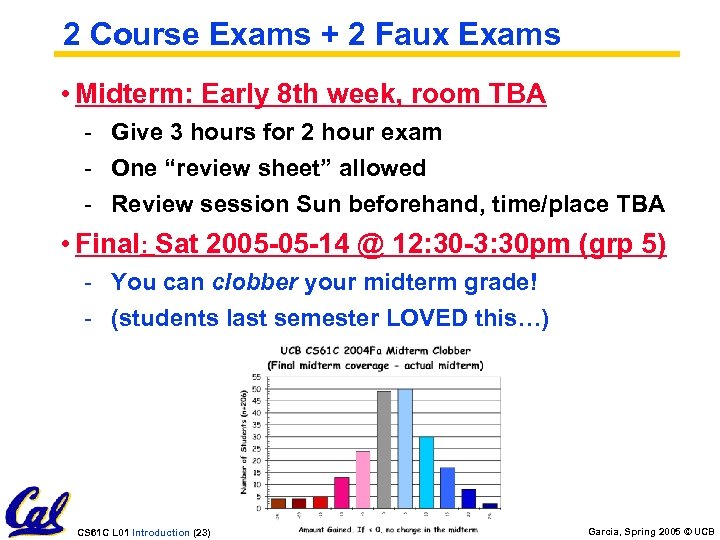
2 Course Exams + 2 Faux Exams • Midterm: Early 8 th week, room TBA - Give 3 hours for 2 hour exam - One “review sheet” allowed - Review session Sun beforehand, time/place TBA • Final: Sat 2005 -05 -14 @ 12: 30 -3: 30 pm (grp 5) - You can clobber your midterm grade! - (students last semester LOVED this…) CS 61 C L 01 Introduction (23) Garcia, Spring 2005 © UCB
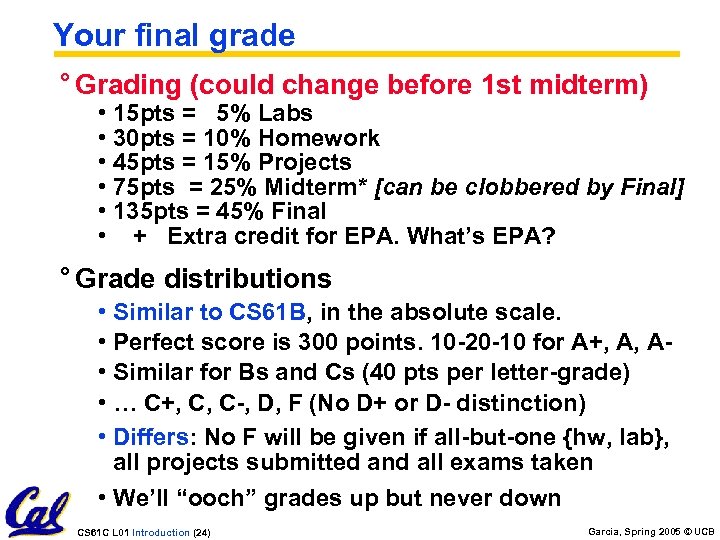
Your final grade ° Grading (could change before 1 st midterm) • 15 pts = 5% Labs • 30 pts = 10% Homework • 45 pts = 15% Projects • 75 pts = 25% Midterm* [can be clobbered by Final] • 135 pts = 45% Final • + Extra credit for EPA. What’s EPA? ° Grade distributions • Similar to CS 61 B, in the absolute scale. • Perfect score is 300 points. 10 -20 -10 for A+, A, A • Similar for Bs and Cs (40 pts per letter-grade) • … C+, C, C-, D, F (No D+ or D- distinction) • Differs: No F will be given if all-but-one {hw, lab}, all projects submitted and all exams taken • We’ll “ooch” grades up but never down CS 61 C L 01 Introduction (24) Garcia, Spring 2005 © UCB
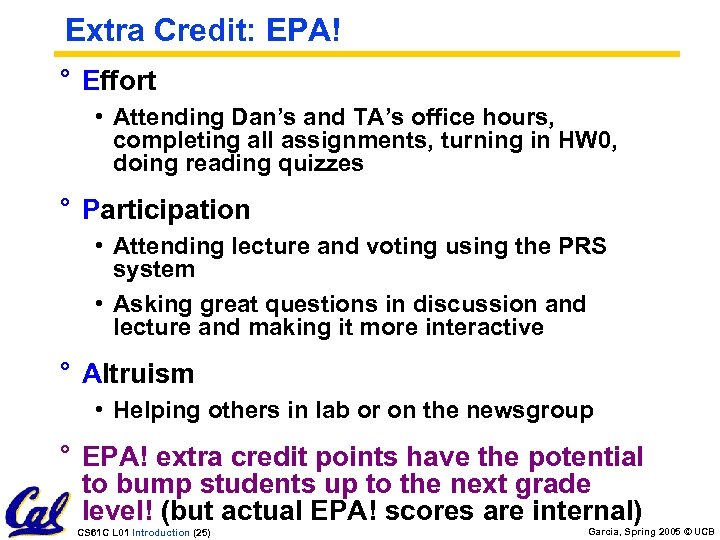
Extra Credit: EPA! ° Effort • Attending Dan’s and TA’s office hours, completing all assignments, turning in HW 0, doing reading quizzes ° Participation • Attending lecture and voting using the PRS system • Asking great questions in discussion and lecture and making it more interactive ° Altruism • Helping others in lab or on the newsgroup ° EPA! extra credit points have the potential to bump students up to the next grade level! (but actual EPA! scores are internal) CS 61 C L 01 Introduction (25) Garcia, Spring 2005 © UCB
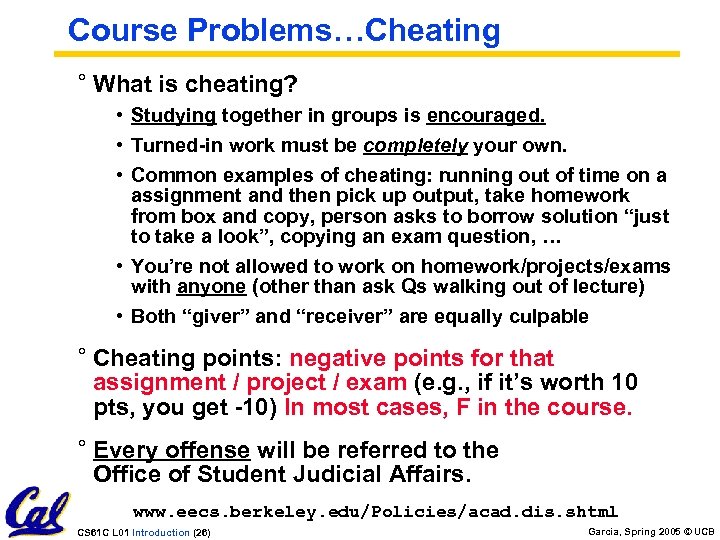
Course Problems…Cheating ° What is cheating? • Studying together in groups is encouraged. • Turned-in work must be completely your own. • Common examples of cheating: running out of time on a assignment and then pick up output, take homework from box and copy, person asks to borrow solution “just to take a look”, copying an exam question, … • You’re not allowed to work on homework/projects/exams with anyone (other than ask Qs walking out of lecture) • Both “giver” and “receiver” are equally culpable ° Cheating points: negative points for that assignment / project / exam (e. g. , if it’s worth 10 pts, you get -10) In most cases, F in the course. ° Every offense will be referred to the Office of Student Judicial Affairs. www. eecs. berkeley. edu/Policies/acad. dis. shtml CS 61 C L 01 Introduction (26) Garcia, Spring 2005 © UCB
Student Learning Center (SLC) ° Cesar Chavez Center (on Lower Sproul) ° The SLC will offer directed study groups for students CS 61 C. ° They will also offer Drop-in tutoring support for about 20 hours each week. ° Most of these hours will be conducted by paid tutorial staff, but these will also be supplemented by students who are receiving academic credit for tutoring. CS 61 C L 01 Introduction (28) Garcia, Spring 2005 © UCB
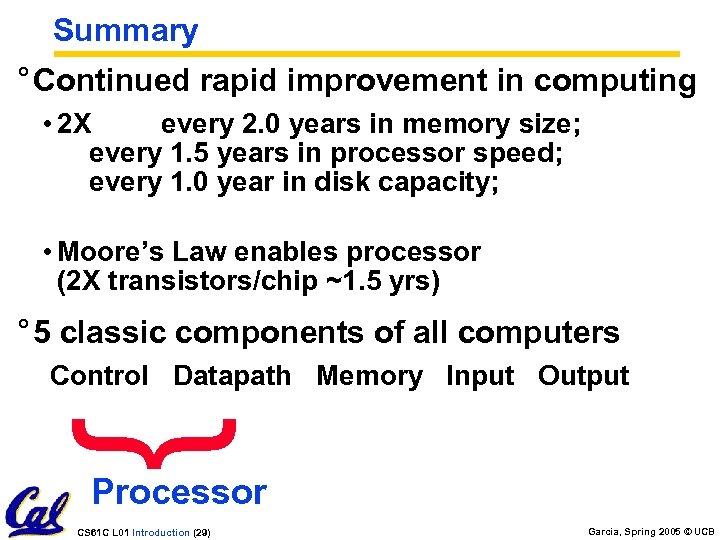
Summary ° Continued rapid improvement in computing • 2 X every 2. 0 years in memory size; every 1. 5 years in processor speed; every 1. 0 year in disk capacity; • Moore’s Law enables processor (2 X transistors/chip ~1. 5 yrs) ° 5 classic components of all computers Control Datapath Memory Input Output } Processor CS 61 C L 01 Introduction (29) Garcia, Spring 2005 © UCB
Скачать презентацию inst eecs berkeley edu cs 61 c CS 61
0b96171038b3514b4abb60f3c3ac9107.ppt