


 Скачать презентацию INST 2403 The Expanding Universe INST 2403
c5540beb73602e8ef1b5e01967b82071.ppt
- Количество слайдов: 28
 INST 2403 The Expanding Universe
 INST 2403 The Expanding Universe Dr. Uwe Trittmann Utrittmann@Otterbein. edu Office: Science 107 Phone: 823 -1806 Secretary: Celina Chou (823 -1316), Science 308 Office Hours: MW 1 -1: 30& 3 -3: 30 pm or by appointment.
 Course Materials • Textbooks: – Astronomy: A Beginner’s Guide to the Universe, 7 th Edition, by Chaisson and Mc. Millan (Addison-Wesley 2012) – Lecture Tutorials for Introductory Astronomy, 3 rd ed. , by Edward E. Prather, Tim P. Slater, Jeff Adams, and Gina Brissenden (Benjamin Cummings) – Need to buy Web. Assign access, too! • Course Web Page: http: //faculty. otterbein. edu/utrittmann/is 2403 -02/ • Observatory schedule, lecture notes, study guides, the syllabus, notices, online resources, …
 Assignments and Grading Rooftop Visit + Essay Activities Participation Constellation quiz Just-in-time responses Homework i. Skylab 3 in-class tests 10% each Final exam (comprehensive!) 2% 8% (total) 5% 6% 5% 12% (total) 30% 20%
 Daily Homework & Warm-Ups • Before class (8 am): answer warm-up questions online about reading for the day – http: //neutrino. otterbein. edu/~tagg/Courses/Too ls/Warmup. DB/IS_Astro_F 14_2 • After Class: use Web. Assign, an online homework system daily! – Password & username: first initial plus last name all lowercase, e. g. utrittmann
 i. Skylab • • Equivalent of a term paper, but more experimental 4 different stages Start early - weather is always a factor Ask questions! • Due Sep 24, Oct 27, Nov 19, Dec 8
 Every Day (MWF) • • Do the textbook reading Look over the Powerpoint slides for the day Answer the Warm-Up questions due 8 am Come to lecture & participate – Ask questions about homework, etc. • Do the homework due at night
 A Glance at this Class • The whole universe in 14 weeks!? Expect to work at least as hard for this course as for your major classes; 2 hrs out of class per class • The focus is on concepts, not facts; on the methods and tools of science: – How do we know? – How can we measure it? – How can we predict it?
 Teaching Philosophy • • • Teaching is merely an invitation to learn You have to learn yourself! Operational instead of Declarative Knowledge Peer instruction Class discussions Participation (Credit!) – Must engage with the material
 Peer Instruction: How it works • Peer instruction is learning by instructing your fellow students and being instructed by them • The process involves 6 steps: – Mini-lecture by course instructor – Conceptual multiple-choice question is put up – Flash-cards are used to “poll the audience” – A few minutes of discussion between students – “Final answer” via flash-cards – The instructor explains the correct answer
 Who was the first man on the Moon? • • Yuri Gagarin Buzz Aldrin Neil Armstrong John Glenn
 Concept Questions • Concept questions maybe easy to answer, but are not simple • You need background knowledge to answer them • They teach you how to use facts and knowledge to find the answer to a problem • They test if you got the concept rather than just knowing facts
 It is New Moon. In one week, what will the phase of the Moon be? • • New Moon First Quarter Moon Full Moon Last Quarter Moon
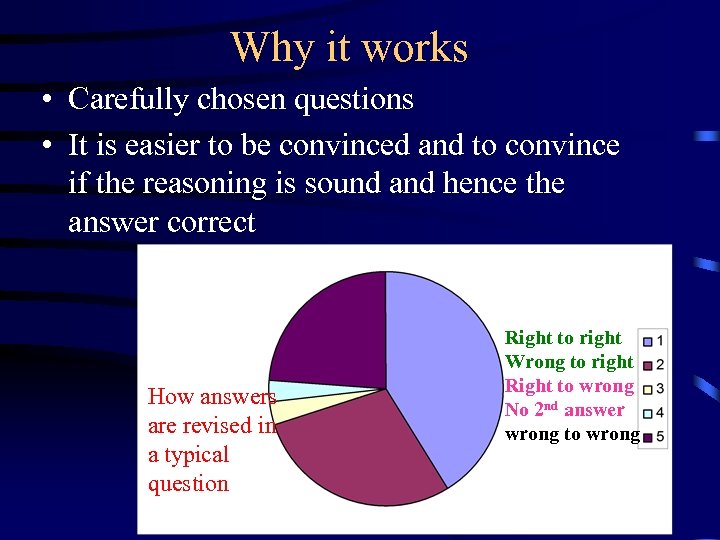 Why it works • Carefully chosen questions • It is easier to be convinced and to convince if the reasoning is sound and hence the answer correct How answers are revised in a typical question Right to right Wrong to right Right to wrong No 2 nd answer wrong to wrong
 Science and Quantitative Reasoning • Without quantitative reasoning there is no progress in science (Galileo) • However, (quantitative) reasoning is also very useful in everyday life – Interest rate, gas mileage, buying a used car, that guy from Nigeria…
 Making Sense of Numbers • Want to compare to relevant scale choose convenient units • Underlying concepts have to be clear – There is evidence that the disconnect between scientists and the public starts at simple concepts, like area, volume, ratios and graphs – We’ll start there and we’ll move up to the stars!
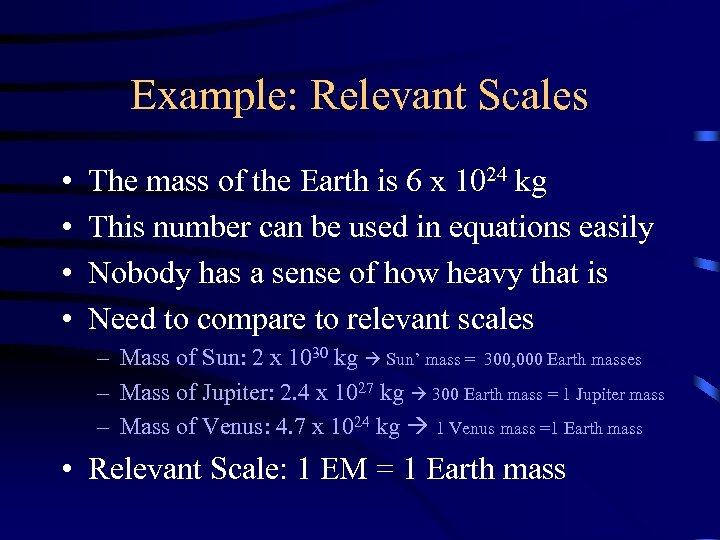 Example: Relevant Scales • • The mass of the Earth is 6 x 1024 kg This number can be used in equations easily Nobody has a sense of how heavy that is Need to compare to relevant scales – Mass of Sun: 2 x 1030 kg Sun’ mass = 300, 000 Earth masses – Mass of Jupiter: 2. 4 x 1027 kg 300 Earth mass = 1 Jupiter mass – Mass of Venus: 4. 7 x 1024 kg 1 Venus mass =1 Earth mass • Relevant Scale: 1 EM = 1 Earth mass
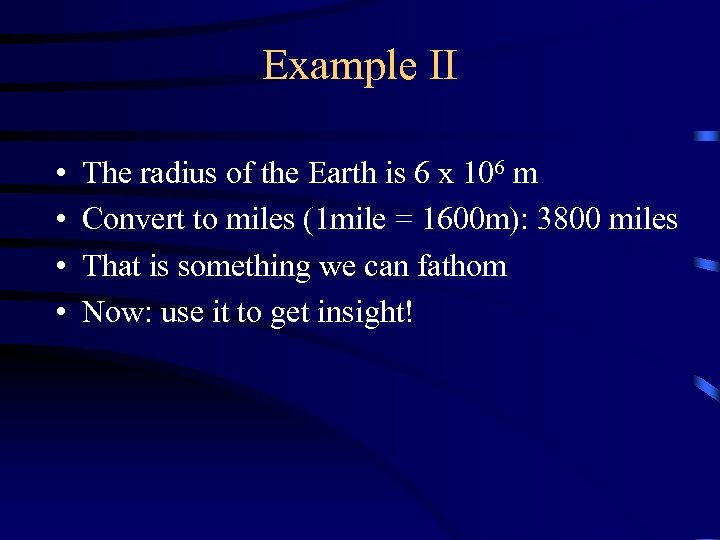 Example II • • The radius of the Earth is 6 x 10⁶ m Convert to miles (1 mile = 1600 m): 3800 miles That is something we can fathom Now: use it to get insight!
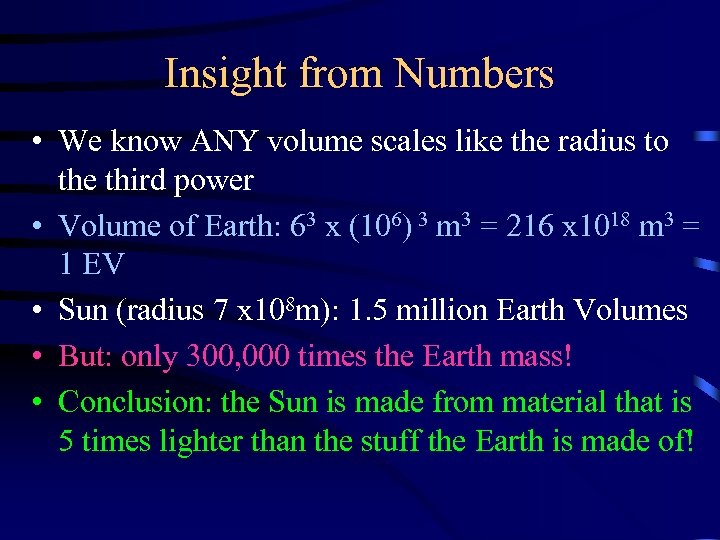 Insight from Numbers • We know ANY volume scales like the radius to the third power • Volume of Earth: 63 x (106) 3 m 3 = 216 x 1018 m 3 = 1 EV • Sun (radius 7 x 10⁸ m): 1. 5 million Earth Volumes • But: only 300, 000 times the Earth mass! • Conclusion: the Sun is made from material that is 5 times lighter than the stuff the Earth is made of!
 Asking questions to ask questions • Scientists often come off as pretending to know everything (Sheldon) • In fact, they have a healthy self-confidence that they can at least say something about everything • Why? They simplify things enough to make a rough estimate, then compare to reality – Correct? Hah! I was right! – Not correct? How interesting! We can explore more!
 Example: How many people live in Australia? • No idea. • But: Need to say something – Can get size of this continent – Know size & inhabitants of USA – Proportionality tells us there should be XX million Australians • Conclusion: there are much fewer! • Next Question: Why?
 Don’t be fooled by what you see! • The sun and the moon appear to be the same size in the sky (0. 5 degrees) • Alpha Centauri appears to be much dimmer than the Sun • Alpha Centauri and Vega appear to be equally bright • Are you upside down?
 Think! • The moon and the sun COULD be at different distances • Alpha Centauri and Vega COULD be different types of stars • YOU could be upside down! • The apple COULD attract the Earth with the same force Expand your universe!
 Top Down • The Universe is accelerating its Expansion – How do we know? • Supernovae are dimmer than they should be in a standard expanding universe – What is a supernova? What is a standard universe? • SN are massive stars exploding at the end of their lives – How do we know?
 Top Down • Stars are hot gas balls that fuse H to He; they run out of fuel – How do we know? • Can measure spectra, compare to the sun – What is a spectrum? How does the sun “work”? • The sun is 300, 000 more massive than the earth, consists of H & He, produces a lot of energy must be fusion – How do we know?
 Top Down • Measure distance to sun, use Newton gravity to obtain mass, measure H & He spectra in lab – How do we measure distance to sun? – What is Newton gravity? – What are spectra in the lab? • Use Kepler’s laws, observe special configuration of planets from different positions on earth – What are Kepler’s laws? How big is Earth?
 Top Down • Planets go around the sun in ellipses – How do we know? • The observer’s view is different for different places on Earth radius – How do we know Look at the sky!