


 Скачать презентацию Inspire Maths Parents Evening Mrs Danson This
9b0ff6c9f4cfc8aa05512512c2f4e403.ppt
- Количество слайдов: 50
 Inspire Maths Parents’ Evening Mrs Danson
 This parents’ evening will explain: • • • how maths will be taught why the children will not be in sets or ability groups how the textbooks will be used in class how the part-whole model works how the bar model works how you can help your child at home. © Oxford University Press 2016
 What is Inspire Maths? • Singapore is consistently ranked in the top three spots in international tests such as TIMSS and PISA. • Inspire Maths is the UK version of the highly acclaimed Singapore maths programme My Pals Are Here!, which is used in almost 100% of state primary schools in Singapore. • It is a mastery curriculum with an emphasis on deep conceptual understanding and problem solving. • The spiral curriculum systematically develops skills and concepts. • The programme is build around the CPA approach. • There is an emphasis on the development of intellectual competence, such as the ability to visualise. © Oxford University Press 2016
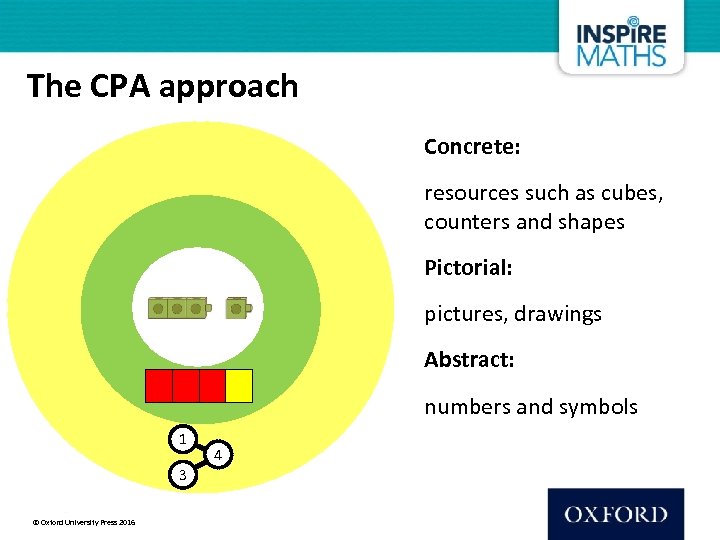 The CPA approach Concrete: resources such as cubes, counters and shapes Pictorial: pictures, drawings Abstract: numbers and symbols 1 3 © Oxford University Press 2016 4
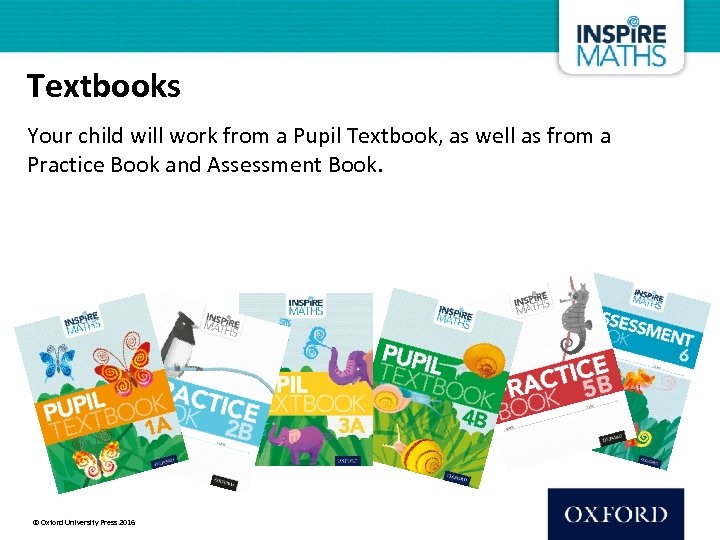 Textbooks Your child will work from a Pupil Textbook, as well as from a Practice Book and Assessment Book. © Oxford University Press 2016
 A mastery curriculum Key features: • The curriculum is highly-structured, based on a spiral approach to learning and learning theories. • Each maths area or topic is covered in depth for the year group once, and is not repeated within the same year. • Children are not grouped or put into ability sets. © Oxford University Press 2016
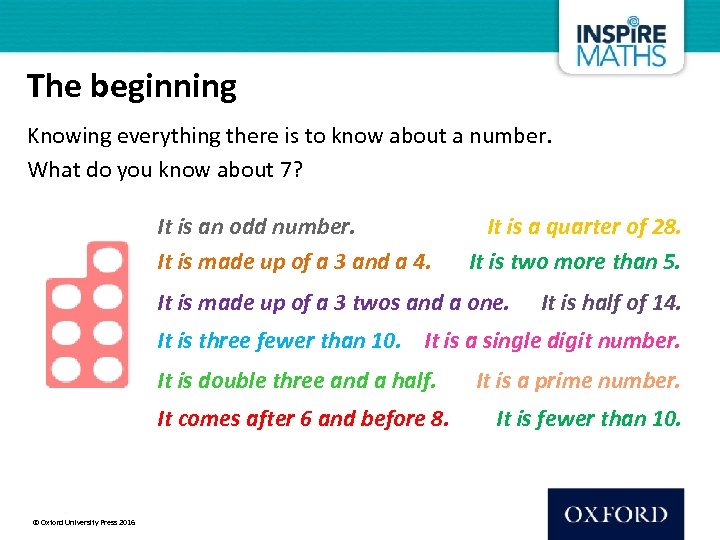 The beginning Knowing everything there is to know about a number. What do you know about 7? It is an odd number. It is made up of a 3 and a 4. It is a quarter of 28. It is two more than 5. It is made up of a 3 twos and a one. It is half of 14. It is three fewer than 10. It is a single digit number. It is double three and a half. It comes after 6 and before 8. © Oxford University Press 2016 It is a prime number. It is fewer than 10.
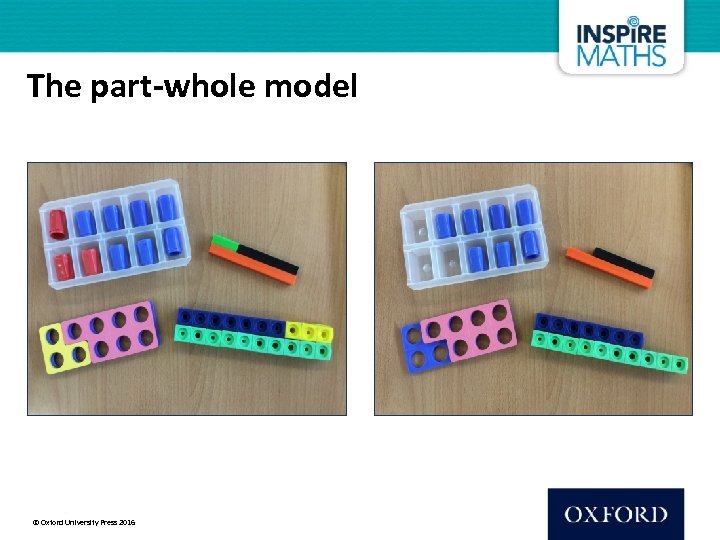
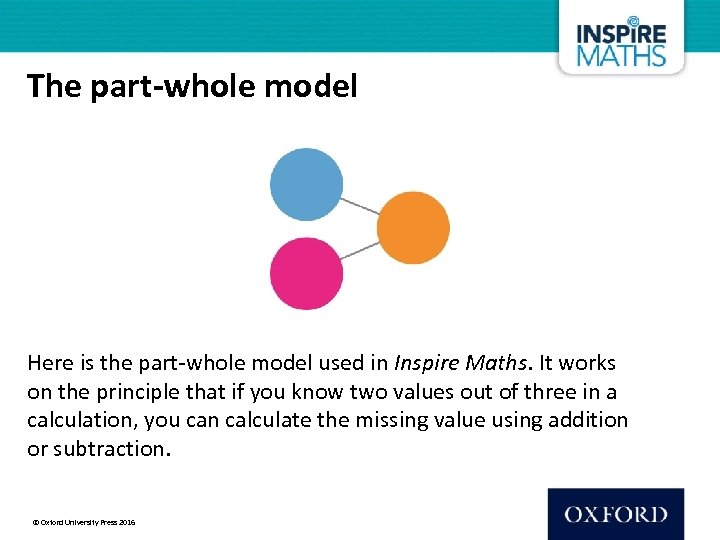 The part-whole model Here is the part-whole model used in Inspire Maths. It works on the principle that if you know two values out of three in a calculation, you can calculate the missing value using addition or subtraction. © Oxford University Press 2016
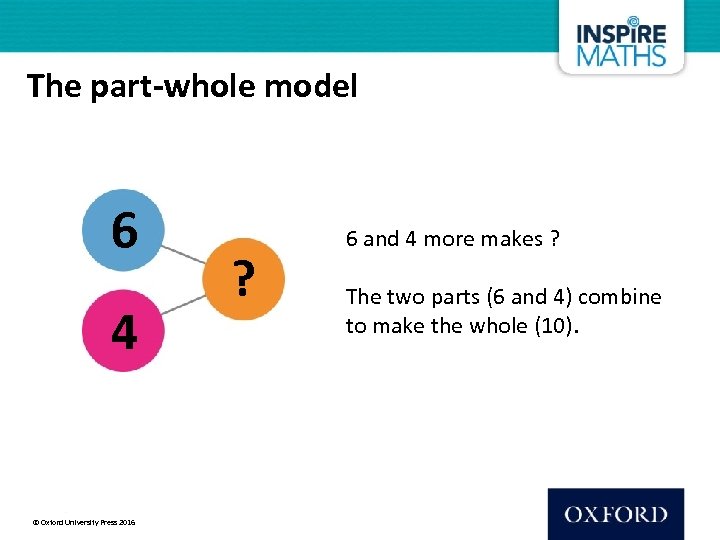 The part-whole model 6 4 © Oxford University Press 2016 ? 6 and 4 more makes ? The two parts (6 and 4) combine to make the whole (10).
 The part-whole model © Oxford University Press 2016
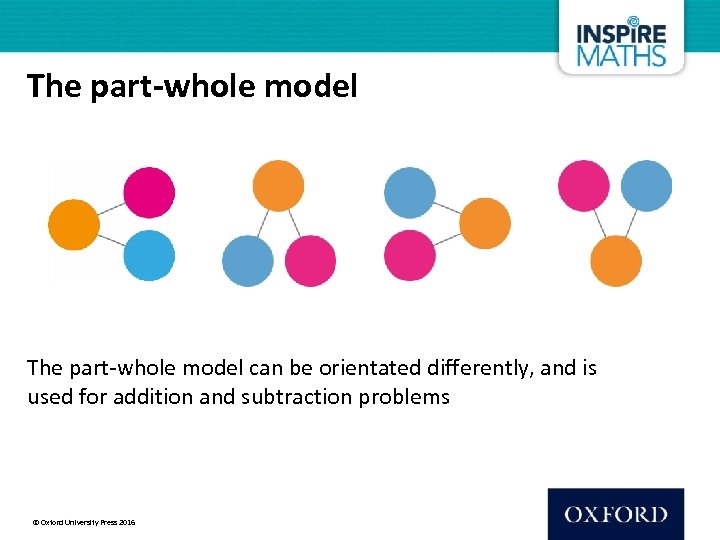 The part-whole model can be orientated differently, and is used for addition and subtraction problems © Oxford University Press 2016
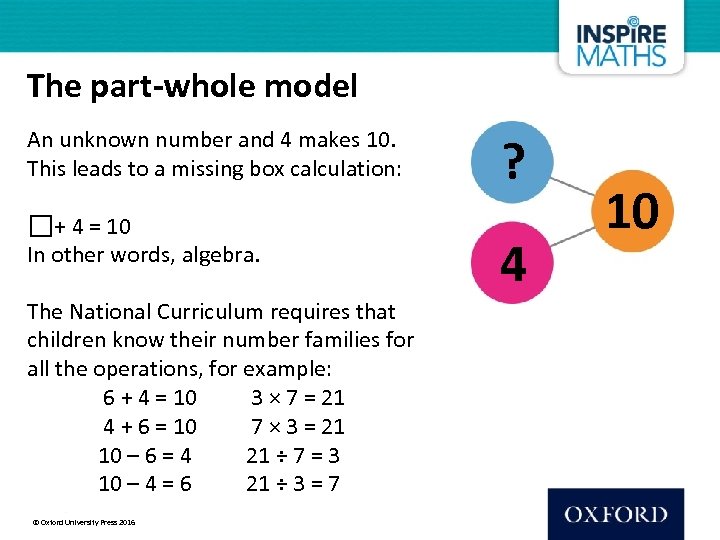 The part-whole model An unknown number and 4 makes 10. This leads to a missing box calculation: + 4 = 10 In other words, algebra. The National Curriculum requires that children know their number families for all the operations, for example: 6 + 4 = 10 3 × 7 = 21 4 + 6 = 10 7 × 3 = 21 10 – 6 = 4 21 ÷ 7 = 3 10 – 4 = 6 21 ÷ 3 = 7 © Oxford University Press 2016 ? 4 10
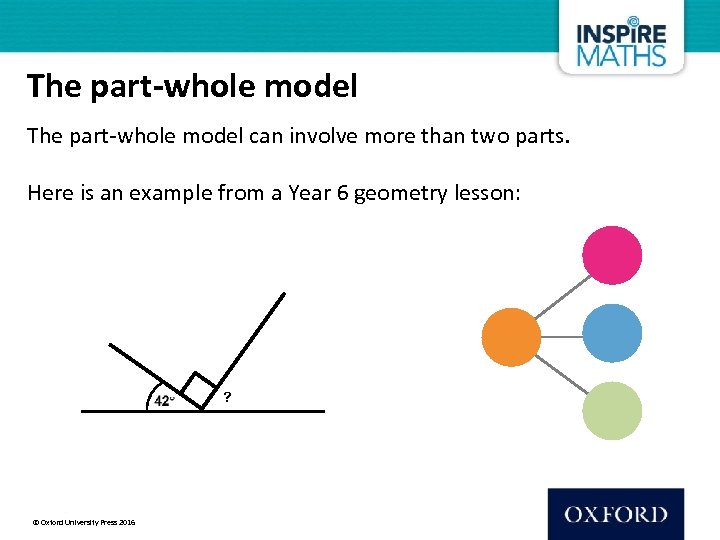 The part-whole model can involve more than two parts. Here is an example from a Year 6 geometry lesson: © Oxford University Press 2016 ?
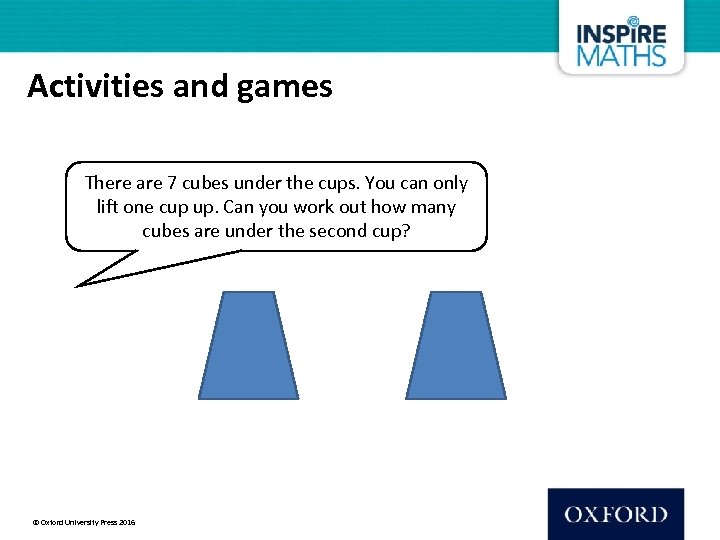 Activities and games There are 7 cubes under the cups. You can only lift one cup up. Can you work out how many cubes are under the second cup? © Oxford University Press 2016
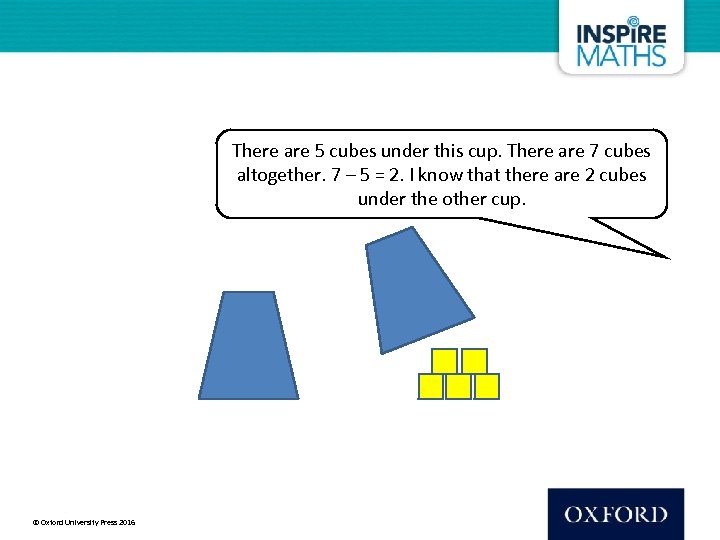 There are 5 cubes under this cup. There are 7 cubes altogether. 7 – 5 = 2. I know that there are 2 cubes under the other cup. © Oxford University Press 2016
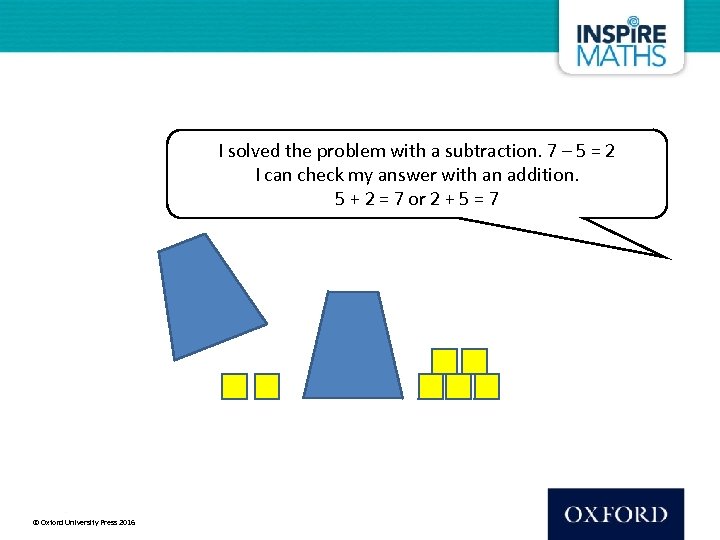 I solved the problem with a subtraction. 7 – 5 = 2 I can check my answer with an addition. 5 + 2 = 7 or 2 + 5 = 7 © Oxford University Press 2016
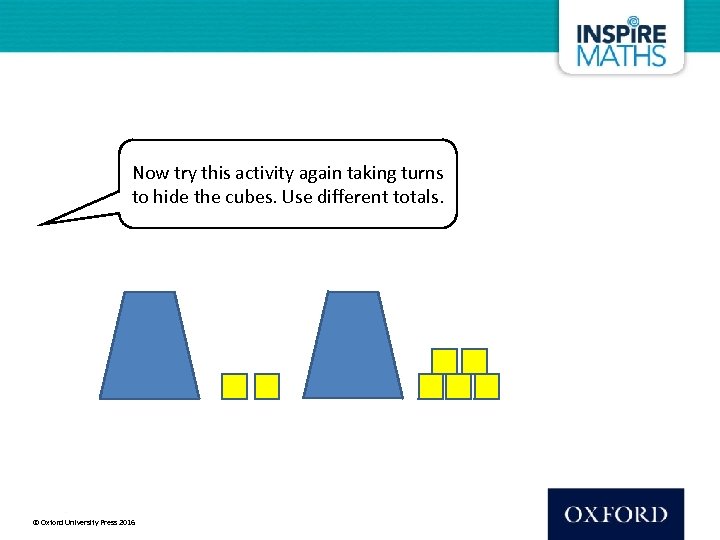 Now try this activity again taking turns to hide the cubes. Use different totals. © Oxford University Press 2016
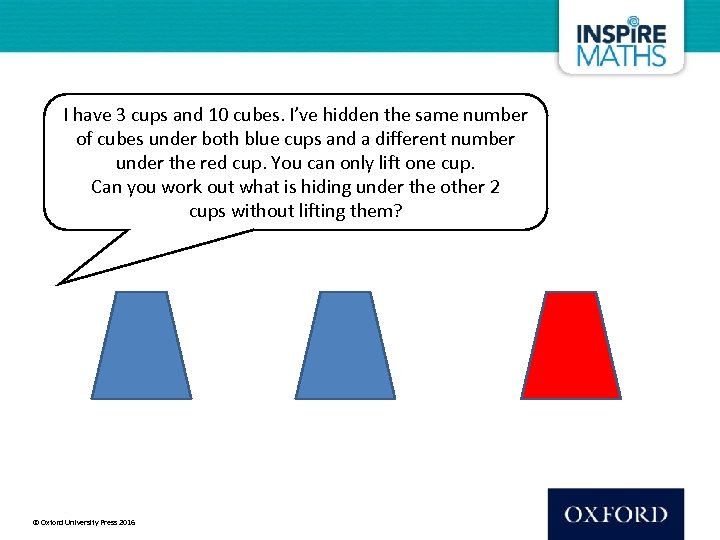 I have 3 cups and 10 cubes. I’ve hidden the same number of cubes under both blue cups and a different number under the red cup. You can only lift one cup. Can you work out what is hiding under the other 2 cups without lifting them? © Oxford University Press 2016
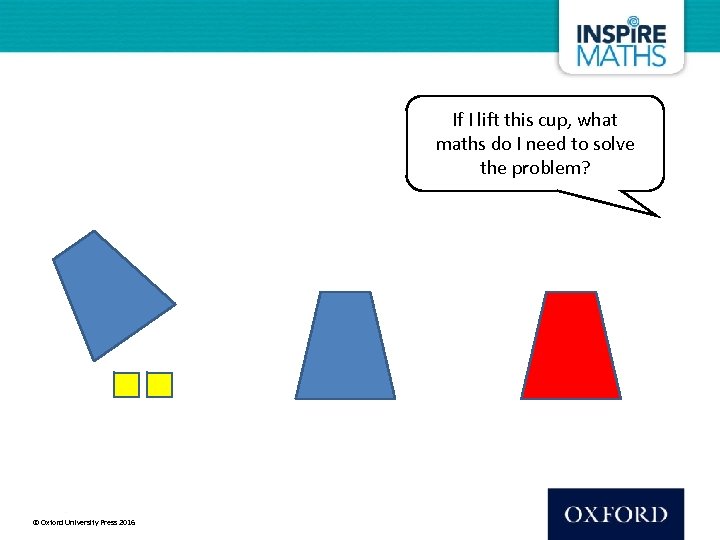 If I lift this cup, what maths do I need to solve the problem? © Oxford University Press 2016
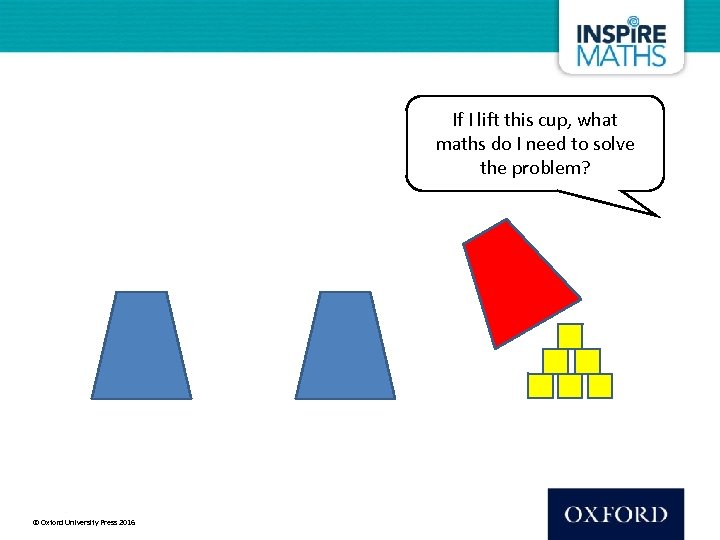 If I lift this cup, what maths do I need to solve the problem? © Oxford University Press 2016
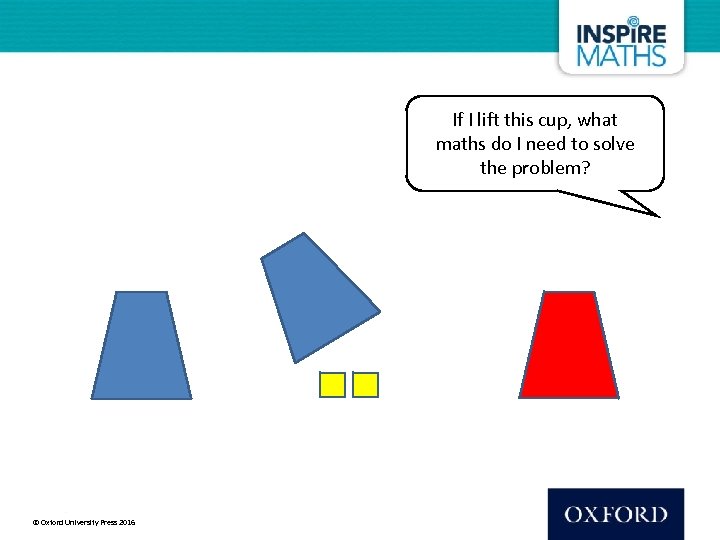 If I lift this cup, what maths do I need to solve the problem? © Oxford University Press 2016
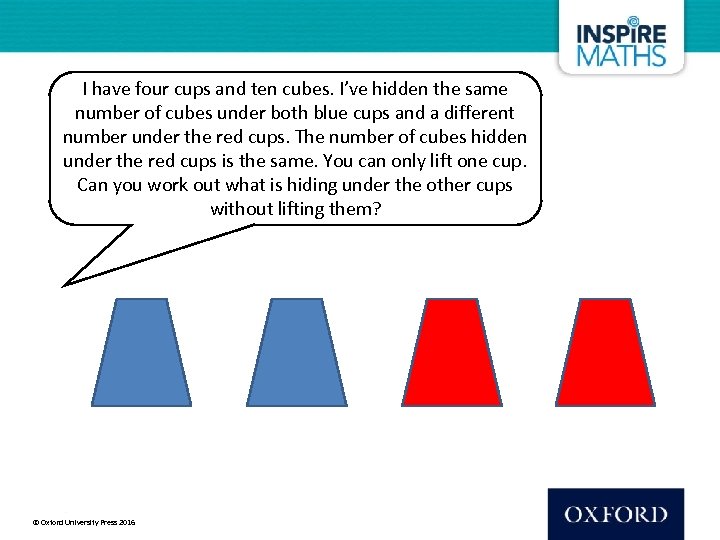 I have four cups and ten cubes. I’ve hidden the same number of cubes under both blue cups and a different number under the red cups. The number of cubes hidden under the red cups is the same. You can only lift one cup. Can you work out what is hiding under the other cups without lifting them? © Oxford University Press 2016
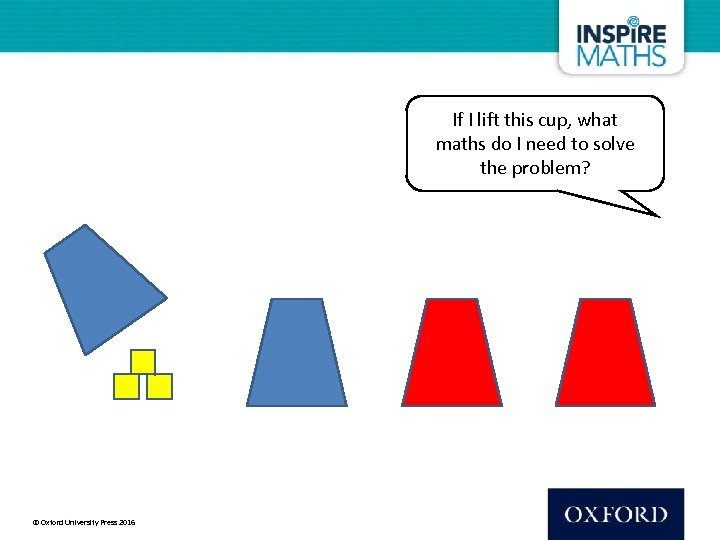 If I lift this cup, what maths do I need to solve the problem? © Oxford University Press 2016
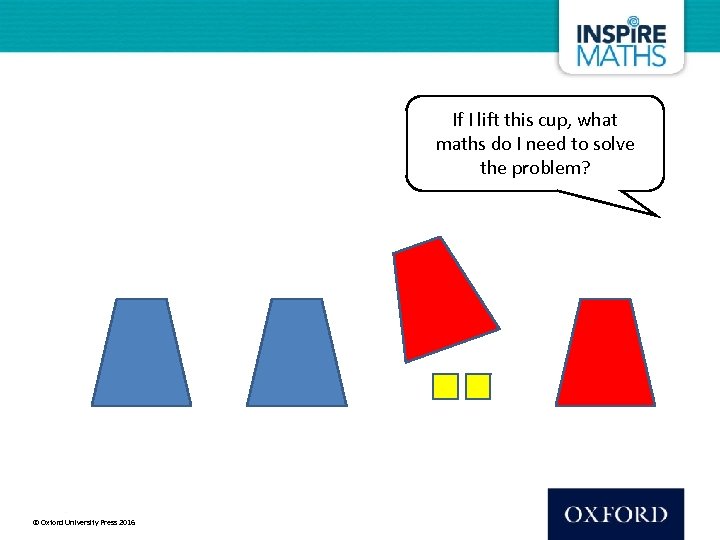 If I lift this cup, what maths do I need to solve the problem? © Oxford University Press 2016
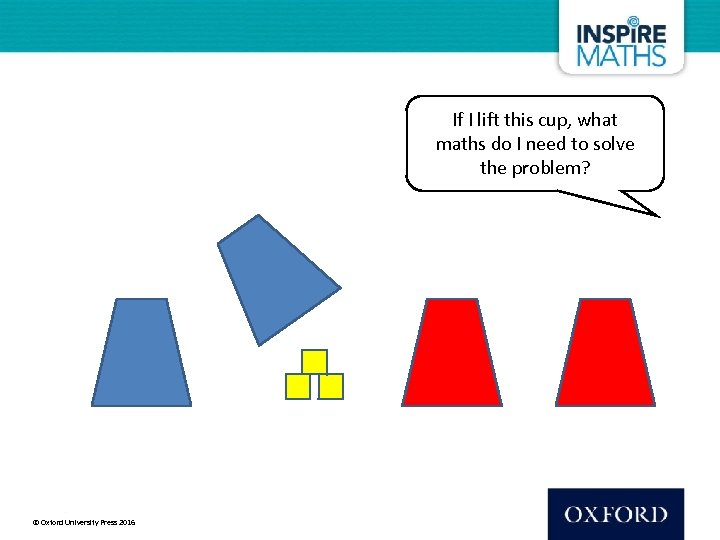 If I lift this cup, what maths do I need to solve the problem? © Oxford University Press 2016
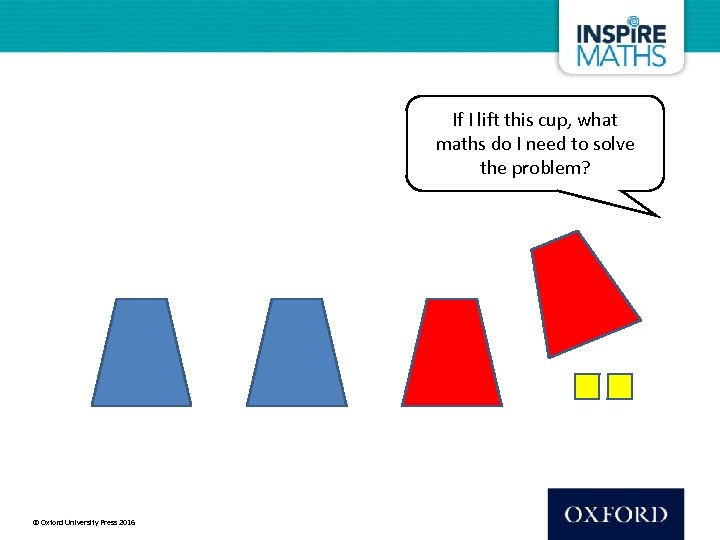 If I lift this cup, what maths do I need to solve the problem? © Oxford University Press 2016
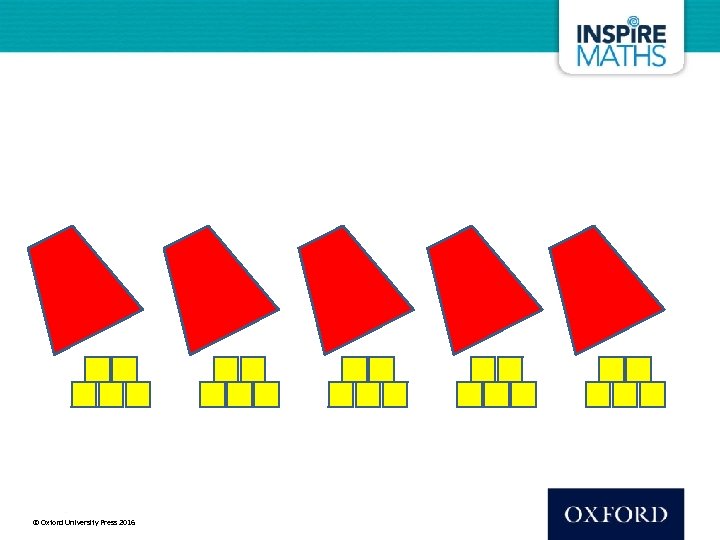
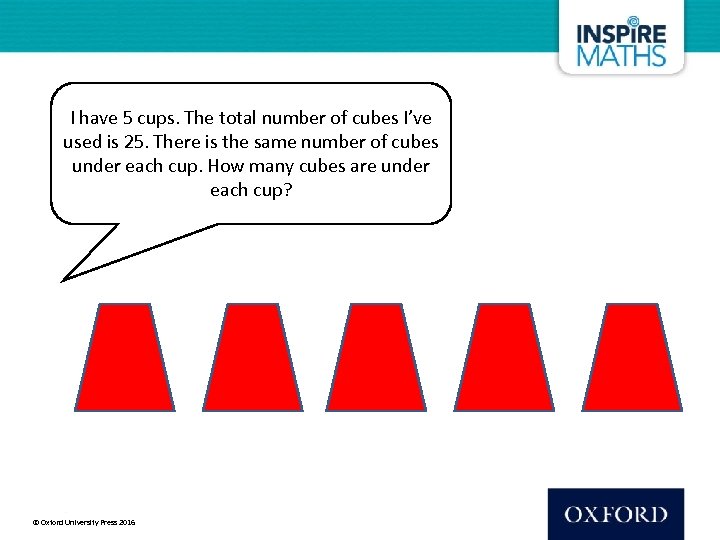 I have 5 cups. The total number of cubes I’ve used is 25. There is the same number of cubes under each cup. How many cubes are under each cup? © Oxford University Press 2016
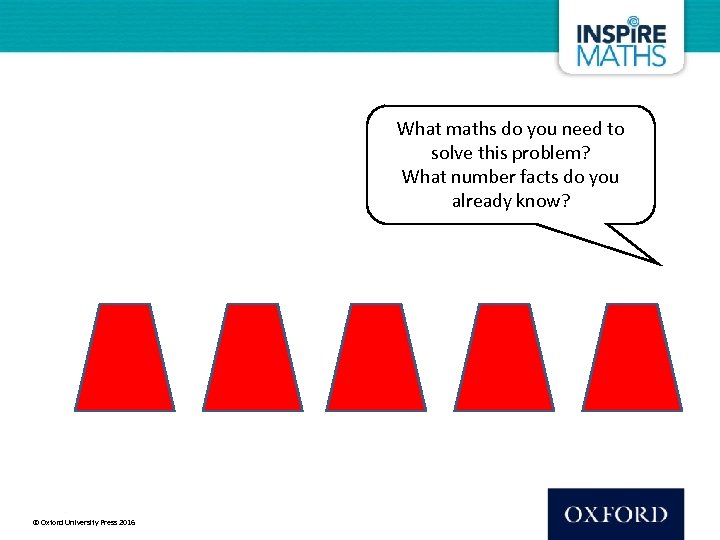 What maths do you need to solve this problem? What number facts do you already know? © Oxford University Press 2016
 © Oxford University Press 2016
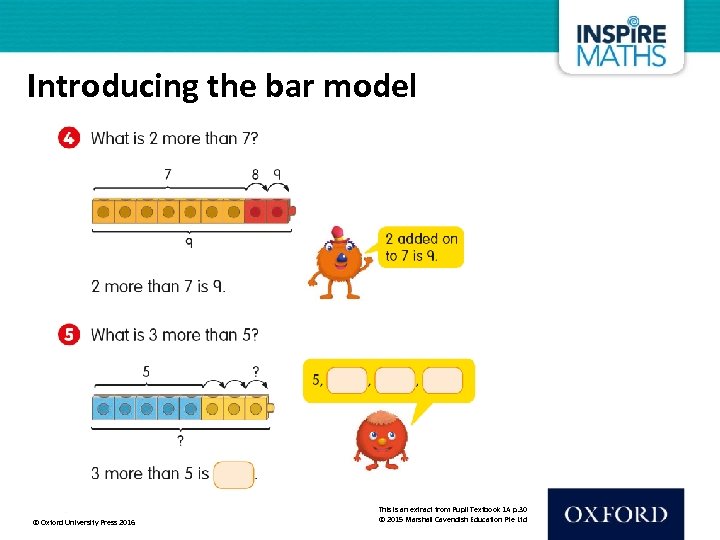 Introducing the bar model © Oxford University Press 2016 This is an extract from Pupil Textbook 1 A p. 30 © 2015 Marshall Cavendish Education Pte Ltd
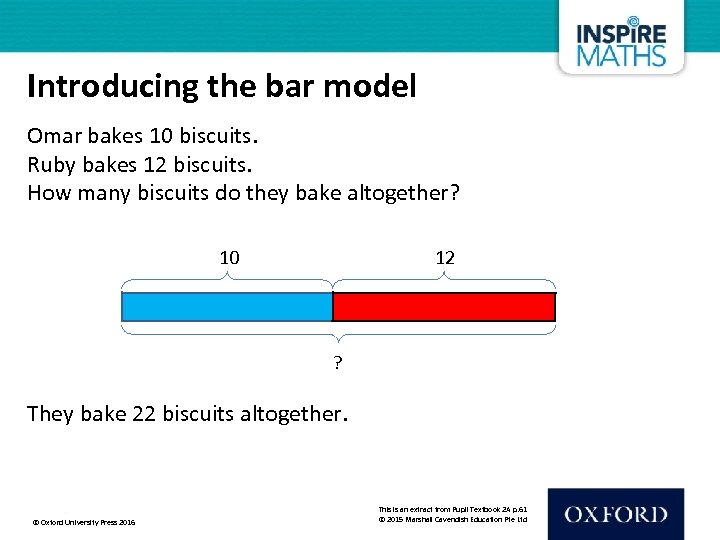 Introducing the bar model Omar bakes 10 biscuits. Ruby bakes 12 biscuits. How many biscuits do they bake altogether? 10 12 ? They bake 22 biscuits altogether. © Oxford University Press 2016 This is an extract from Pupil Textbook 2 A p. 61 © 2015 Marshall Cavendish Education Pte Ltd
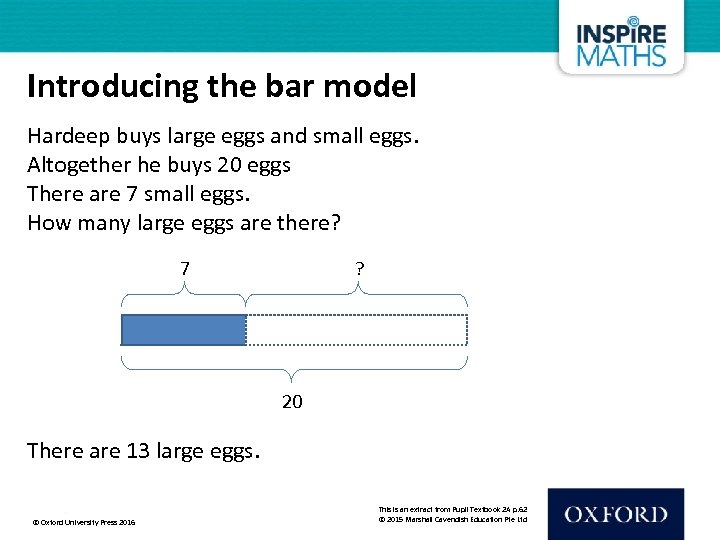 Introducing the bar model Hardeep buys large eggs and small eggs. Altogether he buys 20 eggs There are 7 small eggs. How many large eggs are there? 7 ? 20 There are 13 large eggs. © Oxford University Press 2016 This is an extract from Pupil Textbook 2 A p. 62 © 2015 Marshall Cavendish Education Pte Ltd
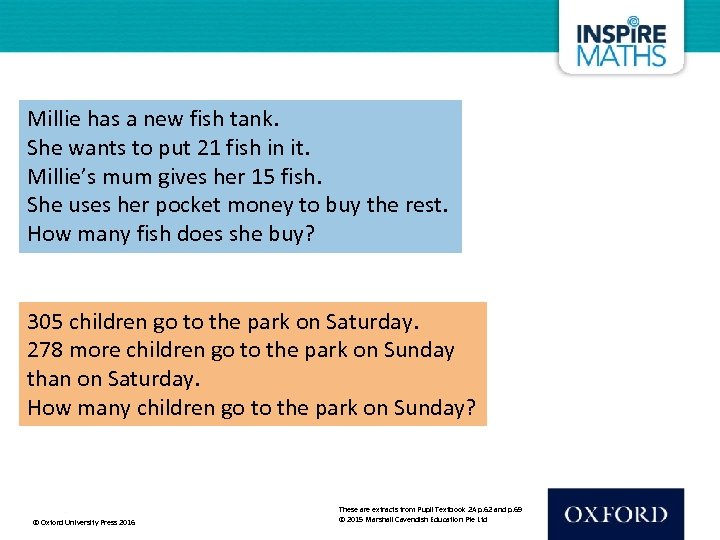 Millie has a new fish tank. She wants to put 21 fish in it. Millie’s mum gives her 15 fish. She uses her pocket money to buy the rest. How many fish does she buy? 305 children go to the park on Saturday. 278 more children go to the park on Sunday than on Saturday. How many children go to the park on Sunday? © Oxford University Press 2016 These are extracts from Pupil Textbook 2 A p. 62 and p. 69 © 2015 Marshall Cavendish Education Pte Ltd
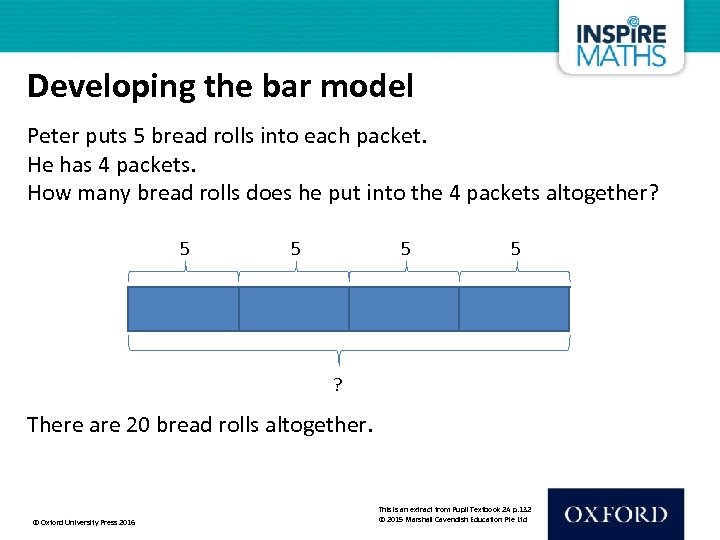 Developing the bar model Peter puts 5 bread rolls into each packet. He has 4 packets. How many bread rolls does he put into the 4 packets altogether? 5 5 ? There are 20 bread rolls altogether. © Oxford University Press 2016 This is an extract from Pupil Textbook 2 A p. 132 © 2015 Marshall Cavendish Education Pte Ltd
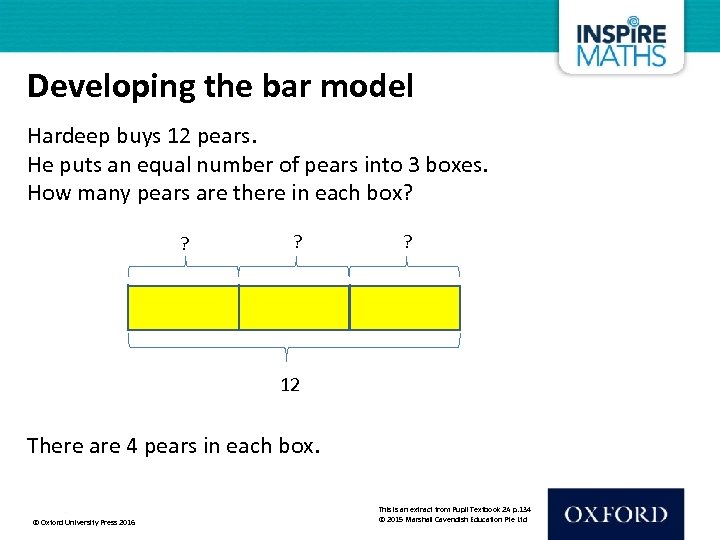 Developing the bar model Hardeep buys 12 pears. He puts an equal number of pears into 3 boxes. How many pears are there in each box? ? ? ? 12 There are 4 pears in each box. © Oxford University Press 2016 This is an extract from Pupil Textbook 2 A p. 134 © 2015 Marshall Cavendish Education Pte Ltd
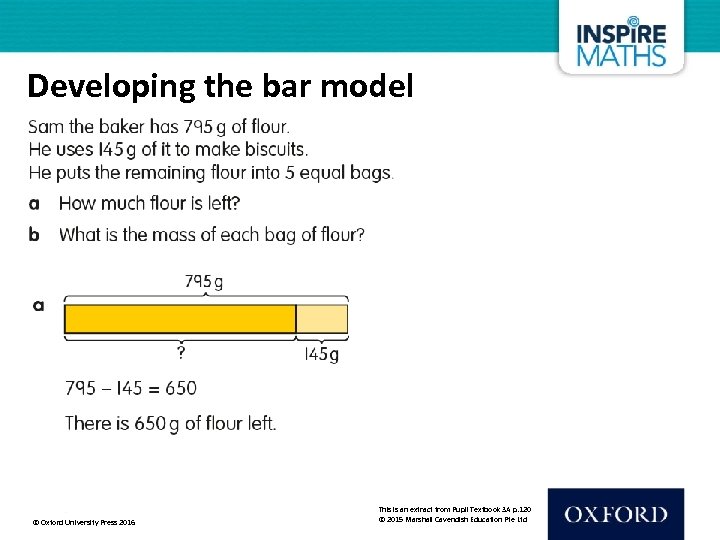 Developing the bar model © Oxford University Press 2016 This is an extract from Pupil Textbook 3 A p. 120 © 2015 Marshall Cavendish Education Pte Ltd
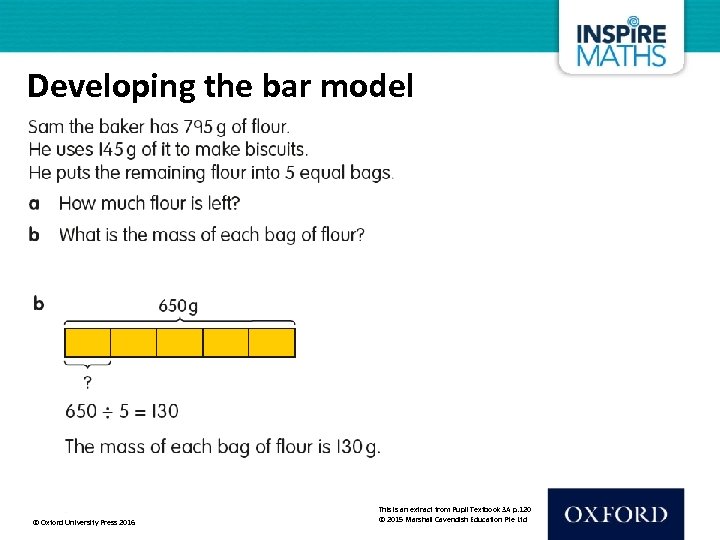 Developing the bar model © Oxford University Press 2016 This is an extract from Pupil Textbook 3 A p. 120 © 2015 Marshall Cavendish Education Pte Ltd
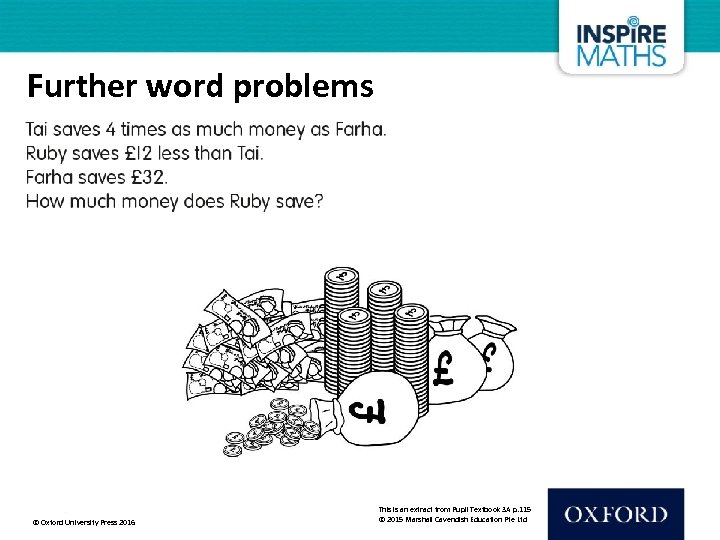 Further word problems © Oxford University Press 2016 This is an extract from Pupil Textbook 3 A p. 115 © 2015 Marshall Cavendish Education Pte Ltd
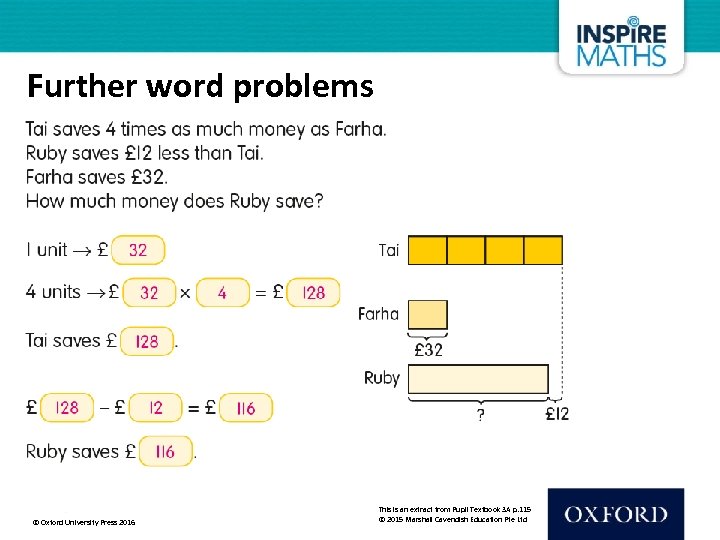 Further word problems © Oxford University Press 2016 This is an extract from Pupil Textbook 3 A p. 115 © 2015 Marshall Cavendish Education Pte Ltd
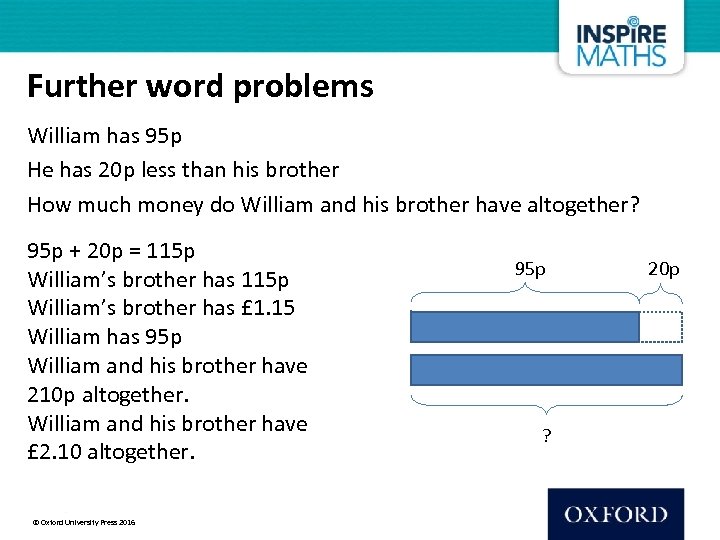 Further word problems William has 95 p He has 20 p less than his brother How much money do William and his brother have altogether? 95 p + 20 p = 115 p William’s brother has £ 1. 15 William has 95 p William and his brother have 210 p altogether. William and his brother have £ 2. 10 altogether. © Oxford University Press 2016 95 p ? 20 p
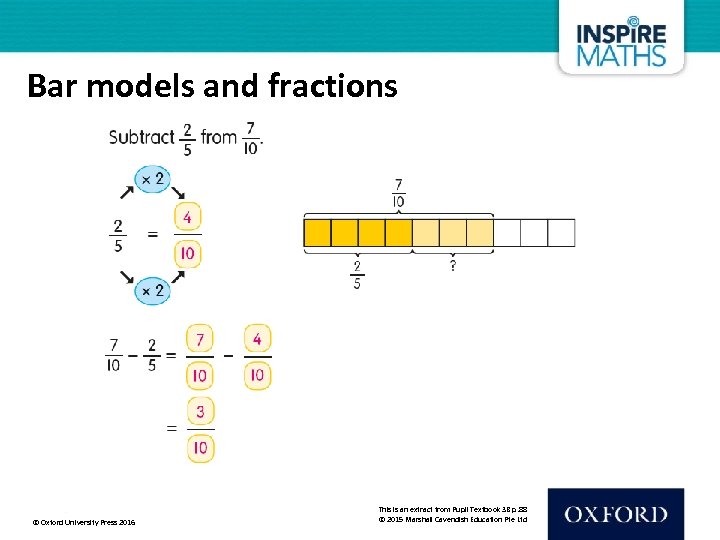 Bar models and fractions © Oxford University Press 2016 This is an extract from Pupil Textbook 3 B p. 88 © 2015 Marshall Cavendish Education Pte Ltd
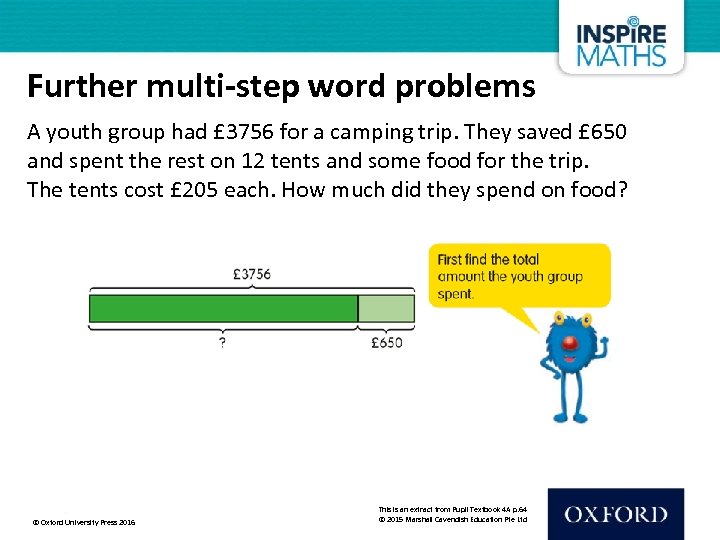 Further multi-step word problems A youth group had £ 3756 for a camping trip. They saved £ 650 and spent the rest on 12 tents and some food for the trip. The tents cost £ 205 each. How much did they spend on food? © Oxford University Press 2016 This is an extract from Pupil Textbook 4 A p. 64 © 2015 Marshall Cavendish Education Pte Ltd
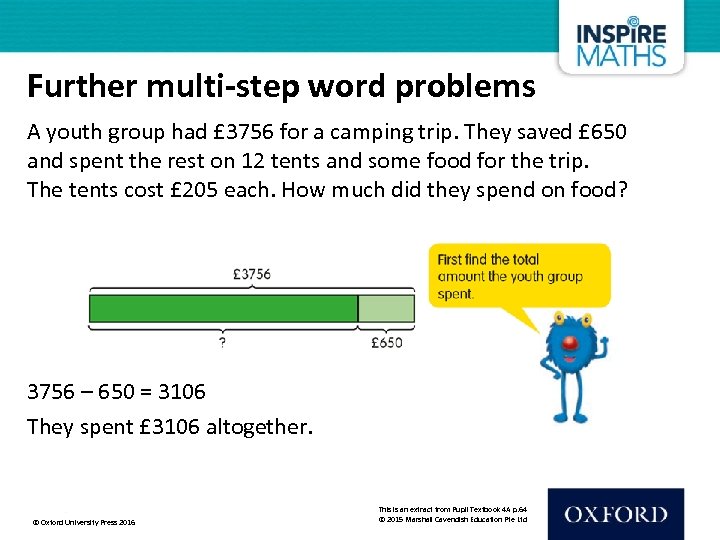 Further multi-step word problems A youth group had £ 3756 for a camping trip. They saved £ 650 and spent the rest on 12 tents and some food for the trip. The tents cost £ 205 each. How much did they spend on food? 3756 – 650 = 3106 They spent £ 3106 altogether. © Oxford University Press 2016 This is an extract from Pupil Textbook 4 A p. 64 © 2015 Marshall Cavendish Education Pte Ltd
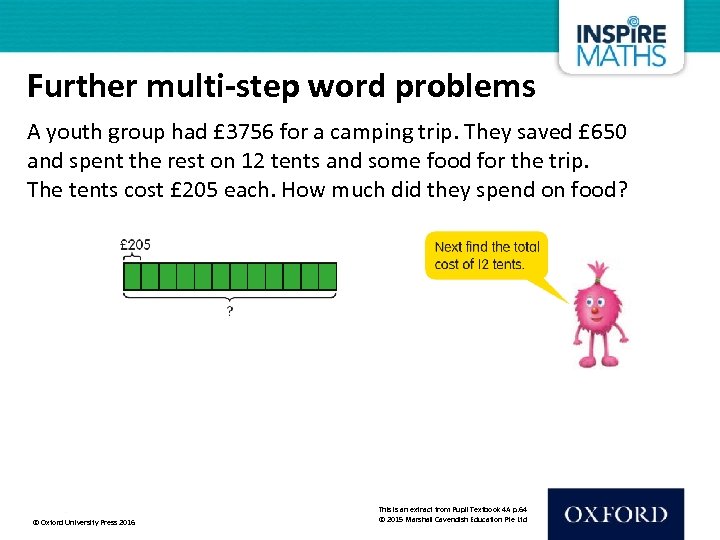 Further multi-step word problems A youth group had £ 3756 for a camping trip. They saved £ 650 and spent the rest on 12 tents and some food for the trip. The tents cost £ 205 each. How much did they spend on food? © Oxford University Press 2016 This is an extract from Pupil Textbook 4 A p. 64 © 2015 Marshall Cavendish Education Pte Ltd
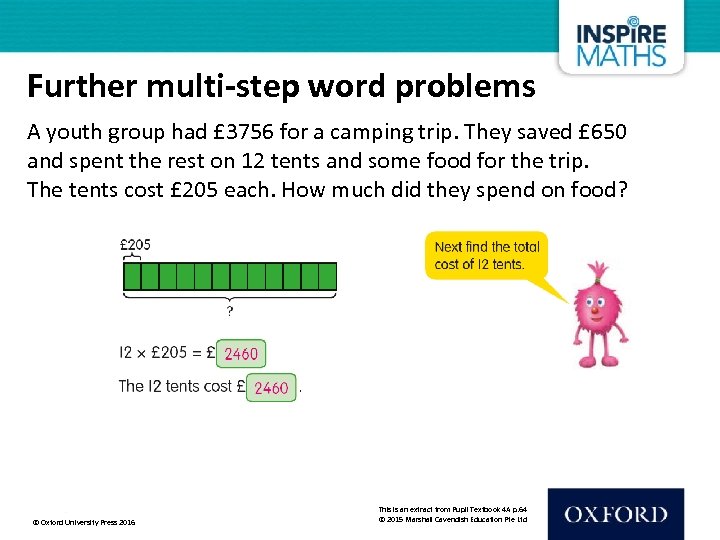 Further multi-step word problems A youth group had £ 3756 for a camping trip. They saved £ 650 and spent the rest on 12 tents and some food for the trip. The tents cost £ 205 each. How much did they spend on food? © Oxford University Press 2016 This is an extract from Pupil Textbook 4 A p. 64 © 2015 Marshall Cavendish Education Pte Ltd
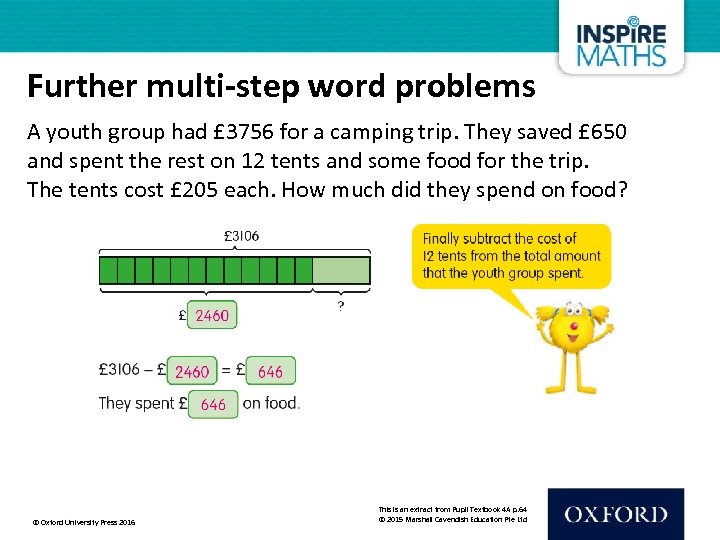 Further multi-step word problems A youth group had £ 3756 for a camping trip. They saved £ 650 and spent the rest on 12 tents and some food for the trip. The tents cost £ 205 each. How much did they spend on food? © Oxford University Press 2016 This is an extract from Pupil Textbook 4 A p. 64 © 2015 Marshall Cavendish Education Pte Ltd
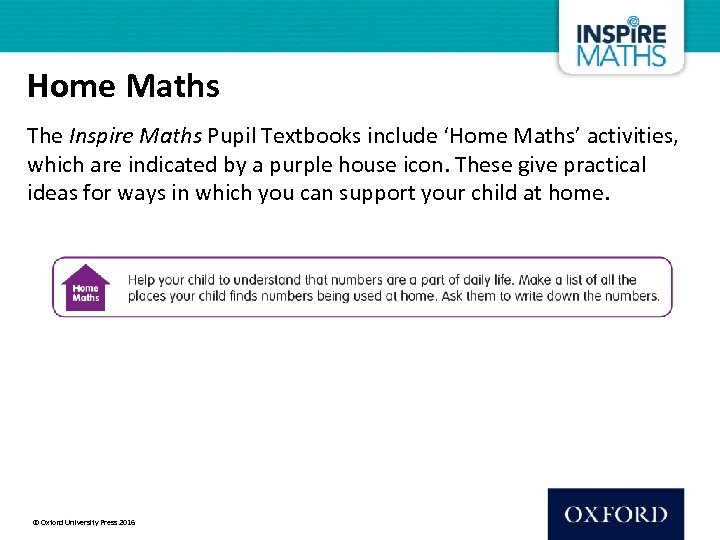 Home Maths The Inspire Maths Pupil Textbooks include ‘Home Maths’ activities, which are indicated by a purple house icon. These give practical ideas for ways in which you can support your child at home. © Oxford University Press 2016
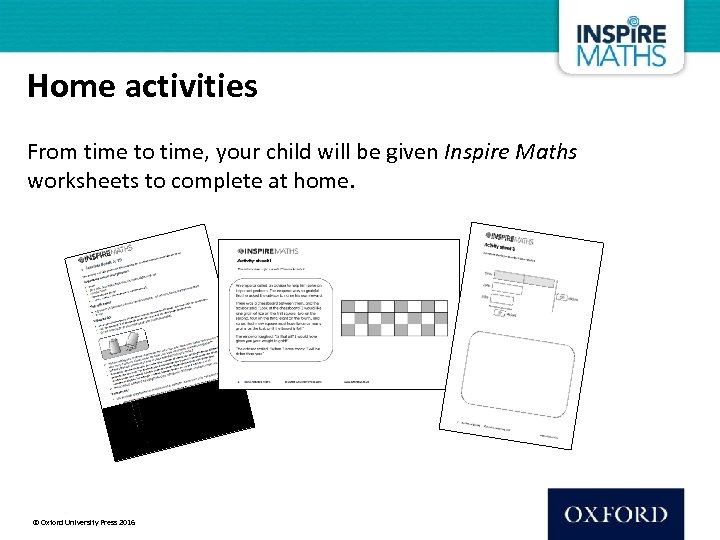 Home activities From time to time, your child will be given Inspire Maths worksheets to complete at home. © Oxford University Press 2016
 How can I help my child? You can help your child by finding and talking about maths in everyday situations. For example, a shopping trip is rich in mathematical opportunities, such as: • spending money, calculating change and working out which offers give the best value for money. • empty packaging can provide your child will immediate access to 3 D shapes and nets. • using packets and tins as a source of mathematical information to discuss, such as mass and volume. • using items often sold in pairs, fours and sixes (such as drinks or yogurts) to talk about multiples or times tables. © Oxford University Press 2016
 How can I help my child? You can also help your child in a number of other ways: • Encourage a secure knowledge of number, by asking questions which help them explain what comes before or after a given number, or how the number is made, for example tens and ones. • Encourage them to draw pictures and models such as part-whole and bar models to answer questions. • Support them with home activities, and encourage them to answer questions in full sentences. If you are unsure about any concepts, please ask your child’s teacher to explain how it is taught and how you can support your child. © Oxford University Press 2016