 Скачать презентацию INSOURCING Bringing Global Business Home Todd M Malan
46e4984e9d100c13b740509c98e25fb9.ppt
- Количество слайдов: 29



INSOURCING Bringing Global Business Home Todd M. Malan President & CEO Organization for International Investment tmalan@ofii. org February 26, 2006
About The Organization for International Investment (OFII) § OFII started 20 years ago to represent interests of U. S. subsidiaries of foreign companies § Over 140 members representing largest foreign companies in the U. S. § Organized to “lobby” like any other business group in Washington § Broad membership means “constituent” relationship with every Member of Congress § Mandate: Educate U. S. public and policymakers about positive economic contribution of U. S. subsidiaries and advocate non-discriminatory treatment
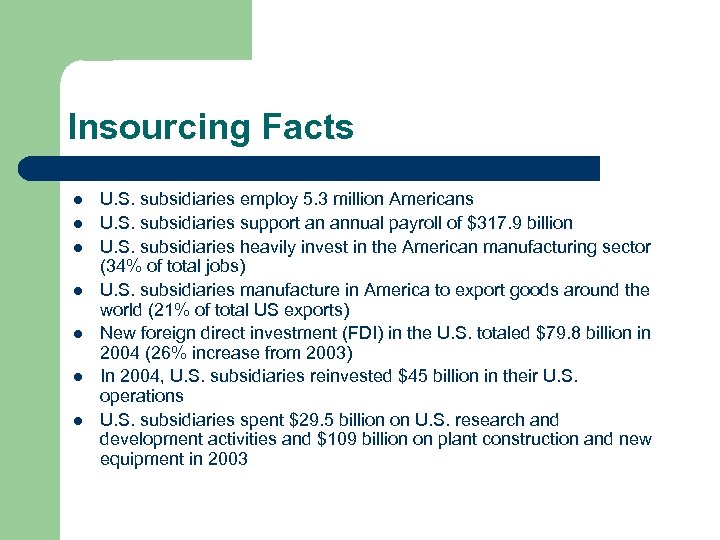
Insourcing Facts l l l l U. S. subsidiaries employ 5. 3 million Americans U. S. subsidiaries support an annual payroll of $317. 9 billion U. S. subsidiaries heavily invest in the American manufacturing sector (34% of total jobs) U. S. subsidiaries manufacture in America to export goods around the world (21% of total US exports) New foreign direct investment (FDI) in the U. S. totaled $79. 8 billion in 2004 (26% increase from 2003) In 2004, U. S. subsidiaries reinvested $45 billion in their U. S. operations U. S. subsidiaries spent $29. 5 billion on U. S. research and development activities and $109 billion on plant construction and new equipment in 2003
Insourcing Anecdotes l The U. S. Nestlé subsidiaries of the Switzerland-based food and beverage company, employ nearly 7200 people in California, with an annual payroll of $500 million l Saint Gobain Containers, a U. S. subsidiary of the France-based glass and building materials producer, operates a manufacturing facility in Muncie. The plant employs 5, 335 people to produce 10 billion glass containers annually. The subsidiary’s jars and bottles are used to store various foods and beverages, including apple juice and barbecue sauce. Many of Saint Gobain Containers’ products are made out of recycled glass.
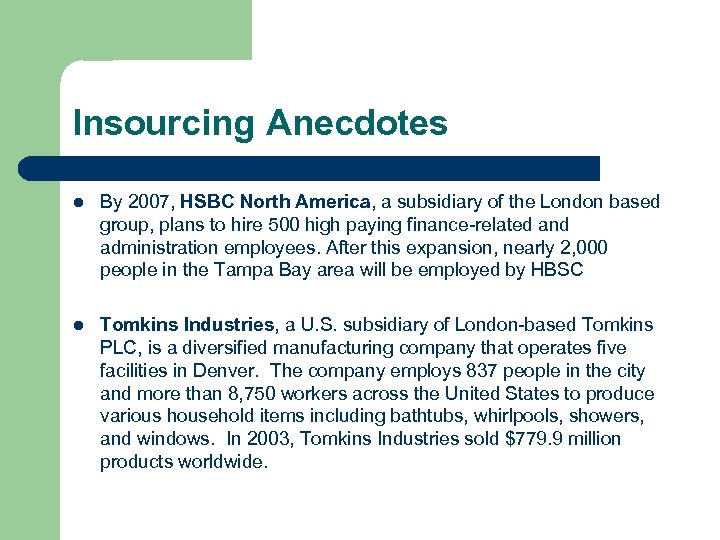
Insourcing Anecdotes l By 2007, HSBC North America, a subsidiary of the London based group, plans to hire 500 high paying finance-related and administration employees. After this expansion, nearly 2, 000 people in the Tampa Bay area will be employed by HBSC l Tomkins Industries, a U. S. subsidiary of London-based Tomkins PLC, is a diversified manufacturing company that operates five facilities in Denver. The company employs 837 people in the city and more than 8, 750 workers across the United States to produce various household items including bathtubs, whirlpools, showers, and windows. In 2003, Tomkins Industries sold $779. 9 million products worldwide.
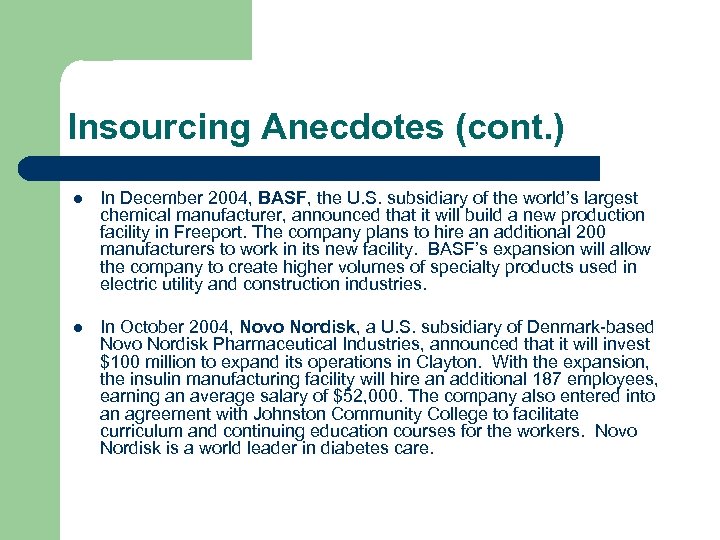
Insourcing Anecdotes (cont. ) l In December 2004, BASF, the U. S. subsidiary of the world’s largest chemical manufacturer, announced that it will build a new production facility in Freeport. The company plans to hire an additional 200 manufacturers to work in its new facility. BASF’s expansion will allow the company to create higher volumes of specialty products used in electric utility and construction industries. l In October 2004, Novo Nordisk, a U. S. subsidiary of Denmark-based Novo Nordisk Pharmaceutical Industries, announced that it will invest $100 million to expand its operations in Clayton. With the expansion, the insulin manufacturing facility will hire an additional 187 employees, earning an average salary of $52, 000. The company also entered into an agreement with Johnston Community College to facilitate curriculum and continuing education courses for the workers. Novo Nordisk is a world leader in diabetes care.
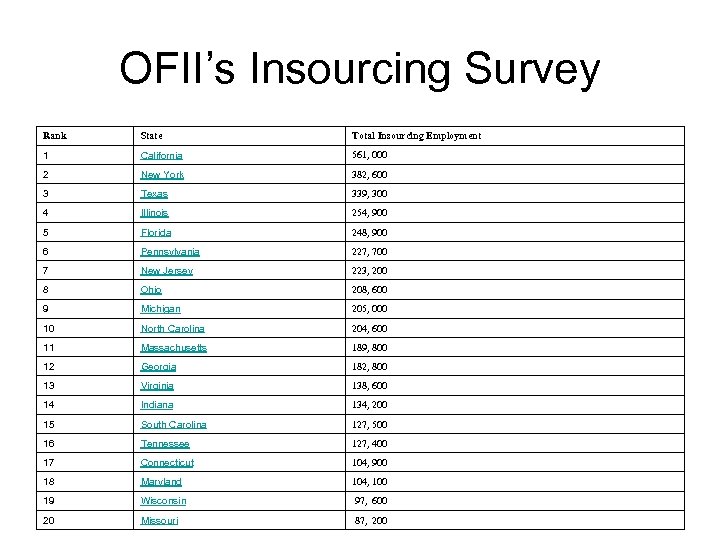
OFII’s Insourcing Survey Rank State Total Insourcing Employment 1 California 561, 000 2 New York 382, 600 3 Texas 339, 300 4 Illinois 254, 900 5 Florida 248, 900 6 Pennsylvania 227, 700 7 New Jersey 223, 200 8 Ohio 208, 600 9 Michigan 205, 000 10 North Carolina 204, 600 11 Massachusetts 189, 800 12 Georgia 182, 800 13 Virginia 138, 600 14 Indiana 134, 200 15 South Carolina 127, 500 16 Tennessee 127, 400 17 Connecticut 104, 900 18 Maryland 104, 100 19 Wisconsin 97, 600 20 Missouri 87, 200
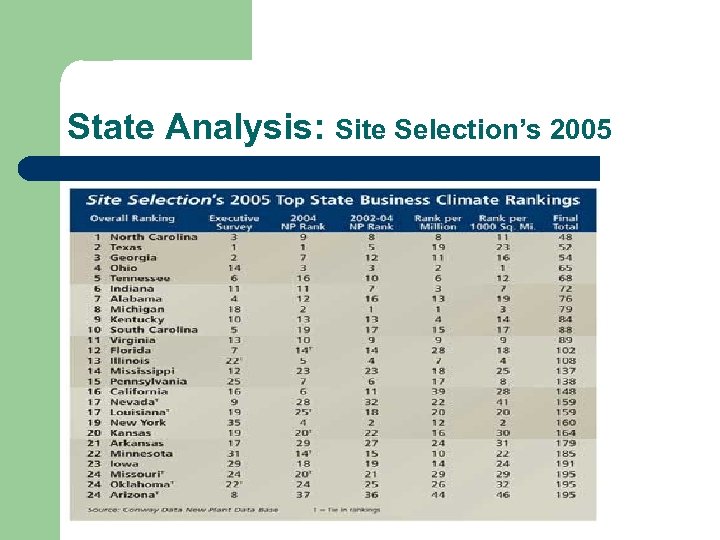
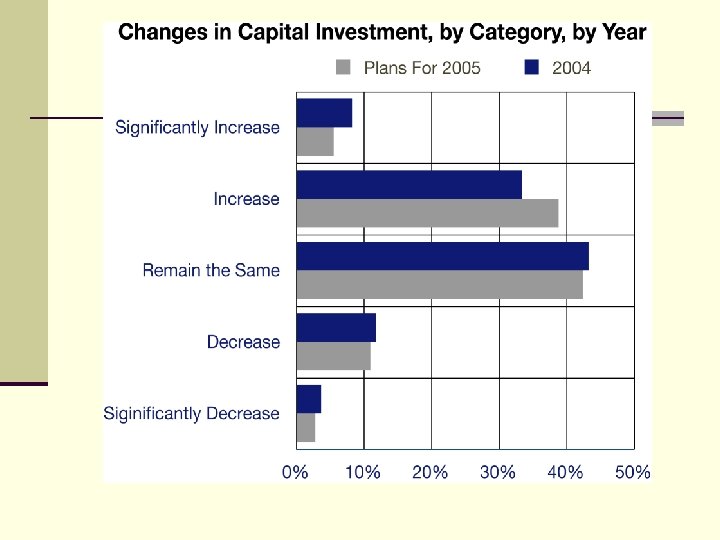
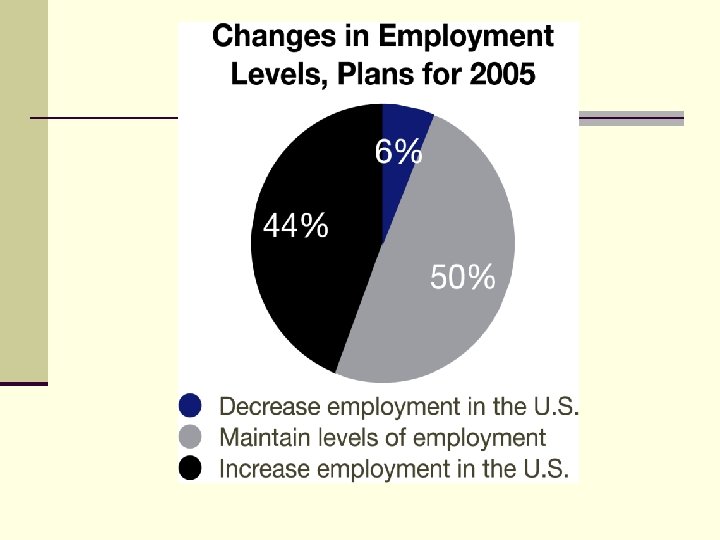
State Analysis: Site Selection’s 2005
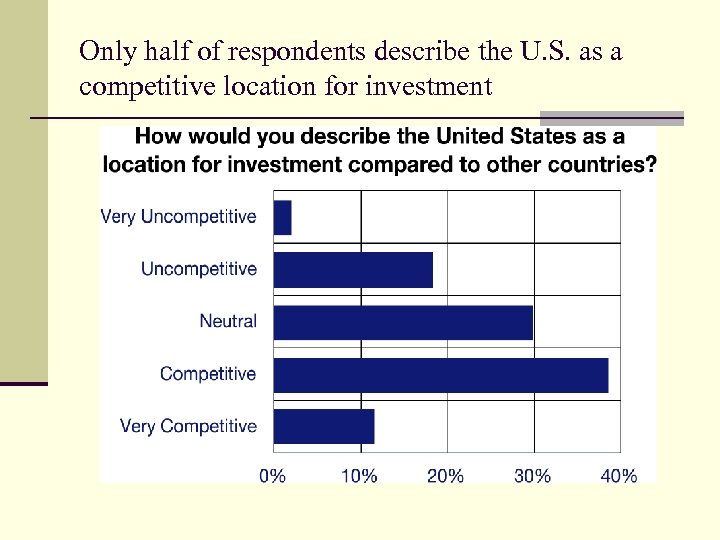
Only half of respondents describe the U. S. as a competitive location for investment
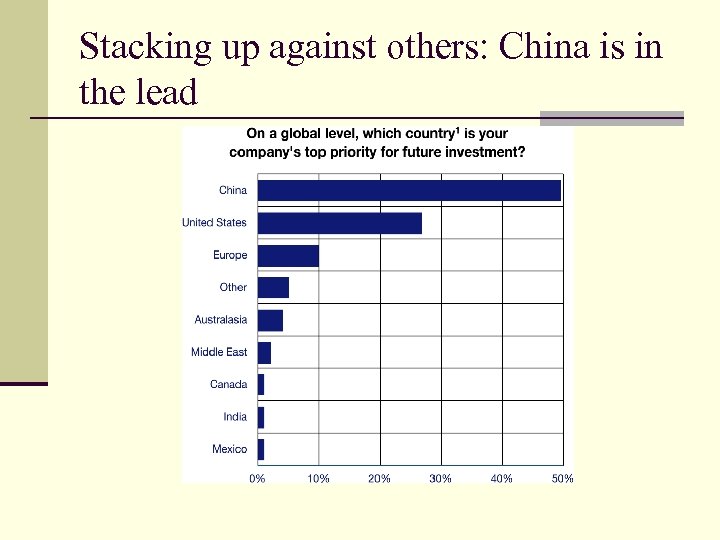
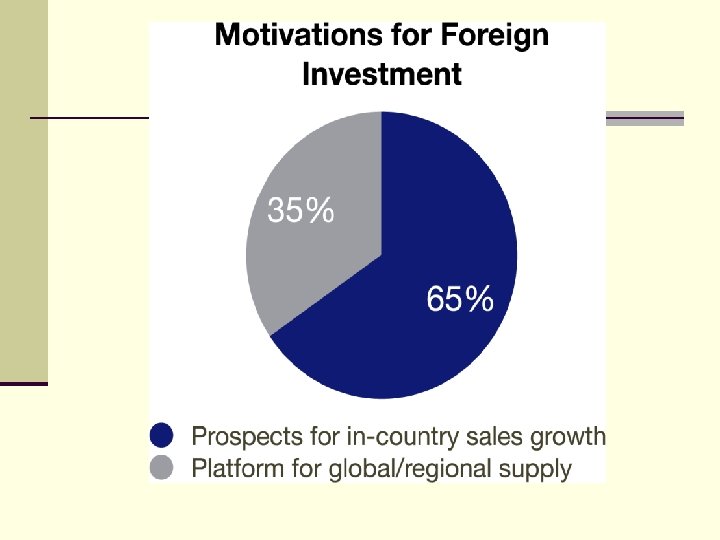
Stacking up against others: China is in the lead
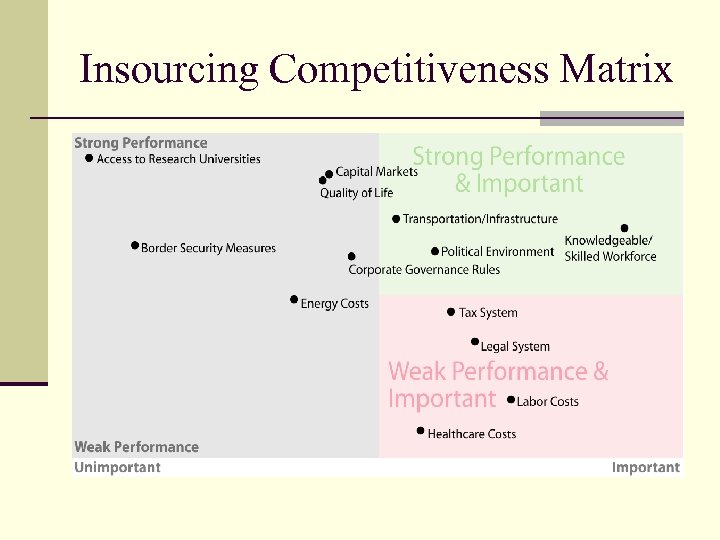
Insourcing Competitiveness Matrix
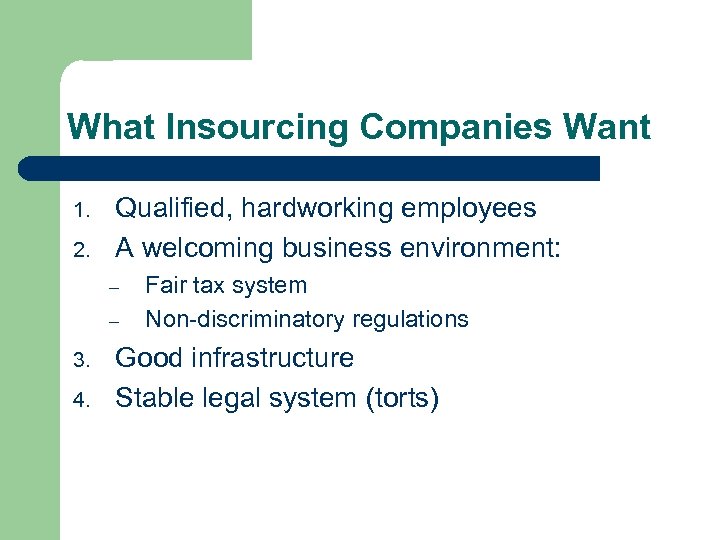
What Insourcing Companies Want 1. 2. Qualified, hardworking employees A welcoming business environment: – – 3. 4. Fair tax system Non-discriminatory regulations Good infrastructure Stable legal system (torts)
Nebraska Mechatronics Education Network The Center for Mechatronics Education Excellence Central Support Facility at Central Community College Columbus, Nebraska
Reinforce the Competitiveness of the U. S. Manufacturing Base Festo Corporation’s Call for a Joint Initiative • Maintaining the Manufacturing Base in the U. S. is Keeping America Competitive • Manufacturing Skills Crisis – A National Challenge • Shifting Manufacturing Facilities to China – the Right Answer?
U. S. Manufacturers – Challenged by Global Competition, Advances in Technologies, Demographics and Skills Crisis Global pressures are squeezing the U. S. manufacturers as they face brutal competition from around the world. To continue to succeed, U. S. manufacturers must compete less on cost than on product design, productivity, flexibility, quality and responsiveness to customer needs. These competitive mandates put a high premium on the skills, morale and commitment of workers.
U. S. Manufacturers – Challenged by Global Competition, Advances in Technologies, Demographics and Skills Crisis Relentless advances in technology have infused every aspect of manufacturing - from design and production to inventory management, delivery and service. Today’s manufacturing jobs are technology jobs, and employees at all levels must have the wide range of skills required to respond to the demands of an increasingly complex environment. “START at Home” Manufacturing jobs are high paid, skilled white collar jobs.
U. S. Manufacturers – Challenged by Global Competition, Advances in Technologies, Demographics and Skills Crisis Demographic shifts portend great change ahead. The “baby boom generation” of skilled workers will be retired within the next 15 to 20 years. The result is a projected need for 10 million new skilled workers by 2020. There will be 4 countries in 30 years from now who will be able to maintain a healthy workforce level for manufacturing; 1. India 2. USA 3. Brazil 4. Mexico
U. S. Manufacturers – Challenged by Global Competition, Advances in Technologies, Demographics and Skills Crisis A long-term manufacturing employment and skills crisis is developing. The loss of more than 2 million manufacturing jobs during the recent recession and anemic recovery masks a looming shortage of highly skilled, technically competent employees who can fully exploit the potential of new technologies and support increased product complexity.
U. S. Manufacturers – Challenged by Global Competition, Advances in Technologies, Demographics and Skills Crisis Manufacturers confront persistent skills shortages in an Uncertain Economy. More than 80 percent of the surveyed manufacturers reported a “moderate to serious” shortage of qualified job applicants even though manufacturing was suffering serious layoffs. In sum, what manufacturing is facing is not a lack of employees, but a shortfall of highly qualified employees with specific educational backgrounds and skills.
Meeting the National Challenge of the Rising Manufacturing Skills Crisis At the Image Front ¢ ¢ Manufacturing grants a major part of our growth incl. R &D Jobs on the floor are changing from blue collar to white collar High skill levels are needed by 2010 80% of skilled workforce missing Excellently paid jobs / careers in manufacturing, production in the future
Meeting the National Challenge of the Rising Manufacturing Skills Crisis At the Education & Research Front ¢ ¢ ¢ High School Awareness Program start with FIRST Robotics Competition & Skills. USA Mechatronics Competition Community colleges implement a “must be” curriculum to increase the value and to improve manufacturing programs Centers for Mechatronics Excellence, incl. Apprenticeship programs Universities & research institutes create a national manufacturing research agenda
Example: State of Nebraska Joint Effort: ¢ Local Industry (will use the facility and curricula to educate their workforce) ¢ One community college will take the lead (Hardware and software will be used virtually by other colleges via the internet & intranet. ) ¢ ¢ ¢ Commissioner of labor has topic on highest priority Curricula are already existing and sponsored Project experience supplied through Festo
Nebraska Mechatronics Education Network Overall objectives: • To provide enhanced consulting services through the Central Community College to (small and medium-size) industrial companies with regard to motion control and Mechatronic concepts • To assist NE colleges /high schools / in-company training units in networking Ø nation-wide with educational institutes in other states Ø Internationally with educational institutes / counterparts in other countries, such as Mexico, Germany, China • To provide a platform for joint pilot projects in industrial manufacturing (discrete production and automation of continuous processes)
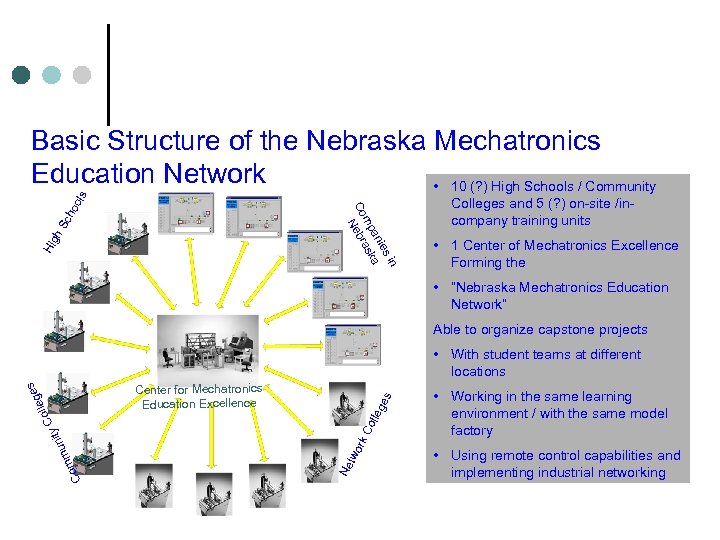
Hi gh Sc ho in ies an a mp ask Co ebr N ols Basic Structure of the Nebraska Mechatronics Education Network • 10 (? ) High Schools / Community Colleges and 5 (? ) on-site /incompany training units • 1 Center of Mechatronics Excellence Forming the • “Nebraska Mechatronics Education Network” Able to organize capstone projects two rk Co lleg es Center for Mechatronics Education Excellence Ne C lleg Co nity mu om es • With student teams at different locations • Working in the same learning environment / with the same model factory • Using remote control capabilities and implementing industrial networking
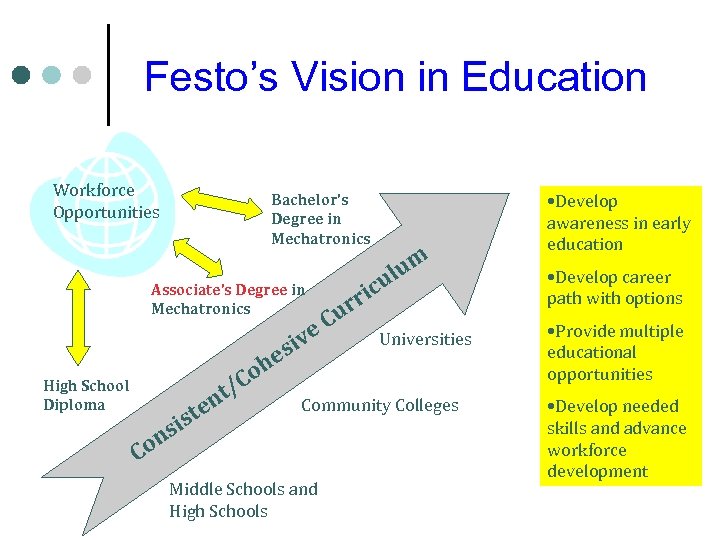
Festo’s Vision in Education Workforce Opportunities Bachelor’s Degree in Mechatronics Associate’s Degree in Mechatronics oh t/C n te sis High School Diploma ive es ur C ric m u ul Universities Community Colleges on C Middle Schools and High Schools • Develop awareness in early education • Develop career path with options • Provide multiple educational opportunities • Develop needed skills and advance workforce development
Todd M. Malan President & CEO Organization for International Investment 1225 19 th Street, NW Suite 501 Washington, DC 20036 (202) 659 -1903 (Phone) (202) 659 -2293 (Fax) tmalan@ofii. org
Скачать презентацию INSOURCING Bringing Global Business Home Todd M Malan
46e4984e9d100c13b740509c98e25fb9.ppt