


 Скачать презентацию INSOLVENCY LECTURE 6 LAW EXTENSION COMMITTEE Last revised
8fa109e3b8ca79303604fc4aa264be0b.ppt
- Количество слайдов: 29
 INSOLVENCY LECTURE 6 LAW EXTENSION COMMITTEE Last revised 22 May 2011 1
 THIS LECTURE • Void transactions (continued from Lecture 5) – s 139 ZQ Notices • Termination of a bankruptcy – Discharge after 3 years – Annulment • Personal insolvency agreements • Debt agreements • Cross-Border Insolvency 2
 NOTICES UNDER S 139 ZQ • • Section 139 ZQ provides an administrative recovery process for a trustee to make a claim based upon ss 120, 121 or 122. The Official Receiver, on behalf of the trustee, can recover property disposed of by a bankrupt in a transaction which is void against the trustee. A notice pursuant to s. 139 ZQ must set out the facts and circumstances which have satisfied the Official Receiver that the transaction referred to in the notice is void against the trustee. A notice may require the recipient to pay the amount claimed within a prescribed time. A notice results in the property being charged with the liability of the recipient of the notice to make payments to the trustee as required by the notice. The trustee has the right to sell any property over which the charge created by the sending of the notice exists. If the party who has been served with a notice refuses or fails to comply with the notice, that party is guilty of an offence which is punishable by imprisonment for a period not exceeding six months – s. 139 ZT. 3
 NOTICES UNDER S 139 ZQ • • • A person who receives a notice may apply to the court to set aside the notice – s. 139 ZS. The court conducts a hearing de novo to investigate and decide whether the facts and circumstances stated in the notice are correct and whether any defence to the liability arises from additional facts provided by the recipient of the notice. The trustee bears the onus of proof in relation to a claim that a transaction is void, however the recipient of the notice must call sufficient evidence to call the validity of the notice into question. When the recipient applies to the court for the setting aside of a notice, the trustee may cross-claim by applying for a declaration that the transaction was void against the trustee. The demand procedure often produces payment or a negotiated settlement without litigation. [Keays 146 -150] 4
![NOTICES UNDER S 139 ZQ Vale v Sutherland [2009] HCA 26 1. The Official](https://present5.com/presentation/8fa109e3b8ca79303604fc4aa264be0b/image-5.jpg "NOTICES UNDER S 139 ZQ Vale v Sutherland [2009] HCA 26 1. The Official") NOTICES UNDER S 139 ZQ Vale v Sutherland [2009] HCA 26 1. The Official Receiver issued a notice under s. 139 ZQ of the Bankruptcy Act asserting that certain property transactions were void under s. 120 of the Act. The values of the relevant properties were incorrectly stated in the Notice. 5
NOTICES UNDER S 139 ZQ Vale v Sutherland [2009] HCA 26 1. The Official Receiver issued a notice under s. 139 ZQ of the Bankruptcy Act asserting that certain property transactions were void under s. 120 of the Act. The values of the relevant properties were incorrectly stated in the Notice. 5
 TERMINATION OF BANKRUPTCY - DISCHARGE - S 149 Automatic discharge (1) Subject to section 149 A, a bankrupt is, by force of this subsection, discharged from bankruptcy in accordance with this section. ……………. . (4) If the bankrupt becomes a bankrupt after the commencement of section 27 of the Bankruptcy Amendment Act 1991, the bankrupt is discharged at the end of the period of 3 years from the date on which the bankrupt filed his or her statement of affairs. 6
 BANKRUPTCY EXTENDED UPON OBJECTION - S 149 B Objection to discharge (1) Subject to the following provisions of this Subdivision, at any time before a bankrupt is discharged from bankruptcy under section 149, the trustee may file with the Official Receiver a written notice of objection to the discharge. (2) The trustee of a bankrupt’s estate must file a notice of objection to the discharge if the trustee believes: (a) that doing so will help make the bankrupt discharge a duty that the bankrupt has not discharged; and (b) that there is no other way for the trustee to induce the bankrupt to discharge any duties that the bankrupt has not discharged. 7
 GROUNDS OF OBJECTION - S 149 D Grounds of objection (1) The grounds of objection that may be set out in a notice of objection are as follows: (a) the bankrupt has, whether before, on or after the date of the bankruptcy, left Australia and has not returned to Australia; (aa) any transfer is void against the trustee in the bankruptcy because of section 120 or 122; (ab) any transfer is void against the trustee in the bankruptcy because of section 121; (ac) any transfer is void against the trustee in the bankruptcy because of section 128 B; (ad) any transfer is void against the trustee in the bankruptcy because of section 128 C; (b) after the date of the bankruptcy, the bankrupt contravened section 206 A of the Corporations Act 2001 (disqualification from managing corporations); (c) after the date of the bankruptcy the bankrupt engaged in misleading conduct in relation to a person in respect of an amount that, or amounts the total of which, exceeded $3, 000; 8
 GROUNDS OF OBJECTION (d) the bankrupt, when requested in writing by the trustee to provide written information about the bankrupt’s property, income or expected income, failed to comply with the request; (da) after the date of the bankruptcy, the bankrupt intentionally provided false or misleading information to the trustee; (e) the bankrupt failed to disclose any particulars of income or expected income as required by a provision of this Act referred to in subsection 6 A(1) or by section 139 U; (f) the bankrupt failed to pay to the trustee an amount that the bankrupt was liable to pay under section 139 ZG; (g) at any time during the period of 5 years immediately before the commencement of the bankruptcy, or at any time during the bankruptcy, the bankrupt: (i) spent money but failed to explain adequately to the trustee the purpose for which the money was spent; or (ii) disposed of property but failed to explain adequately to the trustee why no money was received as a result of the disposal or what the bankrupt did with the money received as a result of the disposal; 9
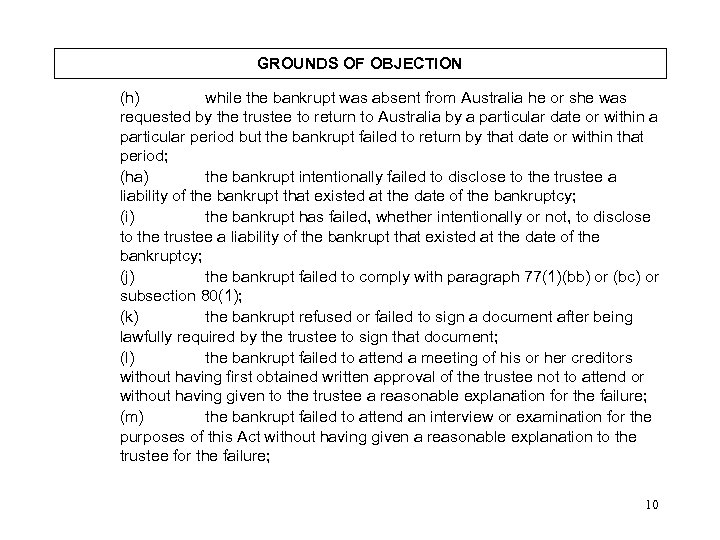 GROUNDS OF OBJECTION (h) while the bankrupt was absent from Australia he or she was requested by the trustee to return to Australia by a particular date or within a particular period but the bankrupt failed to return by that date or within that period; (ha) the bankrupt intentionally failed to disclose to the trustee a liability of the bankrupt that existed at the date of the bankruptcy; (i) the bankrupt has failed, whether intentionally or not, to disclose to the trustee a liability of the bankrupt that existed at the date of the bankruptcy; (j) the bankrupt failed to comply with paragraph 77(1)(bb) or (bc) or subsection 80(1); (k) the bankrupt refused or failed to sign a document after being lawfully required by the trustee to sign that document; (l) the bankrupt failed to attend a meeting of his or her creditors without having first obtained written approval of the trustee not to attend or without having given to the trustee a reasonable explanation for the failure; (m) the bankrupt failed to attend an interview or examination for the purposes of this Act without having given a reasonable explanation to the trustee for the failure; 10
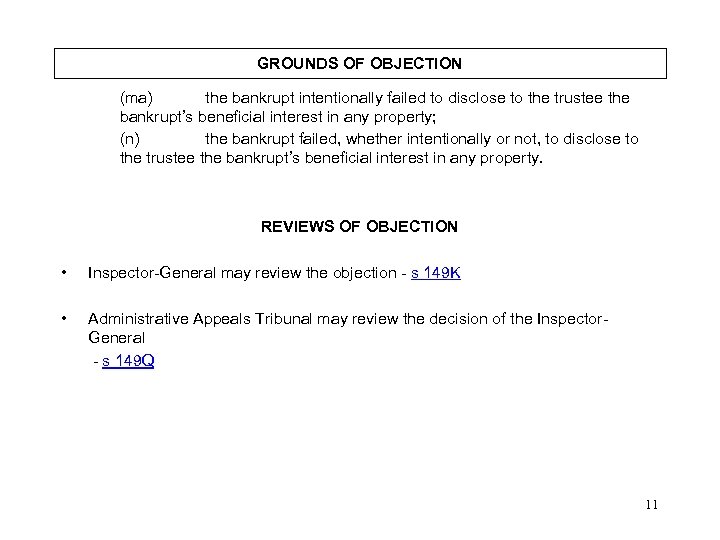 GROUNDS OF OBJECTION (ma) the bankrupt intentionally failed to disclose to the trustee the bankrupt’s beneficial interest in any property; (n) the bankrupt failed, whether intentionally or not, to disclose to the trustee the bankrupt’s beneficial interest in any property. REVIEWS OF OBJECTION • Inspector-General may review the objection - s 149 K • Administrative Appeals Tribunal may review the decision of the Inspector. General - s 149 Q 11
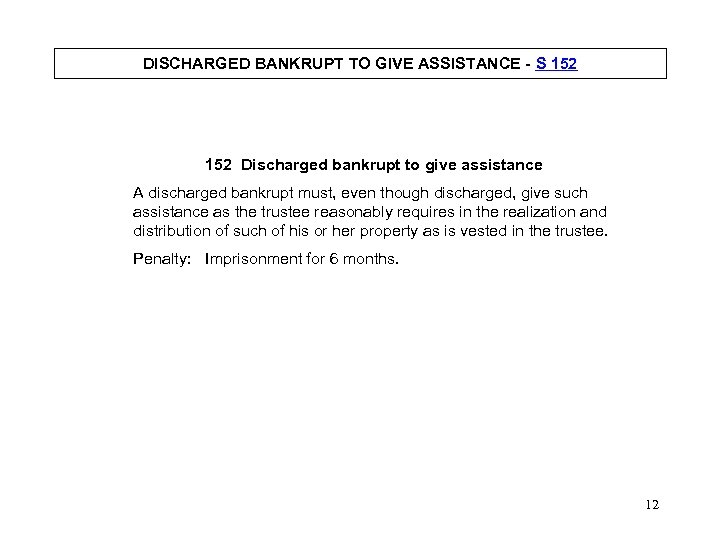 DISCHARGED BANKRUPT TO GIVE ASSISTANCE - S 152 Discharged bankrupt to give assistance A discharged bankrupt must, even though discharged, give such assistance as the trustee reasonably requires in the realization and distribution of such of his or her property as is vested in the trustee. Penalty: Imprisonment for 6 months. 12
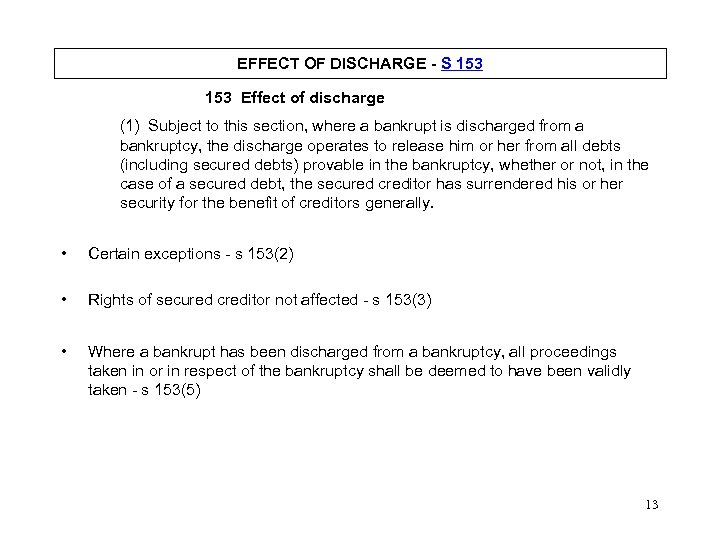 EFFECT OF DISCHARGE - S 153 Effect of discharge (1) Subject to this section, where a bankrupt is discharged from a bankruptcy, the discharge operates to release him or her from all debts (including secured debts) provable in the bankruptcy, whether or not, in the case of a secured debt, the secured creditor has surrendered his or her security for the benefit of creditors generally. • Certain exceptions - s 153(2) • Rights of secured creditor not affected - s 153(3) • Where a bankrupt has been discharged from a bankruptcy, all proceedings taken in or in respect of the bankruptcy shall be deemed to have been validly taken - s 153(5) 13
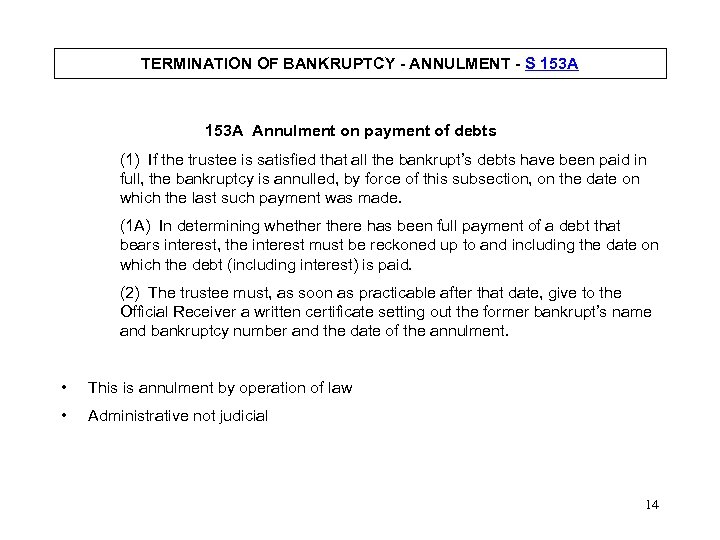 TERMINATION OF BANKRUPTCY - ANNULMENT - S 153 A Annulment on payment of debts (1) If the trustee is satisfied that all the bankrupt’s debts have been paid in full, the bankruptcy is annulled, by force of this subsection, on the date on which the last such payment was made. (1 A) In determining whethere has been full payment of a debt that bears interest, the interest must be reckoned up to and including the date on which the debt (including interest) is paid. (2) The trustee must, as soon as practicable after that date, give to the Official Receiver a written certificate setting out the former bankrupt’s name and bankruptcy number and the date of the annulment. • This is annulment by operation of law • Administrative not judicial 14
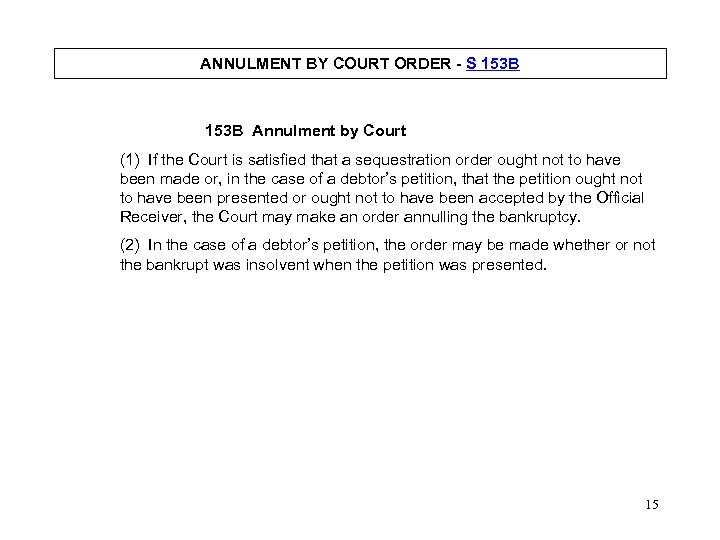 ANNULMENT BY COURT ORDER - S 153 B Annulment by Court (1) If the Court is satisfied that a sequestration order ought not to have been made or, in the case of a debtor’s petition, that the petition ought not to have been presented or ought not to have been accepted by the Official Receiver, the Court may make an order annulling the bankruptcy. (2) In the case of a debtor’s petition, the order may be made whether or not the bankrupt was insolvent when the petition was presented. 15
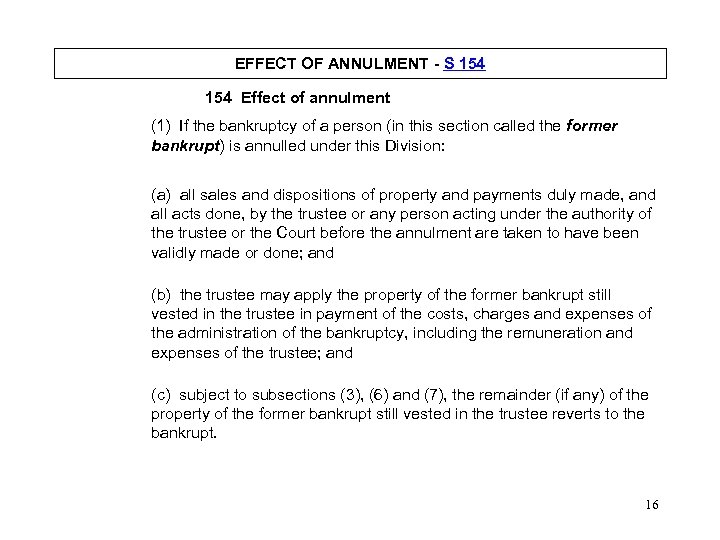 EFFECT OF ANNULMENT - S 154 Effect of annulment (1) If the bankruptcy of a person (in this section called the former bankrupt) is annulled under this Division: (a) all sales and dispositions of property and payments duly made, and all acts done, by the trustee or any person acting under the authority of the trustee or the Court before the annulment are taken to have been validly made or done; and (b) the trustee may apply the property of the former bankrupt still vested in the trustee in payment of the costs, charges and expenses of the administration of the bankruptcy, including the remuneration and expenses of the trustee; and (c) subject to subsections (3), (6) and (7), the remainder (if any) of the property of the former bankrupt still vested in the trustee reverts to the bankrupt. 16
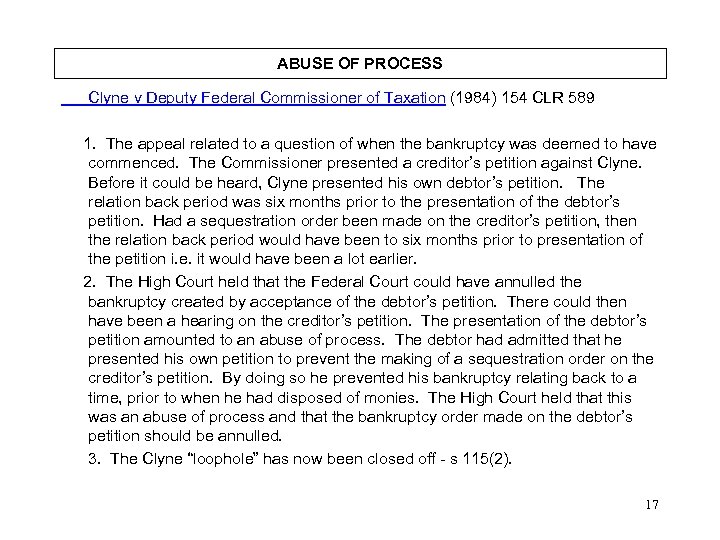 ABUSE OF PROCESS Clyne v Deputy Federal Commissioner of Taxation (1984) 154 CLR 589 1. The appeal related to a question of when the bankruptcy was deemed to have commenced. The Commissioner presented a creditor’s petition against Clyne. Before it could be heard, Clyne presented his own debtor’s petition. The relation back period was six months prior to the presentation of the debtor’s petition. Had a sequestration order been made on the creditor’s petition, then the relation back period would have been to six months prior to presentation of the petition i. e. it would have been a lot earlier. 2. The High Court held that the Federal Court could have annulled the bankruptcy created by acceptance of the debtor’s petition. There could then have been a hearing on the creditor’s petition. The presentation of the debtor’s petition amounted to an abuse of process. The debtor had admitted that he presented his own petition to prevent the making of a sequestration order on the creditor’s petition. By doing so he prevented his bankruptcy relating back to a time, prior to when he had disposed of monies. The High Court held that this was an abuse of process and that the bankruptcy order made on the debtor’s petition should be annulled. 3. The Clyne “loophole” has now been closed off - s 115(2). 17
 OTHER MEANS OF ANNULMENT UNDER S 74 • • • Under s 73(1) a bankrupt may propose a composition in satisfaction of his debts or a scheme of arrangement in relation to his affairs The creditors may by special resolution accept the proposal - s 73(3) Upon the passing of the special resolution the bankruptcy is annulled - s 74(5) 18
 PERSONAL INSOLVENCY AGREEMENTS Part X • • S 188 A - Debtor puts forward a proposed agreement S 204 - Meeting of creditors decides whether to accept it S 190 - Trustee administers the agreement Dividend paid to creditors S 230 - debtor is then discharged from all liability 2007 reforms required greater disclosure Now little used - about 1% of all personal insolvencies 19
 DEBT AGREEMENTS Part IX • • • Only available to debtors with limited assets and limited income and smaller debts (< $100, 000) - s 185 C [n. b. these thresholds are being raised by the 2010 amendments] Majority of creditors must accept the debtor’s proposal - s 185 E Proposal is recorded on National Personal Insolvency Index (NPII) - debtor then protected from creditors Upon completion of agreement, debtor released from provable debts - s 185 NA Now about 20% of all personal insolvencies 20
 CROSS-BORDER INSOLVENCY • In May 1997 the United Nations Commission on International Trade Law (UNCITRAL) adopted a Model Law on Cross-Border insolvency. • The Model Law has since been adopted throughout Europe and also in Great Britain, Japan, the United States, Canada and New Zealand. • The Cross-Border Insolvency Act 2008 (Cth) provides that the UNCITRAL Model Law, as modified by the Act, is to take effect as a law of Australia. The UNCITRAL Model Law is a schedule to the Act. 21
 OPERATION OF THE MODEL LAW • It provides access to Australian courts to a person administering a foreign insolvency proceeding, for the purpose of seeking a temporary stay of proceedings in Australia against assets of an insolvent debtor. • It permits a foreign representative to commence an insolvency proceeding in Australia where the debtor is subject to a foreign proceeding, and participate in an Australian insolvency proceeding in relation to that debtor. • It allows foreign creditors the same rights as Australian domiciled creditors regarding the commencement of and participation in insolvency proceedings in Australia. • It applies the concept of “Centre of Main Interest” to allow a court to determine whether a proceeding is a “Foreign Main Proceedings” or a “Foreign Non-Main Proceeding”. 22
 INTERPRETATION OF MODEL LAW • International jurisprudence in interpreting and dealing with the Model Law will assist Australian courts to interpret it. • In Re Betcorp Limited (In Liquidation) 400 B. R. 266 - the US Bankruptcy Court gave judgment in favour of an Australian liquidator in a Cross Border Insolvency proceeding under Chapter 15 of the US Bankruptcy Code. The Australian voluntary winding up was recognised in the US as a “foreign main proceeding” - see article. 23
 THE AUSTRALIAN ELEMENTS INTRODUCED • The Model Law operates in relation to both personal and corporate insolvency i. e. the Bankruptcy Act 1966 and Chapter 5 of the Corporations Act 2001; • Banks and insurance companies are exempted from the operation of the Model Law by regulation. • The Federal Court of Australia has exclusive jurisdiction in proceedings under the Model Law relating to individual debtors (i. e. bankruptcy). • Both the Federal Court and the State Supreme Courts have jurisdiction under the Model Law in relation to corporate insolvency. • A reference to a person or body administering a re-organisation or liquidation under the laws of Australia is taken to be a reference to the trustee in bankruptcy or the registered liquidator. 24
 FOREIGN MAIN PROCEEDING • If a foreign proceeding is recognised, the Australian court will determine whether it is a foreign main proceeding or a foreign non-main proceeding. • Where does the debtor have its centre of main interest or where does the debtor have a place of operation? • If a proceeding is a foreign main proceeding, insolvency is presumed and the Model Law allows for a stay in the same terms as an Australian stay in insolvency. 25
 CONCURRENT PROCEEDINGS • After recognition of a foreign main proceeding, the commencement of an Australian proceeding against the debtor will be prevented unless the debtor has assets in Australia and provided the action is limited to the assets of the debtor in Australia. • The Australian court is to co-operate to the maximum extent possible with foreign courts or foreign representatives and is permitted to communicate directly with them. • The trustee in bankruptcy and a registered liquidator must co-operate to the maximum extent possible with foreign courts and foreign representatives, subject to the supervision of the Australian court. 26
 JUDICIAL CONSIDERATION OF THE MODEL LAW • “Cross Border Insolvency - Co-operation or Conflict? ” - address by Spigelman CJ, 16 September 2008. • Hur v Samsun Logics Corporation [2009] FCA 372 - Korean insolvency proceedings were recognised as a foreign proceeding and as a foreign main proceeding pursuant to the Model Law. • Tucker v Aero Inventory (UK) Ltd (No. 2) [2009] FCA 1481 - proceedings in the High Court of Justice of England Wales, in which the plaintiffs were appointed joint administrators of the defendant, were recognised as a foreign proceeding and a foreign main proceeding pursuant to the Model Law. • Katayama v Japan Airlines Corporation [2010] FCA 794 - Japanese insolvency proceedings were recognised as a foreign main proceeding. The administration and realisation of all of the defendants’ assets located in Australia was entrusted to the plaintiffs. 27
![Katayama v Japan Airlines Corporation [2010] FCA 794 • Japan Airlines had applied in](https://present5.com/presentation/8fa109e3b8ca79303604fc4aa264be0b/image-28.jpg "Katayama v Japan Airlines Corporation [2010] FCA 794 • Japan Airlines had applied in") Katayama v Japan Airlines Corporation [2010] FCA 794 • Japan Airlines had applied in the Tokyo District Court for a corporate reorganisation under Japanese law • Mr Katayama had expensive experience in both Japanese and US corporate bankruptcy law • The Federal Court was satisfied that : – Mr Katayama was a foreign representative within the meaning of the Model Law – the Japanese proceeding was a foreign proceeding within the meanng of the Model Law – the corporate headquarters and principal place of business was in Japan, and the majority of assets, creditors and debtors were located in Japan, thus the Japanese proceeding was a foreign main proceeding within the meaning of the Model Law • The Federal Court held that it was appropriate to make orders that the administration and realisation of all JAL’s assets located in Australia be entrusted to Mr Katayama. 28
Katayama v Japan Airlines Corporation [2010] FCA 794 • Japan Airlines had applied in the Tokyo District Court for a corporate reorganisation under Japanese law • Mr Katayama had expensive experience in both Japanese and US corporate bankruptcy law • The Federal Court was satisfied that : – Mr Katayama was a foreign representative within the meaning of the Model Law – the Japanese proceeding was a foreign proceeding within the meanng of the Model Law – the corporate headquarters and principal place of business was in Japan, and the majority of assets, creditors and debtors were located in Japan, thus the Japanese proceeding was a foreign main proceeding within the meaning of the Model Law • The Federal Court held that it was appropriate to make orders that the administration and realisation of all JAL’s assets located in Australia be entrusted to Mr Katayama. 28
 NEXT LECTURE : CORPORATE INSOLVENCY Next lecture: Corporate Insolvency (Non-Liquidation Arrangements) • Introduction to external administration • Receivership and its effects on a company • Schemes of arrangement Reading: Power. Point slides Lecture 7 Keays 505 -571, 644 -649 Corporations Act Parts 5. 1, 5. 2 29