 Скачать презентацию Insert Title financial benchmarking curriculum efficiency curriculum benchmarking
4cbb0881077ded3f9faa6fce5f44fd9f.ppt
- Количество слайдов: 27




Insert Title financial benchmarking curriculum efficiency curriculum benchmarking learner mapping curriculum modelling FE Total Financial Benchmarking § Tribal Education Benchmarking

Insert Title Financial Benchmarking for the Higher Education sector Presentation to the 1994 Group Registrars’ Group 7 December 2006 Glyn Saul and Jenny Rudd
Agenda § § § The Tribal Group Principles of Benchmarking The Tribal Benchmarking Methodology Current HE Clients Strengths and Weaknesses § Case Study – University of Sussex § Proposal and Indicative Costs
About The Tribal Group § Listed plc, six years old § Consultancy, support services and delivery § Markets: education, health and social care, local government, housing and regeneration, central government § Services: consultancy, technology, resourcing, property, communications and delivery § Group turnover of £ 275 m § 60 offices, over 2, 000 staff
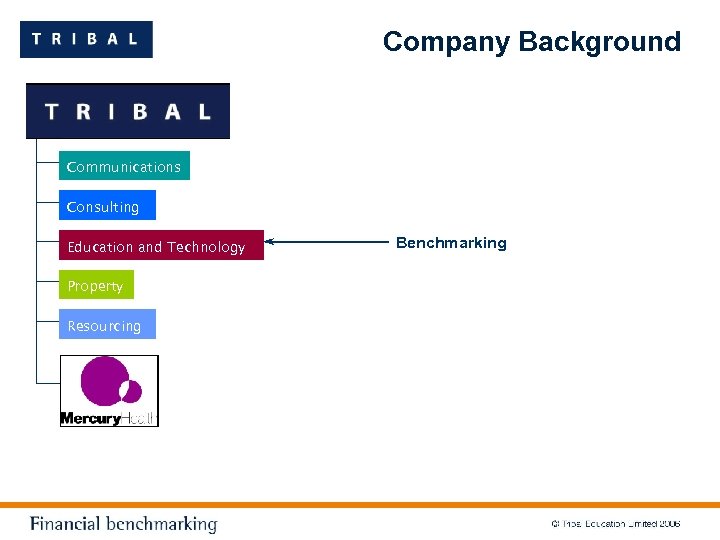
Company Background Communications Consulting Education and Technology Property Resourcing Benchmarking
Benchmarking § Based in Nottingham (formerly Ben Johnson-Hill Associates) § Market leader for provision of benchmarking services within both Higher and Further Education § Products & services include; § § Quantitative (incl. financial benchmarking) Qualitative (incl. student experience benchmarking) Curriculum planning and development Value added
Principles of Benchmarking “Benchmarking is the process of identifying, understanding and adapting outstanding practices and processes from organisations anywhere in the world in order to help your own organisation improve its performance” (English Universities Benchmarking Club) § Continuous improvement § Competitive advantage - evaluate products or services against competitors § Compare existing structures and processes against “best practice” § Inform planning process § Continuous Systematic Implementation Best Practice
The Tribal Benchmarking Methodology § Flexible and scalable – benchmark single department up to whole institution § Analyse ALL activity in every department § Analysis of income, pay costs, staff numbers, pay levels, non-pay costs § Function driven model - identify full costs to deliver a function, regardless of delivery model
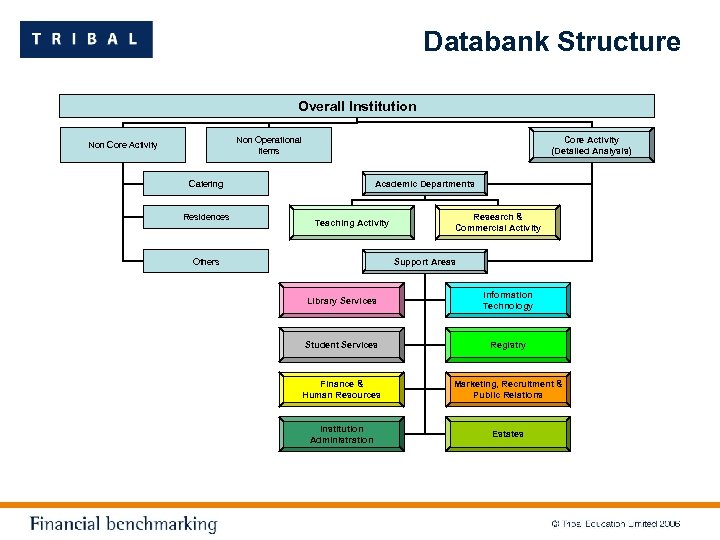
Databank Structure Overall Institution Core Activity (Detailed Analysis) Non Operational Items Non Core Activity Catering Residences Academic Departments Teaching Activity Others Research & Commercial Activity Support Areas Library Services Information Technology Student Services Registry Finance & Human Resources Marketing, Recruitment & Public Relations Institution Administration Estates
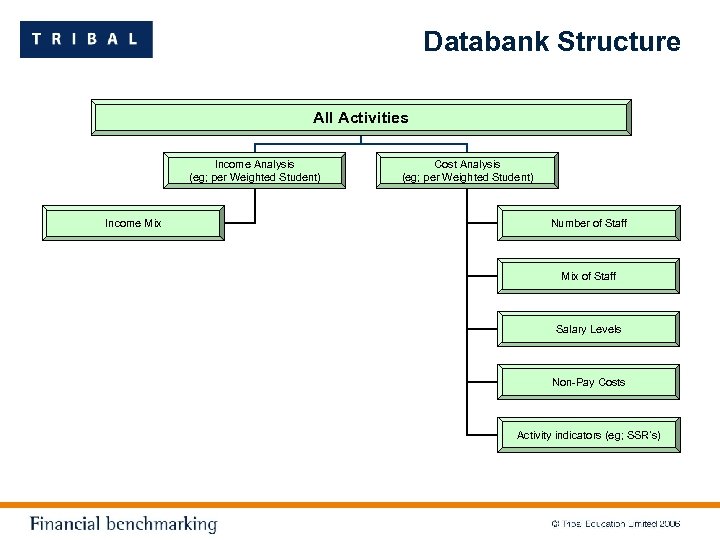
Databank Structure All Activities Income Analysis (eg; per Weighted Student) Income Mix Cost Analysis (eg; per Weighted Student) Number of Staff Mix of Staff Salary Levels Non-Pay Costs Activity indicators (eg; SSR’s)
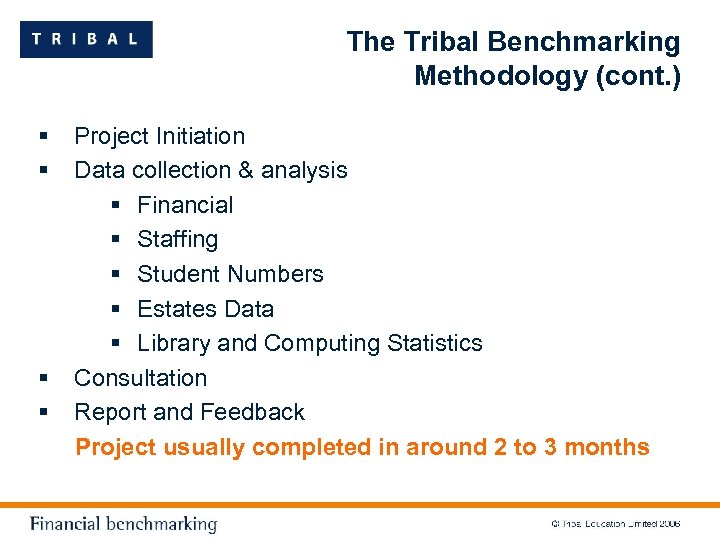
The Tribal Benchmarking Methodology (cont. ) § § Project Initiation Data collection & analysis § Financial § Staffing § Student Numbers § Estates Data § Library and Computing Statistics Consultation Report and Feedback Project usually completed in around 2 to 3 months
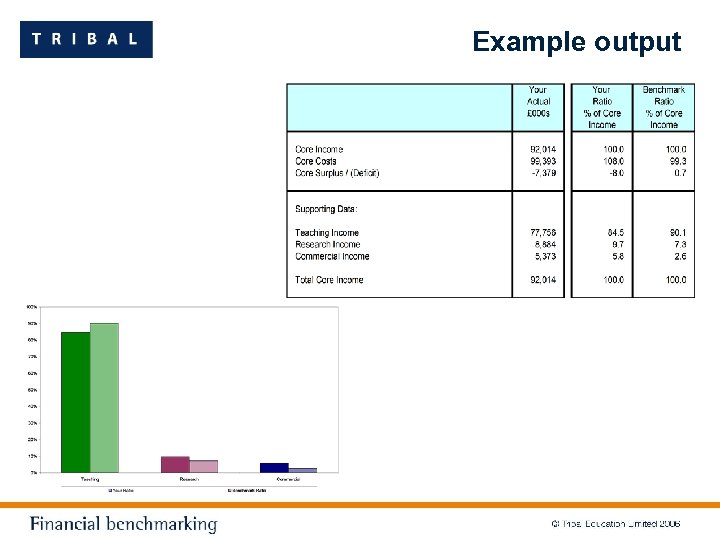
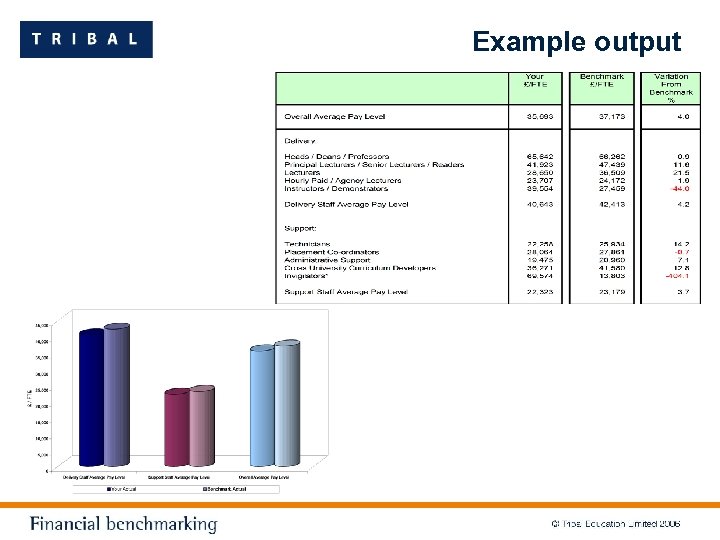
Example output
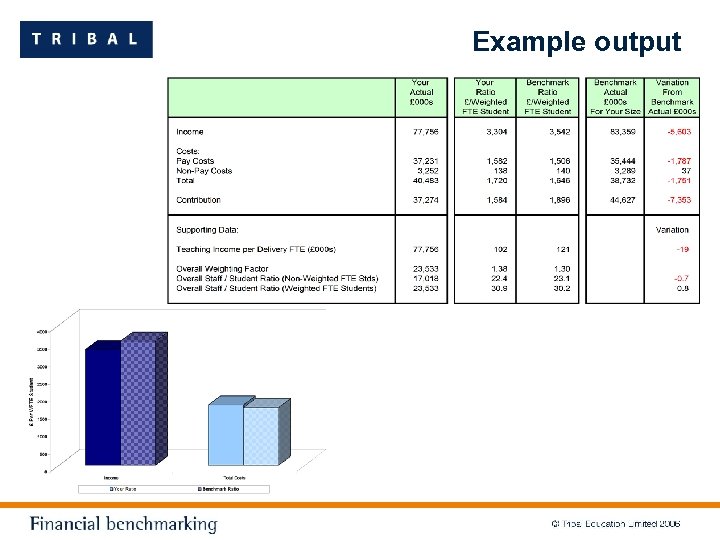
Example output
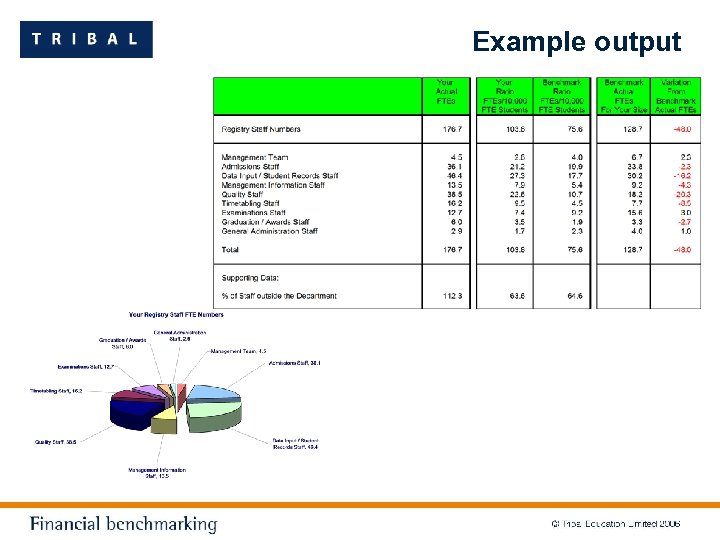
Example output
Example output
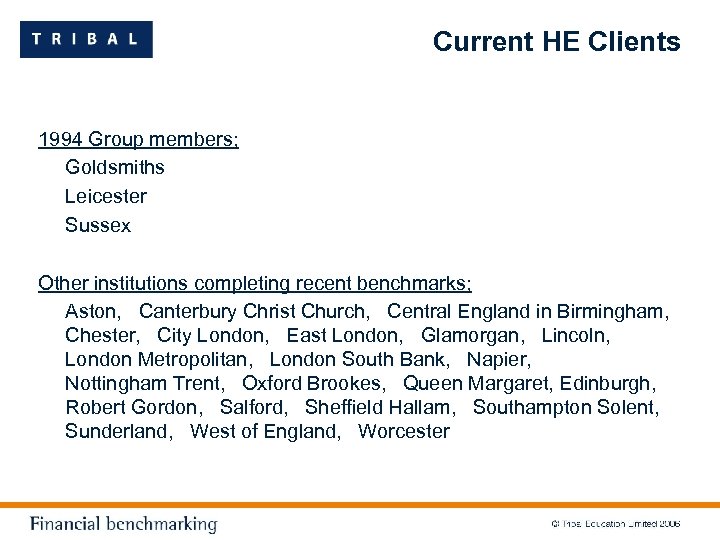
Current HE Clients 1994 Group members; Goldsmiths Leicester Sussex Other institutions completing recent benchmarks; Aston, Canterbury Christ Church, Central England in Birmingham, Chester, City London, East London, Glamorgan, Lincoln, London Metropolitan, London South Bank, Napier, Nottingham Trent, Oxford Brookes, Queen Margaret, Edinburgh, Robert Gordon, Salford, Sheffield Hallam, Southampton Solent, Sunderland, West of England, Worcester
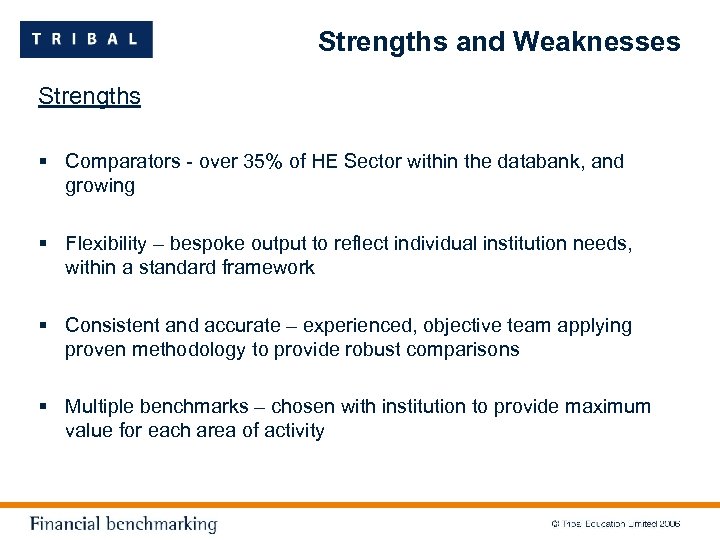
Strengths and Weaknesses Strengths § Comparators - over 35% of HE Sector within the databank, and growing § Flexibility – bespoke output to reflect individual institution needs, within a standard framework § Consistent and accurate – experienced, objective team applying proven methodology to provide robust comparisons § Multiple benchmarks – chosen with institution to provide maximum value for each area of activity
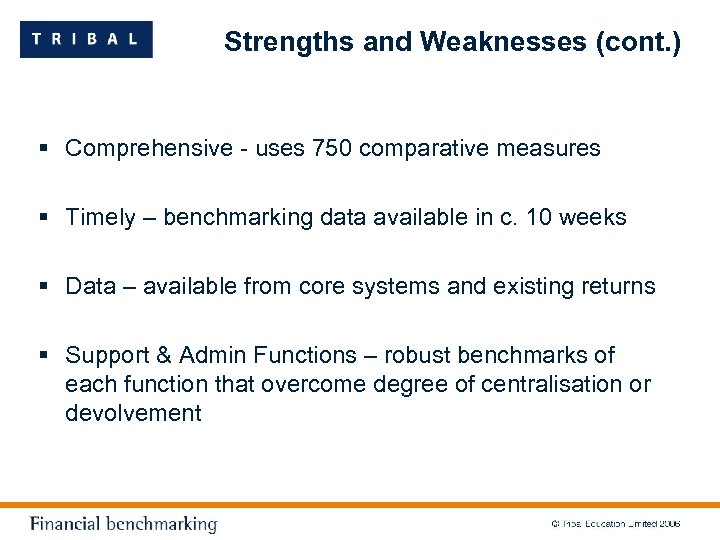
Strengths and Weaknesses (cont. ) § Comprehensive - uses 750 comparative measures § Timely – benchmarking data available in c. 10 weeks § Data – available from core systems and existing returns § Support & Admin Functions – robust benchmarks of each function that overcome degree of centralisation or devolvement
Strengths and Weaknesses (cont. ) § Management involvement – consultation ensures data accuracy, detailed knowledge of institution and buy-in to process § Product development – relationship with clients informs changes to methodology and outputs, to reflect current issues and developments in the sector § Compatibility – with other sector datasets, eg; TRAC, Sconul, EMS
Strengths and Weaknesses (cont. ) Weaknesses § Impact on university staff – although this is kept to a minimum by using data which is available from core systems § Retrospective – although benchmarking can be undertaken using forecast or planning data § Availability of certain comparators – although databank is growing rapidly
Case Study – University of Sussex
Proposal To establish a 1994 Group Benchmarking Club § Enables members to accurately benchmark their activities / resources against the peer group average § Benchmark against other named members (subject to agreement on data sharing) § Facilitates the sharing of best practice amongst the Club § Tribal to provide regular benchmark updates to members
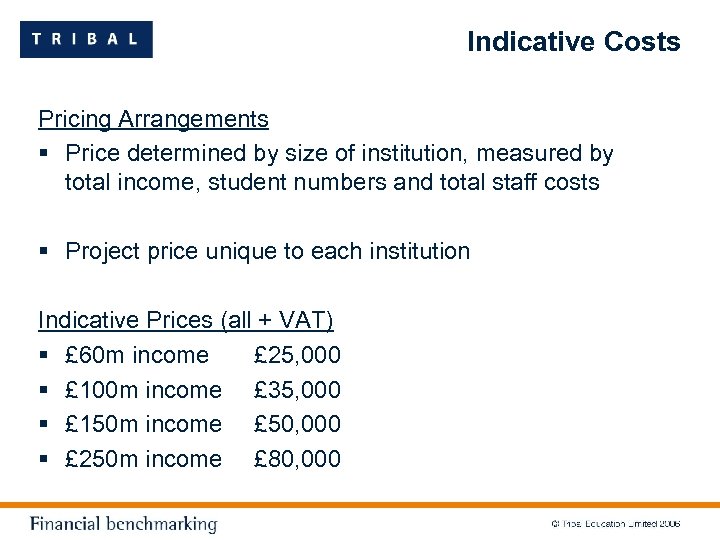
Indicative Costs Pricing Arrangements § Price determined by size of institution, measured by total income, student numbers and total staff costs § Project price unique to each institution Indicative Prices (all + VAT) § £ 60 m income £ 25, 000 § £ 100 m income £ 35, 000 § £ 150 m income £ 50, 000 § £ 250 m income £ 80, 000
Indicative Costs (cont. ) § Discount available for purchasing 2 or more benchmarking projects § Prices available for benchmarking specific functional areas, eg support services
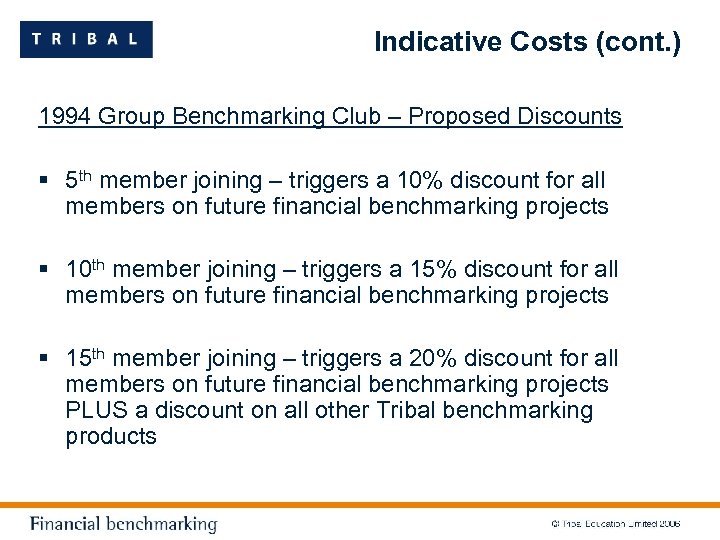
Indicative Costs (cont. ) 1994 Group Benchmarking Club – Proposed Discounts § 5 th member joining – triggers a 10% discount for all members on future financial benchmarking projects § 10 th member joining – triggers a 15% discount for all members on future financial benchmarking projects § 15 th member joining – triggers a 20% discount for all members on future financial benchmarking projects PLUS a discount on all other Tribal benchmarking products
Why use Tribal Benchmarking? § Our role is not to tell you whether you are right or wrong : – Our role is to tell you where you are different!
Questions and Way Forward
Скачать презентацию Insert Title financial benchmarking curriculum efficiency curriculum benchmarking
4cbb0881077ded3f9faa6fce5f44fd9f.ppt