 Скачать презентацию Insert Picture Here Enabling More Intelligent and Profitable
4e769a0463d92ad6a1752f9990c906b8.ppt
- Количество слайдов: 33



<Insert Picture Here> Enabling More Intelligent and Profitable Customer Interactions Using Oracle BI Real-Time Decisions (RTD) <Name> <Title>, <Organization>
Agenda • Introduction to Real-Time Decisions (RTD) • Solution Demo • Key Capabilities & Features • Q&A <Insert Picture Here>
<Insert Picture Here> Introduction to RTD
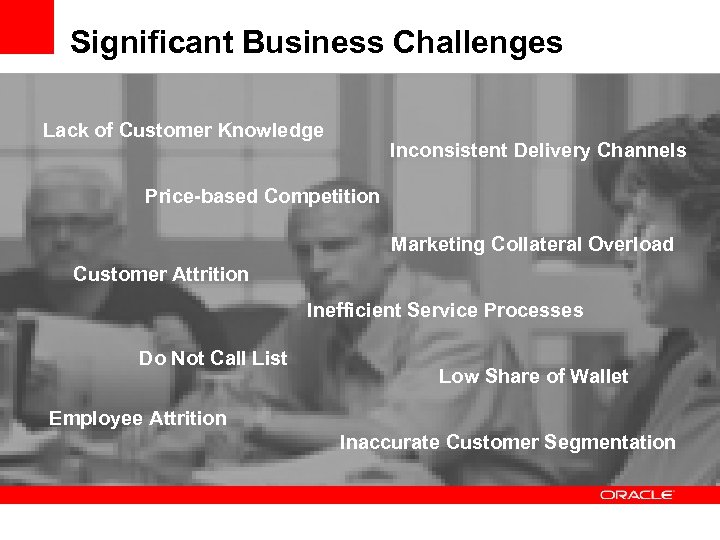
Significant Business Challenges Lack of Customer Knowledge Inconsistent Delivery Channels Price-based Competition Marketing Collateral Overload Customer Attrition Inefficient Service Processes Do Not Call List Low Share of Wallet Employee Attrition Inaccurate Customer Segmentation
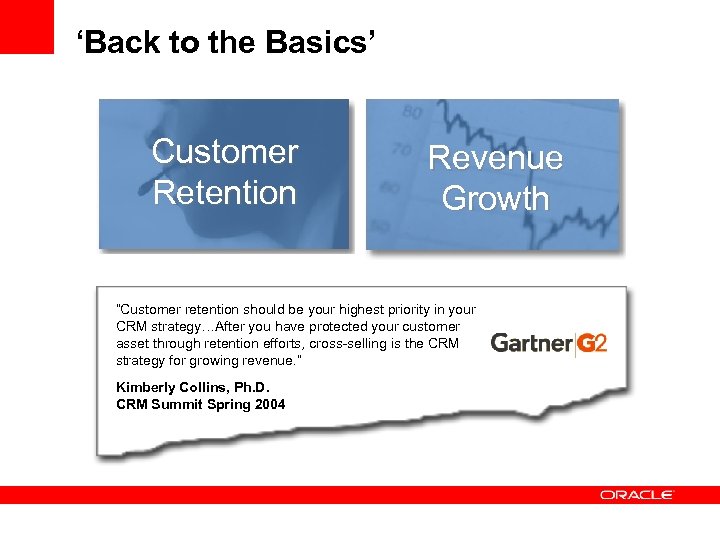
‘Back to the Basics’ Customer Retention Revenue Growth “Customer retention should be your highest priority in your CRM strategy…After you have protected your customer asset through retention efforts, cross-selling is the CRM strategy for growing revenue. ” Kimberly Collins, Ph. D. CRM Summit Spring 2004
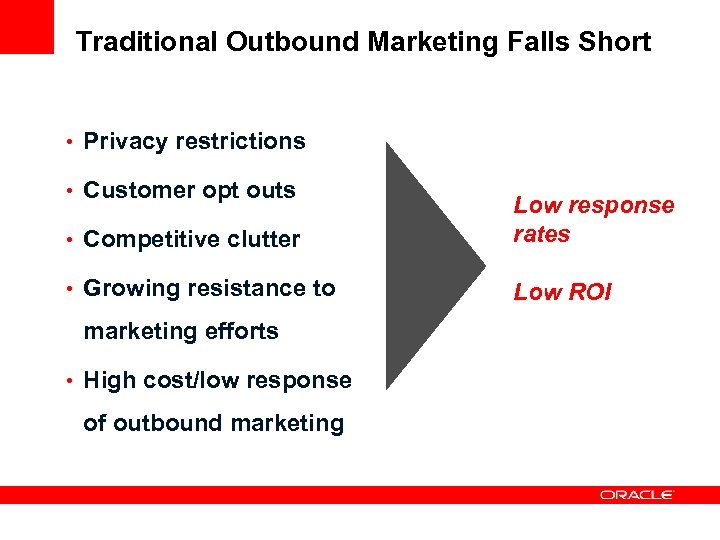
Traditional Outbound Marketing Falls Short • Privacy restrictions • Customer opt outs • Competitive clutter Low response rates • Growing resistance to Low ROI marketing efforts • High cost/low response of outbound marketing
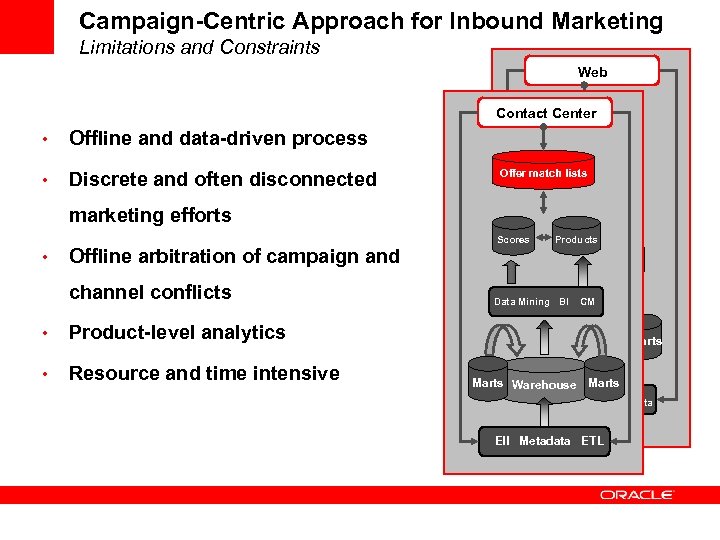
Campaign-Centric Approach for Inbound Marketing Limitations and Constraints Web Contact Center • • Discrete and often disconnected Offer match Offline and data-driven process Offer match lists Scores Products marketing efforts • Offline arbitration of campaign and channel conflicts • Product-level analytics • Resource and time intensive Scores Products Data Mining BI CM CM Marts Warehouse Marts EII ETL Metadata EII Metadata ETL
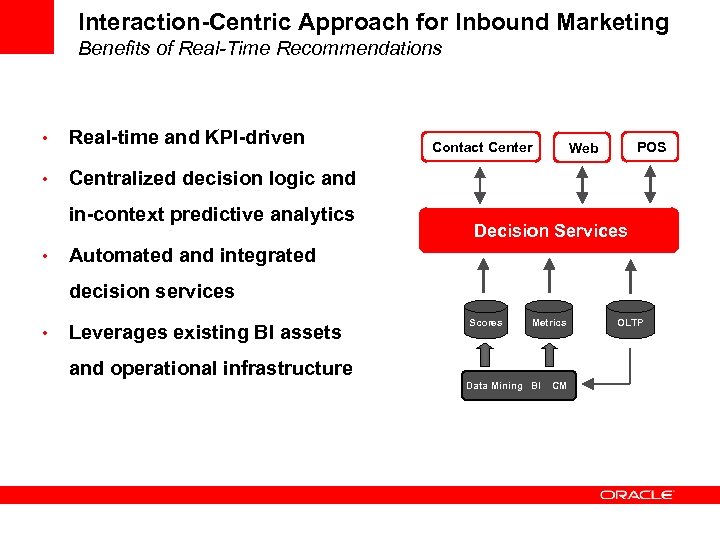
Interaction-Centric Approach for Inbound Marketing Benefits of Real-Time Recommendations • Real-time and KPI-driven • Centralized decision logic and in-context predictive analytics • Contact Center POS Web Decision Services Automated and integrated decision services • Leverages existing BI assets Scores Metrics and operational infrastructure Data Mining BI CM OLTP
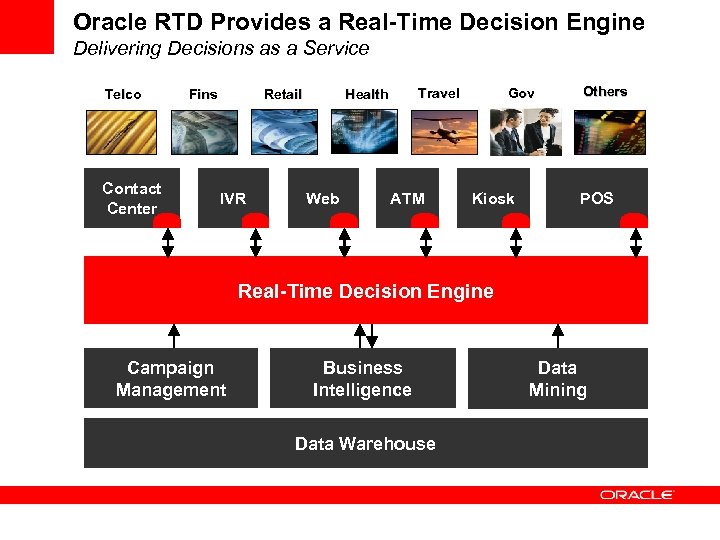
Oracle RTD Provides a Real-Time Decision Engine Delivering Decisions as a Service Telco Contact Center Retail Fins IVR Web Gov Travel Health ATM Kiosk Others POS Real-Time Decision Engine Campaign Management Business Intelligence Data Warehouse Data Mining
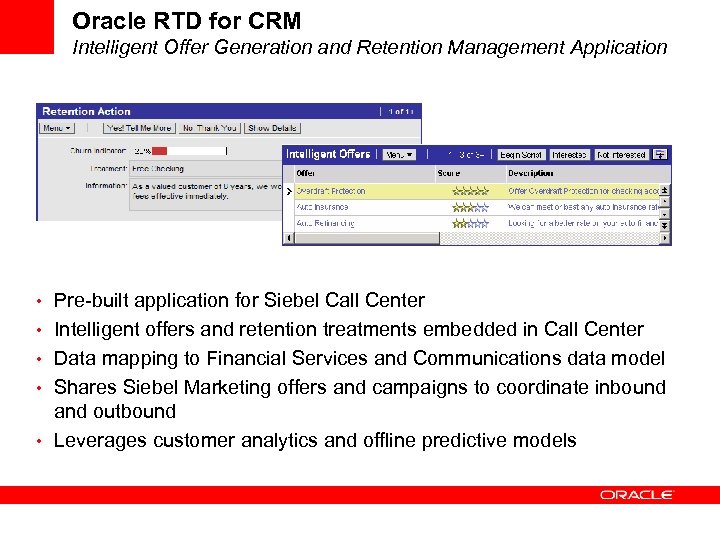
Oracle RTD for CRM Intelligent Offer Generation and Retention Management Application • Pre-built application for Siebel Call Center • Intelligent offers and retention treatments embedded in Call Center • Data mapping to Financial Services and Communications data model • Shares Siebel Marketing offers and campaigns to coordinate inbound and outbound • Leverages customer analytics and offline predictive models
<Insert Picture Here> Solution Demo
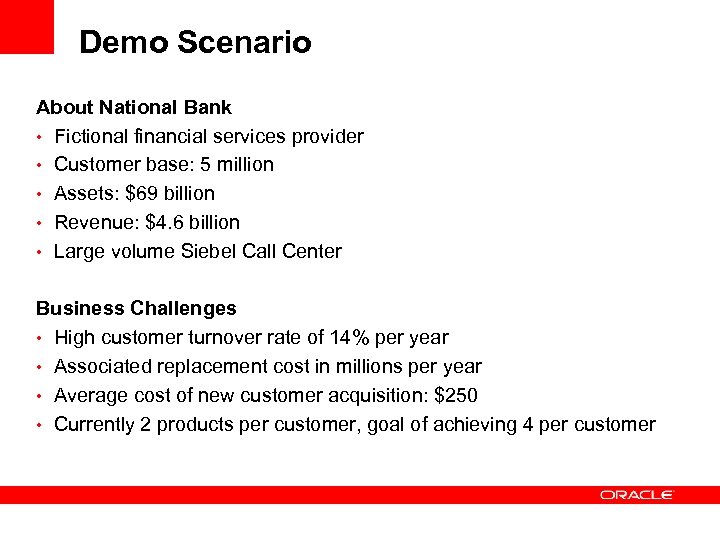
Demo Scenario About National Bank • Fictional financial services provider • Customer base: 5 million • Assets: $69 billion • Revenue: $4. 6 billion • Large volume Siebel Call Center Business Challenges • High customer turnover rate of 14% per year • Associated replacement cost in millions per year • Average cost of new customer acquisition: $250 • Currently 2 products per customer, goal of achieving 4 per customer
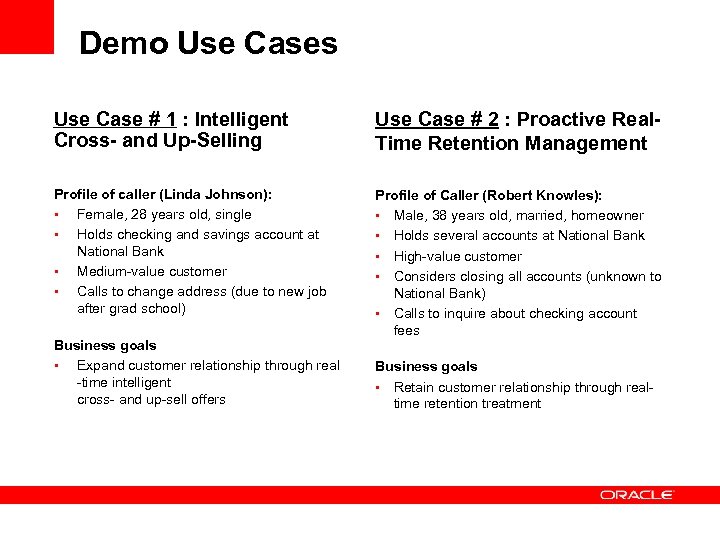
Demo Use Cases Use Case # 1 : Intelligent Cross- and Up-Selling Use Case # 2 : Proactive Real. Time Retention Management Profile of caller (Linda Johnson): • Female, 28 years old, single • Holds checking and savings account at National Bank • Medium-value customer • Calls to change address (due to new job after grad school) Profile of Caller (Robert Knowles): • Male, 38 years old, married, homeowner • Holds several accounts at National Bank • High-value customer • Considers closing all accounts (unknown to National Bank) • Calls to inquire about checking account fees Business goals • Expand customer relationship through real -time intelligent cross- and up-sell offers Business goals • Retain customer relationship through realtime retention treatment

RTD Leverages Inbound Interactions Enterprise Marketing-initiated Customer Triggered Customer Initiated, Relationship Driven Campaign Event Driven Leveraging Inbound in Real Time Customer “Unexpected” 1 -5% Response “Convenient” 5 x Success “Appropriate” 10 x Success Advanced real-time predictive analytics allow each interaction at any time and any channel to be tailored for each customer Source: Gareth Herschel, Gartner, ‘ 03
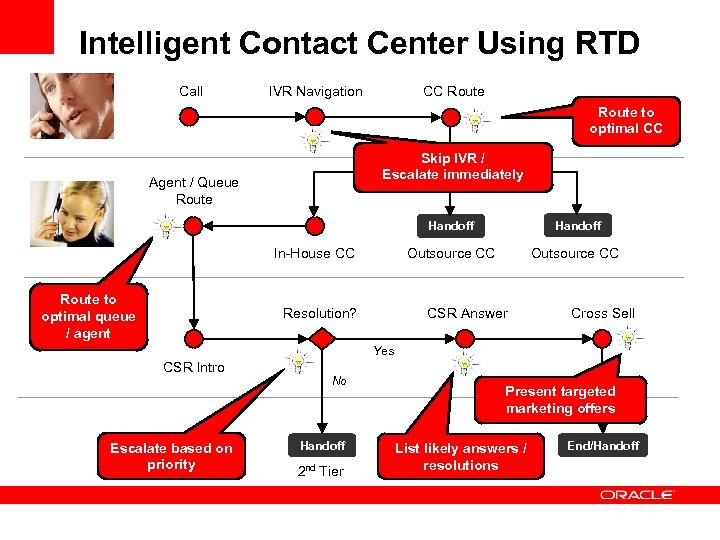
Intelligent Contact Center Using RTD Call IVR Navigation CC Route to optimal CC Skip IVR / Escalate immediately Agent / Queue Route Handoff Outsource CC In-House CC Route to optimal queue / agent Resolution? Handoff Outsource CC CSR Answer Cross Sell Yes CSR Intro Escalate based on priority No Handoff 2 nd Tier Present targeted marketing offers List likely answers / resolutions End/Handoff
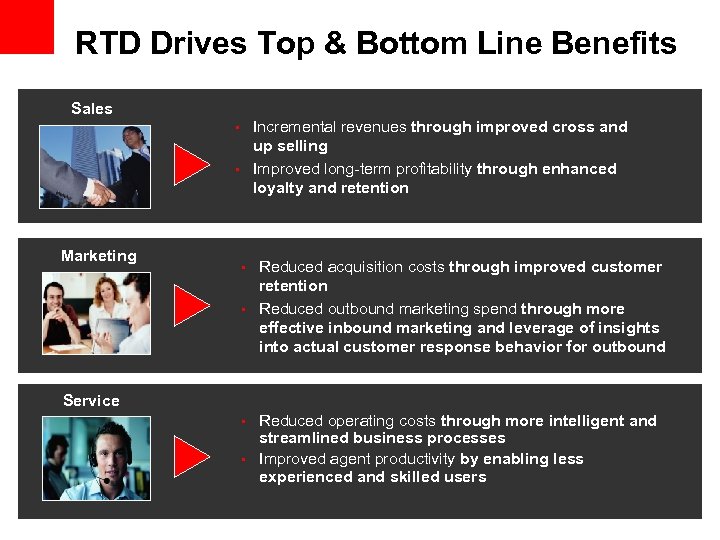
RTD Drives Top & Bottom Line Benefits Sales • Incremental revenues through improved cross and up selling • Improved long-term profitability through enhanced loyalty and retention Marketing • Reduced acquisition costs through improved customer retention • Reduced outbound marketing spend through more effective inbound marketing and leverage of insights into actual customer response behavior for outbound Service • Reduced operating costs through more intelligent and streamlined business processes • Improved agent productivity by enabling less experienced and skilled users
<Insert Picture Here> Key Capabilities & Features
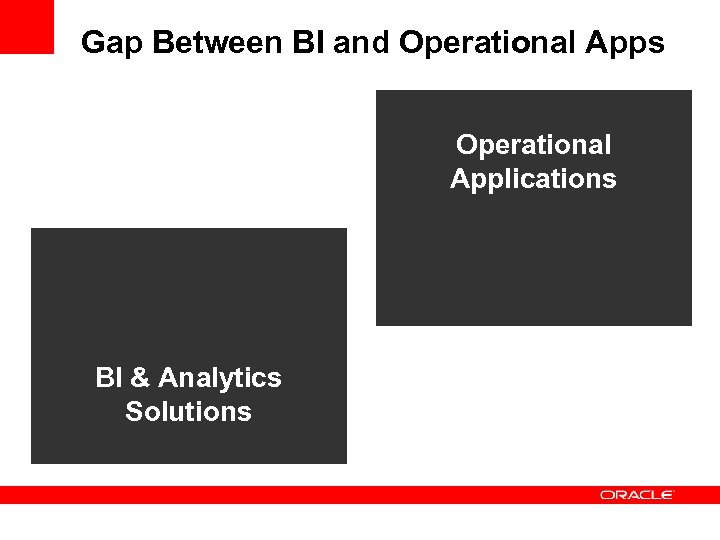
Gap Between BI and Operational Apps Operational Applications BI & Analytics Solutions
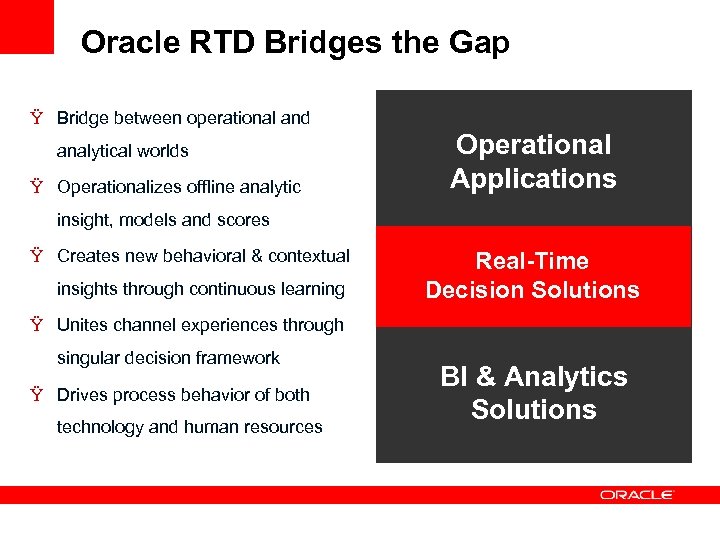
Oracle RTD Bridges the Gap Ÿ Bridge between operational and analytical worlds Ÿ Operationalizes offline analytic Operational Applications insight, models and scores Ÿ Creates new behavioral & contextual insights through continuous learning Real-Time Decision Solutions Ÿ Unites channel experiences through singular decision framework Ÿ Drives process behavior of both technology and human resources BI & Analytics Solutions
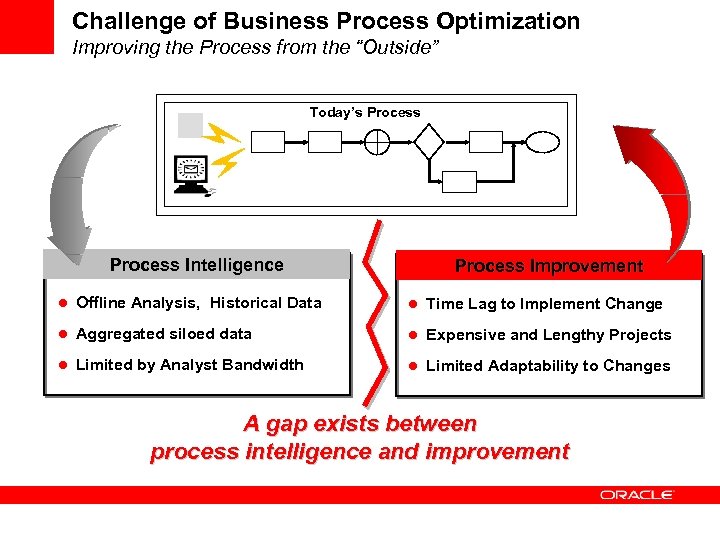
Challenge of Business Process Optimization Improving the Process from the “Outside” Today’s Process Intelligence Process Improvement l Offline Analysis, Historical Data l Time Lag to Implement Change l Aggregated siloed data l Expensive and Lengthy Projects l Limited by Analyst Bandwidth l Limited Adaptability to Changes A gap exists between process intelligence and improvement
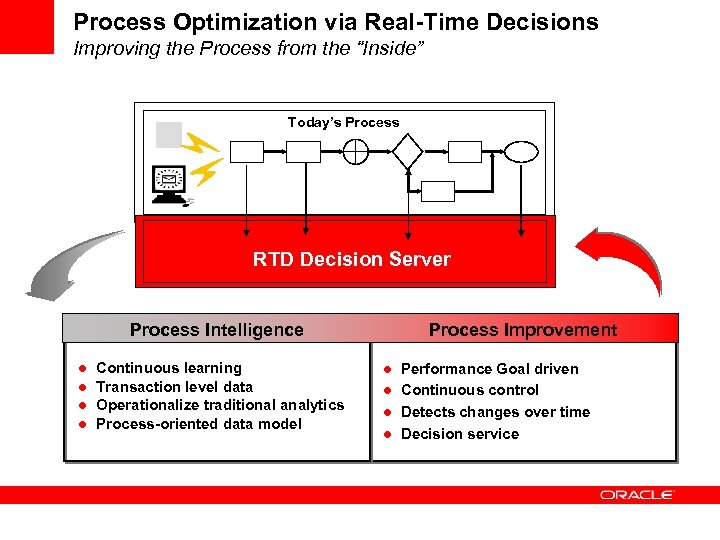
Process Optimization via Real-Time Decisions Improving the Process from the “Inside” Today’s Process RTD Decision Server Process Intelligence Continuous learning l Transaction level data l Operationalize traditional analytics l Process-oriented data model l Process Improvement Performance Goal driven l Continuous control l Detects changes over time l Decision service l
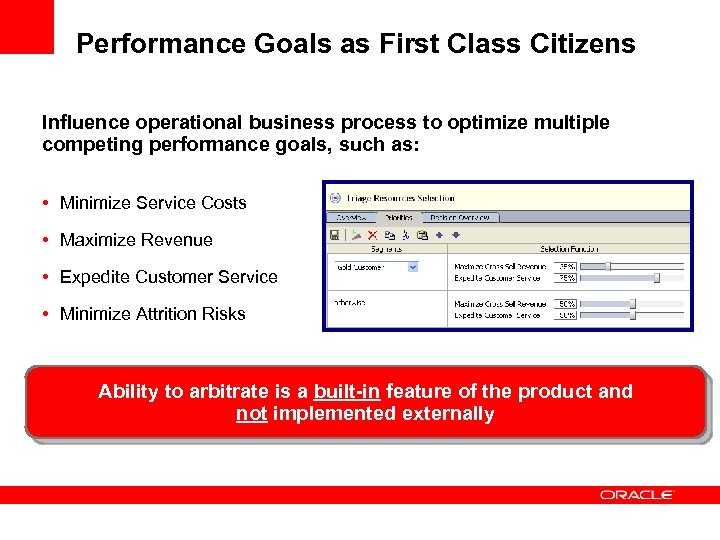
Performance Goals as First Class Citizens Influence operational business process to optimize multiple competing performance goals, such as: • Minimize Service Costs • Maximize Revenue • Expedite Customer Service • Minimize Attrition Risks Ability to arbitrate is a built-in feature of the product and not implemented externally
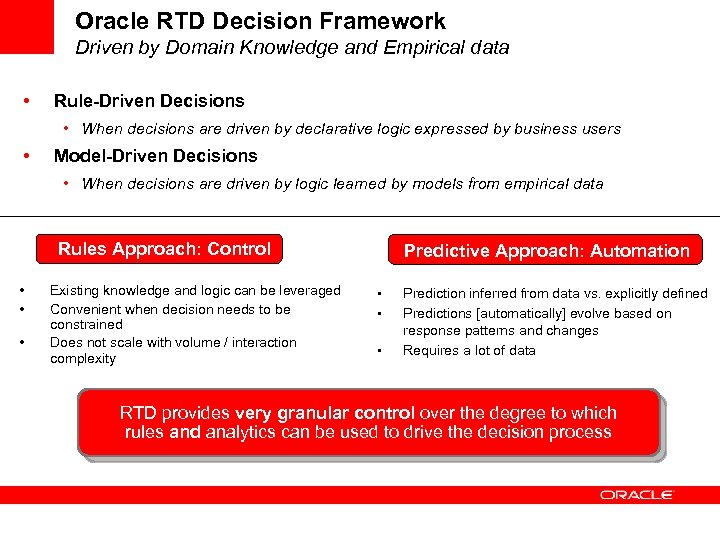
Oracle RTD Decision Framework Driven by Domain Knowledge and Empirical data • Rule-Driven Decisions • When decisions are driven by declarative logic expressed by business users • Model-Driven Decisions • When decisions are driven by logic learned by models from empirical data Rules Approach: Control • • • Existing knowledge and logic can be leveraged Convenient when decision needs to be constrained Does not scale with volume / interaction complexity Predictive Approach: Automation • • • Prediction inferred from data vs. explicitly defined Predictions [automatically] evolve based on response patterns and changes Requires a lot of data RTD provides very granular control over the degree to which rules and analytics can be used to drive the decision process
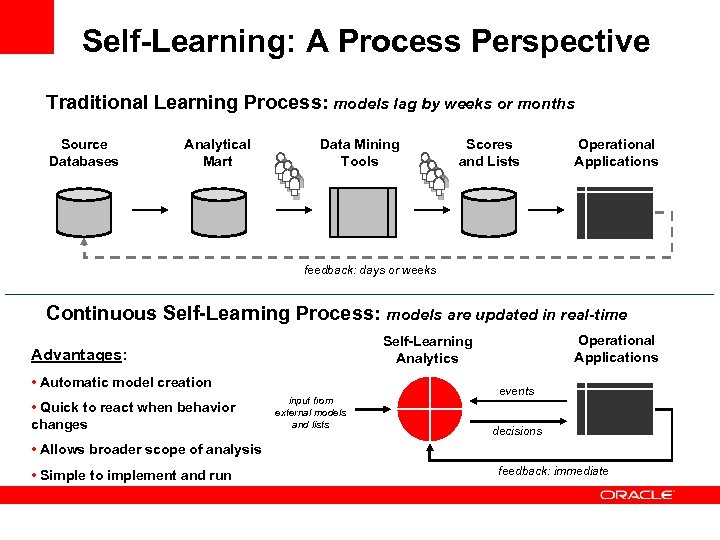
Self-Learning: A Process Perspective Traditional Learning Process: models lag by weeks or months Source Databases Analytical Mart Data Mining Tools Scores and Lists Operational Applications feedback: days or weeks Continuous Self-Learning Process: models are updated in real-time Advantages: • Automatic model creation • Quick to react when behavior changes Operational Applications Self-Learning Analytics input from external models and lists events decisions • Allows broader scope of analysis • Simple to implement and run feedback: immediate
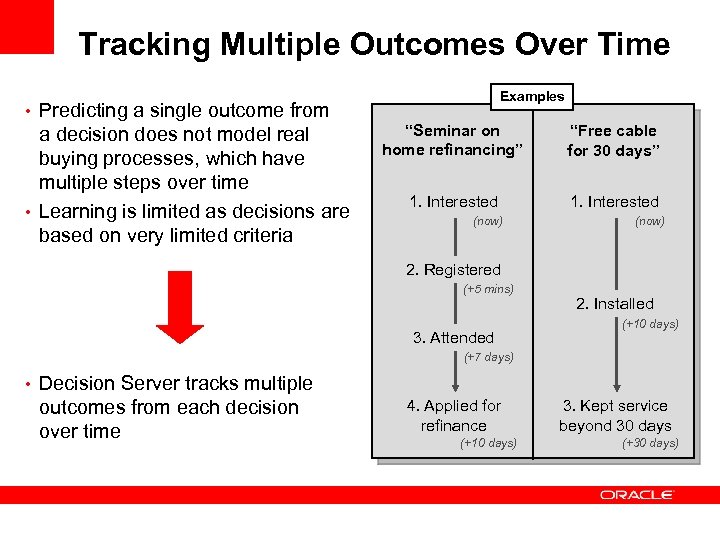
Tracking Multiple Outcomes Over Time Examples • Predicting a single outcome from a decision does not model real buying processes, which have multiple steps over time • Learning is limited as decisions are based on very limited criteria “Seminar on home refinancing” “Free cable for 30 days” 1. Interested (now) 2. Registered (+5 mins) 3. Attended 2. Installed (+10 days) (+7 days) • Decision Server tracks multiple outcomes from each decision over time 4. Applied for refinance (+10 days) 3. Kept service beyond 30 days (+30 days)
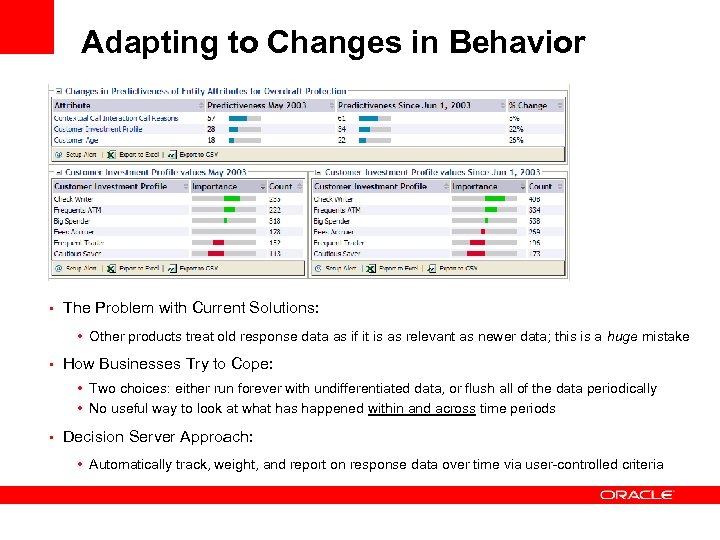
Adapting to Changes in Behavior • The Problem with Current Solutions: • Other products treat old response data as if it is as relevant as newer data; this is a huge mistake • How Businesses Try to Cope: • Two choices: either run forever with undifferentiated data, or flush all of the data periodically • No useful way to look at what has happened within and across time periods • Decision Server Approach: • Automatically track, weight, and report on response data over time via user-controlled criteria
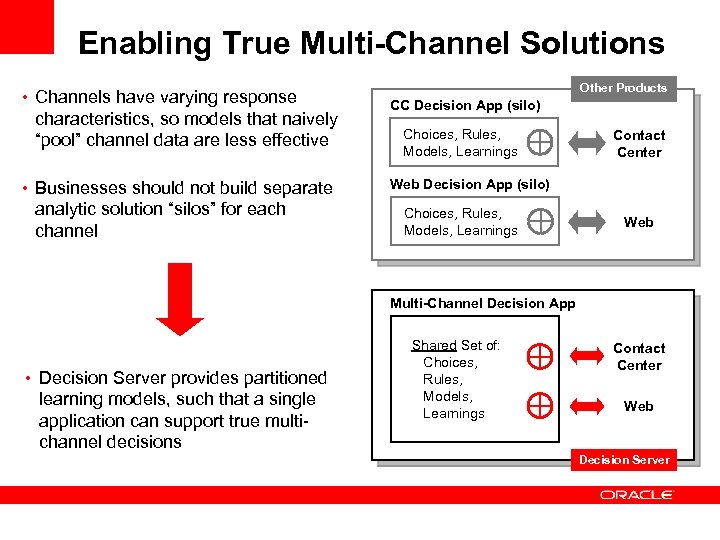
Enabling True Multi-Channel Solutions • Channels have varying response characteristics, so models that naively “pool” channel data are less effective • Businesses should not build separate analytic solution “silos” for each channel Other Products CC Decision App (silo) Choices, Rules, Models, Learnings Contact Center Web Decision App (silo) Choices, Rules, Models, Learnings Web Multi-Channel Decision App • Decision Server provides partitioned learning models, such that a single application can support true multichannel decisions Shared Set of: Choices, Rules, Models, Learnings Contact Center Web Decision Server
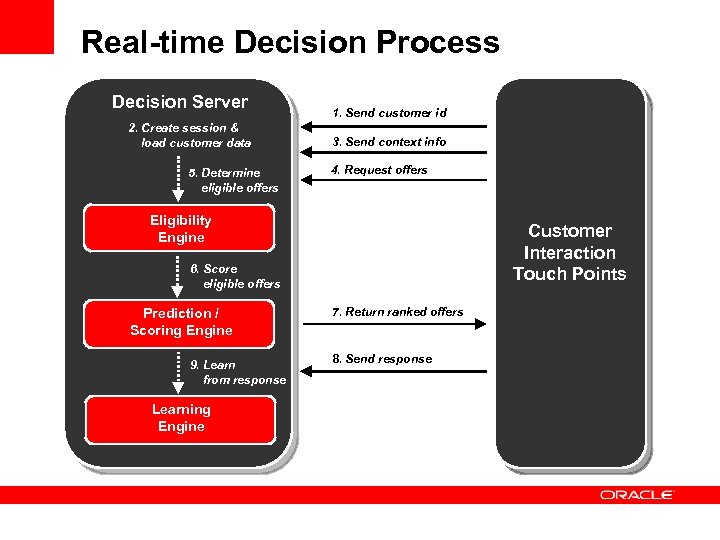
Real-time Decision Process Decision Server 2. Create session & load customer data 5. Determine eligible offers 1. Send customer id 3. Send context info 4. Request offers Eligibility Engine Customer Interaction Touch Points 6. Score eligible offers Prediction / Scoring Engine 9. Learn from response Learning Engine 7. Return ranked offers 8. Send response
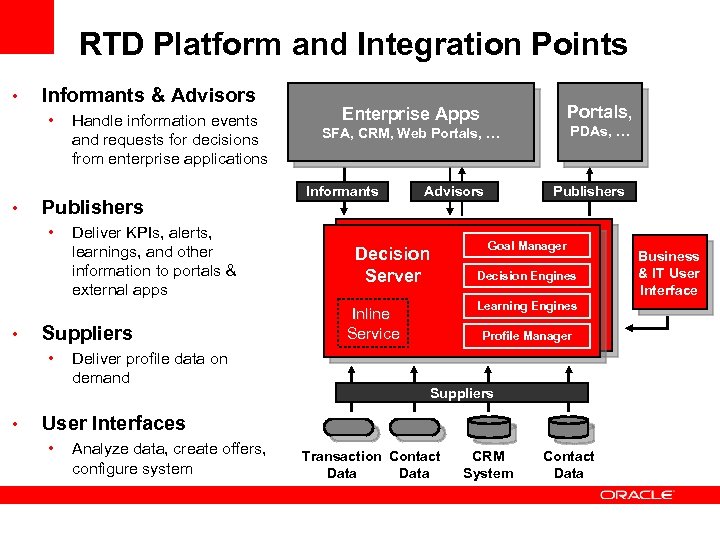
RTD Platform and Integration Points • Informants & Advisors • • Publishers • • Deliver KPIs, alerts, learnings, and other information to portals & external apps Suppliers • • Handle information events and requests for decisions from enterprise applications Deliver profile data on demand Portals, Enterprise Apps PDAs, … SFA, CRM, Web Portals, … Informants Advisors Decision Server Publishers Goal Manager Decision Engines Learning Engines Inline Service Profile Manager Suppliers User Interfaces • Analyze data, create offers, configure system Transaction Contact Data CRM System Contact Data Business & IT User Interface
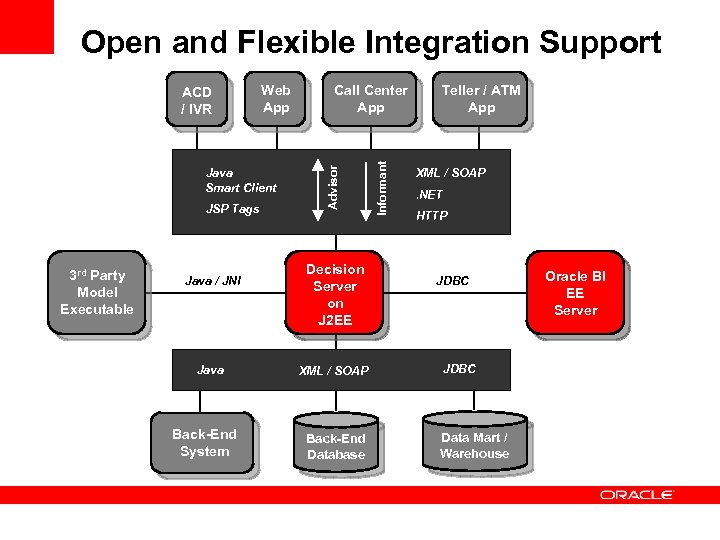
Open and Flexible Integration Support Java Smart Client JSP Tags 3 rd Party Model Executable Java / JNI Java Back-End System Call Center App Decision Server on J 2 EE XML / SOAP Back-End Database Informant Web App Advisor ACD / IVR Teller / ATM App XML / SOAP. NET HTTP JDBC Data Mart / Warehouse Oracle BI EE Server
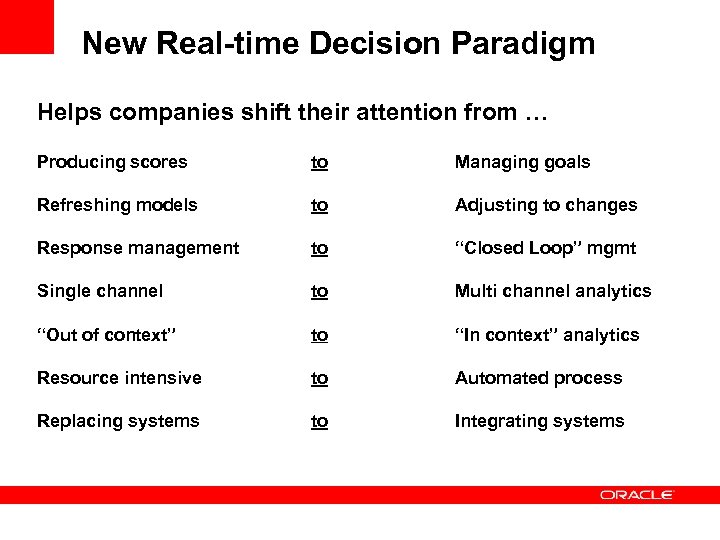
New Real-time Decision Paradigm Helps companies shift their attention from … Producing scores to Managing goals Refreshing models to Adjusting to changes Response management to “Closed Loop” mgmt Single channel to Multi channel analytics “Out of context” to “In context” analytics Resource intensive to Automated process Replacing systems to Integrating systems
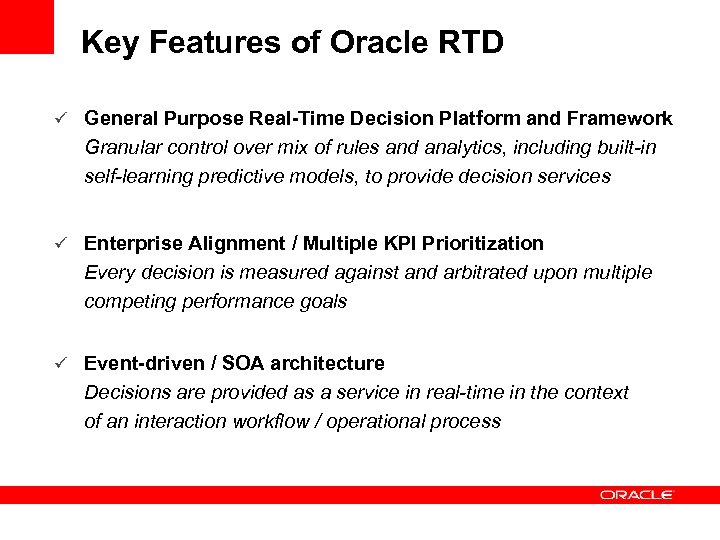
Key Features of Oracle RTD ü General Purpose Real-Time Decision Platform and Framework Granular control over mix of rules and analytics, including built-in self-learning predictive models, to provide decision services ü Enterprise Alignment / Multiple KPI Prioritization Every decision is measured against and arbitrated upon multiple competing performance goals ü Event-driven / SOA architecture Decisions are provided as a service in real-time in the context of an interaction workflow / operational process
<Insert Picture Here> Questions & Answers
Скачать презентацию Insert Picture Here Enabling More Intelligent and Profitable
4e769a0463d92ad6a1752f9990c906b8.ppt