


 Скачать презентацию Insert Chapter Name and or Logo Date of Presentation
88eebee8e6a05c4e8c77854adec2003e.ppt
- Количество слайдов: 99
 Session Outline STUDY WORKBOOK: Module No. 1 - FUNDAMENTALS A. Job roles and responsibilities of the four Project Teams & Participants B. Factors that contribute to an effective team C. Stages of Facility Life Cycle with associated activities and documents D. Project stages with associated activities and documents E. Omni. Class. TM F. Uni. Format. TM G. Master. Format. TM H. Green. Format. TM I. Section. Format. TM J. Page. Format. TM K. Graphic formats L. Principals of communication M. Legal interpretations of Contract Documents N. Sustainable design and construction The Construction Specifications Institute 2
 FUNDAMENTALS Job Roles and Responsibilities of the Four Project Teams STUDY WORKBOOK: Knowledge Item 1 -1 The Construction Specifications Institute 3
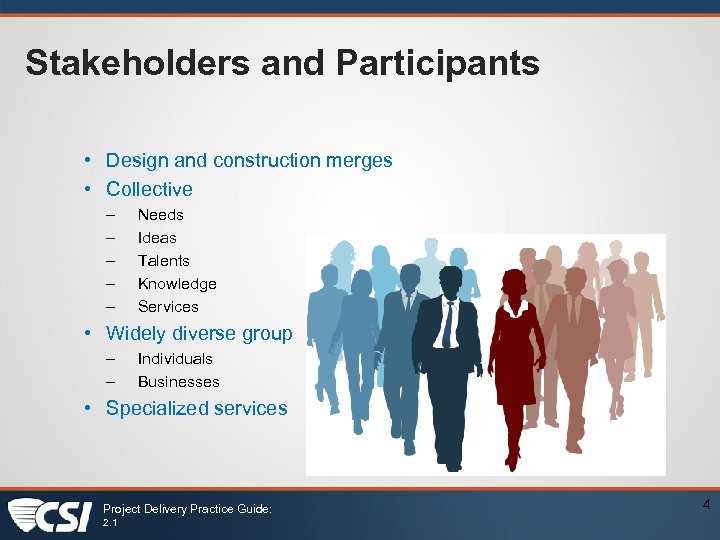 Stakeholders and Participants • Design and construction merges • Collective – – – Needs Ideas Talents Knowledge Services • Widely diverse group – – Individuals Businesses • Specialized services Project Delivery Practice Guide: 2. 1 4
 Stakeholders • Individuals or organizations actively involved in a major portion of the project delivery process • Interests positively or negatively impacted – – – Investment Operational Reputation Project Delivery Practice Guide: 2. 1 5
 Participants • Individuals or organizations • Active in only a portion of the project delivery process • Indirect interests not affected by constructed facility Project Delivery Practice Guide: 2. 1 6
 Project Team Composition • Owner Team • Architect/Engineer (A/E) Team • Contractor Team • Supplier Team Project Delivery Practice Guide: 2. 1 7
 Owner Team Responsibilities • • Initiates Project Assumes risk Provides funding Controls and manages the design and construction process • Approves of design & construction activities • Principal stakeholder • Owner may or may not occupy facility Project Delivery Practice Guide: 2. 2 8
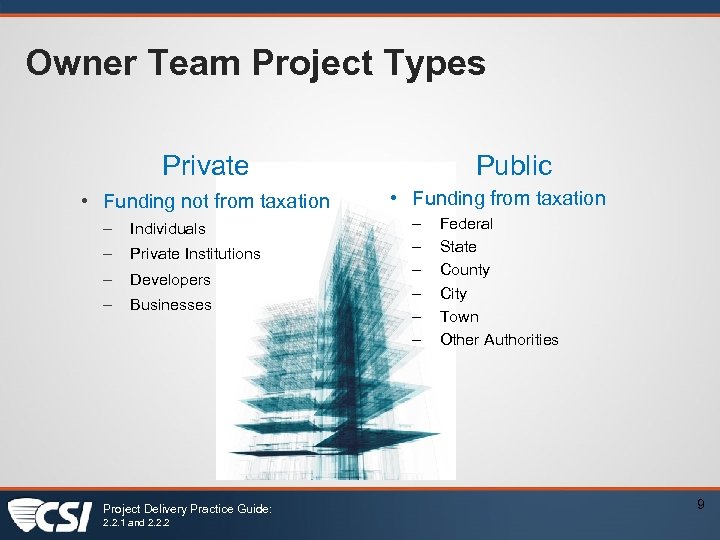 Owner Team Project Types Public Private • Funding not from taxation – Individuals – Private Institutions – Developers – Businesses Project Delivery Practice Guide: 2. 2. 1 and 2. 2. 2 • Funding from taxation – – – Federal State County City Town Other Authorities 9
 Owner Team, Advisors • Financial institutions • Attorneys • Insurance companies Project Delivery Practice Guide: 2. 2. 3 • Real estate agents • Appraisers • Marketing companies 10
 Owner Team, Owner’s Consultants • • • Surveyors Environmental engineers Geotechnical engineers Hazardous materials / abatement Traffic engineers Sustainability Wetland biologists Wildlife biologists Design Engineers Testing and Inspection Agencies Commissioning Authority Project Delivery Practice Guide: 2. 2. 4 11
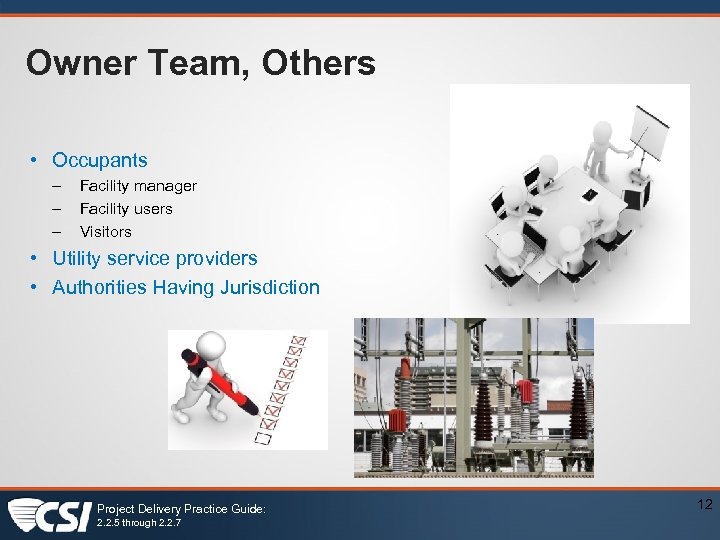 Owner Team, Others • Occupants – – – Facility manager Facility users Visitors • Utility service providers • Authorities Having Jurisdiction Project Delivery Practice Guide: 2. 2. 5 through 2. 2. 7 12
 A/E Team Responsibilities • Transforming Owner’s vision and requirements into a design and construction documentation • Includes multiple design disciplines • Specialized design services and expertise Project Delivery Practice Guide: 2. 3 13
 A/E Team Services A/E Team selection is usually based on qualifications, experience and/or unique design skills. • Planning issues, include those involving the AHJ • Design program and requirements • Design that reflects Owner’s vision • Identify codes and regulations • Product research and evaluation • Produce procurement and construction documents • Administer construction contract • Provide QA procedures and QC review Project Delivery Practice Guide: 2. 3 14
 A/E Team Architect • • • Principal-in-Charge Project Manager Programmer Project Designer Interior Designer Project Architect Job Captain Drafter Specifier Construction Administrator Project Delivery Practice Guide: 2. 3. 1 15
 A/E Team Engineers and Consultants • • • Civil Engineer Structural Engineer Mechanical Engineer Electrical Engineer Plumbing Engineer Landscape Architect Fire Protection Engineer Exterior Enclosure Consultant Roofing and Waterproofing Consultant Cost Estimator Project Delivery Practice Guide: 2. 3. 2 thru 2. 3. 11 16
 A/E Team Engineers and Consultants • • • Code Consultant Sustainability Consultant Commissioning Consultant Food Service Consultant Parking Consultant Acoustical Consultant Lighting Design Consultant Building Transportation Consultant Swimming Pool, Fountain, and Water Feature Consultant Building Maintenance Equipment Consultant Project Delivery Practice Guide: 2. 3. 12 thru 2. 3. 21 17
 Contractor Team Responsibilities Contractor selection could be based on being the low bidder, reputation, previous relationship or special qualifications. • Transforms construction documentation into a finished facility –Cost estimating –Time scheduling –Contracting –Procurement (Bidding, Negotiating, Purchasing) –Management of construction Project Delivery Practice Guide: 2. 4 18
 Contractor Team Roles • Contractor – – – – Principal-in-Charge Project Manager Estimator Supervisor Accountant Layout Technician Safety Director Sustainability Consultant • Subcontractor Project Delivery Practice Guide: 2. 4. 1 and 2. 4. 2 19
 Supplier Team Responsibilities • Furnishes materials and products necessary to construct Project – – Manufacturer Distributor Supplier Fabricator Project Delivery Practice Guide: 2. 5 20
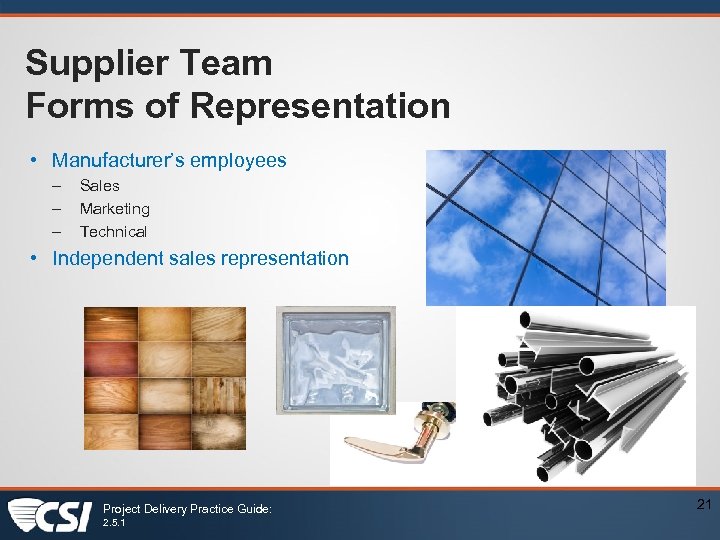 Supplier Team Forms of Representation • Manufacturer’s employees – – – Sales Marketing Technical • Independent sales representation Project Delivery Practice Guide: 2. 5. 1 21
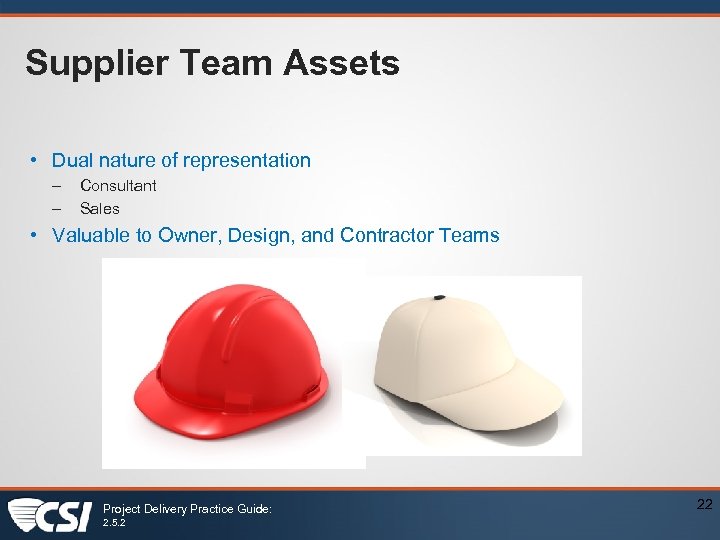 Supplier Team Assets • Dual nature of representation – – Consultant Sales • Valuable to Owner, Design, and Contractor Teams Project Delivery Practice Guide: 2. 5. 2 22
 Supplier Team Skills • Knowledge of products, including cost, manufacturing processes and distribution. • Knowledge of decision making process by design team • Knowledge of construction processes • Sales skills Project Delivery Practice Guide: 2. 5. 2 23
 FUNDAMENTALS Factors that Contribute to an Effective Team STUDY WORKBOOK: Knowledge Item 1 -1 The Construction Specifications Institute 24
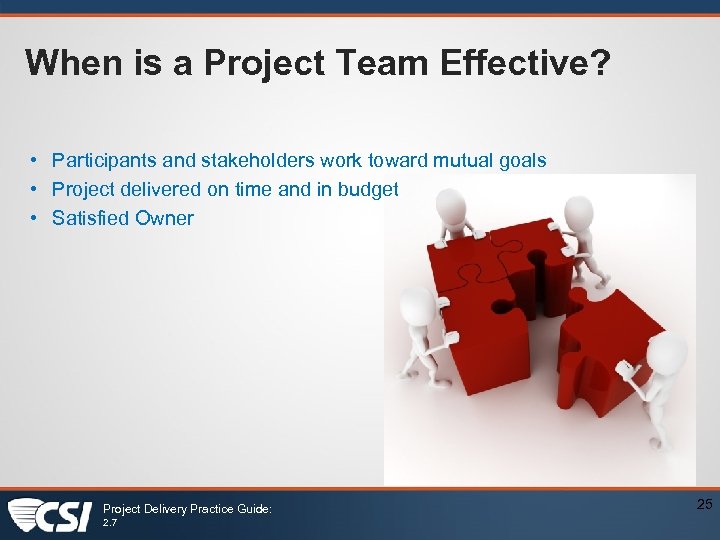 When is a Project Team Effective? • Participants and stakeholders work toward mutual goals • Project delivered on time and in budget • Satisfied Owner Project Delivery Practice Guide: 2. 7 25
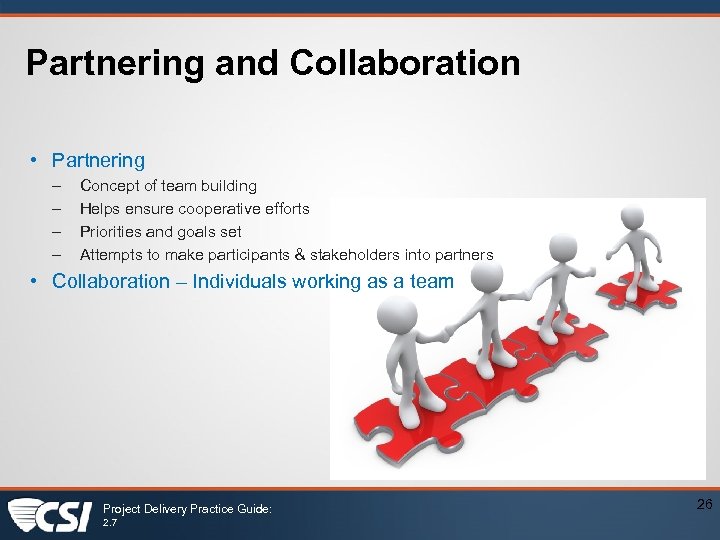 Partnering and Collaboration • Partnering – – Concept of team building Helps ensure cooperative efforts Priorities and goals set Attempts to make participants & stakeholders into partners • Collaboration – Individuals working as a team Project Delivery Practice Guide: 2. 7 26
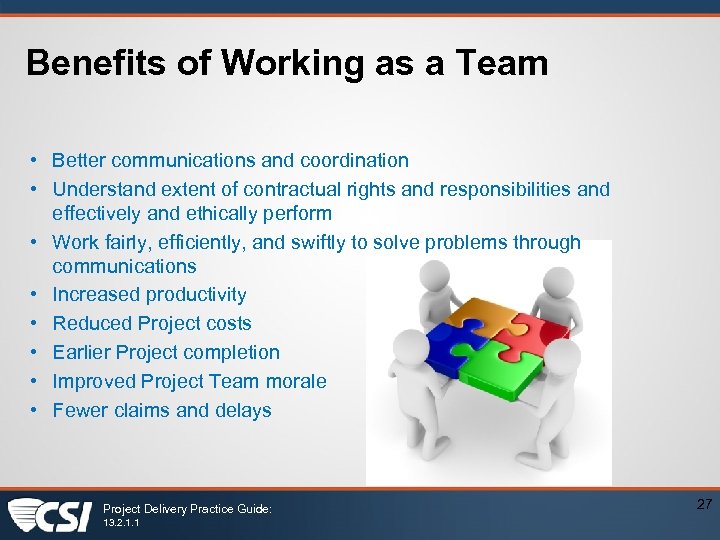 Benefits of Working as a Team • Better communications and coordination • Understand extent of contractual rights and responsibilities and effectively and ethically perform • Work fairly, efficiently, and swiftly to solve problems through communications • Increased productivity • Reduced Project costs • Earlier Project completion • Improved Project Team morale • Fewer claims and delays Project Delivery Practice Guide: 13. 2. 1. 1 27
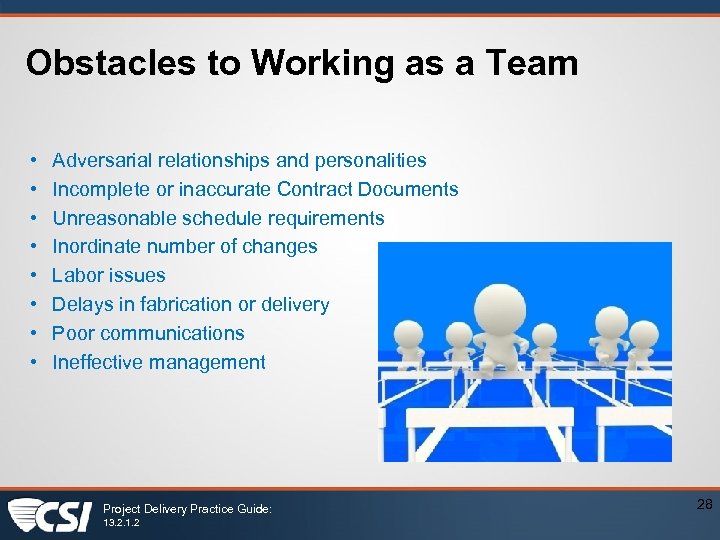 Obstacles to Working as a Team • • Adversarial relationships and personalities Incomplete or inaccurate Contract Documents Unreasonable schedule requirements Inordinate number of changes Labor issues Delays in fabrication or delivery Poor communications Ineffective management Project Delivery Practice Guide: 13. 2. 1. 2 28
 Integrated Project Delivery (IPD) Good Example of Effective Team • • • Mutual respect Mutual benefit and reward Collaborative innovation and decision making Early involvement of key participants Early goal definition Intensified planning Open communications Appropriate technology Organization and leadership Project Delivery Practice Guide: AIA IPD Guide and 4. 1. 1 29
 FUNDAMENTALS Stages of Facility Life Cycle with Associated Activities and Documents STUDY WORKBOOK: Knowledge Item 1 -2 The Construction Specifications Institute 30
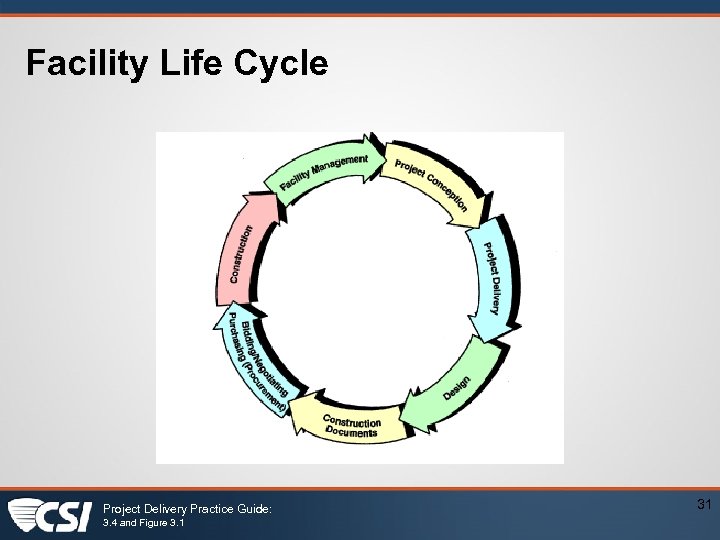 Facility Life Cycle Project Delivery Practice Guide: 3. 4 and Figure 3. 1 31
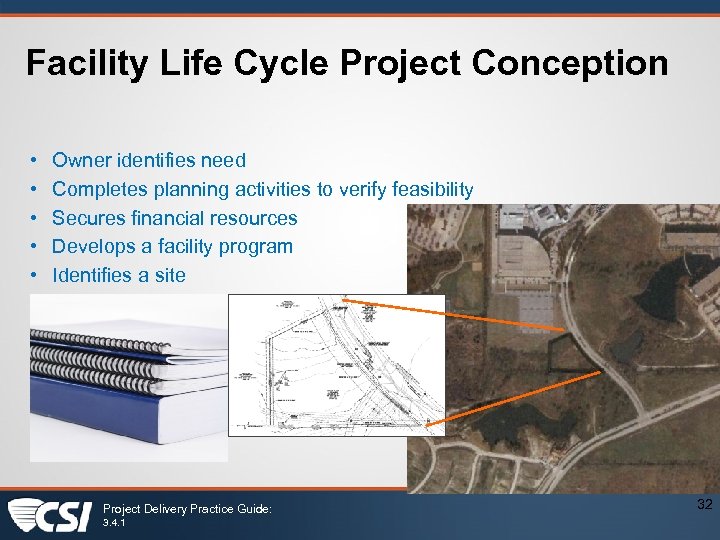 Facility Life Cycle Project Conception • • • Owner identifies need Completes planning activities to verify feasibility Secures financial resources Develops a facility program Identifies a site Project Delivery Practice Guide: 3. 4. 1 32
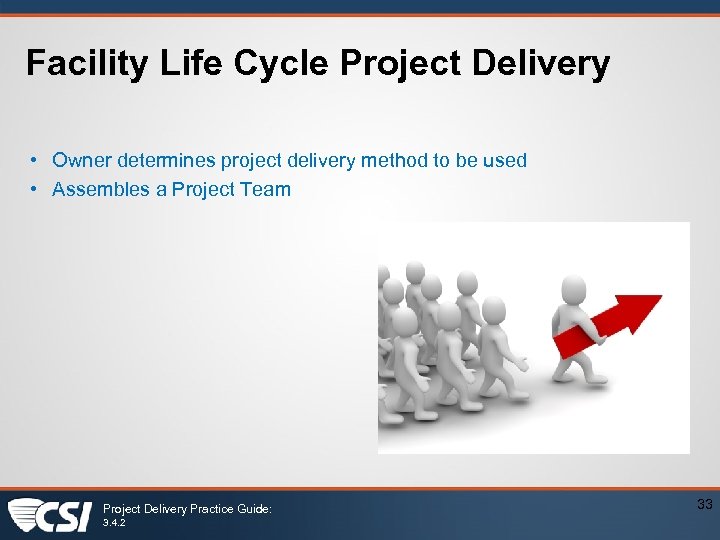 Facility Life Cycle Project Delivery • Owner determines project delivery method to be used • Assembles a Project Team Project Delivery Practice Guide: 3. 4. 2 33
 Facility Life Cycle Design For this educational program, Design is defined as having two phases: • Schematic Design, includes: – – Schematic drawings Preliminary project description Preliminary estimates Preliminary schedules • Design Development, includes: – – Technical information Outline specifications Updated estimates Updated schedules Project Delivery Practice Guide: 3. 4. 3 34
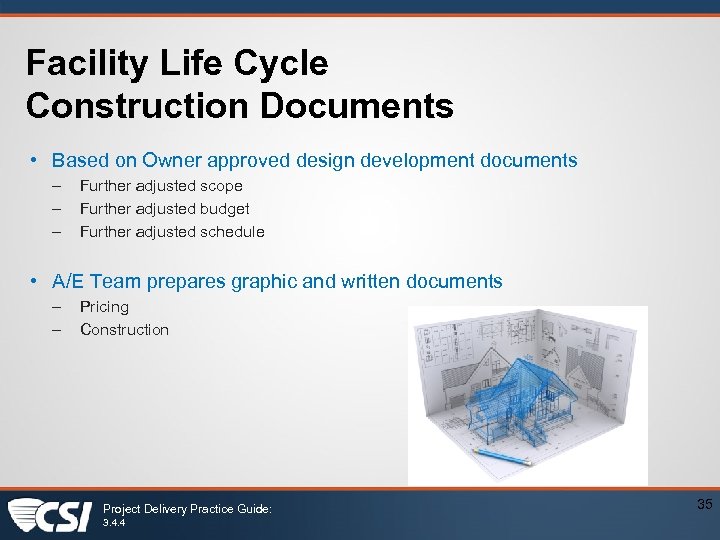 Facility Life Cycle Construction Documents • Based on Owner approved design development documents – – – Further adjusted scope Further adjusted budget Further adjusted schedule • A/E Team prepares graphic and written documents – – Pricing Construction Project Delivery Practice Guide: 3. 4. 4 35
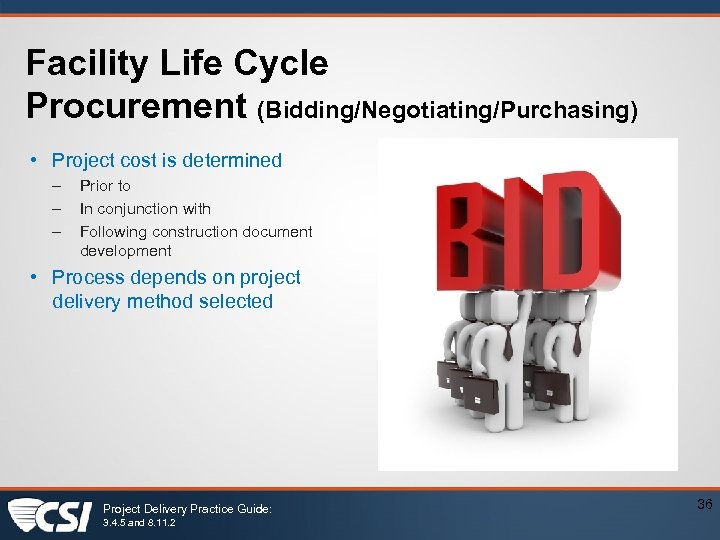 Facility Life Cycle Procurement (Bidding/Negotiating/Purchasing) • Project cost is determined – – – Prior to In conjunction with Following construction document development • Process depends on project delivery method selected Project Delivery Practice Guide: 3. 4. 5 and 8. 11. 2 36
 Facility Life Cycle Construction • Project is constructed according to – – Contract Documents Regulatory requirements Project Delivery Practice Guide: 3. 4. 6 37
 Facility Life Cycle Facility Management • Longest stage in facility life cycle • Commences with substantial completion • Facility Manager maintains and evaluates performance of project components • Facility placed in service • Operations and maintenance procedures Project Delivery Practice Guide: 3. 4. 7 38
 FUNDAMENTALS Project Stages with Associated Activities and Documents STUDY WORKBOOK: Knowledge Item 1 -3 The Construction Specifications Institute 39
 Distinction between Project and Facility • Project – – Process of planning, designing, documenting, procuring, contracting, and constructing Goal of a Project is a facility Object of delivery process or delivery process itself Unique combination of scope of work (extent), budget (cost) and schedule (time) • Facility – Completed Project intended for a specific purpose and function Project Delivery Practice Guide: 1. 5 40
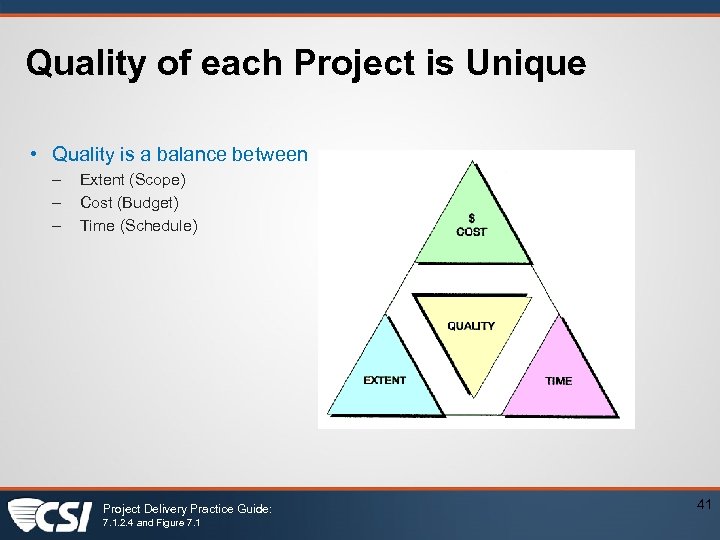 Quality of each Project is Unique • Quality is a balance between – – – Extent (Scope) Cost (Budget) Time (Schedule) Project Delivery Practice Guide: 7. 1. 2. 4 and Figure 7. 1 41
 Project Stages • Project Conception • Design • Construction Documents • Procurement (bidding/Negotiating/Purchasing) • Construction • Facility Management Project Delivery Practice Guide: 3. 4 and Table 3. 4. 1 42
 Project Conception • Activities: – Transform the needs of the Owner into a clear concept that can be designed and built – Feasibility studies – Programming – Site Selection • Documents: – Preliminary studies – Surveys – Reports of existing conditions Project Delivery Practice Guide: 3. 4. 1 and Table 3. 1 43
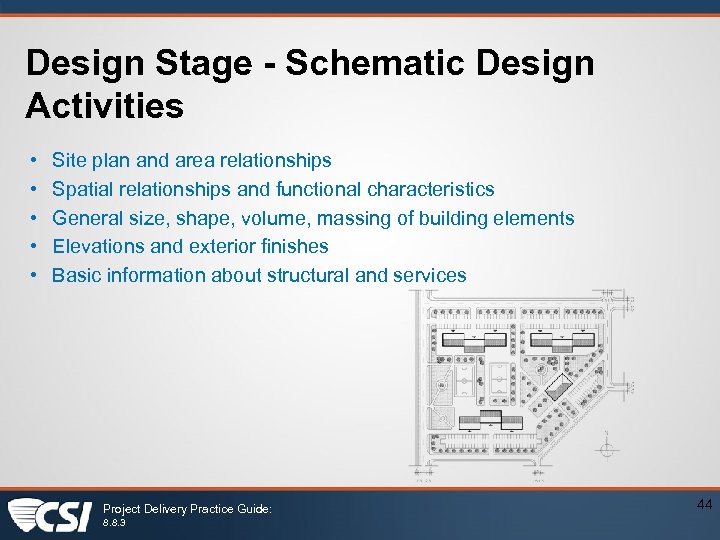 Design Stage - Schematic Design Activities • • • Site plan and area relationships Spatial relationships and functional characteristics General size, shape, volume, massing of building elements Elevations and exterior finishes Basic information about structural and services Project Delivery Practice Guide: 8. 8. 3 44
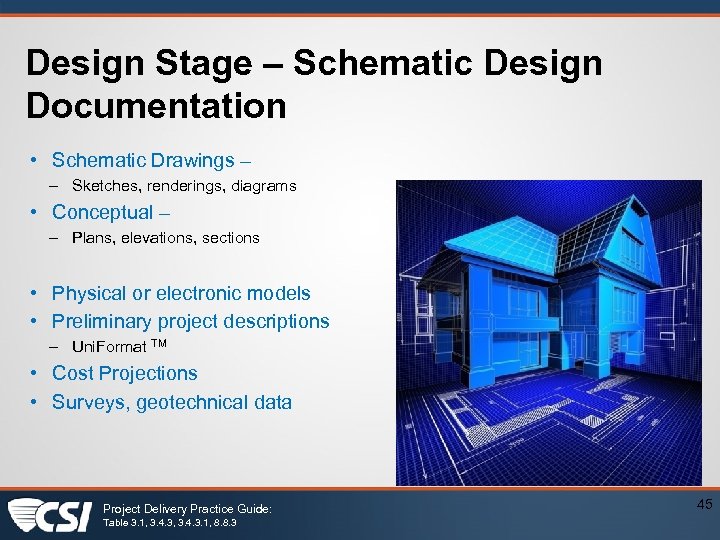 Design Stage – Schematic Design Documentation • Schematic Drawings – – Sketches, renderings, diagrams • Conceptual – – Plans, elevations, sections • Physical or electronic models • Preliminary project descriptions – Uni. Format TM • Cost Projections • Surveys, geotechnical data Project Delivery Practice Guide: Table 3. 1, 3. 4. 3. 1, 8. 8. 3 45
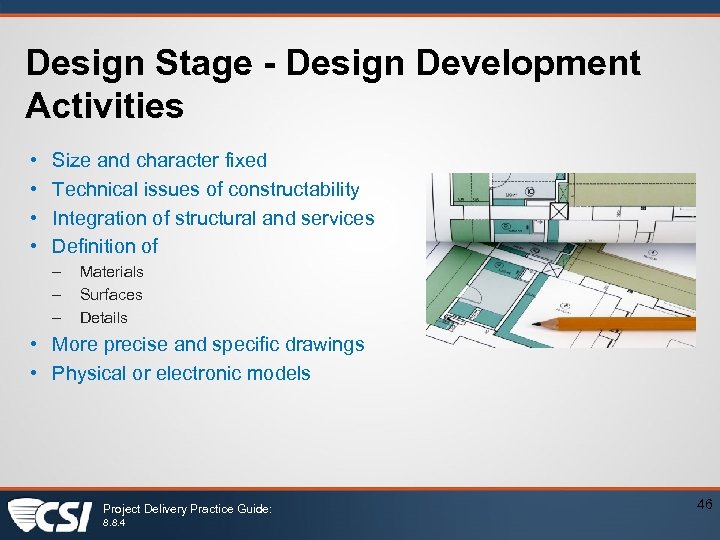 Design Stage - Design Development Activities • • Size and character fixed Technical issues of constructability Integration of structural and services Definition of – – – Materials Surfaces Details • More precise and specific drawings • Physical or electronic models Project Delivery Practice Guide: 8. 8. 4 46
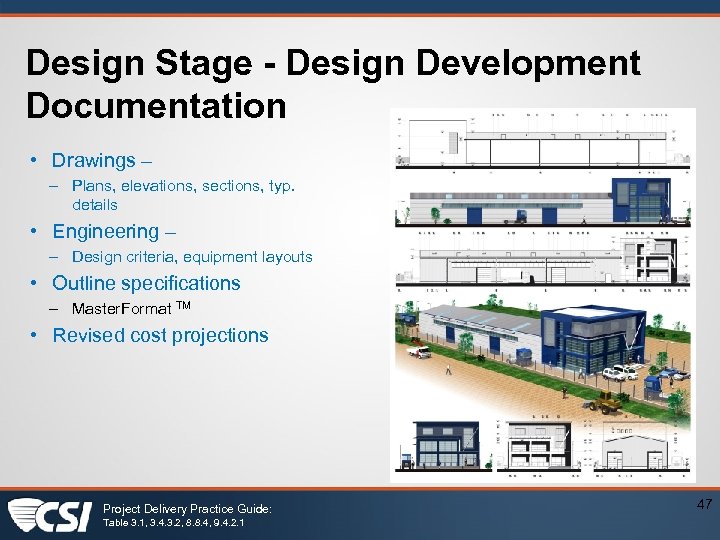 Design Stage - Design Development Documentation • Drawings – – Plans, elevations, sections, typ. details • Engineering – – Design criteria, equipment layouts • Outline specifications – Master. Format TM • Revised cost projections Project Delivery Practice Guide: Table 3. 1, 3. 4. 3. 2, 8. 8. 4, 9. 4. 2. 1 47
 Design Stage - Design Variations • Master planning – – – Design of multiple projects Integrated and complementary functions Same or contiguous site • Prototype design – – Single design developed Multiple projects Different sites Consistent identity and purpose Project Delivery Practice Guide: 8. 8. 1 48
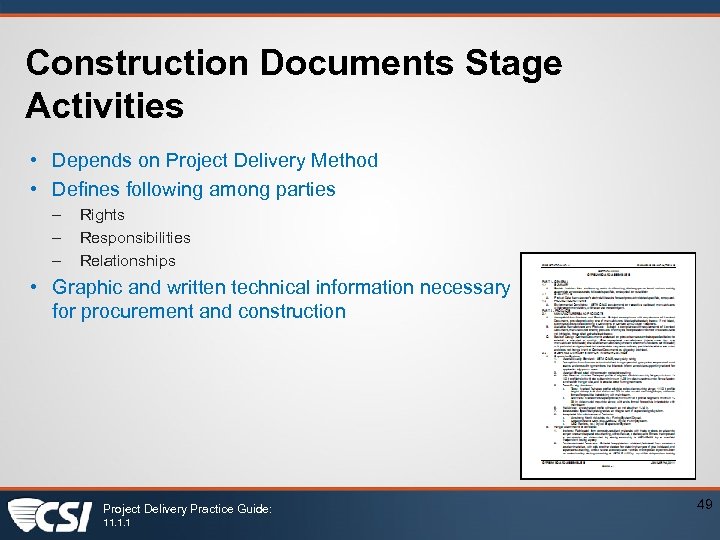 Construction Documents Stage Activities • Depends on Project Delivery Method • Defines following among parties – – – Rights Responsibilities Relationships • Graphic and written technical information necessary for procurement and construction Project Delivery Practice Guide: 11. 1. 1 49
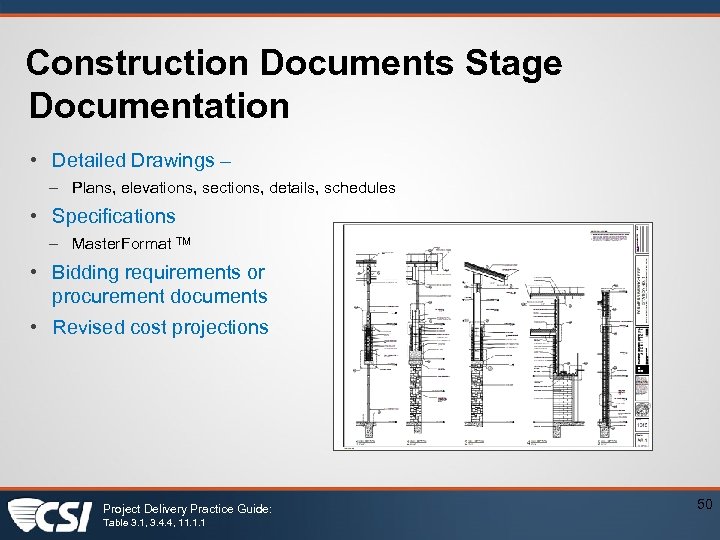 Construction Documents Stage Documentation • Detailed Drawings – – Plans, elevations, sections, details, schedules • Specifications – Master. Format TM • Bidding requirements or procurement documents • Revised cost projections Project Delivery Practice Guide: Table 3. 1, 3. 4. 4, 11. 1. 1 50
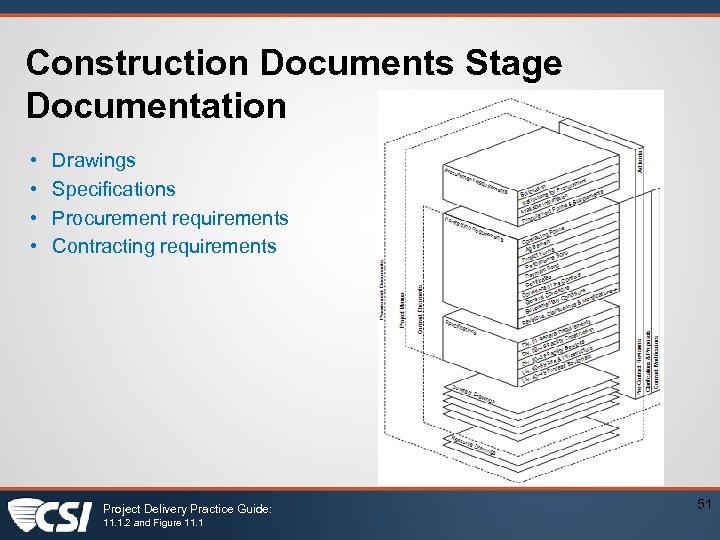 Construction Documents Stage Documentation • • Drawings Specifications Procurement requirements Contracting requirements Project Delivery Practice Guide: 11. 1. 2 and Figure 11. 1 51
 Construction Documents Stage Standardization • • • Master. Format. TM Section. Format. TM Page. Format. TM National CAD Standard Building Information Modeling Standard contracts and forms by professional organizations Project Delivery Practice Guide: 11. 1. 1 52
 Procurement Stage Activities/Documentation • Activities – Competitive bidding or contract negotiations – Direct purchasing of goods & supplies • Documentation – – Request for Proposal – Purchase orders – Addenda – Bid security Project Delivery Practice Guide: Table 3. 1, 3. 4. 5 53
 Construction Stage Activities • Mobilization • Construction • Contract Administration • Project Closeout Project Delivery Practice Guide: Table 3. 1, 3. 4. 6 54
 Construction Stage Documentation • Payment certificates • Modifications • Permits • Schedules • Shop Drawings • Certificates • Record documents • Warranties • Operation and Maintenance Data Project Delivery Practice Guide: Table 3. 1, 3. 4. 6 55
 Facility Management Stage Activities/Documentation • Activities – Commences with substantial completion – Occupancy – Operation/Maintenance – Evaluation – Repairs • Documentation – – Maintenance records – Post-occupancy reports or analysis – Warranty service records Project Delivery Practice Guide: Table 3. 1, 3. 4. 7 56
 FUNDAMENTALS OMNICLASSTM STUDY WORKBOOK: Knowledge Item 1 -4 The Construction Specifications Institute 57
 Omni. Class. TM • Multi-table framework for – – Organizing information Serving participants who work To sustain built environment Throughout Facility Life Cycle • Derived from internationally accepted standards developed by International Organization for Standards (ISO) Project Delivery Practice Guide: 11. 3. 7. 1 58
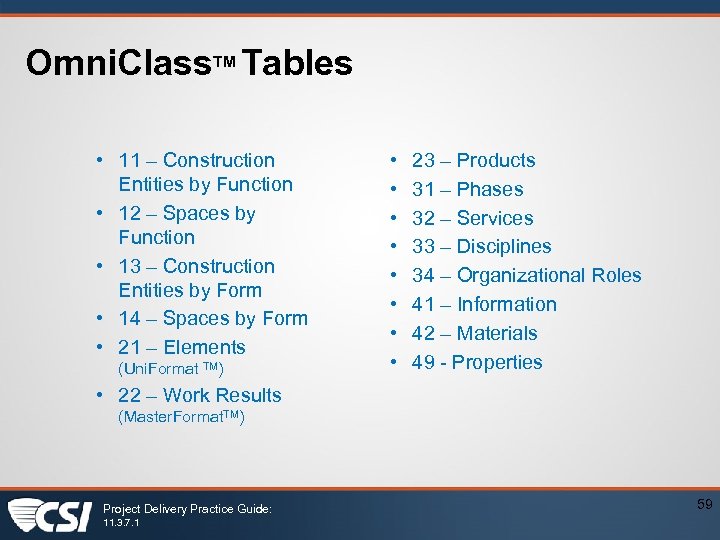 Omni. Class. TM Tables • 11 – Construction Entities by Function • 12 – Spaces by Function • 13 – Construction Entities by Form • 14 – Spaces by Form • 21 – Elements (Uni. Format TM) • • 23 – Products 31 – Phases 32 – Services 33 – Disciplines 34 – Organizational Roles 41 – Information 42 – Materials 49 - Properties • 22 – Work Results (Master. Format. TM) Project Delivery Practice Guide: 11. 3. 7. 1 59
 FUNDAMENTALS UNIFORMATTM STUDY WORKBOOK: Knowledge Item 1 -4 The Construction Specifications Institute 60
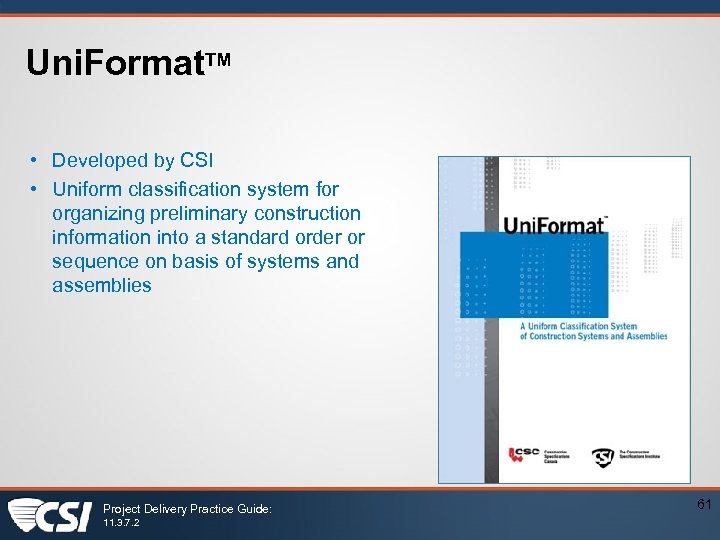 Uni. Format. TM • Developed by CSI • Uniform classification system for organizing preliminary construction information into a standard order or sequence on basis of systems and assemblies Project Delivery Practice Guide: 11. 3. 7. 2 61
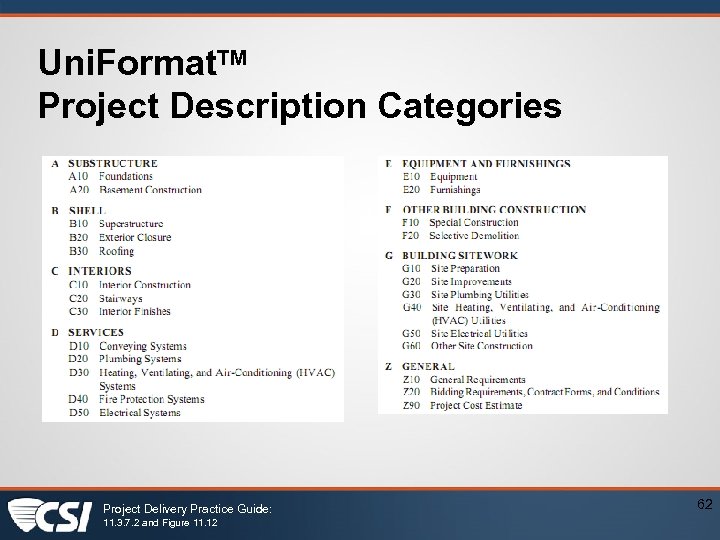 Uni. Format. TM Project Description Categories Project Delivery Practice Guide: 11. 3. 7. 2 and Figure 11. 12 62
 Uni. Format. TM Example of Levels 1 2 3 4 5 A Substructure A 10 Foundations A 1010 Standard Foundations A 1010. 10 Wall Foundations A 1010. 10 CF Continuous Foundations Project Delivery Practice Guide: 13. 3. 7. 2 63
 FUNDAMENTALS MASTERFORMATTM STUDY WORKBOOK: Knowledge Item 1 -4 The Construction Specifications Institute 64
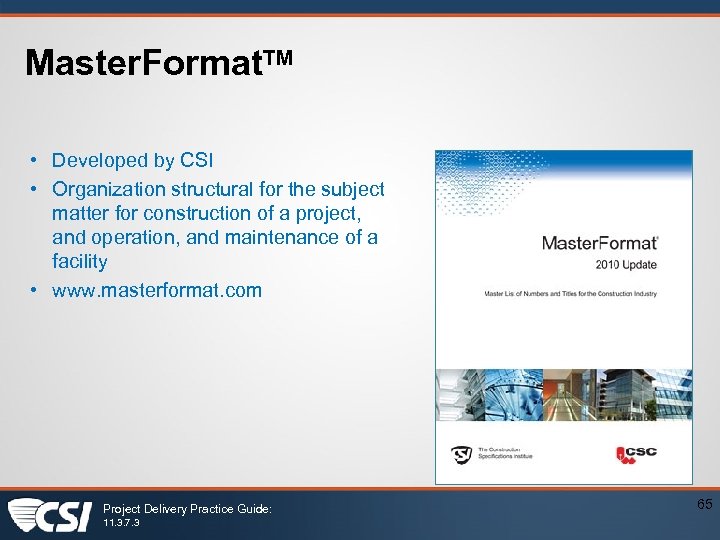 Master. Format. TM • Developed by CSI • Organization structural for the subject matter for construction of a project, and operation, and maintenance of a facility • www. masterformat. com Project Delivery Practice Guide: 11. 3. 7. 3 65
 Master. Format. TM • • • Master list of numbers and titles Arranges related construction practices or work results Different types of construction addressed equally Promotes standardization Facilitates organization of information Improves construction communications Project Delivery Practice Guide: 11. 3. 7. 3 66
 Master. Format. TM • Divisions – – – 50 division format Not organized around traditional subcontracts or construction trades Follows logical groupings of work results • Sections – – 6 digit numbers (some 8) Section covers one portion of work results Different Consistent Project Delivery Practice Guide: 11. 3. 7. 3 67
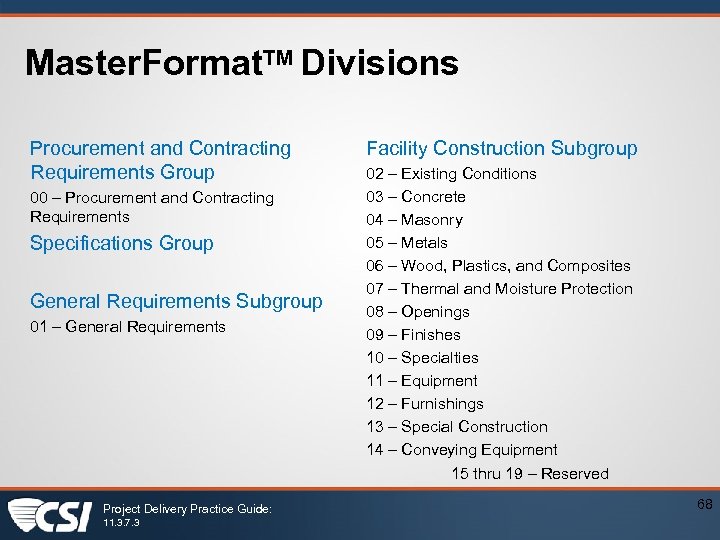 Master. Format. TM Divisions Procurement and Contracting Requirements Group 00 – Procurement and Contracting Requirements Specifications Group General Requirements Subgroup 01 – General Requirements Project Delivery Practice Guide: 11. 3. 7. 3 Facility Construction Subgroup 02 – Existing Conditions 03 – Concrete 04 – Masonry 05 – Metals 06 – Wood, Plastics, and Composites 07 – Thermal and Moisture Protection 08 – Openings 09 – Finishes 10 – Specialties 11 – Equipment 12 – Furnishings 13 – Special Construction 14 – Conveying Equipment 15 thru 19 – Reserved 68
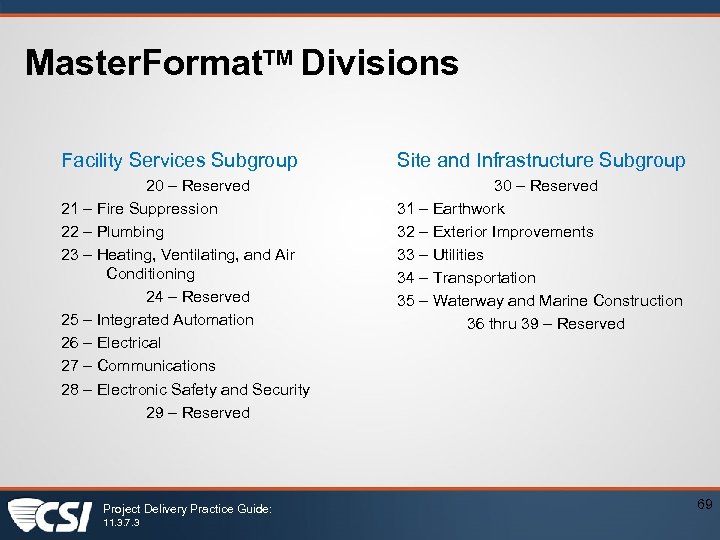 Master. Format. TM Divisions Facility Services Subgroup Site and Infrastructure Subgroup 20 – Reserved 21 – Fire Suppression 22 – Plumbing 23 – Heating, Ventilating, and Air Conditioning 24 – Reserved 25 – Integrated Automation 26 – Electrical 27 – Communications 28 – Electronic Safety and Security 29 – Reserved 30 – Reserved 31 – Earthwork 32 – Exterior Improvements 33 – Utilities 34 – Transportation 35 – Waterway and Marine Construction 36 thru 39 – Reserved Project Delivery Practice Guide: 11. 3. 7. 3 69
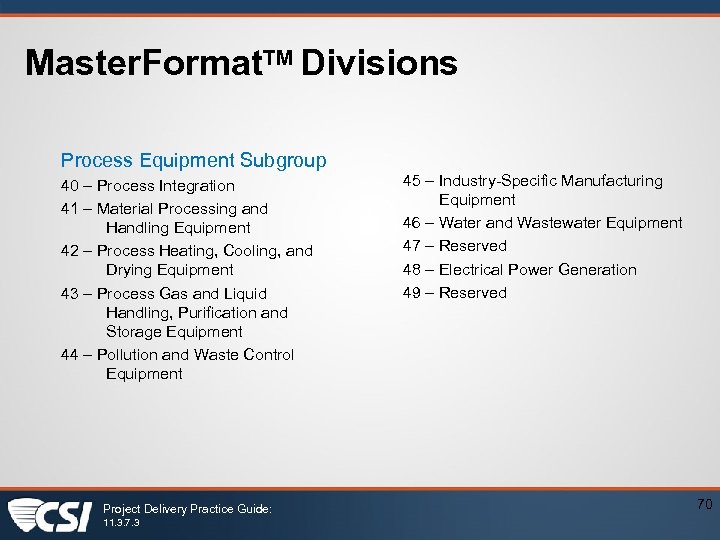 Master. Format. TM Divisions Process Equipment Subgroup 40 – Process Integration 41 – Material Processing and Handling Equipment 42 – Process Heating, Cooling, and Drying Equipment 43 – Process Gas and Liquid Handling, Purification and Storage Equipment 44 – Pollution and Waste Control Equipment Project Delivery Practice Guide: 11. 3. 7. 3 45 – Industry-Specific Manufacturing Equipment 46 – Water and Wastewater Equipment 47 – Reserved 48 – Electrical Power Generation 49 – Reserved 70
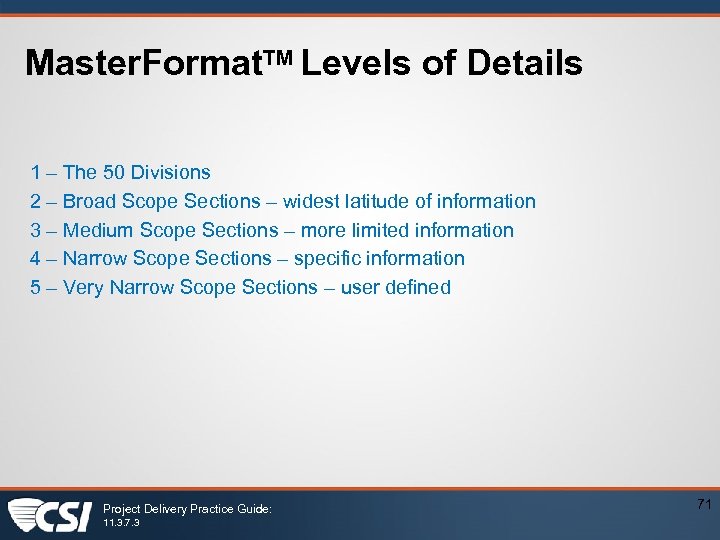 Master. Format. TM Levels of Details 1 – The 50 Divisions 2 – Broad Scope Sections – widest latitude of information 3 – Medium Scope Sections – more limited information 4 – Narrow Scope Sections – specific information 5 – Very Narrow Scope Sections – user defined Project Delivery Practice Guide: 11. 3. 7. 3 71
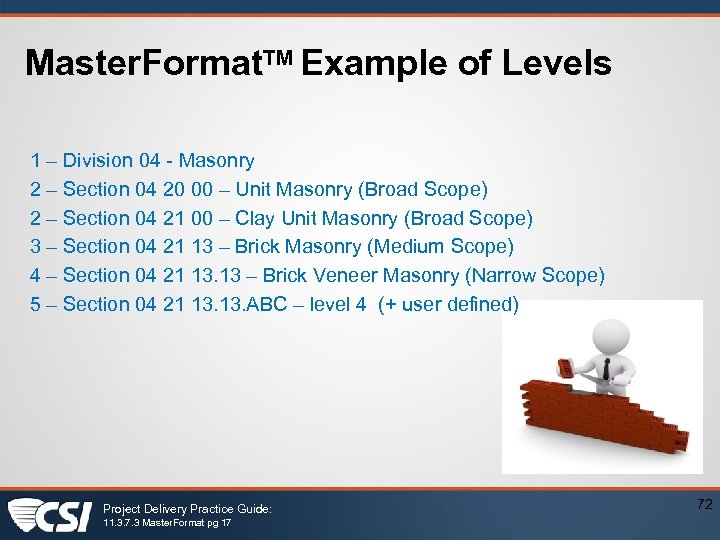 Master. Format. TM Example of Levels 1 – Division 04 - Masonry 2 – Section 04 20 00 – Unit Masonry (Broad Scope) 2 – Section 04 21 00 – Clay Unit Masonry (Broad Scope) 3 – Section 04 21 13 – Brick Masonry (Medium Scope) 4 – Section 04 21 13. 13 – Brick Veneer Masonry (Narrow Scope) 5 – Section 04 21 13. ABC – level 4 (+ user defined) Project Delivery Practice Guide: 11. 3. 7. 3 Master. Format pg 17 72
 FUNDAMENTALS SECTIONFORMATTM STUDY WORKBOOK: Knowledge Item 1 -4 73
 Section. Format. TM • Provides a uniform approach to organizing specification information by establishing a structure consisting of three primary parts. • 3 -parts organize specific information consistently in each section. • Part 1 – General – • Part 2 - Products – • Describes administrative, procedural and temporary requirements unique to the section. Extension of subjects covered in Division 01. Describes products, materials, equipment, fabrications, mixes, systems and assemblies and their quality requirements. Part 3 - Execution – Describes installation or application, including preparatory actions and post-installation cleaning and protection. Project Delivery Practice Guide: 11. 3. 7. 4, Figure 11. 1. 3 74
 FUNDAMENTALS PAGEFORMATTM STUDY WORKBOOK: Knowledge Item 1 -4 75
 Page. Format. TM • Standardized way of presenting information on the page. • Provides orderly and uniform arrangement of text. • Three objectives: – Present text clearly for easy reading – Provide acceptable standard – Provide flexible format compatible with most software Project Delivery Practice Guide: 11. 3. 7. 5 76
 FUNDAMENTALS GREENFORMATTM STUDY WORKBOOK: Knowledge Item 1 -4 77
 Green. Format. TM Green. Format™ is a standardized structure for organizing sustainable information elements associated with materials, products, systems and technologies used in the built environment. By using this standardized format, manufacturers can accurately identify key product characteristics and provide designers, constructors, and building operators with information needed to help meet sustainable design and operation goals. 78
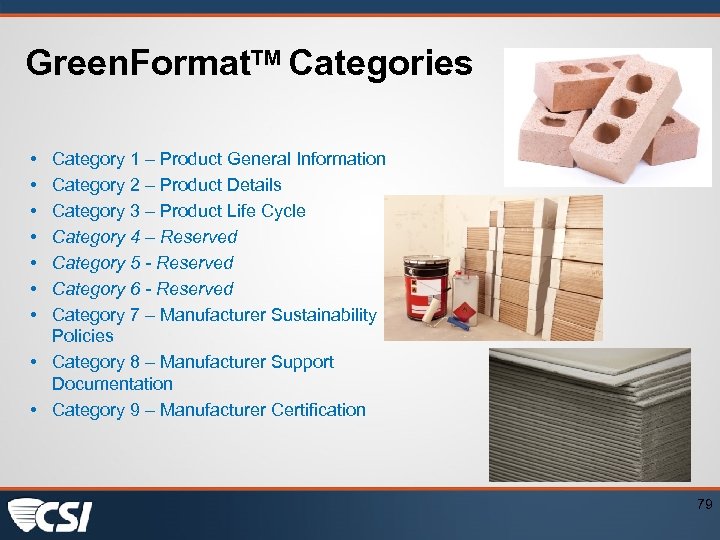 Green. Format. TM Categories • • Category 1 – Product General Information Category 2 – Product Details Category 3 – Product Life Cycle Category 4 – Reserved Category 5 - Reserved Category 6 - Reserved Category 7 – Manufacturer Sustainability Policies • Category 8 – Manufacturer Support Documentation • Category 9 – Manufacturer Certification 79
 FUNDAMENTALS Graphic Formats STUDY WORKBOOK: Knowledge Item 1 -5 80
 Graphic Formats • Drawing set organization – A collection of sheets of drawings related to a project is known as a drawing set – Traditional method of organization is by discipline, then by type (i. e. plans, elevations, sections) • Project aspects that may influence organization – – Number of disciplines – Number of project parts (i. e. individual bldgs. ) – Number of contracts – Project phase – Construction sequence – Number and extend of systems – Project delivery method Project Delivery Practice Guide: 11. 2. 6 81
 Graphic Standards • U. S. National CAD Standard – NCS streamlines and simplifies the exchange of building design and construction data throughout the life of the project. – Classifies electronic building design data consistently – NCS is a consensus standard – Comprises interrelated standards, guidelines and tools for design and construction including – • National Institute Building Sciences Foreword and Administration • AIA CAD Layer Guidelines • CSI Uniform Drawing System • Plotting Guidelines Project Delivery Practice Guide: 11. 2. 7 82
 Graphic Standards • Building Information Modeling (BIM) – With information technology advances, the distinction between drawing and specification is blurring. – BIM is rapidly shifting emphasis from 2 D CAD drawings to 3 D thinking. – BIM is a database of building information. – BIM uses and integrated object based model that describes attributes of building objects and the relationships of those objects to each other. – Geometric entities can be developed as 3 D objects. – Building data can be retrieved from the database and used from schematics through facility management. – Intent of BIM is to achieve interoperability among various software. – Advantage of BIM is standardized platform for multidisciplinary retrieval and use. Project Delivery Practice Guide: 11. 2. 8 83
 FUNDAMENTALS Legal Interpretation and/or Conflicts of Contract Documents STUDY WORKBOOK: Knowledge Item 1 -6 The Construction Specifications Institute 84
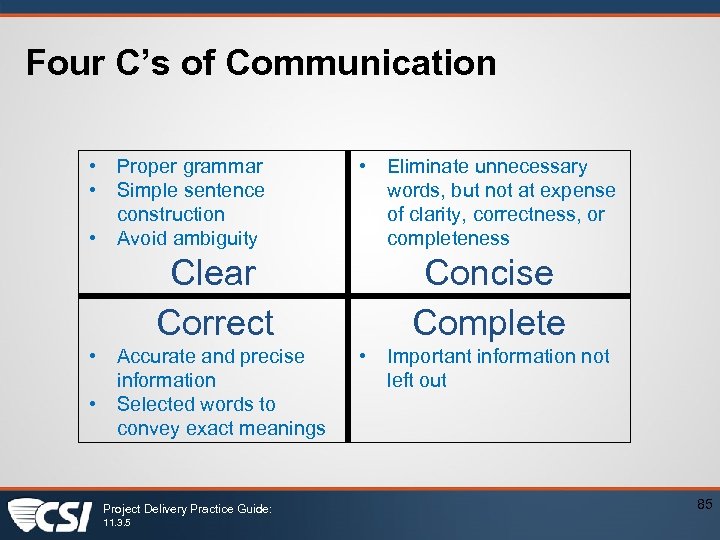 Four C’s of Communication • • • Proper grammar Simple sentence construction Avoid ambiguity • Clear Correct • • Accurate and precise information Selected words to convey exact meanings Project Delivery Practice Guide: 11. 3. 5 Eliminate unnecessary words, but not at expense of clarity, correctness, or completeness Concise Complete • Important information not left out 85
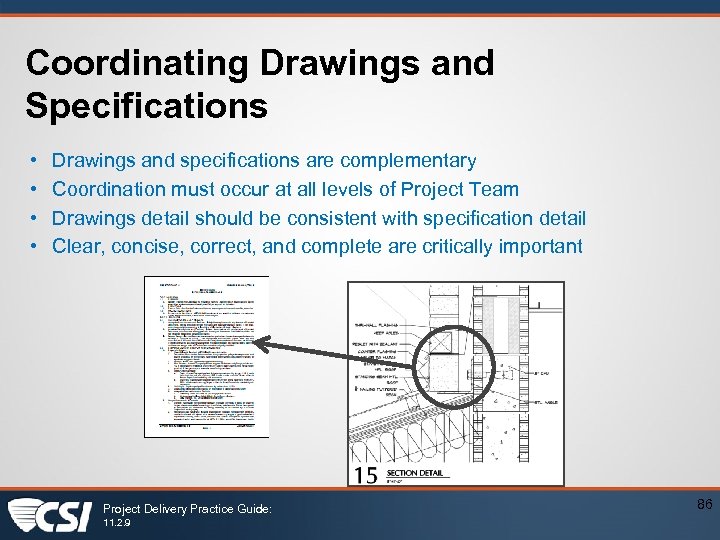 Coordinating Drawings and Specifications • • Drawings and specifications are complementary Coordination must occur at all levels of Project Team Drawings detail should be consistent with specification detail Clear, concise, correct, and complete are critically important Project Delivery Practice Guide: 11. 2. 9 86
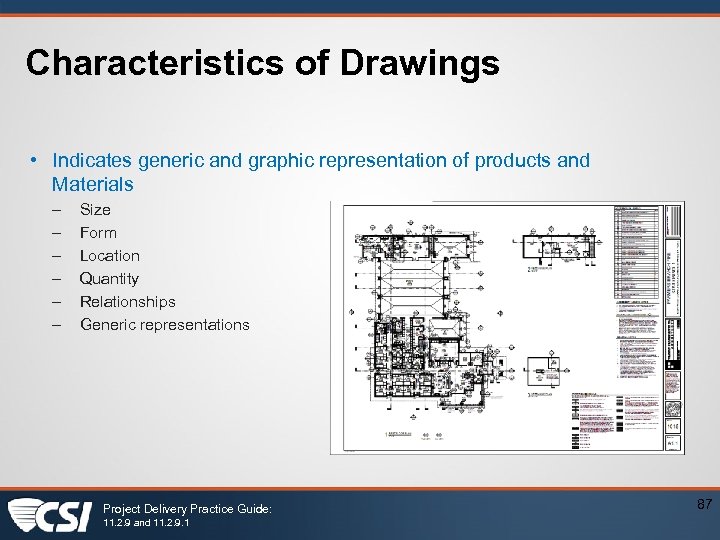 Characteristics of Drawings • Indicates generic and graphic representation of products and Materials – – – Size Form Location Quantity Relationships Generic representations Project Delivery Practice Guide: 11. 2. 9 and 11. 2. 9. 1 87
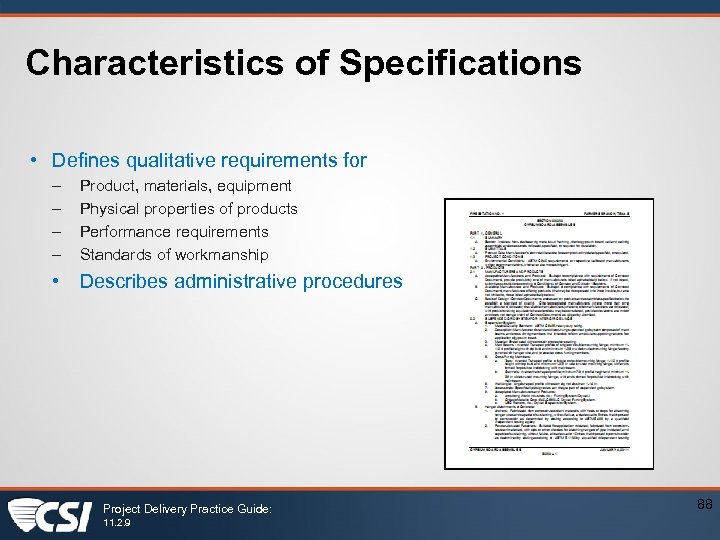 Characteristics of Specifications • Defines qualitative requirements for – – Product, materials, equipment Physical properties of products Performance requirements Standards of workmanship • Describes administrative procedures Project Delivery Practice Guide: 11. 2. 9 88
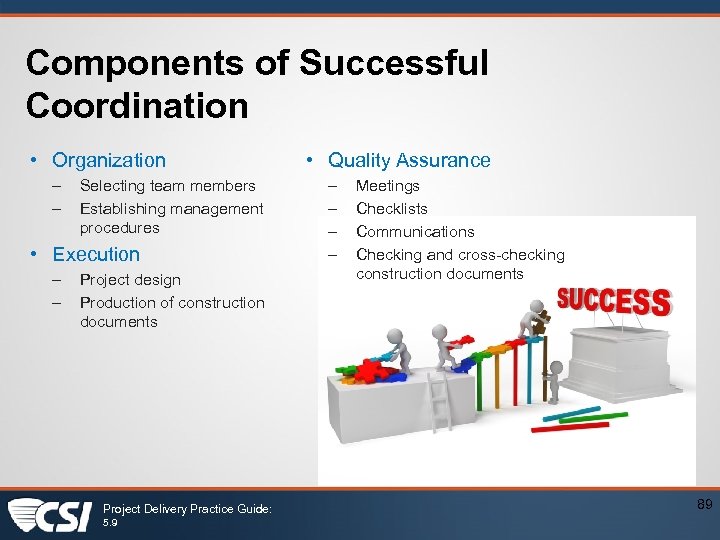 Components of Successful Coordination • Organization – – Selecting team members Establishing management procedures • Execution – – Project design Production of construction documents Project Delivery Practice Guide: 5. 9 • Quality Assurance – – Meetings Checklists Communications Checking and cross-checking construction documents 89
 Components of Incomplete Coordination • • • Duplications Omissions Discrepancies Division 01 not coordinated Terminology differences Project Delivery Practice Guide: 5. 9 90
 FUNDAMENTALS Sustainable Design and Construction STUDY WORKBOOK: Knowledge Item 1 -7 The Construction Specifications Institute 91
 Sustainability • Environmental preservation has become an important issue – – Public policy Private enterprise Project Delivery Practice Guide: 8. 7 92
 Sustainability • EPA – Sustainable building involves – Developing healthier methods of construction, operations, and demolition – Using resources more efficiently • ASTM E 2114 – Standard Terminology for Sustainability Relative to the Performance of Buildings defines green building as – One that meets specified performance requirements – While minimizing disturbance to and improving the functioning of local, regional, and global ecosystems – During and after its construction and specified service life Project Delivery Practice Guide: 8. 7 93
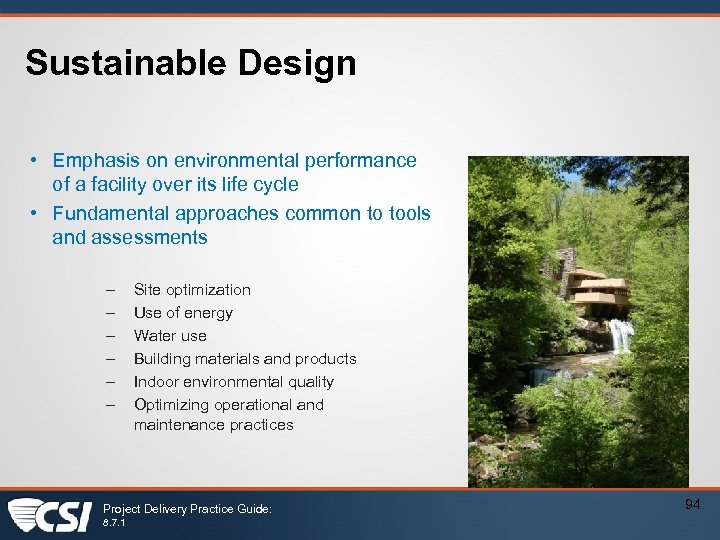 Sustainable Design • Emphasis on environmental performance of a facility over its life cycle • Fundamental approaches common to tools and assessments – – – Site optimization Use of energy Water use Building materials and products Indoor environmental quality Optimizing operational and maintenance practices Project Delivery Practice Guide: 8. 7. 1 94
 Environmental Design Tools • Various tools available for use by product manufacturers, Contractors, and A/E’s – – – NIST’s BEES – Building for Environmental and Economic Sustainability EPA’s Energy Star Program USGBC’s LEED Program Project Delivery Practice Guide: 8. 7. 2 95
 Assessing Product Sustainability • Requires life cycle assessment by a qualified agency • NIST’s BEES (Building for Environmental and Economic Sustainability) Model is one method – – – Global warming potential Acidification Nitrification potential Natural resource depletion Solid waste produced Indoor air quality • Another is ASTM E 2129 – Standard Practice for Data Collection for Sustainable Assessments of Building Products Project Delivery Practice Guide: 8. 7. 3 96
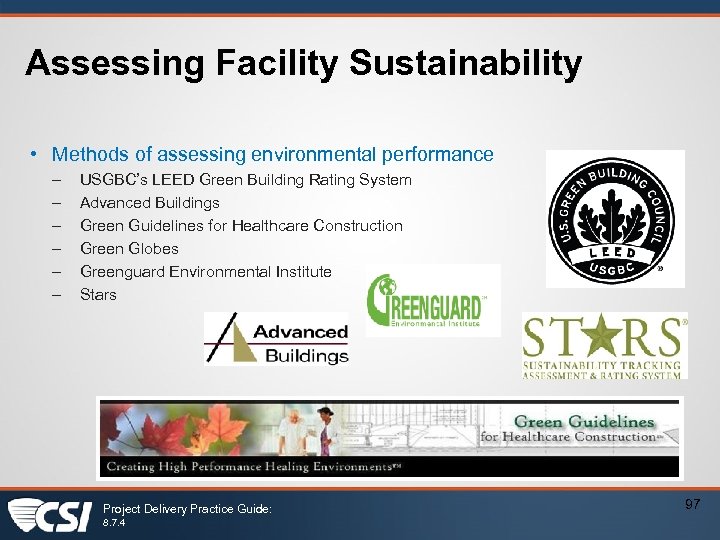 Assessing Facility Sustainability • Methods of assessing environmental performance – – – USGBC’s LEED Green Building Rating System Advanced Buildings Green Guidelines for Healthcare Construction Green Globes Greenguard Environmental Institute Stars Project Delivery Practice Guide: 8. 7. 4 97
 Product Evaluation • Sustainability attributes is one of many categories for evaluation of products – – – – Low embodied energy Recyclability, material reuse, or salvaged Natural or renewable resources Locally or regionally produced Energy efficiency Low environmental impact Durability Recycled content Project Delivery Practice Guide: 10. 5. 4. 4 – – – Waste minimization Promotes good indoor air quality Absence of unhealthful chemicals, toxic substances, or volatile organic compounds Biodegradable or bio-based composition Conservation of resources Responsible wood supplies 98
 Review Outline STUDY WORKBOOK: Module No. 1 - FUNDAMENTALS A. Job roles and responsibilities of the four Project Teams & Participants E. Omni. Class. TM F. Uni. Format. TM G. Master. Format. TM B. Factors that contribute to an effective team H. Green. Format. TM C. Stages of Facility Life Cycle with associated activities and documents J. Page. Format. TM D. Project stages with associated activities and documents L. Principals of communication I. Section. Format. TM K. Graphic formats M. Legal interpretations of Contract Documents N. Sustainable design and construction The Construction Specifications Institute 99