


 Скачать презентацию Input slides figures for June 2000 ITS CVO Roadmap
0ed3cf473b72ba2a0e43ee5c0f52f09e.ppt
- Количество слайдов: 18
 Input slides/figures for June 2000 ITS/CVO Roadmap
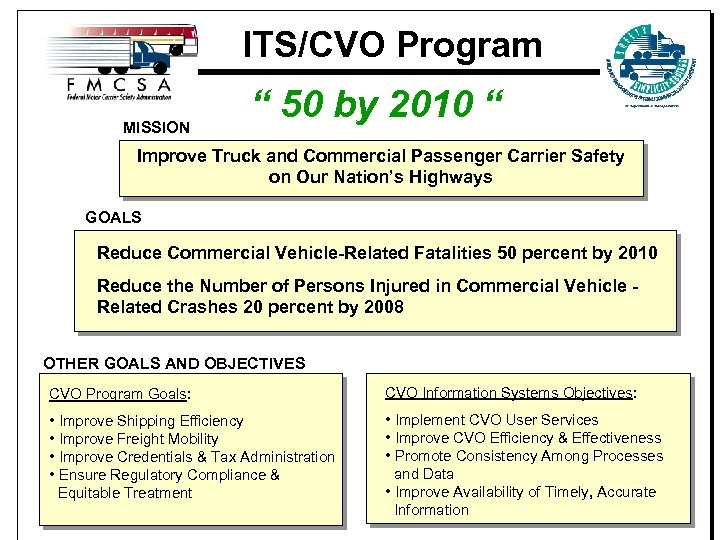 ITS/CVO Program MISSION “ 50 by 2010 “ Improve Truck and Commercial Passenger Carrier Safety on Our Nation’s Highways GOALS Reduce Commercial Vehicle-Related Fatalities 50 percent by 2010 Reduce the Number of Persons Injured in Commercial Vehicle Related Crashes 20 percent by 2008 OTHER GOALS AND OBJECTIVES CVO Program Goals: CVO Information Systems Objectives: • Improve Shipping Efficiency • Improve Freight Mobility • Improve Credentials & Tax Administration • Ensure Regulatory Compliance & Equitable Treatment • Implement CVO User Services • Improve CVO Efficiency & Effectiveness • Promote Consistency Among Processes and Data • Improve Availability of Timely, Accurate Information
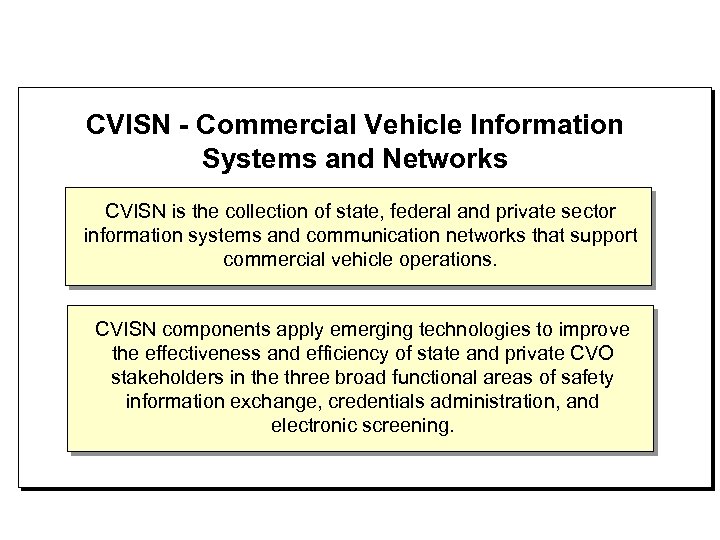 CVISN - Commercial Vehicle Information Systems and Networks CVISN is the collection of state, federal and private sector information systems and communication networks that support commercial vehicle operations. CVISN components apply emerging technologies to improve the effectiveness and efficiency of state and private CVO stakeholders in the three broad functional areas of safety information exchange, credentials administration, and electronic screening.
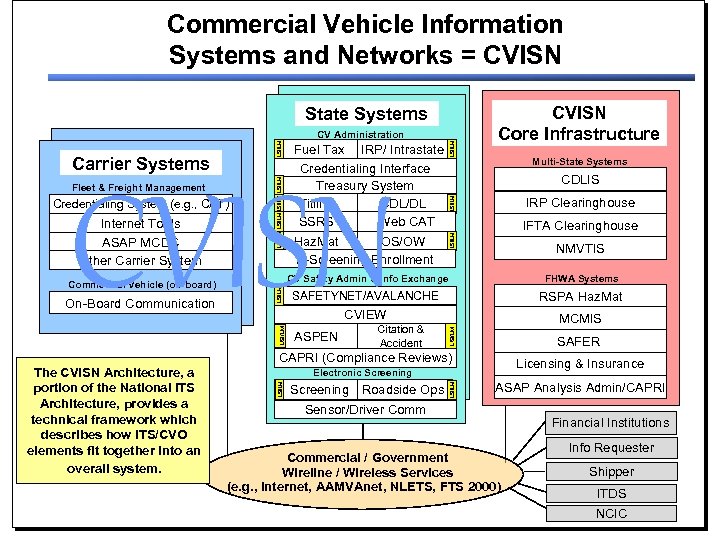 Commercial Vehicle Information Systems and Networks = CVISN State Systems CVISN Fleet & Freight Management Credentialing System (e. g. , CAT) IFTA Clearinghouse NMVTIS LSI/LM SAFETYNET/AVALANCHE RSPA Haz. Mat MCMIS ASPEN Citation & Accident LSI/LM FHWA Systems CVIEW SAFER CAPRI (Compliance Reviews) Licensing & Insurance Electronic Screening LSI/LM The CVISN Architecture, a portion of the National ITS Architecture, provides a technical framework which describes how ITS/CVO elements fit together into an overall system. IRP Clearinghouse CV Safety Admin & Info Exchange LSI/LM On-Board Communication CDLIS Screening Roadside Ops LSI/LM Commercial Vehicle (on-board) LSI/LM Internet Tools ASAP MCDC Other Carrier System Multi-State Systems LSI/LM Fuel Tax IRP/ Intrastate Credentialing Interface Treasury System Titling CDL/DL SSRS Web CAT Haz. Mat OS/OW E-Screening Enrollment LSI/LM Carrier Systems LSI/LM LSI/LM CV Administration CVISN Core Infrastructure ASAP Analysis Admin/CAPRI Sensor/Driver Commercial / Government Wireline / Wireless Services (e. g. , Internet, AAMVAnet, NLETS, FTS 2000) Financial Institutions Info Requester Shipper ITDS NCIC
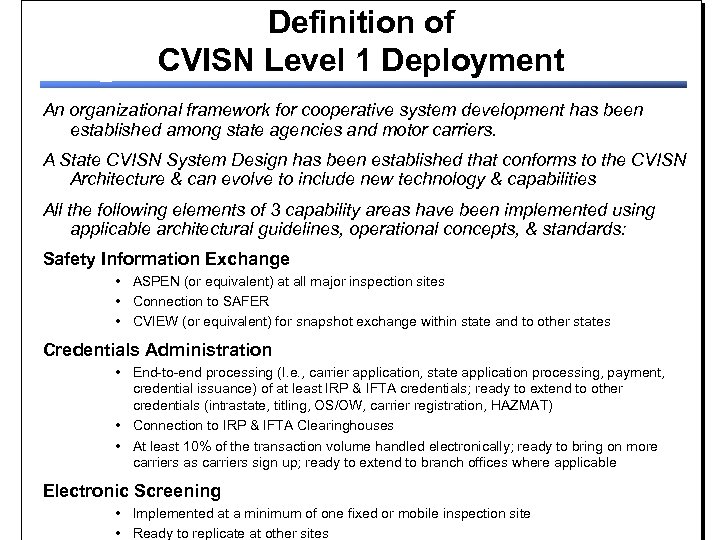 Definition of CVISN Level 1 Deployment An organizational framework for cooperative system development has been established among state agencies and motor carriers. A State CVISN System Design has been established that conforms to the CVISN Architecture & can evolve to include new technology & capabilities All the following elements of 3 capability areas have been implemented using applicable architectural guidelines, operational concepts, & standards: Safety Information Exchange • ASPEN (or equivalent) at all major inspection sites • Connection to SAFER • CVIEW (or equivalent) for snapshot exchange within state and to other states Credentials Administration • End-to-end processing (I. e. , carrier application, state application processing, payment, credential issuance) of at least IRP & IFTA credentials; ready to extend to other credentials (intrastate, titling, OS/OW, carrier registration, HAZMAT) • Connection to IRP & IFTA Clearinghouses • At least 10% of the transaction volume handled electronically; ready to bring on more carriers as carriers sign up; ready to extend to branch offices where applicable Electronic Screening • Implemented at a minimum of one fixed or mobile inspection site • Ready to replicate at other sites
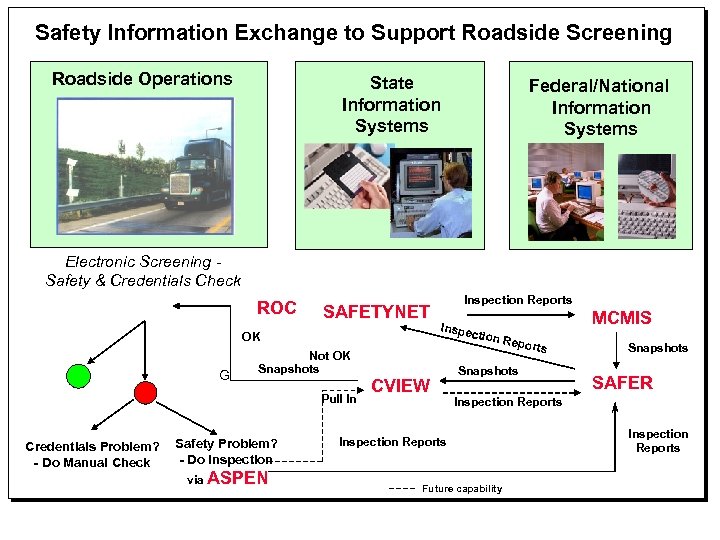 Safety Information Exchange to Support Roadside Screening Roadside Operations State Information Systems Federal/National Information Systems Electronic Screening Safety & Credentials Check ROC SAFETYNET Not OK Snapshots R Credentials Problem? - Do Manual Check Inspe Safety Problem? - Do Inspection via ASPEN MCMIS ction R OK G Inspection Reports Pull In CVIEW eport s Snapshots SAFER Inspection Reports Future capability Inspection Reports
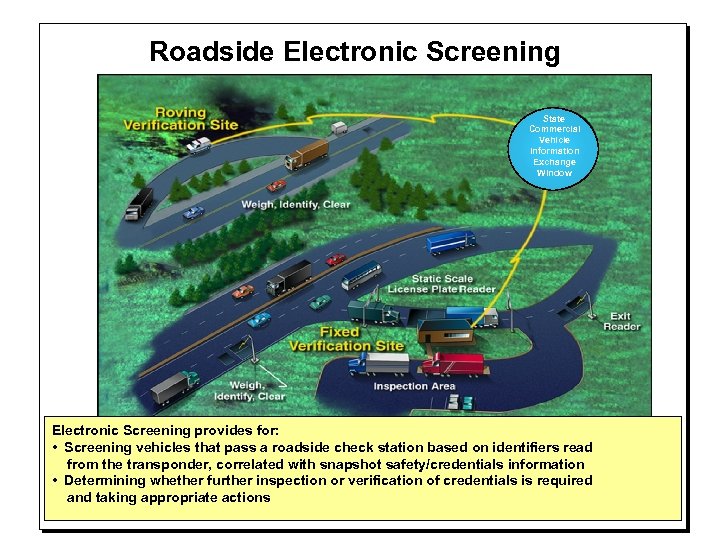 Roadside Electronic Screening State Commercial Vehicle Information Exchange Window Electronic Screening provides for: • Screening vehicles that pass a roadside check station based on identifiers read from the transponder, correlated with snapshot safety/credentials information • Determining whether further inspection or verification of credentials is required and taking appropriate actions
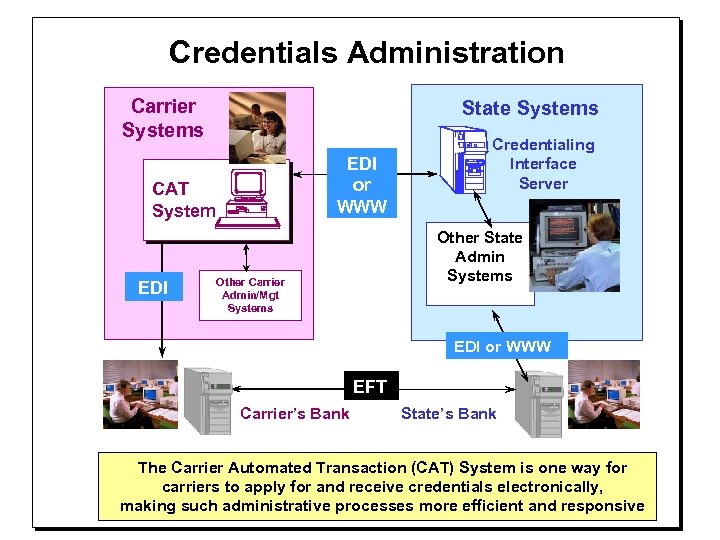 Credentials Administration Carrier Systems State Systems EDI or WWW CAT System EDI Credentialing Interface Server Other State Admin Systems Other Carrier Admin/Mgt Systems EDI or WWW EFT Carrier’s Bank State’s Bank The Carrier Automated Transaction (CAT) System is one way for carriers to apply for and receive credentials electronically, making such administrative processes more efficient and responsive
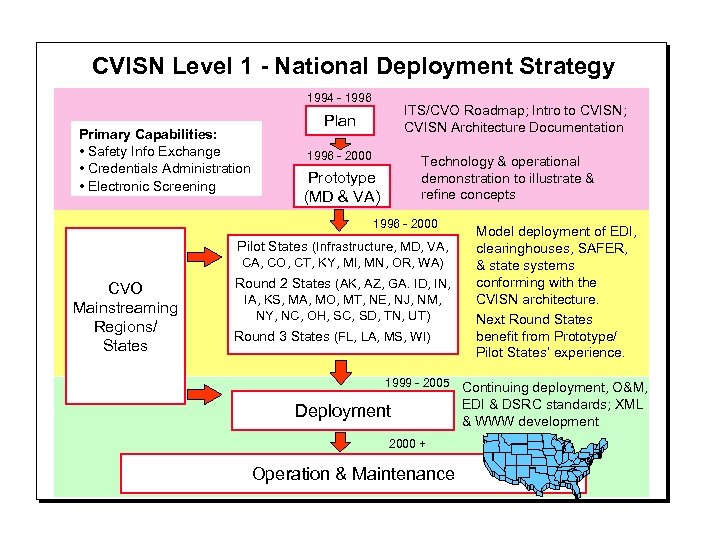 CVISN Level 1 - National Deployment Strategy 1994 - 1996 Primary Capabilities: • Safety Info Exchange • Credentials Administration • Electronic Screening ITS/CVO Roadmap; Intro to CVISN; CVISN Architecture Documentation Plan 1996 - 2000 Technology & operational demonstration to illustrate & refine concepts Prototype (MD & VA) 1996 - 2000 Pilot States (Infrastructure, MD, VA, CO, CT, KY, MI, MN, OR, WA) CVO Mainstreaming Regions/ States Round 2 States (AK, AZ, GA. ID, IN, IA, KS, MA, MO, MT, NE, NJ, NM, NY, NC, OH, SC, SD, TN, UT) Round 3 States (FL, LA, MS, WI) 1999 - 2005 Deployment 2000 + Operation & Maintenance Model deployment of EDI, clearinghouses, SAFER, & state systems conforming with the CVISN architecture. Next Round States benefit from Prototype/ Pilot States’ experience. Continuing deployment, O&M, EDI & DSRC standards; XML & WWW development
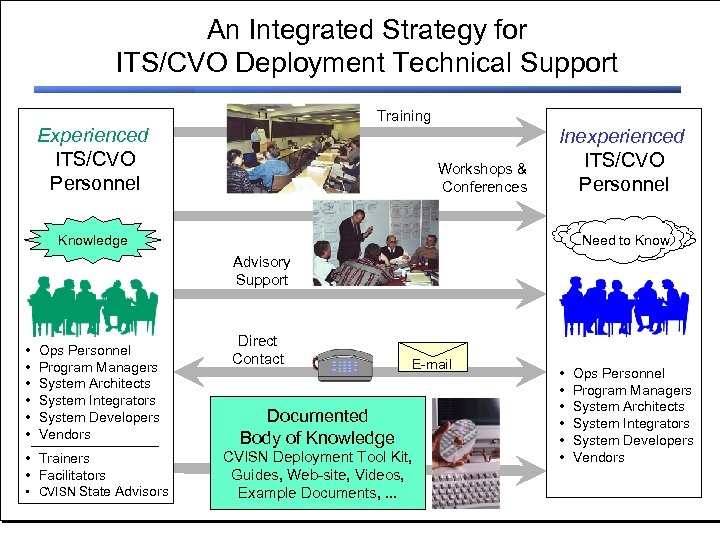 An Integrated Strategy for ITS/CVO Deployment Technical Support Training Experienced ITS/CVO Personnel Workshops & Conferences Inexperienced ITS/CVO Personnel Need to Knowledge Advisory Support • • • Ops Personnel Program Managers System Architects System Integrators System Developers Vendors -------------------------------- • Trainers • Facilitators • CVISN State Advisors Direct Contact E-mail Documented Body of Knowledge CVISN Deployment Tool Kit, Guides, Web-site, Videos, Example Documents, . . . • • • Ops Personnel Program Managers System Architects System Integrators System Developers Vendors
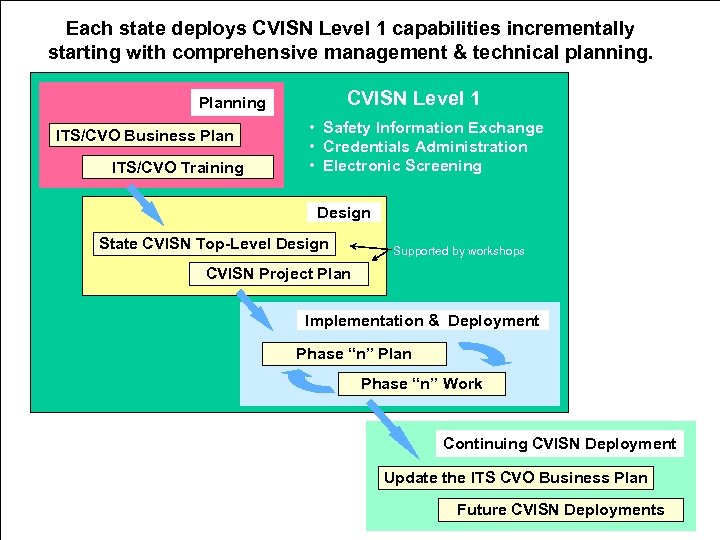 Each state deploys CVISN Level 1 capabilities incrementally starting with comprehensive management & technical planning. CVISN Level 1 Planning ITS/CVO Business Plan ITS/CVO Training • Safety Information Exchange • Credentials Administration • Electronic Screening Design State CVISN Top-Level Design Supported by workshops CVISN Project Plan Implementation & Deployment Phase “n” Plan Phase “n” Work Continuing CVISN Deployment Update the ITS CVO Business Plan Future CVISN Deployments
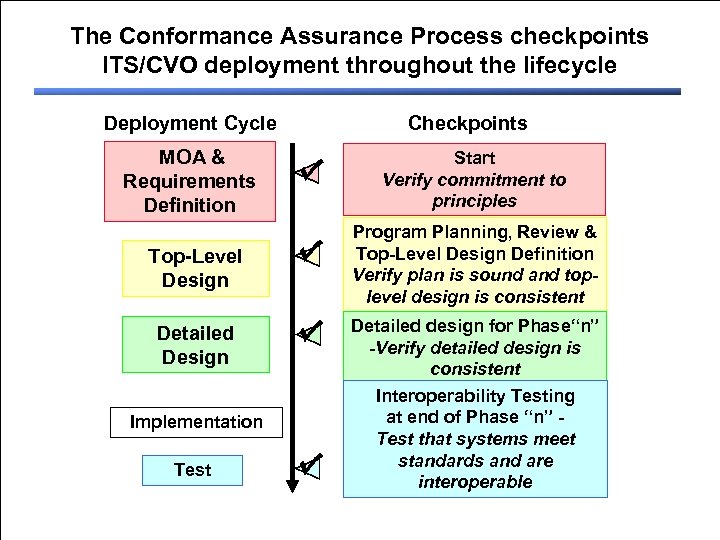 The Conformance Assurance Process checkpoints ITS/CVO deployment throughout the lifecycle Deployment Cycle MOA & Requirements Definition Top-Level Design Detailed Design Implementation Test Checkpoints Start Verify commitment to principles Program Planning, Review & Top-Level Design Definition Verify plan is sound and toplevel design is consistent Detailed design for Phase“n” -Verify detailed design is consistent Interoperability Testing at end of Phase “n” Test that systems meet standards and are interoperable
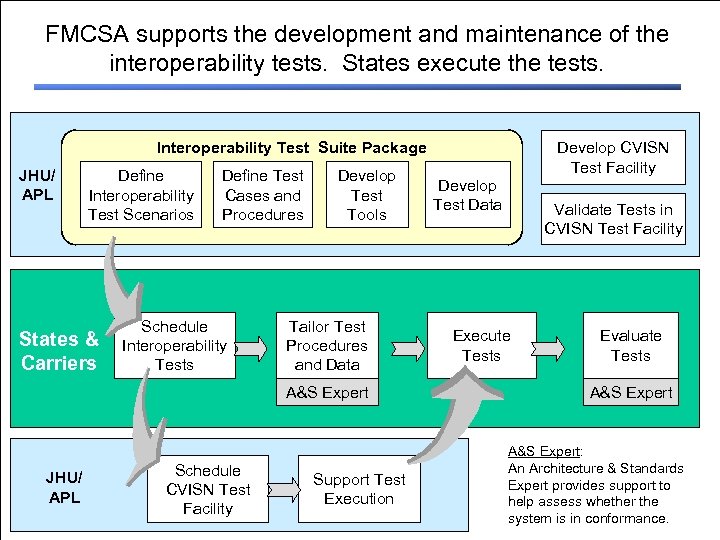 FMCSA supports the development and maintenance of the interoperability tests. States execute the tests. Interoperability Test Suite Package JHU/ APL Define Interoperability Test Scenarios States & Carriers Define Test Cases and Procedures Schedule Interoperability Tests Develop Test Tools Tailor Test Procedures and Data A&S Expert JHU/ APL Schedule CVISN Test Facility Support Test Execution Develop CVISN Test Facility Develop Test Data Validate Tests in CVISN Test Facility Execute Tests Evaluate Tests A&S Expert: An Architecture & Standards Expert provides support to help assess whether the system is in conformance.
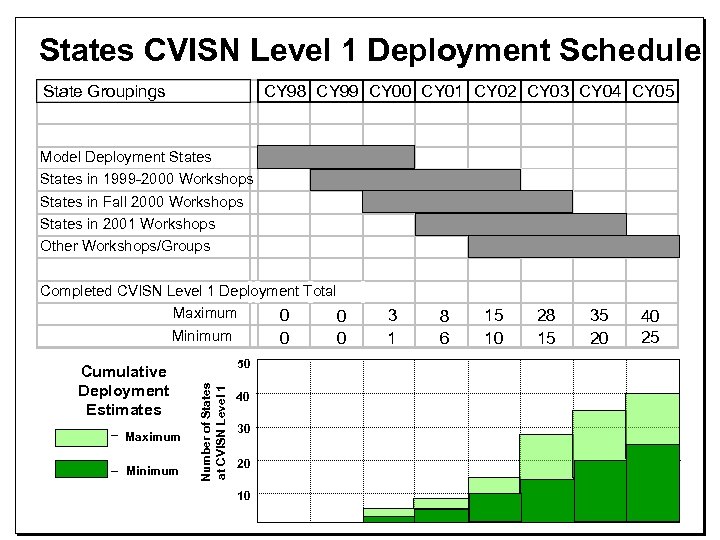 States CVISN Level 1 Deployment Schedule State Groupings CY 98 CY 99 CY 00 CY 01 CY 02 CY 03 CY 04 CY 05 Model Deployment States in 1999 -2000 Workshops States in Fall 2000 Workshops States in 2001 Workshops Other Workshops/Groups Completed CVISN Level 1 Deployment Total Maximum 0 0 Minimum 0 0 Maximum Minimum 50 Number of States at CVISN Level 1 Cumulative Deployment Estimates 40 30 20 10 3 1 8 6 15 10 28 15 35 20 40 25
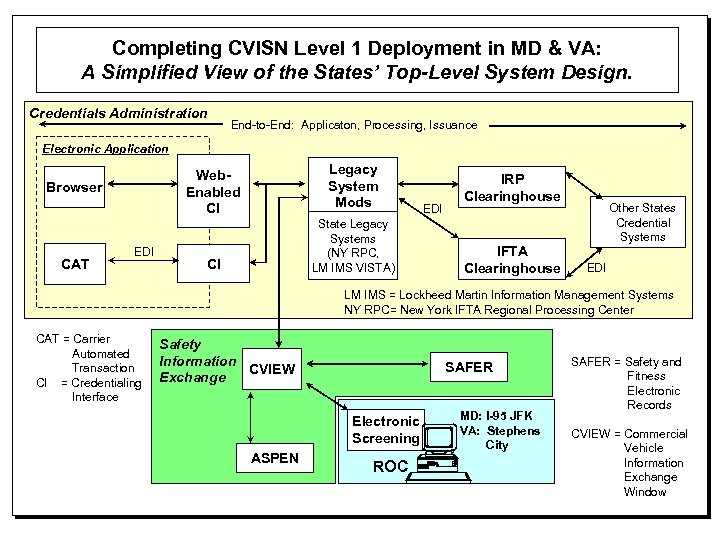 Completing CVISN Level 1 Deployment in MD & VA: A Simplified View of the States’ Top-Level System Design. Credentials Administration End-to-End: Applicaton, Processing, Issuance Electronic Application Web. Enabled CI Browser CAT EDI Legacy System Mods CI State Legacy Systems (NY RPC, LM IMS VISTA) EDI IRP Clearinghouse IFTA Clearinghouse Other States Credential Systems EDI LM IMS = Lockheed Martin Information Management Systems NY RPC= New York IFTA Regional Processing Center CAT = Carrier Automated Transaction CI = Credentialing Interface Safety Information CVIEW Exchange SAFER Electronic Screening ASPEN ROC MD: I-95 JFK VA: Stephens City SAFER = Safety and Fitness Electronic Records CVIEW = Commercial Vehicle Information Exchange Window
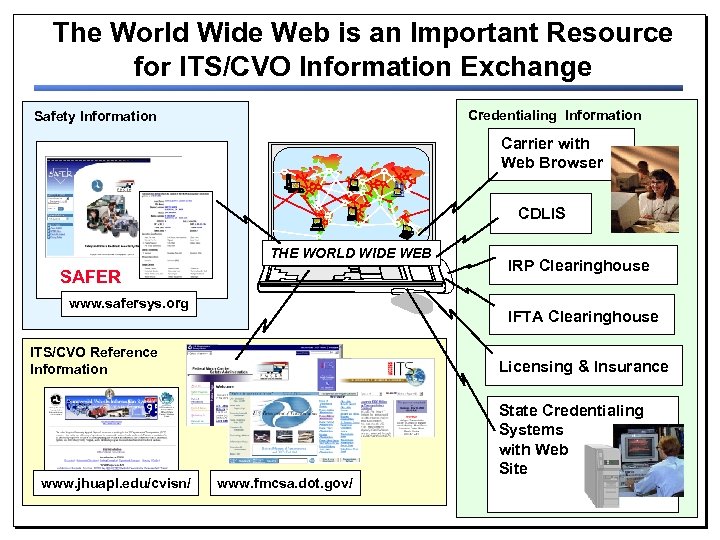 The World Wide Web is an Important Resource for ITS/CVO Information Exchange Credentialing Information Safety Information Carrier with Web Browser CDLIS THE WORLD WIDE WEB SAFER www. safersys. org IFTA Clearinghouse ITS/CVO Reference Information www. jhuapl. edu/cvisn/ IRP Clearinghouse Licensing & Insurance www. fmcsa. dot. gov/ State Credentialing Systems with Web Site
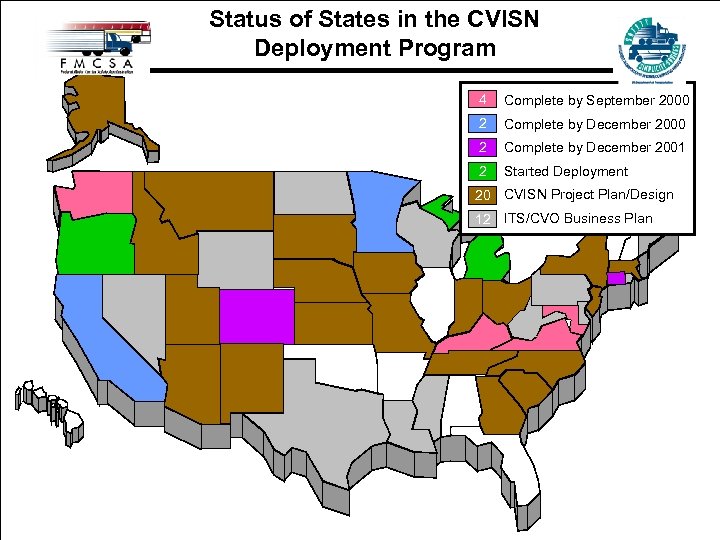 Status of States in the CVISN Deployment Program 4 Complete by September 2000 2 Complete by December 2001 2 Started Deployment 20 CVISN Project Plan/Design 12 ITS/CVO Business Plan
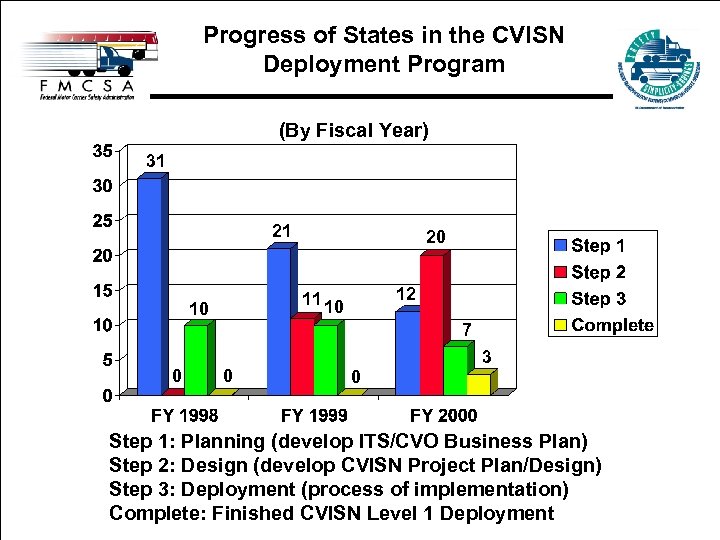 Progress of States in the CVISN Deployment Program (By Fiscal Year) 31 21 20 12 11 10 10 7 0 0 0 3 Step 1: Planning (develop ITS/CVO Business Plan) Step 2: Design (develop CVISN Project Plan/Design) Step 3: Deployment (process of implementation) Complete: Finished CVISN Level 1 Deployment