


 Скачать презентацию Input Output 3 I O Software CS 342
9b6cd8aa0871c6f54ee913804ef5c84c.ppt
- Количество слайдов: 28
 Input/Output – 3 I/O Software CS 342 – Operating Systems Ibrahim Korpeoglu Bilkent University Department of Computer Engineering CS 342 – Operating Systems Spring 2003 © Ibrahim Korpeoglu Bilkent University 1
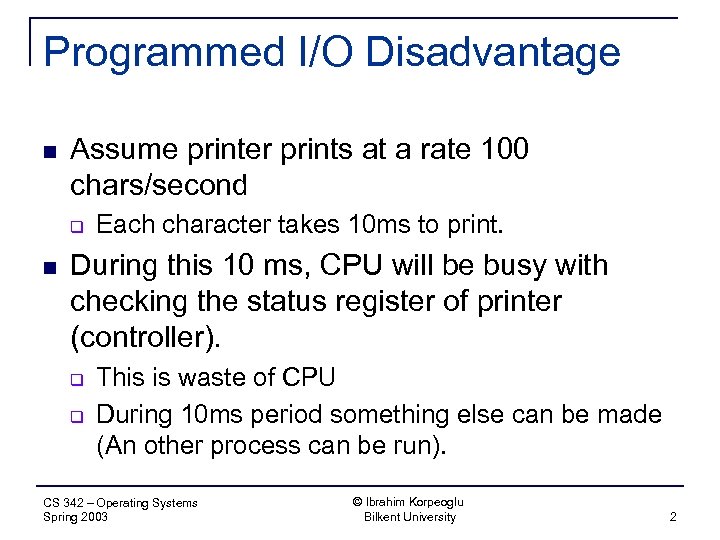 Programmed I/O Disadvantage n Assume printer prints at a rate 100 chars/second q n Each character takes 10 ms to print. During this 10 ms, CPU will be busy with checking the status register of printer (controller). q q This is waste of CPU During 10 ms period something else can be made (An other process can be run). CS 342 – Operating Systems Spring 2003 © Ibrahim Korpeoglu Bilkent University 2
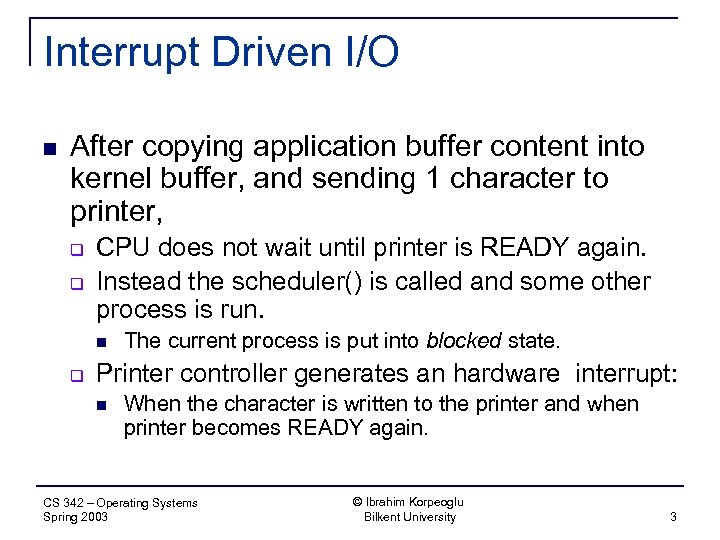 Interrupt Driven I/O n After copying application buffer content into kernel buffer, and sending 1 character to printer, q q CPU does not wait until printer is READY again. Instead the scheduler() is called and some other process is run. n q The current process is put into blocked state. Printer controller generates an hardware interrupt: n When the character is written to the printer and when printer becomes READY again. CS 342 – Operating Systems Spring 2003 © Ibrahim Korpeoglu Bilkent University 3
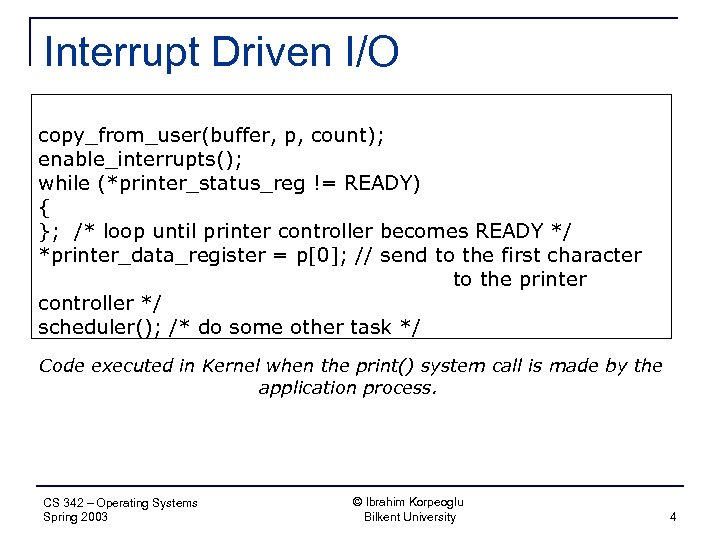 Interrupt Driven I/O copy_from_user(buffer, p, count); enable_interrupts(); while (*printer_status_reg != READY) { }; /* loop until printer controller becomes READY */ *printer_data_register = p[0]; // send to the first character to the printer controller */ scheduler(); /* do some other task */ Code executed in Kernel when the print() system call is made by the application process. CS 342 – Operating Systems Spring 2003 © Ibrahim Korpeoglu Bilkent University 4
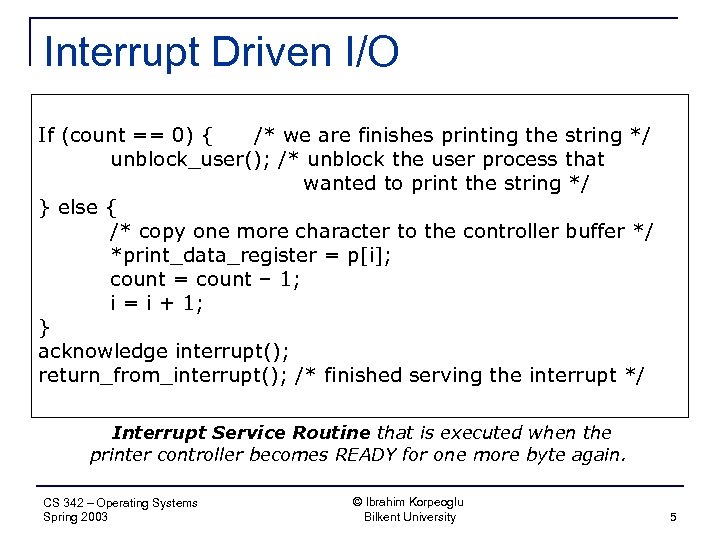 Interrupt Driven I/O If (count == 0) { /* we are finishes printing the string */ unblock_user(); /* unblock the user process that wanted to print the string */ } else { /* copy one more character to the controller buffer */ *print_data_register = p[i]; count = count – 1; i = i + 1; } acknowledge interrupt(); return_from_interrupt(); /* finished serving the interrupt */ Interrupt Service Routine that is executed when the printer controller becomes READY for one more byte again. CS 342 – Operating Systems Spring 2003 © Ibrahim Korpeoglu Bilkent University 5
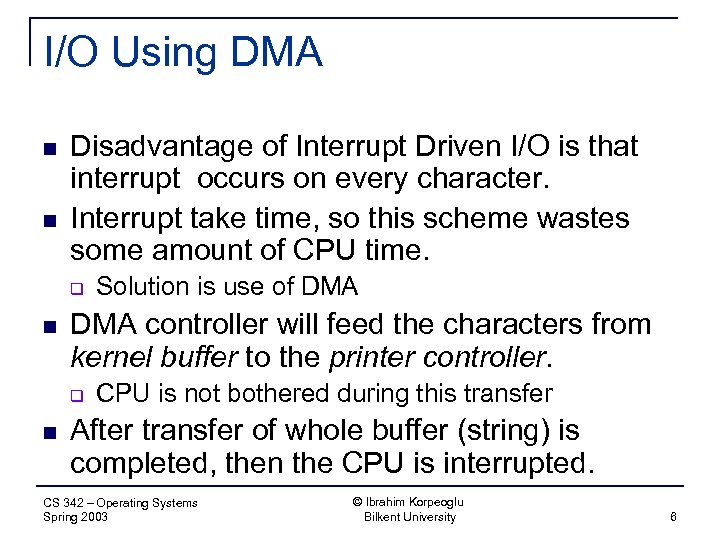 I/O Using DMA n n Disadvantage of Interrupt Driven I/O is that interrupt occurs on every character. Interrupt take time, so this scheme wastes some amount of CPU time. q n DMA controller will feed the characters from kernel buffer to the printer controller. q n Solution is use of DMA CPU is not bothered during this transfer After transfer of whole buffer (string) is completed, then the CPU is interrupted. CS 342 – Operating Systems Spring 2003 © Ibrahim Korpeoglu Bilkent University 6
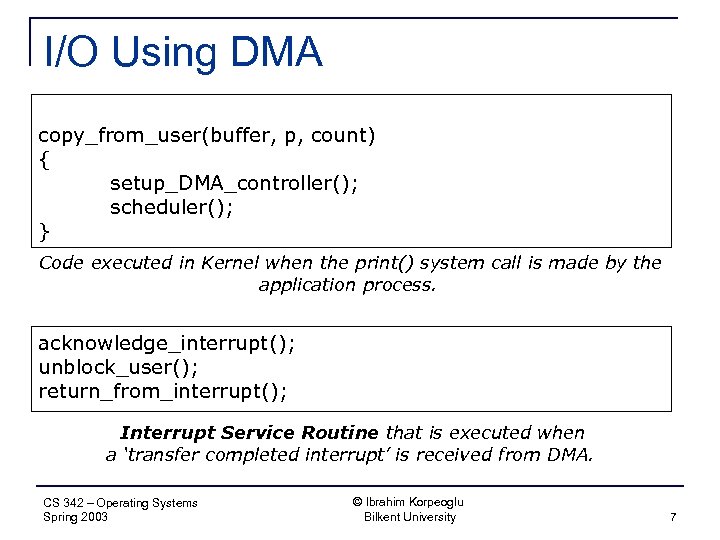 I/O Using DMA copy_from_user(buffer, p, count) { setup_DMA_controller(); scheduler(); } Code executed in Kernel when the print() system call is made by the application process. acknowledge_interrupt(); unblock_user(); return_from_interrupt(); Interrupt Service Routine that is executed when a ‘transfer completed interrupt’ is received from DMA. CS 342 – Operating Systems Spring 2003 © Ibrahim Korpeoglu Bilkent University 7
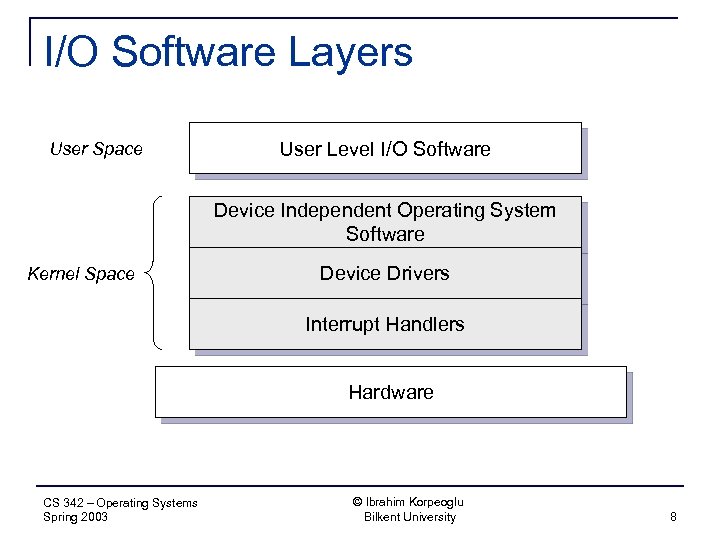 I/O Software Layers User Space User Level I/O Software Device Independent Operating System Software Kernel Space Device Drivers Interrupt Handlers Hardware CS 342 – Operating Systems Spring 2003 © Ibrahim Korpeoglu Bilkent University 8
 Interrupt Handlers n n The interrupts are handled at the lowest possible layer. A device derives initiates an I/O operation. q Then driver blocks (if it is implemented as a separate process) by using one of the following ways: n n Do a down() operation on a semaphore Wait() on a condition variable Call receive() on a message When I/O completes, interrupt occurs. q q Interrupt Handler Routine is exeuted Driver is unblocked (by up() on semaphore, etc. ) so that it can continue to run. CS 342 – Operating Systems Spring 2003 © Ibrahim Korpeoglu Bilkent University 9
 Processing Interrupts n n Not an easy task. It involves al lot of critical steps. Following are steps executes in software after hardware part of interrupt handling is done. 1. Save any registers including the PSW 2. Setup context for the ISR: setup TLB, MMU, page table, etc. 3. Setup a stack for interrupt service routine (ISR) 4. Acknowledge the interrupt controller (re-enables interrupts) 5. Copy registers from where they were saved by hardware to the process table. 6. Run the interrupt service routine. ISR will examine the device controller registers. 7. Choose which process to run next. 8. Set up the MMU context for the process to run. 9. Load the new process’ registers, including it PSW. 10. Start running the new process. CS 342 – Operating Systems Spring 2003 © Ibrahim Korpeoglu Bilkent University 10
 Device Drivers n A device controller has: q q q n This structure changes from device to device q q n Control registers Status registers Data buffers A mouse driver should know how far the mouse has moved and which buttons are pressed A disk driver should know about sectors, tracks, cylinders, heads, arm motion, motor drives, head settling times, … Each I/O device need some device specific code for controlling it. q This code is called device driver. CS 342 – Operating Systems Spring 2003 © Ibrahim Korpeoglu Bilkent University 11
 Device Drivers n n Generally written by device manufacturers q Not necessarily by OS writers. A driver can be written for more than one OS. Driver is then integrated to the OS. Each driver can handle one type of device q A SCSI disk q A floppy drive q A network card q Mouse q Joystick n n Each will have different drivers Device Drivers are usually part of the OS (although they may be integrated later) CS 342 – Operating Systems Spring 2003 © Ibrahim Korpeoglu Bilkent University 12
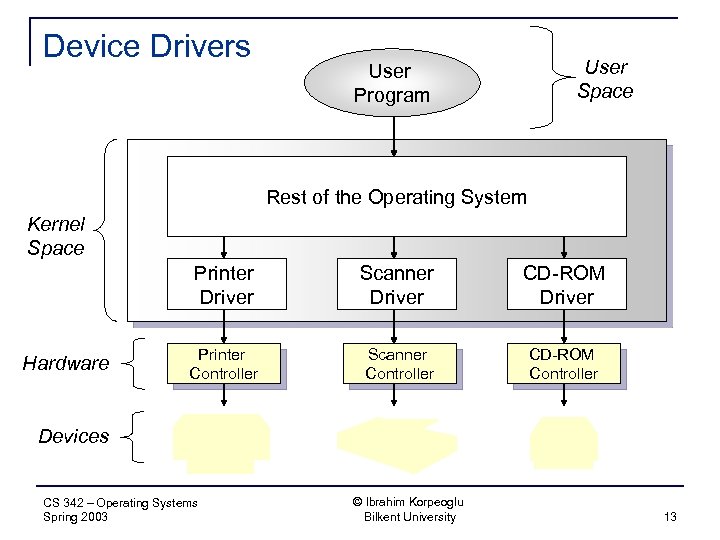 Device Drivers User Space User Program Rest of the Operating System Kernel Space Printer Driver Hardware Scanner Driver CD-ROM Driver Printer Controller Scanner Controller CD-ROM Controller Devices CS 342 – Operating Systems Spring 2003 © Ibrahim Korpeoglu Bilkent University 13
 Device Drivers n We need to have a well-defined model of what a driver does and how it integrates with the rest of the OS. q n This is because, OS implementers and derivers implementers may be different. OSs usually classify drivers into two classes q q Drivers for block devices Drivers for character devices. CS 342 – Operating Systems Spring 2003 © Ibrahim Korpeoglu Bilkent University 14
 Device Drivers n Most OSs define a standard interface q q n that all block drivers must support, and that all character drivers must support. The rest of the OS uses this interface to talk to the drivers. q q A driver implementer should follow this interface. This interface include procedures such as: n n n Read a block, Write a stream of bytes (string), …. CS 342 – Operating Systems Spring 2003 © Ibrahim Korpeoglu Bilkent University 15
 Device Driver Functions n Accept abstract read and write requests from rest of the OS (device-independent part). q Carry these requests out. n Translate from abstract terms to concrete terms. q n n Initialize the devices Check if the device is currently use for some other request. n n Example: A disk driver translates from a linear block address to a physical head, track, sector, and cylinder number. If so, enqueue the request. Issue sequence of commands to control the device. CS 342 – Operating Systems Spring 2003 © Ibrahim Korpeoglu Bilkent University 16
 Device Independent I/O Software n Part of Operating system has deviceindependent I/O software. This is the software that is nearly all for all I/O devices and that does some common tasks. q q q Uniform interfacing to device derivers Buffering Error reporting Allocating and releasing dedicated devices Providing a device-independent block size. CS 342 – Operating Systems Spring 2003 © Ibrahim Korpeoglu Bilkent University 17
 Device Independent I/O Software. Functions n n n Uniform interfacing to device derivers Buffering Error reporting Allocating and releasing dedicated devices Providing a device-independent block size. CS 342 – Operating Systems Spring 2003 © Ibrahim Korpeoglu Bilkent University 18
 Uniform Interfacing n Drives need to have uniform interface. The benefits are: q q The driver implementers know what is expected from them The OS implementers can developed deviceindependent I/O function on top of a well-defined lower-layer driver interface. n They know which functions each driver implements and the pro-types of these function. CS 342 – Operating Systems Spring 2003 © Ibrahim Korpeoglu Bilkent University 19
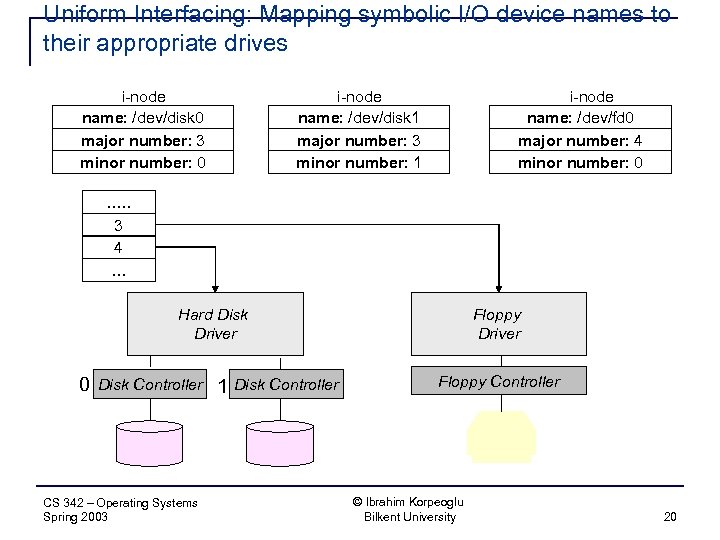 Uniform Interfacing: Mapping symbolic I/O device names to their appropriate drives i-node name: /dev/disk 0 major number: 3 minor number: 0 i-node name: /dev/disk 1 major number: 3 minor number: 1 i-node name: /dev/fd 0 major number: 4 minor number: 0 …. . 3 4 … Hard Disk Driver 0 Disk Controller CS 342 – Operating Systems Spring 2003 1 Disk Controller Floppy Driver Floppy Controller © Ibrahim Korpeoglu Bilkent University 20
 Buffering n Buffering in kernel (in device independent I/O software layer) is required in order: q q To reduce the interrupts that will be given to applications when data is available for application to read To not unblock applications unnecessarily for write operations CS 342 – Operating Systems Spring 2003 © Ibrahim Korpeoglu Bilkent University 21
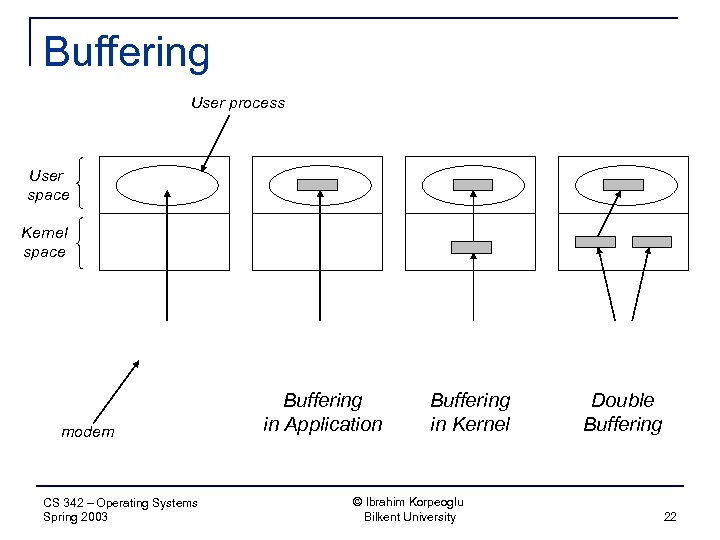 Buffering User process User space Kernel space modem CS 342 – Operating Systems Spring 2003 Buffering in Application Buffering in Kernel © Ibrahim Korpeoglu Bilkent University Double Buffering 22
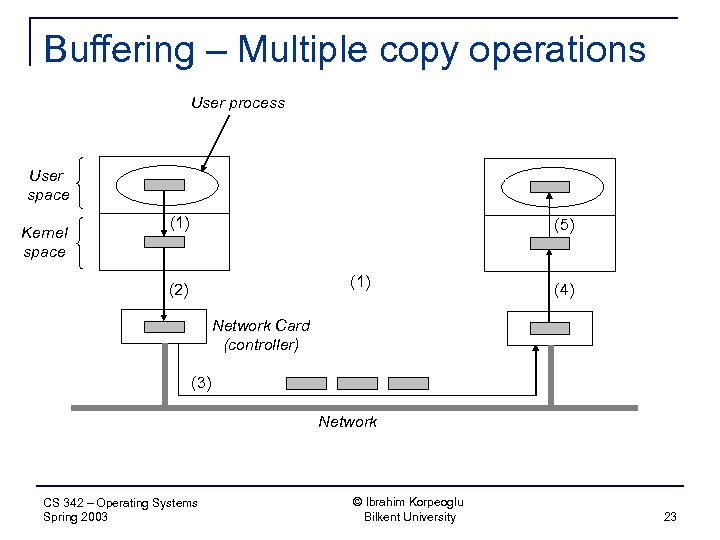 Buffering – Multiple copy operations User process User space Kernel space (1) (5) (1) (2) (4) Network Card (controller) (3) Network CS 342 – Operating Systems Spring 2003 © Ibrahim Korpeoglu Bilkent University 23
 Error Reporting n Some errors are handled by device-controllers q n Some by device derivers q n Example: Checksum incorrect, re-correct the block by using redundant bits Example: disk block could not be read, re-issue the read operation for block from disk Some by the device-independent software layer of OS. q Programming errors: n q Example: Attempt to write to a read-only device Actual I/O errors n Example: The camcorder is shut-off, therefore we could not read. Return an indication of this error to the calling application. CS 342 – Operating Systems Spring 2003 © Ibrahim Korpeoglu Bilkent University 24
 Allocating Dedicated Devices n Do not allow concurrent accesses to dedicated devices such as CD-RWs. q q Each application should issue an open() system call before using a device. Implement open() system call such that it returns an error if the device is currently busy. CS 342 – Operating Systems Spring 2003 © Ibrahim Korpeoglu Bilkent University 25
 Device-independent Block Size. n n n There are different kind of disk drives. Each may have a different physical sector size. A file system uses a block size while mapping files into logical disk blocks. This layer can hide the physical sector size of different disks and can provide a fixed and uniform disk block size for higher layers, like the file system q Several sectors can be treated as a single logical block. CS 342 – Operating Systems Spring 2003 © Ibrahim Korpeoglu Bilkent University 26
 User-space I/O software n This includes q The I/O libraries that provides the implementation of I/O functions which in turn call the respective I/O system calls. n q These libraries also implemented formatted I/O functions such as printf() and scanf() Some programs that does not directly write to the I/O device, but writes to a spooler. CS 342 – Operating Systems Spring 2003 © Ibrahim Korpeoglu Bilkent University 27
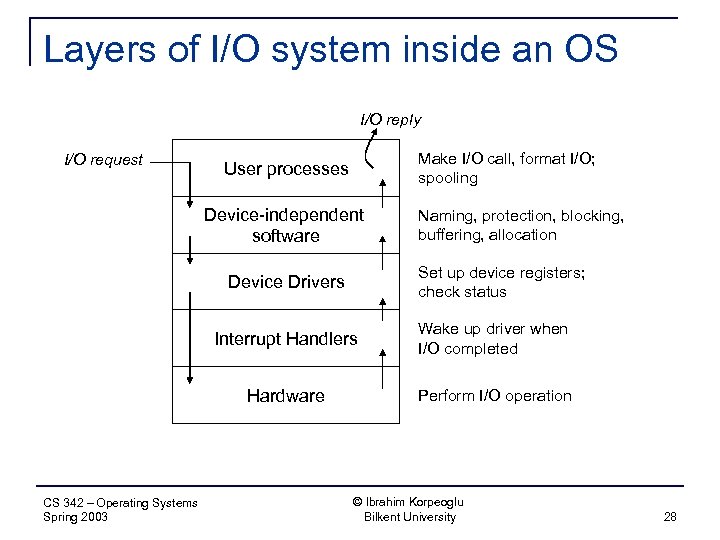 Layers of I/O system inside an OS I/O reply I/O request Make I/O call, format I/O; spooling User processes Device-independent software Naming, protection, blocking, buffering, allocation Set up device registers; check status Device Drivers Interrupt Handlers Hardware CS 342 – Operating Systems Spring 2003 Wake up driver when I/O completed Perform I/O operation © Ibrahim Korpeoglu Bilkent University 28