Скачать презентацию Inorganic Chemical Analysis of Soils J G Crock
2e5280c1d7bcac057ed1b1adb538d676.ppt
- Количество слайдов: 42
 Inorganic Chemical Analysis of Soils J. G. Crock 1, R. F. Sanzolone 1, P. J. Lamothe 1, and G. E. M. Hall 2 1 USGS, Denver, CO USA 2 GSC, NRC, Ottawa, Ontario CAN
 Purpose of this Talk A Spring Board for Discussion of the Appropriate Analytical Methodology
 An example of a comprehensive analytical text for soils: Methods of Soil Analysis Number 5, Part 3 – Chemical Methods D. L. Sparks (Editor) 1996 Soil Science Society of American Society of Agronomy Madison, WI USA
 Inorganic Trace, Minor, and Major Element Composition - Total - Extractable - Bioavailable/Accessibility
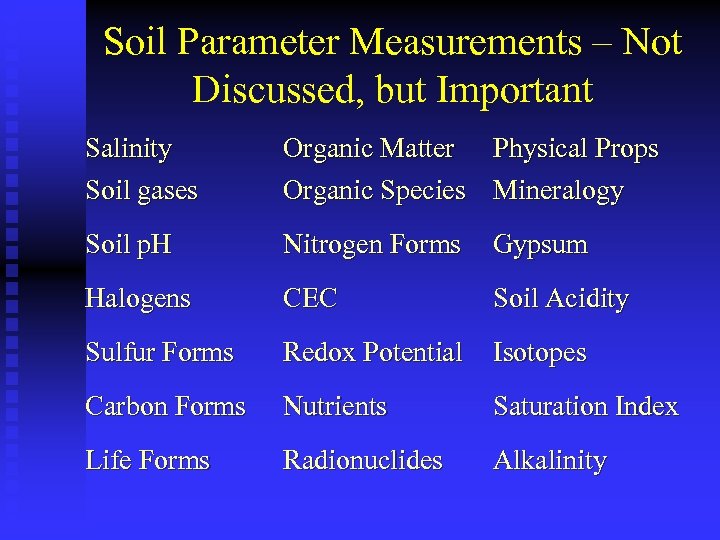 Soil Parameter Measurements – Not Discussed, but Important Salinity Soil gases Organic Matter Physical Props Organic Species Mineralogy Soil p. H Nitrogen Forms Gypsum Halogens CEC Soil Acidity Sulfur Forms Redox Potential Isotopes Carbon Forms Nutrients Saturation Index Life Forms Radionuclides Alkalinity
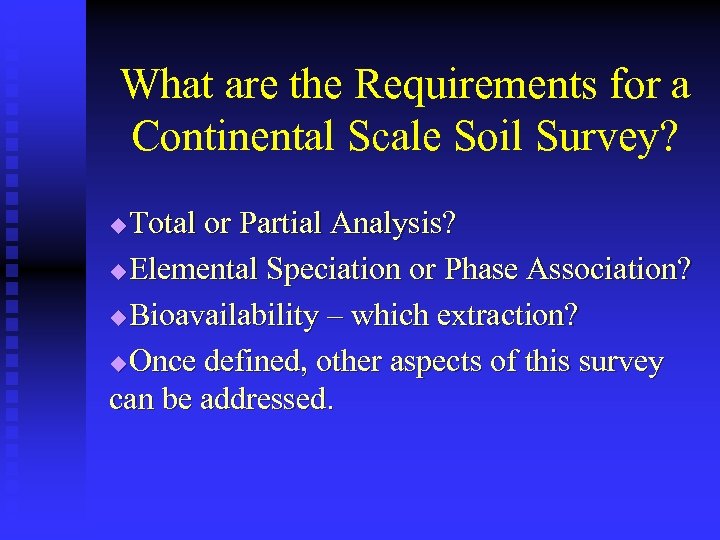 What are the Requirements for a Continental Scale Soil Survey? Total or Partial Analysis? u. Elemental Speciation or Phase Association? u. Bioavailability – which extraction? u. Once defined, other aspects of this survey can be addressed. u
 Analytical Results can be NO better than the sample submitted.
 Sample Collection Questions n n n Representative sample Sample size collected Homogeneity Drying, sieving Regolith - Composite or individual horizon Contamination (equipment and sample) n n n ANOVA design Containers – Paper, glass, plastic? Sample splits Bulk, Archive, Active Preservation – Transportation/ - Regulations for DOT? - Dept. of Agriculture?
 Sample Preparation Questions n. Drying Temperature – Heated or Ambient? n. Forced Air? n. Grind, disaggregate or both? n. Sieving to what size fraction for total analyses and partial determinations – same or different? n. Equipment Used –Steel or Ceramic?
 Total Digestions Four-acid digestion under reflux conditions - Nitric, Hydrofluoric, Perchloric, and Hydrochloric Acids (may still not be total) n Alkaline sinter n High temperature fusion, including sodium carbonate and lithium metaborate n Microwave digestions, with or without HF n Aqua Regia - especially for sulfide-rich materials – but will not completely attack silicates? Commonly used in Europe. n
 Extractable Elemental Content n n n n Operationally defined! – usually phase associated More aggressive extractions may not be better Based of soil characteristic? - Organic Matter Content, Texture, Color - Saturation Index, CEC, Soil p. H - Horizon, Order, Mineralogy, Grain Size All or a Subset of the Samples – Topical Studies? Exploration or Agricultural Extraction? Traditionally used for Anomaly Enhancement Analyze for Total Content First?
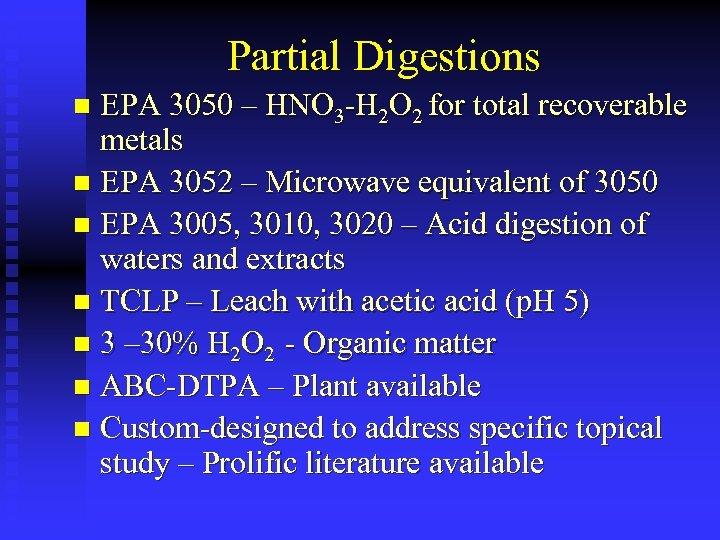 Partial Digestions EPA 3050 – HNO 3 -H 2 O 2 for total recoverable metals n EPA 3052 – Microwave equivalent of 3050 n EPA 3005, 3010, 3020 – Acid digestion of waters and extracts n TCLP – Leach with acetic acid (p. H 5) n 3 – 30% H 2 O 2 - Organic matter n ABC-DTPA – Plant available n Custom-designed to address specific topical study – Prolific literature available n
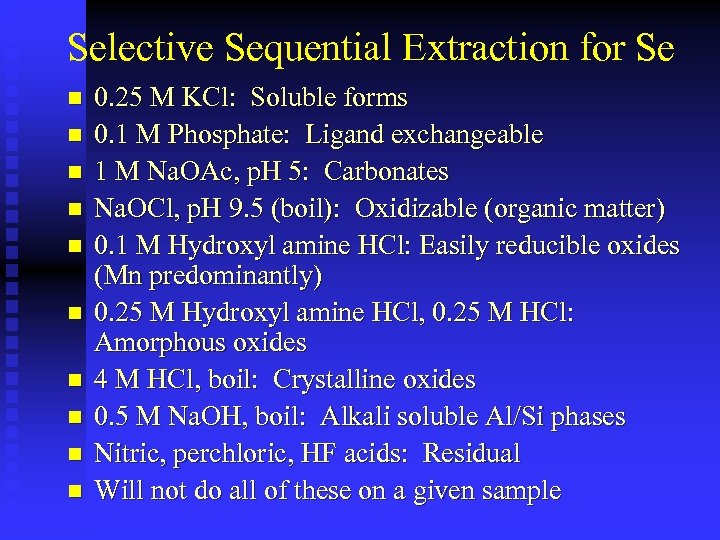 Selective Sequential Extraction for Se n n n n n 0. 25 M KCl: Soluble forms 0. 1 M Phosphate: Ligand exchangeable 1 M Na. OAc, p. H 5: Carbonates Na. OCl, p. H 9. 5 (boil): Oxidizable (organic matter) 0. 1 M Hydroxyl amine HCl: Easily reducible oxides (Mn predominantly) 0. 25 M Hydroxyl amine HCl, 0. 25 M HCl: Amorphous oxides 4 M HCl, boil: Crystalline oxides 0. 5 M Na. OH, boil: Alkali soluble Al/Si phases Nitric, perchloric, HF acids: Residual Will not do all of these on a given sample
 Bioavailability Definition? What is to be approximated? n A good indication of bioavailability is to grow the species in question in the material in question, and then determine the concentration of the element(s) in question. n Which biota? Human, mammals, invertebrates, vegetation? n Method of introduction of the soil? - Inhalation, contact, or ingestion? n
 Bioavailability Measurements Complicated and abundant literature, especially in the medical literature n Large range of reagent strength, composition, temperature - Biota whole tissue - Simple water extraction - Weak to strong acids - Simulated lung fluid or gastric juice n
 Popular Instrumental Techniques Atomic Absorption Spectroscopy (AAS) n Inductively Coupled Plasma-Atomic Emission Spectroscopy (ICP-AES) n ICP-Mass Spectroscopy (ICP-MS) n Atomic Fluorescence Spectroscopy (AFS) n X-ray Fluorescence Spectroscopy, both energy dispersive and wavelength dispersive (EDXRD-S AND WDXRD –S) n Instrumental Neutron Activation Analysis (INAA) n
 AAS Advantages and Limitations Low purchase and maintenance costs n Widespread use with abundant time-tested methods and well-defined interferences n Acceptance by regulatory agencies n Reasonable sensitivity and accuracy/precision n Simplicity and field portable n Sequential determination, speed of analysis n
 Inductively Coupled Plasma – Atomic Emission Spectroscopy Cornerstone technique for most laboratories n Linear response of 4 – 5 orders of magnitude n About 75% of the elements can be determined n Spectral interferences well documented; usually more than one adequate spectral line for most elements is available n Well documented and mature, established technique n
 Inductively Coupled Plasma – Mass Spectrometry Ability to measure isotope abundances of most elements between mass 6 (Li) and mass 238 (U). n All elements have at least one isotope free of isobaric interferences. n Few molecular interferences and these are well known. Result is usually a clean mass spectrum. n Commonly 7 – 8 orders of magnitude analytical range (sub ppb – x 00 ppm). n
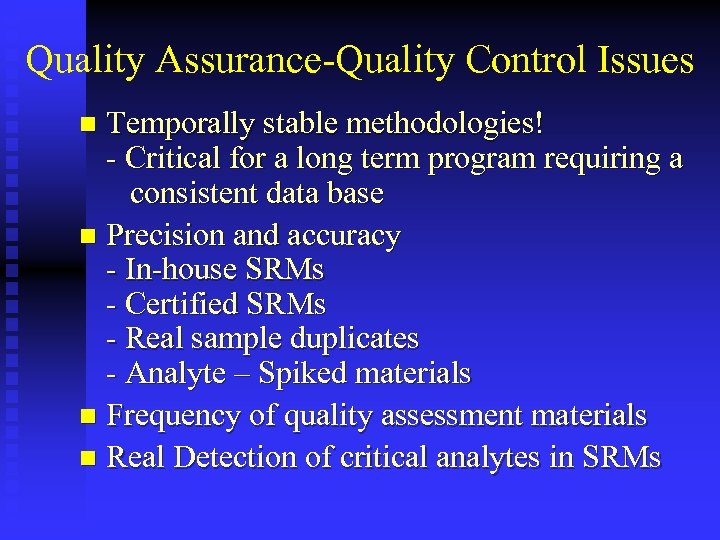 Quality Assurance-Quality Control Issues Temporally stable methodologies! - Critical for a long term program requiring a consistent data base n Precision and accuracy - In-house SRMs - Certified SRMs - Real sample duplicates - Analyte – Spiked materials n Frequency of quality assessment materials n Real Detection of critical analytes in SRMs n
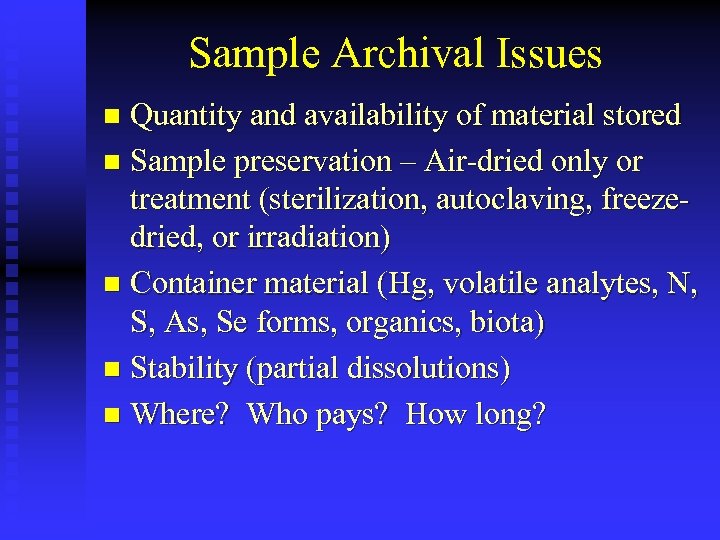 Sample Archival Issues Quantity and availability of material stored n Sample preservation – Air-dried only or treatment (sterilization, autoclaving, freezedried, or irradiation) n Container material (Hg, volatile analytes, N, S, As, Se forms, organics, biota) n Stability (partial dissolutions) n Where? Who pays? How long? n
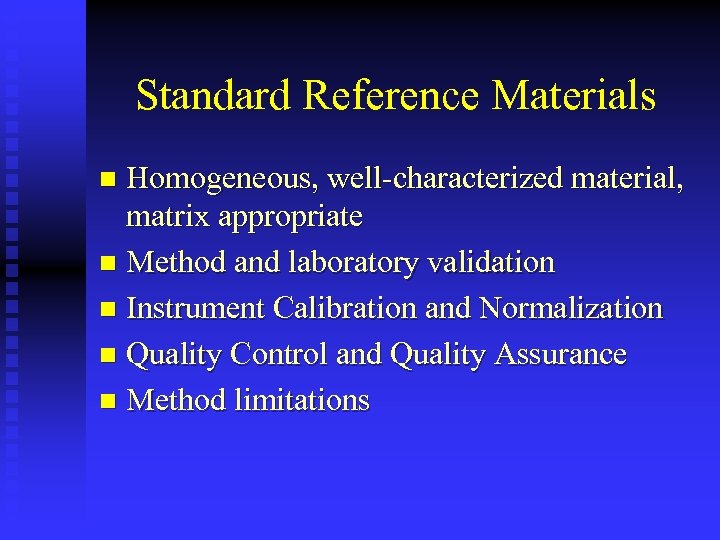 Standard Reference Materials Homogeneous, well-characterized material, matrix appropriate n Method and laboratory validation n Instrument Calibration and Normalization n Quality Control and Quality Assurance n Method limitations n
 Sources of Certified SRMs CCRMP: Canadian Certified Reference Materials Project, Canada Center for Mineral and Energy Technology, Mines and Resources n NRCC: National Research Council of Canada, Chemistry Division, National Research Council n
 Sources of Certified SRMs NIST: National Institute of Standards and Technology, Office of Standard Reference Materials n USGS: United States Geological Survey (Contact S. A. Wilson @303 -236 -2454 or swilson@usgs. gov) n
 In-House SRMS Two soils (from AL and NE) are being prepared currently for this Geochemical Landscapes program. More may follow. n Option of “Salting” in-house SRMs with analytes of concern to insure that the concentrations are above the limits of instrumental detection, especially for totals n
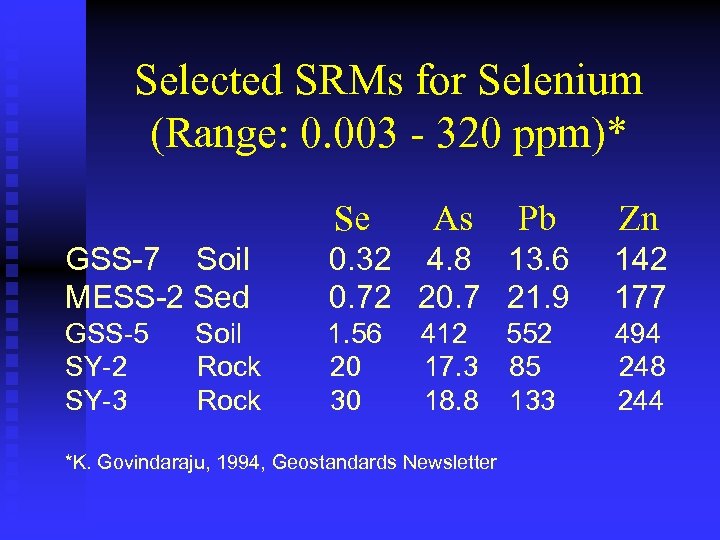 Selected SRMs for Selenium (Range: 0. 003 - 320 ppm)* Se As Pb Zn GSS-7 Soil MESS-2 Sed 0. 32 4. 8 13. 6 0. 72 20. 7 21. 9 142 177 GSS-5 SY-2 SY-3 1. 56 20 30 494 248 244 Soil Rock 412 552 17. 3 85 18. 8 133 *K. Govindaraju, 1994, Geostandards Newsletter
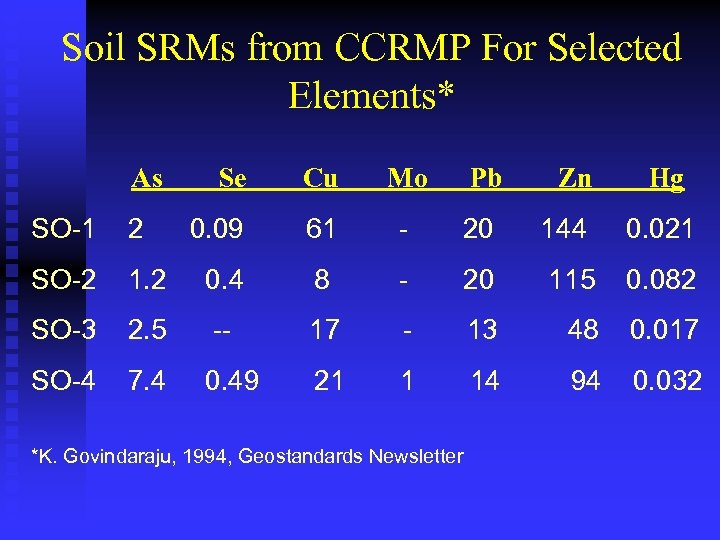 Soil SRMs from CCRMP For Selected Elements* As Se Cu Mo Pb Zn Hg 0. 09 61 - 20 144 0. 021 SO-1 2 SO-2 1. 2 0. 4 8 - 20 115 0. 082 SO-3 2. 5 -- 17 - 13 48 0. 017 SO-4 7. 4 0. 49 21 1 14 94 0. 032 *K. Govindaraju, 1994, Geostandards Newsletter
 Choosing the Best Method to Answer the Question Suggestions from the USGS, Geologic Division, Denver CO
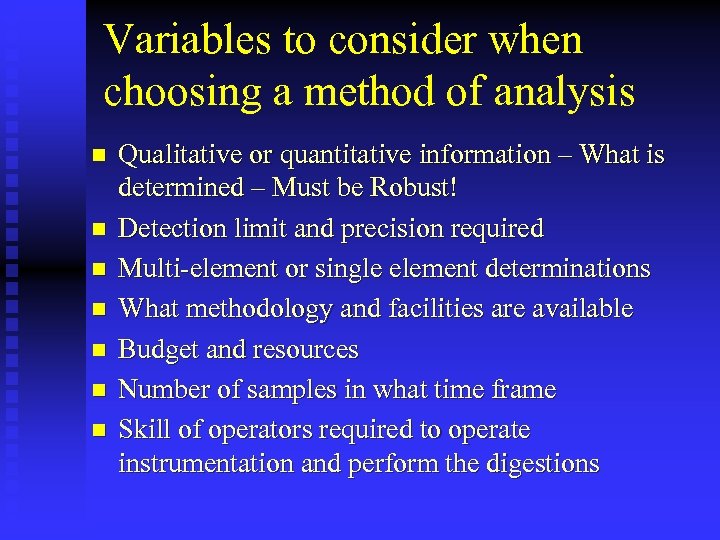 Variables to consider when choosing a method of analysis n n n n Qualitative or quantitative information – What is determined – Must be Robust! Detection limit and precision required Multi-element or single element determinations What methodology and facilities are available Budget and resources Number of samples in what time frame Skill of operators required to operate instrumentation and perform the digestions
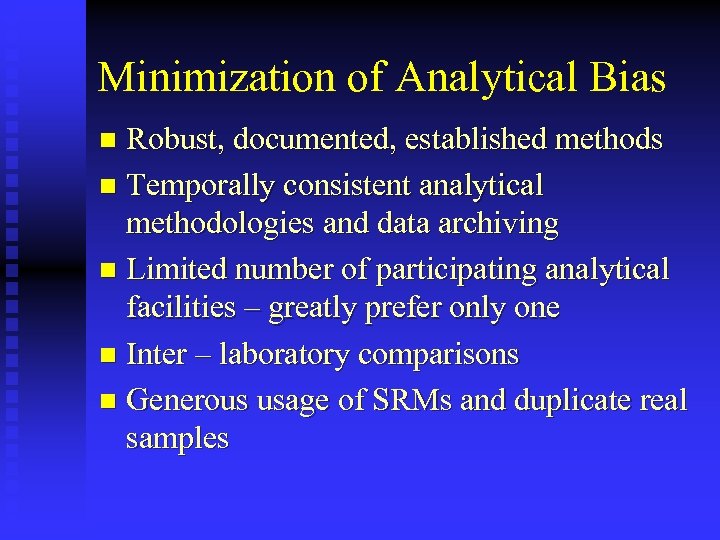 Minimization of Analytical Bias Robust, documented, established methods n Temporally consistent analytical methodologies and data archiving n Limited number of participating analytical facilities – greatly prefer only one n Inter – laboratory comparisons n Generous usage of SRMs and duplicate real samples n
 Analytical methods for chemical analysis of geologic and other materials, U. S. Geological Survey Joseph E. Taggart, Jr. editor Open-File Report 02 -223 2002 U. S. DEPARTMENT OF THE INTERIOR U. S. GEOLOGICAL SURVEY
 ICP-MS is the Suggested Approach n n Suitable total digestion must be chosen -usually multi-acid -must be highly oxidative to destroy organic material quickly to minimize volatility problems Multi-element, especially for the trace element content Applicable for large variation in analyte concentrations and matrices Usually most applicable for partial digestions because of required lower limit of determinations
 If ICP-MS is not available n ICP-AES is usually very applicable for most elements. ICP-AES may be more suitable for the major and minor elements. n Will not have limits of determination at crustal abundance or less for some critical elements, i. e. , Mo, Cd, As, Pb
 Single Element Methods Single element determinations may be the most appropriate technique, i. e. , Hg by CVAAS or CV-AFS, Hydride Generation-AAS for Se, As, or Sb. n Forms of Carbon and Total Sulfur n Specific elements for topical studies, i. e. , nitrogen, forms of sulfur, REEs, precious metals n
 Costs? n USGS-GD internal research analytical facilities (non-routine samples) n USGS Contract Laboratory (routine) XRAL Laboratories A Division of SGS Canada Inc. 1885 Leslie Street Don Mills, Ontario Canada M 3 B 3 J 4 416 -445 -4152
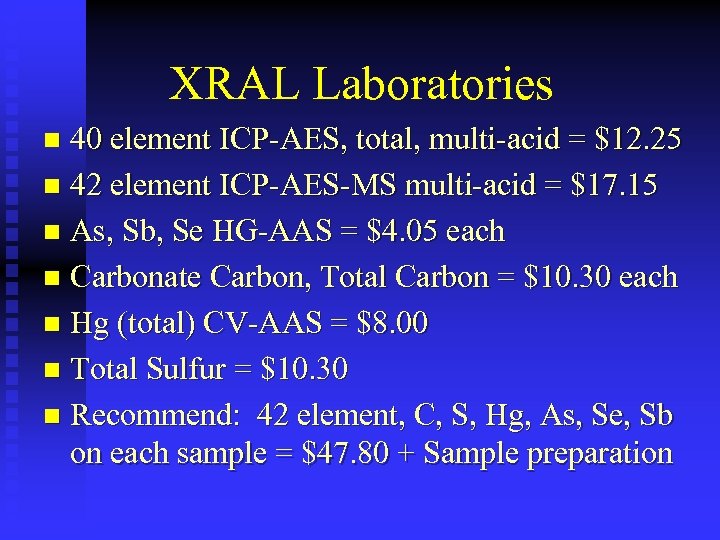 XRAL Laboratories 40 element ICP-AES, total, multi-acid = $12. 25 n 42 element ICP-AES-MS multi-acid = $17. 15 n As, Sb, Se HG-AAS = $4. 05 each n Carbonate Carbon, Total Carbon = $10. 30 each n Hg (total) CV-AAS = $8. 00 n Total Sulfur = $10. 30 n Recommend: 42 element, C, S, Hg, As, Se, Sb on each sample = $47. 80 + Sample preparation n
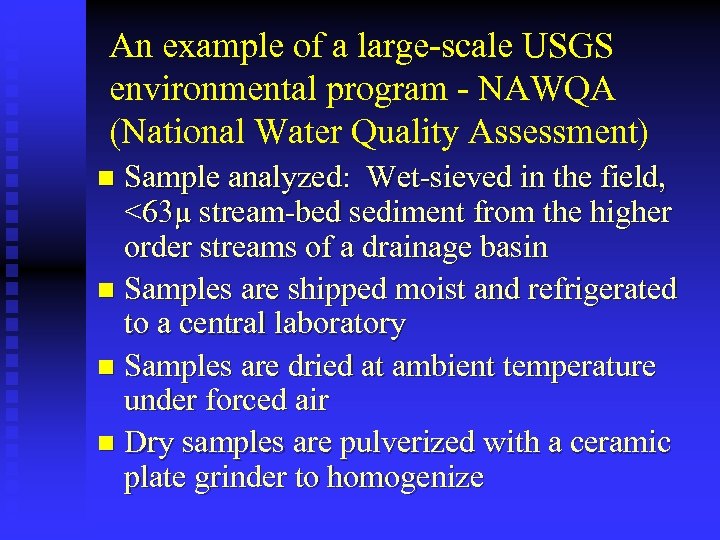 An example of a large-scale USGS environmental program - NAWQA (National Water Quality Assessment) Sample analyzed: Wet-sieved in the field, <63μ stream-bed sediment from the higher order streams of a drainage basin n Samples are shipped moist and refrigerated to a central laboratory n Samples are dried at ambient temperature under forced air n Dry samples are pulverized with a ceramic plate grinder to homogenize n
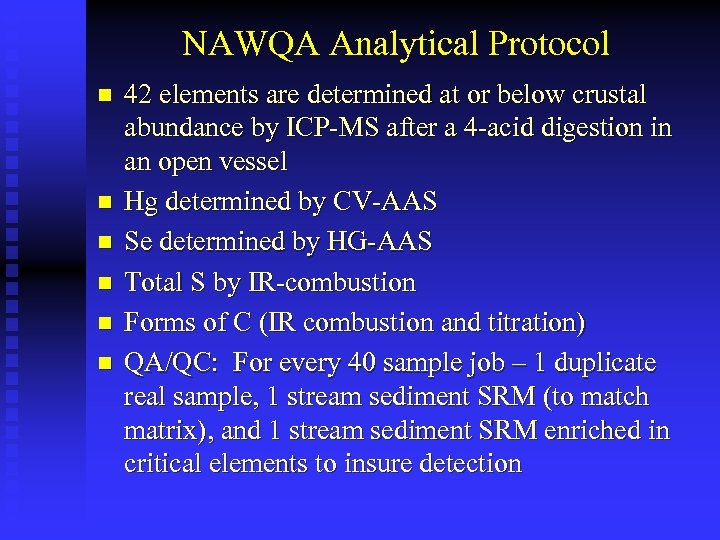 NAWQA Analytical Protocol n n n 42 elements are determined at or below crustal abundance by ICP-MS after a 4 -acid digestion in an open vessel Hg determined by CV-AAS Se determined by HG-AAS Total S by IR-combustion Forms of C (IR combustion and titration) QA/QC: For every 40 sample job – 1 duplicate real sample, 1 stream sediment SRM (to match matrix), and 1 stream sediment SRM enriched in critical elements to insure detection
 Conclusions The sample analyzed must represent the question being asked. n Sensitive, accurate, and precise instrumental methods are available for a broad range of elemental determinations for use in soil surveys. n The use of appropriate QA/QC assessment materials is essential for durable quality analyses. n
 Conclusions (continued) Total analyses tend to be the least expensive and are the most reliable data available. n Total and Speciation/Phase association methods are available for environmental studies of soils, but the costs may be prohibitive for regional soil surveys. n Resources must be defined up front for this study. How much is available to get what accomplished in a given time frame? How do we prioritize the analytical portion of this program? n