 Скачать презентацию Innovative ways sustainable means The Archives Hub and
1be416539644fbb989520eb44cdbc3f9.ppt
- Количество слайдов: 27



Innovative ways, sustainable means The Archives Hub and AIM 25 Jane Stevenson and Geoff Browell 16 March 2009
Hub and AIM 25 benefits • Locate archives across a range of institutions • Save time and resources • Search by subject / name / place • Focus for archive community • Promotion of standards for robust and sustainable descriptions • Innovation and experimentation 16 March 2009
JISC Information Environment • Providing a range of meaningful, rich and innovative methods of accessing electronic materials • A collaborative landscape of service providers who work together to seamlessly cater for the needs of the community on a national basis • Underpinned by real world interoperability, based upon a common standards framework JISC Information Environment Development Strategy [2001] 16 March 2009
British Archives: the vision “Our vision of the future of British archives is of a flow of archival information which takes account of all the opportunities offered by digital networks and offers opportunity for exploration - historical, personal, social - to the broadest possible range of people wherever they can use it - in the home, the classroom or the office. ” British Archives: The Way Forward (NCA, 2000) 16 March 2009
The Archives 2. 0 Manifesto • • Positive Active Responsive Open Interactive Experimental User-focused Participatory http: //www. archivesnext. com 16 March 2009
A new Mindset • An open and flexible approach to access, archives 2. 0 should, fundamentally, be about developing a collaborative, transparent and user-focused approach, based on agreed standards, that enables others to engage with us and with the data that we hold on their own terms. 16 March 2009
Implementation • How to move forward in a sustainable way? • What underlies an effective Archives 2. 0 approach? 16 March 2009
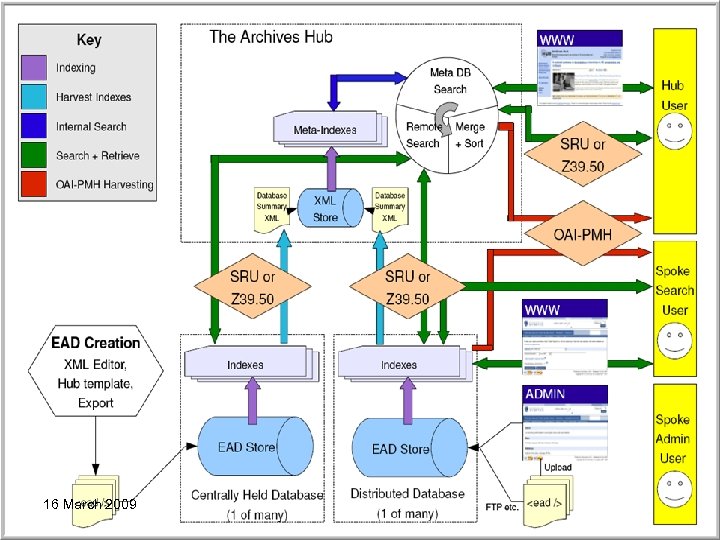
Underlying principles of the Hub • • Data – standards, quality Software – open source System – interoperable, distributed Development – user-focused, innovative 16 March 2009
Data • • • EAD – Encoded Archival Description ISAD(G) Indexing standards Manual data editing Validation through Template for data creation and editing • Training and raising awareness 16 March 2009
Software • Cheshire 3 and Cheshire for Archives – Open source – Flexible – In-house development 16 March 2009
Interoperable System • Ability to interoperate – exchange data between systems • Data working for benefit of users • The Archives Hub and AIM 25 - EAD • CALM and Ad. Lib • Datasets? 16 March 2009
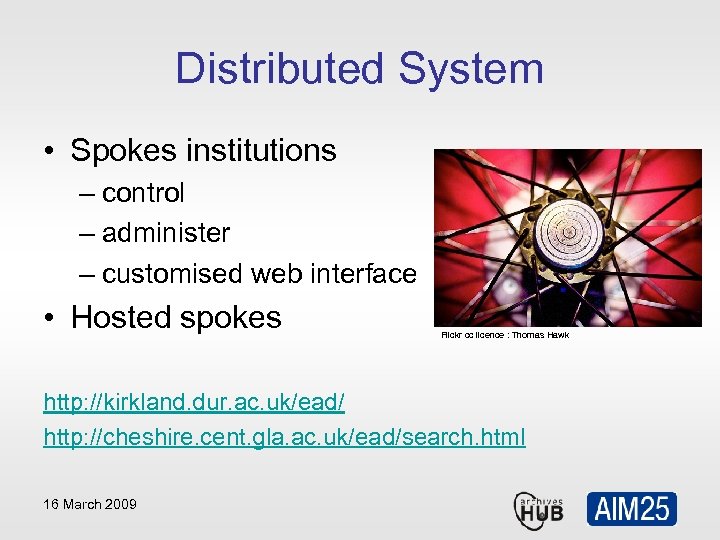
Distributed System • Spokes institutions – control – administer – customised web interface • Hosted spokes Flickr cc licence : Thomas Hawk http: //kirkland. dur. ac. uk/ead/ http: //cheshire. cent. gla. ac. uk/ead/search. html 16 March 2009
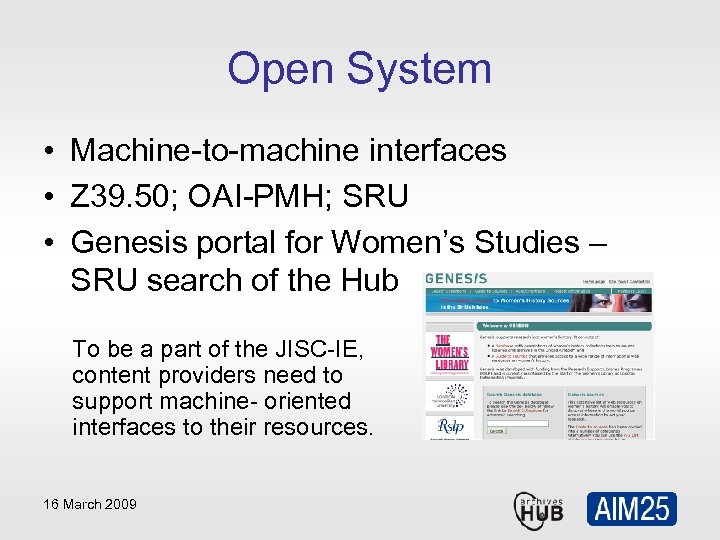
Open System • Machine-to-machine interfaces • Z 39. 50; OAI-PMH; SRU • Genesis portal for Women’s Studies – SRU search of the Hub To be a part of the JISC-IE, content providers need to support machine- oriented interfaces to their resources. 16 March 2009
Development • • • Steering Committee Contributors’ Forum Contributors’ Community Blog, newsletters, email lists National Archives Network 16 March 2009
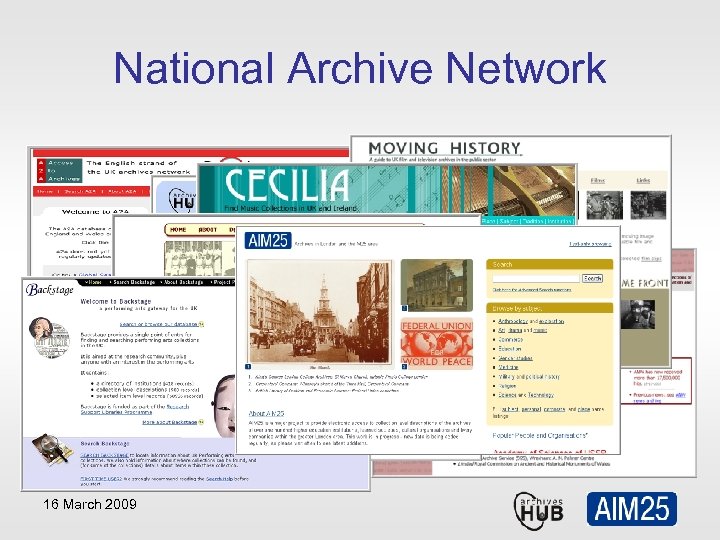
National Archive Network 16 March 2009
16 March 2009
AIM 25 • • 10 years-old 10, 000 descriptions 100 partners Up to 2 m hits per month Google-visible Becoming a hub for London LMA latest partner 2008 -2009 upgrade – new descriptions, improved website, interoperability with M 25 • Partner-led with central indexing standards • Forum to lead on standards, fundraising, sector issues 16 March 2009
AIM 25 and Archives 2. 0 • Asked ourselves - who uses it? • Avoid features for sake of it – what is the demand? Do users have the time – vast majority of users are under 1 minute • If colleagues don’t know what a tag cloud or social networking are, will users? • Can we afford it or do others do it better already – Facebook? • Most users are probably not Californian teenagers 16 March 2009
AIM 25: What did we do? • Moderated Web 2. 0 – democracy or benign dictatorship? • Avoided social networking • Hybrid tag clouds • Information alerts on new collections – RSS • Improving searching with cross searching with M 25 – (‘isn’t it all just information? ’) 16 March 2009
Benefits • More contemporary feel • Help with fundraising • Users able to sift information more effectively and crosssearch • Helps cultivate a ‘brand’. As catalogue information becomes more easily retrievable and machine-readable, so the ‘extra features’ and the trusted name become more important • These extras might include podcast lectures, National Curriculum tie-ins or dramatic re-enactments, extra bibliographic or catalogue content (‘you’re interested in that item, have you seen this? ’), mapping or the ability to interact with other users 16 March 2009
Right and wrong reasons • Right: improves the work of Archives, collecting, preserving and making records accessible for current and future generations • Wrong: for its own sake; next ‘thing’; pressure to be fashionable; ‘cure-all’ or technical shortcut 16 March 2009
Archives 2. 0: Barriers • Legal barriers (can’t publish everything) • Cost barriers (hidden costs such as training, IT development, policing UGC) • Conflicting audiences (all things to all men) • Over-expectations (limited resources of sector): will users become restive if they are used to Flickr or Facebook and get FORTRAN? • Can’t manage resulting demand • Knowledge/training gap (many archivists are unfamiliar with standards or terminology) • Danger of following fashion for its own sake – when is a paradigm shift not a paradigm shift? 16 March 2009
Searching Questions • How far do we want users to be sharing and engaging – do they want to? • Danger of users thinking everything is up for grabs, ‘Can’t I just publish any photograph I come across in your archive? ’ • Role of the finding aid and its integrity – reliability of catalogues. What role is there for expert input? • Danger of ‘never mind the quality, feel the width’ 16 March 2009
Talking points • Better market research needed • Greater standardisation of statistics to gauge usage • Do users want it and can we afford the time, money and energy to handle the consequences? • Will management understand the implications or do they think it is technological panacea? (‘Can’t you just digitise everything? ’) • Archivists need to understand the implications in order to educate institutions of the costs/benefits • Technologising the relationships which archivists have always cultivated – with donors, users and the public. So is it doing more of what we do well already? 16 March 2009
Talking points • Do we get the basics right first? (cataloguing backlogs, basic digitisation and improved physical access) • Standards – electronic and ethical • The role of the archivist from intercessor/ intermediary to facilitator in a personal relationship or journey of discovery through records: an Archive equivalent of the Protestant Reformation? • Knowledge, expertise and interpretive skills remain at the heart of the profession 16 March 2009
Archives 2. 0 will be… • • • Relevant Sustainable Skills-based Fun Result in greater co-operation and networking between all types of archive institution • A journey not a destination 16 March 2009
Contact details • Jane Stevenson: jane. stevenson@manchester. ac. uk • Geoff Browell: geoffrey. browell@kcl. ac. uk Visit the National Archives Network social space: http: //archivesnetwork. ning. com/ Check out the Hub blog: http: //www. archiveshub. ac. uk/blog/ Check out the Archives Hub twitter http: //twitter. com/archiveshub 16 March 2009
Скачать презентацию Innovative ways sustainable means The Archives Hub and
1be416539644fbb989520eb44cdbc3f9.ppt