


 Скачать презентацию Innovative Pedagogical Practices Using Technology IEA SITES Module
a6645077db25785f57fbd96931f9cef4.ppt
- Количество слайдов: 17
 Innovative Pedagogical Practices Using Technology: IEA SITES Module 2 Design Presentation to the CMEC–OECD–Canada Seminar Robert Kozma SRI International
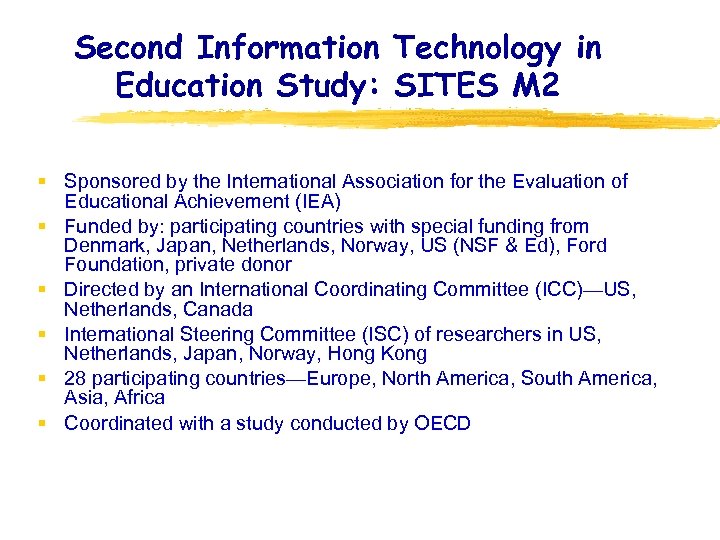 Second Information Technology in Education Study: SITES M 2 § Sponsored by the International Association for the Evaluation of Educational Achievement (IEA) § Funded by: participating countries with special funding from Denmark, Japan, Netherlands, Norway, US (NSF & Ed), Ford Foundation, private donor § Directed by an International Coordinating Committee (ICC)—US, Netherlands, Canada § International Steering Committee (ISC) of researchers in US, Netherlands, Japan, Norway, Hong Kong § 28 participating countries—Europe, North America, South America, Asia, Africa § Coordinated with a study conducted by OECD
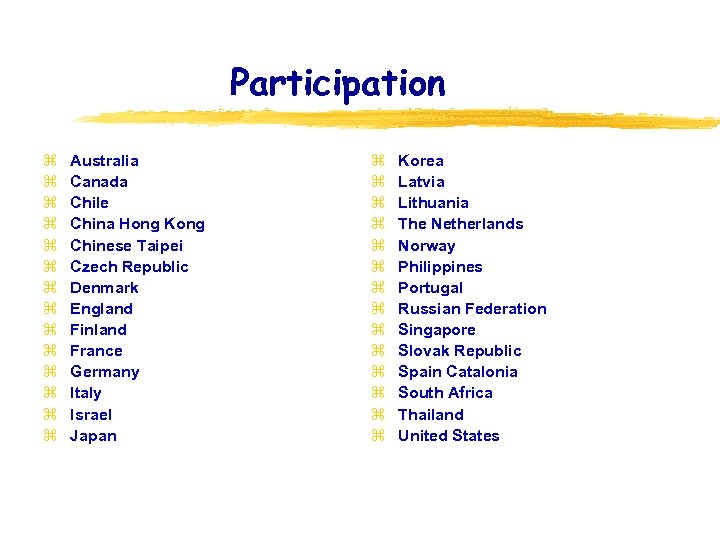 Participation z z z z Australia Canada Chile China Hong Kong Chinese Taipei Czech Republic Denmark England Finland France Germany Italy Israel Japan z z z z Korea Latvia Lithuania The Netherlands Norway Philippines Portugal Russian Federation Singapore Slovak Republic Spain Catalonia South Africa Thailand United States
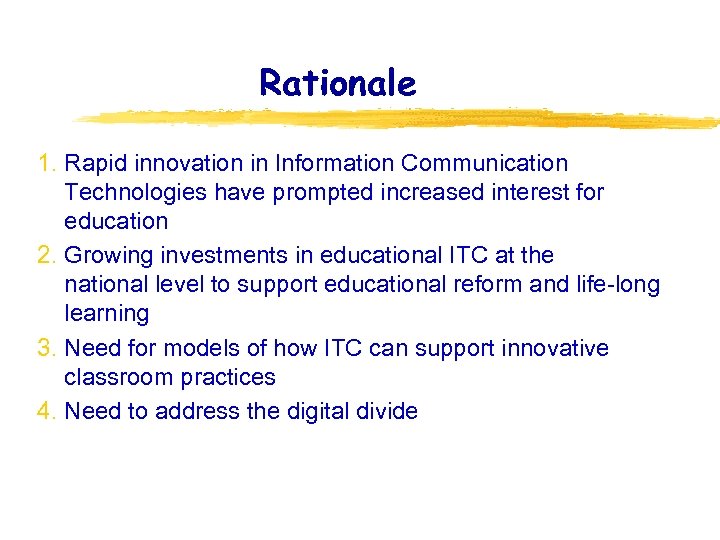 Rationale 1. Rapid innovation in Information Communication Technologies have prompted increased interest for education 2. Growing investments in educational ITC at the national level to support educational reform and life-long learning 3. Need for models of how ITC can support innovative classroom practices 4. Need to address the digital divide
 Builds on SITES M 1 § Survey of principals and technology coordinators in a random sample of schools in 23 countries. § Findings § § Increase in computer—student ratio Increase in classroom access to the internet Emerging paradigm of innovative pedagogical practices Supported by ICT
 SITES M 2 Goals § To identify and describe innovative pedagogical practices that use technology (IPPUTs) § To inform policies related to educational ICT § To provide teachers with information that they can use to improve classroom practices. § To add to the knowledge about the factors that contribute to the successful use of innovative technology -based practices.
 Feeds into SITES M 3 1. Survey of principals, technology coordinators, teachers, and students related to ICT resources and use 2. ICT-based performance assessment of students 1. ICT skills 2. Use of these skills to solve problems in science and math 3. Examine the role of ICT in changing what it is that students are learning. What new skills and knowledge is enabled by ICT? 3. Schedule 2002 -2006
 Goals of Coordinating the SITES & OECD Studies § Create complementary purposes for the studies § Maximize the number of countries that might participate in both studies § Minimize the conflict and redundancy between the studies
 Example SITES M 2 Research Questions § What are the innovative pedagogical practices in which teachers use ICT? § Which national and school policies related to staff development, Internet access, etc. are potentially effective in supporting these innovations? § How do these practices change what teachers and students do in the classroom? § What impact do these practices have on student outcomes? How have they changed the way outcomes are assessed?
 Conceptual Framework § Innovative pedagogical practices; changes in: § Curricular content § Teacher & student practices § Ways of using ICT § Outcomes and assessment § Context § Micro level § Meso level § Macro level
 Study Design 1. Each country formed a national panel 2. The panel reviewed international criteria and proposed modifications, if appropriate 3. They applied the criteria and select up to 12 cases—a total of 174 cases. 4. NRCs used standard protocols and instruments to collect data and write case reports 5. ICC is conducting cross-case analysis and write international report
 Criteria for Selecting Cases § Significant changes in teacher and student roles or activities; curriculum goals, content or assessment § Technology plays an essential role § Measurable student outcomes § Sustainable & transferable § Innovative, as locally defined
 Quality Monitoring § Coordinate conceptual framework, research questions, & instruments § ICC pre-pilot test instruments § Qualitative technical consultant who reviewed instruments and analytic approach § NRC pilot test revised instruments § ICC monitored panel formation, criteria modification, case selection, pilot studies, and case studies § NRCs exchanged 1 case report with other NRC critical friend & ICC § ICT-based coordination
 Data Analysis Plan Mixed Qualitative and Quantitative Approach § Level 1: § High level coding of cases based on conceptual framework § Analysis of trends among cases § Level 2: § Identification of cases that typify trends § Detailed coding within selected cases § Analysis of details of trends and relationships
 Schedule October 2001: Countries completed data collection & case write up Oct 2001 -January 2002: ICC Level 1 analysis Feb- June 2002: Level 2 analysis & report writing July-December 2002: Dissemination
 Reporting and Dissemination International: § § § brochure project report press release & conference website conference presentations National dissemination plans § national reports § national websites § Other material (video)s and events?
 SITES M 2 Website URL: sitesm 2. org